Depression rates increase precipitously in adolescence, coinciding with the emergence of a host of interpersonal challenges (Rudolph, Reference Rudolph, Gotlib and Hammen2009). For example, during this period, youth often first begin to form romantic relationships, introducing an unfamiliar interpersonal milieu that, although developmentally normative, is often turbulent and emotionally taxing (see Furman, Brown, & Feiring, Reference Furman, Brown and Feiring1999). Researchers have explored whether the adolescent depression surge directly relates to the debut of romantic behaviors, showing that adolescents in romantic relationships report higher depression levels (reviewed by Davila, Reference Davila2008). To better understand this linkage, more research is needed to identify multilevel factors that amplify the association between adolescent dating and psychological distress, including genetic markers of vulnerability. The current study examines the role of the serotonin transporter gene in moderating the longitudinal relationship between adolescent romantic involvement and depressive symptoms.
Adolescent Romantic Involvement and Depression
Although romantic relationships are believed to protect against depression among adults (Umberson & Williams, Reference Umberson, Williams, Aneshensel and Phelan1999), a link between adolescent romantic involvement and increased depressive symptoms, both cross-sectionally and longitudinally, has been documented across numerous adolescent samples, with varying sociodemographic backgrounds, clinical characteristics, and specific age groups (Compian, Gowen, & Hayward, Reference Compian, Gowen and Hayward2004; Davila, Steinberg, Kachadourian, Cobb, & Fincham, Reference Davila, Steinberg, Kachadourian, Cobb and Fincham2004; Davila et al., Reference Davila, Stroud, Starr, Miller, Yoneda and Hershenberg2009; Hou et al., Reference Hou, Natsuaki, Zhang, Guo, Huang, Wang and Chen2013; Joyner & Udry, Reference Joyner and Udry2000; Natsuaki, Biehl, & Ge, Reference Natsuaki, Biehl and Ge2009; Starr, Donenberg, & Emerson, Reference Starr, Donenberg and Emerson2012; Stroud, Norkett, Edwards, & Greiter, Reference Stroud, Norkett, Edwards and Greiter2014; Zimmer-Gembeck, Siebenbruner, & Collins, Reference Zimmer-Gembeck, Siebenbruner and Collins2001), leading some to describe it as “a trend that cannot be denied” (Davila, Reference Davila2008, p. 26). Although adolescent romance is statistically normative and contributes to the acquisition of developmentally important skills, evidence suggests that it provides a context for negative emotional consequences to develop among vulnerable individuals.
In her stress and coping model, Davila (Reference Davila2008) suggests that adolescent romantic relationships are associated with depression because they expose youth to stressful or challenging circumstances for which many have yet to develop adequate coping resources. Teen dating typically involves some exposure to stressful circumstances that occur within the romantic relationship (conflict, break-ups, etc.), and this may be especially true among adolescents at elevated depression risk, who are more likely to generate interpersonal stress (Adrian & Hammen, Reference Adrian and Hammen1993). Further, adolescent romantic involvement may distract at-risk youth from engaging fully in developmentally salient tasks, such as developing adaptive peer relations and navigating shifting family dynamics, and may contribute to overreliance on pseudomature behaviors to gain social status and self-esteem (Allen, Schad, Oudekerk, & Chango, Reference Allen, Schad, Oudekerk and Chango2014; Davila, Reference Davila2008). Both of these factors, in combination with other vulnerabilities, could contribute to problems that persist and accumulate over time; for example, dyadic dating during or before midadolescence is associated with family conflict, early sexual debut, externalizing problems, susceptibility to negative peer influences, threats to peer systems and friendships, and poor social adaption (Armour & Haynie, Reference Armour and Haynie2007; Connolly, Nguyen, Pepler, Craig, & Jiang, Reference Connolly, Nguyen, Pepler, Craig and Jiang2013; Dowdy & Kliewer, Reference Dowdy and Kliewer1998; Kreager & Haynie, Reference Kreager and Haynie2011; Zimmer-Gembeck, Reference Zimmer-Gembeck2002; Zimmer-Gembeck et al., Reference Zimmer-Gembeck, Siebenbruner and Collins2001). Thus, youthful dating may place some adolescents on a trajectory in which they are continually exposed to higher levels of chronic stress, which may in turn lead to dysphoria, perhaps especially in those who are already at risk for depression because of preexisting vulnerability factors.
If romantic relationships lead to depression because they expose vulnerable adolescents to stressful circumstances, then adolescents who are more stress reactive are likely most at risk for depression following romantic involvement. Although this question has not been directly tested, individual differences in stress management styles or resources (e.g., preoccupied relational style, corumination, and availability of parental support) have been shown to moderate the association between adolescent romantic involvement and depressive symptoms (Davila et al., Reference Davila, Steinberg, Kachadourian, Cobb and Fincham2004; Doyle, Brendgen, Markiewicz, & Kamkar, Reference Doyle, Brendgen, Markiewicz and Kamkar2003; Starr & Davila, Reference Starr and Davila2009; Steinberg & Davila, Reference Steinberg and Davila2008). Examining whether biomarkers of environmental sensitivity also predict depressive susceptibility to romantic involvement would provide a stronger test of the role of stress reactivity, as well as the underlying stress and coping model, providing a more thorough understanding of the multilevel factors that contribute to the development of depression risk over the course of adolescence.
Genetic Contributions to Association Between Adolescent Romantic Involvement and Depressive Symptoms
No research to date has explored the role of specific candidate genes that may increase vulnerability to depressive symptoms following romantic involvement, although twin and sibling comparison studies suggest that common genetic factors may account for associations between romantic functioning and depression in adolescents and adults (Mendle, Ferrero, Moore, & Harden, Reference Mendle, Ferrero, Moore and Harden2013; South & Krueger, Reference South and Krueger2008; Spotts et al., Reference Spotts, Neiderhiser, Ganiban, Reiss, Lichtenstein and Hansson2004, Reference Spotts, Pederson, Neiderhiser, Reiss, Lichtenstein and Hansson2005). The current study examines molecular genetic moderation of the longitudinal association between romantic involvement and depressive symptoms in adolescence, specifically by a polymorphism in the serotonin transporter linked polymorphic region gene (5-HTTLPR). The 5-HTTLPR short allele is associated with less efficient transcription and reuptake of serotonin and has been meta-analytically associated with depressive responses to environmental stress (Karg, Burmeister, Shedden, & Sen, Reference Karg, Burmeister, Shedden and Sen2011). Recent research suggests that the short allele may specifically confer sensitivity to interpersonal contexts and stressors (Vrshek-Schallhorn et al., Reference Vrshek-Schallhorn, Mineka, Zinbarg, Craske, Griffith and Sutton2014; Way & Taylor, Reference Way and Taylor2010). Furthermore, the short allele has also been linked to the generation of interpersonal stressors (Starr, Hammen, Brennan, & Najman, Reference Starr, Hammen, Brennan and Najman2012), and adolescent romantic relationships may provide a context conducive to stress generation. Thus, short-allele carriers may both experience more stressors associated with romantic involvement and show greater reactivity to these stressors, and these two factors may collectively leave them more vulnerable to depression following early relationships.
If short-allele carriers are indeed more susceptible to depressive outcomes following adolescent romantic involvement, an important next step will be to identify mechanisms and moderators of this effect. We tested two additional models to further probe the potential role of environmental stress. First, we examined whether chronic stress contributed to an increased susceptibility to depression following adolescent romantic involvement among short carriers. As described previously, adolescent romantic relationships may introduce youth to higher levels of chronic stress across multiple areas of functioning, which may in turn spur depressive symptoms. Short-allele carriers may be more vulnerable to this process in two ways: they may be more likely to generate or select into the stressful consequences of romantic involvement (Starr, Hammen, et al., 2012) and more reactive to chronic stress once it occurs (Hammen, Brennan, Keenan-Miller, Hazel, & Najman, Reference Hammen, Brennan, Keenan-Miller, Hazel and Najman2010; Jenness, Hankin, Abela, Young, & Smolen, Reference Jenness, Hankin, Abela, Young and Smolen2011; Starr, Hammen, Conway, Raposa, & Brennan, Reference Starr, Hammen, Conway, Raposa and Brennan2014). To test this explanatory model, we applied conditional process analysis (a versatile adaption of moderated mediation/mediated moderation; Hayes, Reference Hayes2013) to examine whether chronic stress functioned as a moderated mediator of the association between romantic involvement and later depression (with the short allele predicting greater indirect effects) via stronger associations for short-allele carriers between (a) romantic involvement and later chronic stress and (b) chronic stress and depressive symptoms.
Second, we examined whether romantically involved short-allele carriers are particularly susceptible to depression when they are also experiencing high family discord. Studies have suggested that romantic behaviors and depressive symptoms are more closely linked among adolescents with higher levels of familial chronic stress (Doyle et al., Reference Doyle, Brendgen, Markiewicz and Kamkar2003; Steinberg & Davila, Reference Steinberg and Davila2008). Several possible mechanisms may account for this effect, and there are reasons to believe they may be especially applicable to short-allele carriers. First, teens with discordant families may recreate problematic relationship patterns learned at home, resulting in stressful romantic relationships. Family dysfunction predicts both early dating and problematic behaviors within romantic relationships (Cavanagh, Crissey, & Raley, Reference Cavanagh, Crissey and Raley2008; Collins, Reference Collins2003; de Graaf, van de Schoot, Woertman, Hawk, & Meeus, Reference de Graaf, van de Schoot, Woertman, Hawk and Meeus2012; Dowdy & Kliewer, Reference Dowdy and Kliewer1998; Katz, Hammen, & Brennan, Reference Katz, Hammen and Brennan2013; Linder, Crick, & Collins, Reference Linder, Crick and Collins2002), suggesting that stressors occurring within the family sphere may influence what takes place within the romantic sphere. Short-allele carriers may be particularly sensitive to the transfer of family discord to their romantic relationships, as a recent study suggested that the association between parental hostility and romantic quality is highest among carriers of plasticity-linked alleles, including the 5-HTTLPR short allele (Masarik et al., Reference Masarik, Conger, Donnellan, Stallings, Martin and Schofield2014). In turn, short carriers may be more reactive to the resulting stress. In addition, teens from discordant families may receive more limited parental support or guidance, making it more difficult to navigate romantic problems. Short-allele carriers display higher sensitivity to the absence of social support (Kaufman et al., Reference Kaufman, Yang, Douglas-Palumberi, Houshyar, Lipschitz and Krystal2004; Kilpatrick et al., Reference Kilpatrick, Koenen, Ruggiero, Acierno, Galea and Resnick2007), as well as greater depressive reactivity to family chronic stress in general (Hammen et al., Reference Hammen, Brennan, Keenan-Miller, Hazel and Najman2010; Jenness et al., Reference Jenness, Hankin, Abela, Young and Smolen2011; Vrshek-Schallhorn et al., Reference Vrshek-Schallhorn, Mineka, Zinbarg, Craske, Griffith and Sutton2014). Thus, the combination of short-allele presence and family discord may transform adolescent romantic involvement into a more difficult experience that is linked to depression risk.
We tested the hypotheses outlined above in a subsample of a birth cohort study, overrecruited for maternal depression, in which adolescents were assessed at ages 15 and 20. This follow-up period allowed us to examine whether adolescent romantic involvement continues to influence mental health outcomes into young adulthood among genetically vulnerable individuals, in line with the notion that early dating has the potential to influence long-term trajectories for those with certain risk factors. In examining these hypotheses, we considered the potential contributions of two important variables, pubertal timing and gender. Early-maturing teens are more susceptible to depression and may be more likely to initiate romantic relationships at early ages (see Stroud & Davila, Reference Stroud and Davila2008). In addition, some studies suggest that the effects of both 5-HTTLPR and adolescent romantic involvement on depression may be stronger for girls than boys (Hammen et al., Reference Hammen, Brennan, Keenan-Miller, Hazel and Najman2010; Joyner & Udry, Reference Joyner and Udry2000; Wüst et al., Reference Wüst, Kumsta, Treutlein, Frank, Entringer and Schulze2009). Girls are also more reactive to interpersonal stress and are more prone to interpersonal stress generation beginning in adolescence (Rudolph & Hammen, Reference Rudolph and Hammen1999). As a consequence, we tested gender and pubertal status as control variables and examined moderating effects of gender.
Method
Participants
Adolescents were drawn from a large birth cohort study, the Mater University Study of Pregnancy (MUSP), which followed children born between 1981 and 1984 at the Mater Misericordiae Mother's Hospital in Brisbane, Australia (Keeping et al., Reference Keeping, Najman, Morrison, Western, Anderson and Williams1989). When offspring reached age 15, they were recruited into a follow-up study. Research staff preferentially selected youth whose mothers self-reported elevated depressive symptoms to produce a sample with an overrepresentation of depression risk. A total of 815 adolescents (403 female) and their caregivers took part in the age 15 assessment. Of these, 705 youth (363 female) participated in a follow-up at age 20 (for details, see Keenan-Miller, Hammen, & Brennan, Reference Keenan-Miller, Hammen and Brennan2007). Youth participating in the age 20 follow-up were contacted again between ages 22 and 25 and asked to provide a blood sample for DNA, and 512 participants chose to do so (youth providing samples were more likely to be female, χ2 = 21.29, p < .001, but otherwise did not differ from nonparticipating individuals on demographic or depression variables). For practical and budgetary reasons, genotyping for 5-HTTLPR was limited to a single plating of 384 samples selected randomly from the genotyped sample, and of those, three readings were invalid, leaving a final sample of 381 participants. Of these, 232 were female and 95% reported Caucasian ancestry. Other reported racial groups included Asian Australian (3.5%), Maori/Islander (1%), and Australian Aborigine (0.5%); racial group was not associated with genotype. In the current study, analyses that include 5-HTTLPR genotype reflect this sample size, but those that do not involve genotype use the full available sample.
Procedure
At the age 15 assessment, youth and their mothers (and fathers where possible) provided consent/assent, completed a battery of questionnaires, and separately participated in interviews. Similar procedures were followed at the age 20 follow-up. At the time of the DNA collection follow-up, participants were mailed consent forms and blood collection kits. Local facilities drew blood samples and sent them to the laboratory by courier. The Genetic Epidemiological Laboratory of the Queensland Institute of Medical Research conducted genotyping analyses. The institutional review boards of the University of Queensland, Emory University, and the University of California, Los Angeles, approved all research procedures.
Measures
Depressive symptoms
The Beck Depression Inventory—II (Beck, Steer, & Brown, Reference Beck, Steer and Brown1996), a widely used instrument assessing depressive symptoms, was administered at ages 15 and 20. It has repeatedly demonstrated excellent psychometric properties, including reliability, validity, and sensitivity and specificity for depression detection within community samples (Beck, Steer, & Garbin, Reference Beck, Steer and Garbin1988; Lasa, Ayuso-Mateos, Vazquez-Barquero, Diez-Manrique, & Dowrick, Reference Lasa, Ayuso-Mateos, Vazquez-Barquero, Diez-Manrique and Dowrick2000). The Cronbach α value in this sample was 0.92 at both follow-up assessments.
Chronic stress
The UCLA Chronic Stress Interview (CSI; Hammen et al., Reference Hammen, Adrian, Gordon, Burge, Jaenicke and Hiroto1987), a semistructured interview adapted for use with late adolescents (Hammen & Brennan, Reference Hammen and Brennan2001), was administered at age 20 to generate chronic stress scores across multiple developmentally appropriate domains, including social life, close friendships, romantic activities (relationships and interest), family relations, finances, work, academic activity, and health of self and of close family members. Scores based on objective features of individual domains ranged from 1 (superior functioning) to 5 (severe difficulties), and were summed for a total score. Interviews were administered by trained graduate students, with an intraclass reliability of 0.81.
Family discord
We computed a composite variable of family discord at age 15 using the same procedures reported by Hammen et al. (Reference Hammen, Brennan, Keenan-Miller, Hazel and Najman2010). It included 11 measures reported by multiple informants and assessing diverse aspects of family functioning at youth age. Of the 11 measures, 3 were interview-assessed ratings from the mother and adolescent versions of the CSI (Hammen et al., Reference Hammen, Adrian, Gordon, Burge, Jaenicke and Hiroto1987), including mother-reported quality of relationships with her romantic partner and with the target child, and youth-reported quality of relationships with family members. In addition, mothers and (when available) fathers completed two questionnaires each on qualities of their marital relationship: the satisfaction subscale of the Dyadic Adjustment Scale (Spanier, Reference Spanier1976) and the Modified Conflict Tactics Scale (assessing psychological or physical coercion; Pan, Neidig, & O'Leary, Reference Pan, Neidig and O'Leary1994). Finally, for each parent, youth completed two self-reported measures assessing quality of interactions, including the parental acceptance versus rejection subscale and psychological control versus psychological autonomy subscale of the revised Children's Report of Parental Behavior Inventory (Schludermann & Schludermann, Reference Schludermann and Schludermann1988). We standardized each of these 11 scores using the full sample and averaged them to form a composite family discord score (high scores reflect high discord). Scores range from –1.25 to 1.99 (M = –0.01, SD = 0.57), and the Cronbach α was 0.78 (see Hammen et al., Reference Hammen, Brennan, Keenan-Miller, Hazel and Najman2010).
Romantic involvement
Dating status at age 15 was assessed as part of the CSI by interviewers as part of the CSI protocol (“Do you have a steady romantic partner?” Hammen et al., Reference Hammen, Adrian, Gordon, Burge, Jaenicke and Hiroto1987). Research staff reviewed interviewer notes and were able to clearly identify current relationship status in 98.4% of cases. Dating status reflects involvement in a romantic relationship at the time of interview. In the full age 15 sample, 172 reported a current relationship and 631 reported no current relationship; within the genotyped sample, 19% were in relationships at age 15. At age 20, relationship status was coded by CSI interviewers to reflect involvement within the 6-month period preceding the assessment interview. Across the full sample, 66.3% reported romantic involvement in the previous 6 months; of these, 81% were exclusive relationships of 3 months or longer and 19% included only casual dating relationships. Duration of these relationships ranged from 0.25 to 108 months and averaged 21.37 months (SD = 17.95).
Pubertal timing
As part of the larger MUSP study, participants reported on pubertal stage at an assessment conducted at age 14 using the Tanner drawings of five stages of pubertal development, including the genital (boys), breast (girls), and pubic hair (both genders) maturation scales (Morris & Udry, Reference Morris and Udry1980; Tanner, Reference Tanner1962; see Najman et al., Reference Najman, Hayatbakhsh, McGee, Bor, O'Callaghan and Williams2009 for scale administration details). The mean of these two scales was taken for each participant and regressed on chronological age in months at the time of assessment (separate regressions were conducted for males and females). The residual variable was saved as an index of pubertal timing relative to same-sex participants within this sample.
Genotyping
Blood samples were genotyped using agarose gel analysis of polymerase chain reaction products spanning the central portion of the repeats in the 5-HTTLPR. The polymerase chain reaction utilized Qiagen enzyme and buffer, with 30% deazaguanine and with 10 cycles of Touchdown protocol beginning at 67 °C and finishing at 62 °C with a further 32 cycles. Samples were subject to independent duplicate polymerase chain reaction with primer set 1 (acgttggatgTCCTG CATCCCCCAT, acgttggatgGCAGGGGGGATACTGCGA, lower case sequence is nontemplated) that gave products of 198 and 154 base pairs for long and short versions, respectively, and primer set 2 (acgttggatgTCCTGCATCC CCCAT, acgttggatgGGGGATGCTGGAAGGGC) for products of 127 and 83 base pairs. Gel analyses were conducted in triplicate for most samples. At least two matching independent results were required for inclusion. Final call rate was 96.4%. To estimate accuracy, separate from the current study, duplicate samples were genotyped for 764 individuals in a separate study conducted within the same laboratory following above procedures, with discordance rates of 0.45%.
These procedures produced a genotype frequency as follows: long/long (L/L) = 122 (32%), short/long (S/L) = 178 (47%), and short/short (S/S) = 81 (21%), with proportions in Hardy–Weinberg equilibrium, χ2 (1, 381) = 1.61, p = .20. Because research suggests that the long A (LA) and long G (LG) variants of the long allele are functionally more similar to short alleles (Wendland, Martin, Kruse, Lesch, & Murphy, Reference Wendland, Martin, Kruse, Lesch and Murphy2006), following common procedures we reclassified these forms as short alleles, leading to a final genotype distribution of L/L = 101 (27%), S/L = 189 (50%), and S/S = 91 (24%). In light of recent nonreplications of Wendland et al.'s (2006) findings (Martin, Cleak, Willis-Owen, Flint, & Shifman, Reference Martin, Cleak, Willis-Owen, Flint and Shifman2007; Philibert et al., Reference Philibert, Sandhu, Hollenbeck, Gunter, Adams and Madan2008), we also reconducted all major analyses using original, nonadjusted genotypes. All findings were replicated. Note that we are unaware of the existence of rare variants (e.g., XL, VL; Gelernter, Kranzler, & Cubells, Reference Gelernter, Kranzler and Cubells1997) in this sample. In line with other studies that have supported an additive genetic model (Beevers, Scott, McGeary, & McGeary, Reference Beevers, Scott, McGeary and McGeary2009; Bertolino et al., Reference Bertolino, Arciero, Rubino, Latorre, De Candia and Mazzola2005; Caspi et al., Reference Caspi, Sugden, Moffitt, Taylor, Craig and Harrington2003; Fergusson, Horwood, Miller, & Kennedy, Reference Fergusson, Horwood, Miller and Kennedy2011; Starr et al., Reference Starr, Hammen, Conway, Raposa and Brennan2014; Uher et al., Reference Uher, Caspi, Houts, Sugden, Williams and Poulton2011), in primary analyses we treated genotype as a continuous variable reflecting short-allele count (L/L = 0, S/L = 1, S/S = 2). Major results did not differ when an alternative, short-dominant genetic model (L/L vs. S/L or S/S) was used except where noted.
Genotype was unrelated to racial background (as indicated by self-reported maternal race). To control for the effects of population stratification, all genetic analyses were repeated, restricting the sample to those with European maternal ancestry, with no changes in significance or pattern. Similar results were also obtained when including race as a covariate (Caucasian vs. other).
Results
Main effects
Youth in romantic relationships at age 15 reported higher depressive symptoms than those not in romantic relationships at age 15, t (248.58) = –2.23, p = .027), but not at age 20, t (626) = –0.60, p = .548). Looking at longitudinal main effects, across the full sample there were no significant associations for age 15 romantic involvement predicting age 20 depressive symptoms (controlling for baseline symptoms, Beta = 0.04, p = .275). Family discord was associated with age 15 depressive symptoms (r = .32, p < .001) and romantic involvement, t (247.78) = –3.18, p = .002, and predicted increases in depressive symptoms at age 20, controlling for age 15 depressive symptoms (Beta = 0.20, p < .001). There were no main effects of genotype on any study variables (all ps > .05).
Genetic moderation: The association between age 15 romantic involvement and age 20 depressive symptoms
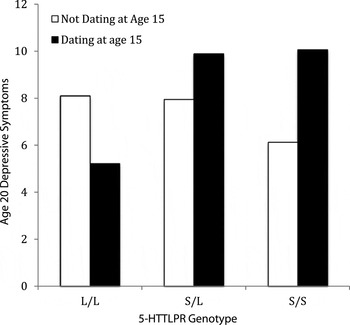
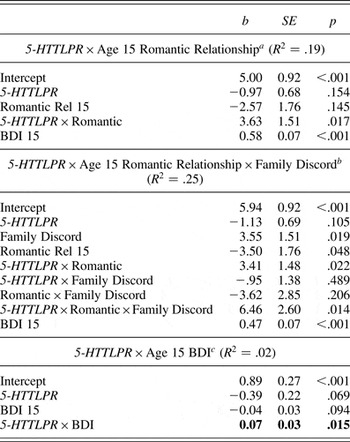
Moderation of the prospective depressive consequences of romantic involvement by 5-HTTLPR genotype was evaluated in a linear regression equation, which included the main effects of age 15 romantic relationship status and number of short alleles and their interaction, with age 15 depressive symptoms entered as a covariate. As displayed in Table 1, the interaction term was significant (p < .05). To probe this interaction, conditional effects of romantic involvement on later depressive symptoms were assessed by genotype using the PROCESS macro for SPSS (Hayes, Reference Hayes2013), a versatile application that conducts moderation, mediation, and conditional process analyses. For moderation analyses, PROCESS automatically generates simple slope test results at selected levels of the moderator. For S/S genotypes, early romantic involvement predicted significant increases in depression over time (b = 4.68, SE = 2.01, p = .021). In contrast, for other genotypes romantic involvement at age 15 was a nonsignificant predictor of changes in depressive symptoms (L/L b = –2.57, SE = 1.76, p = .144; S/L b = 1.06, SE = 1.15, p = .357). The interaction is illustrated in Figure 1. The results were unchanged when controlling for gender or pubertal status. There was also no moderation of results by gender.
Age 20 depressive symptoms by age 15 dating status and 5-HTTLPR genotype, controlling for age 15 depressive symptoms.

Regression results for genetic moderation analyses of the bidirectional association between romantic involvement and depression
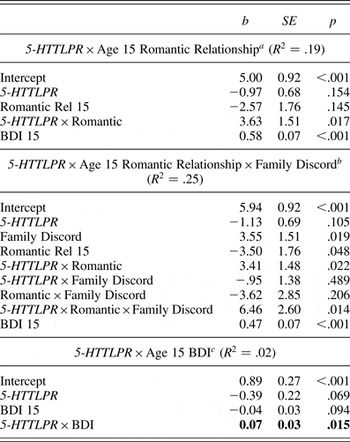
a Outcome = age 20 BDI.
b Outcome = age 20 BDI.
c Outcome = age 20 romantic involvement.
Chronic stress as a mediator of the association between age 15 romantic involvement and age 20 depressive symptoms, moderated by genotype
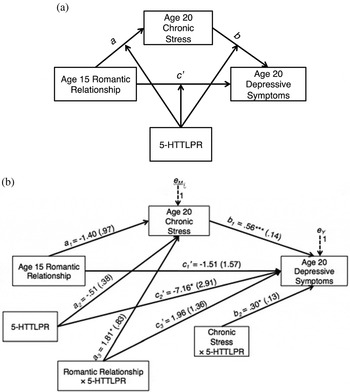
We next examined whether the association between romantic involvement and later depressive symptoms among S/S genotypes would be mediated by chronic stress, based on the hypothesis that the short allele would predict stronger associations between age 15 romantic involvement and age 20 chronic stress and between chronic stress and depressive symptoms. We conducted conditional process analyses using the PROCESS macro for SPSS (Hayes, Reference Hayes2013). These techniques are functionally equivalent to moderated mediation but provide more flexible output, allowing for interpretation according to mediator or moderator. The PROCESS macro uses bootstrapping methods (5,000 resamples) to estimate 95% confidence intervals (CI) for indirect effects at each level of the moderator. We expected that 5-HTTLPR genotype would moderate all three mediational pathways, the a path (romantic involvement predicting chronic stress), b path (chronic stress predicting depressive symptoms), and c path (romantic involvement predicting depression) and thus specified Model 59 in the PROCESS macro (see PROCESS templates; Hayes, Reference Hayes2013). This model tests whether chronic stress differentially mediates the effect of romantic involvement on depressive symptoms by genotype. The conceptual model is illustrated in Figure 2a. Age 15 depressive symptoms were included as a covariate.
(a) Conceptual and (b) statistical diagrams for conditional process analysis, where the indirect effect of age 15 romantic relationship on age 20 depressive symptoms through chronic stress is moderated by 5-HTTLPR short allele count. In the statistical diagram, unstandardized coefficients (standard errors) for all main effects and interactions are included in each pathway. In this model, the 5-HTTLPR genotype moderates all three mediational pathways: the a path (romantic involvement predicting chronic stress), b path (chronic stress predicting depressive symptoms), and c path (romantic involvement predicting depression). Age 15 depressive symptoms were included in the model as a covariate but are not represented in diagrams for simplicity. *p < .05, **p < .01, ***p < .001.

The results are included in the statistical diagram in Figure 2b. As predicted, 5-HTTLPR short-allele count significantly modified both a and b pathways. In both cases, effects were strongest for short homozygotes. The indirect effect was significant (i.e., CI did not include zero) for short-allele carriers, estimate = 2.58, boot SE = 1.18, 95% CI = (0.64, 5.42), but not for S/L, 95% CI = (–0.69, 1.44), or L/L, 95% CI = (–2.30, 0.32). Conditional direct effects revealed that when controlling for chronic stress, romantic involvement no longer predicted later depressive symptoms for any genotype (including S/S; direct effect = 2.40, SE = 1.82, p = .188), supporting full mediation among S/S genotypes. The results suggest that the indirect effect of romantic involvement on depressive symptoms via chronic stress varies significantly by genotype. Controlling for gender did not modify results.
Three-way interaction among 5-HTTLPR genotype, age 15 romantic involvement, and family discord to predict age 20 depression symptoms
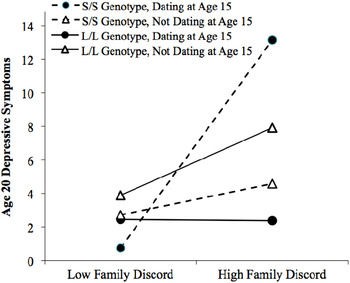
We next examined whether the Gene × Romantic Involvement interaction, predicting prospective changes in depressive symptoms, was intensified under conditions of high family discord. Age 20 depressive symptoms were regressed on three-way interaction between number of short alleles, age 15 dating status, and family discord, in addition to all component main effects and two-way interactions, with age 15 depressive symptoms entered as a covariate. The results are displayed in Table 1 and presented graphically in Figure 3. The three-way interaction term was significant (p < .05). Conditional effects were again evaluated using the PROCESS macro (Hayes, Reference Hayes2013). Family discord magnified the effect of romantic involvement on prospective increases in depressive symptoms for short homozygotes (p = .005) but not long homozygotes (p = .209) and only marginally for heterozygotes (p = .086). Among all genotypes, romantic involvement did not predict changes in depressive symptoms among those with low family discord. However, at high levels of family discord, we observed different patterns by genotype: Age 15 romantic involvement predicted increases in age 20 depressive symptoms among S/S genotypes (B = 5.97, SE = 2.17, p = .006), decreases in depressive symptoms over time among long homozygotes (B = –4.53, SE = 1.85, p = .015), and no significant changes in depressive symptoms among heterozygotes (p > .05). The results were replicated when controlling for gender and pubertal timing (gender moderation was not examined because tests of four-way interactions would have been underpowered in this sample). Note that this finding was not replicated using a short-dominant dichotomous rather than additive genetic model (p = .258).
(Color online) Illustration of three-way interaction among age 15 dating status, family discord, and 5-HTTLPR genotype. The four lines represent regression functions computed for short versus long homozygotes who were dating versus not dating at age 15. Heterozygotes are excluded from this graph. Age 15 depressive symptoms were included as a covariate.

Discussion
We tested genetic moderation of the prospective association between adolescent romantic involvement and depressive symptoms by the 5-HTTLPR polymorphism. Supporting our hypotheses, the short allele predicted stronger longitudinal associations between romantic involvement and depressive symptoms. The results further suggested that the increased susceptibility of short carriers to depression following romantic involvement may be mediated by chronic stress and intensified by high family discord. Taken together, findings suggest that the link between adolescent involvement and depression may be best understood within the greater context of environmental and biological contributors to depression risk.
First, results suggest that, although adolescent romantic involvement may be a positive and protective experience for some youth (e.g., long homozygotes with discordant families), for a subgroup of adolescents with preexisting vulnerabilities, including carriers of the 5-HTTLPR short allele, adolescent romantic involvement may set a path toward depressive outcomes. Previous research has suggested that the short allele promotes susceptibility to the social environment, including both the creation of and reaction to social stressors (Karg et al., Reference Karg, Burmeister, Shedden and Sen2011; Starr, Hammen, et al., Reference Starr, Hammen, Brennan and Najman2012; Starr, Hammen, Brennan, & Najman, Reference Starr, Hammen, Brennan and Najman2013), and adolescent romantic relationships may be an important context in which both of these processes occur. For example, short carriers may generate more stressful situations within their relationships (conflict, break-ups, etc.) and may in turn be more vulnerable to their effects.
In addition to challenges occurring within the relationships themselves, adolescent romantic involvement has the potential to introduce stressors in other spheres, to which the short allele may increase vulnerability. Although adolescent romantic experiences make important positive contributions to psychosocial development (Collins, Welsh, & Furman, Reference Collins, Welsh and Furman2009), dyadic relationships in early and midadolescence (before they are consistent with salient developmental tasks; e.g., Furman & Collibee, in press) have been associated with a range of problematic outcomes, including early sexual debut, externalizing behaviors, substance use, academic problems, deterioration of the parent–child relationship, and continued problems with romantic functioning (Connolly et al., Reference Connolly, Nguyen, Pepler, Craig and Jiang2013; Furman, Low, & Ho, Reference Furman, Low and Ho2009; Joyner & Udry, Reference Joyner and Udry2000; Madsen & Collins, Reference Madsen and Collins2011; Starr, Davila, et al., Reference Starr, Davila, Stroud, Li, Yoneda and Hershenberg2012; Starr, Donenberg, et al., Reference Starr, Donenberg and Emerson2012; Thomas & Hsiu, Reference Thomas and Hsiu1993; van Dulmen, Goncy, Haydon, & Collins, Reference van Dulmen, Goncy, Haydon and Collins2008). Thus, adolescent romantic involvement could potentially place some youth on a trajectory of behaviors that continually introduce stressful circumstances persisting beyond the original romantic relationship. Our results suggest that 5-HTTLPR genotype influences the degree to which romantic involvement predicts chronic stress 5 years later, as well as depressive reactivity to resulting stress. Analyses suggested that increased generation of and reactivity to chronic stress fully accounted for increased vulnerability to depression following romantic involvement among short homozygotes.
We also discovered a three-way interaction among 5-HTTLPR genotype, romantic involvement, and family discord, such that short carriers with high levels of family discord showed the most dramatic association between romantic involvement at age 15 and depression increases by age 20. It is interesting that other research has supported significant prediction of depression by two-way interactions between (a) family stress and romantic experiences (Steinberg & Davila, Reference Steinberg and Davila2008), (b) family stress and 5-HTTLPR genotype (Hammen et al., Reference Hammen, Brennan, Keenan-Miller, Hazel and Najman2010; Jenness et al., Reference Jenness, Hankin, Abela, Young and Smolen2011; Vrshek-Schallhorn et al., Reference Vrshek-Schallhorn, Mineka, Zinbarg, Craske, Griffith and Sutton2014), and (c) in the current study, romantic experiences and 5-HTTLPR genotype. It appears that the combination of all three of these factors produces particularly high risk for depression. Adolescent romantic involvement may be more difficult to manage without sufficient parental support and guidance, particularly among short carriers, who are sensitive to the absence of social support (Kaufman et al., Reference Kaufman, Yang, Douglas-Palumberi, Houshyar, Lipschitz and Krystal2004; Kilpatrick et al., Reference Kilpatrick, Koenen, Ruggiero, Acierno, Galea and Resnick2007). In addition, adolescents from highly discordant families may have more stressful romantic relationship experiences than do youth from more functional families. The capacity for intimate relationships develops as a function of the quality of early family experiences (Ackerman et al., Reference Ackerman, Kashy, Donnellan, Neppl, Lorenz and Conger2013; Bowlby, Reference Bowlby1980; Collins & Sroufe, Reference Collins, Sroufe, Furman, Brown and Feiring1999; Shulman, Elicker, & Sroufe, Reference Shulman, Elicker and Sroufe1994). Poor familial relationships disrupt youth attachment security, which amplifies the negative consequences of both romantic involvement and short-allele presence (Davila et al., Reference Davila, Steinberg, Kachadourian, Cobb and Fincham2004; Starr et al., Reference Starr, Hammen, Brennan and Najman2013). Short-allele carriers from discordant families may also recreate maladaptive relational behaviors learned at home within their romantic relationships (Masarik et al., Reference Masarik, Conger, Donnellan, Stallings, Martin and Schofield2014). In line with this notion, mother–child relationship discord longitudinally predicts romantic dissatisfaction, which in turn predicts depressive outcomes (Katz et al., Reference Katz, Hammen and Brennan2013). Thus, the combination of romantic involvement and family discord may be a potent predictor of the stress to which short carriers are then more sensitive.
Although this study largely focused on genetic moderation, we also highlight associations between romantic involvement and depressive symptoms in this sample, as they have rarely been examined in long-term longitudinal studies. There was a significant cross-sectional association at age 15, corresponding with previous studies (Davila, Reference Davila2008) but not at age 20, perhaps because the association between dating and deleterious outcomes weakens as romantic relationships become more developmentally salient (Furman & Collibee, in press). Further, the nature of romantic relationships changes markedly with development, with early relationships often motivated by infatuation and social status needs and later relationships more centered on commitment and intimacy (Connolly & McIsaac, Reference Connolly, McIsaac, Underwood and Rosen2011), so it is reasonable to expect that romantic involvement at these different ages would have different implications for mental health. We also found no evidence of longitudinal main effects, in contrast to several previous studies that have used shorter follow-up periods (e.g., Davila et al., Reference Davila, Stroud, Starr, Miller, Yoneda and Hershenberg2009; Joyner & Udry, Reference Joyner and Udry2000; Starr, Donenberg, et al., Reference Starr, Donenberg and Emerson2012). It is possible that romance-related dysphoria is typically relatively transitory, dissipating within 5 years, but can persist for individuals with certain risk factors (such as genetic vulnerability). Further, although 81% of our sample was not romantically involved at age 15, dating at this age is beginning to become more normative; we may have found more persistent effects of dating in a younger sample.
Our study offers several strengths, including a large sample with an overrepresentation of youth at elevated risk for the development of depression, longitudinally followed over a key developmental period spanning from midadolescence into the transition to adulthood. A few limitations should be addressed by future studies. As this study was not originally designed to assess romantic experiences, a limited scope of romantic behaviors was assessed. It would have been useful to examine a more thorough index of romantic behaviors and experiences and to evaluate lifetime romantic history at age 15. Existence of a relationship at age 15 was assessed based on interviewer judgment rather than an explicit set of objective criteria, which is not ideal as definitions of romantic relationships may markedly differ across individuals. We also did not assess sexual behavior, which has often been examined in prior research on depression and romantic involvement; in some studies (but not others; e.g., Davila et al., Reference Davila, Stroud, Starr, Miller, Yoneda and Hershenberg2009), sexual intercourse, especially casual sex, has better accounted for the association between romantic involvement and depressive symptoms (Grello, Welsh, Harper, & Dickson, Reference Grello, Welsh, Harper and Dickson2003; Mendle et al., Reference Mendle, Ferrero, Moore and Harden2013). We encourage future researchers to examine genetic moderation of associations between adolescent sexual behaviors and depression.
Nonetheless, our study makes an important contribution as the first examination of genetic moderation of the link between romantic involvement and depression (and to our knowledge, of any specific biological marker in relation to this association). Future research should build upon findings. First, replication of results is critical in Gene × Environment interaction research and will be an important next step. Larger samples would provide more substantial power, particularly for the detection of three-way interactions, including moderation by gender. Second, research should better define the mechanisms and intermediate phenotypes that explain short-allele related vulnerability, and these should be studied within the context of adolescent romantic relationships. Third, although 5-HTTLPR was a reasonable starting point as a candidate gene, other genes may also contribute, including single nucleotide polymorphisms associated with stress reactivity and interpersonal functioning (e.g., brain-derived neurotrophic factor [BDNF], corticotropin releasing hormone receptor 1 [CRHR1], FK506 binding protein 5 [FKBP5], oxytocin receptor [OXTR]).
It is interesting that recent research suggests that the short allele may predict positive outcomes under certain environmental conditions (Hankin et al., Reference Hankin, Nederhof, Oppenheimer, Jenness, Young and Abela2011; Pluess, Belsky, Way, & Taylor, Reference Pluess, Belsky, Way and Taylor2010; Starr et al., Reference Starr, Hammen, Brennan and Najman2013; Way & Taylor, Reference Way and Taylor2010). Likewise, adolescent romantic relationships set the stage for acquisition of lasting relationship skills and as such predict numerous facets of positive social functioning (Furman et al., Reference Furman, Brown and Feiring1999; Zimmer-Gembeck et al., Reference Zimmer-Gembeck, Siebenbruner and Collins2001). Although neither the short allele nor adolescent romantic involvement is fundamentally maladaptive, both are associated with depression under certain conditions. More research is needed to better understand what those circumstances are and how they can be targeted clinically.