Introduction
This article addresses concerns that candidates nominated because of gender quota laws will be less qualified. While questions of candidate quality have long been relevant to legislative behavior, quota laws, which require women to comprise a certain percentage of candidates for national office, have generated a new wave of interest. Gender quotas are often perceived to reduce the scope of political competition. Parliaments in 47 countries have adopted laws that require women to comprise a certain percentage of candidates for national office (International IDEA, 2013).Footnote 1 By putting gender identity center stage, quotas preclude the possibility that elections will be based on ‘ideas’ or ‘merit’ alone. Other electoral rules that restrict candidate selection, such as the centralization of candidate selection common in closed list PR systems, have been found to reduce the quality of candidates (Carey and Shugart, Reference Carroll1994; Gagliarducci et al., Reference Galasso and Nannicini2011), while rules that open up selection, such as primaries, result in higher quality candidates (Carey and Polga-Hecimovich, Reference Carey and Shugart2006; Hirano and Snyder, Reference Hirano and Snyder2013). We exploit the institutional design of Italy’s mixed electoral system in 1994, where quotas were applied only to the PR portion of the list (closed-list) to compare the qualifications of men, women, and ‘quota women’. Using data from a mixed electoral system allows us to determine whether women who were selected under a quota differ from those who were not. We estimate regressions on several measures of deputies’ qualifications for office. We include performance in office as a measure of candidate qualifications, exploiting available data to generate an ex post measure of qualifications.
We find that unlike other rules limiting candidate selection, quotas are not associated with lower quality on most measures of qualifications. On the contrary: quota women may have improved the overall level of qualifications. Quota women are 5% more likely to have local government experience than other representatives. Quota women show up for work more than their male counterparts: they attend legislative sessions 7% more than men elected to PR seats. Once the quota law was rescinded, quota women are less likely to be re-elected than non-quota women or men. To the extent that we regard re-election as a clean indicator of performance, this result is troubling as it might suggest that voters repudiated quota women. In Italy, however, it was not voters but party leaders who determined the re-election prospects of quota women. With the quota gone, party leaders buried female candidates deep on their electoral lists in 1996. Our results thus suggest that discrimination by party leaders – not qualifications – explains the lower numbers of women nominated for office once the quota was gone.
Theoretical background: who is qualified to run for office?
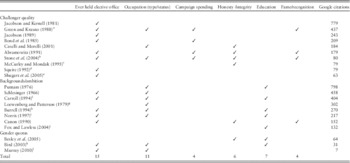
What does it mean to be qualified for political office? If an assembly is to be ‘an exact portrait of the people at large’, as American founding father John Adams urged, then everyone is equally capable of representing the people. Nonetheless, when critics suggest that gender quotas will result in the election of unqualified candidates, they have in mind a specific set of characteristics, many of which are captured by political science research. The literature on challenger quality, political ambition, and gender quotas offers a range of possible measures of qualifications. Our analysis takes these characteristics at face value; we offer a more critical perspective on qualifications in the conclusion. We developed our measures on the basis of empirical relevance (i.e., the concept of qualifications must be measurable and not only theoretical) and frequency of citation, as described in Table 1.
Identifying common formulations of qualifications for political office

a Green and Krasno also use ever running for elective office and political activism as measures of qualification.
b Stone et al. also include problem-solving ability, public speaking, dedication to public service, grasp of issues, and performance in office as measures of quality (all are survey-based).
c McCurley and Mondak also use a measure of perceived competence (survey-based).
d Squire also employs a measure of campaign skills, for example public speaking, derived from media reports.
e Shugart et al. also use birthplace in the district nominated as a measure of qualification.
f Carroll also measures party activity, organizational activity, and campaign resources/planning.
g Loewenberg and Patterson also include social class and interest group affiliations.
h Burrell also includes party and civic activity, marital status, and children.
i Norris also includes age, class, and ambition.
j Fox and Lawless consider a range of other personal characteristics, including political attitudes and experience, family responsibilities, and self-perceived qualifications.
k Bird also assesses family connections to politics, household income levels, age, children at home, and political party membership.
l Murray also includes age as a measure of qualification.
We found that the six most common formulations of qualifications are previous experience in elective office, occupational type or status, campaign spending, honesty or integrity, education, and fame or recognition. Of these, previous experience in elective office is the most prevalent by far. Political experience is sometimes seen as a proxy for many ‘good’ qualities, like charisma and campaign skills, which are demonstrated by virtue of the individual’s success in previous elections (Squire, Reference Squire1995). It can also be interpreted as an indicator of the candidate’s ability to perform the duties of office in the future, because those who have held office before are thought to accumulate practical skills and a relevant knowledge base (Carroll, Reference Caselli and Morelli1994).
Occupation and education are the next most common definitions of qualifications. The social backgrounds literature has found that legislators consistently have higher-status occupations and are better educated than the average citizen (Putnam, Reference Putnam1976). Educational credentials are frequently viewed as measures of competence for holding national office (Burrell, Reference Canon1994), and a high status occupation signifies success in the business, civic, or professional world that voters use as an indicator of future performance in office (Carroll, Reference Caselli and Morelli1994).
In this study we are interested in measuring both the characteristics that define ‘good’ candidates for legislative office, and the characteristics that define the behavior of ‘good’ legislators once they are in office. We follow recent literature in defining three characteristics of performance in office. The number of bills introduced is a basic and frequently used measure of legislator output (see Ferraz and Finan, Reference Fox and Lawless2008; Gagliarducci et al., Reference Gagliarducci, Nannicini and Naticchioni2008; Anzia and Berry, Reference Anzia and Berry2011). Legislators introduce bills to communicate their commitment on a particular issue to their constituents and to party leaders. Introducing no bills can be seen as an indicator of low quality, even if institutional constraints limit opportunities to do so. Another common indicator of legislator quality is absenteeism (see Gagliarducci et al., Reference Galasso and Nannicini2011; Galasso and Nannicini, Reference Guadagnini2011). Elected officials must show up for legislative sessions and vote in order to represent constituents effectively. Finally, re-election is perhaps the ultimate measure of legislator quality (see Diermeier et al., Reference Ferraz and Finan2005; Keane and Merlo, Reference Loewenberg and Patterson2007). According to our model, less qualified candidates introduce fewer bills, show up less frequently to work, and are re-elected less often than their non-quota peers. We explain how we operationalize these three measures of qualifications (previous political experience, occupation, and education) and three measures of quality in office (bills proposed, absenteeism, and re-election) in the Data and Methods section.
Research has established a strong link between the implementation of gender quotas and an increase in the percentage of women elected to office, contingent on how the quota is designed and how it interacts with the electoral system (Jones, Reference Jones and Navia1996, Reference Jones1998, Reference Jones2004; Jones and Navia, Reference Keane and Merlo1999; Meier, Reference Meier2004; Norris, Reference Norris2004; Schmidt and Saunders, Reference Schmidt and Saunders2004; Dahlerup and Freidenvall, Reference Ferrara2005; Squires, Reference Squires2005; Dahlerup, Reference Diermeier, Keane and Merlo2006; Matland, Reference Matland2006; Baldez, Reference Baldez2007; Tripp and Kang, Reference Tripp and Kang2008; Krook, Reference Meier2009; Schwindt-Bayer, Reference Schwindt-Bayer2009; Hughes, 2011). Research examining the impact of quotas on substantive representation focuses on the qualifications that candidates bring to office, their behavior in office, and attitudes toward various issues. Legislative quota policies often apply to all female candidates, so that all women elected effectively become ‘quota women’.
This study adds new dimensions to the growing literature on the impact of gender quotas by focusing on the impact of quotas on candidate qualifications and by examining the impact of quotas as distinct from gender. Most of the literature on the substantive effect of gender quotas reflects this, examining cases in which quotas apply to all of the female candidates and none of the men (Childs, Reference Cowley and Childs2002; Htun and Jones, Reference Htun and Jones2002; Bird, Reference Bird2003; Cowley and Childs, Reference Dahlerup and Freidenvall2003; Schwartz, Reference Schwartz2005; Sater, Reference Sater2007; Franceschet and Piscopo, Reference Gagliarducci, Nannicini and Naticchioni2008; Zetterberg, Reference Zetterberg2008; Júlio and Tavares, Reference King, Tomz and Wittenberg2010). These studies make it impossible to determine whether the observed effects derive from differences between men and women, or from the presence of a quota. We compare men to quota women and non-quota women, taking advantage of data from Italy’s mixed electoral system and a one-time application of gender quotas in the 1994 parliamentary elections. Our analysis thus allows us to determine whether women who were selected under a quota differ from those who were not. Our approach builds on the work of a handful of scholars who isolate the impact of a quota on candidate qualifications (Chattopadhyay and Duflo, Reference Cotta and Verzichelli2004; Besley et al., Reference Besley, Pande and Rao2005; Murray, Reference Murray2010; O’Brien, Reference O’Brien2012).
Case selection: why Italy?
To test assumptions about gender quotas and qualifications, we use data about members of the Italian Camera dei Deputati (House of Representatives) elected in 1994.Footnote 2 During this period, Italy had just undergone a major change to its political system, triggered by a 2-year investigation of widespread political bribery. The mani pulite (clean hands) scandal exposed illegal patronage and kickbacks for government contracts involving all of Italy’s major political parties. As a result, in June 1993, Italians voted in a referendum to change the electoral system from a proportional system to a mixed-member system, whereby 75% of representatives were elected via a majoritarian system and 25% via a proportional system. In the majoritarian tier, members of parliament were elected in single-member districts (SMDs) with simple plurality voting. In the proportional tier, they were elected from closed party lists at the regional level (Bartolini and D’Alimonte, Reference Bartolini and D’Alimonte1996; Bartolini et al., Reference Bartolini, Chiaramonte and D’Alimonte2004).
Capitalizing on the wave of reforms in the early 1990s, women representatives from the center-left coalition introduced a bill designed to ensure adequate representation of women on party lists. The quota proposal gave rise to a lively debate, both in parliament and in the broader public. Advocates claimed that adopting a gender quota would mitigate the negative effects that a majoritarian system would have on women’s representation. Opponents argued that the quota entailed an unnecessary form of protectionism and would result in electing less qualified women to office (Guadagnini, Reference Htun and Jones2005). While controversial, the quota legislation passed into law in August 1993.Footnote 3 The law stipulated that candidates in the proportional tier would be listed in alternate order on the party lists according to gender, a practice known as ‘zipping’.Footnote 4
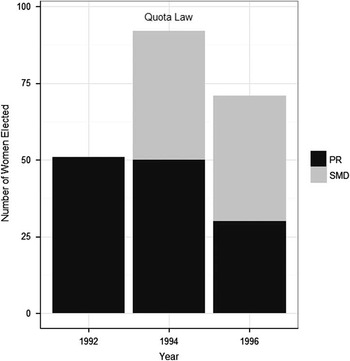
In the pre-quota era, all seats were elected by PR. In 1992, women held 8% of seats. After the implementation of the quota law, the percentage of women elected to the Chamber of Deputies reached an unprecedented level, nearly doubling from 8% (51 women of 630 total seats) in 1992 to 15% (92 women) in 1994 (see Figure 1). There were two tiers in the 1994 election, one (PR) with gender quotas and the other (SMD) with no gender quotas. On the quota side, women won 32% of the seats. On the SMD side, women won 9% of the seats.Footnote 5 In 1995, the Constitutional Court declared the quota law unconstitutional and the legislature repealed it before the next election. Without the quota, the total percentage of women elected in the 1996 elections fell to 11% (71 women). More than half of the gains for women in the PR tier were lost; the percentage of women dropped from 32% to 19%. The percentage of women elected in the majoritarian tier remained around 9%.
Number of women elected to the Italian Parliament by electoral system, 1992–96.

The one-time quota policy in Italy is an instructive case to analyze the qualifications issue because it allows us to distinguish quota women from non-quota women, as well as to compare them with men, addressing the lacuna we discuss above. The numbers are small, but analyzing differences within the 12th parliament (1994–96), as opposed to a before and after analysis, has the added advantage of avoiding biases from comparisons over time that could be the result of other factors specific to particular elections. Evaluating men, women, and quota women within the same legislative term allows us to hold constant many factors that could potentially change after a quota policy has been implemented, such as party selection procedures or voter preferences.
Ideally, we might like to bolster our results by using a ‘difference-in-differences’ research design to compare female representatives’ qualifications across the different types of electoral system before and after the quota law was implemented. Like our strategy, this method also avoids contamination by extraneous factors (a problem with simple pre-post designs). In addition, the double difference would provide a more plausible estimate of the impact of the quota law compared with findings based on a single, ‘between groups’ difference because it would account for selection bias. In our case, women elected in the PR tier may tend to be different from those elected in the majoritarian tier even in the absence of the quota law.Footnote 6 Unfortunately, such an analysis is not possible in the Italian case because the quota law was introduced at the same time as a change in the electoral system. Before quotas were implemented, all representatives were elected via proportional representation. In order to account for this, we model the main independent variable as an interaction effect measuring the combined influence of gender and method of election. This allows for comparisons of qualifications between female PR representatives and male PR representatives, female SMD representatives, and so on.
Because all of the quota women in our sample come from the PR seats, and all of the non-quota women from the SMD seats, we pay careful attention to potential differences between legislators in the two tiers.Footnote 7 Any differences between quota women and non-quota women could be the result of the electoral system rather than the quota law. For example, SMD races tend to be more hotly contested and high profile than closed-list PR races, so parties are more likely to nominate stronger candidates in the SMDs or open-list PR where personal attributes and/or connection to constituents matters more than party loyalty (Carey and Shugart, Reference Carroll1994; Shugart et al., Reference Shugart, Ellis and Suominen2005). Mixed electoral systems have also been found to encourage legislators to specialize in different areas: those elected through the nominal vote focus on representing geographic constituencies, while those elected through the list heed the priorities set by party leaders (Shugart, Reference Shugart2001; Gagliarducci et al., Reference Galasso and Nannicini2011). If these claims are true, we should expect to find significant differences between candidates (both men and women) elected in the majoritarian tier and those elected via PR list. In general, we would expect those elected in SMDs to be more qualified.
Data and methods
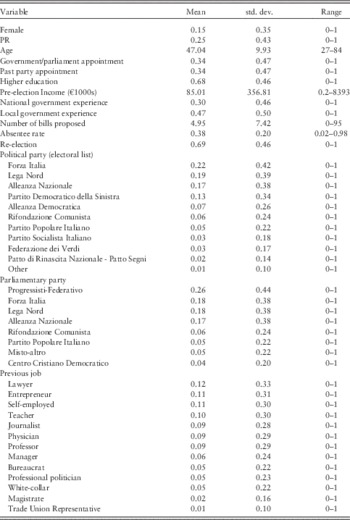
We use data on all members of the Italian Camera dei Deputati (House of Representatives) who were elected in the general election of 1994 (12th legislative term), collected by Gagliarducci et al. (Reference Gagliarducci, Nannicini and Naticchioni2008, Reference Gagliarducci, Nannicini and Naticchioni2011). The data set contains a wealth of information including self-declared demographic characteristics (age, gender, level of education, previous job, and marital status); past and current political experience in elections and party appointments at the local, regional, and national level; past and current appointments in government and parliament; income information from the year before election; information on bills proposed as main sponsor; absences in floor voting sessions without any legitimate reason; and data on re-election.Footnote 8 Table 2 provides a complete list of all variables used in the analysis, as well as summary statistics.
Summary statistics, Italian members of parliament 1994–96

The key independent variable in our analysis is quota women, which is operationalized as the interaction between female gender and being elected in the proportional tier of the electoral system, where the quota was implemented (Female*PR). We compare quota women to non-quota women, those elected in the majoritarian tier. This is the main comparison group we are interested in testing. Without the gender quota, we would expect all women elected to have similar qualifications for office.
We operationalize our measures of qualifications for office as follows: (1) Higher Education, a binary variable coded 1 if the legislator reported having a Bachelor’s degree or above, and 0 otherwise; (2) Pre-election Income, a continuous variable measuring occupational achievement, from tax returns measured in 2005 Euros; (3) National Government Experience, a binary variable coded 1 if the legislator previously served in the Chamber of Deputies, and 0 otherwise (4) Local Government Experience, a binary variable coded 1 if the legislator previously served in local government (mayor or councilor), and 0 otherwise. Following recent studies, we use income as a measure of occupational achievement and overall status because it reflects the market value of an individual’s ability or skills (e.g., Gagliarducci et al., Reference Gagliarducci, Nannicini and Naticchioni2008).Footnote 9 One obvious problem with using national-level political experience for our purposes is its correlation with gender. An average of 6.5% women served in the Italian national parliament from 1946 to 1994; a consistently low percentage of women in office is precisely what prompted support for gender quotas in the first place. Thus, we would expect women, and quota women in particular, to have lower levels of national level experience compared with men.
We explore the similarities and differences between quota women, non-quota women and men once they are in office using three measures of legislative behavior: (1) Bills Proposed, a count variable for the number of bills the legislator proposed as primary sponsor over the legislative term; (2) Absentee Rate, the percentage of votes for which the legislator was absent; and (3) Re-election, a binary variable for whether the legislator won re-election to the next legislative term, conditional on the legislator running.
In the following section we examine the relationship between quota women and our measures of qualifications and quality. First, we use bivariate analysis to answer the question of whether quota women and non-quota women differ on the measures we care about. Specifically, we use χ 2 goodness of fit tests for binary variables (Higher Education, National Government Experience, Local Government Experience, and Re-election) and t-tests for other variables (Pre-election Income, Bills Proposed and Absentee Rate). We next turn to the question of determinants of legislator qualifications and quality more broadly. What predicts or explains qualifications, and do gender quotas have a negative impact? We use multivariate analysis because it allows us to control for other factors that may be correlated with gender, such as previous job or incumbency. The first set of regressions assesses determinants of qualifications for office, and the second set explores determinants of quality once in office. Because our key independent variable is an interaction term (Female*PR), the constituent terms Female and PR in our regression models should be interpreted as women elected in SMDs, and men elected in PR seats, respectively.
We are interested in testing whether women who are elected as a result of gender quotas (and who, presumably, would not have been elected otherwise) are as qualified as their counterparts. We consider their most comparable counterparts to be women elected without the aid of a quota in the majoritarian tier. The key statistic we use to assess whether quota women are different from non-quota women is thus a Wald χ 2 test that measures the significance of differences between the two coefficients Female and Female*PR. Because ‘quota women’ is operationalized as an interaction term in our data (Female*PR), the regression models do not provide us with clear estimates of the marginal effects of female gender or method of election on qualifications. We provide this using ‘first differences’ in expected values.Footnote 10 First differences are calculated from a counterfactual simulation (N=1000), where a legislator typical in all respects is assumed to change the column variable from its minimum to its maximum (e.g. from a non-quota woman to a quota woman). They give us a measure of the magnitude of the effect of each key variable estimated in the models on the scale of the dependent variable (King et al., Reference Matland2000).
As previously discussed, any differences between quota- and non-quota women could be due to their different method of election rather than the quota law. We are able to address this issue by including Wald χ 2 test statistics measuring the significance of differences between the coefficients for men and women elected in the same system. We also provide the marginal effects of PR method of election along with other quantities of interest, including female gender and quota women. In order to convey the average effects of our quantities of interest, most importantly the effect of being a quota woman, we illustrate the distributions of simulated first differences in expected values in Figure 3. We provide the numeric values in Table 6.
We control for other background characteristics where appropriate, including Age, Incumbency, Electoral Political Party, Parliamentary Group, Previous Job, and Government/Parliament Appointment.Footnote 11 In the analysis of quality (performance in office), we also control for Education, Pre-election Income, National Government Experience, and Local Government Experience. These variables may be linked to gender and our measures of qualifications and/or quality, and so we account for them in the model(s) in order to avoid detecting spurious relationships.
In general, we expect Age and Incumbency to have a positive ‘effect’ on qualifications/performance. We expect Higher Education to have a positive impact on pre-election income and measures of performance. We also expect Pre-election Income and Local Government Experience to have a positive effect on measures of performance if qualifications for office should be correlated with quality of performance in office. We expect Government/Parliament Appointment to have a positive effect on performance measures because these representatives have worked their way up in the party and are likely to hold certain responsibilities, like introducing key bills to the parliament. We control for Previous Job only in the regression on Pre-election Income because certain types of jobs are correlated with particular income bands and gender. Finally, we expect Electoral Political Party and Parliamentary Group variables to have different impacts depending on the party. Electoral Political Party refers to the political party affiliation on the candidate list, while Parliamentary Group refers to the group affiliation once in office; the two are sometimes the same. We control for Electoral Political Party when measuring determinants of candidate qualifications, and Parliamentary Group when measuring determinants of legislator performance.Footnote 12 We would expect members of the Communist party to have a negative effect on higher education and income because of the party’s traditional recruitment of working-class candidates (Cotta and Verzichelli, Reference Dahlerup2007). However, Forza Italia was known for recruiting business professionals for their managerial experience (Newell, Reference Newell2010), so we would expect FI membership to have a positive impact on these measures of qualification.
For the dependent variables Pre-election Income and Absentee Rate, we use ordinary least squares regression, transforming pre-election income by the logarithmic function to ensure that extreme incomes do not play a disproportionate role [Log (Pre-election Income)]. For the dependent variables Higher Education, National Government Experience, Local Government Experience, and Re-election we estimate probit regression models because the outcomes are binary. For the dependent variable Bills Proposed, we use negative binomial regression because the outcome is a count.Footnote 13 The sample for the regression on Re-election includes only those representatives who stood for re-election (456 of the 630 representatives). We are not able to distinguish the reasons why some representatives, including 14 of 50 quota women, did not run for re-election. We note that the percentage of quota women who ran for re-election is exactly the same percentage of representatives who ran for re-election overall – 72%.
Analysis
How do the women representatives elected under the 1993 quota law compare to non-quota female and male representatives? If either the quota law or the type of electoral system impacts the selection of female candidates, we would expect the initial bivariate analysis to show significant differences between quota- and non-quota women.
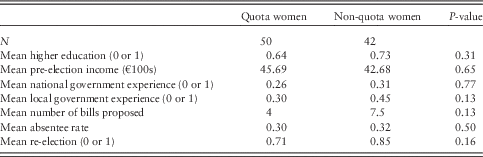
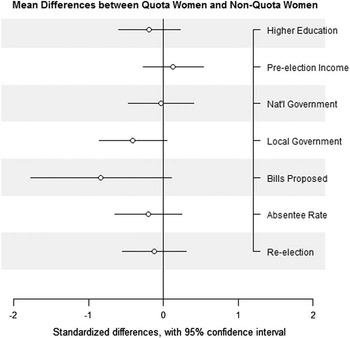
On most of our measures, we find no significant difference between quota women and non-quota women. Table 3 reports the mean values for quota women and non-quota women, and the P-value for associated χ 2 and t-tests.Footnote 14 While we find evidence of some differences, none of them is statistically significant. A smaller percentage of quota women have achieved a degree in higher education (Bachelor’s level and above) than non-quota women, but this difference is not statistically significant. A greater percentage of non-quota women have experience in local and national government. This provides some evidence either toward the theory that candidates elected via SMD will be more invested in their constituency, or toward the theory that quota women will be less experienced. We note that the differences are not statistically significant. Quota women propose fewer bills than non-quota women on average and are less likely to be re-elected, but these differences are not statistically significant. On the other hand, pre-election income is slightly higher for quota women compared with non-quota women, and quota women also have lower absentee rates than non-quota women on average (differences are not statistically significant).
Comparison of quota women and non-quota women

Notes: P-values are for a Pearson χ 2 goodness of fit test (with Yates’ continuity correction) when the variable is binary, or Welch Two Sample t-test (when the variable is continuous or count). Both test the hypothesis that proportions are the same for quota women and non-quota women. Analysis was carried out in R.
Figure 2 shows the standardized difference in means between quota women and non-quota women, with 95% confidence intervals. The standardized difference in means is the difference in the mean value for quota women and the mean value for non-quota women, divided by the standard deviation for quota women. It converts the average differences between the groups to a common scale, so they can all be plotted on the same axis and compared. Every confidence interval bar in the chart crosses 0, showing that although there are average differences between quota and non-quota women, none is statistically significant.
Standardized differences between quota women and non-quota women.

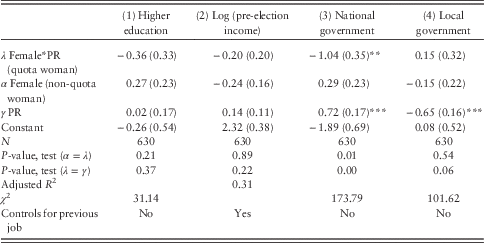
Multivariate analysis allows us to compare quota women and non-quota women to their male counterparts. We begin with ex ante qualifications. Table 4 presents the results of four separate models that estimated the effect of quotas on three aspects of representative characteristics. Model (1) tests the hypothesis that quota women are less educated than non-quota women or men. Model (2) examines the impact of gender and quotas on average pre-election income, controlling for previous job. This model tests the hypothesis that quota women held lower status jobs than non-quota women or men. Finally, models (3) and (4) test the hypothesis that gender quotas increase the number of legislators who have less previous national and local political experience, respectively.
Determinants of legislator qualifications

Notes: White-corrected standard errors are in parentheses. Models (1), (3), and (4) are estimated using probit regression and model (2) is estimated using ordinary least squares regression. Previous job controls are dichotomous variables indicating occupational background, including lawyer, bureaucrat, journalist, teacher, physician, magistrate, professor, entrepreneur, white-collar, self-employed, and retired. All models include controls for age and electoral political party. Model (2) also includes controls for national government experience and higher education. Model (3) includes controls for local government experience and past party appointment, and model (4) includes controls for national government experience and past party appointment. All analyses were carried out using Zelig for R (Imai et al., Reference Imai, King and Lau2008).
Significant codes: ***0.001; **0.01; *0.05.
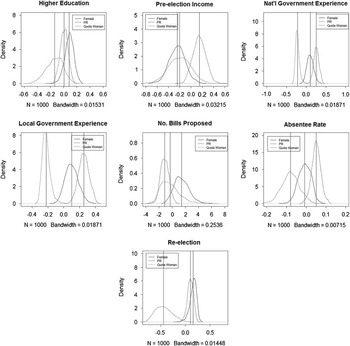
The results of model (1) show that women, whether elected with the aid of a gender quota or not, do not differ from men in terms of overall educational qualifications. The top left distribution in Figure 3 is a simulation of the expected values of achieving higher education for different types of legislators. The dotted line shows the expected difference when we move from a legislator who is not a quota woman to one who is a quota woman (i.e. the value of Female*PR from 0 to 1). The broken line represents all men and women elected in the PR tier and the solid line represents all women (quota- and non-quota women combined). The associated vertical lines represent the mean first difference in expected value (also reported in Table 6). In the case of education, we can see that all the distributions are centered around zero, indicating that quotas have no impact on level of education – nor does gender or being elected in a PR seat.Footnote 15
First differences of quota women on qualifications and quality.
Notes: Figures show density plots of the simulated first differences reported in Table 6, with the corresponding vertical bars indicating the mean first difference in expected values for each type of legislator.

Model (2) demonstrates that, when controlling for previous job, income for quota women (our measure of occupational status) does not differ from that of other legislators. The marginal effect of female gender and quota women on earnings is shown in the top middle panel of Figure 3. The parallel distributions for female legislators and quota women show the similarity of differences in expected values of income for being a woman, regardless of method of election. Women elected in both tiers are expected to have lower pre-election income compared with men, although the difference is not statistically significant. This link does not surprise us, given the persistent gender gap in income. As of 2003, Italian women’s salaries were 74% of men’s, a figure that was probably lower in 1993 (ISTAT, 2003).
Model (3) shows that, as we expected, quota women are less likely to have experience in national office compared with non-quota women and their male peers in the PR tier. A test of the coefficients Female*PR and Female suggests that the difference between quota- and non-quota women is significant (P=0.01), and a similar test also finds the difference between quota women and their male colleagues in the PR tier to be significant (P=0.00). The density plot in the top right panel of Figure 3 shows that quota women are associated with a 22% decrease in national government experience, while women in general are associated with a 10% increase (although this is not significant at standard levels). This finding does not surprise us because the very reason many give for adopting quotas is the paucity of women who manage to reach national office. We turn to our alternative measure of previous experience, service in local government, to explore whether this relationship extends to other characterizations of political capability.
Model (4) indicates that there is a significant relationship between men elected in the PR tier and previous local government experience. Male PR candidates are less likely to have previous experience serving in local government compared with their SMD peers. However, the coefficient for quota women is positive and not significant, and a test of the two coefficients Female*PR and PR indicates that the difference between the two is significant at the 0.10 level (P=0.06). That is, the negative relationship between method of election and local experience is significant only for male representatives. This finding confirms previous studies that show that politicians elected in PR systems are less likely to have strong local ties than those elected in SMDs (Gagliarducci et al., Reference Galasso and Nannicini2011). The first differences reported in Table 6 (and shown in Figure 3) provide a substantive measure of the magnitude of this effect. Representatives (both men and women) elected in the proportional tier are 24% less likely to have local government experience than legislators elected in SMD seats. However, women elected in the proportional tier (quota women) are 5% more likely to have local government experience than other representatives. If we assume that in the absence of a quota law more men would have been elected in the PR tier, this finding suggests that quota women may have improved the overall level of qualifications.
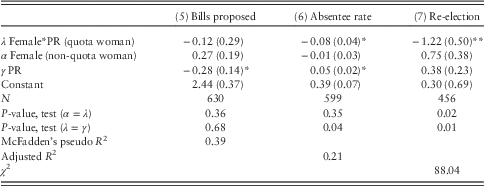
Next, we turn to legislative behavior, which we consider as a measure of ex post qualifications. How does the average performance of quota women in office compare to that of non-quota women and men? Table 5 presents the results of the models estimating the impact of various legislator characteristics on overall quality. We present three separate models to test three different measures of legislative behavior. Model (5) tests the hypothesis that quota women propose fewer bills than non-quota women or men. Model (6) tests the hypothesis that quota women are more likely to shirk their political duties than other representatives, measured in terms of attendance at legislative sessions. Finally, model (7) tests the hypothesis that quota women are less likely to win re-election, which is of course conditional on their running in the next election. Table 5 shows that quotas have a significant impact on two out of three measures of representative quality. Quota women do not differ from their peers in terms of bill introductions, but they do have lower rates of absenteeism and are associated with lower re-election rates.
Determinants of legislator quality

Notes: White-corrected standard errors are reported in parentheses. Model (5) is estimated using negative binomial regression, model (6) is estimated using ordinary least squares regression, and model (7) is estimated using probit regression. The sample for model (7) includes only those representatives who ran for re-election. The sample for model (6) is smaller due to missing data in the dependent variable. All models include controls for age, national government experience, higher education, log (pre-election income), local government experience, appointment in government or parliament, and electoral political party (models 5 and 6) or parliamentary party (model 7). All analyses were carried out using Zelig for R (Imai et al., Reference Imai, King and Lau2008).
Significant codes: ***0.001; **0.01; *0.05.
Model (5), a regression of number of bills proposed, finds that the PR method of election is again associated with negative quality, but quota women do not differ from men elected in the PR tier. Representatives elected by PR propose just over one less bill per legislative term compared with other representatives (Table 6). A Wald test of the difference between Male*PR and PR coefficients was not significant, indicating that we cannot reject the hypothesis that quota women are significantly different from their male PR peers on this measure of performance. The density plots shown in Figure 3 illustrate that the distribution of expected values of bills proposed is similar for quota women and all those elected in the PR tier.
Marginal effects of quota women on qualifications and quality

Notes: Significant effects are in bold. Cells give the estimated change in probability or predicted values (for the negative binomial model (4)) that comes from a counterfactual simulation (N=1000), where a legislator typical in all respects is assumed to change the column variable from its minimum to its maximum, for example from not a quota woman to a quota woman. First differences were simulated from models reported in Tables 4 and 5; 95% confidence intervals for the changes in probability are given in parentheses. First difference effects are estimated using the Zelig package for R (Imai et al., Reference Imai, King and Lau2008).
Model (6) finds that men elected in the proportional tier have higher rates of absenteeism than others. Compared with other legislators, PR elected legislators are associated with a 5% increase in the absentee rate (see Table 6). However, quota women are associated with a significant decrease in absenteeism. A Wald test of the difference between PR and Female*PR coefficients is significant, suggesting that the difference between quota women and men elected in the PR tier is significant (P=0.04). The density plots at the bottom of Figure 3 show that quota women are associated with a 7% decrease in absenteeism (female members in general are associated with a 1% decrease, although this is not significant at standard levels). This finding adds another piece of evidence suggesting that, contrary to critics, quota laws may have a positive impact on legislator quality.
Our last model of legislator quality, model (7), considers the relationship between personal characteristics and the likelihood of re-election. In some ways, this is perhaps the best measure of legislator quality: do political parties and voters want to re-invest in the legislator, or do they want to kick them out? Recall that voters had two votes in Italy’s mixed system: one for a candidate in a SMD and one for a political party represented by closed regional lists. Those elected in the majoritarian seats are thus assessed by their party for re-nomination in a good district and by constituents who vote for them directly, while those elected in the proportional seats mainly look to their political party for good placement on the list in a safe district.
Model (7) finds that quota women are less likely to be re-elected compared with other legislators. Again, this model includes a sample of only those legislators who chose or were selected to run for office in the subsequent election. A Wald test of the difference between PR and Female*PR coefficients is significant, suggesting that the difference between quota women and men elected in the PR tier is significant. Similarly, a test of the difference between Female and Female*PR coefficients is significant, suggesting that the difference between quota women and women elected in SMDs is significant. Both men in the PR tier and women elected in SMDs are more likely to be re-elected (the baseline group left out being men elected in SMDs). Marginal effects presented in Table 6 show that quota women are 43% less likely to be re-elected compared with other representatives running for re-election (men and women).
The finding for quota women is important because the quota law was no longer in effect when representatives were running for re-election. Our results suggest that when the quota was removed, parties placed quota women in less winnable positions. This observation is consistent with Folke and Rickne (n.Reference Folke and Rickned.) finding that male incumbents protect their own careers by limiting the re-election of female legislators, but runs contrary to Bhavnani’s (Reference Bhavnani2009) findings about the withdrawal of quotas in India. Further research is needed to illuminate decision-making processes and to understand better the impact quota laws have on candidate selection after the law is removed.
Our findings are robust to alternative definitions of who counts as quota women. Perhaps incumbent females elected in the PR portion should not be considered part of the quota cohort. We identified all incumbents in 1994 re-elected in the PR tier, dropped them, and re-ran our analysis for a sample of newcomers only (the total sample dropped from 630 to 439, a number which is still large due to the high turnover in 1994). Our results do not change substantively (see Appendix B online for full results). The bivariate analysis shows that quota women are less likely to be re-elected and have less previous experience in local government, but the differences are not statistically significant. The multivariate analysis again finds that quota women do not have a negative impact on local government experience, while their male peers in the PR tier do. A Wald test of the difference between quota women and men elected in the PR tier is significant at the 10% level in this model. Quota women have a negative impact on absenteeism (here the test of the difference between coefficients for quota women and PR men is significant at the 5% level), and are less likely to be re-elected (again, associated Wald tests are significant).
Women who were first on their PR list might also not be considered quota women. We identified all women who were first on their PR lists in 1994.Footnote 16 Ten of the 50 women were first on their list (compared with 67 of the 105 men elected via PR). We dropped these 10 women from the sample and re-ran the analysis. Again there were no substantive changes to our results (see Appendix C online for full results). The bivariate analysis finds that quota women are less likely to be re-elected compared with non-quota women, significant at the 0.10 level (P=0.07). None of the other differences approach statistical significance. The multivariate analysis confirms that quota women do not have a negative impact on local government experience, while their male peers in the PR tier do (the difference is significant, P=0.03). Again, quota women are associated with less absenteeism (and the test of the difference between coefficients for quota women and PR men is significant), and are less likely to be re-elected (associated Wald tests between quota women and PR men, and quota women and non-quota women, are significant).
Conclusion
Our aim in this article was to subject to empirical analysis claims that candidates nominated on the basis of gender quotas will be less qualified to serve in legislative office. We examined this claim through a case study of Italian legislators. Our analysis shows that, contrary to the concerns of quota opponents, quota women are not less qualified than men or than other women in terms of education, occupational achievement, or previous political experience at the local level. Legislators elected in the PR portion of Italy’s mixed system are less likely to have previous experience in national office – but this is not surprising given women’s historic underrepresentation in Italian politics. Our analysis of ex post legislative quality reiterates these findings, demonstrating that quota women are just as likely to propose bills and more consistent in attending sessions of parliament. However, they are less likely to win re-election compared with their peers, a factor we provisionally attribute to the removal of the quota in the subsequent election. This finding suggests that the lower percentage of women in office can be attributed to discrimination against them by party leaders. Re-election may not be a fair or accurate measure of candidate quality in cases where party leaders act as gatekeepers for candidate selection, placement in a winnable district, and list ranking.
We defined qualifications according to conventional standards used most often in the political science literature: level of education, professional achievement, and previous political experience. We also consider behavior in office as a measure of qualifications. In this study, we take the term ‘qualifications’ at face value and define and measure it according to the way that most political scientists do – and, perhaps, the way most people do in everyday language. At the same time, we realize that in relying on a conventional standard of qualifications, we may also be relying on a ‘male’ standard of qualifications. We heed the caution offered by Franceschet et al. (Reference Gagliarducci, Nannicini and Naticchioni2012) about how to define qualifications when it comes to gender quotas. We acknowledge that our approach does not account for the kinds of characteristics where women may be more likely to have an advantage over men, such as participation in non-governmental organizations or other non-partisan forms of political participation. We suspect that when people object to gender quotas on qualifications grounds, what they oppose, usually without saying so, is making gender itself a qualification for office. In a sense, gender does become a formal qualification for office with the adoption of gender quotas (Rehfeld, Reference Rehfeld2009).
Questions about quotas and qualifications remain relevant in Italy. In 2003, the legislature passed a constitutional amendment allowing affirmative action to increase women’s presence in elected bodies, but legislators have not yet acted on this opportunity to reintroduce legislative quotas (Guadagnini, Reference Htun and Jones2005). In 2010, a bill requiring a 30% quota for women on all corporate boards inspired the same type of zero-sum rhetoric about quotas and qualifications as the 1993 legislative quota did. In letters to the editors of major Italian newspapers, citizens argued that ‘I got my position on my own merits’ (Corriere della Sera, July 5, 2011); that ‘gender quotas are offensive to the women who fought and are fighting for parity on the basis of their capacity and their merit’ (La Stampa, March 11, 2011); and even that ‘we need a quota for brains, not sex’ (La Nazione, March 8, 2011).Footnote 17 The corporate board bill also split the conservative Popolo della Libertá (Pdl) party (successor to Forza Italia) along gender lines, with many male party members coming out against the quota while female members supported it. The bill was passed into law on June 28, 2011.
The lessons learned in this study have implications beyond the scope of Italy. Gender quotas remain a popular policy option throughout the international community. Our results offer some leverage in addressing one of the most common arguments against quotas and warrant further testing against data from other cases. One avenue for future research is to expand this research to other countries with mixed electoral systems in which a quota applies only to the PR seats. Promising cases include Armenia, Bolivia, Ecuador, Honduras, Korea, Mauritania, Panama, and Senegal. Our results also suggest broader implications for questions about the impact of electoral rules on candidate selection. According to this research, rules that restrict candidate selection reduce the quality of candidates, while rules that open up selection, such as primaries, generate candidates with higher qualifications. Our study shows this trend does not hold when the electoral rule concerns the selection of a marginalized group, in this case women. Even though quota laws restrict competition, they do not necessarily result in lower quality candidates being elected. One hypothesis is that political parties, the main gatekeepers to elected office in systems of proportional representation, do not always choose the most qualified candidates. While this is the intuition behind the literature suggesting that restricting competition leads to lower quality candidates, quota laws force parties to change their behavior and thus constitute a different type of restriction. In fact, quotas can be viewed as opening up political competition for specific underrepresented groups.
On the supply-side of the political marketplace, plenty of qualified women may want to pursue a political career, and on the demand side of the equation plenty of voters might be willing to support them. If parties do not support female candidates (because of implicit bias or discrimination by party leaders), the explanation for women’s underrepresentation rests with a block in the supply that prevents women from being part of the candidate pool in the first place. Quota laws can overcome this block by forcing parties to change their behavior and select more women. Further research could test this hypothesis by comparing the outcomes of affirmative action policies in countries with varying levels of supply and demand for female candidates. We would expect our results to hold in cases where there is good reason to think the supply is there (e.g. women have access to educational and professional opportunities) and voter demand is relatively high, suggesting supply-side obstacles (i.e. the party selectorate) prevent women from entering politics rather than the supply of women or voter demand.
Supplementary material
To view supplementary material for this article, please visit http://dx.doi.org/10.1017/S1755773914000095