


Recent years have witnessed several natural disasters worldwide, compelling victims in affected areas to seek refuge in evacuation shelters. Prolonged living in evacuation shelters results in nutrition- and food-related problems, in addition to the deterioration of living conditions. For instance, evacuation shelters frequently experience shortages of essential food items such as milk and dairy products, meat, vegetables, legumes, and seafood,Reference Tsuboyama-Kasaoka, Hoshi and Onodera1 whereas emergency provisions tend to consist largely of carbohydrate-richReference Tsuboyama-Kasaoka, Hoshi and Onodera1, Reference Inoue, Nakao and Kuboyama2 and high sodium or high-sugar foods.Reference Ainehvand, Raeissi and Ravaghi3 These inadequate diets may lead to health issues in some evacuees, as evident in previous disasters, including the 2011 Great East Japan Earthquake (GEJE), where gastrointestinal diseases were prevalent among evacuees.Reference Inoue, Nakao and Kuboyama2 Similarly, during the 2017 Hurricane Irma, governmental and volunteer efforts fell short in meeting the dietary needs of older adults and people with disabilities,Reference Holmes, Williams and Wong4 potentially leading to malnutrition and illness.Reference Sudo5 In the 2024 Noto Peninsula Earthquake, meals in evacuation shelters were deficient in energy and protein for older adults.Reference Sakamoto, Asano and Miyata6 Although Japanese municipalities are required to develop regional disaster prevention plans under the Basic Act on Disaster Management, experts criticized that evacuation conditions had not improved since the GEJE.7
While studies have investigated dietary patterns during disasters, focusing on nutrient excesses or deficiencies over short periods, research into the types of meals served and the provision of dietary considerations over extended durations, particularly considering shelter size variations remains limited. Manual for Food and Nutritional Support in the Event of a Disaster (Manual) illustrates that the desired types of meals and nutritional supplement activities differ according to the time elapsed since a disaster occurrence,8 highlighting the need to understand the evolving phases following a disaster and continuously monitor the dietary content in evacuation shelters to provide appropriate nutrition and dietary support.Reference Harada9 However, existing studies have only collected limited data, such as a 2-day snapshot (24 and 25 days after the GEJE) without examining the balance of meals by shelter size and time elapsed since the disaster, illustrating the difficulty large-scale shelters encounter in cooking meals and obtaining gas supply.Reference Tsuboyama-Kasaoka, Hoshi and Onodera1 Regardless of location or meal provider during emergencies, ensuring access to well-balanced diets comprising “grain-based dishes,” “fish, egg, and meat dishes,” and “vegetable-based dishes,” is essential for meeting evacuees’ nutritional needs because this combination is typical in Japanese meals.Reference Hirano, Sudo and Tsuboyama-Kasaoka10
Therefore, this study aims to analyze meal types, dish categories, meal provision details, and dietary considerations based on shelter size and time elapsed since the disaster, using data from Dietary Assessment Sheets for Evacuation Shelters (AS) recorded during the 2016 Kumamoto Earthquake. By shedding light on the actual situation in evacuation shelters of varying sizes and over different time periods, the present study describes anticipated dietary problems in each case. This could contribute municipalities to take concrete measures for disaster nutrition planning considering disaster phase and expected number of evacuees.
Materials and Methods
Study Setting
This study’s context was Kumamoto Prefecture, located in the southwest part of Japan, which experienced a series of natural disasters in April 2016. A magnitude 6.5 earthquake with a seismic intensity of 7 occurred on April 14, 2016 (9:26 p.m. JST), followed by a magnitude 7.3 earthquake on April 16 (1:25 a.m. JST) with equivalent seismic intensity.11 The number of evacuation shelters peaked at 855, with 180 000 evacuees from Kumamoto Prefecture and neighboring areas on April 17.12 By June 30, 1010 registered dietitians of the Japan Dietetic Association-Disaster Assistance Team (JDA-DAT) had been deployed to provide support in the disaster area.
JDA-DAT is a disaster food and nutrition support team established by the Japan Dietetic Association (JDA) after the 2011 GEJE.13 JDA-DAT is made up of about 4 members, including a leader and staff.14 When a disaster happens, the Ministry of Health, Labour and Welfare (MHLW), disaster-affected prefectural governments, and dietetic associations request the dispatch of JDA-DAT to the JDA president. Then, the president decides and requests the dispatch of JDA-DAT from designated prefectural dietetic associations to disaster-affected areas.14 JDA-DAT applicants must be registered dietitians with at least 3 years of job experience. To become JDA-DAT staff, the applicants need to complete 18 hours of training, including 6 hours of exercise, during normal times. These staff, trained by prefectural dietetic associations, can become JDA-DAT leaders after taking leader development training provided by the JDA,15 which was held for 7 hours in 2024.16 As of the end of March 2024, there are 4482 JDA-DAT staff members, including 1083 leaders.17 In the past disasters, JDA-DAT provided nutritional advice to prevent vitamin and dietary fiber shortages among evacuees, conducted nutritional consultations in evacuation shelters, and provided food for vulnerable evacuees such as older adults and infants. JDA-DAT can manage special nutritional care, such as enteral nutrition, which is difficult for other health professionals to provide. The team contributed to prevent evacuees’ chronic diseases from worsening in cooperation with other medical teams.Reference Fukasawa, Yamashita and Hamada18
Dietary Assessment Sheets for Evacuation Shelters in Kumamoto (Kumamoto AS)
As part of disaster relief efforts, JDA-DAT and administrative staff from the affected areas visited each evacuation shelter and completed the AS. These sheets recorded the number of evacuees, lifeline availability, food provision status, and other crucial information. AS was created by each prefecture and dietetic association, and during the Kumamoto Earthquake, sheets from other prefectures were also utilized. Subsequently, JDA-DAT analyzed 130 AS from April 22-June 30, 2016 (i.e., 8-77 days after the disaster). Given that AS collection and analysis were conducted as support tasks, no rigorous research design or statistical sampling techniques were employed. Prioritizing the study method framework over assisting disaster victims is unethical. AS included basic information (survey date and evacuee count), meal details (number of meals per day, menus, meal types provided in a day, and who prepared hot meals), and free-form columns for meal provision situations and dietary considerations for vulnerable evacuees. AS asked the meal preparation staff to select from the following options, allowing multiple answers: self-defense forces, volunteers, evacuees, and others.
Classification of Shelter Size and Timeframes
Of 130 AS, 96 recorded evacuee numbers. Using tertiles based on a past study,Reference Tsuboyama-Kasaoka, Hoshi and Onodera1 facilities accommodating up to 70 evacuees (N = 33), those with more than 70 and no more than 160 (N = 32), and those with more than 160 (N = 31) were classified as “small-scale,” “medium-scale,” and “large-scale” evacuation shelters, respectively. Some shelters had identical evacuee counts, preventing an equal division into 3 categories. Some previous studies conducted nutritional evaluation and infectious disease surveillance by weeks following the GEJE.Reference Sasaki19, Reference Kim, Kamigaki and Mimura20 Based on these studies, the time-course changes were analyzed by weeks: Week 2 (Days 8-14), Week 3 (Days 15-21), Weeks 4-5 (Days 27-31), and Weeks 8-11 (Days 58, 61, 66, 73, 75, 77). As data on May and June (Weeks 8-11) had only 1 or 2 days AS due to the successively closing of shelters, these survey dates could not be classified weekly. According to the Manual, Weeks 2-5 (from Day 8-31) represent the “subacute stage,” addressing protein and vitamin deficiencies, whereas Weeks 8-11 (over 1 month) are categorized as the “chronic phase,” managing unbalanced diets and nutrition deficiencies.Reference Harada9 Thus, combining these multiple weeks into 1 may be reasonable.
Types of Meals and Dish Categories
Meal types were classified as “ready-to-eat foods-based meals,” “hot meal services,” and “boxed meals.” These are the primary meal types during emergencies.Reference Takeda, Sudo and Tsuboyama-Kasaoka21 Ready-to-eat foods are individually packaged commercial products, such as sweet buns, packed rice, and instant noodles.Reference Takeda, Sudo and Tsuboyama-Kasaoka21 They are usually sent as an emergency support from the central governments or private companies nationwide and distributed as food aids for evacuees. 22, 23 AS required recorders to select all meal types received each day. As most shelters received at least 2 meal types in a day with multiple selections often made, all of them were counted to calculate the total number of each meal type. Dish categorization focused on menus provided by ready-to-eat food-based meals and hot meal services, because boxed meal contents were described as “boxed meals from XX company” without specific contents. Only the menus that clearly described the supply sources (ready-to-eat foods-based meals or hot meal services) were selected. As hot meal services had no menu description in Weeks 8-11, statistical analysis excluded Weeks 8-11. Based on the classification in the Japanese Food Guide Spinning Top, all meals were categorized into “grain-based dishes,” “fish, egg, and meat dishes” (protein sources), and “vegetable-based dishes” (vitamin sources).24 The nutritional balance was evaluated based on the presence or absence of these 3 dishes.Reference Hirano, Sudo and Tsuboyama-Kasaoka10, 25 When dishes such as rice with vegetables and meats were served, they were counted as 1 serving each of “grain-based dishes,” “fish, egg, and meat dishes,” and “vegetable-based dishes.”26 Similarly, vegetable juice was considered as 1 serving of “vegetable-based dishes.”Reference Inoue, Nakao and Kuboyama2 Reference Sudo5, 26
Overall meal provision and dietary considerations for vulnerable evacuees
Free-response columns in AS highlighted nutritional challenges and alternative food procurement methods beyond the 3 types of above-mentioned meals and dish categories. Additionally, descriptions of dietary considerations for vulnerable evacuees, such as older adults and patients with chronic disease, were noted. These descriptions provided insight into the meal provision situation and dietary considerations by shelter size and weeks.
Statistical Analysis
For multiple comparisons, a Z test was conducted to compare the column proportions (meal types or dish categories). This method allows us to determine if there is a significant difference in the number of servings across 3 or more qualitative valuables. Bonferroni correction was applied to reduce type I error. Statistical analyses were performed using SPSS Statistics Version 28.0 (IBM Corporation) at a significance level of 0.05.
Ethical Considerations
This study was reviewed and approved by the Ethics Review Committee of the National Institutes of Biomedical Innovation, Health, and Nutrition (receipt number: NIBIO 54). Participant consent was waived as this study involved a retrospective analysis of shelter records. Personal identifiers were removed from the data to ensure anonymity before analysis.
Results
Basic Information About Evacuation Shelters
Table 1 presents basic shelter information categorized by size. The number of shelters decreased over time because of closures and consolidations. Notably, some shelters failed to serve meals more than twice a day, especially in Week 2. Four medium-scale evacuation shelters in Week 2 described the details of volunteers who provided hot meals; 2 of them were students (one clearly specified as university students), and the others were members of a voluntary disaster prevention club from another prefecture.
Average number of evacuees, meals per day in shelters, and the number of shelters serving at most 2 meals per day

* Survey date:
Week 2 (Days 8-14): April 22-28; Week 3 (Days 15-21): April 29-May 5; Week 4-5 (Days 27-31): May 11-15; Weeks 8-11 (Days 58, 61, 66, 73, 75, 77): June 11, 14, 19, 26, 28, 30.
† Mean [standard deviation].
†† Median [interquartile range].
‡ Participants could choose multiple answers from the following options: self-defence forces, volunteers, evacuees, and others.
§ There was no description regarding who prepared hot meals.
Meal Types
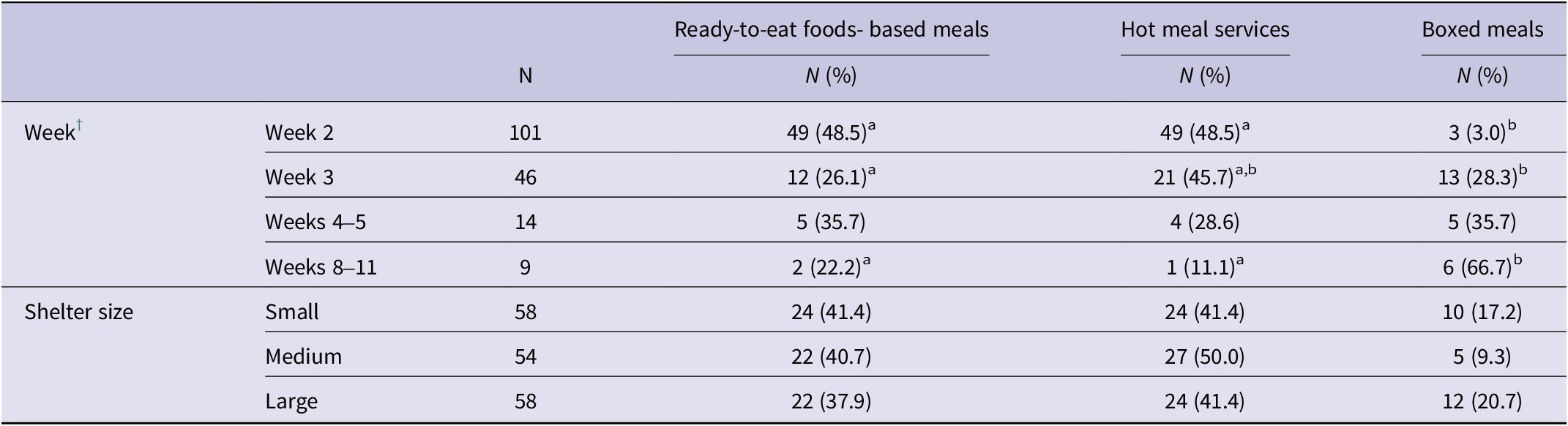
Significant differences in meal types were observed across weeks (top row in Table 2). In Week 2, the proportion of boxed meals was significantly less than that of ready-to-eat foods-based meals and hot meal services. Over time, the provision of boxed meals increased, whereas other meal types decreased. By Weeks 8-11, box meals dominated, significantly surpassing other meal types. However, no significant differences in meal types were found across shelter sizes.
Differences in meal types* by weeks or shelter size
* The previous study13 presents a picture of each meal type (ready-to-eat foods-based meals; hot meal services; boxed meals).
† Survey date:
Week 2 (Days 8-14): April 22-28; Week 3 (Days 15-21): April 29-May 5; Week 4-5 (Days 27-31): May 11-15; Weeks 8-11 (Days 58, 61, 66, 73, 75, 77): June 11, 14, 19, 26, 28, 30.
The different characters, “a” and “b,” denote the presence of significant differences within the same line based on the Z test for multiple comparisons at P<0.05.
Dish categories of ready-to-eat foods-based meals and hot meal services
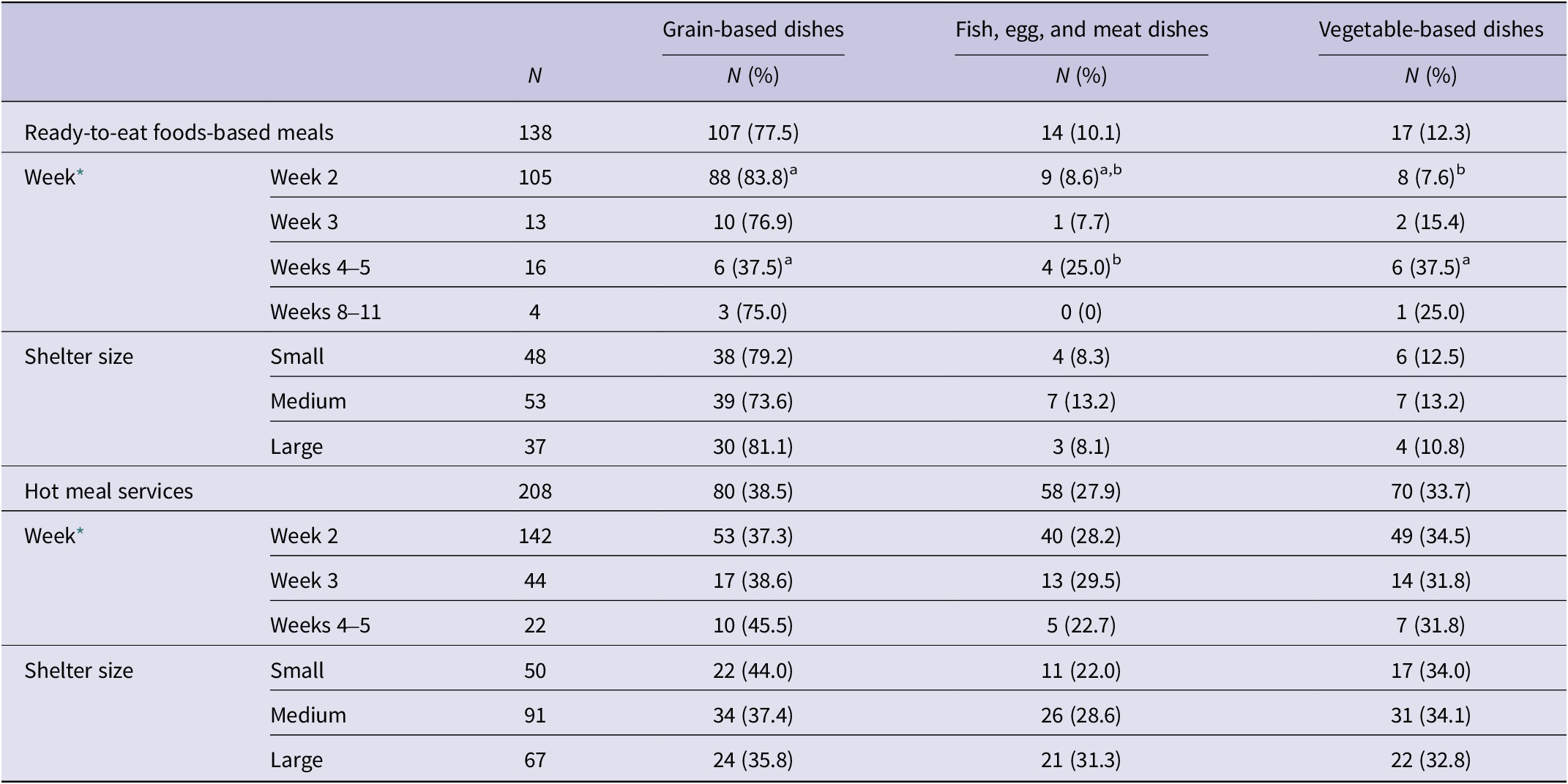
Ready-to-eat food displayed significant differences in dish categories across weeks (top row in Table 3). In Week 2, “grain-based dishes” accounted for more than 80% of all dishes, whereas only 8 “vegetable-based dishes” were present, significantly fewer than “grain-based dishes.” Despite a smaller number of dishes in Weeks 4-5, significant differences in dish proportion existed; “fish, egg, and meat dishes” were less provided compared to “grain-based dishes” and “vegetable-based dishes.” Regarding shelter size, no significant difference in dish categories was found. However, “grain-based dishes” accounted for more than 73% in every shelter scale, reaching 81.1% in large-scale shelters, while other dishes comprised less than 14%. The bottom row of Table 3 presents the differences in dish categories of hot meal services by week and shelter size. Unlike ready-to-eat foods-based meals, no significant differences could be observed in hot meal services across weeks and shelter sizes. Although “grain-based dishes” dominated, all dish categories ranged from 20-45% across weeks and shelter sizes, with “fish, egg, and meat dishes” having the lowest provision.
Differences in dish categorizations of ready-to-eat foods-based meals and hot meal services
* Survey date:
Week 2 (Days 8-14): April 2228; Week 3 (Days 15-21): April 29-May 5; Week 4-5 (Days 27-31): May 11-15; Weeks 8-11 (Days 58, 61, 66, 73, 75, 77): June 11, 14, 19, 26, 28, 30.
The different characters, “a” and “b,” denote the presence of significant differences within the same line based on the Z test for multiple comparisons at P<0.05.
Overall meal provision situation and dietary considerations for vulnerable evacuees
Table 4 describes the meal provision situation in evacuation shelters. The top row presents the overall situation in evacuation shelters whereas the bottom row displays dietary considerations for vulnerable evacuees. Black triangle bullets denote free responses detailing food and nutritional issues. Conversely, white square bullets represent descriptions of support activities or positive responses.
Description contents in the free-form column of Dietary Assessment Sheets for Evacuation Shelters filled out after the earthquake

* Survey date: Week 2 (Days 8-14): April 22-28; Week 3 (Days 15-21): April 29-May 5; Week 4-5 (Days 27-31): May 11-15; Weeks 8-11 (Days 58, 61, 66, 73, 75, 77): June 11, 14, 19, 26, 28, 30.
▲ : Detailed description of food or nutritional issues.
□ : Detailed description of meal provision situations other than the items with black triangle bullets.
Regarding the overall nutritional problems (black triangle bullets in the top row of Table 4), shelters of all sizes, especially in Weeks 2-3, indicated deficiencies in vegetables or protein sources such as meats and fish, whereas “grain-based dishes,” such as rice balls or bread, were oversupplied. Additionally, constipation cases were reported in every scale shelter during these weeks. A large-scale shelter also reported staff shortage in Week 2. In Week 3, undesirable eating habits, such as children consuming snacks and excessive eating, were observed in medium- and large-scale shelters. Notably, in a large-scale shelter in Week 3, registered dietitians were required to organize hot meal services. Even in Weeks 4-5, some shelters continued to offer meals with limited food variety and distributed bread without vegetables. Sweet buns were still served and reported to reduce evacuees’ appetite. Furthermore, a medium-scale shelter reported inadequate vegetable supply in Weeks 8-11, more than 2 months after the disaster.
White square bullets in the top row of Table 4 represent observations beyond food and nutritional issues. In Week 2, 3 small-scale shelters received food aid from local residents. Evacuees in 1 of these shelters began cooking meals from Week 2. Registered dietitians (whose affiliation was not described in AS) took charge of meal preparation in Week 3. In medium- and large-scale shelters during Weeks 2-3, evacuees were reported to shop for food themselves. Hot meal services in these shelters offered a variety of foods, which was appreciated by evacuees.
Dietary considerations for vulnerable evacuees are presented in the bottom row of Table 4. Across all shelter sizes, especially in large-scale shelters in Week 2, some evacuees lacked adequate staff support, with shortage of baby food and food for those with dysphagia. Notably, in 11 cases in large-scale shelters, staff did not provide dietary considerations. Small-scale shelters in Week 2 noted no support for patients with hypertension and vulnerable evacuees and faced challenges in requesting dietary considerations. However, some staff cooked tailored meals for vulnerable evacuees in Weeks 2-3. In a medium-scale shelter, skipping meals caused health issues among older adults in Week 3. Additionally, staff provided candies to evacuees unable to produce saliva. In Week 4-5, a patient with diabetes refilled the meal, which was an inadequate eating behavior for this disease.
Discussion
Ready-to-eat Foods-based Meals
Ready-to-eat foods-based meals were 1 of the primary meal types within the initial 2 weeks following the disaster (Table 2); this kind of food provision was also seen in the early days after the disasters that occurred up to 2017 in Iran.Reference Ainehvand, Raeissi and Ravaghi3 Analysis of dish categories revealed a significant prevalence of “grain-based dishes” over “vegetable-based dishes” during the second week after disaster (Table 3). Ready-to-eat foods-based meals comprised mostly grain-based dishes, accounting for around 77-84% of all dishes by the third week. This aligns with findings from the 2011 GEJE, where carbohydrate-based foods such as instant noodles and sweet buns were served excessively.Reference Tsuboyama-Kasaoka, Hoshi and Onodera1 However, this study’s free responses highlighted concerns regarding the inadequacy of vegetables and protein sources, accompanied by an excess of grain-based dishes in some shelters (Table 4). Therefore, this underscores the imbalanced nutritional composition of ready-to-eat foods-based meals. Given the lack of previous studies extensively evaluating the nutritional value of ready-to-eat foods, considering incorporating other meal types would be desirable. Relying solely on ready-to-eat foods without considering nutritional quality may be detrimental to evacuees,Reference Ainehvand, Raeissi and Ravaghi3 potentially leading to health issues such as constipation in the weeks following the disaster (Table 4).
Hot Meal Services
Although hot meal services were the primary meal type in the early stage, their proportion decreased considerably in Weeks 4-5 and 8-11. (Table 2). The number of evacuees gradually left evacuation shelters as time passed,27 potentially rendering the sustenance of cooking solely for the small number of evacuees difficult. Unlike ready-to-eat foods-based meals, hot meal services provided balanced meals with “grain-based dishes,” “fish, egg, and meat dishes,” and “vegetable-based dishes” (Table 3). Despite previous studies indicating the difficulty in cooking meals and obtaining gas supply in large-scale shelters,Reference Tsuboyama-Kasaoka, Hoshi and Onodera1 this study found no significant impact of shelter size on dish categories (Table 3). Moreover, previous research suggested that the more frequently hot meal services were provided, the more these 3 dish categories were served.Reference Harada, Takizawa and Oka28 Additionally, evacuees expressed satisfaction with hot meal services for providing well-balanced diets (Table 4). Therefore, implementing hot meal services by at least the second week after a disaster, especially when ready-to-eat foods are predominantly provided (Table 2), is advisable. In Nerima ward in Japan, disaster meal drills involved using locally harvested vegetables, as recommended by the local government. During these drills, professional and hobbyist farmers cooked soup with fresh vegetables from local farms by using portable stoves.Reference Sioen, Sekiyama and Terada29 The current study also revealed the possibility of obtaining foods such as vegetables from local neighborhoods during emergencies (Table 4). Therefore, conducting disaster drills utilizing locally sourced crops at the community level could enable the preparation of balanced meals even in the immediate aftermath of a disaster.
Boxed Meals
Table 2 indicated an increase in the proportion of boxed meals provision, whereas the proportions of other meal types decreased over time. This trend may be attributed to many evacuation shelters preparing to close in the later stages.27 Simplifying meal provision with boxed meals instead of hot meal services might be reasonable as shelters wind down operations. However, the trend of decreasing hot meal services and increasing reliance on boxed meals suggests potential challenges in sustaining nutritious food provision over time, which might adversely affect evacuee health outcomes. In fact, boxed meals served for evacuees typically consist of rice with fried dishes and lack sufficient “vegetable-based dishes.” Reference Hirai, Okuda and Masuda30, Reference Nagashima31 This composition may potentially lead to deficiencies in vitamins B1 and C, as well as in potatoes and vegetables with high-fat content in boxed meals.Reference Mihara, Harada and Oka32 Following the 2016 Kumamoto Earthquake, public health dietitians implemented measures to increase the variety of “vegetable-based dishes” and reduced the amount of fried dishes. Furthermore, boxed meals were supplied to evacuation shelters from the Kumamoto Health Promotion Support Store, which promotes a healthy food environment.33 Although specific contents of boxed meals were not determined in this study, improvements in meal contents were expected by sourcing boxed meals from local stores that provide health-conscious food items. Given that evacuation shelters may rely on boxed meals before closing, local government officials, especially public health dietitians, should establish mutual aid agreements by strengthening cooperation with boxed meal vendors beforehandReference Takeda, Sudo and Shimada34 to ensure the provision of nutritious meals when hot meal services are unsustainable.
Overall Meal Provision Situations
As evident in Table 1, some evacuation shelters failed to provide meals more than twice per day even in the second week after the disaster. Additionally, food shortages, especially vegetables, were observed in shelters of all sizes during this period (Table 4). In past disasters, procuring various food types was difficult for disaster-affected areas.Reference Nekouie Moghadam, Amiresmaieli and Hassibi35, Reference Tsuchida, Isobe and Watanabe36 Moreover, some evacuees left evacuation shelters to clean their homes during lunchtime,Reference Sato, Sudo and Takeda37 potentially impacting meal service availability. To address meal deficiencies in evacuation shelters, some evacuees with access to transportation went shopping for food on their own (Table 4). This self-reliance lessened the burden on shelter staff,38 who were then freed from caring for evacuees.
By the third week, unhealthy dietary behaviors emerged in some medium- and large-scale shelters (Table 4). This deviation from the Manual’s recommended nutritional practices, which advise starting nutritional instruction by the fourth day of the disaster,8 indicates a gap in adherence to guidelines. According to the report on the 2024 Noto Peninsula Earthquake39 and the 2005 Hurricane Katrina,Reference Laditka, Laditka and Xirasagar40 labor shortage was identified as a challenge in shelters. Individualized care, especially in large shelters, may be difficult to manage effectively. Therefore, providing easily accessible information on how to access distributed foods and presenting model menus for foods permitted by the shelter to be brought freelyReference Sato, Sudo and Takeda37 would be beneficial.
Dietary considerations for vulnerable people
By the second week following the disaster, some shelters, regardless of their size, could not adequately care for vulnerable people (Table 4), despite the Manual stipulating that staff should consider dietary needs from the onset of the emergency.8 Patients, especially in large-scale shelters, faced challenges in accessing dietary support, and adverse health effects on vulnerable evacuees were reported. Holmes et al.Reference Holmes, Williams and Wong4 noted that government and volunteer staff in special needs shelters failed to meet the dietary requirements of people with disabilities.Reference Holmes, Williams and Wong4 Similarly, this study underscored the challenges faced by staff in catering to vulnerable evacuees, particularly in shelters with larger populations, where time and resources may be limited for preparing specialized meals or providing dietary education. To address these issues, leveraging the expertise of registered dietitians is recommended, as highlighted in the overall meal provision situation (Table 4). In past disasters, dietitians demonstrated their ability to prepare nutritional meals compared to other personnel.Reference Harada, Takizawa and Oka28 Instances occurred where dietitians re-cooked emergency foods, such as alphanized rice and hardtack for people with disabilities and older adults.41 In the July 2018 torrential rain disaster in western Japan, dietitians provided dietary support for children, including managing allergy food shortages and negotiating with the vendor to provide boxed meals.Reference Ito, Tsuboyama-Kasaoka and Nakatani42 According to the document published in 2019, only 50% of municipality disaster prevention plans in Japan described food and nutritional support.43 Moreover, the number of public health dietitians in these administrative districts is extremely small;44 11% have none and 28% have only one.Reference Kubo, Ohara and Enshoiwa45 Therefore, it is difficult for public health dietitians to manage all meals in dozens of evacuation shelters with limited human resources. Considering these facts, planning nutritional support through external cooperation and the early utilization of dietitians’ expertise, especially for the nutrition of vulnerable evacuees, should be incorporated into disaster planning efforts beforehand.
Comparison with other countries
In the immediate aftermath of an emergency, Japanese evacuation shelters usually depend on ready-to-eat foods stocked by municipalities beforehand or sent as a first aid by the central government or private companies.22, 23 This study revealed that ready-to-eat foods accounted for half of all meals within 2 weeks after the disaster (Table 2). However, evacuees were unsatisfied and bored with the continuous provision of these foods, especially carbohydrate-based products.Reference Sasaki19 The main supply of ready-to-eat foods could be also observed in Iran, where the push-type support of these products in large quantities failed to meet the evacuees’ needs, making them difficult to consume.Reference Ainehvand, Raeissi and Ravaghi3 In refugee camps, humanitarian responses focus on food access while neglecting cooking, so evacuees need to prepare meals themselves.Reference Barbieri, Riva and Colombo46 Victims in refugee camps have experienced nutritional problems in various host nations, regardless of their economic status.Reference Khuri, Wang and Holden47
On the other hand, some countries have provided hot meals immediately after disasters. In Italy, cooks or cook-trained volunteers prepared warm pasta for evacuees from the first day.Reference Tsuboyama-Kasaoka48 Following the 2024 Hualien Earthquake in Taiwan, the Buddhist Tzu Chi Charity Foundation conducted evacuation shelter management49, Reference Sato and Sudo50 and provided hot meals within an hour after the disaster.Reference Sato and Sudo50 The volunteer staff in this organization are accustomed to cooking in normal times.Reference Sato and Sudo50 In the 2023 Türkiye-Syria Earthquake, food was distributed by personnel experienced in working in kitchens. While there were some nutritional concerns in that disaster, hot meals represented over 90% of emergency food provisions within 2 weeks.Reference Kalyoncu Atasoy, Kurt and Beckerman-Hsu51
In Japan, ready-to-eat foods were mainly served during the early days of emergency (Table 2), and the oversupply of grain-based dishes was reported as a food provision issue (Table 4). Hot meals provide psychological comfort to disaster victims.52 In addition to regional cooperation,Reference Sioen, Sekiyama and Terada29 it is preferable to establish a system for quick action beforehand, where volunteer organizations or staff with cooking skills prepare hot meals. This recommendation was recently added to the guidelines for evacuation shelter life, revised in December 2024.53 This can also be applied to refugee camps, where victims suffer from malnutrition and must cook meals themselves.Reference Barbieri, Riva and Colombo46
Limitations
This study has 2 primary limitations. First, it included a period during which no survey was conducted with the Kumamoto AS. While the AS comprised data from April 22 (Day 8)-June 30 (Day 77), 2016, data from May 6-10 (Days 22-26), May 16 to June 10 (Days 32-57) and some days after Day 58, 2016 was absent, preventing an analysis of the meal situation during this period. Second, few cases existed in which continuous surveys were conducted for a single evacuation shelter. Consequently, assessing the type of support provided to evacuation shelters facing meal content issues or determining any improvements resulting from such support was not possible.
However, unlike many studies that analyze nutrition or meal content within the limited days immediately after a disaster, this study analyzed meal contents from the second week to more than 2 months after the disaster, allowing elucidation and comparison of time-course changes in meal contents. Furthermore, the analysis was conducted at the dish level rather than the nutrient level, providing insights into specific dish deficiencies or oversupplies. Such detailed data can inform disaster preparedness efforts, including stockpiling for future disasters and providing relief supply allocation at various levels of governance and organization.
Conclusions
Hot meal services offer the potential to deliver well-balanced diets, regardless of the shelter size, and should be initiated early in a disaster, particularly when reliance on ready-to-eat foods is high. Volunteers or external supporters with food service expertise may be able to serve hot meals as soon as disaster occurs. As sustaining hot meal services over the long term may prove challenging, collaborating with boxed meal vendors to provide nutritious alternatives becomes crucial as shelters wind down operations. Undesirable dietary habits and inadequate dietary consideration for vulnerable people were noted, especially in medium- and large-scale shelters. To address this, it is imperative to strengthen dietary support for vulnerable groups by integrating external supporters with nutritional expertise into disaster response plans. The study results can contribute to developing disaster prevention manuals with high feasibility considering material or human resource distribution in disaster phase and shelter scale. Future studies could incorporate comparative analysis to effectively respond to various situations by tracking meal provision across different disaster scenarios and identifying common challenges and effective strategies.
Acknowledgments
We appreciate all investigators and the government of the Kumamoto Prefecture for providing data for the current research. We would like to thank Editage for English language editing.
Author contribution
HS, NS, and MI designed the current study. NT-K accessed the data. HS, NS, and MI interpreted the data. The manuscript was commented and revised from the first version by all authors. All authors agreed the final version of the manuscript before submitting. The corresponding author is NS.
Funding statement
Not applicable.
Competing interests
There are no conflicts of interest to report.



