Implications
Barley contains considerable amounts of starch, which is a valuable energy source for livestock. However, a rapid fermentation of starch in the rumen may cause metabolic disorders. Treating barley grain with organic acids is a relatively novel processing method that may enhance starch fermentation. Barley grain particle size may also affect ruminal fermentation of starch. It is of interest to investigate whether there is an interaction between chemical and physical treatments of barley gain. Knowing how this interaction affects starch fermentation is of value for on-farm formulation of ruminant diets containing barley grain in their effect on reducing the risk of metabolic health problems and improving feed efficiency.
Introduction
Grains are the main ingredient in diets for growing calves in order to meet their high-energy requirements. In comparison with other cereal grains, in particular corn, barley starch is degraded at a faster rate in the rumen (McAllister et al., Reference McAllister, Rode, Major, Cheng and Buchanan-Smith1990; Gimeno et al., Reference Gimeno, Al Alami, Abecia, de Vega, Fondevila and Castrillo2015). This may result in a rapid accumulation of volatile fatty acids (VFA), which can subsequently reduce the rumen pH to acidotic values (Emmanuel et al., Reference Emmanuel, Dunn and Ametaj2008). High-cereal diets may also cause frothy bloat, laminitis, liver abscesses and polioencephalomalacia in cattle (Nagaraja and Titgemeyer, Reference Nagaraja and Titgemeyer2007; Vasconcelos and Galyean, Reference Vasconcelos and Galyean2008). Physical and thermal processing of barley grain may further increase the ruminal degradation rate of barley starch and, therefore, the risk of ruminal acidosis. In contrast, a reduced fermentation in the rumen may contribute to alleviate these disorders. Dehghan-Banadaky et al. (Reference Dehghan-Banadaky, Corbett and Oba2007) stated that grain processing methods or conditions would determine the site of starch digestion in the gastrointestinal tract, with the possibility to decrease its ruminal fermentation and increase the flow of starch to the duodenum without reducing its total tract digestibility (Moharrery et al., Reference Moharrery, Larsen and Weisbjerg2014). Changing the site of digestion of starch may also have an influence on the microbial synthesis in the rumen, which is highly dependent on the provision of energy from the fermentation of the feed organic matter to the rumen microbes (Brassard et al., Reference Brassard, Chouinard, Berthiaume, Tremblay, Gervais, Martineau and Cinq-Mars2015).
Increasing ruminally resistant starch (RRS) in cereal grains by chemical treatments would preclude a rapid fermentation of starch in the forestomachs (Deckardt et al., Reference Deckardt, Metzler-Zebeli and Zebeli2016), thus enhancing the post-ruminal absorption and the net hepatic uptake of glucose, which can be utilised more efficiently than VFA. One alternative chemical treatment to increase RRS is the addition of organic acids (Deckardt et al., Reference Deckardt, Metzler-Zebeli and Zebeli2016) to cereal grains. The addition of lactic acid (LA) to barley grain increased RRS and decreased ruminal fermentation rate of barley starch, with a subsequent decrease of rumen VFA concentrations preventing a drop in pH, thus enhancing the productivity and health of dairy cows (Iqbal et al., Reference Iqbal, Zebeli, Mazzolari, Bertoni, Dunn, Yang and Ametaj2009). Treatment of barley grain with other organic acids, such as citric acid, also increases RRS (Harder et al., Reference Harder, Khol-Parisini, Metzler-Zebeli, Klevenhusen and Zebeli2015a and 2015Reference Harder, Khol-Parisini and Zebelib). The treatment of grains with citric acid changed the chemical composition of barley (Harder et al., Reference Harder, Khol-Parisini, Metzler-Zebeli, Klevenhusen and Zebeli2015a and 2015Reference Harder, Khol-Parisini and Zebelib), and the effects of this treatment on ruminal fermentation have been studied in vitro (Harder et al., Reference Harder, Khol-Parisini and Zebeli2015c), but there is no information available on the effects of this treatment on animal performance.
The grinding particle size (PS) of grains is also an important factor influencing degradation rate of cereals in the rumen. Zhao et al. (Reference Zhao, Yan, He, Anele, Swift, McAllister and Yang2015) showed that the in situ dry matter (DM) disappearance rate was increased when processed barley grain contained a higher proportion of fine particles. Increasing PS will limit the fermentation of starch in the rumen, and thus may increase the outflow of undegraded starch to the small intestine (Gimeno et al., Reference Gimeno, Al Alami, Abecia, de Vega, Fondevila and Castrillo2015). An optimal combination of chemical (addition of citric acid) with physical (grinding PS) treatments may contribute to improve the ruminal tolerance to grain feeding. However, there is little information on the interaction between the use of organic acids to treat cereals and the grinding PS of the grains on rumen fermentation. It will be important to investigate whether the effects of organic acids on cereal starch may be affected by the physical processing of grain, as particle size may influence the activity of the acid (citric acid) changing the properties of the starch. Therefore, the present study was conducted to evaluate the effects of chemical (addition of citric acid) and physical (grinding to two different particle sizes) treatment of barley grain on performance, health signs, rumen fermentation pattern, microbial nitrogen (N) yield in the rumen and selected blood metabolites in male Holstein calves.
Material and methods
Calves management and diets
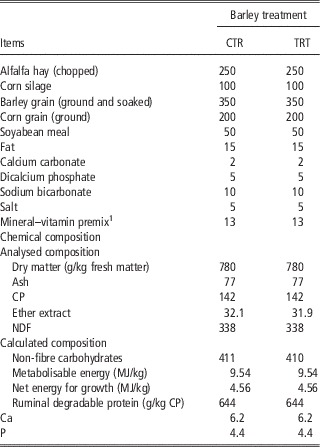
The experiment followed the standards for the care and use of animals established by the Iranian Council of Animal Care (1995). The study was conducted in a commercial farm (Shahrak-Laban Farm) located 20 km from Qom (34°49' N 50°56' E), northern Iran. The study lasted 11 weeks, and the 1st week was considered an adaptation of the animals to the experimental diets and conditions. Average environmental conditions in the farm throughout the study were as follows: temperature ranging between 19°C and 28°C, relative humidity in the range 57% to 62% and day length of 14 to 15 h/day. In all, 28 male Holstein calves (172±5.1 kg BW, age 5.9±0.2 months) were used in a complete randomised design with a 2×2 factorial arrangement (seven animals per experimental group). The total mixed ration (TMR) fed to the calves was formulated according to National Research Council (2000) recommendations for beef cattle, and its ingredient and chemical composition is in Table 1. The animals were housed in individual pens and had free access to water. Barley grain (Gohar cultivar; with 915 g DM/kg and 121 g CP/kg DM) was split in two batches and each was ground in a hammer mill with screens of different mesh size to obtain mash with two different particle sizes, namely small particle size (SPS) with a geometric mean diameter of 1200 µm and large particle size (LPS) with a mean diameter of 2400 µm. Samples of ground barley (both of LPS and SPS) were taken for determination of the particle size distribution. In both cases, barley was treated with citric acid (Iran Chemical Compounds, Tehran, Iran) at two rates of addition, 0 or 20 g citric acid/kg barley. In the treated (TRT) barley, 1 l of an aqueous solution of citric acid with a concentration of 20 g citric acid/l was thoroughly mixed with 1 kg barley. In the control (CTR) barley, 1 kg of barley was soaked in an equal volume (1 l) of tap water. In both cases, ground barley was soaked for 48 h before being incorporated into the TMR, following the approach described by Iqbal et al. (Reference Iqbal, Zebeli, Mazzolari, Bertoni, Dunn, Yang and Ametaj2009). The batch size for the preparation of treated and control barley was 80 kg. Therefore, the four experimental treatments were (i) SPS barley soaked in water (SPS-CTR); (ii) SPS barley soaked in citric acid solution (SPS-TRT); (iii) LPS barley soaked in water (LPS-CTR); and (iv) LPS barley soaked in citric acid solution (LPS-TRT), according to a factorial experimental design. After adding barley to the TMR, this was fed to the animals in two equal meals at 0800 and 1600 h. The diets were fed to the animals for a period of 11 weeks. Orts were collected and weights recorded once daily at 0730 h and the amount of feed offered to each animal was adjusted daily to attain refusals of 10% intake. Dry matter intake was calculated from the amounts and DM contents of feed offered and orts.
Ingredients and chemical composition of the total mixed rations (g/kg dry matter; unless otherwise stated)

CTR=control (barley grain steeped in tap water); TRT=barley grain steeped in citric acid.
1 Composition: 1.8% Mn, 1.8% Zn, 0.85% Fe, 0.40% Cu, 0.03% I, 0.03% Co, 0.01% Se. 2 200 000 IU/kg of vitamin A, 860 000 IU/kg of vitamin D, 8000 IU/kg of vitamin E.
Measurements, sample collection and analysis
Body weights were recorded on the 1st day of the experiment and at 7 days intervals thereafter until the end of experiment. Animals were weighed before the morning meal to minimise the effect of digestive contents on BW.
Samples of each TMR were collected daily and the DM was determined by drying at 60°C for 48 h (Association of Official Analytical Chemists (AOAC), 1995). Composite samples of each TMR were ground in a Wiley mill through a 1-mm screen, and analysed to determine total N, ether extract and ash contents (AOAC, 1995). The methods of Van Soest et al. (Reference Van Soest, Roberts and Lewis1991) were used for the determination of NDF, which was assayed with a heat stable amylase and expressed inclusive of residual ash (NDF). On the last 5 days of the experiment two faecal grab samples were collected daily from each animal at 0600 and 1800 h (10 samples for each calf). Faecal samples were dried in a forced draft oven (60°C; 72 h) and then ground in a Wiley mill through a 1-mm screen. Aliquots of all faecal samples collected for each calf were mixed to obtain one composite sample for each animal. These composite faecal samples were analysed to determine total N, ash and NDF. Apparent total tract digestibility of nutrients was measured by using acid insoluble ash as an internal marker (Van Keulen and Young, Reference Van Keulen and Young1977). In this method, the acid insoluble ash concentration was determined in feed and faeces by treating the ash with a 2 N-HCl solution.
To determine the amount of undigested grain particles in faeces, 1 kg of fresh faeces per calf was collected every 4 weeks, and then washed in a bin with water removing non-particulate matter and fibre particles. The remaining material was filtered through a sieve (800-µm opening size) and the fraction retained in the sieve was dried in an oven at 60°C for 48 h. The fraction (as proportion of the DM in 1 kg of faeces) was regarded as the undigested grain particles (Fatehi et al., Reference Fatehi, Dehghan-Banadaky, Rezayazdi, Moradi-Shahrbabak and Anele2013).
The health status of the animals was assessed by monitoring respiration rate, rectal temperature and faecal score on days 25, 50 and 75 of the experiment. For faecal scoring the scale explained by Heinrichs et al. (Reference Heinrichs, Jones, Van Roekel and Fowler2003) was used where a score=1 represents normal faeces and a score=5 was for watery, mucous and bloody faeces.
Rumen fluid samples were collected using a stomach tube at 3 to 4 h after the morning feeding on days 30 and 60 of experiment. The first 30 ml was discarded because of possible saliva contamination and ruminal pH was measured immediately (HI 8314 membrane pH metre; Hanna Instruments, Villafranca, Italy). The rumen samples were squeezed through four layers of cheesecloth. Two samples of rumen fluid (8 ml each) were mixed with 0.2 ml sulphuric acid 50% and stored at −20°C. Just before analysis, samples were thawed, centrifuged at 10 000×g (4°C, 20 min). Ammonia nitrogen (NH3-N) concentration was determined in one of the samples using a Kjeltech Auto 1030 Analyser, Valley City, OH (FOSS, Hillerød, Denmark) (Crooke and Simpson, Reference Crooke and Simpson1971). The other sample was used for the analysis of VFA using a gas chromatograph (Varian 3700, Varian Specialties Ltd, Brockville, ON, Canada) equipped with a 15 m (0.53 mm i.d.) fused silica column (DBFFAP column; J&W Scientific, Folsom, CA, USA).
Blood was sampled from the jugular vein of each animal at 3 to 4 h after the morning feeding twice throughout the study (on days 31 and 61). Blood samples were heparinised and stored at 2°C; then centrifuged at 3000×g (4°C, 15 min) and the plasma stored at −20°C. Plasma was analysed to determine the concentrations of glucose, β-hydroxybutyrate, non-esterified fatty acids, urea N, total protein and insulin using Pars Azmoon kits and associated procedures (Pars Azmoon Co., Tehran, Iran).
The spot urine sampling technique was used for the estimation of daily urine output from creatinine concentration as explained in detail by Valadares et al. (Reference Valadares, Broderick, Valadares filho and Clayton1999). On days 33 and 66 of the experiment spot urine samples were collected from each animal during the morning (between 0900 and 1100 h) and during the afternoon (between 1500 and 1700 h). Samples were collected when calves urinated spontaneously (~50 ml). An aliquot of 10 ml of each sample was diluted immediately with 90 ml of 0.036 N sulphuric acid and stored at −20°C for analysis. Later, urine samples were thawed at room temperature and analysed to determine the concentrations of urea N (using the automated colorimetric assay described by Broderick and Clayton, Reference Broderick and Clayton1997), creatinine (Kit No. 555-A; Sigma Chemical Co., St. Louis, MO, USA), uric acid (Kit No. 685-50; Sigma Chemical Co.) and allantoin (using the HPLC method described by Chen and Gomes, Reference Chen and Gomes1992). Total excretion of allantoin and uric acid was calculated from estimated daily urine output and determined metabolite concentrations.
Statistical analysis
The experiment was conducted using a complete randomised design with seven replicates (calves) per experimental group. Data for the variables measured in two or more sampling days (BW, intake, health signs, rumen, blood and urine determinations) were analysed using a split plot in a complete randomised design. The statistical model used was Y ijkl =µ+P i +C j +PC ij +A k(ij) +S l +ɛ ijkl , where Y ijkl is each observation for the dependent variable, µ the overall mean, P i the effect of barley particle size (i=2, SPS v. LPS), C j the effect of citric acid addition to barley (j=2, CTR v. TRT), PC ij the interaction effect between barley particle size and citric acid addition, A k(ij) the random effect of animal (calf) within each group, S l the effect of the sampling day and ε ijkl the residual error. Animal was the experimental unit for the main plot, and thus the random effect of calf within group was considered as the error term to assess the significance of the main factors (fixed effects of barley particle size and citric acid addition, and their interaction). The sampling day effect was included in the model as repeated measurements within each experimental unit, using an autoregressive type 1 covariance structure. The Bayesian information criterion was used to select covariance structure of the model for each variable. Sampling day effect was excluded from the above model for the statistical analysis of performance traits over the whole experimental period (initial or final weight, average daily gain, feed to gain ratio) or digestibility data. Thus, in these cases the model was Y ijk =µ+P i +C j +PC ij +ɛ ijk , where the model terms were as described above. Statistical significance was declared at P<0.05, and differences were considered to indicate a trend at 0.05<P<0.10. The ANOVAs were performed using the PROC MIXED of SAS.
Results
As expected, BW and feed intake increased progressively (P<0.05) over the course of the experiment. For all the other variables (rumen, blood and urine determinations), the effect of sample day was never significant (P<0.05), and only the effects of the main factors (grain PS and CA treatment) will be reported.
Intake, performance, apparent digestibility and health
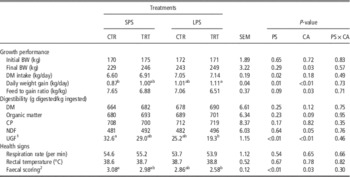
Feed intake, apparent digestibility and the monitored health signs are presented in Table 2. Calves fed the SPS showed a lower intake (P=0.02) than those fed the LPS diet. Daily weight gain was increased with TRT compared with CTR barley (P=0.01) and when grain was ground more coarsely (P<0.01). The feed conversion ratio was improved with the TMR containing TRT barley (P=0.03). Steeping barley grain in citric acid improved fibre digestibility (P=0.05). The digestibility of DM and CP were not affected by any treatment. The proportion of undigested grain particles in faeces was affected by both acid treatment (P<0.01) and PS (P<0.01). Respiration rate and rectal temperature were similar for all the experimental groups; but faecal score values were significantly influenced by both PS (P<0.01) and acid treatment (P=0.03).
Effects of particle size reduction and citric acid treatment of barley grain on performance, digestibility and health of Holstein calves (n=7 per treatment)

SPS-CTR=small particle size barley grain steeped in water; SPS-TRT=small particle size barley grain steeped in citric acid; LPS-CTR=large particle size barley grain steeped in water; LPS-TRT=large particle size barley grain steeped in citric acid; PS=grain particle size; CA=citric acid addition; PS×CA=interaction; DM=dry matter; UGF=undigested grain particles in faeces.
a,bMeans within a row with different superscript letters are different (P<0.05).
1 Presence of UGF (g/kg DM of faeces).
2 Faecal scoring: 1=normal; 2=soft to loose; 3=loose to watery; 4=watery, mucous and slightly bloody; and 5=watery, mucous and bloody.
Rumen fermentation pattern and microbial nitrogen yield
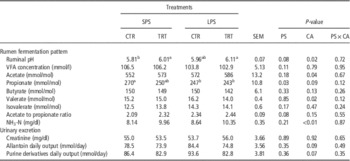
The data for rumen fermentation activities and urinary excretion of purine derivatives are presented in Table 3. Ruminal pH was greater with TRT barley (P=0.02). Barley PS (P=0.11) or citric acid treatment (P=0.79) had no significant effects on total VFA concentration in the rumen. However, effects on the molar proportions of individual VFA were observed. When calves were fed the diet with TRT barley, the molar proportion of acetate was increased (P=0.04) and that of valerate was slightly decreased (P=0.02). The proportion of propionate in the rumen was increased with SPS grain (P=0.03) and tended to decrease with TRT barley (P=0.09). The NH3-N concentration in the rumen was increased when calves were fed the diet with TRT barley (P<0.01). The grain PS had no effect on the urinary excretion of purine derivatives (P=0.36). However, urinary allantoin (P=0.09) and purine derivatives daily outputs (P=0.07) tended to be lower for diets containing the TRT barley.
Effects of particle size reduction and citric acid treatment of barley grain on rumen fermentation pattern and microbial nitrogen flow in Holstein calves (n=7 per treatment)

SPS-CTR=small particle size barley grain steeped in water; SPS-TRT=small particle size barley grain steeped in citric acid; LPS-CTR=large particle size barley grain steeped in water; LPS-TRT=large particle size barley grain steeped in citric acid; PS=grain particle size; CA=citric acid addition; PS×CA=interaction; VFA=volatile fatty acids; NH3-N=ammonia nitrogen.
a,bMeans within a row with different superscript letters are different (P<0.05).
Blood metabolites
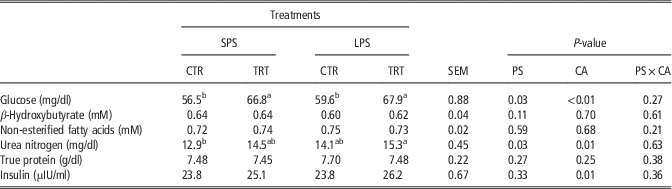
The blood glucose concentration was influenced by both PS (P=0.04) and citric acid treatment (P<0.01) of barley grain (Table 4). The blood urea N was increased in calves-fed LPS (P=0.02) or TRT barley grain (P<0.01). Blood concentrations of non-esterified fatty acids, β-hydroxybutyrate and total protein were not affected by particle size or acid treatment. The plasma insulin concentration was increased in calves fed the diet with TRT barley (P=0.01).
Effects of particle size reduction and citric acid treatment of barley grain on blood metabolites and insulin in Holstein calves (n=7 per treatment)

SPS-CTR=small particle size barley grain steeped in water; SPS-TRT=small particle size barley grain steeped in citric acid; LPS-CTR=large particle size barley grain steeped in water; LPS-TRT=large particle size barley grain steeped in citric acid; PS=grain particle size; CA=citric acid addition; PS×CA=interaction.
a,bMeans within a row with different superscript letters are different (P<0.05).
Discussion
Grain particle size
Grinding barley grain to a smaller particle size decreased feed intake of both CTR and TRT diets. The higher feed intake with LPS barley resulted in increased average daily weight gain, and tended to improve feed efficiency, although the effect of barley PS on feed to gain ratio did not reach statistical significance. With the SPS barley, propionate concentration in the rumen was increased, whereas ruminal pH and acetate to propionate ratio tended to decrease. Propionate produced by microbial fermentation in the rumen may be an important factor controlling feed intake in ruminants fed high-grain diets (Allen et al., Reference Allen, Bradford and Oba2009). According to the hepatic oxidation theory, propionate entering into the liver induces metabolic processes associated with satiety signals to which the animals respond reducing feed intake (Allen et al., Reference Allen, Bradford and Oba2009). A smaller particle size may favour the microbial and enzymatic access to starch thus hastening its rate of fermentation in the rumen and causing a faster decline in pH (Owens et al., Reference Owens, Secrist, Hill and Gill1998). In the present study, ruminal pH was above the benchmark for subacute ruminal acidosis (pH >5.6), but a depression of ruminal pH <6 is already associated with irregular patterns of feed consumption during the day resulting in decreased feed intake (Krause et al., Reference Krause, Combs and Beauchemin2002; Gimeno et al., Reference Gimeno, Al Alami, Abecia, de Vega, Fondevila and Castrillo2015). A larger barley grain PS also resulted in increased glucose concentration in blood. Feed digestibility was not affected by barley grain PS, but the proportion of undigested grain particles in faeces was significantly reduced when calves received the ration with barley grain ground to a larger particle size. Although faecal particle size is not a suitable indicator of the size of particles leaving the reticulorumen (Yang et al., Reference Yang, Beauchemin and Rode2001), the reduction in grain particle size may reduce the retention time in the rumen, increasing the flow of undigested particles to the lower digestive tract.
Citric acid treatment
All the diets used in the present study had the same ingredient composition, and the only source of variation was the physical and chemical treatment of the barley included in the diets at 350 g barley/kg diet. Harder et al. (Reference Harder, Khol-Parisini and Zebeli2015b) observed some changes in the chemical composition of cereal grains treated with citric acid. However, in the present study there were no differences in chemical composition between diets including control or treated barley (Table 1). Even though citric acid treatment could cause the loss of some nutrients in barley grain (Harder et al., Reference Harder, Khol-Parisini and Zebeli2015b), this effect would be minor in the whole diet as barley accounts for only 35% of the TMR.
Treating cereals with organic acids may contribute to modulate ruminal tolerance of grain feeding and alleviate the digestive disorders (Iqbal et al., Reference Iqbal, Zebeli, Mazzolari, Bertoni, Dunn, Yang and Ametaj2009; Humer et al., Reference Humer, Khol-Parisini, Gruber, Gasteiner, Abdel-Raheem and Zebeli2015), thus improving ruminant performance and health. The increased weight gain with a similar feed intake observed in calves fed the TRT diet compared with the CTR diet resulted in a better feed efficiency. This could be probably related to a slightly improved fibre digestibility, which can be in part associated with the increased ruminal pH. Fibrolytic bacteria would be affected negatively at low ruminal pH and may be replaced by amylolytic bacteria (Tajima et al., Reference Tajima, Aminov, Nagamine, Matsui, Nakamura and Benno2001). The addition of citric acid to barley grain would contribute to maintain a higher and more stable pH in the rumen. It has been shown that treating barley grain with LA or tannic acid caused changes in the ruminal microbiota improving fibre digestibility (Deckardt et al., Reference Deckardt, Metzler-Zebeli and Zebeli2016). Harder et al. (Reference Harder, Khol-Parisini and Zebeli2015c) reported an increase in the abundance of Prevotella bacteria and enhanced fibre degradation in vitro when barley was treated with citric acid.
In the present study, steeping barley grain in citric acid did not influence total VFA concentration in rumen, but changed the molar proportion of individual acids, increasing acetate and tending to decrease propionate and valerate. Newbold et al. (Reference Newbold, Lopez, Nelson, Ouda, Wallace and Moss2005) observed that the addition of citrate to a diet with 75% forage and 25% concentrate increased acetate production but did not affect propionate or methane production. Different processing methods of grains can affect starch digestion in the rumen with effects on VFA production as well as on individual VFA profile (Dehghan-Banadaky et al., Reference Dehghan-Banadaky, Corbett and Oba2007). Therefore, the decrease in propionate and valerate concentrations might indicate a change in the extent of starch degradation in the rumen (Huntington et al., Reference Huntington, Harmon and Richards2006). Other authors have reported that treating barley grain with LA increased RSS (Harder et al., Reference Harder, Khol-Parisini, Metzler-Zebeli, Klevenhusen and Zebeli2015a and 2015Reference Harder, Khol-Parisini and Zebelib; Deckardt et al., Reference Deckardt, Metzler-Zebeli and Zebeli2016). As less starch is digested in the rumen, a greater amount of starch can be digested in the small intestine (Reynolds, Reference Reynolds2006), increasing glucose absorption and consequently improving energy efficiency and production response (Huntington et al., Reference Huntington, Harmon and Richards2006; Deckardt et al., Reference Deckardt, Metzler-Zebeli and Zebeli2016). Treating barley grain with citric acid could increase energy utilisation, thus increasing weight gain. Glucose is considered as one important indicator of the animal energy balance (Huntington et al., Reference Huntington, Harmon and Richards2006). The higher glucose and insulin concentrations in the blood of calves-fed diets with TRT barley would support a greater intestinal absorption of glucose, and an increased secretion of insulin in response to the rise in glucose concentration to improve the uptake of glucose by tissues. Treating cereals with other organic acids (LA) also decreased starch degradation in the rumen, shifting the digestion of starch to the intestine in dairy cows (Iqbal et al., Reference Iqbal, Zebeli, Mazzolari, Bertoni, Dunn, Yang and Ametaj2009).
Ruminal NH3-N concentration was increased with CA-treated barley grain. The effect was accompanied by a tendency for a decreased flow of microbial N to the duodenum, estimated from the urinary excretion of purine derivatives. It is plausible that by limiting the starch fermentation in the rumen (in response to the citric acid addition) the fermentable energy available for microbial synthesis will be reduced, thus decreasing the amount of microbial protein leaving the rumen. The uptake of ammonia derived from protein degradation would be constrained, thus raising the concentration of NH3-N in the rumen of calves-fed CA-treated barley. This ammonia would be absorbed in the rumen reaching the liver where it is converted into urea. Consequently, this would also explain the increased urea N concentration in the blood of calves-fed treated barley grain with citric acid, showing that the acid treatment could decrease efficiency of N utilisation in the rumen. According to Kohn et al. (Reference Kohn, Dinneen and Russek-Cohen2005), blood urea N is an indicator of N efficiency in ruminants. However, Reynolds (Reference Reynolds2006) reported that regardless the increase in ammonia production observed when steers are fed a diet to increase the rumen escape of starch; this is not associated with significant changes in the net absorption of amino acids.
Conclusion
Feeding barley grain treated with 20 g citric acid/kg for 11 weeks increased the digestibility of fibre and improved ruminal pH condition. The treatment with citric acid can probably increase the flow of starch to the small intestine, thus increasing the absorption of glucose. A reduced starch degradation in the rumen may decrease N uptake by rumen microbes and microbial protein synthesis in calves fed CA-treated barley grain. The beneficial effects of treating barley grain with citric acid on digestion result in improved weight gain and feed efficiency in growing calves. Increasing grinding particle size of barley grain (up to 2.4 mm diameter) may also influence ruminal degradation and intestinal digestion of starch, resulting in increased feed intake and growth rate of calves. However, there seems to be no interaction between citric acid treatment and particle size of barley grain.
Acknowledgements
Financial support from the Department of Research in Arak University (Arak, Iran) is appreciated deeply. Special thanks to Dr A. Fazlali (deputy of research and technology of Arak University) for his assistance with performing the experiment. The work is part of a companion project between Arak University and a commercial animal farm (Shahrak-Laban Farm, Qom). Dr Moallemian for assistance in laboratory measurements, B. Sajedi MSc in University of Tehran and the animal farm staff are gratefully acknowledged.