Introduction
Accurate incidence estimates are important since they provide a link to potential risk factors, which may vary over time, thus increasing our understanding of the aetiology (Brown, Reference Brown2011). The neurodevelopmental model (Murray & Lewis, Reference Murray and Lewis1987) proposes that exposures such as maternal stress (Huttunen & Niskanen, Reference Huttunen and Niskanen1978; Khashan et al. Reference Khashan, Abel, McNamee, Pedersen, Webb, Baker, Kenny and Mortensen2008; Abel et al. Reference Abel, Heuvelman, Jörgensen, Magnusson, Wicks, Susser, Hallkvist and Dalman2014) maternal famine (Susser & Lin, Reference Susser and Lin1992; Brown et al. Reference Brown, Susser, Lin, Neugebauer and Gorman1995; St Clair et al. Reference St Clair, Xu, Wang, Yu, Fang, Zhang, Zheng, Gu, Feng, Sham and He2005), infections (Buka et al. Reference Buka, Cannon and Torrey2008; Sørensen et al. Reference Sørensen, Mortensen, Reinisch and Mednick2009; Xiao et al. Reference Xiao, Buka, Cannon, Suzuki, Viscidi, Torrey and Yolken2009) and birth complications (Geddes & Lawrie, Reference Geddes and Lawrie1995; Kinney et al. Reference Kinney, Yurgelun-Todd, Tohen and Tramer1998; Kunugi et al. Reference Kunugi, Nanko and Murray2001; Cannon et al. Reference Cannon, van Erp, Rosso, Huttunen, Lönnqvist, Pirkola, Salonen, Valanne, Poutanen and Standertskjöld-Nordenstam2002; Scott et al. Reference Scott, McNeill, Cavanagh, Cannon and Murray2006; Nosarti et al. Reference Nosarti, Reichenberg, Murray, Cnattingius, Lambe, Yin, MacCabe, Rifkin and Hultman2012) during fetal/neonatal life in interaction with predisposing genes, affect the fetus to develop vulnerability for psychiatric disorders, particularly schizophrenia. Improvements in obstetric and maternal healthcare and positive socioeconomic development in Sweden from the 1950s onwards would thus be expected to affect incidence estimates if these risk factors had a major impact. Over the years, several studies have suggested that total incidence, morbid risk or first admission rate for schizophrenia has decreased during 1970–1990 (Munk-Jörgensen, Reference Munk-Jörgensen1995), whereas other studies have found unchanged (Harrison et al. Reference Harrison, Cooper and Gancarczyk1991; Oldehinkel & Giel, Reference Oldehinkel and Giel1995) or even increased (Tsuchiya & Munk-Jörgensen, Reference Tsuchiya and Munk-Jørgensen2002; Bray et al. Reference Bray, Waraich, Jones, Slater, Goldner and Somers2006) incidence rates during this period of time. Only a few studies have reported incidence estimates over time for affective psychosis (Kirkbride et al. Reference Kirkbride, Errazuriz, Croudace, Morgan, Jackson, Boydell, Murray and Jones2012), two of which reported a decline in rates during 1970–1990 (Harrison et al. Reference Harrison, Cooper and Gancarczyk1991; de Alarcon et al. Reference de Alarcon, Seagroatt, Sellar and Goldacre1993), whereas one showed stable incidence rates during 1980–2000 (Kirkbride et al. Reference Kirkbride, Croudace, Brewin, Donoghue, Mason, Glazebrook, Medley, Harrison, Cooper, Doody and Jones2009). All these studies are based on period-based estimates, i.e. the time of diagnosis, which predominantly mirrors proximal or precipitating risk factors affecting everybody regardless of age. In addition period-based estimates are sensitive to diagnostic habits and referral patterns over time. To examine the effect of distal exposures on incidence during a limited time period, e.g. perinatal life, changes between birth cohorts are more interesting than between periods (year of diagnoses). The former are also less susceptible to political reforms or diagnostic criteria varying over time. We therefore set out to explore birth cohort-based incidence estimates of schizophrenia as well as bipolar disorder and affective psychosis.
In Stockholm County the period-based in-patient incidence for schizophrenia and bipolar and other affective psychoses typically varies along with availability of outpatient wards and changes of diagnostic manuals, and no apparent association with improvements in obstetric and maternal healthcare and socioeconomic development from the 1950s onwards has been shown. We hypothesized that a potential impact of these changes on incidence would become more evident when estimates based on consecutive birth cohorts, rather than the year of diagnosis (period-based) were used. If the incidence estimates are increasing for every year of birth this would contradict a major role of perinatal risk factors in the aetiology of the disorders whereas a decrease would not. We also hypothesized that schizophrenia incidence would be more affected compared to bipolar disorder and other affective psychoses since most perinatal risk factors are more pronounced in schizophrenia aetiology. To examine this we calculated incidence estimates for schizophrenia and bipolar disorder and other affective psychosis, respectively, for all consecutive birth cohorts born between 1955 and 1967 in Stockholm, Sweden.
Method
Population
This is a record linkage study based on Swedish national registers held by Statistics Sweden and The National Board of Health and Welfare. All persons born in Sweden between 1955 and 1967 were identified in the Multigeneration Register via each individual's unique personal identification number. These birth cohorts were chosen in order to minimize the impact of changes in the psychiatric care policies in the mid-1990s (opting for outpatient care rather that inpatient care whenever possible). To further obtain homogenous healthcare circumstances, this study was limited to Stockholm County, which is governed by one political structure and contains 20% of the Swedish population. To identify individuals from Stockholm County we linked the data to the Swedish Population and Housing Censuses, which were performed at 5-year intervals between 1960 and 1990, and to the ‘Longitudinal integration database for health insurance and labour market studies’ (LISA) 1995 and 2000. Only people residing in Stockholm County at three or more possible time points were included (N = 2 28 903). Those who had emigrated (N = 11 182) (data obtained from the Register of Total Population) or died (information from the National Cause of Death Register) before the age of 35 years (N = 1294) were excluded. Another 105 individuals were excluded due to missing values on the date variable. The final analytical sample consisted of 2 16 322 individuals.
Outcome
Each birth cohort was followed in the National Patient Register regarding inpatient episodes for psychoses between the ages of 18–30 years, to make the cohorts comparable. The last birth cohort (1967) was thus followed until 1997. No outpatient data were available before 1997 in the registers. Schizophrenia was defined as F20 in ICD-10; 295–295E, 295G, 295W, 295X in ICD-9; 295–295.40, 295.60, 295.80–295.99 in ICD-8. Other non-affective psychoses was defined as F21-F29 in ICD-10; 295F, 295H, 297–297X, 298C-298X in ICD-9; 295.50, 295.70, 297–297X, 298.20–298.99, 299.99 in ICD-8; and no incident schizophrenia episode, and bipolar and other affective psychoses was defined as F30-F31, F323, F333 in ICD-10; 296A, 296C-W in ICD-9; 296.10, 296.20, 296.30, 296.88 in ICD-8. Bipolar disorder and other affective psychoses were grouped together because the ICD classification system was not compatible over time and did not allow a clear-cut discrimination.
Statistical analyses
Number of incident cases per 10 000 person-years was calculated for each birth cohort. Person-years were calculated using date of first admission for the particular diagnosis, date of death, and date of emigration. Starting date was age 18 years and end date was at first admission, or age 30 years, whichever came first. To estimate potential decline in incidence rate by birth cohort, linear regression was used.
Results
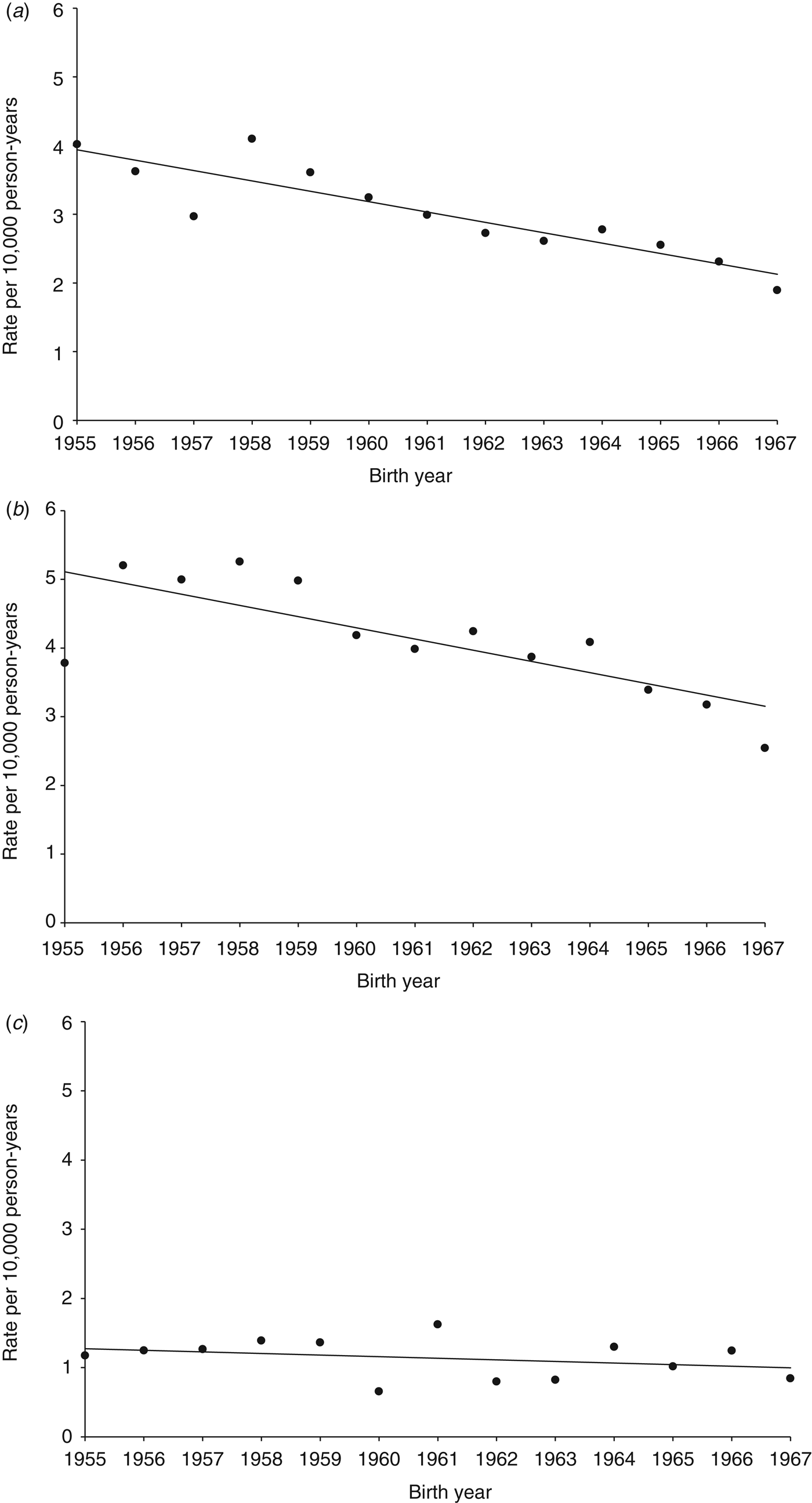
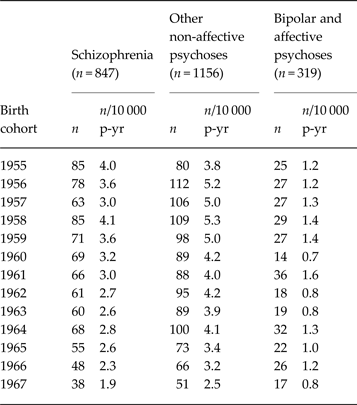
Among the 2 16 322 individuals born between 1955 and 1967 and resident in Stockholm, 847 had an incident episode of schizophrenia, 1156 individuals had inpatient care for other non-affective diagnoses, and 319 had a diagnosis of bipolar or other affective psychoses between ages 18 and 30 years (Table 1). Mean age at onset varied very little between diagnoses and birth cohorts. For schizophrenia the mean age at onset varied between 24.5 and 25.8 years [standard deviation (s.d.) = 3.2–3.8 years] in the different birth cohorts. For other non-affective psychosis the mean age at onset varied between 24.5 and 26.0 (s.d. = 3.3–3.9) years, and for bipolar disorder 24.6 and 26.8 (s.d. = 2.8–4.1) years. Among individuals born in 1955, 4/10 000 persons-years developed schizophrenia whereas among individuals born in 1967 only 2/10 000 person-years developed schizophrenia. This trend of decline is continuous over the successive cohorts, albeit interrupted by birth cohorts 1958–1959 (Fig. 1a ). On average there was a decrease in the incidence rate of 0.15 for every birth cohort from 1955 to 1967 (linear regression, p < 0.0001). As some cases with schizophrenia may be diagnosed as other non-affective psychoses we calculated the incidence of non-affective psychosis, other than schizophrenia. Among those born in 1955, 3.8/10 000 person-years developed other non-affective disorder (Table 1). From the 1958 birth cohort there was a general trend of decrease, down to 2.5/10 000 person-years for those born in 1967 (Fig. 1b ). We found an average decrease in the incidence rate of 0.16 for every birth cohort from 1955 to 1967 (linear regression, p < 0.002).
Inpatient incidence of (a) schizophrenia, (b) other non-affective psychosis (excluding schizophrenia) and (c) bipolar and other affective psychoses.

Number (n) and number of persons per 10 000 person-years (n/10 000 p-yr) diagnosed with schizophrenia, other non-affective psychoses or bipolar disorder (including affective psychoses), by birth year

The incidence of bipolar disorder and other affective psychosis for the same birth cohorts (born 1955–1967) was sustained at approximately 1 case/10 000 persons per year, 18–30 years later (Table 1, Fig. 1c ). Linear regression showed no decrease in the incidence rate (−0.02 for every birth cohort from 1955 to 1967, p = 0.29).
Discussion
This is to our knowledge the first study to compare incidence of schizophrenia with that of bipolar disorder and other affective psychosis based on consecutive birth cohorts. Thus far only two studies have investigated the effects of consecutive birth cohorts on schizophrenia incidence (Takei et al. Reference Takei, Lewis, Sham and Murray1996; Suvisaari et al. Reference Suvisaari, Haukka, Tanskanen and Lönnqvist1999) and no study has investigated bipolar disorder with this study design. Here we present data showing that, among individuals born in Sweden in 1955–67, the birth cohort-based inpatient care incidence (until the age of 30) of schizophrenia as well as other non-affective psychoses decreased, while that of bipolar disorder and other affective psychosis was sustained. These disorders share many clinical features, respond to similar drugs and share several risk genes (Craddock & Sklar, Reference Craddock and Sklar2013) as well as environmental risk factors. Environmental risk factors, including (epi)genetic–environment interactions, are of specific concern in this context as they have an impact on incidence estimates in the short run compared to genetic factors.
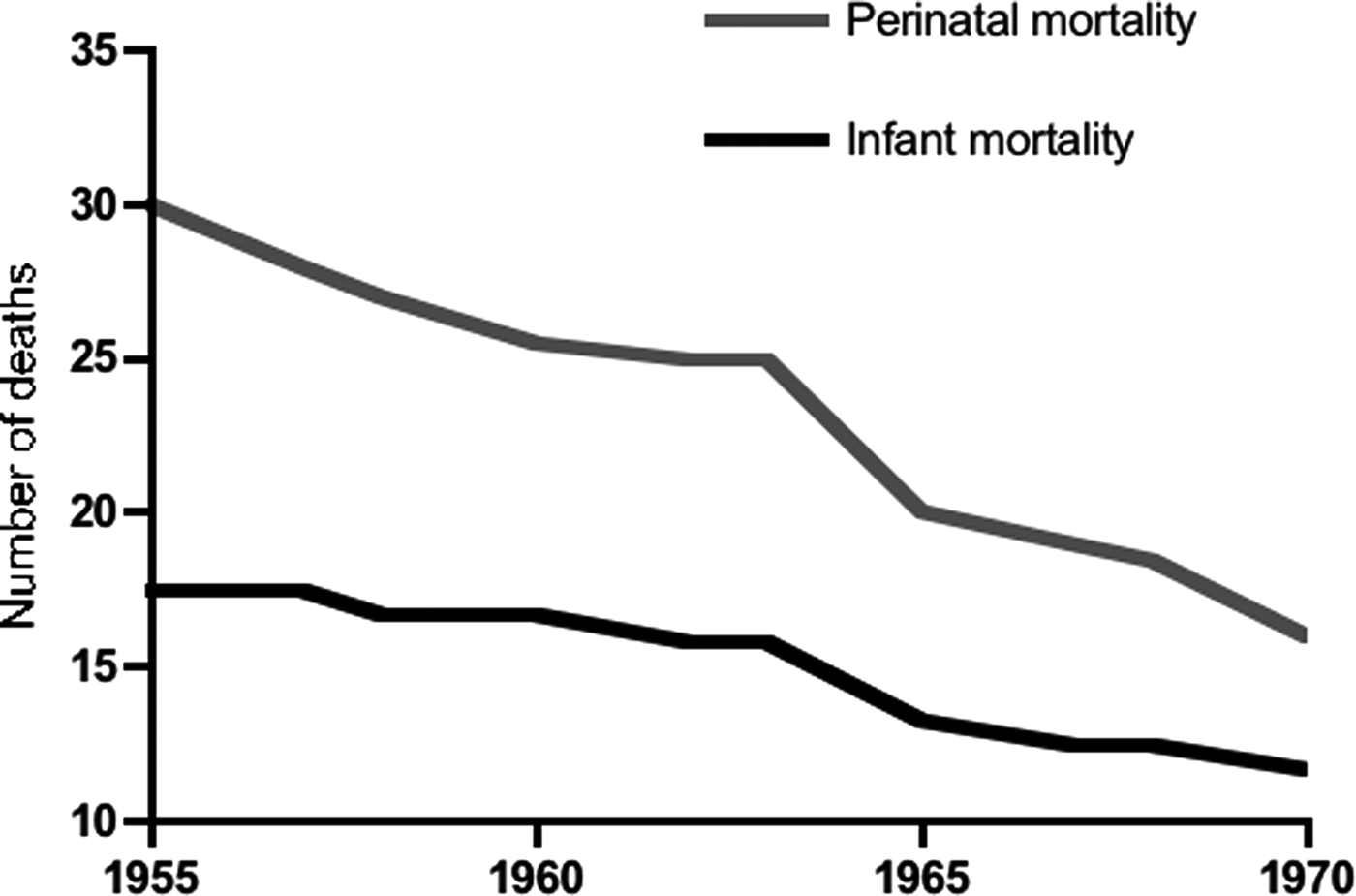
Historically, schizophrenia has been associated with low socioeconomic status (SES), whereas bipolar disorder has been associated with high SES (Stenbäck & Achté, Reference Stenbäck and Achté1966; Helgason, Reference Helgason, Schou and Stromgren1979; Schoeyen et al. Reference Schoeyen, Vaaler, Auestad, Malt, Melle, Andreassen and Morken2011). Accordingly we have previously shown that in individuals born in Sweden between 1963 and 1983, factors associated with low SES increased the risk for development of schizophrenia and non-affective psychosis (Wicks et al. Reference Wicks, Hjern, Gunnell, Lewis and Dalman2005) regardless of family history of psychiatric disorders. Moreover, adoptees in families with low SES showed an increased risk for non-affective psychosis, also in the absence of genetic liability (Wicks et al. Reference Wicks, Hjern and Dalman2010). Clearly, SES has improved during 1955–1967 as indicated by infant mortality, a traditional indicator of the standard of living in a society, due to its association with housing, nutrition, hygiene and education (Köhler, Reference Köhler1991). Infant mortality has decreased in Sweden from 18 deaths/1000 live-born infants during the first year after birth in 1955 to 12.5 deaths/1000 in 1967 (Fig. 2). This shows that incidence of schizophrenia and other non-affective psychoses decrease and incidence for bipolar disorder and affective psychosis is sustained during the same period of time as a marked socioeconomic development took place, which hypothetically may have contributed to the findings.
Infant and perinatal mortality in Sweden from 1955 to 1970. Modified from Köhler et al. (Reference Köhler1991). Perinatal mortality includes both stillborn and deaths during the first week of life. Infant mortality equals the number of deaths during the first year of life.

During this period of time perinatal mortality also decreased in Sweden (Fig. 2). Perinatal mortality is defined by WHO as the number of stillborn and neonatal deaths within the first week/1000 live-born infants, and is often regarded as an indicator of the quality of obstetrics and antenatal care, as well as the care of the newborn (Edouard, Reference Edouard1985). This measure could be considered a reasonable proxy of perinatal exposures. From the literature it is known that many perinatal risk factors seem to be of greater importance for schizophrenia compared to bipolar disorder, including obstetric complications (Geddes & Lawrie, Reference Geddes and Lawrie1995; Kinney et al. Reference Kinney, Yurgelun-Todd, Tohen and Tramer1998; Kunugi et al. Reference Kunugi, Nanko and Murray2001; Cannon et al. Reference Cannon, van Erp, Rosso, Huttunen, Lönnqvist, Pirkola, Salonen, Valanne, Poutanen and Standertskjöld-Nordenstam2002; Scott et al. Reference Scott, McNeill, Cavanagh, Cannon and Murray2006; Nosarti et al. Reference Nosarti, Reichenberg, Murray, Cnattingius, Lambe, Yin, MacCabe, Rifkin and Hultman2012) and suboptimal intrauterine nutritional status (Susser & Lin, Reference Susser and Lin1992; Brown et al. Reference Brown, Susser, Lin, Neugebauer and Gorman1995; St Clair et al. Reference St Clair, Xu, Wang, Yu, Fang, Zhang, Zheng, Gu, Feng, Sham and He2005). The pattern of decreased perinatal mortality and incidence estimates of schizophrenia is compatible with the neurodevelopmental hypothesis of schizophrenia aetiology, stressing the importance of early life exposures decreasing over time, whereas this pattern is less apparent in affective disorders.
The present study unveiled a previously unnoticed continuous decline in schizophrenia incidence in Stockholm County during the post-war era, which is in agreement with the two previous studies based on consecutive birth cohorts performed in Scotland and Finland (Takei et al. Reference Takei, Lewis, Sham and Murray1996; Suvisaari et al. Reference Suvisaari, Haukka, Tanskanen and Lönnqvist1999). This may indicate that a more general decline in schizophrenia incidence may be at hand in Western Europe during the post-war era, but it also sharpens the criticism of earlier, period-based incidence studies of time trends (Harrison et al. Reference Harrison, Cooper and Gancarczyk1991; Munk-Jörgensen et al. Reference Munk-Jörgensen1995; Oldehinkel & Giel, Reference Oldehinkel and Giel1995; Tsuchiya & Munk-Jörgensen, Reference Tsuchiya and Munk-Jørgensen2002; Bray et al. Reference Bray, Waraich, Jones, Slater, Goldner and Somers2006), regarding their sensitivity to diagnostic procedures, political and economic changes and population demographic changes (Kendell et al. Reference Kendell, Malcolm and Adams1993). Thus, also in Stockholm County, the period-based incidence typically varies along with such changes. Period-based incidence estimates are of great value for health planning purposes regarding first-episode care, but blur the discussion about level of exposures to distal risk factors changing over time.
Psychiatric incidence studies are susceptible to changes in diagnostic culture over time and may result in shifts from one diagnosis to another. In the present study, a shift from schizophrenia to a diagnosis of other non-affective psychosis seems less plausible since the incidence of this diagnostic group also decreased. A shift to bipolar disorder could be expected, as the latter diagnosis has become more popular among clinicians lately (Mitchell, Reference Mitchell2012). In this study sample, among those diagnosed with schizophrenia, 7.6% were also given a bipolar diagnosis during the same time period or later (until 2006). Among those diagnosed with other non-affective psychosis (excluding schizophrenia), 18.2% were also given a bipolar diagnosis during the same time period or later (until 2006). However, no increase in bipolar disorder incidence was evident among consecutive birth cohorts in the present study. Moreover, given the similarities between the disorders the opposite may occur, counterbalancing the figure above. A possibility of a diagnostic shift from schizophrenia to autism spectrum disorders (ASD) was also considered. In ICD-8 (1967) and ICD-9 (1978) infantile autism was a subgroup within psychotic syndromes. It was not until 1980, in DSM-III, that autism was considered ‘a pervasive developmental disorder’, different from the psychotic syndromes. As the awareness of the diagnosis increased during the 1980s, changes in diagnostic practice may have resulted in an increasing number of adults being diagnosed with ASD leading to a gradually decreasing incidence of schizophrenia in individuals born in 1955–1967. In addition, a schizophrenia diagnosis given before 1980 may have been changed to ASD later. To scrutinize this, we examined the number of individuals born in 1955–1967 with an incident inpatient episode for schizophrenia during the ages of 18–30 years in Stockholm County and found that about 1% were diagnosed with ASD (ICD-10: F84, ICD-9: 299) during 1987–2006. Similarly, about 1% of those with another non-affective psychosis also had an ASD diagnosis registered during the same time period or later. Although this may be an underestimation it indicates both that the number of misdiagnosed patients was low, and that the diagnostic shift later on was of limited magnitude.
The reliability of the inpatient register as a measurement of incidence can be questioned. From 1997 onwards, mobile teams that were able to meet patients in their homes, and sub-specialized outpatient wards were developed in Stockholm County. These structures facilitated treatment of patients with recent-onset psychosis and bipolar disorder outside the hospital setting. The change has been gradual and in year 2005, 25% of the incident cases of schizophrenia in Stockholm County were treated in outpatient wards only (Jörgensen et al. Reference Jörgensen, Ahlbom, Allebeck and Dalman2010). Accordingly we included the birth cohorts born during 1955–1967 and followed all the cohorts until age 30 years (those born 1967 reached age 30 years in 1997). Consequently our results are generalizable for individuals with age at onset between 18 and 30 years, which, however, is a substantial proportion (Geoffroy et al. Reference Geoffroy, Etain, Scott, Henry, Jamain, Leboyer and Bellivier2013; van der Werf et al. Reference van der Werf, Hanssen, Köhler, Verkaaik, Verhey, van Winkel, van Os and Allardyce2014). Concerning the quality of inpatient diagnoses, they have been validated for both schizophrenia (Jörgensen et al. Reference Jörgensen, Ahlbom, Allebeck and Dalman2010) and bipolar disorder (Sellgren et al. Reference Sellgren, Landén, Lichtenstein, Hultman and Långström2011) and proved to be of high quality.
The present study only included people born in Sweden. Since migration and ethnicity are risk factors for schizophrenia (Hjern et al. Reference Hjern, Wicks and Dalman2004), a birth cohort study of migrants would presumably show other patterns, possibly adding to the period incidence estimates in another direction than the Swedish-born birth cohorts. However, this is beyond the scope of this study.
This is to our knowledge the first study of cohort incidence estimates for bipolar disorder and other affective psychoses and the first to compare the estimates with those of schizophrenia. We found a stable incidence for bipolar disorder and other affective psychoses whereas the finding of the present study adds to previous research showing a continuous reduction in incidence estimates for schizophrenia in Western Europe. The use of consecutive birth cohort-based incidence estimates unveiled these patterns, which are compatible with the neurodevelopmental hypothesis of schizophrenia aetiology, stressing the importance of early life exposures decreasing over time, whereas this pattern is less apparent in affective psychoses. Although somewhat speculative, we note that the decline in schizophrenia incidence is paralleled with ameliorations in obstetric care and social living circumstances.
Acknowledgements
This work was been funded by the Swedish Research Council Registration number 523-2010-1052.
Declaration of Interest
None.