Recently, there has been an evident increase in the number of temporary contracts within advanced industrial societies. Nowadays, temporary workers can be found in technical positions and are part of the competitive strategy of organizations (Burgess & Connell, Reference Burgess and Connell2006). Although most publications have highlighted the risks of temporary work, the increase in temporary employment relationships is less problematic for both workers and organizations if it is accompanied with the growing attention to the future employability of the worker (Forrier & Sels, Reference Forrier and Sels2003). Since temporary workers have high job insecurity, employability represents a protective mechanism in the labor market by ensuring that the workers have the skills to find another job quickly. Employability stresses the continuous possibility of workers getting a permanent job. If the job results from an internal recruitment process, we are referring to internal employability. If it consists of a job opportunity outside the organization, we are talking about external employability (Groot & Maassen van Den Brink, 2000). This may be relevant to temporary workers since they both help combat job insecurity. Internal employability does this through the maintenance or progression within the organization whereas external employability does this by facilitating the acquisition of a new job in another organization.
Training has been singled out as a human resource management practice that enhances temporary workers employability by providing them with opportunities to develop their skills (Forrier & Sels, Reference Forrier and Sels2003). Training may be regarded as an organizational practice that entails a social exchange relationship between the employer and employees (Maurer, Pierce, & Shore, Reference Maurer, Pierce and Shore2002). The practice involves higher levels of organizational investment that create feelings of employee obligation to reciprocate with high positive attitudes toward the organization (Shore, Tetrick, Lynch, & Barksdale, Reference Shore, Tetrick, Lynch and Barksdale2006). However, the relationship between training and temporary workers’ attitudes depends on training being perceived as a human resource management practice that promotes their employability (Chambel & Sobral, Reference Chambel and Sobral2011).
Voluntariness reflects the extent to which temporary workers prefer their employment status. It is also used to explain the dynamics of the worker-organization relationship. It was determined that when the worker chose the temporary status the degree of voluntariness was greater than when the worker felt forced or pressured to accept this type of employment status. Some temporary workers prefer and are satisfied with this type of contract because it gives them greater flexibility, freedom and variety. Others accept this type of contract because they see no other employment alternative even though they prefer another form of employment contract (Ellingson, Gruys, & Sackett, Reference Ellingson, Gruys and Sackett1998). In those instances where workers elect to be temporary in order to reconcile their work with either family life or studies, their pursuit of flexibility is expected to make them less committed to the organization. They view it primarily as an economic exchange. Therefore, these particular voluntary temporary workers will develop a decreased social exchange relationship; they seek to limit their involvement with the organization and have little incentive to go beyond a strictly economic relationship (Chambel & Castanheira, Reference Chambel and Castanheira2007). In contrast, temporary workers with low voluntariness have a more social employment relationship because they see future benefits as incentive for their actions, which in turn maximizes internal employability benefits by the employer, namely a future direct contract (Coyle-Shapiro & Kessler, Reference Coyle-Shapiro and Kessler2002). Therefore, one can then expect voluntariness to moderate the relationship between perceived training for future employability and affective commitment. The difference in the relationship strength between the perception of training as a promoter of (internal or external) employability and the affective commitment is expected. Such difference can be linked to the level temporary workers voluntariness.
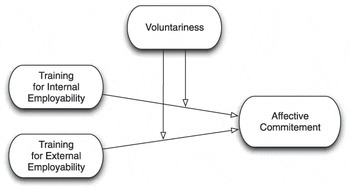
This research has two major objectives (cf. Fig 1). The first is to study the relationship between perceived training for internal or external employability and the temporary workers’ affective commitment. The second is to investigate whether voluntariness moderates these relationships.
Theoretical Model.

This study goes beyond previous research on temporary work in three ways. First, as with Benson (Reference Benson2006), this study distinguishes training that develops internal employability from training that develops external employability; to our knowledge, no other study has applied this distinction to temporary agency workers’ research. Secondly, previous studies have documented the effects of training on temporary agency workers’ outcomes by examining the role of organization-developed actions (Finegold, Levenson, & van Buren, Reference Finegold, Levenson and van Buren2005; Forrier & Sels, Reference Forrier and Sels2003). The present study conceptualizes that it is important to analyze temporary workers’ perceptions and interpretations of training, namely the degree to which it promotes employability. Finally, we take previous research on temporary workers one step further by examining the role of voluntariness as a moderating variable of the relationship between perceived training for (internal or external) employability and the affective commitment of temporary workers.
Coyle-Shapiro and Kessler (Reference Coyle-Shapiro and Kessler2002) suggested that the temporary workers reasons to have a temporary employment moderate the relationship between perceptions of organizational treatment and their reactions. This study analyzes the moderate role of voluntariness on the relationship between how temporary workers perceive the organization’s practices and their affective liaison toward such organization.
Training for Internal and External Employability and Affective Commitment
While permanent workers get security through a continuous job in one organization, temporary workers may seek security through becoming employable (Forrier & Sels, Reference Forrier and Sels2003), that is, the possibility of finding a new job (De Cuyper & De Witte, Reference De Cuyper, De Witte, Naswall, Hellgren and Sverke2008a). We can distinguish between internal and external employability (e.g., Groot & Maassen van Den Brink, 2000). The former is understood as the opportunity that the worker has to continue with and progress within the organization whereas the latter is the opportunity that he/she has to join another organization.
Training is a human resource management practice that allows workers to develop a set of transferable skills. This, in turn, increases the likelihood of getting a job in either the internal or external labor market (Finegold et al., Reference Finegold, Levenson and van Buren2005). Temporary workers perceive the expansion of opportunities through training as a valuable benefit that is offered by the organization (Forrier & Sels, Reference Forrier and Sels2003). The social exchange theory (Blau, Reference Blau1964) is based on the assumption that people form relationships with others based on expectations of return from invested resources. The norm of reciprocity (Gouldner, Reference Gouldner1960) establishes that people feel obliged to respond positively to favorable treatment received from others. Thus, it is expected from workers to respond with a reciprocal positive attitude towards the organization when they perceive a favorable treatment on the part of the organization. Training is related to workers’ perceptions regarding the treatment received from the organization and they will tend to reciprocate with affective commitment.
Organizational commitment is an attitude related to the attachment to the organization, which is conducive to the workers’ desire to maintain organizational membership (Mowday, Steers, & Porter, Reference Mowday, Steers and Porter1979). Meyer and Allen (Reference Meyer and Allen1997) distinguished three forms of commitment: affective, reflecting an affective orientation towards the organization; continuance, the recognition of costs associated with leaving the organization; normative, a moral obligation to remain with the organization. In this study, we selected affective commitment for two reasons. Firstly, it arises from the perception of social exchange relationships between the worker and the organization. An employment relationship based on an economic exchange plays a central role in explaining continuance commitment as this attitude entails an instrumental motivation entailing the exchange of material and tangible benefits and that workers try not to lose. Conversely, workers with high affective commitment reveal an emotional attachment to the organization that presupposes a broad employment relationship entailing the intangible benefits characterizing a social exchange. Secondly, although social exchange also explains normative commitment, in assuming the worker’s obligation to reciprocate positive actions and attitudes from the organization, this form of commitment is weakly related to favorable attitudinal and behavioral outcomes (Meyer, Stanley, Herscovitch, & Topolnytsky, Reference Meyer, Stanley, Herscovitch and Topolnytsky2002). Affective commitment is the form of the employment relationship that better explains positive workers’ responses and continuance is the form typically unrelated or negatively related to desirable workers’ behaviors. A worker with strong affective commitment desires to stay in the organization because he or she wants and is highly motivated to contribute meaningfully to the organization (“Meyer & Allen, 1997, p. 24”). Recently a meta-analysis also confirmed the positive relation (Riketta, Reference Riketta2002) and the positive influence (Riketta, Reference Riketta2008) of affective commitment on both intra- and extra-role performance.
This component is the one that also has greater relevance to the results of the present investigation. Several studies have found a positive relationship between the organizational investment in training and the affective commitment of workers. For example, Bartlett (Reference Bartlett2001) found that the number of training actions in which the nurses from five hospitals had participated was positively related with their affective commitment towards the organization. Birdi, Allan, and Warr (Reference Birdi, Allan and Warr1997) also found a positive relationship between participation in training and the workers’ affective commitment.
However, the relationship between training and the affective commitment of temporary workers depends on their perception of training as a human resource management practice linked to high levels of concern for their needs (Nishii, Lepak, & Schneider, Reference Nishii, Lepak and Schneider2008). Employability is a need of temporary workers that should be taken into account by organizations. When the workers consider such expectation as having been fulfilled, they envision themselves as a part of a social exchange, and reciprocate with affective commitment (Allen, Shore, & Griffeth, Reference Allen, Shore and Griffeth2003).
Benson (Reference Benson2006) stressed that the nature of the skills developed varied with the type of training received. According to this author, there are training actions that develop specific job skills, such as on-job training, and training actions that convey more general skills, such as external training financed by companies. Based on literature review of social exchange, this author expected that the participation in training actions would have a positive effect on workers’ affective commitment to the organization. The author found a positive relationship between participation in on-job training and affective commitment; however, he did not find a significant relationship between participation in external training financed by the company and affective commitment.
Using the underlying belief of Benson (Reference Benson2006) that training can develop different skills, it is reasonable to assume that the training that develops job skills specifically useful to perform a particular function in a particular company (Maurer et al., Reference Maurer, Pierce and Shore2002), i.e., contributes to the promotion of the workers’ internal employability. In gaining these skills, the workers will have a greater chance of getting a better job inside the organization. On the other hand, the training that promotes more general skills, useful to the majority of organizations, is more likely to create external job opportunities for the workers (Lynch, Reference Lynch1991), i.e., promotes their external employability.
Therefore, this study made a distinction between the training that promotes the internal employability of temporary workers and the one that promotes their external employability. Based on the social exchange theory, temporary workers are expected to perceive internal and external employability-promoting training as a benefit that is offered by the organization and reciprocate with affective commitment. Although Benson (Reference Benson2006) did not find a significant relationship between participation in external training financed by the organization and affective commitment in permanent workers, we do expect to find this positive relationship in temporary workers. For temporary workers, employability is their job security and represents an important need (Kluytmans & Ott, Reference Kluytmans and Ott1999), which can be satisfied with both forms of employability.
Based on the information presented above, we posed the following hypotheses:
H1: There is a positive relationship between the perception of training as a promoter of internal employability and temporary workers’ affective commitment.
H2: There is a positive relationship between the perception of training as a promoter of external employability and temporary workers’ affective commitment.
Voluntariness as a Moderator of the Relationship between Training for Employability and Affective Commitment
Voluntariness has dominated temporary employment research for more than 40 years. The impact that voluntariness has upon work-related attitudes and behaviors of temporary workers is one of the most central findings in contingent employment research (DiNatale, Reference DiNatale2001). However, no universal definition has been established.
According to van Breugel, van Olffen, and Olie (Reference van Breugel, van Olffen and Olie2005, p. 546) voluntariness “refers to the perception that an action has been undertaken out of free choice from a set of alternatives”. De Cuyper and De Witte (Reference De Cuyper and De Witte2008b, p. 364), on the other hand, define voluntariness as “the workers’ preferences for temporary jobs or their wish to work on a temporary contract”.
Many authors opted to distinguish between voluntary and involuntary temporary workers. Such labels are unclear: involuntary may be viewed as the individual having no choice in pursuing temporary employment, or as he/she chose to pursue a temporary work arrangement over a permanent one, or as he/she just chose a less preferred employment contract. Moreover, this dichotomy also reduces variation in voluntariness.
To overcome these issues we choose to measure voluntariness on a continuum ranging from low to high. In our study, voluntariness reflects the degree to which temporary workers prefer their employment status rather than pursing alternative employment opportunities. Wanting to remain with the temporary work agency represents an expression of the workers’ voluntariness given that it means continuing with the temporary status.
Temporary workers with high voluntariness prefer their current employment status, have a short-term interest and try to limit their involvement with the organization. For these workers, the organization is simply a place where they do their job and they seek immediate rewards from the employment situation, such as pay and recommendations (Millward & Brewerton, Reference Millward, Brewerton, Cooper and Robertson2000). On the other hand, when temporary workers prefer not to have this type of status and intend to build a career within the organization, they seek a relationship that involves a set of resources. One possible explanation is that these workers want to be seen as permanent and establish a relationship with the organization similar to that of the permanent workers (Chambel & Castanheira, Reference Chambel and Castanheira2007).
Thus, when temporary workers have high voluntariness, the positive relationship between the perception of training as a promoter of internal employability and affective commitment is expected to be weaker. They are constantly seeking for job opportunities that bring them greater financial profitability, more flexibility and personal control (Kalleberg, Reference Kalleberg2000).Those workers value less the promotion of internal employability. Accordingly, they will not develop a strong affective commitment with the organization.
In contrast, the positive relationship between the perception of training as a promoter of external employability and affective commitment is expected to be stronger for temporary workers with high voluntariness. Training will provide them with transferable skills that will facilitate finding a better-paid job or a job that suits better their current personal needs, which is their goal. Consequently, the workers will feel obligated to reciprocate with higher affective commitment.
Taking into account the aforementioned, we put up the hypotheses below:
H3: The positive relationship between the perception of training as a promoter of internal employability and the temporary workers’ affective commitment is weaker when they have high voluntariness.
H4: The positive relationship between the perception of training as a promoter of external employability and the temporary workers’ affective commitment is stronger when they have high voluntariness.
Method
Procedure
The study was presented to the Human Resources Manager of each company. After his/her approval, data about the training developed in the company was collected. The HR Director was to select temporary workers who had been with the company for at least three months. That ensured the temporary workers had participated in two weeks of initial training, had some job experience and could develop an affective connection with the client company. At a meeting with the researchers, the temporary workers’ direct supervisors were presented the goals of the study and asked to distribute the questionnaires to their subordinates and to encourage them to respond. The questionnaires were completed by the temporary workers at the workplace during working hours. The questionnaire took approximately 15 minutes to complete. The questionnaires were then sealed in an envelope and delivered to the Human Resources Director who then handed them to the investigator. All participants were assured that their responses were anonymous and confidential.
Participants
The participants of this study were 279 temporary agency workers (TAW) from 3 organizations in pottery, food and electrical cables factories. For each company, the TAW came from different agencies and all of them had a temporary contract. 55 workers came from organization A (representing 72% of temporary workers in the organization), 80 came from organization B (representing 92.5% of temporary workers in the organization) and 144 came from organization C (representing 78% of temporary workers in the organization). These client organizations hire temporary workers as a response to fluctuations in the labor market. All of these temps were blue-collar workers performing tasks similar to those of permanent workers. The three companies developed initial and continuing training intended to drive the temporary workers job adaptation and promote task performance. They had all received two weeks of initial training; the first week included ‘off the job’ sessions; in the following week, ‘on the job’ sessions. This initial training was geared towards workers acquisition of the necessary skills to start the current job. At the end of this period, if a worker had not adapted, another worker from the same agency would replace him/her and start the initial training process. Whenever the company implemented changes in the manufacturing process or started manufacturing a new product, both permanent and temporary workers would receive training to prepare them for the news tasks. In this case, the number of training hours depended on the product and process complexity. Permanent and temporary workers would receive some ‘on job’ training if they displayed difficulties performing their tasks. The sample is composed mainly of women (70%) and the mean age of the participants is 30 years. However, it is important to note that it was not possible to know the ages of the workers in one of the companies. Data regarding workers’ seniority was not collected to ensure anonymity of the answers.
Measures
Training for employability
The questionnaire that was used to measure the training that promotes internal and external employability was developed by Chambel (Reference Chambel2010) based on literature about training and employability. Since the questionnaire was being used for the first time, a confirmatory factor analysis was performed to verify that the constituent items of each scale actually corresponded to two separate factors. We tested the two-factor model where all observed items loaded on their respective latent variables (training for external employability and training for internal employability). The latent variables were allowed to correlate with each other. The model obtained an acceptable fit χ 2 (18) = 80.28 p < .01; SRMR = .06; TLI = .92; CFI, = .93; RMSEA = .07. Both these factors were comprised of four items (see Appendix). A sample item of the first scale is “I’ve received training that helps me progress within the organization”, and one of the second scale is “With the training that I’ve received, I’ll be able to find a better job in another organization”. The internal consistency of each scale was assessed by Cronbach’s Alpha, and is .78 for “Training for internal employability” and .81 for “Training for external employability”. Items were rated on a 5-point Likert scale, ranging from “Strongly disagree” (1) to “Strongly agree” (5). High scores on these scales indicated that individuals perceived the training as a promoter of their internal or external employability.
Affective commitment
This construct was measured using a translation of the “Organizational Commitment Questionnaire” by Meyer, Allen, and Smith (Reference Meyer, Allen and Smith1993) previously used in a study in Portugal (Chambel & Sobral, Reference Chambel and Sobral2011). This questionnaire consisted of six items (e.g. “This organization has a great deal of personal meaning to me”), three of which were in the negative form and had to be reversed. The scale’s internal consistency, assessed by Cronbach’s Alpha, is .81. The items were scored on a 7-point Likert scale, ranging from “Strongly disagree” (1) to “Strongly agree” (7). High scores on this scale reflected a strong affective commitment to the organization.
Voluntariness
The scale had four items, and a sample item is “I have the goal to keep working in this temporary work agency”. This questionnaire was developed by Chambel (Reference Chambel2010) based on measures of this construct available in the literature (Ellingson et al., Reference Ellingson, Gruys and Sackett1998; Galais & Moser, Reference Galais and Moser2009). The internal consistency of the scale, as determined using Cronbach’s Alpha, is .75. Items were scored on a 5-point Likert scale, ranging from “Strongly disagree” (1) to “Strongly agree” (5). High scores on this scale suggested a strong desire to continue as a temporary worker.
Control Variables
Since age and gender have been consistently associated with affective commitment (e.g., Meyer et al., Reference Meyer, Stanley, Herscovitch and Topolnytsky2002), the effect of these variables was controlled. Age was measured in years and gender was dummy-coded (0 = male; 1 = female). Also, once organization may have been related to study variables, we controlled its effect by coding the organizations into two dummy variables.
Results
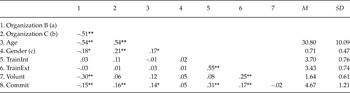
Descriptive statistics and zero-order correlations for all variables can be found in Table 1. According to it, the perception of training for internal employability was higher than the perception of training for external employability. This may be due to the fact that temporary workers received mainly initial and on-job training, whose primary goal is to develop workers adaptation to the role they will perform in the organization. It could also be observed that the workers had a high affective commitment to the organization and low voluntariness, which was consistent with the fact that only the minority of the temporary workforce had this status voluntarily (International Confederation of Private Employment Agencies [CIETT], 2011). With correlation analysis and as expected, there was a relationship between age and affective commitment. In contrast, gender only correlated significantly with age. Also, as expected, training for internal and external employability was correlated with affective commitment.
Descriptive Statistics and Zero-order Correlations for All Variables (N = 279)

Note:
TrainInt = Training for internal employability; TrainExt = Training for external employability; Volunt = Voluntariness; Commit = Affective commitment; (a) Dummy variable coded 0 if Organization = A and C; and 1 if Organization= B; (b) Dummy variable coded 0 if Organization = A and B; and 1 if Organization= C (c) Dummy variable coded 0 for male and 1 for female.
* p < .05; **p < .01.
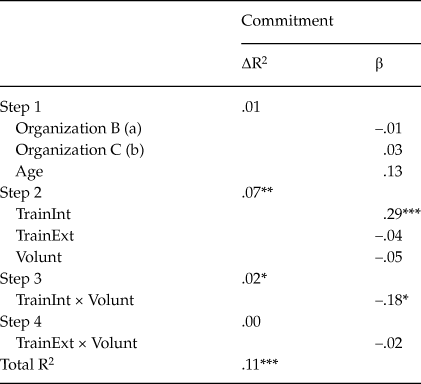
The hypotheses were tested by hierarchical regressions. Hypothesis 1 posited that the higher the perception of training as a promoter of internal employability, the higher the affective commitment of temporary workers. This hypothesis was supported, as can be seen in Table 2: training for internal employability was positively related with affective commitment (β = .29, p < .001).
Analysis of the Relationship between Training for Internal Employability and Workers’ Affective Commitment and Moderation by Voluntariness

Note:
(a) Dummy variable coded 0 if Organization = A and C; and 1 if Organization= B; (b) Dummy variable coded 0 if Organization = A and B; and 1 if Organization= C; TrainInt = Training for internal employability; TrainExt = Training for external employability; Volunt = Voluntariness.
* p < .05; **p < .01; ***p < .001.
Conversely, Hypothesis 2 was refuted, since the expected positive relationship between training for external employability and affective commitment was not significant (β = –.04 n.s.), as indicated in Table 2.
Hypothesis 3 postulated that voluntariness would moderate the relationship between the perception of training as a promoter of internal employability and the temporary workers’ affective commitment; this relationship would be weaker where there is high voluntariness. In opposition and according to Hypothesis 4, the relationship between the perception of training as a promoter of external employability and the affective commitment of temporary workers was stronger where there was high voluntariness.
To test these moderation hypotheses we used the product variable approach by Baron and Kenny (Reference Baron and Kenny1986). According to the authors, three paths feed into the dependent variable: the impact of the independent variable, the impact of the moderator, and the interaction or product of these two. The moderation hypothesis is supported if the interaction is significant. There may also be significant main effects for the independent variable and the moderator, but these are not conceptually relevant to test the moderation hypothesis. Commitment was regressed on training for internal/external employability, on voluntariness, and on the cross-product variable (training for internal/external employability × voluntariness), along with the control variables. Specifically, the control variables were introduced in the first step and the training for internal or external employability and the voluntariness in the second step. Finally, in the third step, the interaction between training for internal or external employability and the voluntariness was introduced.
Many experts recommend the reduction of multi-collinearity before creating the interaction terms. We centered the independent variables around zero by subtracting each value from its respective mean (Aiken & West, 1991, cited by Robinson & Morrison, Reference Robinson and Morrison2000). This transformation does not affect the correlations among the variables, yet it allows for better estimates of the interaction terms.
As shown in Table 2, the training for internal employability by voluntariness interaction term had a significant effect on affective commitment (β = –.18, p < .05), corroborating Hypothesis 3, and the addition of this interaction term explained a significant amount of the additional variance in affective commitment (ΔR 2 = .02, p < .05).
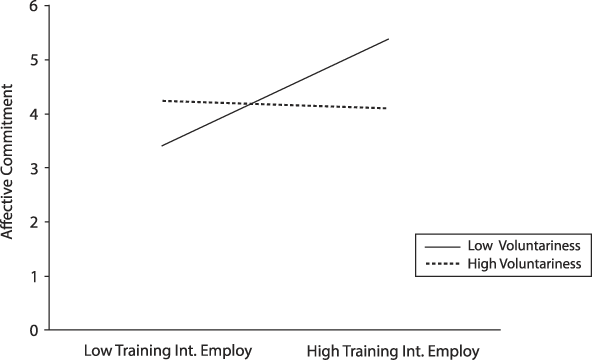
To assess how the moderator affects the strength of the positive relationship between the training for internal employability and the affective commitment as expected, i.e., the relationship between these two variables was weaker for temporary workers with high voluntariness, the analysis shown in Figure 2 was performed. As it could be seen, and as expected, the affective commitment of the temporary workers was not affected by the perception of training as a promoter of their internal employability when these workers had high voluntariness; on the other hand, the perception of this practice was positively related with the affective commitment of the workers when they had low voluntariness.
The moderating effect of voluntariness on the relationship between training for internal employability and affective commitment.

Table 2 shows that the training for external employability by voluntariness interaction term did not have a significant effect on affective commitment (β = .01, n.s.), thus refuting Hypothesis 4.
Discussion
In line with expectations, this study shows there is a positive correlation between the perception of training as a promoter of internal employability and the affective commitment of the temporary workers to the organization. However and contrary to predicted, this relationship is not significant for the perception of training as a promoter of external employability. With respect to the moderation of these relationships by voluntariness, the one referring to training for internal employability was supported: the relationship between this practice and temporary workers’ affective commitment is not significant when they have high voluntariness.
One goal of this research was to investigate the potential link between the temporary workers perception of the training they received as being a promoter of their (internal and external) employability and their affective commitment. According to the social exchange theory (Blau, Reference Blau1964) and the norm of reciprocity (Gouldner, Reference Gouldner1960), the satisfaction of an important need of temporary workers by the organization, i.e., the development of their employability, is expected to create in them an obligation to reciprocate, which would translate into the increase of their affective commitment towards the organization. The results supported the hypothesis concerning the internal employability but refuted the one referring to the external employability. These results are in line with those obtained by Benson (Reference Benson2006). The author found a positive relationship between participation in training that develops internal employability (on-job training) and affective commitment, but not for the participation in training that promotes the external employability (tuition-reimbursement). However, Benson’s study was carried out with permanent workers. In the case of temporary workers, since employability is their job security, it was expected that there would be positive relationship between training for both internal and external employability with affective commitment in both instances. This did not happen and a plausible explanation is that, by developing temporary workers’ external employability, the organization is actually providing them with general skills that are transferable to other organizations. Instead of fostering the affective commitment to the organization it is in reality facilitating the workers exit. In situations where the internal employability is developed, the organization is providing temporary workers with the opportunity to acquire work skills that are especially relevant in that organization and, therefore, the workers become emotionally attached to it. Benson’s finding that the workers who participated in on-job training had a lower turnover than those who participated in tuition-reimbursement classes’ supports this explanation. Alternately, we can consider that workers’ reactions to organization practices depend on what they attribute to be the underlying intentions of the organizations to implement such practices (Nishii et al., Reference Nishii, Lepak and Schneider2008). Temporary workers may infer that the client organizations developed training that promotes their external employability not because of an intention to meet the worker’s needs, but simply due to the fact that the competences acquired were transferable to other organisations. As such, this practice does not entail a social exchange and workers do not feel the need to reciprocate with affective commitment.
The other goal of this research was to ascertain if voluntariness works as a moderator variable of the relationship between the perception of training for (internal and external) employability and the temporary workers’ affective commitment. As expected, we verified that the positive relationship between the perception of training for internal employability and affective commitment is not significant in instances where workers have high voluntariness. The training that promotes internal employability only triggers the more affective commitment reciprocal response in cases where temporary workers prefer not to have that type of work status. In contrast, the workers’ preference does not interfere with the relationship between training for external employability and the affective commitment to the organization. It is quite possible that voluntariness relates more with the affective commitment towards the agency than towards the client organization. Accordingly, Felfe, Schmook, Six, and Wieland (2005) found that a positive attitude towards temporary work doesn’t relate significantly with the affective commitment to the organization, but is positively related with the affective commitment towards the agency. This suggests that voluntariness may moderate the relationship between the perception of training as a promoter of external employability and the temporary workers’ affective commitment to the agency.
Some limitations to this study should be taken into account when interpreting the findings. First, our sample shows low voluntariness. This is consistent with the literature, according to which only one third of the temporary workforce prefers this status (CIETT, 2011; DiNatale, Reference DiNatale2001). This pattern may explain why temporary work is not systematically associated with unfavorable outcomes (De Cuyper & De Witte, Reference De Cuyper and De Witte2008b). Nonetheless, the proportion of temporary workers with low versus high voluntariness that exists in the sample can influence the results. As such, in future research, the sample should be balanced in terms of voluntariness. Second, the number of participants from each gender should also be similar. Rosenblatt, Talmud, and Ruvio (Reference Rosenblatt, Talmud and Ruvio1999) found that the attitudinal reactions to job insecurity differ between genders. Job insecurity has a much greater positive impact on the affective commitment of women. The sample of this research included a predominance of female participants. It was expected given that women are more willing to accept a temporary job (Rubery, Smith, & Fagan, Reference Rubery, Smith and Fagan1999), but it can influence the results. Third, since there is an association between voluntariness and the affective commitment to the agency (Felfe et al., Reference Felfe, Schmook, Six and Wieland2005), it would be relevant to investigate if the extent to which temporary workers prefer their employment status moderates the relationship between training for external employability and the affective commitment to the agency. Finally, despite the fact that the industrial sector employs a large number of temporary workers in Portugal, it would be interesting to see if the results of this study would be replicated with temporary workers from other sectors.
Even with these limitations, this study has shown that training is a valuable HR practice for temporary agency workers. First, temporary agency workers directly reciprocate the implementation of this organizational practice —the promotion of their internal employability— with higher levels of affective commitment. Second, this practice contributes to temporary workers’ social exchange relationship with the organization if these workers have lower voluntariness because they are the ones that respond more favorably to this practice, namely with higher affective commitment.
Over the last ten years, the number of agency workers in Europe has greatly increased, partially because of the progressive liberalization of certain tightly regulated labor markets. In 2009, there were nearly 9 million agency workers, and Europe alone accounted for 34% of the total number of these workers and for 48% of all private employment agencies worldwide (CIETT, 2011).
The increase of temporary workers presents unique challenges to organizations. More and more attention should be paid to the management of these workers.
This research helps to shed some light in this issue by highlighting the importance of building on an essential need for temporary workers: their employability. Specifically, training by the organizations should promote internal employability of temporary workers since the training for external employability had no relevant results. It is known that if organizations want a committed temporary workforce they should consider the perceived organizational support (e.g., Veitch & Cooper-Thomas, Reference Veitch and Cooper-Thomas2009), the workload (e.g., De Cuyper & De Witte, Reference De Cuyper and De Witte2006), and the psychological contract fulfillment (e.g., McDonald & Makin, Reference McDonald and Makin2000). Now, organizations should also contemplate the development of internal employability; the perception that temporary workers hold about the training they receive as promoting their internal employability is positively related with their affective commitment towards the organization. However, the results show that this relationship is not relevant for voluntary temporary workers. This means that if organizations intend to get the commitment of workers through the promotion of their internal employability, they must try to understand the extent to which temporary workers prefer this employment status.
This does not mean that organizations should only recruit temporary workers with low voluntariness. Moreover, both legislation and ethical codes prohibit discriminative selection procedures. We support the use of fair selection procedures and suggest that HR practitioners pay special attention to those employees whose affective commitment cannot be obtained through the promotion of their internal employability, and use other means to obtain it.
This study is part of a larger research project “Temporary Agency Workers’ transitions: Motives, experiences and outcomes—PTDC/MHC-PSO/ 4399/2012” founded by the Foundation of Science and Technology of Portuguese Government. This grant is gratefully acknowledged.
Appendix Items of Training for Employability Scales