Implications
In a context in which productive but also balanced and functional animals are demanded, understanding the way animals acquire and allocate resources is becoming highly relevant. Acquisition and allocation over the lifetime of reproductive females is defined by their priorities at all times and could condition their performance and health in the long term. In this work, we have evaluated the way three genetic types of reproductive females acquire and allocate resources in the long term and how energy source of the diet modulates them. This information could be used to develop specific nutritional strategies for each genetic type in order to maximise their productivity while maintaining their functionality.
Introduction
In the last 40 years, there has been a huge phenotypic improvement in most productive traits of domestic animal species (Hill, Reference Hill2008). Long-term selection exclusively for productive criteria tends to generate specialised animals (Poggenpoel et al., Reference Poggenpoel, Ferreira, Hayes and du Preez1996) that prioritise functions related to the global context in which they were selected (Savietto, Reference Savietto2014). As a result of this specialisation, selection exclusively for production criteria could be accompanied by undesired side effects (Rauw et al., Reference Rauw, Kanis, Noordhuizen-Stassen and Grommers1998). Therefore, one of the main challenges in current animal science consists of developing strategies that provide productive but also balanced animals in their breeding context. In these circumstances, the importance of the way animals acquire and allocate resources among life functions is becoming highly relevant (Rauw, Reference Rauw2009). Acquisition and allocation of resources are affected by the animal’s priorities throughout its life and could condition performance and health in the long term, as they define the investment in each function at each moment of its life trajectory.
The rabbit represents a good zootechnical model to investigate these relationships in the long term, as they have a relatively short reproductive cycle (RC) and there are genetic lines founded and selected for a wide range of goals (Baselga, Reference Baselga2004) with different priorities among life functions. For instance, females coming from selection programmes aiming to improve daily gain during the growing period tend to be bigger and gain more fat, but have lower maternal abilities (Gómez et al., Reference Gómez, Baselga and Rafel1999). Furthermore, females coming from selection programmes aiming to improve litter size tend to yield more milk; some genetic types base reproduction on body fat utilisation and others on feed intake ability (Savietto et al., Reference Savietto, Cervera, Blas, Baselga, Larsen, Friggens and Pascual2013). Consequently, it would be interesting to evaluate the way each genetic type acquires and allocate resources, as well as to provide tools to modulate them. In this sense, energy source of the diet could be a good modulator for energy allocation. It has been reported that fat-enriched diets favour milk yield, whereas starch-enriched diets favour body reserve gain (Pascual et al., Reference Pascual, Motta, Cervera, Quevedo, Blas and Fernández-Carmona2003).
This is the first of three consecutive scientific papers that aim to evaluate the hypothesis that the effect of energy source of the diet varies with the genetic type, having implications in the way each genetic type acquires and allocates resources over time, their immunological status or their fitness and productivity (see companion papers Arnau-Bonachera et al., Reference Arnau-Bonachera, Savietto and Pascual2017; Penadés et al., Reference Penadés, Arnau-Bonachera, García-Quirós, Viana, Selva, Corpa and Pascual2017). Specifically, in the present work we studied: (i) the way three genetic types, widely differing in their genetic background, acquire and allocate resources. (ii) The dynamics of resource acquisition and allocation of each genetic type. (iii) How feed energy source could modulate acquisition and allocation of each genetic type over time.
Material and methods
The experimental procedure was approved by the Animal Welfare Ethics Committee of the Universitat Politècnica de València and carried out following the recommendations of the European Group on Rabbit Nutrition (Fernández-Carmona et al., Reference Fernández-Carmona, Blas, Pascual, Maertens, Gidenne and García2005) and Spanish Royal Decree 53/2013 on the protection of animals used for scientific purposes.
Animals
A total of 203 female rabbits were used from their first artificial insemination until their sixth parturition (from December 2011 to April 2013). Rabbit females belonged to three genetic types (H, LP, R) developed at the Institute of Animal Science and Technology of the Universitat Politècnica de València, differing greatly in their genetic background (foundation, referring to the criteria used to select animals for the generation 0, and criteria used during the genetic selection). Animals from generation 0 of Line H were obtained following hyper-prolific criteria at birth (more than 17 young born alive in any parity or cumulative number of young born alive in all recorded parities equal or higher to the threshold corresponding to the best 0.01 in a population with a mean of nine young born alive, a standard deviation of 2.65 and a repeatability of 0.2; Cifre et al., Reference Cifre, Baselga, García-Ximénez and Vicente1998). Generations 1 and 2 were obtained without selection. H females used in this experiment belonged to the 17th generation of selection by litter size at weaning (n=66; survival rate at 6th parturition=42%; av. fertility=63%; av. born alive=9.3); Animals from generation 0 of line LP were obtained following functional hyper-longevity criteria (females with at least 25 parturitions in commercial farms and an average live litter size of 8.8; more details in Sánchez et al., Reference Sánchez, Theilgaard, Mínguez and Baselga2008). Generations 1 and 2 were obtained without selection. LP females used in the experiment belonged to the 7th generation of selection by litter size at weaning (n=67; survival rate at 6th parturition=72%; av. fertility=79%; av. born alive=9.5). In previous experiments, females from this line have shown less environmental sensitivity to environmental constrains, indicating greater robustness than other commercial lines (Savietto et al., Reference Savietto, Friggens and Pascual2015); Animals from generation 0 of line R were obtained after two generations of randomly mating from a pool of animals of three commercial sire lines (Estany et al., Reference Estany, Camacho, Baselga and Blasco1992). R females from this experiment belonged to the 38th generation of selection by average daily gain during the growing period (n=70; survival rate at 6th parturition=28%; av. fertility=78%; av. born alive=5.6).
Diets
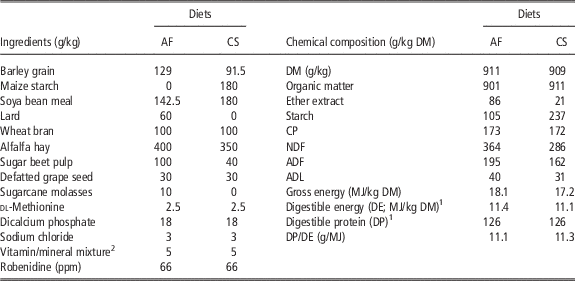
Two experimental diets were formulated and pelleted (Table 1), following the recommendations of De Blas and Mateos (Reference De Blas and Mateos2010) for reproductive rabbit does, enhancing major differences in energy source. The cereal starch (CS) diet was prepared promoting CS (237 g of starch and 21 g of ether extract per kg of dry matter (DM)), whereas in animal fat (AF) diet part of the starch was replaced by AF (105 g of starch and 86 g of ether extract per kg of DM). Nevertheless, both diets were designed to be isoenergetic and isoprotein (on av. 11.3 MJ of digestible energy and 126 g of digestible protein per kg of DM). Chemical analyses of diets were performed according to the methods from the Association of Official Analytical of Chemists (AOAC, 2000).
Ingredients and chemical composition of experimental diets for rabbit females

AF=diet enhancing animal fat inclusion as main energy source; CS=diet enhancing cereal starch as main energy source; DM=dry matter.
1 Experimentally determined according to Perez et al. (Reference Perez, Lebas, Gidenne, Maertens, Xiccato, Parigi-Bini, Dalle Zotte, Cossu, Carazzolo, Villamide, Carabaño, Fraga, Ramos, Cervera, Blas, Fernández-Carmona, Falcao e Cunha and Bengala Freire1995). Using 24 healthy growing rabbits of 42 days of live per diet weaned at 30 days. Faces were collected during 4 days after a period of 7 days of adaptation to diets.
2 Contains (g/kg): thiamine, 0.25; riboflavin, 1.5; calcium pantothenate, 5; pyridoxine, 0.1; nicotinic acid, 12.5; retinol, 2; cholecalciferol, 0.1; α-tocopherol, 15; phytylmenaquinone, 0.5; cyanobalamin 0.0006; choline chloride, 100; MgSO4 H2O, 7.5; ZnO, 30; FeSO4 7H2O, 20; CuSO4 5H2O, 3; KI, 0.5; CoCl2 6H2O, 0.2; Na2SeO3, 0.03.
Experimental procedure
Females were housed under conventional environmental conditions (average daily temperatures varying from 13.3°C to 26.1°C), with an alternating cycle of 16 h of light and 8 h of darkness. Although not all the females began the experiment at the same time (231 days between the first and the last female), most of them did so during the first 3 months (See Supplementary Figure S1). The entry of animals from each of the three genetic types was distributed over time similarly. Animals were housed in individual cages (700×500×320 mm) at 12 weeks of age, inseminated at 19 weeks of age (with pooled semen from their respective lines) and provided with a nest for litters from day 28th of gestation. Females from each group (within genetic type and experimental diet) were homogeneously distributed across the experimental farm. After the first parturition, all females were randomly assigned to one of the experimental diets. Until this moment, all the females received the same commercial diet for reproductive rabbit does (11.3 MJ of digestible energy, 141 g of digestible protein, 170 g of starch and 34 g of ether extract per kg of DM). Experimental diets were provided ad libitum.
Litters were standardised to eight to nine kits at first parturition and nine to 11 onwards. This procedure was performed to equalise the energetic effort during lactation among females, in order to compare each genetic type under similar lactational effort. This procedure also allows us to decrease the data CV which increases the statistical accuracy of the estimates (Fernández-Carmona et al., Reference Fernández-Carmona, Blas, Pascual, Maertens, Gidenne and García2005). Females were inseminated at 11 days postpartum and litters were weaned at day 30 of lactation. Non-pregnant females were re-inseminated 21 days after the insemination attempt for a maximum of three attempts.
Traits
To study the dynamics of acquisition and use of resources, all the traits were recorded at different stages of the RC, from the first to the fifth RC.
Performance traits
Within RC, milk yield was recorded 4 days a week during the first 3 weeks of lactation. To record it, nests were closed and once a day were opened to let the females suckle their kits. Milk yield was measured by weighing the females before and after suckling. From day 18 of lactation (18d), nests were kept permanently open to allow kits to leave the nest and begin solid intake. Finally, data coming from the same week were averaged to obtain one unique value per week and female. Within RC feed intake was recorded during early lactation (EL, from parturition to 18d) and from weaning to parturition (WPI). Body weight and perirenal fat thickness (PFT) were recorded at parturition, 18d and weaning according to Pascual et al. (Reference Pascual, Castella, Cervera, Blas and Fernández-Carmona2000).
Blood plasma traits
Blood samples were collected at parturition of the first, second and fifth RC, and at 18d in lactation and at weaning of the first and fifth RC. Blood was drawn from the central artery of the ear using tubes with EDTA, always at 1100 h after a fasting period of 3 h. Samples were immediately centrifuged (3000×g during 10 min at 4°C). Plasma samples from 11 females per group (three genetic types (H, LP and R)×two diets (AF, CS)) with complete records (from first artificial insemination to fifth weaning) were analysed for glucose, β-OH-butyrate, non-esterified fatty acids (NEFA) and leptin. Glucose was determined according to standard procedures (Siemens Diagnostics® Clinical Methods for ADVIA 1650 Tarrytown, NY, USA). β-OH-butyrate was determined as an increase in absorbance at 340 nm due to the production of NADH, at slightly alkaline pH in the presence of β-OH-butyrate dehydrogenase; sample blanks were included and the method involved oxamic acid in the media to inhibit lactate dehydrogenase, as proposed by Harano et al. (Reference Harano, Ohtsuki, Ida, Kojima, Harada, Okanishi, Kashiwagi, Ochi, Uno and Shigeta1985). Non-esterified fatty acids were determined using the NEFA C ACS-ACOD assay method (Wako Chemicals GmbH, Neuss, Germany). Analyses of glucose, β-OH-butyrate and NEFA were performed using an auto-analyser, ADVIA 1650® Chemistry 53 System (Siemens Medical Solutions, Tarrytown, NY 10591, USA); in all instances the intra- and inter-assay CV were below 2.0% and 4.0%, respectively. Leptin was analysed by Multi-Species Leptin assays (RIA, XL-85K) (Millipore Corporation, Billerica, MA, USA), according to the manufacturer’s guidelines. Intra- and inter-assay CV were 9.1% and 9.3%, respectively.
Statistical analysis
For daily feed intake, BW, PFT and milk yield, all data from each trait was studied using the following model:
 $$\eqalignno{ y_{{gdsrlg ki}}\, {\equals}\, & {\rm GT}_{g} \left| {{\rm D}_{d} } \right|{\rm S}_{s} {\rm \:\mid\!RC}_{r} {\rm {\plus}OG}_{g} \,{\rm \cdot \,S}_{s} {\rm {\plus}OL}_{{\rm l}} {\rm \,\cdot \,S}_{s} \cr & {\rm {\plus}}\beta T_{k} {\rm\, \cdot \,S}_{s}{\rm {\plus}}p_{{is}} {\plus}e_{{gdsrlg ki}} $$
where y gdsrlgki represents one record of a given trait; GT g was the effect of genetic type (three levels; H, LP, R); D d was the diet effect (two levels: AF, CS); S s was the stage effect (two levels for feed intake and intake per metabolic weight: EL, WPI interval; three levels for BW and PFT: parturition, 18d, weaning; three levels for milk yield: week 1, week 2, week 3); RC r was the RC fixed effect (five levels; 1st, 2nd, 3rd, 4th, 5th). For the analysis of each trait we considered all the previous simple effects, as well as all their interaction; OLl was considered as fixed effect to take into account the effect of getting pregnant during lactation (two levels: pregnant or not during lactation). OG g was considered as fixed effect to take into account the effect of being lactating during gestation (two levels: lactating or not lactating females at the beginning of gestation). By using OLl and OG g we intended to take into account the effects of simultaneously gestating and lactating on energy acquisition and allocation at the different stages of the RC. T k was the average ambient temperature of the farm during the RC as covariate and β its regression coefficient; As random effects we considered p is and e dgsrlgki , where p is was the permanent effect of the ith female at the sth stage and e dgsrlgki represented the random residuals of the records. This analysis was performed using the proc MIXED of SAS (2009), where variance components were estimated by the restricted maximum likelihood (REML) method. The model defining the (co)variance matrix was selected from 16 candidate models with the lowest akaike information criterion (AIC) for most of the traits (or very close to it) and good biological interpretation of its (co)variance components (Arnau-Bonachera, Reference Arnau-Bonachera2017). To perform it, we considered that records within a RC represented different stages of the RC. Consequently, variance was allowed to vary within a RC, remaining constant throughout RCs for a given stage. We included the permanent effect of the animal, which could be different depending on the stage within a RC. These different permanent effects were assumed to be differently correlated among them. Regarding the residuals, we also considered that they could be different at different stages within an RC, being differently correlated among them and correlated in a decreasing way among RCs (the more distant two measures were, the lower was their correlation).
For blood plasma parameters, the model was:
 $$y_{{gdck}} \, {\equals}\, {\rm GT}_{g} \left| {{\rm D}_{d} } \right|C_{c} {\rm {\plus}}\beta T_{k} {\plus}e_{{gdck}} $$
where y gdck represents one record of a given trait; GT g was the effect of genetic type (three levels; H, LP, R); D d was the diet effect (two levels: AF, CS); C c was the time control (seven levels; parturition, 18d and weaning for the 1st, parturition for the 2nd, and parturition, 18d and weaning for the 5th RC); T k was the average ambient temperature of the farm during the RC as covariate and β its regression coefficient. The model defining the (co)variance matrix described above did not present the best statistical fitting (in terms of AIC). (Co)variance matrix was modelled without assuming any defined structure (unstructured matrix; SAS, 2009) with the REML method.
Results
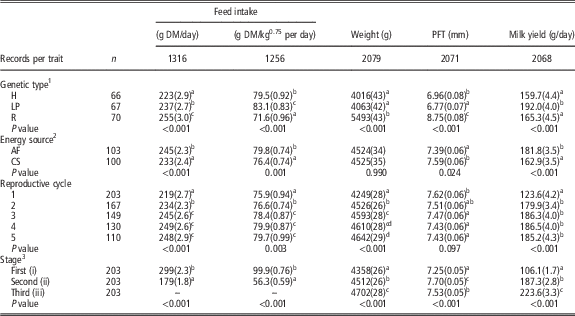
A proper understanding of mechanisms governing the links between resource acquisition and allocation requires the control of a large number of traits, and could complicate the presentation of results. Table 2 presents the main effects on acquisition and allocation traits. However, numerous interactions were also observed (see P-values for all the effects in Supplementary Tables S1 and S2). Consequently, only relevant interactions have been presented to promote understanding.
Least square means and standard errors of the main effects on feed intake, perirenal fat thickness and milk yield of rabbit females

n=number of animals per treatment; DM=dry matter; PFT=perirenal fat thickness; RC=reproductive cycle.
a,b,c,d Means in the same effect and column not sharing superscripts significantly differ at P<0.05.
1 Genetic type: H characterised by hyper-prolificacy; LP characterised by functional hyper-longevity; R characterised by high average daily gain.
2 Energy source: AF, animal fat; CS, cereal starch (Table 1 for details).
3 Stage within RC according to the trait were: (For feed intake: early lactation (i) and weaning to parturition interval (ii)); (for weight and PFT: parturition (i), day 18th of lactation (ii) and weaning (iii)); (for milk yield: 1st week of lactation (i), 2nd week (ii) and 3rd week (iii)).
Resource acquisition capacity
Table 2 shows the results for the main effects on feed intake as absolute value and compared with the metabolic weight of females. As absolute value, feed intake was higher in lactation (+67%; P<0.05). It increased over RCs, reaching the maximum between third and fourth RC (+21.1% compared with primiparous does; P<0.05). It was also affected by diet, as females fed with AF had an intake 5.1% greater than those fed with CS (P<0.05). R females had greater average feed intake than females from the maternal lines (H and LP females; on av. +10.9%; P<0.05). LP females presented higher intake than H females (+6.3%; P<0.05). On the other hand, with respect to the metabolic weight of females, results from the effects of the stage, RC and diet were comparable with those reported for the absolute value. For the effect of genetic type, LP females presented the highest average intake (+5% and +16% compared with H and R females; P<0.05), whereas the intake per metabolic weight of H females was higher than R females (+11%; P<0.05).
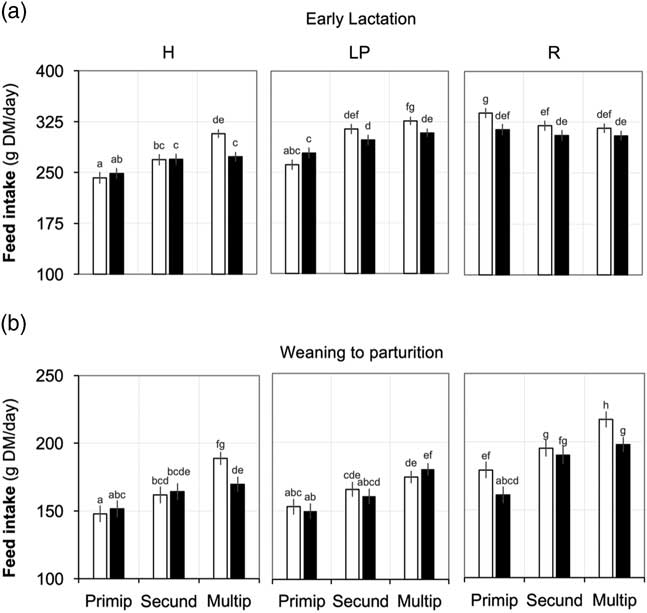
However, absolute feed intake from each genetic type varied with energy source and time. The results from this interaction are presented in Figure 1. Females from the maternal lines increased their intake during EL over RCs, reaching a maximum around third lactation (on av. 257, 288 and 303 g DM/day for primiparous, secundiparous and multiparous, respectively; P<0.05), whereas for R females, feed intake did not increase with age. R primiparous females fed with AF ate 8.0% more than those fed with CS (P<0.05), whereas primiparous females from the maternal lines did not differ in feed intake independently of the offered diet. In multiparous, LP females had a feed intake during EL as high as R females (on av. +6.9% compared with H; P<0.05). On the other hand, the greatest intake of R females was observed especially between weaning and the next parturition (+16.3% compared with H and LP; P<0.05; Figure 1b). Moreover, between weaning and next parturition, greater feed intake with AF was observed in R females (+7.1%; P<0.05) and H multiparous females (+11.8%; P<0.05).
Evolution of feed intake of rabbit females over reproductive cycles (RC, primiparous, secundiparous and multiparous (av. of 3rd, 4th and 5th cycles)) for the different stages within the RC [(a) early lactation, (b) weaning to parturition] depending on genetic type (H, characterised by hyper-prolificacy; LP, characterised by functional hyper-longevity; R, characterised by daily gain) and the energy source (animal fat (□); cereal starch (■)). Least square means and standard errors. a,b,c,d,e,f,g,h Means within a stage not sharing superscripts significantly differ at P<0.05.

Resource allocation
Weight and perirenal fat thickness
In Table 2 we can observe that within the RC BW increased as lactation progress. It also increased over RCs, reaching a plateau around fourth RC (on av. +9% compared with primiparous females; P<0.05). No effect of energy source on BW was observed. R females presented the highest values for BW (+36.0%; P<0.05). Regarding PFT, the lowest value was observed at parturition (Table 2); it increased until 18d (+6%; P<0.05), and subsequently decreased until weaning (−2%; P<0.05). Perirenal fat thickness decreased over RCs. Females fed with CS presented higher PFT (+0.2 mm, P<0.05). R females presented the highest PFT (on av. +27.5%; P<0.05) and LP the lowest (−0.19 and −1.79 mm compared with H and R females, respectively; P<0.05).
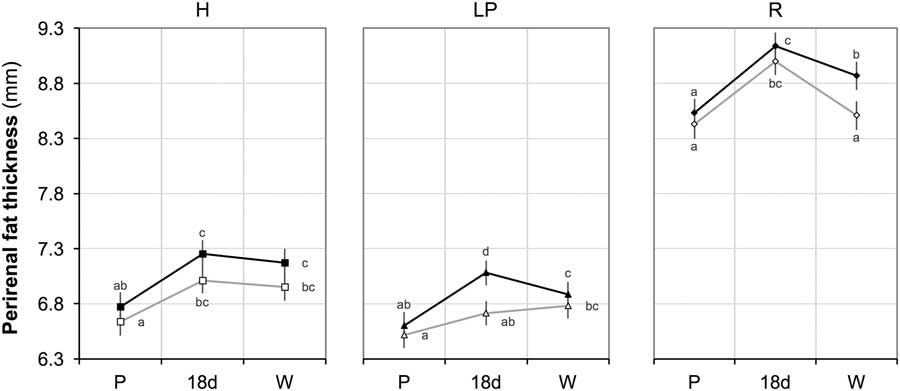
However, the effect of energy source on the PFT pattern within the RC was different depending on the genetic type. Figure 2 shows that the PFT decrease in R females at late lactation (−4.3%; P<0.05) was significantly higher than that observed for H and LP lines (on av. −0.1%; P>0.05), particularly for those fed with AF. Moreover, LP females fed with AF progressively increased PFT across the RC, whereas those fed with CS increased PFT during EL (+7.3%; P<0.05), but partially mobilised it during late lactation (−2.8%; P<0.05). H females followed a similar trajectory throughout the RC independently of the offered diet.
Evolution within a reproductive cycle of perirenal fat thickness of rabbit females depending on genetic type (H (— ■ —), characterised by hyper-prolificacy; LP (—▲—), characterised by functional hyper-longevity; R (—♦—), characterised by daily gain) and energy source (animal fat (□Δ◊); cereal starch (■▲♦)). P=parturition; 18d=day 18th of lactation; W=weaning. Least square means and standard errors. a,b,c,d Means within a genetic type not sharing superscripts significantly differ at P<0.05.

Milk yield
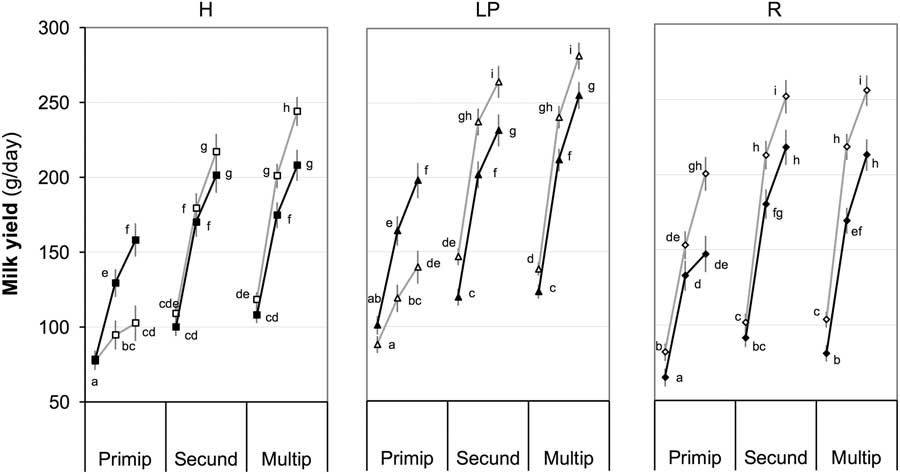
In Table 2 we can observe that milk yield increased as lactation progress. The lowest average value was presented at first RC (on av. −33%; P<0.05). Females fed AF diet presented on average higher milk yield than those fed with CS (+11.7%, P<0.05). Regarding the effect of genetic type, LP females presented the highest average value for milk yield (on av. +19%; P<0.05).
However, milk yield from each genetic type varied with energy source and time. Figure 3 represents this interaction. In general, females fed with AF diet had higher milk yield compared with CS from second parturition, regardless of genetic type. This occurred particularly in the 2nd and 3rd week of lactation, although differences were not significant in the second RC of H females. However, although primiparous R females yielded more milk with AF diet (+26.2%; P<0.05), primiparous H and LP females yielded more with CS (+34.1%; P<0.05), especially from 2nd week of lactation on. R females yielded less milk at 1st week of lactation than H, and especially LP females (on av. 87.5, 98.5 and 119.5 g/day, respectively; P<0.05).
Evolution of the lactation curve over reproductive cycles of rabbit females (primiparous, secundiparous and multiparous (av. of 3rd, 4th and 5th cycles)) depending on genetic type: (H (—■—), characterised by hyper-prolificacy; LP (—▲—), characterised by functional hyper-longevity; R (—♦—), characterised by daily gain) and energy source (animal fat (□Δ◊); cereal starch(■▲♦)). Least square means of average yield at 1st, 2nd and 3rd week of lactation and standard error. a,b,c,d,e,f,g,h Means within a genetic type not sharing superscripts significantly differ at P<0.05.

Blood plasma parameters
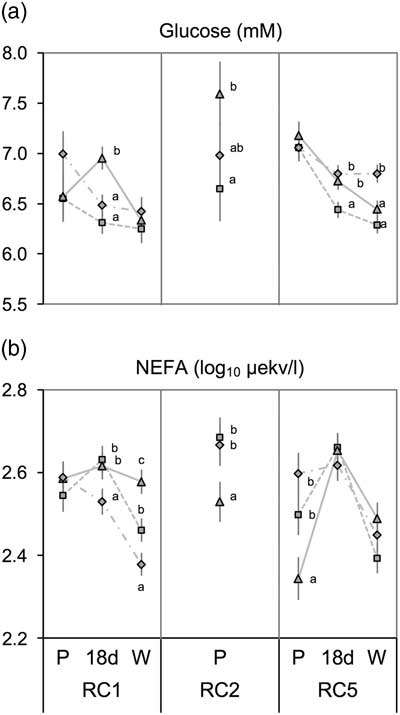
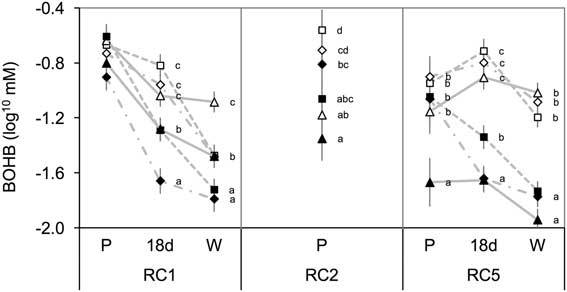
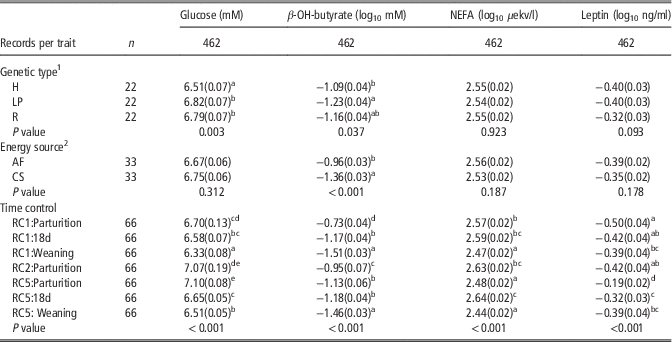
Average glucose plasma concentration was always higher for LP and R than for H females (on av. +4.6%; P<0.05; Table 3), but differences were mainly due to the higher glucose concentration of LP females at 18d of first RC and at second parturition, and of R females at fifth weaning (Figure 4a). There were no significant differences in average NEFA plasma concentration between genetic types (Table 3). However, R females presented lower NEFA values at 18d and weaning of the first RC than LP and H, whereas LP females had lower values at second and fifth parturitions compared with R and H (Figure 4b). Average β-OH-butyrate concentration was significantly lower in the plasma of LP compared with H females (−27.6%; P<0.05; Table 3). However, although β-OH-butyrate plasma concentration decreased as the first lactation progressed independently of genetic type and diet (on av. –81.8% from parturition to weaning, Figure 5; P<0.05), the evolution of β-OH-butyrate during the fifth RC depended on genetic type and diet (Figure 5). In contrast to that observed during the first RC, females fed with AF and LP females fed with CS had no relevant variations in BOBH plasma concentration throughout the fifth lactation (Figure 5). However, β-OH-butyrate concentration of R and H females fed with CS decreased significantly throughout the fifth lactation (on av. –79.8% from parturition to weaning, Figure 5; P<0.05) as in the first RC.
Plasma glucose (a) and non-esterified-fatty-acids (NEFA) (b) concentration of rabbit females over time depending on genetic type. Least squared means and standard error for H (- -■- -), characterised by hyper-prolificacy; LP (—▲—), characterised by functional hyper-longevity; R (–·–♦–·–), characterised by daily gain. RC=reproductive cycle; P=parturition; 18d=day 18th of lactation; W=weaning. Least square means and standard errors. a,b Means in a time control and cycle not sharing superscripts significantly differ at P<0.05.

Plasma β-OH-butyrate concentration of rabbit females over time depending on genetic type (H (- -■- -), characterised by hyper-prolificacy; LP (—▲—), characterised by functional hyper-longevity; R (–·–♦–·–), characterised by highly daily gain) and energy source (animal fat (□Δ◊); cereal starch (■▲♦)). RC=reproductive cycle; P=parturition; 18d=day 18th of lactation; W=weaning. Least square means and standard errors. a,b,c,d Means in a time control and cycle not sharing superscripts significantly differ at P<0.05.

Least square means and standard errors of the main effects on plasma concentration of glucose, β-OH-butyrate, non-esterified fatty acids (NEFA) and leptin of rabbit females

n=number of animals per treatment; RC=reproductive cycle.
a.b.c.d,e Means in the same effect and column not sharing superscripts significantly differ at P<0.05.
1 Genetic type: H characterised by hyper-prolificacy; LP characterised by functional hyper-longevity; R characterised by daily gain.
2 Energy source: AF, animal fat; CS, cereal starch (Table 1 for details).
Discussion
Resource acquisition capacity
Information regarding the effect of dietary energy source on DM intake is highly controversial. However, in agreement with our results it seems that fat-enriched diets tend to increase feed intake (reviewed by Pascual et al., Reference Pascual, Motta, Cervera, Quevedo, Blas and Fernández-Carmona2003), especially during EL (Lebas and Fortun-Lamothe, Reference Lebas and Fortun-Lamothe1996). The increase in feed intake of females fed on AF diet during EL could be related to the increase in their nutritional requirements (due to the higher milk yield of females fed with this diet; Pascual et al., Reference Pascual, Motta, Cervera, Quevedo, Blas and Fernández-Carmona2003). Between weaning and the next parturition, it seems that feed intake is more closely related to the utilisation of body reserves during lactation (Pascual et al., Reference Pascual, Cervera, Blas and Fernández-Carmona2002 and Reference Pascual, Motta, Cervera, Quevedo, Blas and Fernández-Carmona2003). Consequently, during this period, differences between diets for each genetic type and RC could be related to different degrees of body reserve utilisation during lactation of each genetic type at each RC (Figure 1).
R females presented the highest energy acquisition (Table 2). Nevertheless, it was the lowest when considering intake per metabolic weight. This indicates that their great average acquisition capacity is mainly due to their heavy BW. Contrary to what was expected (Xiccato, Reference Xiccato1996), results reported in the present experiment suggest that the acquisition capacity of R females during EL could be almost fully developed when primiparous, as there was no difference in feed intake between primiparous and multiparous does (Figure 1a). On the contrary, the intake of primiparous females from the maternal lines was lower than that observed later (multiparous), indicating a limited acquisition capacity of these females during their early reproductive career (Xiccato, Reference Xiccato1996). Nevertheless, the average acquisition capacity observed in LP females was much higher than that expected for their size (Table 2). Specifically, LP females were characterised by a high acquisition capacity during lactation (Figure 1). This great acquisition capacity agrees with the results reported by Theilgaard et al. (Reference Schneider and Wade2009) and Savietto et al. (Reference Savietto, Friggens and Pascual2015). Finally, H females presented an intermediate acquisition capacity between R and LP females, similar to that of LP females between weaning and parturition and to that of R females during lactation.
Resource allocation
Regarding the energy source effect, females fed on CS diet presented higher PFT whereas females fed with AF yielded more milk. These results agree with those reported by Xiccato et al. (Reference Xiccato, Parigi-Bini, Dalle Zotte, Carazzolo and Cossu1995), Fortun-Lamothe and Lebas (Reference Fortun-Lamothe and Lebas1996) and Pascual et al. (Reference Pascual, Cervera, Blas and Fernández-Carmona2002). Consequently, it seems that by selecting the energy source of the diet we could impose a shift of energy partitioning between milk and body reserves of females (Pascual et al., Reference Pascual, Motta, Cervera, Quevedo, Blas and Fernández-Carmona2003).
R females were heavier and fatter than those from the maternal lines (Table 2; Naturil-Alfonso et al. Reference Naturil-Alfonso, Lavara, Millán, Rebollar, Vicente and Marco-Jiménez2016). Milk yield was not low (similar to H females), but lower than expected for their metabolic weight. Apart from the particular average allocation, energy was differently allocated across time compared with females from the maternal lines; on the one hand, lactation effort was low at the beginning but increased as lactation progressed (Figure 3); on the other, females recovered a great amount of body reserves during EL (+0.2 mm than females from maternal lines; P<0.05), which was used afterwards during late lactation (Figure 2). Both facts suggest that, at the onset of lactation, R females seem to prioritise their body recovery more than current litter interests in comparison to maternal lines, whereas as lactation progressed these priorities could have been inverted. Consequently, the greater acquisition capacity of R females seems to be mainly addressed to maintaining their heavier body size rather than litter development. Moreover, they were highly dependent on body reserves to cope with the reproductive requirements of the current RC, especially at the end of lactation.
Regarding the shift imposed by energy source, milk yield was higher during the whole controlled lactation for R females fed with AF (Figure 3), but the effects on body condition (Figure 2) and feed intake (Figure 1) were more evident from mid lactation onward. R females fed with AF presented higher mobilisation during late lactation (Figure 2) and, in response to this higher mobilisation, had higher feed intake between weaning and the next parturition (Figure 1b). So, it seems that females fed with AF made a greater effort in the current litter at the end of lactation than those fed with CS.
Regarding the LP females, they presented the lowest amount of body reserves, and the highest milk yield (Table 2). Moreover, as previously discussed, they presented the highest average intake per kg of metabolic weight. This was especially evident during EL of multiparous females, when their acquisition capacity was fully developed. In this sense, it has been proposed that LP females base production on energy acquisition, whereas they use body reserves as a safety factor (Savietto et al., Reference Savietto, Friggens and Pascual2015). According to this idea, it seems that LP females fed with AF tended to gain body reserves during the whole lactation, whereas those fed with a diet promoting body reserve gain (CS) accumulated a large amount of reserves during EL, but they mobilised later (Figure 2), resulting in a similar value of PFT at weaning independently of the offered diet. Consequently, it seems that LP females were able to adapt their allocation across time (Savietto et al., Reference Savietto, Cervera, Blas, Baselga, Larsen, Friggens and Pascual2013). This strategy would have allowed them to reach second parturition in suitable metabolic conditions (higher glucose, lower NEFAs and lower β-OH-butyrate levels compared with females from the other genetic lines). Thus, LP females could be characterised by an acquisition capacity and an allocation pattern adapted to changing requirements (imposed by physiological stage or diet) that allow them to confront high reproductive efforts, but safeguarding body reserves (Savietto et al., Reference Savietto, Friggens and Pascual2015).
The pattern of H females could be located between the patterns of R and LP females. As previously reported for females specialised in prolificacy (Rauw et al., Reference Rauw, Luiting, Beilharz, Verstegen and Vangen1999), lower values of average feed intake and glucose but higher values of β-OH-butyrate and PFT (Tables 2 and 3) would indicate that H females were more dependent on body reserves than LP females. However, H females tended to accumulate reserves in EL and maintain them during late lactation (Figure 2). As H females accumulated reserves during EL that were not used in late lactation and this pattern was observed for females fed with either diet, these results suggest that H females tend to store body reserves for the next RC. Moreover, CS diet could be encouraging the storing skills of H females at the end of lactation even more. The higher values of PFT, and lower values for β-OH-butyrate and milk yield than when fed with AF, support this statement. However, similarly to R females fed with CS, this strategy would lead H females fed with CS to high mobilisation at parturition (high values of β-OH-butyrate) and high β-OH-butyrate changes during the RC compared with LP females (Figure 5). Therefore, H females were dependent on body reserves but, in contrast to R females, it seems that they accumulated them to cope with future reproduction.
Finally, the effect of diet on milk yield of primiparous females from the maternal lines was different to that reported in other experiments (Pascual et al., Reference Pascual, Cervera, Blas and Fernández-Carmona2002) and to that observed for R females, LP and H average values. This lack of agreement could be the consequence of confused effects, as most of the females had their first parturition during winter (Supplementary Figure S1). In fact, a low-temperature challenge could be the underlying cause of these results. Although we cannot properly elucidate whether the observed results were the consequence of the temperature or an interaction between temperature and the RC, we hypothesised that they could be the consequence of an interaction. In this sense, the effects of a low-temperature challenge on performance depend on food availability (Manning and Bronson, Reference Manning and Bronson1990) and the moment it takes place (Bronson and Marsteller, Reference Bronson and Marsteller1985), but can be attenuated or exaggerated by body reserves (Schneider and Wade, Reference Theilgaard, Baselga, Blas, Friggens, Cervera and Pascual1991). In contrast to R females, females from the maternal lines seemed to be physically limited, as their feed intake when primiparous was similar independently of the offered diet and lower than when multiparous (Figure 1). This different development of the acquisition capacity could have affected food availability, conditioning the response to the challenge for each genetic type. As the acquisition capacity of the R females was almost fully developed, they were able to respond to diets as expected because they could have sufficient intake to ensure adequate body condition and milk yield. In fact, R females fed with AF were able to increase their intake during EL to confront that situation (Figure 1a). On the contrary, females from the maternal lines, with a limited acquisition capacity, were not able to increase feed intake when they were fed a diet that did not ensure body condition (AF; Figure 1a). In that situation, instead of yielding more milk, it seems that they accelerated the weaning process (Figure 3; Martin and Sauvant, Reference Martin and Sauvant2010) to give priority to maintenance and to safeguarding body condition under this low-temperature challenge.
Conclusions
The resource acquisition capacity and allocation pattern of rabbit females is different for each genetic type. Each pattern would be differently modulated by energy source according to the priorities of the females, given by their genetic background. R females were characterised by a high dependence on their body reserves to cope with the reproductive requirements of the current RC, being more evident when females were fed with diets promoting milk yield (AF). Similarly, H females were also highly dependent on body reserves, but with a different goal. The criteria used to obtain females from generation 0 of this line (hyper-prolificacy) would have promoted a pattern based on body reserve accretion during lactation to cope with future reproduction, magnified when fed with diets promoting body condition (CS). Finally, LP females were characterised by an acquisition capacity better fitted to changing requirements. The criteria used to obtain females from generation 0 of this line (functional longevity) would have promoted body reserve safeguards to ensure performance in the long term.
Acknowledgements
The authors thank Juan Carlos Moreno for his technical support. The grant for Alberto Arnau from the Ministry of Economy and Finance (BES-2012-052345) is also gratefully acknowledged. This study was supported by the Interministerial Commission for Science and Technology (CICYT) of the Spanish Government (AGL2014-53405-C2-1-P).
Supplementary Material
To view supplementary material for this article, please visit https://doi.org/10.1017/S1751731117003287