Introduction
Modern warfare is characterized by an increase in explosion-related injuries.Reference Bilukha, Leidman, Sultan and Hussain 1 , Reference Belmont, Schoenfeld and Goodman 2 In recent conflicts, including in Iraq and Afghanistan (among combatants)Reference Bilukha, Leidman, Sultan and Hussain 1 , Reference Bellamy and Zajtchuk 3 and in Pakistan,Reference Owens, Kragh, Wenke, Macaitis, Wade and Holcomb 4 , Reference Mirza, Parhyar and Tirmizi 5 the majority of injuries sustained resulted from explosives. Cross-country analyses suggest that bombs are a primary tool of modern global terrorists, causing twice as many fatalities and five times as many injuries as guns.Reference Dodd and Perkins 6
Action on Armed Violence’s Explosive Violence Monitoring Project (EVMP; Stratford, United Kingdom) documented 31,076 civilians injured or killed by explosive devices in 2013, a 15% increase from 2012 and a 45% increase from 2011.Reference Mirza, Parhyar and Tirmizi 5 , Reference Bogen and Jones 7 Incidents of explosive violence were documented in nearly 60 countries and territories.Reference Bogen and Jones 7
The use of explosives has accelerated during recent years, in large part due conflict in Iraq.Reference Bellamy and Zajtchuk 3 , Reference Dodd and Perkins 8 More than a decade since the US-led military coalition, Iraq continues to experience sustained violence. Since 2003, insurgent groups have orchestrated violent attacks using suicide bombings, improvised explosive devices (IEDs), and other tactics to target coalition forces and civilians.Reference Brevard, Champion and Katz 9 Violence peaked in late 2006, but was sustained at high levels until 2008. 10 , 11 A “surge” in US troop levels in 2008, supported by an improving Iraqi army, contributed to the decline in violence.
The last US troops withdrew in 2011; however, Iraq remains engaged in an ongoing struggle to reestablish stability. In 2013, EVMP reported that Iraq was the country worldwide most affected by violence from explosive devices.Reference Dodd and Perkins 8 In the last year, an insurgency group known as the Islamic State of Iraq and the Levant (ISIL; Ar-Raqqah, Syria) seized several Iraqi cities, fueling sectarian violence, and resulting in a significant surge in casualties.Reference Hagopian, Flaxman and Takaro 12 , Reference Arango, Fahim and Hubbard 13 The attacks by ISIL and the military response continue to cause large-scale displacement and civilian deaths.
In this context, understanding the epidemiology of injuries in countries affected by ongoing explosive violence is fundamental to mitigating harm. The epidemiologic patterns of injuries, the demographics of victims, and the wound patterns resulting from explosions are different from conventional trauma and other weapons of war.Reference Bilukha, Leidman, Sultan and Hussain 1 , 14 The objective of this analysis was therefore to examine the most recent Iraqi Ministry of Health (MoH; Baghdad, Iraq) injury surveillance data to describe the demographic profile of those killed by explosions, to highlight the types of devices causing fatal injuries, to identify the geographic distribution of events, and to document current trends.
Methods
Data on fatal injuries caused by explosives were obtained from the Injury Mortality Surveillance System operated by Iraqi MoH. This surveillance system collects data on all deaths caused by injury reported by coroner offices from eight of the 18 governorates of Iraq: Baghdad, Al-Anbar, Basrah, Erbil, Kerbala, Maysan, Ninevah, and Al-Sulaimaniya (spelling of governorate names is consistent with that used by the Iraq Central Organization for Statistics and Information Technology (COSIT; Baghdad, Iraq)). These eight governorates represent all reporting sites involved in injury surveillance during the period under investigation. The Iraqi MoH and the Kurdistan Regional Government MoH (Erbil, Iraq) initiated the system of improved surveillance with technical support from the World Health Organization (Geneva, Switzerland) and the US Centers for Disease Control and Prevention (Atlanta, Georgia USA).
Trained clerks at the coroner offices collected the data on fatal injuries using a standardized surveillance form. Information collected included the date and location of the incident, victim demographics, death certificate number and date of issue, mechanism of injury, and circumstances of the incident. Information was extracted from police reports, results of examination at the coroner offices, and interviews with family members. Iraqi Law No 148 makes it compulsory to register all births and deaths.Reference Kluger, Peleg, Daniel-Aharonson and Mayo 15 , 16 Additional regulations require that fatalities must be reported to the coroner offices for investigation before a death certificate is issued.Reference Al-Rabie 17 Previously published population-based studies from Iraq have shown that death certificates were available for 81% 18 of deaths from 2002-2004, 92%Reference Roberts, Lafta, Garfield, Khudhairi and Burnham 19 of deaths from 2002-2006, and 91% (74% witnessed by surveyor during the interview, 17% reported to be present but not witnessed ) 11 of deaths from 2003-2011. The data were entered at the coroner offices and transmitted to the MoH for aggregate analysis.
The case definition used by the Iraqi injury surveillance system included all persons killed as a result of an external injury, including both intentional and unintentional injuries; sexual assaults and legal intervention (action by police) were excluded. A subset of all injuries was used for this analysis. The subset included persons killed by any explosive devices activated knowingly or with the intention to harm. Excluded were persons killed by an unintentional activated explosive devices (eg, an abandoned landmine) and fatalities resulting from bullet wounds (rifle, pistol, or otherwise). Data were collected on all fatal injuries, both civilians and combatants.
Explosive devices were classified based on language consistent with that used by media and other publications.Reference Burnham, Lafta, Doocy and Roberts 20 “Car bombs” referred to IEDs placed inside a car and intentionally detonated. Improvised explosive devices concealed by an individual, on or around his/her person, in order to kill others, including him/herself, were categorized as “suicide bombs.” All other home-made (as opposed to manufactured), remotely detonated explosives were categorized as “other IEDs.” Industrially manufactured explosive ordnance (eg, artillery shells, missiles, rockets, mortars, and grenades) and explosive devices where the type of device could not be identified were categorized as “other/unknown explosives.”
The database was checked for duplicate entries by comparing victim demographics, the time and location of incident, and mechanism of injury. The Iraq COSIT-projected population estimates were used for analysis.Reference Dodd and Perkins 21 Statistical analysis was performed using STATA statistical software Version 13.1 (StataCorp LP; College Station, Texas USA). The Institutional Review Board of the Centers for Disease Control and Prevention determined this study to not involve human subject research because it entailed secondary analysis of routinely collected public health surveillance data. Personal identifiers were not included in the final dataset used for analysis.
Results
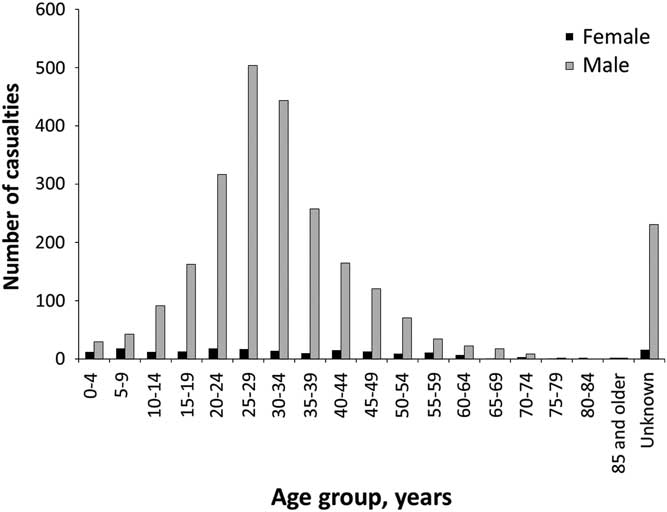
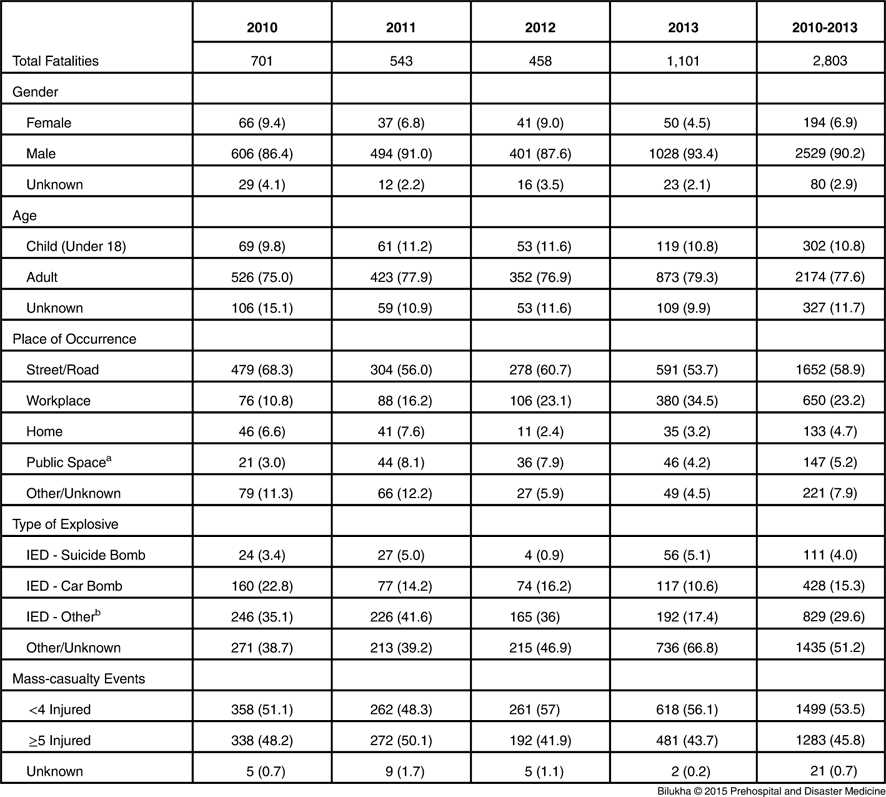
Analysis included 2,803 fatal injuries due to explosives that occurred between January 2010 through December 2013 in eight Iraqi governorates (Baghdad, Al-Anbar, Basrah, Erbil, Kerbala, Maysan, Ninevah, and Al-Sulaimaniya). Age and gender distribution of the injuries are presented in Figure 1. Overall, 2,529 (90.2%) injuries were among males and 194 (6.9%) were among females; the sex of 80 (2.9%) fatalities was unknown. Three-hundred and two (10.8%) fatalities were children aged less than 18 years and 2,174 (77.6%) were adults; the age of 327 (11.7%) fatalities was unknown (Table 1). Among fatalities with known age, 87.8% were adults and mean age was 30.5 years. Males aged 20-39 years accounted for 61.5% of all fatalities with known age.
Age and Sex Distribution of Deaths Caused by Explosives and Selected Governorates in Iraq, 2010-2013. Not shown: 80 (2.9%) fatalities with unknown gender.

Distribution of Fatalities due to Explosive Devices by Year and Selected Governorates in Iraq, 2010-2013 (N=2,803)Footnote c

Abbreviation: IED, improvised explosive device.
a Public space includes markets and public gatherings.
b Improvised explosive devices which could not be categorized as either car or suicide bombs.
c Data are presented as number (% of group).
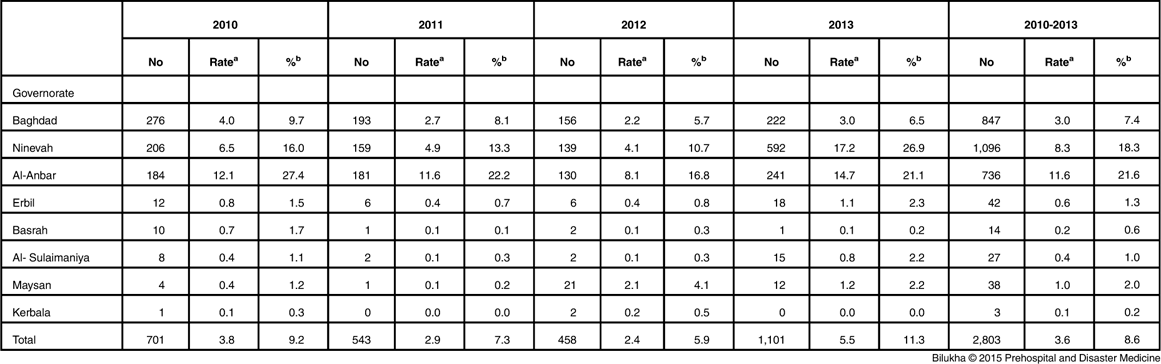
Table 2 presents the total number, population-based rates of explosion-related fatalities, and proportion of explosion-related fatalities among all fatal injuries of any cause recorded in coroner offices, by year and by governorate. Mortality rate is a population standardized metric which enables comparisons across governorates. The proportion of explosion-related deaths among all injury deaths provides information on the proportion of total injury deaths attributable to explosions. As shown in Table 2, the total number of fatalities and incidence rates gradually declined from 2010 to 2012, and then increased notably in 2013. The total number of fatalities recorded in 2011 and 2012 was 22.5% and 34.7% lower than that in 2010, respectively. Overall, mortality rate declined from 3.8 per 100,000 in 2010 to 2.4 per 100,000 in 2012. In 2013, 1,101 fatalities were recorded, 2.4 times that of 2012. An increase in the number and rate of explosion-related fatalities was documented in five of the eight governorates, including Baghdad, Ninevah, and Al-Anbar. Similar trends were seen in explosion-related deaths as a proportion of all injury-related fatalities. Overall injuries resulting from explosions fell from 9.2% of all injury-related fatalities in 2010, to 5.9% in 2012, and rebounded to 11.3% in 2013.
Number and Incidence of Deaths Caused by Explosives, and Proportion of Explosion-related Deaths among All Injury Deaths, by Year and Governorate, 2010-2013 (N=2,803)

a Rate per 100,000; population figures from the Iraq Central Organization for Statistics and Information Technology.
b Fatal injuries from explosives as a percentage of all fatal injuries reported at the coroner office.
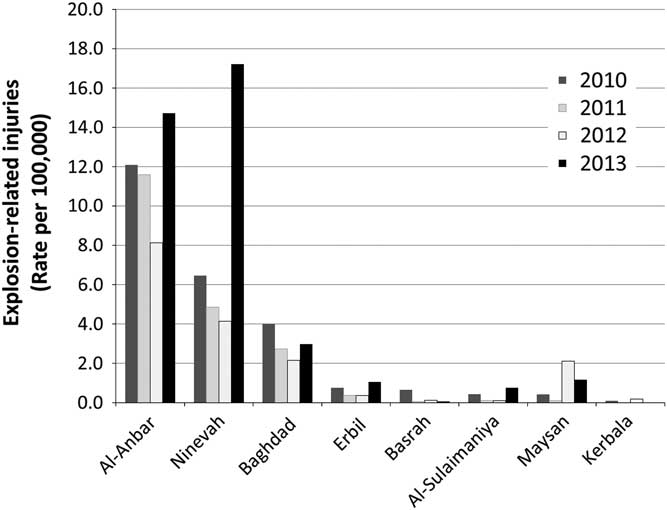
The majority (95.6%) of explosion-related fatalities occurred in three governorates: Baghdad (847; 30.2%), Ninevah (1,096; 39.1%), and Al-Anbar (736; 26.3%; Table 2). While the absolute number of deaths between 2010 and 2012 was highest in Baghdad, both mortality rates and the proportion of explosion-related deaths among all injury-related fatalities were highest in Al-Anbar. The geographical distribution of fatal explosions changed in 2013. During 2013, Ninevah experienced 592 explosion-related fatalities, more than the total number recorded from all eight governorates in each of the previous two years (543 and 458, respectively). In 2013, mortality rate and proportion of explosion-related deaths among all fatal injuries in Ninevah exceeded those in Al-Anbar and Baghdad (Table 2; Figure 2).
Rates of Explosion-related Deaths by Governorate, 2010-2013.

The 4-year average proportion of explosion-related fatalities among all injuries in Al-Anbar was over two times that of Baghdad and slightly higher than that in Ninevah. In Al-Anbar and Nineveh, explosions were among the top three leading causes of fatal injuries. In Al-Anbar, during the study period, explosions caused on average more than 20% of all fatal injuries. In five governorates (Erbil, Basrah, Al-Sulaimaniya, Maysan, and Kerbala) explosions represented two percent or less of all fatal injuries (Table 2).
The majority of fatalities occurred on streets or roads (58.9%); other common places of incidents included the workplace (23.2%), home (4.7%), and public spaces such as markets and public gatherings (5.2%). The proportion of fatal injuries occurring in workplaces, including government offices, increased from 10.8% to 34.5% during the period under surveillance. Place of occurrence was “other” for 190 (6.8%) and “unknown” for 31 (1.1%) fatalities (Table 1).
Nearly one-half of deaths were caused by IEDs: car bombs, 15.3%; suicide bombs, 4.0%; other IEDs, 29.6%. Among all explosion-related fatalities, nearly one-half (1,283; 45.8%) were the consequence of a mass-casualty event, defined as five or more injured or killed in the explosion (Table 1). Of fatal injuries from a mass-casualty event, 80.5%, 69.1%, and 57.4% were caused by car bombs, suicide bombs, and other IEDs, respectively.
Discussion
This study presents the most recent trends in conflict-related fatal injuries from prospective mortality surveillance in Iraq not previously documented in retrospective mortality surveys. These recent data allow for continuous monitoring of the conflict, which is essential for adapting interventions to the changing context.
These data suggest that violence gradually declined between 2010 and 2012, followed by a dramatic increase in explosion-related deaths in 2013. Previous research has documented steady declines in mortality from 2006, the peak of the conflict, to 2011. 10 , 11 These data confirm this trend and show that the situation continued to improve until the beginning of 2013. In 2013, Iraq experienced double the number of explosion-related deaths recorded during the previous two years. The increase was driven by a dramatic surge in deaths in Ninevah in mid-2013, more than a year before the ISIL seized the governorate capital and the second largest city in Iraq, Mosul, and overran the governorate in early June of 2014. These time trends provide evidence of escalating violence that preceded the 2014 insurgent offensive; however, during the period, researchers have since reported ISIL actors were actively state-building.Reference Hagopian, Flaxman and Takaro 12 Documenting the time trends of violence has important value in understanding the rise of ISIL, key for both political and public health actors.
Of all fatalities in this study, 95% were concentrated in three governorates: Baghdad, Ninevah, and Al-Anbar. Most fatalities during 2010-2013 occurred in Ninevah. However, the mortality rate and the proportion of explosion-related fatalities among all injuries were highest in the Al-Anbar governorate. These findings are consistent with media reports that suggest insurgents first re-inserted control in Al-Anbar. Al-Anbar was the stronghold of the insurgency during the American-led occupation. 22 , Reference Al-Salhy and Arango 23 The governorate is vast, made of deserts many consider ungovernable, and located just across the border from territory in Syria controlled by the insurgents.Reference Al-Salhy and Arango 23 , Reference Ghazi and Arango 24 The geographic distribution of explosion injuries has potential implications for targeting interventions.
Approximately nine out of 10 fatalities in this study were men. This sex distribution is consistent with earlier analysis from a household survey in Iraq (2003-2011), which documented that for violence-related fatalities, there were 8.5 males for every female, 11 as well as figures documented in other countries experiencing conflict. In Karachi, Pakistan, 96.8% of the 249 fatalities resulting from explosions from 2007 through 2011 were male.Reference Owens, Kragh, Wenke, Macaitis, Wade and Holcomb 4 A retrospective review of terrorist bombings in Istanbul, Turkey found that 98 (81.7%) of the fatalities from 1976 through 2000 were male.Reference Ghazi and Arango 25 Those injured or killed by intentional explosions in Nepal (2008-2011) were also disproportionately male, with males representing 78.0% of the 437 casualties.Reference Yavuz, Asirdizer, Cetin, Yavuz, Cansunar and Kolusayin 26 Among males, the data suggest that explosions disproportionately affected those 20-39 years of age; this group accounted for 61.5% of deaths among those with known age in this study, despite accounting for only 15.6% of the Iraqi population.Reference Dodd and Perkins 21 While global estimates have limited age disaggregated data, available studies have consistently shown this age group to be at increased risk. Of 120 fatalities in Istanbul, 60 (50.0%) were between 21 and 30 years old.Reference Ghazi and Arango 25 Of 249 fatalities in Karachi, 106 (42.6%) were 15 to 29 years of age.Reference Owens, Kragh, Wenke, Macaitis, Wade and Holcomb 4 This could suggest that the greater number of younger male deaths is attributable to the fact that men in Iraq are more often in public settings and therefore more likely to be exposed to danger. The targeting of combatants who predominantly come from this age/sex group may also put this cohort at greater risk.
The place of injury for most (58.9%) fatalities was streets and roads. An increasing number of injuries also occurred at workplaces. Compared with explosions occurring on roads and other open-air spaces, those in enclosed spaces have been found to result in a higher number of those injured and increased severity and mortality.Reference Bilukha, Becknell, Laurenge, Danee and Subedi 27 , Reference Leibovici, Gofrit and Stein 28 In open-air explosions, the explosion is likely to be fatal only if the victims are in close proximity to the device when it detonates.Reference Bilukha, Becknell, Laurenge, Danee and Subedi 27
Nearly one-half of fatalities in the study were caused by car bombs, suicide bombs, and other improvised devices. This figure likely underestimates the true proportion caused by IEDs; fatalities for which the explosive device was unknown or unverified may have resulted from IEDs. Significant evidence exists that IEDs were the leading cause of death among coalition troops in Iraq.Reference Arnold, Tsai, Halpern, Smithline, Stok and Ersoy 29 – Reference Ramasamy, Harrisson, Lasrado and Stewart 31 This study provides evidence that IEDs are also a leading cause among the general Iraqi population, killing at least as many people as conventional explosives. The high proportion of deaths caused by IEDs may be due in part to higher lethality of IEDs compared with other explosive devices. US Department of Defense (Washington, DC USA) data from 2001 through 2012 suggest that the lethality of IEDs (9.7%) is higher than common conventional explosives, such as mortars and rockets (7.4%) or rocket-propelled grenades (6.3%).Reference Ramasamy, Hill and Clasper 32
Data used in the study are from Iraqi MoH death registration. Vital registration systems are considered the “gold standard” for monitoring mortality.Reference Chivers 33 If complete, vital registration is generally preferred to retrospective mortality surveys as it enables real-time monitoring of trends, minimizes recall and response biases, and allows for better geographic disaggregation.Reference Checchi and Roberts 34 Each reported death included in this study is a documented, verifiable casualty. In Iraq, all injury-related fatalities are required to be examined at a coroner office where a death certificate is issued.Reference Al-Rabie 17 Previously published population-based studies from Iraq have shown that death certificates were available to verify 81%-92% of deaths occurring between 2002-2011. 11 , 18 , Reference Roberts, Lafta, Garfield, Khudhairi and Burnham 19 Even during the conflict, death certificates were required for burial at cemeteries, verification of insurance claims, and payments of benefits.Reference Checchi and Roberts 35 Therefore, the sensitivity of the mortality surveillance system is likely high.
Limitations
This study is subject to several limitations. First, during the period of investigation, data collection was ongoing in only eight pilot governorates. The Iraq Body Count project has documented high mortality rates associated with the explosions in several governorates not under MOH surveillance: Diala, Salah al-Deen, Kirkuk, and Babylon.Reference Burnham, Doocy, Dzeng, Lafta and Roberts 36 Second, analysis was restricted to fatal injuries resulting from explosion devices, excluding firearms; however, evidence suggests that firearms represented a substantial percent of violent deaths during the Iraq war. 10 , 11 Third, population denominators used are COSIT-reported estimates, projections from the 1997 census data.Reference Dodd and Perkins 21 Outdated census data lend uncertainty to the population estimates used to calculate mortality rates. Fourth, analysis by incident was not feasible as fatalities injured in the same explosion were not linked in the database. Fifth, although the sensitivity of surveillance is likely to be high, some explosion-related fatalities may have been missed by the system. Finally, there is potential misclassification, especially with respect to the device type and type of location. Efforts were made to accurately document the circumstances of all deaths using police reports and physical examination; however, the validity of these two variables may be questionable.
Conclusions
These most recent trends show that intentional explosion incidents still pose a threat to the population of Iraq, and were on the upsurge in 2013. Most fatalities occurred in Baghdad, Ninevah, and Al-Anbar. Males aged 20-39 years accounted for a majority of casualties. Sustained highly fatal explosion-related injury rates in Al-Anbar and the surge in injuries in Nineveh governorate in 2013 closely followed increasing activity of ISIL insurgents that culminated with overt war on Iraqi government and seizure of several cities, including Mosul, in the summer of 2014. 22 , Reference Ghazi and Arango 24 Improved understanding of the epidemiology of current explosions provides valuable information for Iraqi government agencies and other partners designing and targeting prevention interventions.
Acknowledgements
The authors thank all focal points at all coroner offices and emergency departments for their long standing commitments in collecting data from victims of injury in Iraq, as well as the Director of the Operational Center and the Director General of Medical Operation and Specialized Services, Iraqi Ministry of Health, for their logistics support of the Iraqi Injury Surveillance System.
Authors’ Contributions
OOB, ASSS, SJH, and EL designed the study; ASSS collected the data; OOB, ASSS, and EL analyzed the data; OOB and EL interpreted the data; OOB and EL drafted the manuscript; and ASSS and SJH critically revised the manuscript for important intellectual content. OOB, ASSS, SJH, and EL approved the final version to be published. OOB is a guarantor. All authors had full access to all of the data and take responsibility for the integrity of the data and the accuracy of the data analysis.