Introduction
The uniqueness of Spitsbergen as a location for international environmental monitoring is demonstrated in abundant studies and long-term research on atmospheric, hydrological, soil and vegetation conditions, in addition to fauna and the geological environment in this region. The remoteness from large industrial centres and the low level of atmospheric particulate matter (PM) make this territory attractive for atmospheric baseline studies. In particular, long-term investigations of air composition in Spitsbergen have helped to establish the origin of the regional phenomena called Arctic haze (Shaw Reference Shaw1995).
Airborne PM contains significant amounts of toxic elements and compounds on their surface or inside their structure including: mercury (Felkier and Garbalewski Reference Felkier and Garbalewski1984; Berg and others Reference Berg, Bartnicki and Munthe2001) and other heavy metals (Heintzenberg and others Reference Heintzenberg, Hansson and Lannefors1981), polycyclic aromatic hydrocarbons (PAHs), polychlorinated biphenyls (PCBs), pesticides and other persistent organic pollutants (Kallenborn and Jensen Reference Kallenborn, Jensen, Jensen and Madsen2011; Kallenborn and Manø Reference Kallenborn and Manø2011; Kallenborn and others Reference Kallenborn, Schmidbauer and Reimann2012; Weinbruch and others Reference Weinbruch, Wiesemann and Ebert2012).
Previous studies have shown that the source of the atmospheric PM has an essential influence on the level of air contaminants due to seasonal fluctuations that affect the macro compound in the airborne PM (Staebler and others Reference Staebler, Toom–Sauntry and Barrie1999). Concentrations of atmospheric PM in Spitsbergen correlate with air mass origin: the lowest concentrations of airborne particles are associated with air masses originating from Greenland, Canada, and the Norwegian Sea, while the highest concentrations/accumulations are associated with air masses from Scandinavia and Russia (Maenhaut and others Reference Maenhaut, Cornille and Pacyna1989; Shevchenko and others Reference Shevchenko, Lisitzin and Vinogradova2003; Berg and others Reference Berg, Bartnicki and Munthe2001; Jiao and others Reference Jiao, Zheng and Minh2009).
In this context, Spitsbergen is regarded as a receptor of large-scale transregional impacts, the sources of which are thousands of kilometers away from the archipelago (Maenhaut and others Reference Maenhaut, Cornille and Pacyna1989). One of the most obvious signatures of solid PM influx from the middle latitudes is evidence for radionuclides of Chernobyl origin that have accumulated in the icescapes in Spitsbergen (Lefauconnier and others Reference Lefauconnier, Hagen and Pinglot1994).
At the same time, a wide range of persistent organic pollutants, heavy metals, gases and vapours with different composition are transported not only from remote territories, but are also generated locally by such sources of contamination as industry, transport, and public utilities, amongst others. The ratio and relative contributions between local and remote airborne PM and contaminants remain uncertain in many cases (Demin and others Reference Demin, Graevskii and Demeshkin2011; Demeshkin Reference Demeshkin2014).
Different types of contaminants are monitored with varying levels of thoroughness. The vast majority of studies about atmospheric PM focus on the investigation of heavy metals and chlorinated organic compounds (Jari and others Reference Jari, Isaksson and Moore2002; Isaksson and others Reference Isaksson, Hermanson and Hicks2003; Evenset and others Reference Evenset, Christensen and Skotvold2004; Ferrari and others Reference Ferrari, Padova and Faïn2008; Jiao and others Reference Jiao, Zheng and Minh2009; Bidleman and others Reference Bidleman, Helm and Braune2010; Polkowska and others Reference Polkowska, Cichała–Kamrowska and Ruman2011; Kozak and others Reference Kozak, Polkowska and Ruman2013; Demeshkin Reference Demeshkin2014; Liu and others Reference Liu, Kukučka and Venier2014; Siegel and others Reference Siegel, Galasso and Kravitz2000).
PAHs in the Spitsbergen environment are associated both with remote sources of airborne PM from the middle latitudes (including forest fires) and local sources of emissions from the combustion of coal. In studying PAHs of airborne PM it is important to pay attention to local sources in air contamination and take into account physiochemical properties of PAHs including low water solubility, instability in the oxidation environment and UV radiation. Almost all types of coal contain many PAHs. These include naphthalene and phenanthrene, pyrene, fluorene and chrysene (Gennadiev and Tsibart Reference Gennadiev and Tsibart2013). Moreover, combustion of coal is a significant anthropogenic source of PAHs. Thus, coal mining is a significant source of PAH contamination in Spitsbergen. This study is focused on determining the local sources of PAH contamination in Spitsbergen in the context of the overall evaluation of airborne PM and PAH concentrations in the Spitsbergen environment.
Before mining started in the late 19th century, naturally eroded coal seams were supposed to be the main source of PAHs for the landscapes of Spitsbergen. Both level and molecular composition of PAHs associated with unburnt hard coal particles depend on the origin of coal. Bituminous sapropelic coal widely occurred and was mined in the areas of Longyearbyen and Barentsburg (Harland and others Reference Harland, Pickton and Wright1976) both of which are noted globally for high levels of PAHs, up to hundreds or thousands of mg/kg, amongst which napthalene and phenanthrene predominate with pyrene, chrysene, flourene being also present in large amounts, and benzo(a)pyrene and other polyarenes mostly as traces (Achten and Hofman Reference Achten and Hofmann2009).
Over a century of coal mining coal, its constituents and associated rock material expanded into Spitsbergen's environment. The present-day situation is such that most parts of mines are abandoned with only one, the Gruve 7, continuing operation in the area of Longyearbyen. Extraction of rock inside the colliery using the room-and-pillar method of drift mining is followed by coal transportation on conveyor belts out of the mountain and then onward by trucks to Longyearbyen. The major part of mine's annual production, some 50,000 tons, is delivered to the local coal-fired power plant, with the rest being shipped overseas from the local harbour.
Therefore, current operational sources of coal for the environment include the mine itself, slope conveyor lines, coal and waste (gob) piles near the mine's opening, coal dumps at the power plant and quay, and motor roads connecting the mine with final sites of coal transportation. Historical sources of coal are much more wide spread: weathered and eroded dumps and piles near the abandoned mines and jetties, hectares of mountainsides covered with coal fragments (especially along the formerly used rail and cableways).
In Svalbard's environment, most historical coal dumps are relatively stable under predominating winter conditions. Some of their material has been redistributed in summer by slope processes, with the area of secondary downslope coal debris accumulations being much higher than eroded piles initially occupied. A portion of the coal fragments and particles erodes into headwaters, then moves downstream and accumulates in bottom sediments of rivers and fjords.
The presence of unburnt coal is typical for marine sediments off the coasts of coal producing countries (Johnson and Bustin Reference Johnson and Bustin2006; Ahrens and Morrisey Reference Ahrens and Morrisey2005); contrasting coal distributions along the shores of western Spitsbergen are explained both by natural erosion in coal-rich areas of the archipelago and transportation of wind-blown coal particles from stockpiles (Dahle and others Reference Dahle, Savinov and Petrova2006).
Maximum anthropogenic contributions of airborne PM occur during winter (Heintzenberg and others Reference Heintzenberg, Hansson and Lannefors1981). Aerosol transport increases due to atmospheric circulation, low rate of liquid precipitation and low temperatures. Snow is a more efficient scavenger for particulates than rain, because of its higher surface area to weight ratio. Also at the coal-fired power stations the coal consumption grows during the winter season (Davies and others Reference Davies, Abrahams and Tranter1984). According to data from the Norwegian Meteorological Institute (http://sharki.oslo.dnmi.no/) in Spitsbergen snow cover accumulated during 8 months per year in the winter seasons of 2013–2014 and 2014–2015 in the Longyearbyen and Barentsburg areas. Thus, investigation of snow cover is a representative method of studying airborne PM and PAH contamination. According to long-term observations, the height of a snowpack in Spitsbergen increases throughout the winter with stabilisation at the end of March and a significant decrease in June (Miętus, Reference Miętus and Branch1991). Therefore, the largest percentage of airborne PM in the snow pack can be expected in May of every year.
Results of snow investigations in Spitsbergen (Aamaas and others, Reference Aamaas, Boggild and Stordal2011) support the conclusion that coal dust is migrating in large amounts from mining and related facilities to offsite locations: dust plumes visible from satellite images spread as far as 30 km from sources. At the same time, observations at background (reference) Spitsbergen areas (for instance, Austfonna, Lomonosovfonna, Holtedahlfonna and others) showed snow cover to contain measurable amounts of carbonaceous aerosol particles that have been emitted from remote continental sources, both natural (forest and steppe fires) and technogenic (fossil fuel combustion) (Forsström and others Reference Forsström, Strom and Pedersen2009). For this reason, two aspects of snow-related research prevail in Spitsbergen: the snow surface albedo affected by dust fallout, and the long-range transport of pollutants including PAHs. Local pyrogenic PAH sources also exist, with some of them being stationary with evident influence (like power plant chimney stacks that emit dark colored plumes on a regular base) and the others being mobile and having no clearly identified area of influence. Accumulation of PAH-bearing aerosols in snow cover of snowmobile tracks and motor roadsides provides evidence for local contributions from combustion engines (Reimann and others, Reference Reimann, Kallenborn and Schmidbauer2009).
Settlement descriptions
Longearbyen (78°13 N, 15°38 E) and Barentsburg (78°3 N, 14°12 E) are situated in the southwest part of Spitsbergen Island, Svalbard archipelago. Longyearbyen is the administrative centre in Spitsbergen, and is located along the Advenfjorden. Barentsburg is situated 50 km from Longyearbyen to the west along the Eastfjorden. They are amongst the northernmost settlements globally.
Materials and methods
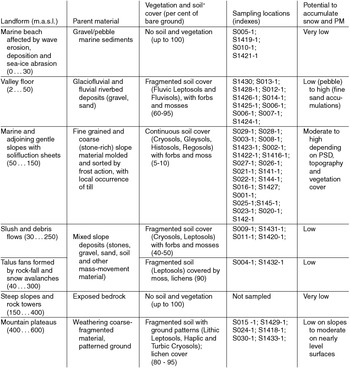
PAHs of airborne particulates in Spitsbergen originate from several sources the individual contribution of which varies depending on distance to the site, landscape position, soil and vegetation cover, current and historical weather situation and other factors. The study performed was focused on distribution of poly-aromatic hydrocarbons in particulates of the snow cover at sites the relative positions of which enable us to assess the share of the most significant local PAH sources and reveal locations with background levels of airborne pollutants (see Table 1). Based on the results obtained in this study, further investigations to trace PAH fate in soil cover and bottom sediments of the same areas have been planned.
Summarised data on investigated sampling sites.

*Dominant soil units are given in accordance with WRB-2014 (FAO 2015) with due regard for regional soil studies (Klimowicz and others, Reference Klimowicz, Melke and Uziak2009; Szymanski and others, Reference Szymański, Skiba and Wojtuń2013).
Field studies to determine PAH contamination in airborne particulate particles in Spitsbergen were performed in late winter/early spring in 2013 and 2014. During these field excursions, snow cover around Barentsburg and Longyearbyen was sampled from 14 May to 27 June 2013, and from 14 April to 21 May 2014 in 54 locations, with 47 situated within potentially contaminated areas and others serving as background (reference) sites. The samples were collected in representative sites on different landforms. Sampling incorporated the whole snow mass and combined morphological observations, thickness and density measurements. In many sampling sites snow samples were collected both in 2013 and 2014 for comparisons of PAH concentrations in different years.
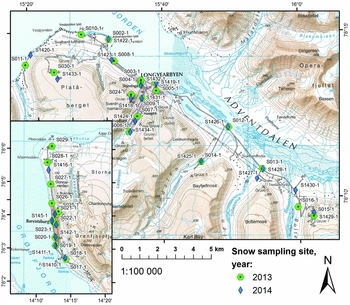
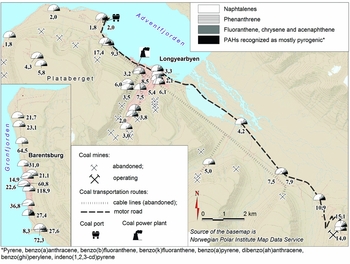
Snow samples were collected from the following contaminated locations (Fig. 1):
Snow sampling sites around Barentsburg and Longyearbyen. Basemap (c) Norwegian Polar Institute.

Coal-fired power plant areas (S004-1, S1432-1, S142-1);
Motor and snowmobile road sides (S008-1, S1423-1, S013-1, S1428-1, S1426-1, S027-1);
Airport areas (S010-1, S1421-1);
Coal mining areas (S015-1, S1429-1, S1430-1, S144-1);
Coal terminal areas (S1422-1, S023-1, S145-1);
Coal stockpiles sites (S026-1, S028-1, S1416-1, S1410-1);
Fuel storage sites (S1411-1);
Residential areas (S001-1, S005-1, S1419-1, S006-1, S1434-1, S007-1, S1424-1, S1431-1, S025-1, S141-1).
The background value of snow contamination was determined by studying the snow samples from several locations, which were collected in regions remote from potential sources of contamination sites. The sample points on the top of Plateauberget (S024-1, S1418-1), in the vicinity of Svalsat, 6 km in the western direction (S030-1, S1433-1) and in Bjørndalen, 10 km in the western direction (S011-1, S1420-1) (Fig. 1) represent the background value in the reference sites of Longyearbyen. For Barentsburg, the location of the background value sample site is situated 3 km out of town towards the south. This is the sample collection point S017-1 (Fig. 1).
The procedure of snow sampling was conducted using the Russian standard RD 52.04.186-89 (Atmosphere pollution control guidelines). Snow was sampled using a plastic tube sampler (78.5 sm2), which was pressed into the snow until it reached the ground surface mostly covered with ice. A snow pit was also dug at each sampling location for describing the stratification of snow cover and measuring the thickness and calculating the density, following which a snow sampler was pressed into the snow. The snow samples were then put into plastic containers. Several snow cores were taken at one site in order to obtain a composite sample. The number of snow cores was dependent on the snow thickness at the sampling site, and was determined as the amount sufficient to produce 2.5 dm3 of snow water per one sample. If the snow thickness exceeded 60 cm the number of snow cores were no less than three.
Sample preparation
Samples were prepared in accordance with the Russian standard RD 52.04.186-89 (Atmosphere pollution control guidelines). Snow was allowed to melt at room temperature in sealed plastic containers. Meltwater in amounts of at least 2.5 to 3 ls was filtered through a 47 mm Durapore Hydrophilic Polyvinylidene Fluoride (PVDF) plain membrane filter with 0.45 µm pore size. Before filtering, each filter was dried to a constant weight under 50–70°C with subsequent cooling to room temperature, weighted to 0.1 mg and washed with 2 ls of bi-distilled water. Filters with particulate matter were placed in individual porcelain cups, dried at 45 to 50°C for 3 to 4 hrs and weighted to the same accuracy.
PAHs were extracted from filters with 2 x 5 ml of acetonitrile at room temperature and 10 min of ultra-sonication followed by 5 min long centrifuging at 10000 rpm. Then a 1.8 ml aliquot of the final extract was injected into the chromatograph. The extraction degree of PAHs was about 90%.
Chemical analysis
The analysis was performed at Typhoon Research and Production Association (Obninsk, Russia) accredited for hydrocarbon quantitative diagnostics according to Russian state standards and participating in QA/QC inter-laboratory comparison tests. PAHs in extracts were separated and analysed with a Shimadzu LC-20 Prominence HPL chromatograph equipped with RF-20A fluorimetric detector (ISO 12884:2000). There, 16 individual compounds of PAHs were analysed in each sample (naphthalene, the sum of 1-methylnaphthalene and 2-methylnaphthalene, the sum of fluorene and acenaphthene, phenanthrene, anthracene, fluoranthene, pyrene, benz(a)anthracene, chrysene, benzo(b)fluoranthene, benzo(k)fluoranthene, benzo(a)pyrene, dibenz(a, h)anthracene, benzo(g,h,i)perylene, indene (1,2,3-c, d) pyrene).
The columns Envirosep PP (125 x 3.2 mm, 5 micron) were used with protective cartridge C18 (4 x 2 mm) (Phenomenex) under gradient elution with a mixture of acetonitrile and water from 70% to 90% at a flow rate of 0.75 ml/min and a column temperature of 40°C. Injected sample volume was 10 µl. The optimal wavelengths of excitation and emission were set with the ‘LC Solution’ software. PAH compounds were identified with the calibration standards (Supelco) and (Dr. Ehrenstorfer GmbH). All measurements were made under standard ambient temperature and pressure conditions (SATP) (T = 25°C, P = 1 atm). Since PAHs are degraded by UV radiation, all the work with them is carried out in the absence of direct sunlight and fluorescent light.
The acidity value of each meltwater and filtered sample was measured. The composition of total dissolved solids (TDS) was analyzed by conductometry analysis methods using pH-meter. Also, 0.15 ml of meltwater and filtered water were collected for the future determination of micro ions using an ion chromatography (IC) analysis method according with Russian national standards FR.1.31.2005.01724 (Russian Federation 2008) and PND F 14.1:2:4. 132–98 (Russian Federation 1998). These measurements were conducted in the chemical laboratory of the Geography department at Lomonosov Moscow State University, Russia. Ion chromatography was held under standard protocols. Quantity determination of cations is carried out by chromatographic analysis of one of the calibration solutions and further chromatographic analysis of the prepared sample. To ensure reliability of chromatographic analysis measurements of the calibration solution, the prepared sample is carried out at least 3 times in a row.
Measurement uncertainties
The values of the relative standard deviation of the output signals of PAH (retention time) do not exceed 1%. Limit of detection (LOD) for different PAH detection limits is different. For benzo (a) pyrene it is 0.02 ng/ml (or 0.2 ng on filters) calculated as 3S/N (S-signal, N-noise). MDL is calculated as 2 S/N and does not exceed 5%. Limit of quantification (LOQ) is 0.06 ng/ml for the PAHs calculated as 10 S/N. Material loss on the column is not more than 5%; recovery rate is about 90%. The technique provides performance measurement error not exceeding 25%, at a confidence level of 0.95.
Results and discussion
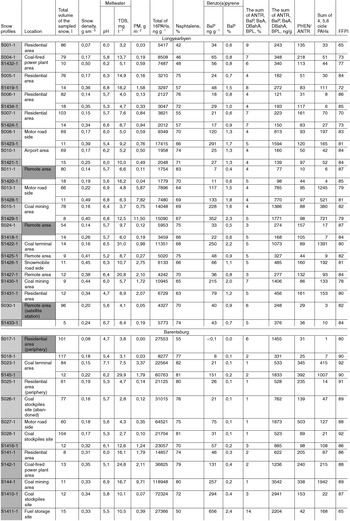
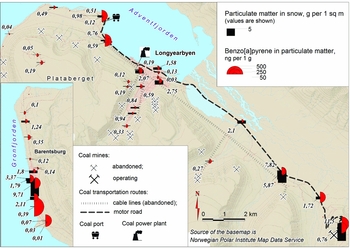
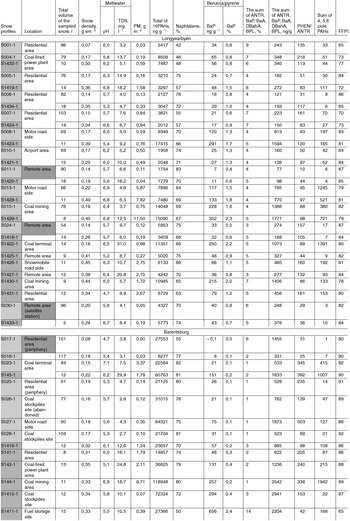
Results obtained capture a wide range of airborne PM concentrations amongst the study areas. The concentration of airborne PM varies from 0.002 grams per square meter (g m−2) (S017-1, the outskirts of Barentsburg) to 12 g m−2 (S1429-1, a slope near the operating coal mine in Lonyearbyen) (see Table 2, Fig. 2), indicating that local sources significantly determine the concentrations of PM. The total amount of PM accumulated in snow cover of the sampled sites varies: in elevated positions (Platoberget) PM ranges from 0.05 to 0.3 g m−2; in residential areas from 0.3 to 1.0 g m−2, and in the operating coal mine (Gruve 7) it exceeds 11 g m−2 (Fig. 2). In Barentsburg, similar amounts of snow particulates were found, namely from 0.1 to 10 g m−2, so the load of atmospheric dust at both investigated areas is similar.
Concentrations of PAHs in snow in areas studied
■Samples were collected in 2013
■Samples were collected in 2014
■Background (reference) site
The concentration of airborne PM and the presence of benzo(a)pyrene in snow particulates.

Locally originated coal dust is supposed to be the main PAH contributor to both snow and soil cover. A portion of coal fragments and particles erodes into headwaters, then moves downstream and accumulates in bottom sediments of rivers and fjords. Coal stockpiles and historical coal dumps around mining sites and along the transportation routes (Fig. 2) are the main sources of coal dust. The dust deposition on the snow surface is maximal in the beginning of winter and tends to decrease as soil and plant material are consolidated by ice and covered by snow. In Spitsbergen's environment, most coal stockpiles and historical coal dumps are relatively stable under predominating winter conditions. Some of the material in this environment has been redistributed in summer by slope processes, with the area of secondary downslope coal debris accumulations being much higher than eroded piles initially occupied. However, even in the winter season when the open coal stockpiles and historical coal dumps are covered by snow and are not exposed to wind, the coal particles settle down and accumulate in the snow cover as coal dust layers. Probably, in this situation, the most significant contribution of coal dust sources is the transportation of the coal to the pier and the power station. Thus, the total amount of PM, samples for which were taken near coal transportation roads, varies from 0.12 to more than 7 g m−2 in the snow samples sites (Fig. 2).
At the areas near sources of potential contamination, concentrations of airborne PM vary to a large extent in the samples of 2013 and 2014, while concentrations of PAHs are almost equal. This fact proves that the contribution of local sources of PAHs prevails in the surveyed areas and remains nearly the same from year to year, while concentrations of PM can change due to emission from other sources. More specifically, at operating mine areas (samples S015 and S1429) concentrations of airborne PM in snow in 2013 equal 0.75 g m−2 and concentrations of airborne PM in snow in 2014 equal 11.5 g m−2. However, PAH concentration equals 14048 ng/g and 15089 ng/g respectively including 0.6% and 2.3% of benzo(a)pyrene.
In samples collected in the year 2014, the mineralisation of melting snow was higher than the mineralisation of melting snow in samples collected in 2013 (13 mg/l and 5 mg/l respectively). However, acidity in samples of 2014 was lower than in samples of 2013 (6.0 and 5.8 respectively) (see Table 2).
There was no significant difference in the concentrations of PAHs between samples of 2013 and 2014. For example, in the Nybyen area in Longyearbyen (samples S006-1 and S1434-1) concentrations of PAHs with particle sizes exceeding 0.45 micrometer equaled 2127 ng/g and 3047 ng/g respectively. Also, concentrations of benzo(a)pyrene in these samples equaled 18 ng/g and 29 ng/g in 2013 and 2014 respectively. There is also uniformity of PAH concentrations and in particular benzo(a)pyrene concentrations in 2013 and 2014 measured near the fjord coast in residential areas (samples S005-1 and S1419-1); coal fired power plant in Longyearbyen (samples S004-1 and S1432-1); airport area in Longyearbyen (samples S010-1 and S1421-1); and road to an operating coal mine in Longyearbyen (samples S013 and S1428) (see Table 2).
As to the total PAH content, it was found to be significantly higher in samples from Barentsburg, up to 50–120 µg g−1 in contrast to the Longyearbyen northwestern shore (Bjørndalen) (S011-1, S1420-1), where samples from elevated and residential positions had values of 2–10 µg g−1, with contrasting vicinities of the coal pier area and operating mine having values of 14–18 µg g−1 (see Table 2).
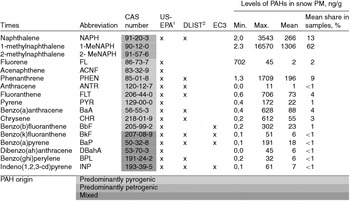
Interpretation of PAH levels detected in environmental samples is normally challenging due to the complexity of hydrocarbon mixtures. A common approach is to set apart associations of polyarenes, which differ in origin, petrogenic, biogenic and pyrogenic (Stogiannidis and Laane Reference Stogiannidis and Laane2015). Several diagnostic ratios and coefficients are used to identify signals from various PAH patterns and sources, background regional, coal related, remote PM related and so on (see Table 3). More specifically to our case study, the low rank coals are reported to be rich in typically petrogenic substituted series of phenanthrene, fluoranthene and chrysene, while bituminous coals demonstrate pyrogenic, like PAH pattern with clear presence of high-molecular compounds including benzo(a)pyrene. For the coal combustion emissions, fluoranthene, pyrene, phenanthrene, anthracene, chrysene, and benzo(k)fluoranthene dominate with other 4 to 6 ring PAHs also present in large amounts. Against this background it would be problematic to reveal minor contribution of motor vehicle exhausts that usually contains benzo(a)pyrene, benz(a)anthracene, and benzo(b)fluoranthene, i.e. compounds whose traces or more significant concentrations are also present in both coals and coal fired power plant emissions.
Diagnostic ratios and coefficients for PAHs

CAS numbers (from http://www.chemnet.com/cas/supplier.cgi)
US-EPA1, US Environmental Protection Agency. 16 priority PAHs, which were identified by the US Environmental Protection Agency (Simcik and Offenberg Reference Simcik and Offenberg2006).
European Parliament 2006. Regulation (EC) 166/2006 of the European Parliament and of the Council of 18 January 2006 concerning the establishment of a European Pollutant Release and Transfer Register and amending Council. Directives 91/689/EEC and 96/61/EC.
Dutch Registry (Dutch List), Directive on soil remediation (Soil Remediation Circular, 2013).
In the present study a practical way to deal with complex PAH mixtures is to select sampling sites in relation to the source and receptor areas (spatial distribution), perform repeated sampling (temporal distribution), and monitor the measured compounds also in sources and adjacent environments.
Results further demonstrate that PAHs are comprised primarily of naphthalene and substituted naphthalene, the contributions of which vary from 42 to 83%, with an average value of 70% (Fig. 3, Table 3). A large part of PAH composition also includes phenanthrene (it is a natural PAH and is present in coal composition). The percentage of chrysene, fluoranthene, pyrene and benz(a)anthracene in PAH composition equals 2–5% per each compound. The most harmful type of PAHs, benzo(a)pyrene, was observed in all samples with concentrations ranging from 0.01-2.4% and an average value of 0.9%.
Total level (values are shown in µg g-1) and composition of PAHs in snow particulates.

Such a pattern of PAH composition reflects coal dust as the dominating factor the role of which was initially natural but increased significantly as a result of mining and associated human activity. The latter include coal combustion and the use of various engines whose exhausts contain PAHs of so called pyrogenic association. Its mean share for all the samples analysed is 10 percent with variations from 4 to 21 percent and 0.01 to as much as 2.5 percent being related to benzo(a)pyrene (Fig. 3).
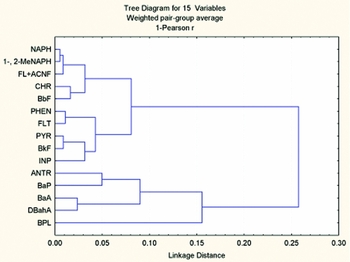
The results of PAH concentrations in snow samples were analyzed with software STATISTICA 8.5. For determining relative associations among 16 types of PAHs, a cluster analysis was used, which was based on PAH concentrations in 43 analysed snow samples. The values in all samples except one (S017-1) were higher than LOD (limit of detection). For sample S017-1, where values were below LOD, ½ LOD was used as nominative value. The distance metric was 1-Pearson r, and the amalgamation (linkage) rule was weighted pair-group average. The results of the cluster analysis are presented in a tree diagram (Fig. 4).
Cluster analysis tree diagram.

According to the cluster analysis, PAH compounds can be generally grouped into 2 associations (in which every linkage distance is less than 0.2). The PAH compounds that were grouped in one association have similarities in the distributions in analyzed samples. The first association consists mainly of petrogenic naphthalene and its homologues, phenanthrene and chrysene that are also natural to a great extent, with participating a number of compounds of mixed origin (fluorene and acenaphthene, benzo(b)fluoranthene, fluoranthene, pyrene, benzo(k)fluoranthene and indeno(1,2,3-cd)pyrene).
The other group of PAHs integrates benzo(a)pyrene, benzo(ghi)perylene, anthracene, benzo(a)anthracene, dibenzo(ah)anthracene whose presence may either be supposed to result from the local and remote fuel combustion emissions or, to a lesser degree, from deposition of bituminous coal dust (Fig. 4).
Since both associations contain individual polyarenes of mixed origin, the PAH pattern of sampled snow particulates is similar. The value of FFPI (Fossil fuel pollution index), which is the ratio of fossil-derived PAHs to total sum of PAHs (Boehm and Farrington Reference Boehm and Farrington1984) averaged 82 and ranged from a low of 65 units to a high of 92 units, which illustrates coal mining as major sources of PAH for the surrounding landscapes (see Table 2). The data obtained characterise the baseline PAH pattern, which is the same for the most of PM samples with clear predominance of naphthalene and phenanthrene. Very similar total levels of PAHs were measured in Svalbard inshore sediments with values ranging from 2 to 20 µg g−1, and PAH association was also the same with more than 70 percent of naphthalene and phenanthrene and similar FFPI and phenanthrene/anthracene ratios (Dahle and others, Reference Dahle, Savinov and Petrova2006).
Also, in order to determine relative associations among 16 types of obtained PAHs, the Pearson correlation coefficient (r) has been used. According to the Pearson coefficient, naphthalene, fluorene, acenaphthene, phenanthrene, fluoranthene, benzo(a)anthracene, chrysene, benzo(b)fluoranthene and dibenz(ah)anthracene were combined in one association due to high values of the correlation coefficient, which varies from 0.83 to 0.99 in the samples. By contrast, the distribution of benzo(a)pyrene depends on many factors: correlation coefficient with naphthalene equals 0.39. At the same time, benzo(a)pyrene can be correlated with anthracene (r = 0,72), pyrene (0.77), benzo(k)fluoranthene (0.80), benzo(g, h, i)perylene (0.79) and ideno(1,2,3-cd) pyrene (0.73).
Thus, the percentage of each compound of PAHs in relative association does not reflect the type of source of contamination directly, however it can characterize the intensity of natural (for example, phenanthrene) or anthropogenic (for example, benzo(a)pyrene) processes.
Concentration of PAHs, which belongs to one association with Benzo(a)pyrene varies from 77 to 3542 ng/g. This concentration range equals 2 to 13 % of the total PM (see Table 2).
In one unique sample indexed as S-017 (Table 2), in the residential area at the southern periphery of Barentsburg, a trace of benzo(a)pyrene was found. For the other part samples, minimum levels of benzo(a)pyrene in PM are very close in both areas, Barentsburg and Longyearbyen, some 10 to 40 ng g−1. In particular, samples from the northwestern shore (Bjørndalen - S011-1, S1420) and Platoberget contained 10 to 40 ng of benzo(a)pyrene per gram of dust, while samples from residential areas contained 20 to 60 ng g−1 with a clear increase to 50–70 ng g−1 in areas adjacent to the coal power plant. Locations around the Gruve 7 stand out from the rest of sampled sites owing to extremely high benzo(a)pyrene concentrations, 200–350 ng g−1. The coal pier area has the second highest level of benzo(a)pyrene - 120 ng g−1. The absolute maximum of benzo(a)pyrene level, 100 to 660 ng g−1, was found in PM near the Barentsburg power plant (Fig. 4).
By contrast, significant amounts of benzo(a)pyrene were detected in the industrial areas: at the fuel storage in Barentsburg (S1411), where the concentration of benzo(a)pyrene equals 656 ng/g; at the operating coal mine in Longyearbyen (S1429), where the concentration of benzo(a)pyrene equals 352 ng/g, and at the south mine dump in Barentsburg (S1410), where the concentration of benzo(a)pyrene equals 294 ng/g.
This fact indicates that the presence of PAHs in Spitsbergen is significantly influenced by the local sources of contamination which are associated with benzo(a)pyrene, especially in the areas of fuel combusting.
Naphthalene, phenanthrene and some other accompanying compounds of coal particles accumulate in the research areas proportionally, indicating that the variety of sources and processes are determined by the different associations of PAHs.
Conclusions
Results from this study show that the airborne PM, which was extracted from 54 snow sample sites, contained a wide range of PAH compounds including the harmful type Benzo(a)pyrene and also other types of carcinogenic and mutagenic compounds. Maximum obtained concentration of PAHs equals 120 mg/kg and maximum obtained concentration of Benzo(a)pyrene equals 656 ng/g. The concentrations of PAHs and Benzo(a)pyrene in the snowpack are not standardised, but the maximum permissible concentration of Benzo(a)pyrene in Russian soil equals 20 ng/g, maximum level of concentration of the sum of 10 types of PAHs including Benzo(a)pyrene in soils of Netherlands is 40 µg/g and maximum level of concentration of Benzo(a)pyrene in soils of Netherlands is 1 µg/g.
The load of atmospheric dust at both investigated areas is similar, with snow particulate amounts ranging from 0.1 to 10 g m−2. However, the total PAH content is higher in Barentsburg than in Longyearbyen. In Barentsburg it varies from 50 to 120 µg g−1 and in Longyearbyen the total PAH content ranges from 2–10 µg g−1 in the northwestern shore (Bjørndalen) to 14–18 µg g-1 at the coal port and operating mine.
Results from this study are consistent with previous published hypotheses suggesting that a major source of PAHs in the landscapes of Spitsbergen is airborne PM. At the same time these results do not prove the hypothesis about the significant influence of remote sources for PAH contamination in the air of Spitsbergen. Analysis of spatial distribution of PAHs in the snowpack demonstrates the significant impact of air contamination from local sources.
Since all the sources of coal are exposed to wind, they also produce airborne particulates whose plumes are often visible above all-season operational stockpiles, coal loading equipment and uncovered trucks. The role of historical coal dumps, piles and slope deposited as sources of dust decreases in winter as stable ice and snow cover forms. Detained PAHs in airborne PM can be divided in two associations: naphthalene-phenanthrene and Benzo(a)pyrene ones. Potentially, naphthalene-phenanthrene association determines the contribution of coal particles to PAH concentrations, whereas Benzo(a)pyrene associations is related to the combustion of fuel.
The results of repeated observations determine that at the same snow-sampling sites in 2013 and 2014, concentrations of PAHs were almost equal even if concentrations of airborne PM varied to a large extent. The relative stability of PAH concentrations provide evidence in favor of a local sources of PAHs associated with PM.
Within the surveyed areas, locations were found with insignificant or trace levels of Benzo(a)pyrene and accompanying anthropogenic hydrocarbons in air particulates. This gives a perspective to outline the impact areas around the local PAH sources, verify dispersion models as applied to coal fired power plants and other local emitters, and optimize positions for further PAH observations in both studied areas.
The results from this study provide an important contribution to the knowledge of these highly toxic carcinogenic contaminants on a local scale. Further analysis of PM composition (including trace metals), sampling of coal seams and bottom sediments of this vulnerable area will allow more detailed assessment of PAH origin and behavior in the environment.
Financial support
The present study was performed by a research working group within the frame of the Safety of Maritime Operation and Sustainable Industrial Development in the Arctic programme (SMIDA) supported by the Norwegian Centre for International cooperation in Education (SIU), (grant number CPRU-2011/10042). This work was also supported by the Svalbard Environmental Protection Fund (grant number 14/140).
Conflicts of interest
None