




No CrossRef data available.
Informal Groups of States and the UN Security Council
Published online by Cambridge University Press: 09 August 2005
Abstract
This article discusses the dynamics between informal groups of states and the UN Security Council. First, I argue that informal groups have proliferated in response to systemic change. Second, these groups serve as a mechanism that allows for exit from structural constraints of the Security Council and voice for stakeholders in a conflict. In effect, they may narrow the operational and participatory gap growing out of the multiple incapacities that prevents the Council from formulating an effective response to crisis situations. Third, the processes of diplomatic problem solving and its collective legitimation have become increasingly decoupled. The former tends to be delegated to informal groups or coalition of states, while the Council provides the latter. I illustrate how these findings affect one's understanding of power, legitimacy, and change in the theory of international relations.This article is the extensively revised version of a paper presented at the Annual Meeting of the Academic Council on the United Nations System in 2003. The project received financial support from the Economic and Social Research Council, United Kingdom (Grant No. R42200024335), and the Centre for International Studies, University of Oxford. The UN Studies Program at Yale University was a frequent host and home over recent years. I would like to express my gratitude for the long-term support and advice of Karl Kaiser, Bruce Russett, James Sutterlin, and especially Neil MacFarlane. I also wish to thank Mats Berdal, Richard Caplan, Sam Daws, Kurt Gaubatz, Marrack Goulding, Jean Krasno, Edward Luck, David Malone, Lisa Martin, James Mayall, Joseph Nye, Adam Roberts, Avi Shlaim, Ngaire Woods, and two anonymous referees for comments and criticism.
Information
- Type
- Research Article
- Information
- Copyright
- © 2005 The IO Foundation and Cambridge University Press
The U.S. intervention in March 2003 aiming at Iraq's disarmament and the change of its regime without explicit authorization of the United Nations (UN) Security Council has revived discussions about potential and limits of this international institution.1
I follow Mearsheimer's definition of institutions as a “set of rules that stipulate the ways in which states should cooperate and compete with each other.” Mearsheimer 1994/95, 8. See also Mearsheimer 2001, 14–22.
Glennon 2003, 18.
Malone, for example, points to the lack of “a sound understanding of what the Security Council is good at and what it is bad at.” Malone 2004, 1.
Hurd 2002; see also the account by the same author on why legitimacy matters to international institutions, Hurd 1999.
Emergence and proliferation of informal groups of states, 1956–2004

This article seeks to grasp the dynamics between informal groups of states and the UN Security Council. My assessment touches on wider questions that are at the heart of the discourse over the extent to which international organizations (IOs) are able to adapt to systemic change. While other scholars have attempted to address the causes of why states choose to act through formal IOs, such analysis provided a rather static view and neglected the effects of systemic change on IO governance.5
In this context, I define governance as “the processes and institutions, both formal and informal, that guide and restrain the collective activities of a group.”6Keohane and Nye 2000, 12.
Former UN secretary-general Dag Hammarskjöld emphasized this aspect in his address on “The Element of Privacy in Peacemaking,” delivered at Ohio University, Athens/Ohio, on 5 February 1958. Cordier and Foote 1974, 27.
In this article, I set forth three main arguments. First, informal groups of states proliferated in the 1990s in response to increasing demands on the UN to adapt to the security environment of the postbipolar world, without changing formally the constitutional foundation of the organization. These state groups are agents of incremental change. Second, informal groups of states serve as a mechanism that allow for exit from structural constraints of the Security Council and voice for stakeholders in a conflict. In effect, they may narrow the operational and participatory gap growing out of the multiple incapacities that prevents the Security Council from formulating an effective response to crisis situations. Third, the post–Cold War era has fostered an environment where the processes of diplomatic problem solving and its collective legitimation have become increasingly decoupled. The former tends to be delegated to informal groups or coalition of states, while the UN Security Council provides the latter.
The article is organized into four parts. The following section establishes the framework of analysis to grasp the dynamics between informal groups of states and the UN Security Council. Then, I examine the causes of informal groups of states, focusing in particular on the question of why informal groups of states have been proliferating in the postbipolar era. The third section applies the analytical framework to three specific conflict settings, that is, Namibia, El Salvador, and Kosovo. In the final section, I summarize the effects of informal groups of states on Council governance, highlighting implications for understanding power, legitimacy, and change in the theory of international relations.
Informal Groups of States and the Security Council: Grasping the Dynamics
Underlying my analysis is the assumption that the Security Council can best be described as a Janus-faced structure of both an open system and a closed shop. This notion reflects its sensitivity toward external change while the restrictive provisions of the Charter constrain the possibilities of formal adaptation.8
Prantl and Krasno 2004, 312–15.
This article does not aim at providing an encyclopedic overview on all possibilities of informal influence on Council decision making. Others have done that; see, for example, Bailey and Daws 1998. Although the influence displayed by other players such as the African Union, the European Union, the G-77, the Nonaligned movement, or the Organization of American States (OAS) is clearly important, these institutions do not match two crucial criteria of groups of friends and contact groups. They are neither informal nor ad hoc.
In this article, I adopt a predominantly rationalist theoretical approach.11
Although such a framework has been designed by scholars to assess the actual workings of international institutions, this approach clearly has its limits. It is my primary concern to establish the importance of informal groups of states as empirical phenomena rather than following a single line of international relations theory. IOs are complex settings, which cannot be analyzed through the exclusive lens of the rationalist research agenda.12Barnett and Finnemore, for example, gain important insights by applying a constructivist approach treating IOs as bureaucracies to explain their autonomy, including their propensity for self-defeating behaviour; see Barnett and Finnemore 1999 and 2004.
Lippmann 1922, 10.
Keohane and Martin 2003, 102–4.
How do international institutions cope with the problem of adjustment? As organization theory has illustrated, there are considerable constraints on initiating a formal adaptation process to respond to both changes in the relative power of states and the demands of a changed security environment.15
Keohane 1984, 100–3.
Keohane and Martin 2003, 100–2.
See McCarthy 1997; and Glennon 2003.
On the problem of unanticipated effects of international institutions, see Gallarotti 1991.
The findings of this article that are related to governance in and of the UN Security Council may force a reexamination of Abbott's and Snidal's proposition that centralization and independence are key functional characteristics of IOs, which provide a powerful incentive for states to act through formal IOs.19
Empirical evidence presents a much more complex picture. It demonstrates that informal groups of states in fact decentralize the workings of the UN Security Council, with the effect of ameliorating its structural deficiencies. Seen from the perspective of agency theory, those findings have direct impact on one's understanding of the nature of delegation to IOs, including the relationship between principal and agent.20On the delegation of tasks to IOs and the related issue of IO autonomy, see, for example, Barnett and Finnemore 1999 and 2004; Hawkins et al. 2003; Koremenos, Lipson, and Snidal 2004; Pollack 1997; and Lake and McCubbins 2004.
It is important in this regard to distinguish between procedural and output legitimacy. While procedural legitimacy refers to the creation of broad acceptance through public discourse over and through the formal decision making leading towards a specific course of action, output legitimacy refers to the creation of acceptance through the outcomes a course of action itself is able to produce.
In order to examine the dynamics between informal groups of states and the UN Security Council, I complement my analytical framework further by incorporating concepts and methods developed in the domestic context. Here, I draw on Hirschman's typology of exit, voice, and loyalty.23
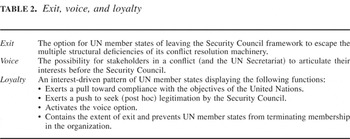
Such an analytical framework provides one with explanatory leverage to analyze institutional effects of the UN Security Council under conditions of systemic change. Exit signifies the option of leaving the UN framework, either partially or completely, in order to escape from the structural constraints of the UN. Exit is partial if it occurs within the objectives of the UN, for example, by acting under the umbrella of a Security Council resolution. I illustrate this further in the case of Namibia. Exit is complete if it occurs outside UN objectives. This may take form of (temporarily) bypassing the UN, as it has been the case during the Kosovo and Iraq wars in 1999 and 2003, respectively. Voice constitutes the possibility for stakeholders in a conflict (as well as the UN Secretariat) to articulate their interests before the Security Council and to take informal influence on its decision making. This is particularly relevant in those cases where stakeholders are not being represented on the Council, as I demonstrate in the case study on El Salvador. The decision to opt either for exit or voice is informed by the conflict setting. Underlying the notion of loyalty is the interest-based argument that achieving legitimacy eventually buttresses the position of (groups of) states. Loyalty displays four distinctive functions. First, it exerts a pull on UN member states toward compliance with the objectives of the organization. Second, it may push those players acting outside the UN framework to seek (post hoc) legitimation by the UN Security Council. Third, it activates the voice option. Fourth, loyalty may contain the extent of exit and limit the damage created by the marginalization of the organization. Table 2 illustrates the key features of exit, voice, and loyalty.Exit, voice, and loyalty

It is important to understand that this analytical framework differs from Hirschman's typology in one important respect. The classical exit option implies that if a customer is so dissatisfied with the quality of the product or the service provided by a firm, then he or she may buy the product from a competitor. This is different in the case of the UN, as there are no peer competitors around. This is neither to suggest that the UN has a monopoly in maintaining international peace and security nor is this to argue that the organization is the exclusive provider of legitimacy. However, with its nearly universal membership, the UN enjoys an unparalleled comparative advantage in providing a forum for achieving the broadest possible international acceptance for state action taken. Procedural legitimacy is one of the most important products the UN has to sell. The termination of UN membership is therefore an extremely unlikely option, as the political cost for implementation would be considerable. Loyalty matters. In the absence of loyalty, exit would be essentially costless.
In conclusion, analysis of the interplay between levels of formal and informal cooperation highlights variations in institutional effects. Grasping those variations constitutes a key challenge to institutional theory.24
For a useful review of the “state of the art” of institutional theory, see Simmons and Martin 2002.
Informal Groups of States: Causes
The breakdown of the bipolar system has provided the permissive political context to engage the UN conflict resolution machinery in a plethora of conflicts that had remained unaddressed during the Cold War.25
This was especially because of the increased cooperation of the P5 on important security issues from 1987 onwards. Although such cooperation would be established practice by 1990, it stayed selective on a case-by-case basis; see Hume 1994.
Why did informal groups of states proliferate in the post–Cold War era? In this section, I develop the argument that ad hoc arrangements constitute policy alternatives that emerged in response to systemic change. Although informal groups are not a unique feature of the postbipolar international system,26
Table 1 illustrates this point further.
The Complexity of Crisis Settings
The pattern of UN involvement in the postbipolar era is characterized by conflict settings on an intrastate rather than an interstate level. One can observe a shift away from border conflicts between states to conditions of internal violence that often spill over into neighboring countries in the region.27
Wallensteen 2002, 203–30.
Collier et al. 2003, 33–39.
Complex crisis settings require differentiated responses from the international community, a varying mix of policies and flexible sequencing of different kinds of interventions such as peace enforcement with aid and reform.29
Ibid., 185.
The increasing demands of the changing security environment affected both the Security Council and the Office of the Secretary-General. The Security Council responded by extending the scope of Article 39, adopting far-reaching mandates to deal with the complexity of crisis situations.31
The secretary-general was pushed into a position where “the management aspects … have become more demanding and more politically charged.”32Sutterlin 1995, 116.
Structural Constraints of the UN Security Council
The UN presents, as Doyle has rightly observed, “an almost textbook case of multiple strategic incapacities produced by both institutional incapacity and lack of support from its member countries.”34
Doyle 2001, 539.
Ibid.
Ibid.
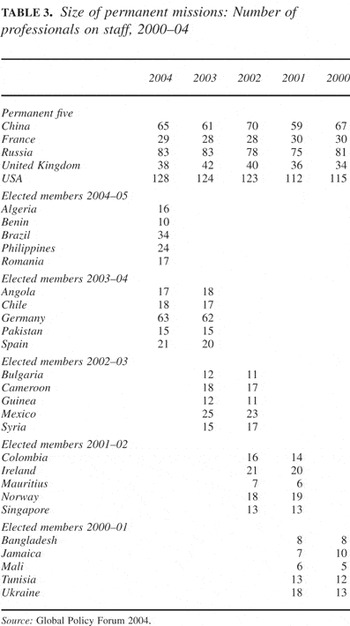
As far as the capacities of UN member states are concerned, only few delegations serving on the Council have the necessary (human) resources—taking into account, for example, the size of their permanent missions—to deal in depth with the plethora of conflicts placed on its daily agenda. Table 3 shows the number of professionals on staff of member states serving on the UN Security Council in the period from 2000 to 2004. The size of permanent missions such as Bangladesh, Jamaica, Mauritius, or Mali ranged, for example, in the year 2001 between six to eight professionals. Those numbers may illustrate the extremely limited resources of some UN member states to bear the additional burden of a two-year term on the Council. At the same time, they demonstrate the dominance of the five permanent members to set the Security Council's agenda and to define the chain of action.37
Caron 1993, 564.
This is especially prevalent in the case of France.
Size of permanent missions: Number of professionals on staff, 2000–04

Second, the biannual rotation of nonpermanent members constitutes another structural constraint, which prevents the formulation of comprehensive approaches to crisis settings. Consequently, much of the crisis response occurs ad hoc and in a rather incremental way. The very concept of nonpermanent membership is an impediment to any long-term commitment toward a conflict, especially a civil war. Given the fact that the average civil conflict goes on for about seven years, with a need for continued commitment lasting well into the decade of postconflict peace, the development and pursuance of long-term policy goals within the framework of the Security Council remains a difficult task.39
Collier et al. 2003, 3, 7.
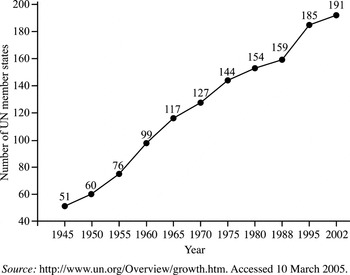
The third internal constraint relates to adaptations in the Council's working methods and procedures in response to systemic changes. In essence, the breakdown of the bipolar system exacerbated structural limitations of the UN Security Council that had originated much earlier when the UN had to adapt to change resulting from decolonization, which constituted “the most important single process in international relations since the Second World War.”40
Roberts 2003, 57.
For the growth in UN membership, see Figure 1.

Growth in UN membership, 1945–2002
In consequence, pressure increased to adapt the composition of the Security Council in order to achieve a more balanced geographical representation of countries on that body. The enlargement of the Security Council, coming into effect on 31 August 1965, had wide-ranging implications for its inner-institutional balance of power and diplomacy, with the dominance of Western countries waning.42
Hiscocks 1973, 99.
In fact, the formation of the Western Contact Group on Namibia in 1977 occurred in direct response to those structural deficiencies, as I will elaborate further below.
Article 31 of the UN Charter reads as follows: “Any Member of the United Nations which is not a member of the Security Council may participate, without a vote, in the discussion of any question brought before the Security Council whenever the latter considers that the interests of that Member are specially affected.” United Nations Department of Public Information 1997.
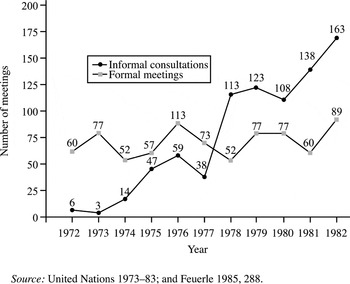
Bailey and Daws 1998, 155. At peak times, especially when the Security Council discussed matters related to decolonization and Apartheid, as much as 50 percent of the total UN membership participated in its formal meetings. For example, on 1 June 1983, a total number of sixty-four delegations, not being members on the Council, participated in this meeting; see UN Document S/PV.2451, 1 June 1983.
Figure 2. The year 1978 appears as watershed, with the number of informal consultations tripling from 38 meetings in 1977 to 113 the following year. This increase occurred because of the completion of a separate room in 1978 built for the sole purpose of holding informal consultation. This de-facto formalization contributed to a significant increase of the informal consultations of the whole.
Cited in Feuerle 1985, 294.
The Western Contact Group on Namibia, established in 1978, constitutes the precedent case where a group of UN member states chose the exit option to escape those structural deficiencies. This became frequent practice in the 1990s.

Formal meetings and informal consultations of the Security Council, 1972–82
In the post–Cold War era, this negative trend worsened, with the UN Security Council operating in a permissive political context that allowed for dealing with more and more complex conflict settings than ever before in the history of the UN. In effect, the situation challenged the capacity of the Council to fulfill its role as the primary instrument for the maintenance of international peace and security, generating an Article 24 crisis with essentially three dimensions.49
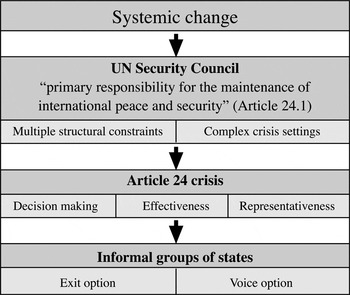
First, the crisis of representativeness pertains to the perception that the composition of the Security Council is neither geographically balanced nor does it reflect the current distribution of relative power among UN member states. Second, the crisis of effectiveness relates to the growing mismatch in the Security Council between the willingness to take decisions and the allocation of resources for their implementation. Those problems had been most prominent in the cases of Srebrenica and Rwanda. Third, the crisis of decision making refers to the selectivity of the Security Council in addressing some conflicts while ignoring others. Especially after the failed intervention in Somalia, Council members had become more reluctant to engage in conflict settings on the African continent. Although this trend has reversed somewhat recently, the overall problem of selectivity remains.In conclusion, informal groups of states emerged early in the history of UN peacemaking out of the structural deficiencies the UN Security Council has been facing at various levels. They proliferated out of the demands the UN have been confronted with after the breakdown of the bipolar system. The permissive political context that allowed for the greater engagement of the UN in combination with the complexity of crisis settings and the multiple structural constraints of the Security Council, fostered the development toward an Article 24 crisis, affecting Council decision making, effectiveness, and representativeness. UN member states redelegated tasks away from the UN to informal arrangements. Governance in the Council changed significantly, as much of the work was done within the decentralized setting of those informal frameworks, with minimal involvement of other Council members. Figure 3 illustrates the causal relationship between systemic change, problems of the UN Security Council to adapt accordingly, the resulting Article 24 crisis, including the recourse to informal groups of states as a mechanism that allows for exit from structural constraints and voice for stakeholders in a conflict.

Proliferation of informal groups in the post–Cold War era: Causes
In the following section, I apply the analytical framework of exit, voice, and loyalty to specific conflict settings to illustrate my argument. The conflict settings of Namibia (exit) and El Salvador (voice) constitute precedent cases that illustrate the contextual and situational parameters contributing to the establishment of the Western Contact Group and the Group of Friends of the Secretary-General respectively. Both informal devices served as models that would be applied in subsequent crisis settings.50
While the Western Contact Group served as a model for the Contact Group on former Yugoslavia, formed in 1994, the group of friends mechanism was subsequently applied in other conflict settings such as Haiti (1992), Western Sahara (1993), or Guatemala (1994).
The Cases of Namibia, El Salvador, and Kosovo
Exit and voice are distinctive policy options accommodating different needs. The decision to opt for either exit or voice is informed by the specific conflict setting. This section demonstrates the explanatory leverage of exit, voice, and loyalty as analytical framework by applying it to the cases of Namibia, El Salvador, and Kosovo.51
These cases are fully elaborated in Prantl forthcoming.
Exit: The Western Contact Group on Namibia
The process leading toward the independence of Namibia in 1990 illustrates the problems of the UN to adapt to systemic change well before the breakdown of the bipolar system. As mentioned earlier, the process of decolonization resulted in a significant increase of membership that shifted the balance of power in the General Assembly and the Security Council. In addition, with the admission of postcolonial states, decolonization turned into an ideological issue that contributed to a situation where direct UN involvement had proven ineffective. These structural conditions complicated the process toward the further dismantling of the colonial system and generated a push toward exit, as epitomized in the establishment of the Western Contact Group in 1977.52
The Western Contact Group comprised Canada, France, Germany, United Kingdom, and United States. For a good overview on the workings of the Western Contact Group, see Brenke 1989; Jabri 1990; Karns 1987; and Vergau 2002.
The emergence of the informal group coincided with the nonpermanent Council membership of Canada and the Federal Republic of Germany in 1977–78. At this time, several General Assembly resolutions had been adopted under massive pressure of the Organization of African Unity (OAU), criticizing the attitude of Western countries toward Apartheid in general, and their stance toward the situation in Namibia and Rhodesia in particular. Furthermore, growing recourse to Article 31 of the UN Charter that granted nonmembers the possibility of participation in formal meetings of the Council effectively transformed the body into a mini-General Assembly, with negative repercussions for dealing effectively with the conflict.53
Prantl forthcoming.
The frontline states were Angola, Botswana, Mozambique, Tanzania, and Zambia.
The Contact Group operated without an explicit mandate of the Security Council and negotiated a settlement proposal for Namibia's independence outside the UN framework, though within the objectives of the organization.55
The Western Contact Group explicitly based its initiative on Resolution 385, adopted in January 1976, which had already provided a framework of objectives for a negotiated settlement. The settlement proposal became later endorsed by Resolution 435, adopted in September 1978.
The Reagan administration adopted the linkage approach in 1981 and made progress in the question of Namibian independence dependent on a prior withdrawal of Cuban troops from the neighboring country of Angola. Then the preservation of Resolution 435 as the legitimate basis for the settlement of conflict became the primary concern for Contact Group members and the UN secretary-general. Preventing the complete exit of the superpower was achieved by tacitly acknowledging the U.S. policy of linkage without publicly approving it. See Crocker 1999; and Prantl forthcoming.
Voice: The Group of Friends of the Secretary-General on El Salvador
Contrary to the process leading toward Namibian independence, the formation of the Group of Friends of the Secretary-General on El Salvador57
The group consisted of Colombia, Mexico, Spain, and Venezuela, later joined by the United States. At that stage the Friends became known as the “4+1.”
See de Soto, 1999; Johnstone 1995; Juhn 1998; and Whitfield 1999.
This case, therefore, sheds light on the role of IOs as active agents. It also illustrates the tensions between what IOs want and what states want, which has been a serious shortcoming in the work of international relations scholars thus far; see Barnett and Finnemore 2004. At the same time, the case shows that the constructivist and principal-agent analysis are mutually enforcing rather than exclusive; see Prantl forthcoming.
Seen from the perspective of U.S. foreign policy, the case of El Salvador also demonstrates that “support for multilateral negotiations can be more effective and less costly than the unilateral use of force.”60
Karl 1992, 164.
Exit versus Loyalty: Quint, G-8, and Troika during the
Kosovo War61 The Quint is composed of the five
key allies within NATO, that is, France, Germany, Italy, UK, and the United
States. During the Kosovo crisis, they coordinated positions on NATO's
air campaign and cooperated to maintain the coherence of the Atlantic
Alliance. The Group of Eight (G-8) consists of Canada, France, Germany,
Italy, Japan, UK, United States, and Russia. The Troika was composed of
then President of Finland Martti Ahtisaari as EU Envoy, Russian Envoy
Victor Chernomyrdin, and then U.S. Deputy Secretary of State Strobe
Talbott; on the workings of these informal settings, see Albright 2003; Joetze 2001;
and Talbott 2002.
The Quint is composed of the five key allies within NATO, that is, France, Germany, Italy, UK, and the United States. During the Kosovo crisis, they coordinated positions on NATO's air campaign and cooperated to maintain the coherence of the Atlantic Alliance. The Group of Eight (G-8) consists of Canada, France, Germany, Italy, Japan, UK, United States, and Russia. The Troika was composed of then President of Finland Martti Ahtisaari as EU Envoy, Russian Envoy Victor Chernomyrdin, and then U.S. Deputy Secretary of State Strobe Talbott; on the workings of these informal settings, see Albright 2003; Joetze 2001; and Talbott 2002.
The Kosovo conflict is a textbook case that amply illustrates the Article 24 crisis of the UN Security Council at the end of the 1990s. The military and political management of the crisis was being conducted outside the UN framework without explicit authorization of the Security Council. The Western Alliance chose the exit option by employing NATO because the Security Council was or appeared to be deadlocked.62
See Roberts 1999; and Daalder and O'Hanlon 2000.
NATO intervention in Kosovo without authorization of the Security Council pushed the exit option to its extreme, while generating a maximum pull on the key actors to seek post hoc legitimation for their action taken. Despite the marginalization of the Security Council in the management of the crisis, loyalty mattered. The prospect of reinvolving the UN constituted an important precondition for the resolution of conflict. In addition, G-8 and Troika were instrumental in providing a platform for the reinvolvement of the UN. Exiting the UN framework allowed to employ military force, which the Western Alliance considered to be necessary to achieve political outcomes. Informal settings such as Quint, G-8, and Troika were instrumental in merging the military and political track of conflict management.
The Kosovo case illustrates the decoupling of the processes of diplomatic problem solving and its collective post hoc legitimation. It underlines the importance and persistence of the “symbolic life”63
of the UN Security Council. While the decoupling of the substance of conflict management from the process of its legitimation significantly increased the political costs of intervention, the prospect of reengaging the UN via the adoption of Council Resolution 1244 helped to create broader acceptance and the perception of legitimacy. Consequently, loyalty contained the negative repercussions of exit. Quint, G-8, and Troika delivered substantial outcomes, with the UN Security Council producing legitimacy through its formal decisions. The adoption of Council Resolution 1244 merged process and substance of conflict settlement. In conclusion, the dynamics between Quint, G-8, and Troika on the one side and the UN Security Council on the other side were mutually reinforcing. If exit resulted in a deprivation of legitimacy, loyalty contributed to its restoration.Informal Groups of States: Effects
The previous section has analyzed the dynamics between informal groups of states and the UN Security Council by applying the analytical framework of exit, voice, and loyalty to the conflict settings of Namibia, El Salvador, and Kosovo. These examples illustrated the causes behind the emergence of informal groups of states and their proliferation in the post–Cold War era. I have also identified patterns of interaction with the Security Council. In this section, I address the question of what one can learn from the cases of Namibia, El Salvador, and Kosovo. What are the effects of informal groups of states?
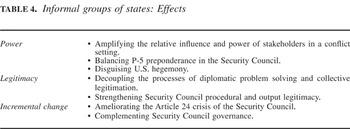
In the following, I organize my arguments around three broad themes that are key concepts in the theory of international relations: (1) power, (2) legitimacy, and (3) change. I argue that, despite the various constraints to amend IOs in response to systemic change, informal groups of states have initiated an informal adaptation process by taking on certain problem-solving functions in the resolution of conflicts. Table 4 summarizes how informal groups of states impact on the relative power between UN member states and on processes of legitimation.
Informal groups of states: Effects

Power
Informal groups of states affect the balance of power between UN member states. In this context, I follow Dahl's definition that “A has power over B to the extent that he can get B to do something that B would not otherwise do.”64
Dahl 1957, 203.
This specific proposition may also apply more generally to China and Russia.
1. Amplifying the influence of stakeholders. Informal groups of states are instrumental in positioning stakeholders that do not have a seat on the Security Council. Their influence ranges from consultations with Council members to a much stronger involvement, which comes close to a kind of “informal membership.”66
Hurd has offered a useful starting point to elaborate on the concept of informal membership. However, the terminology is quite problematic because it suggests a “quasi-membership” on the Council, which covers only one end of the spectrum where influence on Security Council decision making is particularly strong. Empirical evidence shows a much more diverse picture; see Hurd 1997.
Seen from the perspective of a stakeholder participating in such diplomatic device, the probability of making a difference increases because decisions taken are usually based on consensus within the group. It is important to understand that working through informal groups of states not only has a strong payoff for those states not being represented on the Council, but also for its elected members. In a recent article on “Power and Satisfaction in the Security Council,” O'Neill has illustrated that their influence in terms of voting power is just tiny.67
Following his observations, I claim that, seen from the perspective of elected members of the Security Council, engagement in informal groups of states bears a considerably higher potential for determining outcomes than formal participation in the workings of the Security Council. In addition, informal settings provide a flexible format that is often preferable to the formalized procedures of the Security Council.
2. Balancing P-5 preponderance. The transformation of the bipolar system generated the permissive political context for the greater engagement of the UN in conflict settings. The formation of the Group of Friends on El Salvador occurred in response to the shifting balance of power between UN Secretariat and Security Council during this transformation period. The conflict setting almost excluded any deep involvement of the UN Security Council, given the strong resistance of the FMLN. The case of El Salvador is indicative of how group of friends are able to recalibrate the strategic balance between stakeholders, Secretariat and Security Council. Decentralization of problem solving through informal groups of states prevents any micromanagement of the conflict by the Council. In effect, it balances the preponderance of the P-5.
At the same time, the formation of such diplomatic devices signals a preexisting level of commitment by a group of UN member states to contribute to the solution of conflict. By setting the agenda, informal groups of states may reduce dependency on the P-5 and other members of the Council to address conflicts. Engagement of informal groups decreases the probability of a widening gap between declaratory and operational policy of the Security Council. The preexisting level of commitment by a group of member states suggests that political will for the solution of conflict exists, compliance with resolutions adopted by the Security Council will be secured, and the necessary means for implementation be provided. Ultimately, informal settings tend to increase “the likelihood and robustness of cooperation.”68
Oye 1986, 21.
3. Disguising U.S. hegemony. Choosing multilateral means by employing multilateral gatherings with small numbers is a promising strategy for achieving policy ends at relatively low costs.69
Ikenberry has observed that, for a leading state, institutional agreements are attractive as “they potentially lock other States into stable and predictable policy orientations thereby reducing the need to use coercion to secure the dominant State's foreign policy aims.”70See Ikenberry 2002, 122; and Ikenberry 2003, 51–54.
Ikenberry 2002, 122.
Yale–UN Oral History Interview Transcripts, Chester Crocker, former U.S. Assistant Secretary of State for African Affairs, 20 July 1998.
For an astute analysis of this relationship, see Hurrell 2005.
In conclusion, U.S. exceptionalism is a factor that has to be taken into account and cannot be ignored in the resolution of conflicts with U.S. involvement. Informal groups of states have the effect of disguising U.S. preponderance and avoiding the appearance of unilateral action. As a result, they may create greater acceptance of U.S. foreign policy.
Legitimacy
This subsection examines the effects of informal groups of states on understanding legitimacy.75
Clark provides an extensive treatment of the practice of legitimacy in international relations; see Clark 2005.
He argues that “[t]he symbolic power of the Security Council is evident in the energy states expend on having the Council pay attention to issues of concern to them.” Hurd 2002, 39.
What is legitimacy? Franck has defined legitimacy as “a property of a rule or rule-making institution which itself exerts a pull toward compliance on those addressed normatively because those addressed believe that the rule or institution has come into being and operates in accordance with generally accepted principles of right process.”78
Franck 1990, 24.
Ostrom 1990, 139.
Claude 1966, 369.
The exceptionalist role of the United States may serve as the most prominent example to elaborate on those different perceptions. Luck has convincingly elaborated on the distinctive U.S. conception of political legitimacy, which is based on both its domestic political culture and relative power position in the international system (in terms of military and economic power, including cultural attraction).81
Luck 2002, 51.
Confidential interview by author with a senior official of the U.S. State Department, Washington, D.C., 21 November 2000. This view seems to be a consistent pattern throughout various administrations. Differences between subsequent presidencies in the conduct of U.S. foreign policy relate often much more to style rather than substance.
Claude 1966, 368.
Ibid.
Clark 2005, 239.
Legitimacy equally requires, as Kissinger has argued, “the acceptance of the framework of the international order by all major powers, at least to the extent that no state is so dissatisfied that … it expresses its dissatisfaction in a revolutionary foreign policy.”86
Kissinger 1957, 1.
Although this has been the standard argument in support of Security Council reform over the last few years, I illustrate further below that the Article 24 crisis will not be solved simply by enlarging the membership of the UN Security Council. In the following, I elaborate on implications of my previous claim that the exit option is contained by the loyalty of UN member states toward the Security Council. I argue, first that the Council functions of diplomatic problem solving and legitimation have become decoupled. Second, I claim that these functions are separable but not separate: decoupling may eventually strengthen the output legitimacy of the Council.
1. Decoupling the processes of diplomatic problem solving and collective legitimation. The structural conditions of the postbipolar era have fostered a devolution of crisis management to ad hoc coalitions of able and willing countries or informal settings, whereas the UN Security Council still remains a pull factor by granting the platform—at least in most cases—for the “right process,” that is, the procedural legitimation for state action.87
On the supposed failure of the democratic process to produce substantive outcomes, see Dahl 1989, 163–75.
For example, in 1977–78, the Western Contact Group on Namibia negotiated a settlement proposal for Namibia's independence outside the UN framework, which was later endorsed by the Security Council; see the case study on Namibia above.
This argument is not to be understood as entirely sequential. The U.S. invasion in Iraq illustrates that the pull for UN reinvolvement did not follow immediately but subsequently with the invasion forces facing growing resistance on the ground and the political (and financial) costs of the operation rising. I have to thank Joseph Nye for raising this caveat.
Parsons 1977 underlines the importance of “procedural primacy” to explain the workings of domestic institutions.
2. Strengthening procedural and output legitimacy of the UN Security Council. This subsection further develops the argument that informal groups of states may strengthen the procedural and output legitimacy of the Security Council. While informal settings are able to produce substantial outcomes, it is the Council that provides legitimacy through its formal decisions. The functions of problem solving and legitimation are separable, though not separate. In fact, they are mutually dependent and may be reinforcing.
At the same time, decentralization of the workings of the Security Council enlarges the ownership of its decision-making process. Woods has succinctly pointed out that “the longer-term considerations of effectiveness require a more active and participatory membership than the traditional hierarchical vision, and herein lies a powerful reason for applying lessons of good governance to international institutions.”92
Woods 1999, 43.
Ibid.
In conclusion, the dynamics between informal groups of states and the UN Security Council may produce double-edged legitimacy in terms of procedure and output. The remerging of the two functions helps to achieve legitimacy as the common good, which enjoys broad acceptance.94
“The common good,” according to Dahl, “consists of the practices, arrangements, institutions, and processes that … promote the well-being of ourselves and others—not, to be sure, of ‘everyone,’ but of enough persons to make the practices, arrangements, etc. acceptable and perhaps even cherished.” Dahl 1989, 307.
Incremental Change
This subsection analyzes the effects of informal groups of states on institutional change. Given the circumstance that the UN is a prism through which one also may examine transformations of the international system, such analysis may also allow to draw wider conclusions for adaptations in the power relationships between states. In the following, I elaborate on the function of informal groups of states as agents of incremental change, examining their impact on Security Council governance. I also address the question of the extent to which the engagement of informal groups of states may constitute a compensation for formal adaptation of the institution. I argue, first, that informal settings may ameliorate the Council's Article 24 crisis in the fields of decision making, effectiveness, and representativeness. Second, any formal adaptation in the membership of the Council will not resolve the Article 24 crisis.
1. Ameliorating the Article 24 crisis of the UN Security Council. Informal groups of states ameliorate the Article 24 crisis of the UN Security Council, without formally changing its membership. In this context, exit and voice are policy options that allow for an incremental adaptation of international institutions. They serve as flexible agents of incremental change. Change is incremental because the Charter of the UN remains unaltered. Consequently, those agents are able to alleviate tensions generated by systemic change in combination with the inability of the Security Council to adapt. In effect, they constitute a safety valve to divert the inner-institutional pressure for Council reform. Informal groups of states are stabilizing elements for international institutions in transition.
Within the specific context of the UN, informal groups take on four broad functions.95
These functions are condensed from a thorough review of UN documents dealing with concepts and instruments to adapt the Organization to the postbipolar security environment. They include An Agenda for Peace (1992) as well as its Supplementary Paper (1995), An Agenda for Democratization (1996), and subsequent reports by the UN secretary general on the causes of conflict and the promotion of durable peace and sustainable development in Africa (1998–2001); see UN documents A/47/277—S/24111, 17 June 1992, paragraph 62; A/50/60—S/1995/1, 3 January 1995, paragraph 83; A/51/761, 20 December 1996, paragraph 48; S/1998/318, 13 April 1998, paragraph 24; S/1999/1008, 25 September 1999, paragraphs 9–11; and A/56/371, 18 September 2001, paragraph 9.
See Jones 2001 and 2002; and Stedman 2001.
However, it seems to be the prevailing understanding in the UN Secretariat that overconceptualizing informal settings would already restrain their flexibility and limit their usefulness as agents of incremental change.97
Author's confidential interview with a senior official of the UN Secretariat, 29 October 2002.
This view is confirmed by a high-ranking senior diplomat of a candidate country for a permanent seat on the UN Security Council; confidential interview by author, 26 September 2000.
2. Complementing governance of the UN Security Council. Ultimately, informal groups of states may enhance governance in and of the Security Council. Although informal groups of states bear the potential of complementing governance of the UN Security Council, states do not have entered the brave new world of good governance, yet. The complementary functions of informal devices are far from being the Weberian ideal-type solution to meet longer-term considerations of effectiveness. Many of these groupings tend to be self-selected, with an exclusive participation and a virtually absent degree of accountability. In positive terms, informal groups may complement Council governance by narrowing the operational and participatory gap growing out of the multiple strategic incapacities that prevents the Council from formulating an effective response to crisis situations. The output legitimacy of the Council is strengthened, while actions taken by informal settings become more acceptable.
Any positive impact on Council governance is however dependent upon the ability to strike a balance between competing demands of inclusiveness, efficiency, informality, accountability, and transparency. In negative terms, informal groups of states will operate in competition with the UN Security Council. Then, the legitimacy of the Council is weakened, while the political costs for states acting through informal settings are increasing. The processes of diplomatic problem solving and its collective legitimation become mutually excluding.
Conclusions
This article has established the importance of informal groups of states as part and parcel of Security Council governance. In order to understand the variables that define the performance of the Security Council, I have extended my analysis to levels of informal cooperation. Informal groups have reshaped international diplomacy and altered the balance of power within the UN. Seen from the perspective of principal-agent theory, UN member states have redelegated tasks away from the Security Council to informal arrangements that allow for the better management of multiple policy externalities. In this article, I have moved further with the question of why states act through formal IOs.99
Abbot's and Snidal's analysis of the costs and benefits of IOs is rather static and has not taken into account the effects of systemic change. One needs to qualify the claim that the functions of centralization and independence enhance efficiency. This pattern may alter when IOs are challenged to adapt to systemic change. The synergistic framework of analysis that I have chosen helps to explain why decentralization through informal groups of states may enhance efficiency. Ad hoc arrangements are instrumental to escape from the structural constraints of IOs. Decentralization results in a new and rather peculiar structure of international diplomacy, in which the functions of diplomatic problem solving and legitimation have become decoupled. The two functions are separable but not separate. I have illustrated how the roles of informal groups of states and the UN Security Council may be mutually reinforcing.The dynamics between informal settings and the UN Security Council can best be captured by applying the analytical framework of exit, voice, and loyalty, as I have demonstrated in the cases of Namibia, El Salvador, and Kosovo. In doing so, I have illustrated how conflict settings inform the choice for either exit or voice. The comparative study of the interaction between informal groups and Security Council appears to be particularly useful to understand observed variations in levels of cooperation, which constitutes a key challenge to institutional theory. The importance of the analytical framework chosen originates in the explanatory leverage it provides to draw inferences about the institutional effects of the UN Security Council under conditions of systemic change. Informal groups of states are a means of generating an (incremental) adaptation process in response to altered structural conditions. In this context, the growing recourse to informal arrangements appears as the “cheaper option” than a complete overhaul of the organization's foundations, that is, the revision of the UN Charter. The diplomatic devices are a “safety valve”100
Hirschman 1970, 124.
In effect, the redelegation of tasks to informal groups of states may well be seen as a stabilizing element for international institutions in transition.101
In order to test this proposition further one needs to broaden the research agenda by examining in greater detail how informal arrangements affect governance in other international institutions such as IMF, World Bank, WTO, European Union, or NATO.
See McCarthy 1997 and 1998; and Glennon 2003 argues in a similar vein.
Russett 1997, 18–21.
This proposition is supported by recent academic work on the role of government networks; see Slaughter 2004.
Further study is needed to analyze the dynamics between informal arrangements and formal IOs. Examining the anatomy of this relationship will enhance one's understanding of power, legitimacy, and change in the theory of international relations.
References
REFERENCES
Abbott, Kenneth W., and
Duncan Snidal.
1998.
Why States Act Through Formal International Organizations.
Journal of Conflict Resolution
42 (1):3–32.Google Scholar
Albright, Madeleine.
2003.
Madam Secretary: A Memoir.
New York:
Miramax.
Bailey, Sydney, and
Sam Daws.
1998.
The Procedure of the UN Security Council. 3rd ed.
Oxford:
Oxford University Press.
Barnett, Michael, and
Martha Finnemore.
1999.
The Politics, Power, and Pathologies of International
Organizations.
International Organization
53 (4):699–732.Google Scholar
Barnett, Michael, and
Martha Finnemore.
2004.
Rules for the World: International Organizations in Global
Politics.
Ithaca, N.Y.:
Cornell University Press.
Berdal, Mats.
2003.
The UN Security Council: Ineffective but Indispensable.
Survival
45 (2):7–30.Google Scholar
Brenke, Gabriele.
1989.
Die Bundesrepublik Deutschland und der Namibia-Konflikt.
Munich, Germany:
Oldenbourg.
Caron, David D.
1993.
The Legitimacy of the Collective Authority of the Security
Council.
American Journal of International Law
87 (4):552–88.Google Scholar
Clark, Ian.
2005.
Legitimacy in International Society.
Oxford:
Oxford University Press.
Claude, Inis L.
1966.
Collective Legitimization as a Political Function of the United
Nations.
International Organization
20 (3):367–79.CrossRefGoogle Scholar
Collier, Paul,
Lani Elliott,
Håvard Hegre,
Anke Hoeffler,
Marta Reynal-Querol, and
Nicholas Sambanis.
2003.
Breaking the Conflict Trap: Civil War and Development Policy.
Washington, D.C.:
World Bank.
Cordier, Andrew W., and
Wilder Foote.
1974.
Public Papers of the Secretaries-General of the United Nations, Vol.
IV. Dag Hammarskjöld,
1958–1960.
New York:
Columbia University Press.
Cox, Robert W., and
Harold K. Jacobson.
1973.
The Framework for Inquiry. In
The Anatomy of Influence: Decision-Making in International
Organization, edited by
Robert W. Cox and
Harold K. Jacobson,
1–36.
New Haven, Conn.:
Yale University Press.
Crocker, Chester A.
1999.
Peacemaking in Southern Africa: The Namibia-Angola Settlement of
1988. In
Herding Cats: Multiparty Mediation in a Complex World, edited
by
Chester A. Crocker,
Fen Osler Hampson, and
Pamela Aall,
207–44.
Washington, D.C.:
U.S. Institute of Peace Press.
Daalder, Ivo H., and
Michael E. O'Hanlon.
2000.
Winning Ugly: NATO's War to Save Kosovo.
Washington, D.C.:
Brookings Institution Press.
Dahl, Robert A.
1989.
Democracy and Its Critics.
New Haven, Conn.:
Yale University Press.
De Soto, Alvaro.
1999.
Ending Violent Conflict in El Salvador. In
Herding Cats: Multiparty Mediation in a Complex World, edited
by
Chester Crocker,
Fen Osler Hampson, and
Pamela Aall,
345–85.
Washington, D.C.:
U.S. Institute of Peace Press.
Doyle, Michael.
2001.
War Making and Peace Making: The United Nations'
Post–Cold War Record. In
Turbulent Peace: The Challenges of Managing International
Conflict, edited by
Chester A. Crocker,
Fen Osler Hampson, and
Pamela Aall,
529–60.
Washington, D.C.:
U.S. Institute of Peace Press.
Feuerle, Loie.
1985.
Informal Consultation: A Mechanism in Security Council
Decision-Making.
New York University Journal of International Law and Politics
18 (1):267–308.Google Scholar
Franck, Thomas M.
1990.
The Power of Legitimacy Among Nations.
Oxford:
Oxford University Press.
Freudenschuß, Helmut.
1993.
Article 39 of the UN Charter Revisited: Threats to Peace and Recent
Practice of the UN Security Council.
Austrian Journal of International Law
46 (1):1–39.Google Scholar
Gallarotti, Guilio M.
1991.
The Limits of International Organization: Systematic Failure in the
Management of International Relations.
International Organization
45 (2):183–220.Google Scholar
Glennon, Michael J.
2003.
Why the Security Council Failed.
Foreign Affairs
82 (3):16–35.CrossRefGoogle Scholar
Global Policy Forum.
2004.
Size of Permanent Missions—Number of Professionals on Staff,
1994–2004.
Available from
〈http://www.globalpolicy.org/security/data/tabsec.htm〉.
Accessed 10 March 2005.
Hawkins, Darren,
David A. Lake,
Daniel Nielson, and
Michael J. Tierney.
2003.
Delegation Under Anarchy: States, International Organizations, and
Principal-Agent Theory.
Working Paper.
Program on International Organization & Change.
Available at
〈http://www.internationalorganizations.org/Delegation_Under_Anarchyv_8.26.pdf〉.
Accessed 10 March 2005.
Hirschman, Albert O.
1970.
Exit, Voice, and Loyalty: Responses to Decline in Firms,
Organizations, and States.
Cambridge, Mass.:
Harvard University Press.
Hiscocks, Richard.
1973.
The Security Council: A Study in Adolescence.
London:
Longman.
Hume, Cameron R.
1994.
The United Nations, Iran, and Iraq: How Peacemaking Changed.
Bloomington:
Indiana University Press.
Hurd, Ian.
1997.
Security Council Reform: Informal Membership and Practice.
In
The Once and Future Security Council, edited by
Bruce Russett,
135–52.
New York:
St. Martin's Press.
Hurd, Ian.
1999.
Legitimacy and Authority in International Politics.
International Organization
53 (2):379–408.CrossRefGoogle Scholar
Hurd, Ian.
2002.
Legitimacy, Power, and the Symbolic Life of the UN Security
Council.
Global Governance
8 (1):35–51.Google Scholar
Hurrell, Andrew.
2005.
Power, Institutions, and the Production of Inequality. In
Power in Global Governance, edited by
Michael Barnett and
Raymond Duvall,
33–58.
Cambridge:
Cambridge University Press.
Ikenberry, G. John.
2002.
Multilateralism and U.S. Grand Strategy. In
Multilateralism and US Foreign Policy: Ambivalent Engagement,
edited by
Stewart Patrick and
Shepard Forman,
121–40.
London:
Lynne Rienner.
Ikenberry, G. John.
2003.
State Power and the Institutional Bargain: America's
Ambivalent Economic and Security Multilateralism. In
US Hegemony and International Organizations: The United States and
Multilateral Institutions, edited by
Rosemary Foot,
S. Neil MacFarlane, and
Michael Mastanduno,
49–70.
Oxford:
Oxford University Press.
Jabri, Vivienne.
1990.
Mediating Conflict: Decision-Making and Western Intervention in
Namibia.
Manchester, England:
Manchester University Press.
Joetze, Günther.
2001.
Der letzte Krieg in Europa? Das Kosovo und die deutsche
Politik.
Munich, Germany:
DVA.
Johnstone, Ian.
1995.
Rights and Reconciliation: UN Strategies in El Salvador.
Boulder, Colo.:
Lynne Rienner.
Jones, Bruce D.
2001.
The Challenges of Strategic Coordination: Containing Opposition and
Sustaining Implementation of Peace Agreements in Civil Wars.
IPA Policy Paper Series on Peace Implementation, June
2001.
New York:
International Peace Academy.
Jones, Bruce D.
2002.
The Challenges of Strategic Coordination. In
Ending Civil Wars: The Implementation of Peace Agreements,
edited by
Stephen John Stedman,
Donald Rothchild, and
Elizabeth M. Cousens,
89–115.
Boulder, Colo.:
Lynne Rienner.
Juhn, Tricia.
1998.
Negotiating Peace in El Salvador: Civil-Military Relations and the
Conspiracy to End the War.
London:
Macmillan.
Kahler, Miles.
1992.
Multilateralism with Small and Large Numbers.
International Organization
46 (3):681–708.CrossRefGoogle Scholar
Karl, Terry Lynn.
1992.
El Salvador's Negotiated Revolution.
Foreign Affairs
71 (2):147–64.CrossRefGoogle Scholar
Karns, Margaret P.
1987.
Ad Hoc Multilateral Diplomacy: The United States, the Contact Group,
and Namibia.
International Organization
41 (1):93–123.CrossRefGoogle Scholar
Keohane, Robert O.
1984.
After Hegemony: Cooperation and Discord in the World Political
Economy.
Princeton, N.J.:
Princeton University Press.
Keohane, Robert O., and
Joseph S. Nye.
2000.
Introduction. In
Governance in a Globalizing World, edited by
Joseph S. Nye and
John D. Donahue,
1–41.
Washington, D.C.:
Brookings Institution Press.
Keohane, Robert O., and
Lisa L. Martin.
2003.
Institutional Theory as a Research Program. In
Progress in International Relations Theory: Appraising the
Field, edited by
Colin Elman and
Miriam Fendius Elman,
71–107.
Cambridge, Mass.:
MIT Press.
Kissinger, Henry A.
1957.
A World Restored—Metternich, Castlereagh and the Problems of
Peace, 1812–22.
Boston:
Houghton Mifflin.
Koremenos, Barbara,
Charles Lipson, and
Duncan Snidal, eds.
2004.
The Rational Design of International Institutions.
Cambridge, Mass.:
Cambridge University Press.
Lake, David A., and
Mathew D. McCubbins.
2004.
Delegation to International Agencies.
Working Paper.
University of California, San Diego.
Available from
〈http://weber.ucsd.edu/∼dlake/Working%20Papers/mclake-delegation%20Draft%202.1.pdf〉.
Accessed 8 April 2005.
Lippmann, Walter.
1922.
Public Opinion.
New York:
Simon & Schuster.
Luck, Edward.
2002.
The United States, International Organization, and the Quest for
Legitimacy. In
Multilateralism and US Foreign Policy: Ambivalent Engagement,
edited by
Stewart Patrick and
Shepard Forman,
47–74.
London:
Lynne Rienner.
Malone, David M.
2000.
Eyes on the Prize: The Quest for Nonpermanent Seats on the UN
Security Council.
Global Governance
6 (1):3–23.Google Scholar
Malone, David M.
2004.
Introduction. In
The UN Security Council: From the Cold War to the 21st
Century, edited by
David M. Malone,
1–15.
Boulder, Colo.:
Lynne Rienner.
McCarthy, Patrick A.
1997.
Positionality, Tension, and Instability in the UN Security
Council.
Global Governance
3 (2):147–69.Google Scholar
McCarthy, Patrick A.
1998.
Hierarchy and Flexibility in World Politics: Adaptation to Shifting
Power Distributions in the United Nations Security Council and the
International Monetary Fund.
Aldershot:
Ashgate, England.
Mearsheimer, John J.
1994/95.
The False Promise of International Institutions.
International Security
19 (3):5–49.Google Scholar
Mearsheimer, John J.
2001.
The Tragedy of Great Power Politics.
New York:
Norton.
O'Neill, Barry.
1997.
Power and Satisfaction in the Security Council. In
The Once and Future Security Council, edited by
Bruce Russett,
59–82.
New York:
St. Martin's Press.
Ostrom, Elinor.
1990.
Governing the Commons: Evolution of Institutions for Collective
Action.
Cambridge:
Cambridge University Press.
Oye, Kenneth A.
1986.
Explaining Cooperation Under Anarchy: Hypotheses and
Strategies. In
Cooperation Under Anarchy, edited by
Kenneth A. Oye,
1–24.
Princeton, N.J.:
Princeton University Press.
Parsons, Talcott.
1977.
The evolution of societies, edited and with an introduction by
Jackson Toby.
Englewood Cliff, N.J.:
Prentice Hall.
Pollack, Mark.
1997.
Delegation, Agency, and Agenda-Setting in the European
Community.
International Organization
51 (1):99–134.CrossRefGoogle Scholar
Prantl, Jochen.
Forthcoming.
Informal Ad Hoc Groupings of States and the UN Security
Council.
Oxford, England:
Oxford University Press.
Prantl, Jochen, and
Jean E. Krasno.
2004.
Informal Groups of Member States. In
The United Nations: Confronting the Challenges of a Global
Society, edited by
Jean E. Krasno,
311–57.
Boulder, Colo.:
Lynne Rienner.
Roberts, Adam.
1999.
NATO's Humanitarian War over Kosovo.
Survival
41 (3):102–23.CrossRefGoogle Scholar
Roberts, Adam.
2003.
Order/Justice Issues at the United Nations. In
Order and Justice in International Relations, edited by
Rosemary Foot,
John Gaddis, and
Andrew Hurrell,
49–79.
Oxford:
Oxford University Press.
Rotberg, Robert I.
2004.
When States Fail: Causes and Consequences.
Princeton, N.J.:
Princeton University Press.
Russett, Bruce.
1997.
Ten Balances for Weighing UN Reform Proposals. In
The Once and Future Security Council, edited by
Bruce Russett,
13–28.
New York:
St. Martin's Press.
Simmons, Beth A., and
Lisa L. Martin.
2002.
International Organization and Institutions. In
Handbook of International Relations, edited by
Walter Carlsnaes,
Thomas Risse, and
Beth A. Simmons,
192–234.
London:
Sage Publications.
Slaughter, Anne-Marie.
2004.
A New World Order.
Princeton, N.J.:
Princeton University Press.
Stedman, Stephen John.
2001.
Implementing Peace Agreements in Civil Wars: Lessons and
Recommendations for Policymakers.
IPA Policy Paper Series on Peace Implementation, May
2001.
New York:
International Peace Academy.
Sutterlin, James S.
1995.
The United Nations and the Maintenance of International Peace and
Security: A Challenge to be Met.
Westport, Conn.:
Praeger.
Talbott, Strobe.
2002.
The Russia Hand.
New York:
Random House.
United Nations (UN).
1973–83.
Index to proceedings of the Security Council.
New York:
United Nations.
United Nations (UN).
2004.
Growth in UN Membership, 1945–2004.
Available at
〈http://www.un.org/Overview/growth.htm〉.
Accessed 10 March 2005.
UN Department of Peacekeeping Operations.
2004.
United Nations Peacekeeping, 1948–2004.
Available at
〈http://www.un.org/Depts/dpko/dpko/timeline/index.html〉.
Accessed 10 March 2005.
UN Department of Public Information.
1997.
Charter of the United Nations and Statute of the International Court
of Justice.
New York:
United Nations.
Vergau, Hans-Joachim.
2002.
Genscher und das südliche Afrika. In
Genscher, Deutschland und Europa, edited by
Hans-Dieter Lucas,
223–39.
Baden-Baden, Germany:
Nomos.
Wallensteen, Peter.
2002.
Understanding Conflict Resolution: War, Peace and the Global
System.
London:
Sage Publications.
Whitfield, Teresa.
1999.
The Role of the United Nations in El Salvador and Guatemala: A
Preliminary Comparison. In
Comparative Peace Processes in Latin America, edited by
Cynthia J. Arnson,
257–90.
Stanford, Calif.:
Stanford University Press.
Woods, Ngaire.
1999.
Good Governance in International Organizations.
Global Governance
5 (1):39–61.Google Scholar
Exit, voice, and loyalty
Size of permanent missions: Number of professionals on staff, 2000–04
Growth in UN membership, 1945–2002
Formal meetings and informal consultations of the Security Council, 1972–82
Proliferation of informal groups in the post–Cold War era: Causes
Informal groups of states: Effects
 You have
Access
- 80
- Cited by