The role of morphological awareness for Chinese children's language and literacy development is of increasing interest (e.g., Chen, Hao, Geva, Zhu, & Shu, Reference Chen, Hao, Geva, Zhu and Shu2009; Chung & Hu, Reference Chung and Hu2007; Li, Anderson, Nagy, & Zhang, Reference Li, Anderson, Nagy, Zhang, Li, Gaffney and Packard2002; Liu & McBride-Chang, Reference Liu and McBride-Chang2010; McBride-Chang, Cheung, Chow, Chow, & Choi, Reference McBride-Chang, Cheung, Chow, Chow and Choi2006; McBride-Chang, Cho, et al., Reference McBride-Chang, Cho, Liu, Wagner, Shu and Zhou2005; McBride-Chang, Shu, Zhou, Wai, & Wagner, Reference McBride-Chang, Shu, Zhou, Wat and Wagner2003; McBride-Chang, Tardif, et al., Reference McBride-Chang, Tardif, Cho, Shu, Fletcher and Stokes2008; Nagy, Kuo-Kealoha, Wu, Li, Anderson, & Chen, Reference Nagy, Kuo-Kealoha, Wu, Li, Anderson, Chen, Li, Gaffiney and Packard2002; Shu, McBride-Chang, Wu, & Liu, Reference Shu, McBride-Chang, Wu and Liu2006; Tong, McBride-Chang, Shu, & Wong, Reference Tong, McBride-Chang, Shu and Wong2009). The characteristics of Chinese, including its relatively simple phonological system, the (almost perfectly consistent) one to one to one correspondences among morpheme, character, and syllable, the great number of homophones, and the predominant compounding structure of words, all make morphological awareness salient for Chinese literacy development (e.g., Li et al., Reference Li, Anderson, Nagy, Zhang, Li, Gaffney and Packard2002; McBride-Chang et al., Reference McBride-Chang, Shu, Zhou, Wat and Wagner2003). In oral language, morphological awareness in Chinese (e.g., Liu & McBride-Chang, Reference Liu and McBride-Chang2010; McBride-Chang, Tardif, et al., Reference McBride-Chang, Tardif, Cho, Shu, Fletcher and Stokes2008) has been understood in two ways, that is, as homophone/homonym awareness and lexical compounding; similar measures have been used in English in at least one study (McBride-Chang, Wagner, Muse, Chow, & Shu, Reference McBride-Chang, Cho, Liu, Wagner, Shu and Zhou2005). In the present study, we examined the associations of each of these two aspects of morphological awareness to word reading and vocabulary knowledge in primary school Hong Kong Chinese children in order to clarify the role of each in language and literacy development in Chinese.
MORPHOLOGICAL AWARENESS AT BOTH THE MORPHEME AND STRUCTURAL LEVELS
Morphological awareness, defined as “children's conscious awareness of the morphemic structure of words and their ability to reflect on and manipulate that structure” (Carlisle, Reference Carlisle and Feldman1995, p. 194), should be understood at both the morpheme and morphological structure levels. On the morpheme level, morphological awareness involves children's ability to identify and manipulate specific morphemes; on the structure level, morphological awareness is related to children's understanding and manipulation of morphological structure rules. In alphabetic languages, a focus on inflectional and derivational morphology is central for tapping morphological awareness. However, both inflectional and derivational morphology are minimal in Chinese (Finegan, Reference Finegan2007). Instead, in Chinese, a major focus of morphological awareness is compound words, because lexical compounding is the predominant morphological structure in this language. More than 75% of Chinese words are compounds (Institute of Language Teaching and Research [in China]), 1986), which are formed by combining two or more bound or free morphemes. Thus, in a comparison between 黃 金 (wong4 gam1, yellow-gold, gold) and 金 黃 (gam1 wong4, gold-yellow, golden), one can see that the morphemes (黃, 金) are important in both cases, but the order in which these are presented are also critical for understanding the meanings of each, with the first morpheme in a sense modifying the second.(A parallel example in English might be to compare pancake with cake pan for meanings.) Hence, both the individual morphemes and their order are important for morphological awareness in Chinese.
Therefore, in consensus with previous work (e.g., Li et al., Reference Li, Anderson, Nagy, Zhang, Li, Gaffney and Packard2002; McBride-Chang et al., Reference McBride-Chang, Shu, Zhou, Wat and Wagner2003), we conceptualize Chinese morphological awareness here from both the morpheme and morphological structure levels. At the morpheme level, because there are a large number of homophones in Chinese languages (e.g., Li et al., Reference Li, Anderson, Nagy, Zhang, Li, Gaffney and Packard2002), morpheme awareness is also considered as homophone/homonym awareness, that is, the understanding that one syllable may represent different meanings (morphemes). For example, the Cantonese syllable /zi2/ has a number of meanings, including paper, purple, finger, son, stop, and so forth. Thus, in order to understand the Chinese language, children have to distinguish a great number of homophones, facilitating the development of homophone awareness. The identification of specific morphemes is the foundation of homophone awareness. The main idea behind homonym awareness is the same. For instance, the Chinese character 商 (soeng1) could represent several meanings, including business, consultation, quotient, the name of an ancient Chinese dynasty, and a Chinese surname. In fact, for young children, it is difficult to distinguish between these two related concepts, given that both homophones and homonyms represent the same concept in the absence of knowledge of the written representation: In both instances, the same spoken representation indicates two or more different meanings. For simplicity, throughout the rest of this paper, we will refer only to homophone awareness to represent morphological awareness on the morphemic level, though our comments and hypotheses about homophone awareness encompass both homophone and homonym awareness.
HOMOPHONE AWARENESS IN CHINESE
The importance of homophone awareness for Chinese children's reading development was established in several previous studies (e.g., Chung & Hu, Reference Chung and Hu2007; Liu & McBride-Chang, Reference Liu and McBride-Chang2010; McBride-Chang et al., Reference McBride-Chang, Shu, Zhou, Wat and Wagner2003; Shu et al., Reference Shu, McBride-Chang, Wu and Liu2006; Tong et al., Reference Tong, McBride-Chang, Wong, Shu, Reitsma and Rispens2010). Generally, two kinds of tasks have been used to measure homophone awareness, particularly in Chinese. One, targeted to young children, is called the morpheme identification task. In this task, children are asked to select from among some pictures the one containing the same morpheme as that used in an orally presented target word. For example, presented with pictures of a basketball (laam4 kou1), a boy (laam4 hai4), and the color blue (laam4 cik1), children are asked to select the one that contains the same morpheme as in the target word faa1 laam2 (flower-basket). The correct answer is the first picture. This task or a similar version of it has been used to test young children's homophone awareness (ages 5 to 6 years old) (e.g., Chung & Hu, Reference Chung and Hu2007; McBride-Chang et al., Reference McBride-Chang, Shu, Zhou, Wat and Wagner2003). Homophone awareness, measured in an English version morpheme identification task, is also uniquely associated with vocabulary knowledge in English-speaking children (e.g., McBride-Chang, Wagner, et al., Reference McBride-Chang, Wagner, Muse, Chow and Shu2005). However, its receptive design makes it too easy for older children (e.g., McBride-Chang et al., Reference McBride-Chang, Shu, Zhou, Wat and Wagner2003).
Thus, for older children, a homophone production task has been used. In this type of task, children are first presented with a specific morpheme (e.g., 書 [syu1, book] in 書 桌 [syu1 coek3, book-table desk]; a similar example in English might be bee in beehive), and then asked to produce words that include this morpheme (e.g., 書 包 [syu1 bauu1, book-bag, schoolbag]; similarly bee sting, honey bee in English) and also those that contain a homophone or homonym for this morpheme (e.g., 輸 贏 [syu1 jeng4, lose-win], 舒 服 [syu1 fuk6, comfortable]; similarly beside, maybe in English). This type of task has been successfully used in several studies, distinguishing fifth graders with and without dyslexia from Beijing (Shu et al., Reference Shu, McBride-Chang, Wu and Liu2006) and explaining unique variance in both word reading and vocabulary knowledge in third graders from Mainland China (Liu & McBride-Chang, Reference Liu and McBride-Chang2010).
It should be noted that, although literacy skills likely contribute to children's performances on homophone tasks, the ones reviewed above (and used in the present study) focus on oral language measures only. There are a number of excellent studies on homophone and homonym awareness in Chinese children that focus on written Chinese words in the measures (e.g., Ku & Anderson, Reference Ku and Anderson2003; Li et al., Reference Li, Anderson, Nagy, Zhang, Li, Gaffney and Packard2002; Shu et al., Reference Shu, McBride-Chang, Wu and Liu2006). Although these are clearly important for understanding Chinese children's literacy development, our own goal in measuring morphological awareness focuses on oral language, one purpose of which is to identify children at-risk for reading difficulties using tasks that do not explicitly make use of print.
COMPOUNDING STRUCTURE AWARENESS IN CHINESE
The second aspect of morphological awareness at the morphological structure level in Chinese focuses on lexical compounding. Awareness of the structure of words comprised of two or more morphemes in Chinese can facilitate knowledge (either pronunciation or meaning) of compound words, either orally or in print, in at least two ways. First, compounding structure awareness can help children learn and understand new words by analyzing the inside structures of these words. There are some Chinese words that, at least compared to their corresponding English translations, are relatively easily understood by analyzing the meanings of the specific morphemes comprising them, as well as the way in which they are structured. For instance, the Chinese word 長 頸 鹿 (coeng4 geng2 luk6, long-neck deer, meaning giraffe) should be relatively easier for Chinese children to learn compared with the English translation, because there are also 梅 花 鹿 (mui4 faa1 luk6, plum-blossom deer, meaning sika deer), 小 鹿 (siu2 luk6, little-deer, meaning, fawn), and 鹿 媽 媽 (luk6 maa1 maa1, deer-mother, meaning doe), all of which are kinds of deer and follow the same compounding structure. In addition, compounding structure awareness can also help children to infer the meanings of some new words, especially when they are familiar with one morpheme within them. For example, when children see the word 剪 刀 (zin2 dou1, shearing-knife, meaning scissors), even though they may not be familiar with the morpheme 剪, they still can infer that this word represents a kind of knife if they have developed compounding structure awareness.
Awareness of this lexical compounding, which is measured using a morphological construction (or lexical compounding, see Methods Section) task (e.g., McBride-Chang et al., Reference McBride-Chang, Shu, Zhou, Wat and Wagner2003), has been demonstrated to be significantly associated with both vocabulary knowledge and word recognition in several studies of Chinese children (e.g., Chen et al., Reference Chen, Hao, Geva, Zhu and Shu2009; McBride-Chang, Cho, et al., Reference McBride-Chang, Cho, Liu, Wagner, Shu and Zhou2005; McBride-Chang, Tardiff, et al., Reference McBride-Chang, Tardif, Cho, Shu, Fletcher and Stokes2008; Tong et al., Reference Tong, McBride-Chang, Shu and Wong2009), as well as in Korean children (e.g., Cho, McBride-Chang, & Park, Reference Chow, McBride-Chang, Cheung and Chow2008; McBride-Chang, Cho, et al., Reference McBride-Chang, Cho, Liu, Wagner, Shu and Zhou2005; McBride-Chang, Tardif, et al., Reference McBride-Chang, Tardif, Cho, Shu, Fletcher and Stokes2008). In the morphological construction task, for example, children might be told, “When the sun goes down at night, we call that a sunset. What would we call it if the moon went down at night?” A good answer for this would be moonset. Such compounding tasks have also been shown to have a significant and sometimes unique association with vocabulary knowledge, but not word reading, in English (McBride-Chang, Cho, et al., Reference McBride-Chang, Cho, Liu, Wagner, Shu and Zhou2005; McBride-Chang, Wagner, et al., Reference McBride-Chang, Wagner, Muse, Chow and Shu2005) and Dutch (Rispens, McBride-Chang, & Reitsma, Reference Rispens, McBride-Chang and Reitsma2008). In the present study, this morphological construction task and another modified morphological structure task were used to test children's lexical compounding awareness.
ASSOCIATIONS OF MORPHOLOGICAL AWARENESS AT THE MORPHEME AND STRUCTURAL LEVELS WITH WORD READING AND VOCABULARY KNOWLEDGE IN CHINESE CHILDREN
The present study was carried out in an effort to establish the extent to which homophone and lexical compounding awareness are uniquely associated with vocabulary knowledge and word reading in Hong Kong Chinese children. Given the importance of morphological awareness of compound words for word reading, vocabulary knowledge, or both, in Chinese, as well as in Korean (e.g., McBride-Chang, Cho, et al., Reference McBride-Chang, Cho, Liu, Wagner, Shu and Zhou2005), English (McBride-Chang, Wagner, et al., Reference McBride-Chang, Wagner, Muse, Chow and Shu2005), and Dutch (Rispens et al., Reference Rispens, McBride-Chang and Reitsma2008), understanding more about the two aspects of morphological awareness and the corresponding measures may be useful for future work. One feature that distinguishes the measures of the two aspects across languages is that the homophone (either production or identification) task focuses on existing word knowledge by distinguishing across words for which a given morpheme has the same versus a different meaning, whereas the lexical compounding task requires that children build new concepts or pseudowords that do not exist from known morphemes. Thus, although both tasks tap morphological knowledge, the former does so within the context of real words, whereas the latter requires basic knowledge of “legal” word form structures and morphemes in a given language but places fewer demands on children's actual vocabulary knowledge. At the same time, because both tasks focus on morphological processing, they tend to be at least moderately intercorrelated (e.g., Liu & McBride-Chang, Reference Liu and McBride-Chang2010; McBride-Chang, Wagner, et al., Reference McBride-Chang, Wagner, Muse, Chow and Shu2005).
The developmental trajectories of homophone awareness and lexical compounding likely differ in part because they focus on different features of language. Homophone awareness requires vocabulary knowledge that is sufficiently developed to recognize morphemes that have the same and different meanings. That is to say, only when children recognize that there are, in fact, homophones (e.g., 書 [syu1, book] and 舒 [syu1, relax]), can they show the ability to distinguish them (as in 舒 服 [syu1 fuk6, comfortable]). However, although developmental work on this is scant, such skills are difficult to test in children below the ages of 4 to 5 years old, because of their limited vocabulary size. In contrast, lexical compounding has a long history, with children as young as 2 years old demonstrating some ability to use their compounding skills in context (e.g., Clark, Reference Clark, Fletcher and MacWhinney1995, e.g., a child using the construct “plant man” to mean “gardener”) and children showing clear insight into compounding as a metalinguistic task by the ages of 3 to 5 (e.g., Berko-Gleason, Reference Berko-Gleason1958). For example, a child may explain “An airplane is called airplane because it is a plain thing that goes in the air” (Berko-Gleason, Reference Berko-Gleason1958). These differential developmental trajectories may suggest a stronger association between homophone knowledge and vocabulary skills (compared to an association of compounding knowledge and vocabulary skills) across languages in older children.
Lexical compounding, although clearly associated with vocabulary knowledge across languages (e.g., McBride-Chang, Tardif, et al., Reference McBride-Chang, Tardif, Cho, Shu, Fletcher and Stokes2008; McBride-Chang, Wagner, et al., Reference McBride-Chang, Wagner, Muse, Chow and Shu2005; Rispens et al., Reference Rispens, McBride-Chang and Reitsma2008), appears to play at least an equally important role in word recognition for Chinese children. Given that there are so many words for children to learn (estimates at 9,700 from Grades 1 to 6 in elementary school according to the Chinese Language Education Section in Hong Kong, 2009) relative to the number of Chinese characters children are expected to know to master literacy (estimates at approximately 3000 for elementary school children according to the Chinese Language Education Section in Hong Kong, 2009), it is clear that Chinese words often incorporate the same morphemes, that is, characters, across a variety of words.
Recognition of such words, comprising two or more characters, sometimes relies on context. Thus, if one knows a single character in a two-character word, one might combine one's knowledge of oral language vocabulary with one's identification of the single morpheme to read the whole word (similar to recognizing door via word recognition and using some different strategies in order to glean the second morpheme, knob, to guess the whole word doorknob). If one's knowledge that morphemes are presented in certain orders to convey certain meanings is clear, that can facilitate reading using such multiple strategies, particularly in Chinese. Especially for developing readers of Chinese, it may be that reading with the aid of morphological structure knowledge is essential to bootstrap full word and text reading. This is because it is difficult for developing readers to remember precisely the visual configurations of all learned characters. Thus, this compounding ability might facilitate reading by aiding word recognition via oral language.
For this reason, we hypothesized in the present study that lexical compounding would be relatively strongly associated with word reading, in addition to vocabulary knowledge, even in children in Grades 3 and 4, with several years of reading experience behind them. In contrast, homophone knowledge measured using a production task, although useful for learning to read, might be less important for word recognition per se, a task that typically requires only the oral utterance of a list of words. Rather, knowledge of homophones is perhaps even more strongly associated with aspects of meaning in reading (e.g., Chung & Hu, Reference Chung and Hu2007), including word meanings and extended to reading comprehension (e.g., Shu et al., Reference Shu, McBride-Chang, Wu and Liu2006). A recent study of training separately for homophones and lexical compounding among kindergartners (Zhou, McBride-Chang, Fong, Wong, & Cheung, in press) demonstrated that homophone training alone facilitated only vocabulary knowledge but not word reading. However, lexical compounding training promoted both vocabulary knowledge and word reading skill, relative to a control group, although the increase in vocabulary knowledge was somewhat weaker in this group compared to the homophone training group.
In reality, it is sometimes difficult to disentangle homophone awareness from lexical compounding skills, particularly in older children, because both involve meaning and structure across multimorpheme words. In particular, by about third grade, the grade level of students included in the present study, strong bidirectional associations between vocabulary knowledge and word reading are clear (e.g., Adams, Reference Adams1990; Jenkins, Stein, & Wysocki, Reference Jenkins, Stein and Wysocki1984; Nagy, Anderson, & Herman, Reference Nagy, Anderson and Herman1987; Nagy, Herman, & Anderson, Reference Nagy, Herman and Anderson1985). In order to account for the role of vocabulary knowledge in word recognition and the role of reading skill (i.e., word recognition) for vocabulary knowledge, the present study looked at associations of both morphological awareness skills and phonological awareness to word reading and vocabulary knowledge with the other skills statistically controlled. To be particularly stringent, we also controlled statistically for the autoregressive effects of each, that is, word recognition and vocabulary knowledge, in order to test the contribution of the two aspects of morphological awareness to the developmental variances of the two dependent variables.
Path analyses were also conducted with the purpose of considering the associations among homophone awareness, lexical compounding awareness, word reading, and vocabulary knowledge in a proposed developmental model. In these models, not only could we test the direct effects of the two aspects of morphological awareness on Chinese word reading and vocabulary knowledge (e.g., Adams, Reference Adams1990; Jenkins et al., Reference Jenkins, Stein and Wysocki1984; Nagy et al., Reference Nagy, Herman and Anderson1985, Reference Nagy, Anderson and Herman1987), but also their indirect effects. In these models, we hypothesized an association between both morphological awareness tasks. We then tested the unique association of each to vocabulary knowledge and word reading. Ultimately, although in reality the associations among morphological awareness skills, word reading, and vocabulary knowledge are all likely bidirectional by this age, in models in the present study, vocabulary knowledge was specified to predict word reading, given constraints on specifications. That is, in the path models, we considered Chinese word reading as the final dependent variable and vocabulary as the mediator because of the primary focus on morphological awareness in relation to literacy development in past work on Chinese.
To summarize, the aim of the present study was to test the associations of two aspects of morphological awareness, homophone, and lexical compounding awareness, to word reading and vocabulary knowledge among third and fourth graders. Our tests of these associations were very stringent in order to examine in depth their unique utility for word recognition and vocabulary skills. With path analyses, we could look at the strength of each morphological awareness skill to vocabulary knowledge and word reading independently. We hypothesized, following the findings of Zhou et al. (in press) in relation to younger Chinese children, that homophone awareness would be uniquely and directly associated with vocabulary knowledge in this age group. However, we expected that lexical compounding would be more strongly related both to word reading and vocabulary knowledge. Moreover, considering the bidirectional association between word reading and vocabulary knowledge in this age range, we also expected to demonstrate indirect effects of both lexical compounding and homophone awareness.
METHOD
Participants
The participants of the present study were 154 (63 boys, 91 girls) Hong Kong Chinese children, who took part in a longitudinal study beginning from the ages of 9 to 16 months focusing on Hong Kong Chinese children's language and literacy development in both Cantonese and English. The mean age of these children in this testing phase was 9.14 years (SD = 0.29). The average monthly family income of these children was about HK$19,500, which is very close to the median Hong Kong monthly family income of HK$17,500 in 2009 (Information Services Department, 2009). Our main focus was on a single testing time when we had perfected measures of both homophone awareness and lexical compounding following previous work of Mandarin-speaking children of a similar age (Liu & McBride-Chang, Reference Liu and McBride-Chang2010). However, we made use of previously collected data on nonverbal reasoning and phonological awareness from different time points in order to control statistically for relevant control variables. We did not collect all of these variables at the same time point because this was part of a larger study on writing composition in Chinese and in English, and we had limited time for testing.
Measures
Morphological awareness. Children's morphological awareness was tested using both a homophone/homonym task and a morphological structure level (compounding structure awareness) task. For homophone awareness, the homophone production task was administered. In this task, children were first orally presented with a morpheme in a word, for example 書 (syu1, book) in 書包 (syu1 baau1, schoolbag). Then they were asked to name another word with this same morpheme (e.g., 書桌 [syu1 coek3, desk]). After that, children were asked to think of one or more words using a homophone of this morpheme within 20 s (e.g., 輸贏 [syu1 jeng4, lose–win], 舒服 [syu1 fuk6, comfortable], etc.). Children were encouraged to name as many words as they could. The number of correct words with different homophone morphemes children produced (including the word with the same morpheme as in the model) constituted the score in this task. There were 14 test items and 2 practice items comprising this task. This task was similar to the one used previously by Shu et al. (Reference Shu, McBride-Chang, Wu and Liu2006) and by Liu and McBride-Chang (Reference Liu and McBride-Chang2010), both administered in Mandarin.
The morphological construction task was used to test children's compounding structure awareness. This test was deliberately structured similarly to the Comprehensive Test of Phonological Processing (Wagner, Torgesen, & Rashotte, Reference Wagner, Torgesen and Rashotte1999) to range from easier to more difficult items. In the beginning, children were first orally presented with given scenarios, for example, “We call the day on which we celebrate the foundation of a nation Nation Celebration Day.” Children were then asked to produce a novel word to correspond to a similar scenario, for example, “What should we call the day on which we celebrate the foundation of a city?” (Answer: City Celebration Day). Following 27 such structured items children were then directly asked to produce novel words to correspond to eleven additional questions. One example from this section is, “What should we call a house that is red?” (Answer: Red house). One point was allotted per item correct. A similar task has been used in a previous study in testing Mainland Chinese children (Liu & McBride-Chang, Reference Liu and McBride-Chang2010). Thus, the maximum possible score for this combined morphological structure awareness task was 38.
Phonological awareness. Phonological awareness was accessed using a task previously tested (McBride-Chang, Tong, et al., Reference McBride-Chang, Tong, Shu, Wong, Leung and Tardif2008) in children. Its structure also made use of the Comprehensive Test of Phonological Processing format (Wagner et al., Reference Wagner, Torgesen and Rashotte1999), with 29 syllable deletion items coming first and followed by 22 initial phoneme deletion items.
Chinese word reading. The Chinese word reading test was obtained from the Hong Kong Test of specific learning difficulties in reading and writing (Ho, Chan, Tsang, & Lee, Reference Ho, Chan, Tsang and Lee2000). The test consisted of a list of 150 Chinese two-character words. Children were asked to read each of the words aloud. One mark was given for each correctly pronounced word. The test was terminated when the child scored 0 across 15 consecutive items.
Vocabulary definitions. A test of vocabulary definitions knowledge modeled after the Stanford-Binet Intelligence Scale vocabulary subtest (Throndike, Hagen, & Sattler, Reference Thorndike, Hagen and Sattler1986) and used previously (e.g., McBride-Chang, Tardif, et al., Reference McBride-Chang, Tardif, Cho, Shu, Fletcher and Stokes2008) was used to tap vocabulary knowledge in the present study. In this test, children were asked to give definitions of the Chinese words orally presented by the experimenter. Depending on the preciseness of the definition, the score for each item ranged from 0 to 2. An example of one item on this task is the following: “What is 假 期 (holiday)?” One answer that yielded two points was 唔 駛 番 學 既 日 子 (days in which we do not have to go to school or work). One one-point response was 可 以 去 玩 既 日 子 (days in which we can go to play). A zero-point response was 放 假 好 開 心 (it's “happy”/pleasant to have a holiday). There were a total of 52 words in the list, resulting in a total score of 104.
Nonverbal IQ. Sets A and B from Raven's Standard Progressive Matrices (Raven, Court, & Raven, Reference Raven, Court and Raven1996) were administered to measure children's nonverbal reasoning at ages 3 and 4; this score was included in the present study as a control variable. There were 24 items for a maximum score of 24 points for that task.
Mother's educational level. Mother's educational level was measured on a 7-point scale: 1 = primary third grade or below, 2 = primary fourth grade to sixth grade, 3 = middle school, 4 = high school, 5 = college school, 6 = university, 7 = postgraduate.
Procedure
All children were tested at home. The measure of the Raven's nonverbal reasoning test (Raven et al., Reference Raven, Court and Raven1996) was administered at age 3.5 (approximately) only. The test of phonological awareness was administered at age 8 only, and tests of word reading and vocabulary knowledge were administered at both ages 8 and 9. Both homophone awareness and lexical compounding awareness tasks were administered at age 9 only.
RESULTS
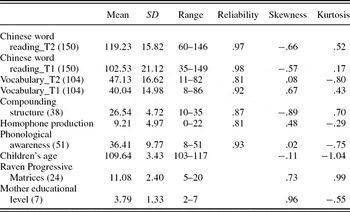
Descriptive statistics on all variables are shown in Table 1. The reliabilities of all measures were higher than 0.80. The distribution properties of all measures were then checked; absolute values of skewness and kurtosis indices for all measures were less than one (except for the kurtosis of children's age), indicating no severe violations of normality assumptions for further correlational analyses.
Means, standard deviations, range, reliability, and distribution properties for all variables (N = 154)
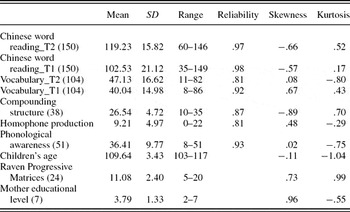
Note: T2, Time 2; T1, Time 1.
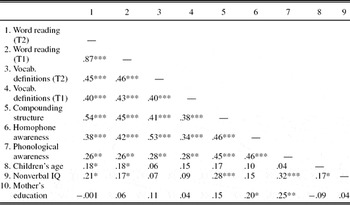
The zero-order correlations among all measures are shown in Table 2. The correlations among Chinese word reading, vocabulary definition, and both homophone awareness and compounding structure awareness were from moderate to high, whereas the correlations among these measures and phonological awareness were somewhat lower. Furthermore, although the correlation between the previous and concurrent year's word recognition was very high (r = .87), the association of the vocabulary knowledge test across years was only modest (r = .40), suggesting some problems in measuring vocabulary knowledge across years.
Correlations among all variables (N = 154)

Note: T2, Time 2; T1, Time 1.
*p < .05. **p < .01. ***p < .001.
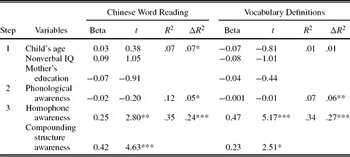
Hierarchical regression analyses were then conducted to further explore the associations of homophone awareness and compounding structure awareness with both Chinese word reading and vocabulary definitions. In the first two regression models, with children's age, nonverbal intelligence, mother's educational level, and phonological awareness statistically controlled, both homophone awareness and compounding structure awareness significantly explained Chinese word reading (for homophone awareness, β = 0.25, t = 2.81, p < .01; and for compounding structure awareness, β = 0.43, t = 4.64, p < .001) and vocabulary knowledge (for homophone awareness, β = 0.47, t = 5.18, p < .001; for compounding structure awareness, β = 0.23, t = 2.51, p < .05). The results for these first two regression models are shown in Table 3. Note that the standardized beta weights of the morphological awareness measures for word reading and vocabulary knowledge can be compared here. The beta weight for the homophone awareness measure is stronger for vocabulary knowledge and weaker for word reading; the associations for the lexical compounding measure are the opposite. These results suggest a stronger association in Chinese third graders of lexical compounding for word reading and of homophone awareness for vocabulary knowledge.
Hierarchical regression explaining Chinese word reading and vocabulary definitions from homophone and compounding structure awareness with other variables controlled

*p < .05. **p < .01. ***p < .001.
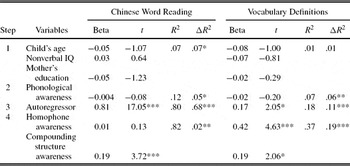
In the next regression models, shown in Table 4, these children's previous year's Chinese word reading and vocabulary knowledge were included as autoregressors, in order to further test the strength of the two morphological awareness tasks for explaining each. With the autoregressive effects of vocabulary knowledge further controlled, both homophone awareness and compounding structure awareness still significantly explained current vocabulary knowledge, although the standardized beta weight of the homophone task remained larger than that of the lexical compounding task (for homophone awareness, β = 0.42, t = 4.63, p < .001; and for compounding structure awareness, β = 0.19, t = 2.06, p < .05). For Chinese word reading, however, with the autoregressive effects of word recognition further controlled, only compounding structure awareness, but not homophone awareness, was uniquely associated with concurrent Chinese word reading (for homophone awareness, β = 0.01, t = 0.14; and for compounding structure awareness, β = 0.19, t = 3.74, p < .001).
Hierarchical regression explaining Chinese word reading and vocabulary definitions from homophone and compounding structure awareness with autoregressors further controlled

*p < .05. **p < .01. ***p < .001.
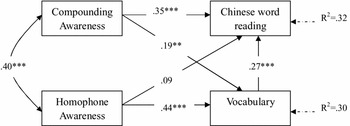
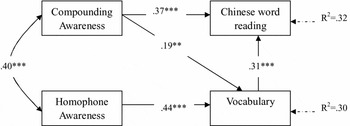
Path analyses were then conducted to further explore the associations among the two aspects of morphological awareness, Chinese word reading, and vocabulary. Because it was impossible to build nonrecursive models with the specified concurrently collected four variables, and considering the relatively central task of word learning for the children toward the end of primary school, we set Chinese word reading as the dependent variable and vocabulary as the mediator. The analyses began from a saturated model (see Figure 1). As shown in Figure 1, compounding structure awareness showed significant direct effects on both Chinese word reading (β = 0.35, p < .001) and vocabulary (β = 0.19, p < .01), whereas homophone awareness had a significant direct effect on vocabulary (β = 0.44, p < .001), but not on Chinese word reading (β = 0.09, p > .05). In order to evaluate the goodness of fit of the model, the nonsignificant path was removed to obtain an overjustified model (as shown in Figure 2). The fit indices of this model were as follows: χ2 (1) = 1.30, p > .05; comparative fit index = 0.998, goodness of fit index = 0.996, adjusted goodness of fit index = 0.958, root mean square error analysis = 0.044, all of which indicate a good fit to the model. Apart from these significant direct effects, there were also two significant indirect effects on Chinese word reading, which were mediated by vocabulary (for the indirect effect of compounding structure awareness, β = 0.06, p < .05; and for homophone awareness, β = 0.14, p < .001).
A saturated path model of the associations among lexical compounding awareness, homophone awareness, Chinese word reading, and vocabulary knowledge.

A modified path model of the associations among lexical compounding awareness, homophone awareness, Chinese word reading, and vocabulary knowledge.

DISCUSSION
In the present study, the associations of two different aspects of morphological awareness with older (9-year-old) Hong Kong Chinese children's Chinese word reading and vocabulary knowledge were explored. After children's age, nonverbal intelligence, mothers’ educational levels, and phonological awareness were statistically controlled, both homophone awareness and compounding structure awareness significantly explained concurrently measured Chinese word reading and vocabulary knowledge. However, when autoregressor effects of these were further controlled, only compounding structure awareness, but not homophone awareness, explained unique variance in Chinese word reading, though both were unique in their associations to vocabulary knowledge. Finally, the path model expressed the associations among the two aspects of morphological awareness, Chinese word reading, and vocabulary more comprehensively. Both compounding structure awareness and homophone awareness showed significant direct effects on vocabulary, while compounding structure awareness additionally showed a significant direct effect on Chinese word reading. It is important that vocabulary knowledge itself had an additional direct effect on word reading. These results suggest that homophone awareness and lexical compounding might play slightly different roles in Chinese literacy and vocabulary development.
Compounding structure awareness, word reading, and vocabulary knowledge
Although the role of morphological awareness for children's language and literacy development has been highlighted in alphabetic languages (e.g., Deacon, Parrila, & Kirby, Reference Deacon, Parrila, Kirby, Reid, Fawcett, Manis and Siegel2008; Nagy, Berninger, & Abbott, Reference Nagy, Berninger and Abbott2006; Nagy, Berninger, Abbott, Vaughan, & Vermeulen, Reference Nagy, Berninger, Abbott, Vaughan and Vermeulen2003), it is possible that, at least for diagnostic and training purposes, the focus on morphological awareness, specifically in the form of lexical compounding, should be particularly strong for Chinese children in terms of language and literacy development. This association was well demonstrated in the present study, which, with a fairly normally distributed sample of typically developing children, was somewhat strong (r = .54) for Chinese word reading. The predominance of compound words in Chinese and the relatively diverse compounding structures (i.e., there are at least five different compounding structures in Chinese, including coordinative, subordinate, subject–predicate, verb–object, and verb/adjective–complement) in Chinese words relative to words in other languages (e.g., Liu & McBride-Chang, Reference Liu and McBride-Chang2010) make the understanding of compounding structure information important in the processing of Chinese language.
Compounding structure awareness can likely facilitate children's word reading and vocabulary knowledge in at least three ways. First, given the context and grammatical information they provide, compounding structures can provide extra cues to help children remember new words (either meaning or pronunciation). Second, compounding structure information can sometimes directly help children understand the meaning of compound Chinese words. For example, the Chinese words 牙刷 (ngaa4 caat2, toothbrush) and 刷牙 (caat3 ngaa4, to brush one's teeth) are composed of the same morphemes. However, apart from the order of the two morphemes, the structures of these two words are different. The first word is a subordinate word (牙 [ngaa4] is a modifier, and 刷 [caat2] is a head), whereas the second word is a verb–object word (刷 [caat3] is a verb, and 牙 [ngaa4] is the object of the verb). Both the understanding of the meaning of these two words and the distinction between them require knowledge of specific morphological structures. Third, compounding structure information can help children infer possible meanings of new words. For example, just as in the 剪刀 (zin2 dou1, shearing-knife, scissors) example we mentioned earlier, only when children have the awareness of subordinate structure can they infer the meaning of this word as a kind of knife (or cutting object), a fact that not only might help children to learn the meaning of this whole (two-morpheme) word but might also help them learn the new character 剪 by linking it with the attribute of being knife-like. Therefore, compounding structure awareness may be particularly important for Chinese children's language and literacy development. This is reflected by the results in the present study showing that lexical compounding awareness was associated with both Chinese word reading and vocabulary.
Homophone awareness and vocabulary
Homophone awareness, which constitutes morphological awareness at the morpheme level, is also important for explaining Hong Kong Chinese children's vocabulary development, although not uniquely and directly for Chinese word reading, at least in the present study. Homophone awareness may directly facilitate children's vocabulary development by counteracting the effects of distracting homophones, which is particularly important in Chinese because of the existence of the great number of homophones. If children are aware that words (or morphemes) with the same pronunciation may have different meanings, they may be less likely to be confused by the fact that the meaning of one morpheme they learn in one word might not work in another word (because actually they are homophones). Children's performance on this task has also been independently associated with vocabulary knowledge in English-speaking children, suggesting its cross-language potential for vocabulary facilitation (McBride-Chang, Wagner, et al., Reference McBride-Chang, Wagner, Muse, Chow and Shu2005). Moreover, training young Chinese children in homophone awareness promoted their vocabulary knowledge, although not their word reading, in one recent study (Zhou et al., in press).
Therefore, the findings in the current study suggest a comprehensive theoretical model on the associations of the two aspects of morphological awareness to Chinese word reading and vocabulary knowledge. In previous studies on this issue, the somewhat different roles of lexical compounding awareness and homophone awareness were not typically explicitly distinguished; both were thought to be important for Chinese word reading and vocabulary knowledge (e.g., McBride-Chang et al., Reference McBride-Chang, Shu, Zhou, Wat and Wagner2003; Shu et al., Reference Shu, McBride-Chang, Wu and Liu2006; Tong et al., Reference Tong, McBride-Chang, Wong, Shu, Reitsma and Rispens2010), with mixed results. According to the final path model of the present study, they are indeed both important for reading and vocabulary. However, as shown in the final model and discussed above, lexical compounding awareness tends to be important for both Chinese word reading and vocabulary, whereas homophone awareness seems to be more important for facilitating vocabulary acquisition, which itself has a direct association with word reading in Chinese. Furthermore, vocabulary knowledge also acted as a mediator in the indirect effects of both lexical compounding and homophone awareness to Chinese word reading. Thus, on the one hand, overall, these four variables are likely mutually reinforcing of one another. On the other hand, because of the characteristics of these two aspects of morphological awareness, their direct roles are slightly different. In future studies, though both lexical compounding and homophone awareness should be clearly considered as two important aspects of morphological awareness in Chinese, these two concepts should be understood and measured separately.
Measurement issues
Apart from the nature of the characteristics of homophone awareness and lexical compounding awareness, another issue in the present study is related to the measurement of these two aspects of morphological awareness. As measured in the homophone production task, children's knowledge of homophones may be more directly associated with their vocabulary size (namely, how many words [or morphemes] they know), but not how many words they can necessarily read aloud. Following the possible role of lexical compounding in Chinese children's reading development presented in the introduction, knowledge of the structure of words might help children to identify words of two or more morphemes, particularly when one character is known and others are vague or unknown. In such cases, the number of homophones or homonyms children can produce may be less strongly associated with learning to read than is lexical compounding skill, although both are clearly important (McBride-Chang et al., Reference McBride-Chang, Shu, Zhou, Wat and Wagner2003; Shu et al., Reference Shu, McBride-Chang, Wu and Liu2006; Tong et al., Reference Tong, McBride-Chang, Wong, Shu, Reitsma and Rispens2010).
In addition, vocabulary knowledge itself is subject to difficulties in measurement. Debates about how to measure it and at what ages continue (e.g., Biemiller & Slonim, Reference Biemiller and Slonim2001; Snow & Hoefnagel-Hohle, Reference Snow and Hoefnagel-Hohle1978). Context-specific vocabulary versus general vocabulary knowledge, as well as differences in receptive and expressive vocabulary measures and concepts, complicate the issue. Whereas measuring word recognition as oral word reading, perhaps the most typical measure, is fairly straightforward across cultures, vocabulary knowledge measurement is much more diverse (Bowels, & Salthouse, Reference Bowles and Salthouse2008; Pearson, Hiebert, & Kamil, Reference Pearson, Hiebert and Kamil2007). A variety of formats, including multiple-choice synonyms, multiple-choice antonyms, definition production, and picture identification are all viable ways to tap vocabulary knowledge in both children and adults (e.g., Bowels & Salthouse, Reference Bowles and Salthouse2008; Pearson et al., Reference Pearson, Hiebert and Kamil2007). The best measure of vocabulary knowledge therefore often depends specifically on the age of the participants as well as the goal of the study (e.g., Bowels & Salthouse, Reference Bowles and Salthouse2008; Pearson et al., Reference Pearson, Hiebert and Kamil2007). In our own study, we sought to measure vocabulary knowledge in a way that did not specifically overlap with the measurement of morphological awareness, an issue of some concern for Chinese measures of vocabulary knowledge because of the relative semantic transparency of some early vocabulary items (e.g., McBride-Chang, Tardif, et al., Reference McBride-Chang, Tardif, Cho, Shu, Fletcher and Stokes2008). This measure clearly had the limitation of a relatively low correlation across the two years. At the same time, however, it was also a unique correlate of word reading in our final path analysis. The pursuit of an excellent vocabulary measure for Chinese children is therefore an important future goal. It may be necessary to involve multiple measures in testing children's vocabulary knowledge to get a relatively comprehensive and stable assessment of it.
Of course, parallel to the perspectives on the relationship between phonological processing and literacy development, that is, that phonological representations can develop as a result of language and literacy development (e.g., Foy & Mann, Reference Foy and Mann2006; Hartmann, Reference Hartmann2008), the relations between morphological awareness and Chinese word reading and vocabulary should also be bidirectional (e.g., Chung & Hu, Reference Chung and Hu2007; McBride-Chang, Shu, Ng, Meng, & Penney, Reference McBride-Chang, Shu, Ng, Meng, Penney, Wagner, Muse and Tannenbaum2007; McBride-Chang, Tardif, et al., Reference McBride-Chang, Tardif, Cho, Shu, Fletcher and Stokes2008). That is, better literacy or vocabulary development can also facilitate morphological awareness. For example, learning of more compound words may help children learn and understand different compounding structures in Chinese better. The overlap between vocabulary and homophone awareness is fairly clear, because the more words children learn, the more homophones children may begin to recognize.
The present study represents a step forward in measurement of lexical compounding for older Chinese children as well. Following Liu and McBride-Chang (Reference Liu and McBride-Chang2010), our task of lexical compounding in the present study combined a structured set of questions suitable for younger children with an open-ended format. Such production tasks have been successfully used in alphabetic languages in testing children's morphological awareness for many years (e.g., Berko-Gleason, Reference Berko-Gleason1958; Clark, Gelman, & Lane, Reference Clark, Gelman and Lane1985). As suggested by several researchers (e.g., Clark, Reference Clark, Sinclari, Jarvella and Levelt1978; Wilkinson, Wilkinson, Spinelli, & Chiang, Reference Wilkinson, Wilkinson, Spinelli and Chiang1984), open-ended questions are more difficult and, thus, increase variability in responses of older children.
Limitations and implications
There were several limitations of the present study, all focused on measurement. First, because the new morphological structure task was only designed and used for the first time this year, there are no longitudinal data on the relationship between this new measure and language and literacy measures. Thus, although our analyses were strict in statistically controlling for a number of literacy-related skills, no causal associations can be established from the present study. Second, as mentioned above, our vocabulary knowledge test had a relatively low association across years, suggesting that it is not the ideal vocabulary measure. The main problem with this is that our assertion that homophone awareness may be more strongly associated with vocabulary knowledge than with word reading per se in Chinese is subject to the criticism that the measure may be subject to reliability and perhaps even validity questions. Although we have some independent verification for this association from a recent study demonstrating that homophone training promoted only vocabulary knowledge, but not word reading, in young Chinese children, whereas lexical compounding training facilitated both (Zhou et al., in press), this remains a concern for future work.
Third, a further measurement issue is that, even though the findings in the present study indicated that homophone awareness was particularly important for Hong Kong Chinese children's vocabulary acquisition compared to Chinese word reading, it is possible that the design of the production task, focused on number of homophones, amplified this pattern. In tasks in which children are required only to judge whether two two-morpheme words share a homophone or not, the association between homophone awareness and vocabulary and Chinese word reading might be somewhat different; this is an issue for future research. Finally, in the present study, children's reading skills were measured on the word level, but not on the character level. In future studies both word level and character level reading performance might be considered in order to get a relatively intact picture of Chinese children's reading skills. This is an issue for reasons of comparison across studies. For example, measures of reading in Hong Kong often focus on multiple character words, whereas studies focused on Mainland Chinese children often focus on single character reading (e.g., McBride-Chang et al., Reference McBride-Chang, Shu, Zhou, Wat and Wagner2003; McBride-Chang, Cho, et al., Reference McBride-Chang, Cho, Liu, Wagner, Shu and Zhou2005; Packard et al., Reference Packard, Chen, Li, Wu, Gaffney and Li2006; Shu et al., Reference Shu, McBride-Chang, Wu and Liu2006; Wu et al., Reference Wu, Anderson, Li, Wu, Li and Zhang2009). Because multimorpheme word reading might make greater use of lexical compounding than single character recognition, in which there are no extra “cues” to facilitate reliance on compounding for word recognition, this may be an issue for future research. Indeed, there is some evidence that character and word reading may be influenced by different processes (Liu, Chung, McBride-Chang, & Tong, Reference Liu, Chung, McBride-Chang and Tong2010).
Despite these limitations, however, the present study may be theoretically and practically useful. The findings in the present study confirm and extend the importance of lexical compounding as a primary correlate of word reading in intermediate readers of Chinese as a first language and also replicate previous work showing that lexical compounding can be useful for explaining variability in vocabulary knowledge. These results demonstrate similar associations for word reading; that is, that both morphological processing skills may be useful in understanding word recognition and vocabulary knowledge variability in Hong Kong Chinese children. With the most stringent controls of other variables and path analyses, our analyses suggest that lexical compounding is a primary correlate of both word recognition and vocabulary knowledge; in contrast, homophone awareness as we measured it emerged as a unique correlate of vocabulary knowledge but not word reading, although the design of the homophone awareness measure should be carefully considered in future research. These findings are in line with a recent training study demonstrating that, compared to a control group, homophone training in Chinese promoted vocabulary knowledge in kindergarten children across 12 weeks, whereas lexical compounding awareness promoted both word reading and vocabulary in these children (Zhou et al., in press). Overall, these results, along with previous work from other languages (e.g., McBride-Chang, Cho, et al., Reference McBride-Chang, Cho, Liu, Wagner, Shu and Zhou2005; McBride-Chang, Tardif, et al., Reference McBride-Chang, Tardif, Cho, Shu, Fletcher and Stokes2008; McBride-Chang, Wagner, et al., Reference McBride-Chang, Wagner, Muse, Chow and Shu2005; Rispens et al., Reference Rispens, McBride-Chang and Reitsma2008) including intervention studies (for a review, see Carlisle, Reference Carlisle, Wagner, Muse and Tannenbaum2007; Halaaslyster, Reference Halaaslyster2002; Shakibai, Reference Shakibai2008) suggest that perfecting the measurement of these metalinguistic skills across languages and training of these core skills might be useful to pursue in future work, especially for facilitating children's vocabulary development. With reference specifically to Chinese, the findings in the present study, together with intervention studies on morphological awareness in Chinese (e.g., Chow, McBride-Chang, Cheung, & Chow, Reference Chow, McBride-Chang, Cheung and Chow2008; Packard et al., Reference Packard, Chen, Li, Wu, Gaffney and Li2006; Wu et al., Reference Wu, Anderson, Li, Wu, Li and Zhang2009) suggest that it is important to consider children's morphological awareness at the word, in addition to the previously recognized character (e.g., Packard et al., Reference Packard, Chen, Li, Wu, Gaffney and Li2006; Wu et al., Reference Wu, Anderson, Li, Wu, Li and Zhang2009), levels, in promoting literacy courses and in designing reading materials for children. For example, lexical compounding at age 5 has been found to be a unique predictor of dyslexia 2 years later in those at risk for reading difficulties (e.g., McBride-Chang et al., Reference McBride-Chang, Lam, Lam, Chan, Fong and Wong2011). The importance of word-level morphological awareness is clearly important for word reading in typically developing Chinese children and may be applicable to those learning Chinese as a foreign language as well.
ACKNOWLEDGMENTS
This study was supported by Hong Kong government RGC Grant 448907 (to C.M.-C.). We thank all the teachers, the children, and their parents for their participation.