Introduction
Traumatic brain injury (TBI) arises from motor vehicle accidents, warfare, assaults, and accidents. Severe injuriesFootnote 1 lead to protracted coma and/or altered consciousness acutely and to chronic physical, neuropsychological and emotional deficits that interfere with the resumption of former lifestyles. According to their relatives, changes in behavior and personality, for example, childishness, self-centeredness, disinterest or dislike of others, quarrelsome, unreasonable or socially inappropriate behavior, unhappiness, and excitation are frequent and chronic (Brooks, Campsie, Symington, Beattie, & McKinlay, Reference Brooks, Campsie, Symington, Beattie and McKinlay1986; Brooks & McKinlay, Reference Brooks and McKinlay1983; Kinsella, Packer, & Olver, Reference Kinsella, Packer and Olver1991; McDonald & Saunders, Reference McDonald and Saunders2005; McKinlay, Brooks, Bond, Martinage, & Marshall, Reference McKinlay, Brooks, Bond, Martinage and Marshall1981; Thomsen, Reference Thomsen1984). Such changes predict relative stress (Brooks et al., Reference Brooks, Campsie, Symington, Beattie and McKinlay1986; Brooks & McKinlay, Reference Brooks and McKinlay1983; Schönberger, Ponsford, Olver, & Ponsford, Reference Schönberger, Ponsford, Olver and Ponsford2010) and poor social adjustment and participation (Cattran, Oddy, Wood, & Moir, Reference Cattran, Oddy, Wood and Moir2011).
In 1978, Lezak described impaired capacity for social perceptiveness as a key feature of the characterological changes seen post injury (Lezak, Reference Lezak1978). Thirty-five years later research into the mechanisms underpinning poor social perceptiveness is only just commencing, fuelled by the growing field of social neuroscience. A central construct is social cognition, that is, the ability to understand other people (Lieberman, Reference Lieberman2007). Social cognition enables us to predict the behavior of others, share experiences and communicate effectively. As the human species relies upon cooperation and competition within groups to survive, social cognition is argued to be an evolutionary imperative, resulting in its modular development independent of non-social information processing skills (Adolphs, Reference Adolphs2003). Behaviorally, there is evidence for dissociations between non-social and social cognition. Individuals with discrete frontal lesions from trauma or other pathology often present with social functioning that is disproportionately impaired relative to intellect (e.g., Blair & Cipolotti, Reference Blair and Cipolotti2000; Cicerone & Tanenbaum, Reference Cicerone and Tanenbaum1997; Eslinger & Damasio, Reference Eslinger and Damasio1985; Tranel, Bechara, & Denburg, Reference Tranel, Bechara and Denburg2002).
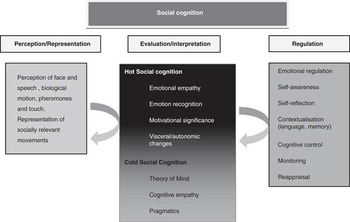
At base, social cognition entails the ability to construct representations of the mental states of others, that is, their beliefs, feelings, experiences, and intentions, in relation to ourselves and to use these flexibly to guide social behavior (Adolphs, Reference Adolphs2001; Amodio & Frith, Reference Amodio and Frith2006). These are matters that cannot directly be observed but must be inferred from both incoming stimuli and our knowledge of the social world. Conceptually, a distinction is drawn between “hot” social cognition, that is, emotion processing including identifying and empathizing with another's emotional state and “cold” social cognition that is, thinking about things from another's point of view, including Theory of Mind (ToM) abilities. The discovery of “mirror” neuron systems in the premotor cortex that are activated when observing the actions of others (Rizzolatti & Sinigaglia, Reference Rizzolatti and Sinigaglia2010), along with physiological evidence of mimicry (discussed further below), has spurred theorizing that social cognition encompasses simulation, that is, the representation of the minds and experience of others in oneself as a means to understand them. To this end, it is critical to be self-aware, knowing one's own mind to represent others and also to differentiate between self and other. Effortful control ensures that emotional responses are regulated, the perspective between self and other is maintained, we are able to put social information in context and we can flexibly accommodate changing social input. These aspects of social cognition are summarized in Figure 1.
Processes in social cognition, adapted from Adolphs (Reference Adolphs2010).

The extent to which social cognition is modular is hotly debated. In part this arises because there are different levels of social cognitive processing, not all of which are specialized. Perception of social stimuli entails both conscious explicit processing (e.g., via visual cortex) and also rapid coarse processing via the superior colliculi. Perception is specialized for different inputs (facial expressions, prosody, biological movement) (Adolphs, Reference Adolphs2010). Evaluation and interpretation of social information also appears to be mediated by a specialized system of interconnected networks involving the orbital and ventromedial frontal cortex, cingulate cortex and striatum, insula, and amygdala. These structures orchestrate the automatic, often implicit, appraisal of emotionally salient information and mental states (Adolphs, Reference Adolphs2009; Lieberman, Reference Lieberman2007; Phillips, Drevets, Rauch, & Lane, Reference Phillips, Drevets, Rauch and Lane2003). Finally, effortful regulation of responses and contextualization is mediated by dorsal regions of the lateral and medial prefrontal cortex in concert with the hippocampus and temporo-parietal zones (Lieberman, Reference Lieberman2007; Phillips et al., Reference Phillips, Drevets, Rauch and Lane2003). Unlike the former stages, these cognitive and memory processes are probably generic and not specific to social cognition.
Structures underlying social cognition are vulnerable to severe traumatic brain injury. Although TBI produces variable multifocal and diffuse neuropathology, typical patterns arise due to acceleration-deceleration forces that scrape the soft brain tissue across the bony floor of the anterior and middle fossa of the skull (Bigler, Reference Bigler2007). Medial frontal surfaces are compressed against the dorsal bone and collide with the cerebral falx (Bigler, Reference Bigler2007). Immediate contusions and wallerian degeneration causes disruption to medial regions and their connections. Thus, pathology is often concentrated in the ventrolateral, medial and orbital frontal lobes and the ventromedial temporal lobes (Bigler, Reference Bigler2007; Bigler & Maxwell, Reference Bigler and Maxwell2011; Courville, Reference Courville1945; Gentry, Godersky, & Thompson, Reference Gentry, Godersky and Thompson1988; Hadley et al., Reference Hadley, Teasdale, Jenkins, Condon, MacPherson, Patterson and Rowan1988). There is also diffuse axonal injury to the brainstem, corpus callosum, and the gray-white matter junctions of the cerebral cortex (Adams et al., Reference Adams, Doyle, Ford, Gennarelli, Graham and McLellan1989; Meythaler, Peduzzi, Eleftheriou, & Novack, Reference Meythaler, Peduzzi, Eleftheriou and Novack2001; Viano et al., Reference Viano, Casson, Pellman, Zhang, King and Yang2005) further disrupting connections between subcortical and frontal systems (Kennedy et al., Reference Kennedy, Wozniak, Muetzel, Mueller, Chiou, Pantekoek and Lim2009) and possibly somatosensory and motor cortex (Green, Turner, & Thompson, Reference Green, Turner and Thompson2004). As the ventromedial and orbital frontal lobes are highly vulnerable in TBI, many psychosocial problems reported may usefully be examined within the rubric of disorders of social cognition. This is not, however, a simple task. The neuropathology of TBI is complex and highly variable. No one individual with TBI has identical deficits to another. Furthermore, the information processing requirements of social cognition are only beginning to be understood. At this time, it is clear they represent a complex interplay between specifically social facets of processing and generic cognitive, memory and executive functions. This hampers conclusions as to the extent to which specific deficit in social cognition arise following TBI and also the identification of subtypes. The goal of this review is to critically evaluate the evidence for disorders in “hot” social cognition, that is, affective empathy, emotion perception and emotional resonance and “cold” cognition, that is, ToM, cognitive empathy and pragmatics following severe TBI. A further aim is to consider whether some of the hypothesized mechanisms underpinning social cognition, developed from the normal literature, functional neuroimaging, and focal lesion research, are relevant to explaining social cognition deficits post TBI.
Disorders of “Hot” Social Cognition
Affective empathy
Affective empathy refers to the ability to emotionally resonate with others’ feelings while understanding that they are distinct from one's own (Baron-Cohen & Wheelwright, Reference Baron-Cohen and Wheelwright2004). Using self-report measures such as the Balanced Emotional Empathy Scale (Mehrabian, Reference Mehrabian2000), 60–70% of adults with severe TBI self-report little to no emotional empathy compared to 30% of matched control participants (de Sousa, McDonald, & Rushby, Reference de Sousa, McDonald and Rushby2012; de Sousa et al., Reference de Sousa, McDonald, Rushby, Li, Dimoska and James2010, Reference de Sousa, McDonald, Rushby, Li, Dimoska and James2011; Williams & Wood, Reference Williams and Wood2010; Wood & Williams, Reference Wood and Williams2008). The use of self-report measures has been criticized in TBI research as these are vulnerable to loss of insight, attentional bias and cognitive impairments affecting complex language processing, attention and flexibility. Despite this, evidence suggests they can be a valid measure of emotional changes following even severe TBI (Kinsella, Moran, Ford, & Ponsford, Reference Kinsella, Moran, Ford and Ponsford1988). Furthermore, the relatively similar incidence rates using self-report across studies gives validity to the claim that empathy is reduced after TBI. Self-reported empathy is unrelated to injury severity (length of post-traumatic amnesia), time since injury or co-existing cognitive deficits (Williams & Wood, Reference Williams and Wood2010; Wood & Williams, Reference Wood and Williams2008) raising questions as to the cause of this self-perceived deficit. Emotional empathy is a complex construct entailing emotion perception, emotional resonance, self-awareness, and regulation. Consequently an examination of components may be more revealing as discussed below.
Emotion Perception
Facial emotion
Empirical research into emotion perception deficits following TBI commenced in the 1980s (Braun, Baribeau, Ethier, Daigneault, & Proulx, Reference Braun, Baribeau, Ethier, Daigneault and Proulx1989; Jackson & Moffatt, Reference Jackson and Moffat1987; Prigatano & Pribam, Reference Prigatano and Pribam1982) and since then, a plethora of studies have reported deficits in the recognition of photographs of facial expressions in adults with both acute and chronic severe TBI (Borgaro, Prigatano, Kwasnica, Alcott, & Cutter, Reference Borgaro, Prigatano, Kwasnica, Alcott and Cutter2004; Croker & McDonald, Reference Croker and McDonald2005; Green et al., Reference Green, Turner and Thompson2004; Ietswaart, Milders, Crawford, Currie, & Scott, Reference Ietswaart, Milders, Crawford, Currie and Scott2008; Knox & Douglas, Reference Knox and Douglas2009; McDonald & Saunders, Reference McDonald and Saunders2005; Milders, Fuchs, & Crawford, Reference Milders, Fuchs and Crawford2003; Milders, Ietswaart, Crawford, & Currie, Reference Milders, Ietswaart, Crawford and Currie2008; Spell & Frank, Reference Spell and Frank2000). While samples sizes in this area are typically small, a meta-analysis of 296 adults with moderate-severe TBI from 13 studies (Babbage et al., Reference Babbage, Yim, Zupan, Neumann, Tomita and Willer2011) indicated a relatively large effect size (1.1 SD) differentiating people with TBI from matched controls. Overall, it was estimated that up to 39% of people with severe TBI experience deficits in recognizing emotions from static presentations of facial expressions.
Static photographic stimuli bear little resemblance to naturally occurring facial expressions which are dynamic, evolve rapidly from one emotion to another and provide additional cues via facial movement (Bassili, Reference Bassili1978). Dissociations between recognition of static and dynamic expressions have been reported in patients with non-traumatic brain lesions (Adolphs, Tranel, & Damasio, Reference Adolphs, Tranel and Damasio2003; Humphrey, Donnelly, & Riddoch, Reference Humphrey, Donnelly and Riddoch1993) which suggests separable neural systems; ventral fronto-temporal systems mediating static images and dorsal fronto-parietal zones mediating facial movement (Adolphs et al., Reference Adolphs, Tranel and Damasio2003). As the ventral fronto-temporal lobes are especially vulnerable to TBI due to their position within the anterior and middle fossa (Bigler & Maxwell, 2011) disorders recognizing static expressions as a result of focal pathology may be expected to occur more frequently than disorders recognizing dynamic images. In one study that directly compared the two this was found to be the case, that is, 8/34 participants versus 1/34, respectively (McDonald & Saunders, Reference McDonald and Saunders2005).
Brain-behavior relationships are difficult to establish in TBI, in part because of the heterogeneity of the TBI population. Where subgroups have been compared, differences in emotion perception scores between those with frontal versus other pathology have been marginal or insignificant (Ietswaart et al., Reference Ietswaart, Milders, Crawford, Currie and Scott2008; McDonald & Flanagan, Reference McDonald and Flanagan2004). Other confounds complicate the picture. Slowed processing speed and poor cognitive flexibility interfere with emotion perception tasks, both static (Ietswaart et al., Reference Ietswaart, Milders, Crawford, Currie and Scott2008) and dynamic (McDonald & Saunders, Reference McDonald and Saunders2005) and, indeed, in one study (Ietswaart et al., Reference Ietswaart, Milders, Crawford, Currie and Scott2008) these entirely accounted for between group differences. Injury severity, indexing extent of cognitive impairment, also partially predicts poor performance (Ietswaart et al., Reference Ietswaart, Milders, Crawford, Currie and Scott2008; McDonald & Saunders, Reference McDonald and Saunders2005). Arguably, complex, dynamic display of emotions tax cognitive abilities more than static (Knox & Douglas, Reference Knox and Douglas2009) and certainly additional skills have been found to contribute to dynamic emotion recognition including premorbid intellectual ability, working memory, reasoning and new learning (McDonald et al., Reference McDonald, Bornhofen, Shum, Long, Saunders and Neulinger2006). While convergent evidence from various sources (as will be discussed below) suggests that impairment in facial emotion recognition is a real problem for many people with TBI, the correlation between indices of severity, various neuropsychological measures and behavioral responses to emotion identification does suggest that incidence figures are likely to be inflated.
Vocal Emotion
Recognition of emotional expression in voice is also impaired following TBI (Dimoska, McDonald, Pell, Tate, & James, Reference Dimoska, McDonald, Pell, Tate and James2010; Hornak, Rolls, & Wade, Reference Hornak, Rolls and Wade1996; McDonald & Pearce, Reference McDonald and Pearce1996; McDonald & Saunders, Reference McDonald and Saunders2005; Milders et al., Reference Milders, Fuchs and Crawford2003, Reference Milders, Ietswaart, Crawford and Currie2008; Spell & Frank, Reference Spell and Frank2000). Emotional prosody engages brain systems (especially right hemisphere) which overlap but do not entirely coincide with those engaged in facial expressions (Adolphs, Damasio, & Tranel, Reference Adolphs, Damasio and Tranel2002). Consequently, dissociations on the basis of neuropathology might also be expected in TBI and there is evidence for this both in terms of individual patients having problems in face not voice or vice versa (Hornak et al., Reference Hornak, Rolls and Wade1996) and also in a lack of correlation between face versus voice discrimination (McDonald & Saunders, Reference McDonald and Saunders2005).
Confounding this issue, however, is the fact that tasks of prosody and face recognition are often not well equated (Ietswaart et al., Reference Ietswaart, Milders, Crawford, Currie and Scott2008). In one study where effort was made to equate them, differences emerged to suggest more participants experienced significant impairment with (static) facial emotion than vocal emotion but the group, as a whole, experienced a loss of efficiency with prosody (McDonald & Saunders, Reference McDonald and Saunders2005). This highlights an inherent problem with this field of research, that is, face and voice discrimination have different cognitive demands that, in general, might facilitate facial processing. First, facial processing provides greater scope for additional strategies (e.g., the use of verbalization) (Hornak et al., Reference Hornak, Bramham, Rolls, Morris, O'Doherty, Bullock and Polkey2003). Second, emotions in voice are conveyed by two sources: speech content and quality, making dual processing and working memory demands (Dimoska et al., Reference Dimoska, McDonald, Pell, Tate and James2010). Thus, impaired recognition of prosody may reflect a loss of efficiency that is not specific to vocal emotion. Nevertheless, more general cognitive impairment cannot fully account for deficits in prosodic perception. For example this does not explain differential impairment across categories of emotion (Dimoska et al., Reference Dimoska, McDonald, Pell, Tate and James2010; Spell & Frank, Reference Spell and Frank2000). In addition, when semantic content is experimentally reduced, problems with prosody are amplified, suggesting a difficulty processing the tonal quality per se (Dimoska et al., Reference Dimoska, McDonald, Pell, Tate and James2010).
Potential Mechanisms Underpinning Impaired Emotion Processes
Research into both normal adults and those with focal lesions has provided a more detailed account of emotion processing. This has motivated studies in TBI that focus upon specific impairment in the processing of negatively valenced stimuli, as well as the role of simulation and self-awareness.
Differential impairment in processing negatively valenced materials post TBI
The ventromedial frontal regions, amygdala and insula appear to be preferentially geared to rapidly orientate to and process threat related emotions (Adolphs, Reference Adolphs2002; Adolphs, Russell, & Tranel, Reference Adolphs, Russell and Tranel1999; Adolphs & Tranel, Reference Adolphs and Tranel2004; Graham, Devinsky, & LaBar, Reference Graham, Devinsky and LaBar2007; Harmer, Thilo, Rothwell, & Goodwin, Reference Harmer, Thilo, Rothwell and Goodwin2001; Phillips et al., Reference Phillips, Young, Senior, Brammer, Andrew, Calder and David1997; Sato et al., Reference Sato, Kubota, Okada, Murai, Yoshikawa and Sengoku2002). Differential impairment in the perception of negative expressions (fear, disgust, sadness, and anger) relative to positive is found in TBI studies (e.g., Braun et al., Reference Braun, Baribeau, Ethier, Daigneault and Proulx1989; Callahan, Ueda, Sakata, Plamondon, & Murai, Reference Callahan, Ueda, Sakata, Plamondon and Murai2011; Croker & McDonald, Reference Croker and McDonald2005; Dimoska et al., Reference Dimoska, McDonald, Pell, Tate and James2010; Hopkins, Dywan, & Segalowitz, Reference Hopkins, Dywan and Segalowitz2002; Jackson & Moffat, Reference Jackson and Moffat1987; McDonald, Flanagan, Rollins, & Kinch, Reference McDonald, Flanagan, Rollins and Kinch2003; Prigatano & Pribam, Reference Prigatano and Pribam1982). This could be construed as evidence for deficits to the ventromedial system although the pattern is not always seen (Ietswaart et al., Reference Ietswaart, Milders, Crawford, Currie and Scott2008; McDonald & Saunders, Reference McDonald and Saunders2005) so in these cases there must be more pervasive impairment or the contribution of other factors. Another consideration for both TBI research and more generally, is the uneven representation of positive [happy and sometimes (pleasant) surprise] and negative (angry, sad, fearful, disgust) emotions skewed further by the almost universal recognition of happy expressions. Thus, differential impairment in the recognition of negative expressions may reflect the nature of the materials rather than difficulties with particular categories of emotion per se. Evenso, throughout the psychological literature, there does appear to be a pattern whereby negative events are afforded preferential treatment over positive (Baumeister, Bratslavsky, Finkenauer, & Vohs, Reference Baumeister, Bratslavsky, Finkenauer and Vohs2001). Furthermore, other evidence (below) reinforces the view that processing of negative emotions is especially vulnerable to TBI.
Impaired physiological responsivity
Another feature of the ventromedial system is that it mediates autonomic responses to emotional stimuli even before conscious awareness (Phillips et al., Reference Phillips, Drevets, Rauch and Lane2003). This may also be compromised as a result of severe TBI. A minority self-report that their emotional experiences are dulled (Croker & McDonald, Reference Croker and McDonald2005; Hornak et al., Reference Hornak, Rolls and Wade1996) and many studies have reported reduced physiological reactivity to unpleasant stimuli, e.g., reduced modulation of the startle reflex (Sanchez-Navarro, Martınez-Selva, & Roma′n, Reference Sanchez-Navarro, Martınez-Selva and Roma′n2005; Saunders, McDonald, & Richardson, Reference Saunders, McDonald and Richardson2006), dampened skin conductance changes (arousal) and reduced facial reactivity when viewing affectively valenced pictures and films (de Sousa et al., Reference de Sousa, McDonald and Rushby2012, Reference de Sousa, McDonald, Rushby, Li, Dimoska and James2010; Soussignan, Ehrle, Henry, Schaal, & Bakchine, Reference Soussignan, Ehrle, Henry, Schaal and Bakchine2005). This has been reported for both positive and negative stimuli (de Sousa et al., Reference de Sousa, McDonald and Rushby2012; Sanchez-Navarro et al., Reference Sanchez-Navarro, Martınez-Selva and Roma′n2005; Soussignan et al., Reference Soussignan, Ehrle, Henry, Schaal and Bakchine2005) but also specifically to negative (Angrilli, Palomba, Cantagallo, Maietti, & Stegagno, Reference Angrilli, Palomba, Cantagallo, Maietti and Stegagno1999; de Sousa et al., Reference de Sousa, McDonald, Rushby, Li, Dimoska and James2010; Saunders et al., Reference Saunders, McDonald and Richardson2006). In some reports, changes in physiological responses to negative images corresponded to subjective reports that they did not find the stimuli arousing (de Sousa et al., Reference de Sousa, McDonald and Rushby2012, Reference de Sousa, McDonald, Rushby, Li, Dimoska and James2010; Saunders et al., Reference Saunders, McDonald and Richardson2006) although a dissociation between physiological changes and subjective report has also been reported (Sanchez-Navarro et al., Reference Sanchez-Navarro, Martınez-Selva and Roma′n2005; Soussignan et al., Reference Soussignan, Ehrle, Henry, Schaal and Bakchine2005).
Simulation following TBI
Simulation appears to be intrinsic to emotion perception. Adults typically demonstrate facial mimicry (Dimberg & Lundquist, Reference Dimberg and Lundquist1990; Dimberg & Petterson, Reference Dimberg and Petterson2000; Dimberg & Thunberg, Reference Dimberg and Thunberg1998), changes in skin conductance (Merckelbach, van Hout, van den Hout, & Mersch, Reference Merckelbach, van Hout, van den Hout and Mersch1989; Vrana & Gross, Reference Vrana and Gross2004) and subjective experience (Hess & Blairy, Reference Hess and Blairy2001; Wild, Erb, & Bartels, Reference Wild, Erb and Bartels2001) when viewing facial expressions. In turn, facial movements alter emotional experience (Adelman & Zajonc, 1989; Levenson et al., 1990) and the emotional state of the observer influences recognition of emotional states in others (Neidenthal, Brauer, Halberstadt, & Innes-Ker, Reference Neidenthal, Brauer, Halberstadt and Innes-Ker2001). At a neural level, the mirror neuron system in the premotor cortex is activated when viewing facial expressions (Carr, Iacoboni, Dubeau, Maxzziotta, & Lenzi, Reference Carr, Iacoboni, Dubeau, Maxzziotta and Lenzi2003; Kilts, Egan, Gideon, Ely, & Hoffman, Reference Kilts, Egan, Gideon, Ely and Hoffman2003). Activation of the somatosensory cortex also occurs, thought to provide the viewer with sensory cues “as if” the expression were their own (Adolphs, Damasio, Tranel, Cooper, & Damasio, Reference Adolphs, Damasio, Tranel, Cooper and Damasio2000) while autonomic changes reflect ventromedial activation.
In TBI, specific impairment in the early automatic mimicry of angry expressions relative to happy has been reported (McDonald, Li, et al., Reference McDonald, Li, De Sousa, Rushby, Dimoska, James and Tate2011) along with reduced skin conductance changes (Blair & Cipolotti, Reference Blair and Cipolotti2000; de la Plata et al., Reference de la Plata, Garces, Kojori, Grinnan, Krishnan, Pidikiti and Diaz-Arrastia2011; Hopkins et al., Reference Hopkins, Dywan and Segalowitz2002). Impairment is specific to angry expressions providing further evidence for differential impairment with negatively valenced emotions. It also discounts explanations based upon motor paralysis or deficits in mirroring, both of which should affect all emotions. It is consistent with an impairment of processing mediated by the ventromedial system.
Relation between simulation and emotion processes
Simulation is argued to be an implicit component of emotion recognition, providing cues that aid recognition (Goldman & Sripada, Reference Goldman and Sripada2005; Neidenthal et al., Reference Neidenthal, Brauer, Halberstadt and Innes-Ker2001). However, evidence for the simulation theory in TBI studies is weak. On the one hand, subjective reports of altered emotional experience after TBI do correlate with emotion perception accuracy (Croker & McDonald, Reference Croker and McDonald2005) and poor emotion perception and impaired emotional responses can co-occur in individual patients (Blair & Cipolotti, Reference Blair and Cipolotti2000). But, in general, correlations between mimicry and/or skin conductance and emotion perception have, to date, been insignificant (McDonald, Li, et al., Reference McDonald, Li, De Sousa, Rushby, Dimoska, James and Tate2011; McDonald, Rushby, et al., Reference McDonald, Rushby, Li, de Sousa, Dimoska, James and Togher2011). This lack of concordance is also seen in normal populations (Blairy, Herrera, & Hess, Reference Blairy, Herrera and Hess1999; Hess & Blairy, Reference Hess and Blairy2001) and casts doubt on the role of simulation in emotion perception. Simulation does, however, have a clearer role in empathy, providing both a vicarious empathic reaction (McIntosh, Reference McIntosh1996) and a communicative role, conveying an understanding of the situation. For example, mimicry has been found to vary systematically with the extent to which the participant knows s/he is being observed (Bavelas, Black, Chovil, Lemery, & Mullett, Reference Bavelas, Black, Chovil, Lemery and Mullett1988; Bavelas, Black, Lemery, & Mullett, Reference Bavelas, Black, Lemery and Mullett1986). There is evidence that impaired automatic mimicry is related to low emotional empathy in both people with TBI (de Sousa et al., Reference de Sousa, McDonald, Rushby, Li, Dimoska and James2011) and normal adults (Sonnby-Borgström, Jönsson, & Svensson, Reference Sonnby-Borgström, Jönsson and Svensson2003). Deficits in motor mimicry also extend to the capacity to make emotional expressions whether spontaneous or posed. This is not a motor impairment per se as happy expressions are normal (Dethier, Blairy, Rosenberg, & McDonald, Reference Dethier, Blairy, Rosenberg and McDonald2012).
Impairments in self-awareness and self-regulation
Self-awareness and self-regulation are necessary to emotional empathy so as to recognize one's own emotional experience, to see it as separate from the other and to control it effectively (Decety & Meyer, Reference Decety and Meyer2008). Self-awareness appears to be impaired in severe TBI although empirical evidence comes from a scattered, relatively small literature. People with severe TBI reportedly have impaired sensitivity to internal somatic states, specifically their own heartbeat (Hynes, Stone, & Kelso, Reference Hynes, Stone and Kelso2011). They also report less congruent mood changes when adopting a body posture consistent with an angry or sad emotional state compared to happy (Reference Dethier, Blairy, Rosenberg and McDonaldDethier, Blairy, Rosenberg, & McDonald, in press).
Poor self-awareness is also documented in studies of alexithymia., that is, difficulties identifying and describing one's emotions and physiological reactions. Using the Toronto Alexithymia Scale (Bagby, Parker, & Taylor, Reference Bagby, Parker and Taylor1994), between 32 and 58% of convenience samples of people with TBI self-report alexithymia (Allerdings & Alfano, Reference Allerdings and Alfano2001; Henry, Phillips, Crawford, Theodorou, & Summers, Reference Henry, Phillips, Crawford, Theodorou and Summers2006; Koponen et al., Reference Koponen, Taiminen, Honkalampi, Joukamaa, Viinamäki, Kurki and Tenovuo2005; McDonald, Rosenfeld, et al., Reference McDonald, Rosenfeld, Henry, Bornhofen, Tate and Togher2011; Williams et al., Reference Williams, Galas, Light, Pepper, Ryan, Kleinmann and Donovick2001; Wood & Williams, Reference Wood and Williams2007) compared to the much lower incidence in the general population (7–15%) (Koponen et al., Reference Koponen, Taiminen, Honkalampi, Joukamaa, Viinamäki, Kurki and Tenovuo2005; Pasini, Chiale, & Serpia, Reference Pasini, Chiale and Serpia1992). Furthermore, alexithymia post TBI is reportedly associated with empathy (Williams & Wood, Reference Williams and Wood2010). Although this is consistent with expectations based on theory, caution regarding the validity of the construct of alexithymia (literally “without words for emotions”) in the TBI population is required. Given its strong association with poor verbal and working memory capabilities (Wood & Williams, Reference Wood and Williams2007) it is not entirely clear what alexithymia represents in cognitively impaired people with TBI.
Loss of self-awareness is intrinsically related to self-regulation. Indeed, alexithymia and poor self-regulation are linked in many clinical populations (Connelly & Denney, Reference Connelly and Denney2007; Taylor, Bagby, & Parker, Reference Taylor, Bagby and Parker1997). Disorders of emotion regulation are common following TBI, manifest as apathy (disorder of drive) or poor frustration tolerance and disinhibition (disorders of control) (Kinsella et al., Reference Kinsella, Packer and Olver1991; Tate, Reference Tate1999) and these too, have been linked to both alexithymia (Koponen et al., Reference Koponen, Taiminen, Honkalampi, Joukamaa, Viinamäki, Kurki and Tenovuo2005) and empathy (de Sousa et al., Reference de Sousa, McDonald and Rushby2012) although, once again, the research is scant and preliminary.
Mood disorders
A major consideration for emotion processing in severe TBI is the prevalence of depression and anxiety (Bombardier et al., Reference Bombardier, Fann, Temkin, Esselman, Barber and Dikmen2010). In non-brain injured populations, depression impairs emotion perception (Langenecker et al., Reference Langenecker, Bieliauskas, Rapport, Zubieta, Wilde and Berent2005; Leppänen, Milders, Bell, Terriere, & Hietanen, Reference Leppänen, Milders, Bell, Terriere and Hietanen2004) and empathy (Cusi, MacQueen, Spreng, & McKinnon, Reference Cusi, MacQueen, Spreng and McKinnon2011) and has similarly altered brain circuits to those discussed in relation to TBI (Cusi, Nazarov, Holshausen, MacQueen, & McKinnon, Reference Cusi, Nazarov, Holshausen, MacQueen and McKinnon2012). Many TBI studies have addressed this confound by either matching groups for depression and anxiety or examining the contribution statistically. These found that mood disorders were not the major contributor to impairment in emotion perception (Ietswaart et al., Reference Ietswaart, Milders, Crawford, Currie and Scott2008; Milders et al., Reference Milders, Ietswaart, Crawford and Currie2008) or empathy (de Sousa et al., Reference de Sousa, McDonald, Rushby, Li, Dimoska and James2010; Wood & Williams, Reference Wood and Williams2008) although they were co-morbid with alexithymia (Wood & Williams, Reference Wood and Williams2007).
Overall, it is reasonable to conclude that deficits in emotion perception and empathy are a consequence of TBI. However, these are unlikely to be uniform, representing a complex admixture of impairment arising from structural lesions underpinning emotion processes, mood disorders, and cognitive impairments, overlaid upon pre-existing personality attributes. Future research may identify subtypes of emotion processing disorders in TBI but at this time, the evidence is too exploratory and the numbers too few.
“Cold” Social Cognition
Cold social cognition entails the ability to explain one's own and others’ behavior on the basis of thoughts, intentions and beliefs, that is, to have a theory of Mind (ToM) (Castelli, Frith, Happé, & Frith, Reference Castelli, Frith, Happé and Frith2002, p. 1839). It also refers to the ability to use ToM to appreciate another's point of view in addition to one's own, that is, to have cognitive empathy (Rogers, Dziobek, Hassenstab, Wolf, & Convit, Reference Rogers, Dziobek, Hassenstab, Wolf and Convit2007, p. 709) and to use ToM to understand pragmatic inference, that is, intended meanings in communication. Impairment of these inter-related domains following severe TBI is suggested by several indicators. Relatives report their person with TBI to be self-centered (Kinsella et al., Reference Kinsella, Packer and Olver1991), insensitive (Brooks & McKinlay, Reference Brooks and McKinlay1983) and disinterested and childish (Elsass & Kinsella, Reference Elsass and Kinsella1987; Thomsen, Reference Thomsen1984). Experimental tasks demonstrate that adults with TBI have difficulty identifying the source of interpersonal conflict or the meaning of social behavior in stories or videoed interactions (Channon & Crawford, Reference Channon and Crawford2010; Hynes et al., Reference Hynes, Stone and Kelso2011; Kendall, Shum, Halson, Bunning, & Teh, Reference Kendall, Shum, Halson, Bunning and Teh1997; Turkstra, Reference Turkstra2008), interpreting non-verbal interpersonal interactions (Bara, Cutica, & Tirassa, Reference Bara, Cutica and Tirassa2001; Cicerone & Tanenbaum, Reference Cicerone and Tanenbaum1997) and filling out a personality questionnaire as though they were someone else (Spiers, Pouk, & Santoro, Reference Spiers, Pouk and Santoro1994).
Cognitive empathy
Cognitive empathy is normally assessed using self-report scales such as the Interpersonal Reactivity Scale (Davis, Reference Davis1983), the Empathy Scale (Hogan, Reference Hogan1969) and the Brock Adaptive Functioning Questionnaire (Hopkins et al., Reference Hopkins, Dywan and Segalowitz2002). Using these, individuals with TBI self-report lower cognitive empathy than do matched controls (de Sousa et al., Reference de Sousa, McDonald, Rushby, Li, Dimoska and James2010; Grattan & Eslinger, Reference Grattan and Eslinger1989; Wells, Dywan, & Dumas, Reference Wells, Dywan and Dumas2005). In these convenience samples (the study by Grattan & Eslinger had a mixed neurological group, including TBI), the incidence of impaired cognitive empathy was around 50% (de Sousa et al., Reference de Sousa, McDonald, Rushby, Li, Dimoska and James2010; Grattan & Eslinger, Reference Grattan and Eslinger1989) and was associated with high distress in care-givers (Wells et al., Reference Wells, Dywan and Dumas2005).
ToM tasks
ToM is conventionally measured using laboratory tasks, typically relying upon comprehension of stories, cartoons, photos and videos. Adults and children with severe TBI often fare poorly on these. In a recent meta-analysis based upon 173–354 adults with acquired brain injury, roughly 50% of whom had TBI, effect sizes for ToM tasks were moderate to large (0.5–0.7) and this was true for the TBI group alone (Martin-Rodriguez & Leon-Carrion, Reference Martin-Rodriguez and Leon-Carrion2010). Tasks include comprehension of complex stories that require knowing that one of the protagonists is operating on a false belief or has committed a faux pas (Bibby & McDonald, Reference Bibby and McDonald2005; Geraci, Surian, Ferraro, & Cantagallo, Reference Geraci, Surian, Ferraro and Cantagallo2010; Milders et al., Reference Milders, Fuchs and Crawford2003; Milders, Ietswaart, Crawford, & Currie, Reference Milders, Ietswaart, Crawford and Currie2006; Milders et al., Reference Milders, Ietswaart, Crawford and Currie2008; Spikman, Timmerman, Milders, Veenstra, & van der Naalt, Reference Spikman, Timmerman, Milders, Veenstra and van der Naalt2012; Stone, Baron-Cohen, & Knight, Reference Stone, Baron-Cohen and Knight1998; Turkstra, Williams, Tonks, & Frampton, Reference Turkstra, Williams, Tonks and Frampton2008), appreciating jokes based upon understanding the character's thoughts (Bibby & McDonald, Reference Bibby and McDonald2005; Milders et al., Reference Milders, Ietswaart, Crawford and Currie2006, Reference Milders, Ietswaart, Crawford and Currie2008; Spikman et al., Reference Spikman, Timmerman, Milders, Veenstra and van der Naalt2012), and predicting the intentions of characters in cartoon sequences (Havet-Thomassin, Allain, Etcharry-Bouyx, & Le Gall, Reference Havet-Thomassin, Allain, Etcharry-Bouyx and Le Gall2006; Muller et al., Reference Muller, Simion, Reviriego, Galera, Mazaux, Barat and Pierre-Alain2010). People with TBI also have difficulty making judgments about mental states based upon the eye region of the face (Geraci et al., Reference Geraci, Surian, Ferraro and Cantagallo2010; Havet-Thomassin et al., Reference Havet-Thomassin, Allain, Etcharry-Bouyx and Le Gall2006; Henry, Phillips, Crawford, Ietswaart, & Summers, Reference Henry, Phillips, Crawford, Ietswaart and Summers2006; Turkstra et al., Reference Turkstra, Williams, Tonks and Frampton2008) or deducing thoughts and intentions of speakers in video vignettes (McDonald & Flanagan, Reference McDonald and Flanagan2004; Turkstra, Dixon, & Baker, Reference Turkstra, Dixon and Baker2004).
Pragmatics
ToM plays a critical role in pragmatics, that is, language use. For example, when giving instructions, the speaker needs to think about the task from the listener's point of view and structure the explanation accordingly. When asking a favor they need to anticipate potential objections when framing their request. On occasion they may need to avoid offence by hinting what is on their mind. The incidence of aphasia post TBI is generally low (2–30% (Heilman, Safran, & Geschwind, Reference Heilman, Safran and Geschwind1971; Sarno, Reference Sarno1980, Reference Sarno1984, Reference Sarno1988; Sarno & Levita, Reference Sarno and Levita1986), yet 43% of mothers, when surveyed, reported language impairment (Kinsella et al., Reference Kinsella, Packer and Olver1991). This suggests there were additional difficulties using language effectively. In the absence of aphasia, difficulties with language use have also been documented on tasks that require tailoring responses to the listener's needs (McDonald, Reference McDonald1993; McDonald & Pearce, Reference McDonald and Pearce1995, Reference McDonald and Pearce1998; McDonald & Van Sommers, Reference McDonald and Van Sommers1993; Turkstra, McDonald, & Kaufmann, Reference Turkstra, McDonald and Kaufmann1996).
ToM is pivotal to comprehension of pragmatic inference. Speakers often allude to what they mean indirectly, or politely lie when diplomacy is required. Alternatively, they may assert the opposite to what they mean to ridicule or scorn (i.e., be sarcastic). To comprehend pragmatic inference, listeners need to impute what the speaker intends by their remarks from facial and body cues and also an understanding of the context. Children, adolescents and adults with severe TBI are reportedly poor at comprehending pragmatic inference in text and in videoed vignettes (Channon & Crawford, Reference Channon and Crawford2010; Channon, Pellijeff, & Rule, Reference Channon, Pellijeff and Rule2005; Dennis, Purvis, Barnes, Wilkinson, & Winner, Reference Dennis, Purvis, Barnes, Wilkinson and Winner2001; McDonald & Flanagan, Reference McDonald and Flanagan2004; McDonald et al., Reference McDonald, Flanagan, Rollins and Kinch2003; McDonald & Pearce, Reference McDonald and Pearce1996; Shamay-Tsoory, Tomer, & Aharon-Peretz, Reference Shamay-Tsoory, Tomer and Aharon-Peretz2005; Turkstra et al., Reference Turkstra, Dixon and Baker2004; Turkstra, McDonald, & DePompei, Reference Turkstra, McDonald and DePompei2001). In comparison to other ToM tasks, performances on pragmatic inference tasks yield the largest effect size (0.87) (Martin-Rodriguez & Leon-Carrion, Reference Martin-Rodriguez and Leon-Carrion2010). Furthermore, there is a significant relation between impairments in ToM, cognitive empathy and comprehension of sarcasm (Channon et al., Reference Channon, Pellijeff and Rule2005; McDonald & Flanagan, Reference McDonald and Flanagan2004; Shamay, Tomer, & Aharon-Peretz, Reference Shamay, Tomer and Aharon-Peretz2002). Other types of pragmatic communication have also been reported to be impaired, such as understanding inferred meanings in real-world ambiguous advertisements which rely upon a play on words (Pearce, McDonald, & Coltheart, Reference Pearce, McDonald and Coltheart1998), or making judgments about the social skills of conversational partners (such as whether they are able to share the conversation equally) (Turkstra et al., Reference Turkstra, Dixon and Baker2004). It is inevitable that language problems per se will compound difficulties with pragmatic inference. Most experimental tasks have control tasks with similar language demands but still reveal problems specific to pragmatic inference. Potentially more difficult to partial out, is the reliance of such tasks on working memory and information processing speed (McDonald et al., Reference McDonald, Bornhofen, Shum, Long, Saunders and Neulinger2006).
Potential Mechanisms Underpinning ToM
As with social cognition more broadly, it has been speculated that ToM is a specialized, modular, indeed unique, feature of human cognition (Havet-Thomassin et al., Reference Havet-Thomassin, Allain, Etcharry-Bouyx and Le Gall2006; Rowe, Bullock, Polkey, & Morris, Reference Rowe, Bullock, Polkey and Morris2001) independent of generic cognitive skills. However, modularity has been difficult to demonstrate empirically, especially within the heterogeneous TBI population. Two approaches have been used, behavioral tasks and neuroimaging.
Relation between ToM and non-social reasoning
One approach to establishing modularity is to examine the association between ToM performance and standard neuropsychological tests. An inherent confound is that different ToM tasks (e.g., stories vs. photographs) rely differentially upon visual attention, language, etc. They also vary in complexity making disparate demands upon flexibility, working memory, learning and abstract reasoning, abilities that are often compromised as a result of TBI. Research samples are often small, making it even more difficult to find general patterns across studies. Unsurprisingly, evidence for the independence of ToM is mixed.
Several research studies have reported a lack of association between measures of cognitive processes, especially executive function and ToM (Havet-Thomassin et al., Reference Havet-Thomassin, Allain, Etcharry-Bouyx and Le Gall2006; Muller et al., Reference Muller, Simion, Reviriego, Galera, Mazaux, Barat and Pierre-Alain2010; Spikman et al., Reference Spikman, Timmerman, Milders, Veenstra and van der Naalt2012). However, this is not a universal finding and, indeed, individual measures of working memory, processing speed, inhibition and flexibility have been correlated with ToM performance (Bibby & McDonald, Reference Bibby and McDonald2005; Channon & Crawford, Reference Channon and Crawford2010; Dennis, Agostino, Roncadin, & Levin, Reference Dennis, Agostino, Roncadin and Levin2009; Havet-Thomassin et al., Reference Havet-Thomassin, Allain, Etcharry-Bouyx and Le Gall2006; Henry, Phillips, Crawford, Ietswaart, et al., Reference Henry, Phillips, Crawford, Ietswaart and Summers2006; Milders et al., Reference Milders, Ietswaart, Crawford and Currie2006; Turkstra, Reference Turkstra2008) and cognitive empathy (Grattan & Eslinger, Reference Grattan and Eslinger1989; Shamay-Tsoory, Tomer, Goldsher, Berger, & Aharon-Peretz, Reference Shamay-Tsoory, Tomer, Goldsher, Berger and Aharon-Peretz2004). The strength of associations that are reported also varies. In Dennis et al. (Reference Dennis, Agostino, Roncadin and Levin2009), a study of school aged children with TBI, it was concluded that poor ToM was entirely accounted for by cognitive inhibition and working memory deficits, that is, the ToM requirements were non-domain specific. On the other hand, Bibby and McDonald (Reference Bibby and McDonald2005) examining adults with severe TBI found that while simple first order ToM (i.e., understanding what a person thinks) was not reliant upon working memory and general inferencing capacity, more complex, second order ToM tasks (i.e., understanding what one person thinks about another person's thoughts) were, suggesting that the former may be tapping into a particular ToM impairment.
An alternative approach is to compare performance on a mental inference task with a similar task that requires non-mental inferences. Here too, results are equivocal, that is, both verbal and pictorial non-mental inference analogue tasks are frequently impaired (Bibby & McDonald, Reference Bibby and McDonald2005; Martin & McDonald, Reference Martin and McDonald2005; Milders et al., Reference Milders, Ietswaart, Crawford and Currie2006; Muller et al., Reference Muller, Simion, Reviriego, Galera, Mazaux, Barat and Pierre-Alain2010) although not always (Channon & Crawford, Reference Channon and Crawford2010; Milders et al., Reference Milders, Fuchs and Crawford2003; Muller et al., Reference Muller, Simion, Reviriego, Galera, Mazaux, Barat and Pierre-Alain2010). Failure on non-mental inferences does not preclude additional requirements in the ToM version of the task. The clearest way to reveal specific ToM deficits would be to statistically control for performance on non-mental inferencing when examining ToM performance. This is rarely reported but when it has been, it seems that much of the deficits in ToM tasks can be explained by similar deficits on other inference making tasks although, again, not for simple ToM (Bibby & McDonald, Reference Bibby and McDonald2005). In general, it would appear that there are common processes required for social and non-social tasks, depending upon the medium and response requirements (spoken, written, etc.), but there are unique requirements called into play when making ToM judgments.
Neural accounts
A recent approach to ToM is to use functional neuroimaging during simple tasks that require thinking about mental states. In healthy adults this paints a complex picture of composite processes (Frith & Frith, Reference Frith and Frith2010, Reference Frith and Frith2003; Schmitz, Rowley, Kawahara, & Johnson, Reference Schmitz, Rowley, Kawahara and Johnson2006). The temporo-parietal junction is activated (Castelli, Frith, Happé, & Frith, Reference Castelli, Frith, Happé and Frith2002) when viewing animated movement (such as when viewing light points attached to actors filmed in the dark; Heberlein, Adolphs, Tranel, & Damasio, Reference Heberlein, Adolphs, Tranel and Damasio2004) and people readily infer intention from such cues, even when viewing inanimate objects programmed to move and interact (Heider & Simmel, 1944). Greater activation occurs in the right temporo-parietal junction when oneself is agent (Decety & Meyer, Reference Decety and Meyer2008). The medial prefrontal cortex is consistently implicated in any task requiring the participant to think about themselves, regardless of its medium (verbal, visual, emotional, spatial) (Northoff et al., Reference Northoff, Heinzel, de Greck, Bermpohl, Dobrowolny and Panksepp2006) and also when thinking about others who are similar to self (Mitchell, Banaji, & Macrae, Reference Mitchell, Banaji and Macrae2005b) raising the specter of simulation, that is, self-reference, when understanding the mental state of others.
Posterior dorsal regions of the (especially left) medial prefrontal cortex, attributed to action monitoring and updating (Amodio & Frith, Reference Amodio and Frith2006) are engaged when considering psychological attributes (Mitchell, Banaji, & Macrae, Reference Mitchell, Banaji and Macrae2005a, Reference Mitchell, Banaji and Macrae2005b), especially from the viewpoint of a third person (D'Argembeau et al., Reference D'Argembeau, Ruby, Collette, Degueldre, Balteau, Luxen and Salmon2007). Inferior dorsolateral and orbitofrontal regions, known to play a role in inhibition of inappropriate responses (Collette et al., Reference Collette, Van der Linden, Delfiore, Degueldre, Luxen and Salmon2001; Nigg, Reference Nigg2001) are also activated when considering the perspective of another and may reflect the need to inhibit one's own perspective to do so (D'Argembeau et al., Reference D'Argembeau, Ruby, Collette, Degueldre, Balteau, Luxen and Salmon2007; Ruby & Decety, Reference Ruby and Decety2004). Finally, temporal pole activation (especially left) is common (D'Argembeau et al., Reference D'Argembeau, Ruby, Collette, Degueldre, Balteau, Luxen and Salmon2007; Frith & Frith, Reference Frith and Frith2003) possibly reflecting the role of semantic processing, autobiographical recall, etc., to place information in context. In all, neuroimaging research suggests that ToM engages numerous processes for attributing mental states, perspective taking and contextualization mediated by a neural network including ventromedial, dorsolateral, and orbital frontal lobes, the temporo-parietal junction and the temporal poles.
It might be assumed that a similar functional imaging approach would advance understanding of ToM abilities in TBI. Such studies have been undertaken (Newsome et al., Reference Newsome, Scheibel, Hanten, Chu, Steinberg, Hunter and Levin2010; Schmitz et al., Reference Schmitz, Rowley, Kawahara and Johnson2006; Schroeter, Ettrich, Menz, & Zysset, Reference Schroeter, Ettrich, Menz and Zysset2010) but their validity is questionable. They reveal a complex picture of impaired processes and compensatory activation that is difficult to unravel. Structural imaging in TBI, arguably, provides a clearer picture of brain-behavior relations. Shamay-Tsoory and colleagues have conducted several such studies, excluding patients with diffuse axonal injuries. They reported that, consistent with normal imaging, ToM deficits are especially severe following ventromedial lesions, although are also seen with extensive dorsolateral frontal pathology (Shamay-Tsoory & Aharon-Peretz, Reference Shamay-Tsoory and Aharon-Peretz2007; Shamay-Tsoory, Aharon-Peretz, & Perry, Reference Shamay-Tsoory, Aharon-Peretz and Perry2009; Shamay-Tsoory et al., Reference Shamay-Tsoory, Tomer and Aharon-Peretz2005). The extent to which these findings generalize, however, is limited by the exclusion of diffuse pathology, given its prevalence in severe TBI.
Finally, an interesting issue from both a conceptual and clinical perspective, is the extent to which deficits in cognitive versus emotional empathy occur independently. Dissociations have been reported after TBI (de Sousa et al., Reference de Sousa, McDonald, Rushby, Li, Dimoska and James2010; Eslinger, Satish, & Grattan, Reference Eslinger, Satish and Grattan1996) and neuroanatomically, there is argument for both overlap and potential dissociation. Both cognitive and affective empathy appear to recruit ventromedial frontal systems (Shamay-Tsoory et al., Reference Shamay-Tsoory, Tomer, Goldsher, Berger and Aharon-Peretz2004). Within the medial prefrontal cortex, cognitive processing of self and others appears to differentially engage ventral and dorsal regions while emotional resonance and empathy seems to rely upon the anterior cingulate and insula (Shamay-Tsoory, Reference Shamay-Tsoory2011) in combination with the amygdala (Carr et al., Reference Carr, Iacoboni, Dubeau, Maxzziotta and Lenzi2003; Phillips, Reference Phillips2003) and the mirror neuron system in the inferior frontal gyrus (Nummenmaa, Hirvonen, Parkkola, & Hietanen, Reference Nummenmaa, Hirvonen, Parkkola and Hietanen2008; Shamay-Tsoory et al., Reference Shamay-Tsoory, Aharon-Peretz and Perry2009).
Conclusion
Current theorizing suggests that specialized, overlapping neural systems mediate core emotional processes and ToM judgments, sharing reciprocal functionality with both perceptual and regulatory mechanisms. The propensity for neuropathology following TBI to compromise the ventromedial frontal lobes highlights the likelihood of problems in one or more aspects of social cognition in this population. Diffuse axonal injury, also prevalent in TBI, will further disrupt critical connections in circuits underpinning social cognition. Characterization of ensuing deficits in social cognition is, however, far from simple. Most tasks designed to tax social cognition engage perceptual, language, memory and executive abilities. The challenge for researchers in social cognition in TBI is to ensure that all tasks adequately control for these more general impairments. This review has focused upon those with severe injuries. Little is known about the impact of mild–moderate injuries on social cognition, nor about the pattern of recovery post-injury. Two studies that have examined recovery over 12 months point to stable deficits in both emotion and ToM (Ietswaart et al., Reference Ietswaart, Milders, Crawford, Currie and Scott2008; Milders et al., Reference Milders, Ietswaart, Crawford and Currie2008) in the context of increasing behavioral problems suggesting a complex relationship. Another issue is the increasing salience of blast injuries that lead to differing patterns of neuropathology (Nakagawa et al., Reference Nakagawa, Manley, Gean, Ohtani, Armonda, Tsukamoto and Tominaga2011) increasing the heterogeneity within this population and calling into question the generalizability of research that has focused primarily upon those with acceleration–deceleration injuries.
With these caveats in mind, the rapidly growing field of social neuroscience provides a fruitful avenue for researching other facets of social cognition following TBI. For, example, neuroimaging studies suggest that metacognition and self-awareness are related to the capacity to make ToM judgments. Loss of insight regarding cognitive abilities is common following TBI as is impaired ToM. The relation between the two is yet to be explored.
There are also other phenomena within the umbrella of social cognition that are yet to be examined in detail. Stereotypical social knowledge (regarding gender, race, attractiveness, etc.) is thought to arise from gradual implicit learning of relationships that have emotional significance, that subsequently guide social intuition and social behavior (Lieberman, Reference Lieberman2000). Automatic social cognitions are mediated by the same frontal-amygdala systems as already discussed. For example, judgments concerning physical attractiveness (Kampe, Frith, Dolan, & Frith, Reference Kampe, Frith, Dolan and Frith2001; O'Doherty et al., Reference O'Doherty, Winston, Critchley, Perrett, Burt and Dolan2003) and sexual orientation (Ishai, Reference Ishai2007) activate the medial prefrontal cortex while “trustworthiness” based on facial characteristics (Adolphs, Tranel, & Damasio, Reference Adolphs, Tranel and Damasio1998; Winston, Strange, O'Doherty, & Dolan, Reference Winston, Strange, O'Doherty and Dolan2002) is mediated by the amygdala. These automatic stereotypes provide the basis for initial, habitual responses to social phenomena that are regulated by more effortful executive control (Satpute & Lieberman, Reference Satpute and Lieberman2006). TBI may disrupt the influence of social stereotypes by either loss of access (Milne & Grafman, Reference Milne and Grafman2001) or dysregulation (Barker, Andrade, & Romanowski, Reference Barker, Andrade and Romanowski2004; Gozzi, Raymont, Solomon, Koenigs, & Grafman, Reference Gozzi, Raymont, Solomon, Koenigs and Grafman2009; McDonald, Saad, & James, Reference McDonald, Saad and James2011) but there is a need for further research in this field.
Moral reasoning, or the ability to follow ethical and accepted rules and norms (Blair & Cipolotti, Reference Blair and Cipolotti2000) is another area of relevance to TBI. Failures of moral reasoning occur in people with fronto-temporal dementia (Mendez, Anderson, & Shapira, Reference Mendez, Anderson and Shapira2005) and focal ventromedial damage (Koenigs et al., Reference Koenigs, Young, Adolphs, Tranel, Cushman, Hauser and Damasio2007) possibly due to deficiencies in emotional responsiveness when confronted with moral dilemmas. For example, most people balk at deciding to push a stranger off a footbridge in front of an oncoming trolley to save five people on the main track whereas those with frontal damage are less reluctant. Research into this area with people with TBI is yet to be developed.
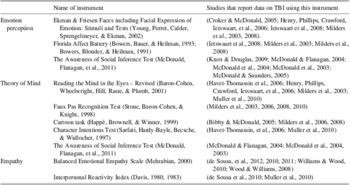
From a clinical perspective, standard neuropsychological assessment is unlikely to provide a clear overview of difficulties in social perception. Whether problems arise from modular deficits in social reasoning or as a result of more generic cognitive impairments is not strictly relevant. What is important is that tests used are able to predict interpersonal problems. Furthermore, it will be important for TBI research that there is a standardization to the assessment of social cognition, as has been recommended for neuropsychological testing more broadly (Wilde et al., Reference Wilde, Whiteneck, Bogner, Bushnik, Cifu, Dikmen and von Steinbuechel2010). The realm of social cognition is very recent. Although several tests have been used repeatedly with this population (see Table 1) this cannot be taken to suggest they are the most sensitive or predictive of functional deficits.
Some of the more common measures of social cognition used to examine impairment following TBI and examples of studies that have cited these measures

Text based stories encompassing the need to understand sarcasm (Channon & Crawford, Reference Channon and Crawford2010) or Faux Pas (Stone et al., Reference Stone, Baron-Cohen and Knight1998) have proven sensitive to TBI but, to date, have not been found to predict behavioral problems according to relatives (Milders et al., Reference Milders, Fuchs and Crawford2003, Reference Milders, Ietswaart, Crawford and Currie2008). On the other hand, emotion perception based on photos does predict those who are likely to misinterpret the mood of others (Hornak et al., Reference Hornak, Rolls and Wade1996) and those who relatives rate as having poor pragmatic communication (Milders et al., Reference Milders, Ietswaart, Crawford and Currie2008; Watts & Douglas, Reference Watts and Douglas2006) and low social integration (Knox & Douglas, Reference Knox and Douglas2009).
Video vignettes with follow-up probes such as The Awareness of Social Inference Test (TASIT) (McDonald, Flanagan, & Rollins, Reference McDonald, Flanagan and Rollins2011), the Video Social Inference Test (VSIT) (Turkstra, Reference Turkstra2008) and the Assessment of Social Context (ASC) (Hynes et al., Reference Hynes, Stone and Kelso2011) provide a better approximation of real life encounters although only TASIT has substantial norms. TASIT and ASC are predictive of everyday social behavior as rated by relatives (Hynes et al., Reference Hynes, Stone and Kelso2011; Reference McDonald, English, Randall, Longman, Togher and TateMcDonald et al., Submitted) and independent observers (McDonald, Flanagan, Martin, & Saunders, Reference McDonald, Flanagan, Martin and Saunders2004). In general, further test development is required before social cognition assessment is locked into particular assessment frameworks.
The delineation of social cognition deficits following TBI highlights not only the need for specific assessments in this area but also remediation. While remediation research after TBI is a large and growing literature, there is a relative dearth of research into remediation for social cognition. On PsycBITE (www.PsycBITE.com), the comprehensive database of treatment studies, as of May 2012 there were 906 treatment studies listed that provide evidence for treatment of psychologically based disorders after TBI. Of these, only 14 bear any clear relation to treatments for social cognition or social communication. Selecting the few randomized control trials from this group, treatment of disorders of emotion perception has yielded modest benefits (Bornhofen & McDonald, Reference Bornhofen and McDonald2007, Reference Bornhofen and McDonald2008), as has broader treatment approaches focused upon interpersonal communication and social skills (Dahlberg et al., Reference Dahlberg, Cusick, Hawley, Newman, Morey, Harrison-Felix and Whiteneck2007; Helffenstein & Wechsler, Reference Helffenstein and Wechsler1982; McDonald et al., Reference McDonald, Tate, Togher, Bornhofen, Long, Gertler and Bowen2008).
The heterogeneity of TBI and its variable impact upon social cognition is a major stumbling block for group treatment studies. Single case experimental studies broaden the scope for assessing treatment effects in unusual or rare conditions. This along with growing sophistication of social cognition research should provide new avenues for designing treatment. For example, if emotional processing and responsivity are mediated by a relatively automatic, ventral system that is regulated by a dorsolateral frontal system (Phillips et al., Reference Phillips, Drevets, Rauch and Lane2003) a deficit in the automatic system (for example, a loss of arousal to emotionally salient material) may be ameliorated by strategies that engage the dorsal regulatory system. Preliminary research suggests this may be the case. Low physiological arousal to negative faces seems to normalise if people with TBI are given explicit instructions to attend to the images (McDonald, Rushby, et al., Reference McDonald, Rushby, Li, de Sousa, Dimoska, James and Togher2011). Deliberate mimicry of emotional expressions to improve engagement and recognition of emotions is another ploy that has theoretical potential, although in the one study to date to examine this (McDonald, Bornhofen, & Hunt, Reference McDonald, Bornhofen and Hunt2009), the results were not promising. More recent research suggests that the subjective and physiological effects of mimicry itself may be impaired in TBI (Reference Dethier, Blairy, Rosenberg and McDonaldDethier, et al., in press). By examining these effects in detail, further insights may come to light as to how best remediate and/or manage deficits in social cognition following TBI, so as to tackle one of the core areas of impairment and disability in this population.
Acknowledgments
Much of the cited research by the author was funded by the National Health and Medical Research Council of Australia and the Australian Research Council. The Awareness of Social Inference Test (TASIT) is sold commercially by Pearson Assessment and the author receives royalties for this. Otherwise there are no conflicts of interest in the research reported in this article.