Overweight and obesity in children is one of the most important public health problems in the developed world. In Spain, one of the highest ranked countries in the world with regard to this problem, more than 30% of children are affected (Amigo, Busto, Peña, & Fernández, Reference Amigo-Vázquez, Busto-Zapico, Peña-Suárez and Fernández2013; Ng et al., Reference Ng, Fleming, Robinson, Thompson, Graetz, Margono and Gakidou2014). Children who are overweight suffer from numerous medical problems, such as, for example, intolerance to glucose, which were, until now, extremely rare in children (Yi et al., Reference Yi, Hwang, Kim, Lee, Kim and Lim2014). Furthermore, the problem is made more serious by the fact that the majority of obese children will become obese adults (Stovitz, Pereira, Vázquez, Lytle, & Himes, Reference Stovitz, Pereira, Vázquez, Lytle and Himes2008).
The emergence of this problem, which began in the 1980s, is the result of radical changes which have taken place in children’s lifestyles over this period. Several studies show how this increase in childhood obesity is more related to different inappropriate behavioral practices, than to genetic factors (Birch & Fisher, Reference Birch and Fisher1998; Dietz, & Gortmaker, Reference Dietz and Gortmaker1985). Among these changes are the proliferation of sedentary leisure activities (Amigo-Vázquez, Busto-Zapico, Errasti-Pérez, & Peña-Suárez, Reference Amigo-Vázquez, Busto-Zapico, Errasti-Pérez and Peña-Suárez2016), the decrease in active leisure activities and the reduction in the number of hours that children sleep (Chaput et al., Reference Chaput, Lambert, Gray-Donald, McGrath, Tremblay, O’Loughlin and Tremblay2011). Laguna et al. (Reference Laguna, Ruiz, Gallardo, García-Pastor, Lara and Aznar2013) have observed that the physical activity carried out by children through play is much more intense and frequent in children who are not overweight. Kettner et al. (Reference Kettner, Kobel, Fischbach, Drenowatz, Dreyhaupt, Wirt and Steinacker2013) found that almost 50% of children do not do sufficiently intense physical activity when playing to maintain good health, according to current recommendations. Rohilla et al. (Reference Rohilla, Rajput, Rohilla, Malik, Garg and Verma2014) and Goyal, Kumar, Parmar, Shah, and Patel (Reference Goyal, Kumar, Parmar, Shah and Patel2011) have shown that not participating in some form of games outside the home has significant association with being overweight. In line with these results, it has also been shown that the more siblings children have, the lower their BMI (Padez, Mourão, Moreira, & Rosado, Reference Padez, Mourão, Moreira and Rosado2005).
However, it is not only games which imply physical activity that are associated with normal weight, but other activities such as reading have also proved to be associated. It would appear that a lack of leisure reading and a reduction in hours of sleep can together predict an inappropriate lifestyle which favors overweight (Taylor, Winefield, Kettler, Roberts, & Gill, Reference Yi, Hwang, Kim, Lee, Kim and Lim2012). With regard to sleep, the data indicates that sleeping less than 9 hours a day is related to an increase in BMI in children (Amigo-Vázquez, Peña-Suárez, Errasti-Pérez, & Busto-Zapico, Reference Amigo-Vázquez, Peña-Suárez, Errasti-Pérez and Busto-Zapico2014; Ren, Zhou, Liu, Wang, & Yin, Reference Ren, Zhou, Liu, Wang and Yin2017) . It has been suggested that this relationship could be due to changes in how satiety and appetite are regulated, provoking alterations in leptin and ghrelin levels, in turn associated with low sleep duration (Hart et al., 2014).
The aim of this study is to test a model, using path analysis, in which active leisure activities and, in particular, reading, predict hours of sleep in children, in turn associated with lower BMI.
Method
Participants
The sample was taken at random from the schools of the Principality of Asturias. A random cluster sample was used, thus making it possible to obtain results which would be representative of the whole of the population of Asturias in this age group.
The sample size was calculated a priori in order to obtain moderate effect sizes (effect size F = .15) (Cohen, Reference Cohen1988) using the G*POWER 3 (Faul, Reference Faul2012) for multiple regression: A type I error, (α err prob = .05); a statistical power analysis, 1−β err prob = .95; and number of predictors = 3. This procedure for regression models handles cases of tests for an overall effect – that is, the hypothesis that the population value of R 2 is different from zero (Faul, Erdfelder, Lang, & Buchner, Reference Faul, Erdfelder, Lang and Buchner2007). The results showed that a sample size of 119 participants was required in order to obtain a moderate effect size. A total of 291 children from 30 state education centers of the Principality of Asturias were evaluated. One hundred and forty-two (49.3% of the sample) were girls and 149 (50.7%) were boys, the mean age being 9.33 years with a standard variation of .55 (range = 3.09; minimum = 8; maximum = 11.09).
Instruments
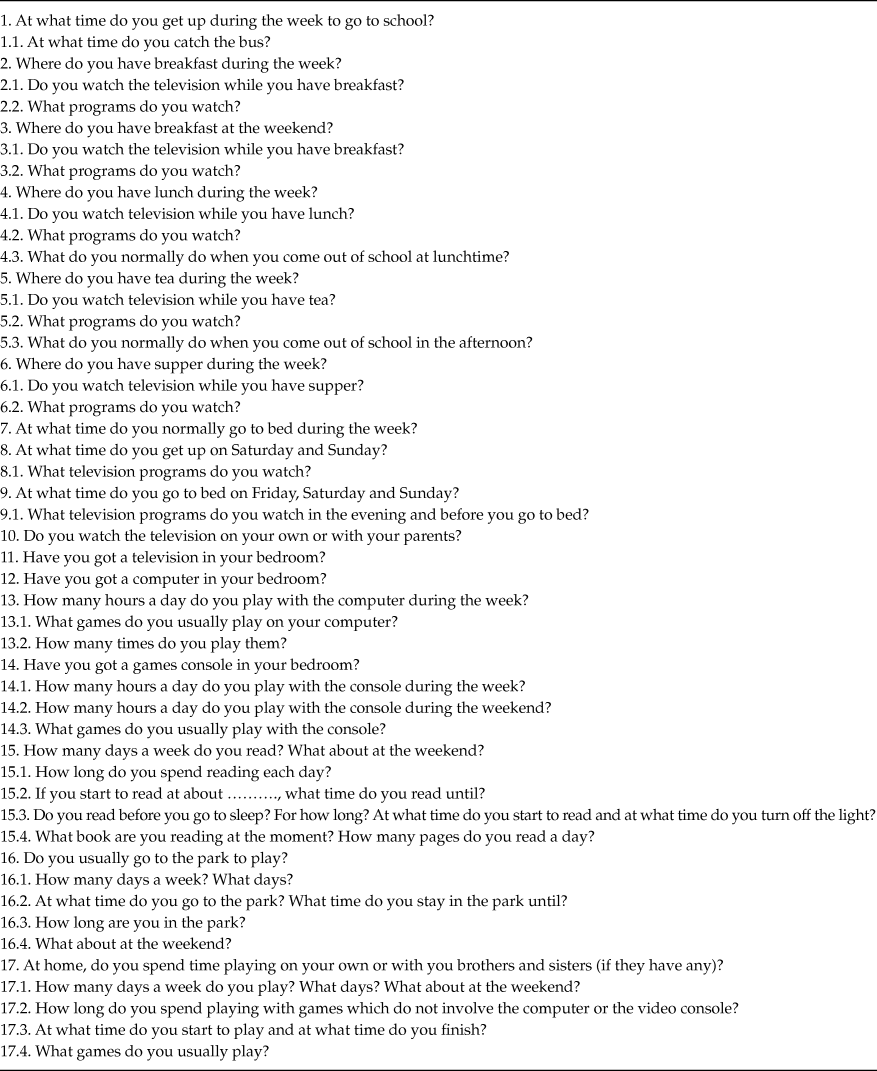
In order to weigh the participants, electronic scales of the Firstline brand, model FPS4141, were used. To measure their height, a Kóndor brand measuring tape, model CF265, was used. A questionnaire was designed regarding habits related to sedentary leisure activities and sleep (Table 1). The questionnaire made it possible to calculate the time that each child dedicated to each of the variables being studied.
Questionnaire Regarding Physical Activity, Sedentary Leisure Activities and Sleep

Procedure
Parents were asked to give their signed consent for the children to participate in a study into children’s lifestyles. The study involved an individual interview, lasting between approximately 25 and 30 min, which was carried out in an office in the school. Two anthropometric parameters, weight and height, were obtained and these were subsequently used to calculate the body mass index (BMI) following the criteria of Cole, Bellizi, Flegal, and Dietz (Reference Cole, Bellizi, Flegal and Dietz2000). Each participant was weighed and measured barefoot in an upright position and with their head held up. In order to check the reliability of the height measurement, a series of 50 measurements were taken and then compared with those taken by another evaluator. Both the Kappa concordance index (.75) and the intra-observer concordance (.79) were good.
Having obtained these two parameters, the child completed the questionnaire, which consisted of 17 basic questions. When answering the questions regarding the number of hours spent watching television, the children were shown a television guide in order to check the real duration of the programs and thus assure a greater degree of accuracy in the answers.
The information collected was used to calculate the time that each child spent to sedentary leisure (hours of TV, videogames and computer), reading and active leisure. Hours of sedentary leisure and hours of reading were calculated per day; hours of active leisure were calculated per week as children exercised on differing days during the week and also included spare time in the weekends.
Information regarding the time of going to bed and of getting up was provided by parents at the same time as they gave their signed consent for the participation of their children.
Data Analysis
The descriptive analyses, Pearson correlations and simple linear regression analyses were carried out using the SPSS IBM 20 program for Windows. The path analysis was performed with the Mplus 5 software. The analyses employed a fundamentally confirmatory logic. The model was evaluated based on the statistical significance of the chi-squared test and goodness of fit measures that included the Tucker Lewis Index (TLI), the Comparative Fit Index (CFI) and the Root Mean Square Error Approximation (RMSEA). Initial Pearson´s Correlation and multiple regression analyses were performed to determine the significant relationships between variables in the path analysis.
Results
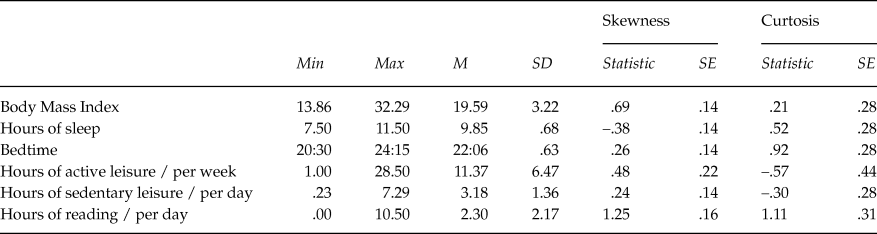
Descriptive statistics of the variables are showed in Table 2. Analyses were carried out in order to identify any cases of outliers using box-plot diagrams and normality tests in order to check that the skewness and kurtosis statistics were within a range from −1.25 to 1.25.
Descriptive Statistics of the Variables

Note: Min = Minimum; Max = Maximum; M = Mean; SD = Standard Deviation; SE = Standard Error.
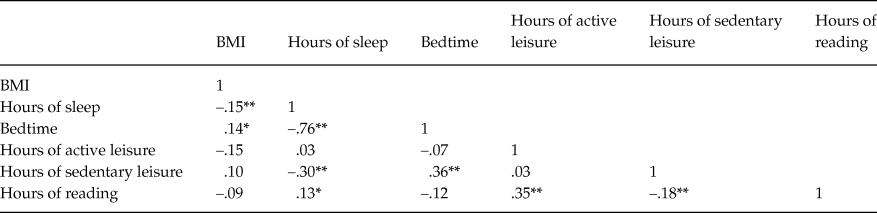
The box-plot diagrams did not indicate the presence of atypical values, although in the case of sedentary leisure, one outlier case was found and this was replaced by the mean value. The correlation matrix between the variables studied is shown in Table 3. Significant relationships were found between BMI, bedtime, time spent reading, and sedentary leisure and hours of sleep and/or bedtime.
Correlation Matrix between Variables

Note: **p < .01. *p < .05.
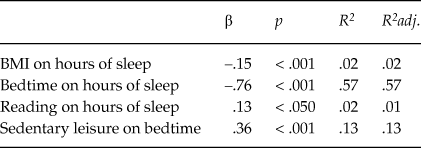
Different models of linear regression equations were constructed based on the aforementioned significant variables, using sedentary leisure activities and sleep as criterion variables. Table 4 shows the standardized coefficients, the significance of those coefficients and the percentage of explained variance of each model. Firstly, a simple regression model was made up where hours of sleep was the criterion variable and BMI was the predictor, F(1, 289) = 6.89 p < .001. In the second simple regression model, hours of sleep was the criterion variable and bedtime was the predictor, F(1, 291) = 386.22 p < .001. A third simple regression model was elaborated where hours of sleep was the criterion variable and time spent reading was the predictor, F(1, 242) =4.09 p < .050. The fourth simple regression model was one in which bedtime was the criterion variable and sedentary leisure was the predictor, F(1, 290) =43.51 p < .001.
Simple Regression Models of Hours of Sleep and Bedtime

Note: β = Standardized Coefficients; R 2 = total explained variance; R 2 = Regression coefficient; R 2 adj. = Adjusted regression coefficient.
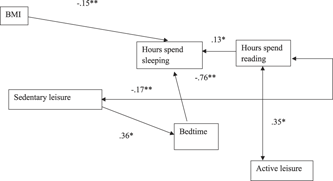
The path analysis showed that the fit of the model tested was good. The chi-squared test was not significant, 11.19 p = .13; the fit indexes CFI and TLI were .98 and .98 respectively, and the RMSEA showed a value of .04 with confidence intervals from .00 to .09 (see Figure 1).
Model of Relationships between BMI, Sleep, Read, Bedtime, Sedentary Leisure, and Active Leisure.
**p < .001. *p < .05.
All the relationships are statistically significative.

The path analysis shows that several variables have an effect on hours of sleep. A greater BMI (β = –.15 p < .001) and going to bed late (maximum score = 24.15) (β = –.76 p < .001) predict less hours of sleep per day whilst more time spent reading predicts more hours of sleep (β = .13 p < .001). Time spent reading also has a positive correlation with active leisure (r = .35 p < .001) and a negative one with sedentary leisure (r = –.17 p < .001). Finally, sedentary leisure is also shown to predict going to bed later (β = .36 p < .001).
Discussion
The results showed that a lower BMI predicts a greater number of hours of sleep and an earlier bedtime. In addition, total time spent on reading, playing at home, with siblings and in the park predicts a lower BMI because this type of leisure is associated with a greater number of hours of sleep. These results coincide with those presented by Olds, Maher, and Matricciani (Reference Olds, Maher and Matricciani2011) and Blanck et al. (Reference Blanck, Allen, Bashir, Gordon, Goodman, Merriam and Rutt2012). Similarly, Golley, Maher, Matricciani, and Olds (Reference Golley, Maher, Matricciani and Olds2013) also stressed the bedtime variable as having a significant relationship with BMI in children and Potwarka, Kaczynski, and Flack (Reference Potwarka, Kaczynski and Flack2008), in a study carried out in Canada, found that youngsters who lived near a park had a five times greater probability of having a healthy weight than of suffering from overweight or obesity.
Using this model, sedentary leisure activities were found to be associated with a greater BMI. They were also shown to predict an increase in BMI through a reduction in hours of sleep, as indicated in recent literature (Amigo-Vázquez et al., Reference Amigo-Vázquez, Peña-Suárez, Errasti-Pérez and Busto-Zapico2014; Chaput et al., Reference Chaput, Katzmarzyk, LeBlanc, Tremblay, Barreira, Broyles and Olds2015).
However, this model also showed that sedentary leisure has an inverse relationship with leisure reading. This activity predicts less sedentary leisure and more hours of sleep, which in turn means a lower BMI. This result coincides with the findings of Sisson, Broyles, Baker, and Katzmarzyk (Reference Sisson, Broyles, Baker and Katzmarzyk2011) and may be related to habits in certain families, where reading is the last activity before going to bed at a predetermined time as opposed to going to bed when a particular television program finishes. This latter option does not always guarantee the child’s bedtime being the most appropriate one. Indeed, reading predicts a lower BMI through a greater number of hours of sleep. All of these facts appear to indicate that, in children, reading is the result of a family lifestyle in which a number of healthy behavior patterns converge to control weight.
The model based on this analysis makes it possible to make a series of observations regarding lifestyle habits which may contribute, at least partially, to an increase in overweight and obesity in children. It appears that weight control in childhood depends not only on the quantity and type of food eaten but also on the child having a healthy lifestyle. Establishing this order involves, firstly, limiting the number of hours spent in front of the television, console or computer (Falbe et al., Reference Falbe, Rosner, Willett, Sonneville, Hu and Field2013). This implies, indirectly, controlling the hours of sleep since, as previously pointed out, the longer children spend in front of a screen, the less they sleep. Consequently, encouraging reading as the last activity before going to bed can benefit not only children’s intellectual development but also more general aspects of their health.
For all of the above reasons, it is important that public health campaigns aimed at controlling the problem of overweight in children should include sleep as one of the elements to be taken into account. Children should be encouraged to go to bed at a predetermined time, according to the time they have to get up and not depending on the television program they are watching. By extension, it is not advisable for children to have a TV in their bedroom since this increases the likelihood of their going to bed later (Cameron et al., Reference Cameron, van Stralen, Brug, Salmon, Bere, Chinapaw and Velde2013). Furthermore, children should be encouraged to play at home and in the park and to read on a daily basis to ensure their healthy development. Other more general measures of a social nature could also fulfil the same function. One such measure could involve “prime time” TV. Bringing forward the times of television programs could be useful in this context. This would in turn involve taking into account the much broader topic of work and school timetables, which is beyond the scope of this study.
One limitation of this study is its transversal nature, which could raise doubts as to whether the relationships found here may vary over time (Bijleveld, Mooijaart, & Van der Kamp, Reference Bijleveld, Mooijaart, van der Kamp, Bijleveld and van der Kamp1998). However, the use of path analysis could at least partially solve this problem since this procedure involves creating “a priori” a theoretical model based on a study of the literature and in which the relationships between a series of variables are confirmed by means of statistical tests.
To obtain better generalization of the results a future line of research in which we are working is to include private schools in the study sample.