Background
At 2:46pm on March 11, 2011, a massive, magnitude 9.0 earthquake struck Japan. The epicenter was 70km offshore of Sendai City in Miyagi Prefecture. Miyagi Prefecture has a population of around 2.3 million and is located approximately 300km northeast of Tokyo. On the prefectural level, Miyagi suffered the greatest amount of damage from this huge earthquake and subsequent tsunami. Five years have passed since the earthquake, and the official toll is 19,418 people confirmed dead and 2,592 still missing. 1 The great earthquake and tsunami destroyed much of the infrastructure in the prefecture, and even though Japan is an industrially advanced nation, lifelines such as electricity, gas, and water were cut off for an extended period of time, placing an enormous amount of stress on most residents.
Expectant and nursing mothers are a vulnerable population,Reference Wisner and Adams 2 and they play an important role in revitalizing their community. The impacts of disasters on expectant and nursing mothers have been analyzed previously, especially birth outcomes such as preterm birth rate and low-birth-weight rate, and sex ratio. In most surveys, increases in the rates of preterm births and low-birth-weight infants have been reported.Reference Tan, Li and Zhang 3 – Reference Tong, Zotti and Hsia 5 These phenomena have been attributed to a deterioration in food and housing conditions, excessive stress during pregnancy, and limited access to health care facilities, particularly in developing countries.Reference Oyarzo, Bertoglia and Avendaño 4 , Reference Tong, Zotti and Hsia 5
The purpose of this survey is to compile birth records from health care facilities, to analyze the birth outcomes broken down by coastal and inland regions, and to discuss the impact that this great earthquake, which devastated outlying metropolitan areas, had on pregnant women in the advanced nation of Japan.
Methods
Study Methods
This study was conducted in accordance with the Declaration of Helsinki and approved by the ethics committee of the Tohoku Medical Megabank Organization, Tohoku University (Sendai, Japan; 2014-21). Because there is no standardized birth database in Japan, data were compiled and analyzed from post-disaster birth records of the 36 facilities that provided obstetric services in Miyagi Prefecture. The breakdown of facility types is as follows: three midwifery homes, 22 private clinics (primary facilities), eight public hospitals (secondary facilities), and three specialized care hospitals (tertiary facilities). The breakdown by geographic location was 12 costal facilities located in local government districts directly impacted by the tsunami, and 24 inland facilities.
Birth records were maintained by each obstetrics facilities in paper-based documents or digital data. The records of patients who gave birth between March 11, 2011 and December 31, 2011 were compiled, and data for 14,217 patients were entered into a database. The database was maintained in the facility in a personal computer without any network connections. Obstetric items in the database were the following: name of institutions, date of birth, maternal age, gestational weeks and days of delivery, mode of delivery, amount of bleeding at delivery, sex of newborns, body weights of newborns, and Apgar scores. First, 247 patients in which an entry for gestational age was missing were excluded, leaving 13,036 women who were pregnant on March 11, 2011; that is, women whose expected delivery date was between March 2, 2011 and December 16, 2011. Then the following were excluded: patients with multiple pregnancies (65), infants with chromosomal disorders (10), infants with other congenital disorders (100), and mothers who delivered without prior examination at a medical facility (1). Finally, patients lacking an entry for the age of the mother at delivery (33), or for the birth weight (2) or sex of the infant (17), were excluded, and the 12,808 patients that remained formed the analysis set for baseline characteristics.
To examine the effect of the disaster on birth outcomes, the gestational age at delivery, birth weight of the infant, sex of the infant, mode of delivery for each level of medical institution, facility location, and stage of pregnancy at the time of the disaster were analyzed. Next, the risk of delivery of low-birth-weight infants in the two disaster regions in 12,808 subjects were analyzed. In addition, to compare the risk of preterm births in the two disaster regions, patients who were still pregnant at 37 weeks, 0 days or more after March 11, 2011, and analyzed a set of the remaining 12,042 subjects, were excluded.
Statistical Analysis
In the baseline characteristics of the analysis set, continuous variables were expressed as mean (SD) and categorical variables as percentage (%). In the comparisons of baseline characteristics between coastal and inland regions, the Student t-test was used for continuous variables, and for categorical variables, a χ2 test or Fisher’s exact test was used.
Next, multi-level logistic regression analysis to compare the risks of low birth weight and preterm birth between coastal and inland regions was used for this study. Laplace approximation as the parameter estimation method, and a ridge-stabilized Newton Raphson algorithm were used to avoid convergence problems. The type of birth facility was treated as a random effect.
In the analysis using low birth weight as an outcome, the age of the mother at delivery (age <20, 20-24.9, 25-29.9, 30-34.9, 35-39.9, ≥40); gestational age at delivery; stage of pregnancy at the time of the disaster (1st trimester, 2nd trimester, 3rd trimester [28-36 weeks], 3rd trimester [37 weeks or longer]); sex of the infant; location (costal or inland region); and level of medical institution (midwifery home versus primary, secondary, or tertiary facility) were entered into the model as fixed effects. In the analysis using preterm birth as an outcome, the age of the mother at delivery (age <20, 20-24.9, 25-29.9, 30-34.9, 35-39.9, ≥40); stage of pregnancy at the time of the disaster (1st trimester, 2nd trimester, 3rd trimester [28-36 weeks]); sex of the infant; location; and level of medical institution were entered into the model as fixed effects.
It was assigned P<.05 as the level of statistical significance, and performed all statistical analyses using SAS Ver.9.4 (SAS Institute Inc.; Cary, North Carolina USA).
Results
The average age of mothers was 30.3 (SD=5.1), and the stage of pregnancy at the time of the disaster was as follows: 1st trimester-35.2%, 2nd trimester-36.6%, and 3rd trimester-28.3%. Coastal medical institutions accounted for 21.3% of the deliveries, and 20.3% were caesarean. The male-to-female ratio was 51.3%/48.7%, the mean length of gestation was 39.3 (SD=1.6) weeks, and the mean birth weight was 3,036 (SD=419) gm. It was demonstrated that a preterm birth rate was 4.6% and a low-birth-weight rate was 8.8% (data not shown).
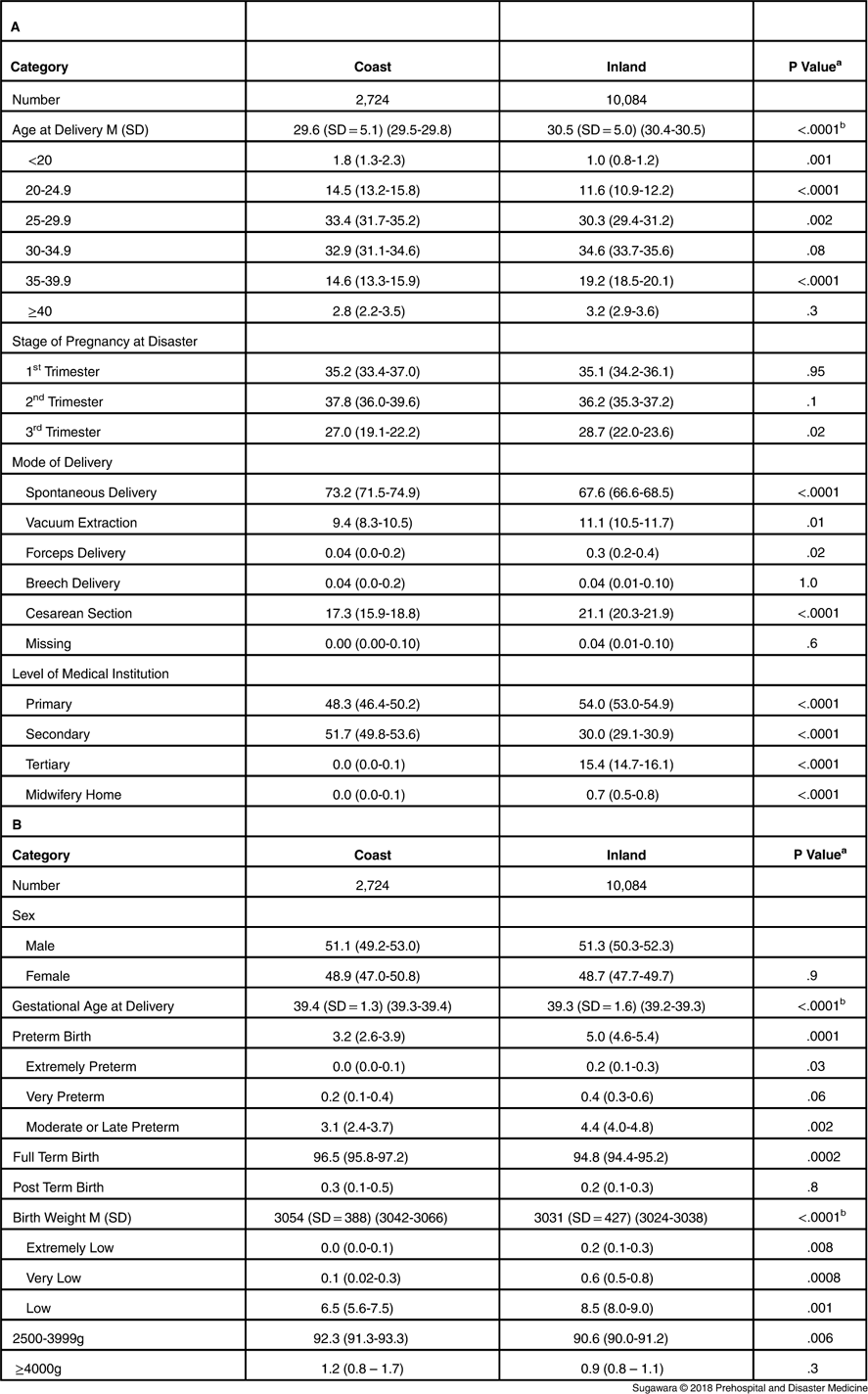
Next, the baseline characteristics of mothers and neonates were compared using the regional location of the medical institution. When the baseline characteristics of the mothers by location was compared, the age of mothers in the coastal region was significantly younger than the age of the mothers in the inland region (29.61 [SD=5.1] versus 30.5 [SD=5.0]). Moreover, in the coastal region, the natural birth rate was higher (73.2% versus 67.6%), and the rate of caesarean delivery was lower (17.3% versus 21.1%). In addition, because the coastal region had no tertiary facility, the delivery rates at primary and secondary facilities tended to be higher (Table 1A).
Baseline Maternal (A) and Neonatal (B) Characteristics by Region

Note: Values except for mean of age at delivery (A) and gestational age and birthweight (B) are percentages.
a χ2 test or Fisher’s exact test for categorical variables.
b Student t-test was used for continuous variables.
When the baseline characteristics of the neonates was compared by location, the preterm birth rate was 3.2% in coastal regions and 5.0% in inland regions, so the preterm birth rate in the coastal regions was significantly lower. In the breakdown of preterm births, the comparison between coastal and inland regions was as follows: extremely preterm (<28 w) 0.0% versus 0.2%; very preterm (28-31 w) 0.2% versus 0.4%; and moderate-to-late preterm (32-36 w) 3.1% versus 4.4%. All parameters tended to be lower in the coastal region. The birth weights were 3,054 (SD=388) gm in the coastal region and 3,031 (SD=427) gm in the inland region, so the birth weight in the coastal region was significantly higher. In the breakdown of birth weights, the comparison between coastal and inland regions was as follows: extremely-low-birth-weight (<1,000g) 0.0% versus 0.2%; very-low-birth-weight (<1,500g) 0.1% versus 0.6%; and low-birth-weight (<2,500g) 6.5% versus 8.5%. All tended to be lower in the coastal region (Table 1B).
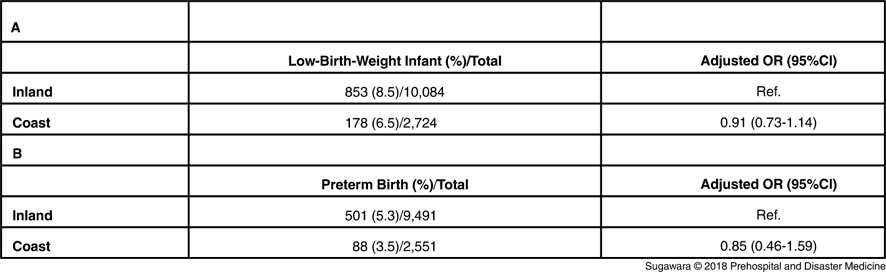
Next, the risk for low-birth-weight infants was analyzed in both regions, and it was demonstrated that the risk in the coastal region could not be considered any higher than in the inland region (Table 2A; adjusted odds ratio 0.91 [0.73-1.14]). Moreover, in the risk analysis of preterm birth rate, the risk in the coastal region could not be considered any higher than in the inland region (Table 2B; adjusted odds ratio 0.85 [0.46-1.59]).
Regional Risk Analysis of the Birth Weight (A)Footnote a and Preterm Birth Rate (B)Footnote b

a Model was controlled for the age of the mother at delivery, gestational age at delivery, stage of pregnancy at the time of the disaster, sex of the infant, location, and level of medical institution.
b Model was controlled for the age of the mother at delivery, stage of pregnancy at the time of the disaster, sex of the infant, location, and level of medical institution.
Discussion
This is the first study to perform a detailed analysis of birth outcomes from the Great East Japan Earthquake classified by stage of pregnancy, level of medical facility, and birth region. In this survey study, a retrospective analysis of birth outcomes was performed in expectant mothers who were presumed to be pregnant at the time of the massive earthquake and tsunami in Miyagi Prefecture, where most of the casualties were recorded.
Many of the previously conducted surveys of birth outcomes after major disasters have reported increased rates of preterm births and low-birth-weight infants.Reference Tan, Li and Zhang 3 – Reference Tong, Zotti and Hsia 5 These findings have been attributed to causes such as excessive stress on the pregnant woman, limited access to health care facilities, and insufficient health care provision. The preterm birth rate in this study was 4.6% directly after the earthquake disaster, lower than the preterm birth rate of 5.4% in 2012 and 5.8% in 2013 for Miyagi Prefecture in Japan. 6 This finding is completely different from those of previous reports from various other countries. The preterm birth rate in Japan tends to be the lowest in the world, 7 , Reference Blencowe, Cousens and Oestergaard 8 and this has been attributed to the well-established system of publicly funded prenatal examinations for pregnant women, early-stage diagnosis of impending preterm delivery, and continuous preventive health care. The lower preterm birth rate in this study may have been affected by medical intervention at an earlier stage than usual, increased bed rest due to lengthy limitations in work and travel, and early mass transfer of high-risk expectant mothers to inland tertiary care facilities.Reference Sugawara, Hoshiai and Sato 9
Next, the rate of low-birth-weight infants overall was 8.7%, and this tended to be lower than the statistical result for Miyagi Prefecture of 9.3% in 2012 and 9.8% in 2013. 6 Moreover, the rates of very-low-birth-weight infants (0.5% versus 1.1%) and extremely-low-birth-weight infants (0.2% versus 0.6%) tended to be lower than in 2012. 6
When characteristics of the mothers were compared by disaster region, the coastal region was affected by the absence of a tertiary health care facility for high-risk patients, so the natural birth rate tended to be higher in the coastal region, and the caesarean birth rate tended to be lower. In the outcomes for neonates, the rates for preterm births and low-birth-weight infants were both lower in the coastal region, and these findings suggest there may be no association between short-term birth outcome and the extent of the disaster caused by the tsunami.
Next, the investigation of risks for preterm births and low-birth-weight infants in the coastal region revealed that in both instances, the risk could not be considered higher in the coastal region than inland. These findings differ from previous reports.
The obstetric outcomes in women of the Fukushima Prefecture have recently been reported.Reference Hayashi, Fujimori and Yasumura 10 They demonstrate that the occurrence of preterm birth and low birth weight is higher in women who conceive up to six months after the disaster than in those who were pregnant at the time of the disaster. In Fukushima, nuclear plant accidents created very strong, continuous, stressful conditions for residents, whereas the tsunami was the main impact in Miyagi Prefecture. As mentioned above, the disaster situations were different in each area; however, further investigation is needed to clarify the impact on obstetric outcomes in Miyagi Prefecture.
This study indicates that the rates for preterm birth and low-birth-weight infants differ from previous post-disaster reports, and surprisingly, were more favorable in the coastal region. The analysis by type of health care facility suggests that the early transfer of high-risk expectant mothers from the coastal region to inland tertiary health care facilities after the disaster may be reflected in those findings. In other words, both early transfer away from the tsunami’s enormous destruction and intensive medical care may be associated with a favorable birth outcome.
Limitations
Ideally, from the viewpoint of cohort research, a retrospective study should be conducted that compares identical time periods before and after the earthquake using the expected delivery date as a reference. In this case, however, an accurate assessment was impossible because some of the pre-disaster birth records were destroyed by the tsunami, and there was no digital backup. Therefore, analysis for a set length of time after the earthquake disaster was conducted.
Because Japan has no standardized birth records at this time, it was impossible to take into account the mother’s height and weight, pregnancy and delivery history, marital status, and classification of birth defects of the infants that are necessary for a statistical analysis. Moreover, because this analysis was performed using only birth data from Miyagi Prefecture, it does not cover people who fled outside the prefecture, and for patients who were transferred inside the prefecture, it could not be ascertained which patients had been transferred. Therefore, it could not be accurately accounted for the effects of fleeing or being transferred.
Conclusions
Although the baseline data of the analysis set cannot be considered sufficient, the birth outcomes resulting from the Great East Japan Earthquake differ from those in earlier reports from various foreign countries, and both the preterm birth rate and rate of low-birth-weight infants, which are indicators of short-term obstetric outcomes, were not adversely affected by the earthquake. Measures such as early transfer to facilities outside the disaster area and early medical intervention may have led to several findings in this analysis, and ongoing surveillance will be necessary to determine the long-term outcomes in both mothers and children.
Acknowledgments
The authors would like to thank all staffs of department of obstetrics and gynecology in hospitals in Miyagi Prefecture for providing obstetrical medical records to this study.