INTRODUCTION
Distress is defined as an unpleasant emotional state that may affect one's way of feeling, thinking, and acting (National Comprehensive Cancer Network, 2013). Patients with advanced disease often suffer from psychosocial distress (Block, Reference Block2001; Gotze et al., Reference Gotze, Brahler and Gansera2014; Gruneir et al., Reference Gruneir, Smith and Hirdes2005; Mazzocato et al., Reference Mazzocato, Stiefel and de Jonge2000). Its prevalence varies depending on the measurement instrument used (Thekkumpurath et al., Reference Thekkumpurath, Venkateswaran and Kumar2008). It has been associated with a decrease in patients' adherence to their treatment, with the ability to cope with the diagnosis, and with an increase in the symptom burden, and it has been determined to have a negative effect on overall quality of life (Jacobsen et al., Reference Jacobsen, Donovan and Trask2005; Kelly et al., Reference Kelly, McClement and Chochinov2006; Kennard et al., Reference Kennard, Stewart and Olvera2004). Nevertheless, psychological distress tends to be underdiagnosed and undertreated in the palliative care setting (Thekkumpurath et al., Reference Thekkumpurath, Venkateswaran and Kumar2008). Ultrashort screening methods such as the Distress Thermometer (DT) were developed to facilitate detection of distress by patients and clinicians (Mitchell, Reference Mitchell2007).
Since many patients wish to spend their last days at home (Escobar Pinzon et al., Reference Escobar Pinzon, Claus and Zepf2011), the practice of home-based palliative care has grown significantly in recent years in Germany (Müller-Busch, Reference Müller-Busch2008). This particularly applies to specialized outpatient palliative care, which is supported by the law (German Social Code, Book V, April 2007). A 2015 amendment supports expansion of general outpatient palliative care. Around 99% of the German population is insured; however, emotional and psychosocial care are not covered by health insurance nor included in home care service packages. Insurance covers full psychotherapeutic treatment only after a diagnosis of a syndrome has been made. This requires patients to go through a burdensome process to request a consult and long waiting periods for appointments. The German Association of Palliative Medicine recommended the DT among the instruments for palliative basic assessments, but its use is still limited. Studies on the psychosocial distress of patients in palliative care living at home in Germany are very limited, and research on assessment tools is certainly lacking.
The aims of our paper were (1) to describe the prevalence of psychosocial distress and related factors in palliative patients being treated at home, and (2) to test the implementation of the DT within a home-based palliative care service.
METHODS
Ours was a 15-month prospective study that began in September of 2013 in western Germany with consecutive patients cared for by a home care palliative care service. The survey was conducted during the first contact (at registration). Patients were excluded if they were under 18 years of age, mentally or physically unable to complete the assessment questionnaires as judged by their healthcare worker, or unable to understand the German language.
Measures
Sociodemographic and medical data were collected. The variables assessed were sex, age, marital status, living situation (alone, with family, or in an institution), care situation, diagnosis, functional status (Karnofsky Performance Status [KPS] score reported by the health worker), duration of illness (time from diagnosis until first contact), and outcome (either death or discharge). In addition, for patients who died, the total number of days in the study were recorded.
The Distress Thermometer (DT) is a single-item self-report measure of distress (Roth et al., Reference Roth, Kornblith and Batel-Copel1998). It was developed as an ultrashort screening tool for patients with a cancer diagnosis by the National Comprehensive Cancer Network (NCCN) (Holland et al., Reference Holland, Anderson and Breitbart2013; Roth et al., Reference Roth, Kornblith and Batel-Copel1998) and has been validated and utilized in different settings and patient populations (Donovan et al., Reference Donovan, Grassi and McGinty2014; Ma et al., Reference Ma, Zhang and Zhong2014), including the palliative care setting (Gessler et al., Reference Gessler, Low and Daniells2008; Thekkumpurath et al., Reference Thekkumpurath, Venkateswaran and Kumar2009). The DT has an 11-point range with endpoints labeled from 0 (“no distress”) to 10 (“extreme distress”). Respondents were instructed to circle the number (0–10) that described best how distressed they were during the previous week. A score of 4 or higher is defined as “significant distress” and should indicate the need for professional support (National Comprehensive Cancer Network, 2013). In the Problem List (PL), patients identify the source of their distress during the previous week from a list of five categories (emotional, familial, practical, spiritual, and physical).
The Problem List includes 38 problems commonly experienced by cancer patients grouped into five categories (practical, family, problems, spiritual/religious, and physical problems) (National Comprehensive Cancer Network, 2013). Respondents were instructed to indicate whether (“yes” or “no”) any of the items listed were a problem during the previous week. The PL helps determine what type of professional support is most appropriate. We employed the NCCN Guidelines (v. 2013), which we modified by skipping the item “ability to conceive children” (accepted by the NCCN) and translated based on the validated German version (Mehnert et al., Reference Mehnert, Müller and Lehmann2006).
A structured questionnaire was applied after the DT to assess (1) the comprehensibility of the instrument (1 = “very understandable,” 5 = “not understandable at all”), and (2) whether completing the DT/PL was experienced as a burden or relief. Further comments were recorded as free text.
Sample Size Calculation
Our sample size calculation determined that 62 patients were required to achieve a 95% confidence interval, assuming that both the sensitivity and specificity of the Distress Thermometer were equal to 0.80 (nQuery Advisor®, v. 7.0). A sensitivity and specificity of 80% was considered to be indicative of a valid diagnostic measure.
Statistical Analysis
The data were anonymized and collected in a digital database. Statistical analysis was conducted using SPSS software for Windows (v. 21). After a descriptive analysis, the demographic and clinical parameters of patients who completed the study were compared to those of patients who did not. The DT score was considered the primary outcome. The chi-squared (χ2) test was employed to compare categorical data, and an independent t test or Kruskal–Wallis test was utilized for continuous data. Pearson's correlations (ρ) were conducted to explore the univariate effects on the DT. The level of significance was set at p < 0.05.
RESULTS
During the study period, a total of 286 new individuals were registered for home care services. Of these, 138 were excluded from our study. The completion rate was 69.6% (n = 103). More than half of the participants (n = 53, 51.5%) completed the DT/PL by themselves, while the rest requested assistance. Completion of the DT/PL took an average of 9 (±4.8) min for those who did it alone and 16 (±7.9) min for those who needed help.
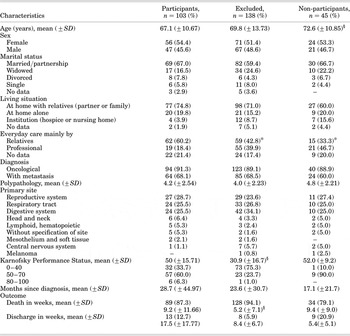
Participants were mostly women (54.4%). The mean age was 67 years (range = 45–89). The majority of participants were married or living in a formal relationship (67.0%). Some 95% of participants lived at home and were mainly cared for by relatives (60.2%). The main diagnosis was cancer (91.3%), mostly located in the reproductive organs (28.7%), respiratory tract (25.5%), and digestive system (25.5%). Participants had an average of four different diagnoses. The mean KPS score was 50 (±15.7). For 60% of participants, this score was found to be between 50 and 70.
The time between receiving the underlying diagnosis and first contact with the home care team was 29 ± 45 months (range = 25 days to 25 years). More than three-quarters (87.3%) of patients died within 9 (±11.7) weeks, and 12.7% were discharged within 15.5 (±17.7) weeks after first contact (Table 1).
Sociodemographic and medical characteristics of the sample

* Statistically significant (p < 0.05) χ2 test.
§ Statistically significant (p < 0.05) Kruskal–Wallis test.
Nonparticipants
A total of 138 patients were excluded because they did not meet the inclusion criteria: 95 (69.8%) had physical limitations or were at the end of life; ~23% of excluded persons reported so much emotional distress that they were unable to participate; and 7.4% did not speak German. Excluded patients had a shorter survival rate than participants, were older, less cared for by relatives, and had lower KPS scores than participants. Half of them died within three weeks after first contact and had less of a chance to stabilize. All other variables yielded no statistically significant differences (Table 1).
A total of 45 patients (15.7%) refused to participate. We were unable to determine the reason for these refusals in 64.4% of these cases. All other variables yielded no statistically significant differences (Table 1).
DT Score
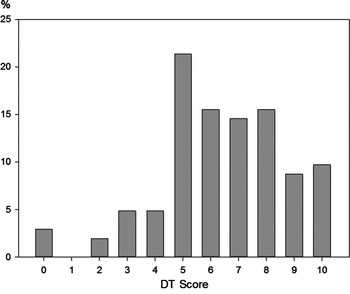
The lowest reported score was 0, the highest 10, with an average of 6.3 (SD = ±2.5). Almost 90% (89.3%) of participants had DT scores above the DT cutoff (≥4). A third of participants scored ≥8. Figure 1 depicts the frequency distribution of DT scores.
Frequency distribution of DT scores (n = 103).

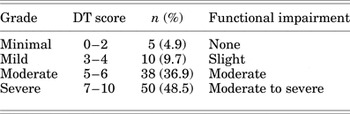
According to the scale proposed by Bidstrup et al. (Reference Bidstrup, Johansen and Mitchell2011), almost 50% of participants reported severe distress (DT = 7–10) and 36.9% moderate distress (DT = 5–6, which means moderate to severe functional impairment) (Table 2).
Grades of psychosocial distress according to Bidstrup et al. (Reference Bidstrup, Johansen and Mitchell2011)

DT Score and Sociodemographic and Medical Variables
Participants who were discharged due to stabilization of their medical status had lower distress scores than those who died later (t test). No significant correlation was found between distress level and age, survival time, KPS score, or multiple morbidities (Pearson's correlation). There were no statistical differences, neither between gender, primary care giver (family vs. professional or oncological care) (t test), nor marital status or living situation (Kruskal–Wallis test).
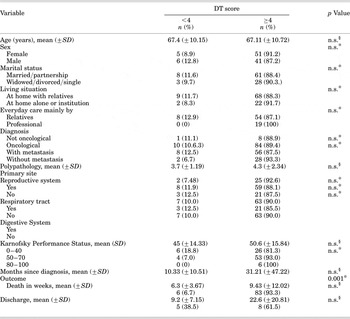
The relationship between a DT cutoff score of 4 to sociodemographic and medical variables was analyzed (Table 3). Analysis of primary sites of cancer diagnosis was limited to the three most frequent. No statistically significant relationship between a high DT score and sociodemographic or clinical variables was found. However, participants who were discharged due to stabilization of their symptoms had DT scores below 4. Participants with better KPS scores were more likely to complete the instrument without help and had lower DT scores (both statistically significant t tests).
Relation of a Distress Thermometer cutoff score of 4 to sociodemographic and medical variables

* χ2 test.
§ t test.
Problem List
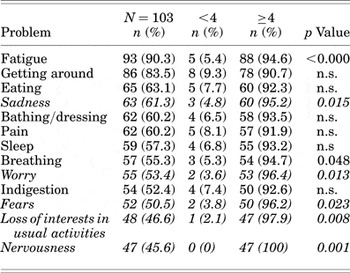
Overall, the physical concerns category was the most frequently selected, with 100% of patients selecting at least 1 of the 22 items. The second was the emotional concerns category, with 83.5% of patients selecting at least 1 of 6 items. Spirituality and family problems were the least selected, with 5.8 and 29.1%, respectively. All patients selected at least one problem within one or more of the five categories, with an average of 11 (±4) mentioned problems and a maximum of 25 problems checked (median = 11). “Fatigue” was the most frequently mentioned problem, which concerned 90.3% of patients, followed by such everyday problems as “getting around” (83.5%), “eating” (63.1%), “bathing/dressing” (60.2%), and “sleep” (57.3%). Among the most frequently mentioned terms associated with physical problems were “pain” (60.2%) and “breathing” (55.3%). “Sadness” (61.3%), “worries” (53.4%), “fears” (50.2%), “loss of interest in usual activities” (46.6%), and “nervousness” (45.6%) were the most frequently mentioned emotional concerns (Table 4).
Most frequently mentioned problems both for the total population and for participants scoring below and above the DT cutoff score*

Problems not displayed had a frequency <45% and were not significantly different between scores above and below the cutoff with a χ2 test.
* Psychological problems are in italics.
The least-mentioned problems were “spiritual/religious” (5.8%), “work/school” (4.9%), “dealing with children” (4.9%), “fever” (4.9%), and “drugs” (1.9%). Other physical problems were added: “dry mouth,” “sensitive skin,” “convulsions,” and “medication dependency,” as well as such mental problems as “loneliness,” “isolation,” and “inner restlessness.”
We found a statistically significant difference between the groups scoring above and below the DT cutoff with regard to the symptoms “fatigue,” “sadness,” “breathing,” “worries,” “fears,” “loss of interest in usual activities,” and “nervousness.” All these issues were mentioned more frequently by patients scoring above the DT cutoff (range = 90–100%). The least significant difference between the two groups was found for the issue of sexual problems (Table 4).
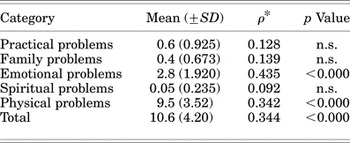
The DT score was positively correlated with total number of problems (ρ = 0.344, p < 0.000), as well as with the number of emotional (ρ = 0.435, p ≤ 0.000) and physical (ρ = 0.343, p ≤ 0.000) problems mentioned. The number of physical and emotional problems yielded a significantly strong correlation (ρ = 0.495, p ≤ 0.000).
Patients with a DT score ≥4 checked off significantly more of these problems (t test): “child care” (p = 0.018), “depression” (p = 0.028), “fears” (p = 0.001), “nervousness” (p = 0.001), “sadness” (p = 0.004), “worries” (p = 0.008), “loss of interests in usual activities” (p = 0.003), “breathing” (p = 0.019), “constipation” (p = 0.034), “fatigue” (p < 0.000), “pain” (p = 0.034), and “sleep” (p = 0.018).
Comparing participants cared for by professional health carers and those cared for by family members, the latter were statistically significantly more likely to report a higher number of problems (t test). This was also the case with regard to such emotional problems as “fears,” “nervousness,” “sadness,” “worries,” and “loss of interest in usual activities,” as well as with regard to such physical problems as “bathing/dressing,” “breathing,” “changes in urination,” “constipation,” “diarrhea,” “eating,” “fatigue,” “feeling swollen,” “getting around,” “indigestion,” “memory/concentration,” “mouth sores,” “nausea,” “nose dry or congested,” “pain,” “skin dry/itchy,” “sleep,” and “tingling in hands/feet” (χ2 test).
Men reported statistically more sexual problems than women (χ2 test). Patients with head and neck cancer reported more problems with eating and mouth sores (χ2 test). No differences were found with regard to the other sociodemographic and medical variables.
Evaluation
The comprehensibility of the DT/PL was rated on average at 1.8 (±0.964) (1 = “very understandable” and 5 = “not understandable at all”), and 49% of participants considered it to be “very understandable.” In general, completion of the DT/PL was perceived as “unremarkable” by 80% of participants, and 14% found it “relieving,” while for the remaining 6% it was emotionally distressing, because it prompted them to more clearly realize the seriousness of their situation.
DISCUSSION
High psychosocial distress in palliative care patients has been described in the literature (Neuwohner & Lindena, Reference Neuwohner and Lindena2011; Thekkumpurath et al., Reference Thekkumpurath, Venkateswaran and Kumar2008). Approximately 90% of all palliative patients who participated in our study showed clinically significant psychosocial distress as measured by the Distress Thermometer according to the cutoff criteria. This prevalence rate is higher than that described in previous studies. Thekkumpurath et al. (Reference Thekkumpurath, Venkateswaran and Kumar2009) reported that more than a third of palliative care patients experienced psychological distress. Weingaertner et al. (Reference Weingaertner, Scheve and Gerdes2014) used the DT (cutoff 4.5–4.6) for patients with advanced chronic obstructive pulmonary disease or lung cancer and presented a prevalence of 72–74% of patients with a significantly high level of distress. This result suggests the need for complex and intensive care for the psychosocial problems of palliative care patients being treated at home.
A correction of the cutoff in this setting may be pertinent. The ideal cutoff for the Distress Thermometer for palliative care patients is a matter of some controversy (Mitchell, Reference Mitchell2007). The NCCN has recommended that a cutoff score of 4 was too low for the palliative care field and instead suggested a cutoff of 5 or 6 (Ma et al., Reference Ma, Zhang and Zhong2014; Thekkumpurath et al., Reference Thekkumpurath, Venkateswaran and Kumar2009). The importance of validation of the DT for special populations has already been established, and an adjustment is required (Gunnarsdottir et al., Reference Gunnarsdottir, Thorvaldsdottir and Fridriksdottir2012).
Interestingly, no statistical associations between level of distress reported and sociodemographic or medical variables could be found. Previous studies have reported a positive association between high distress levels on the DT with female gender, younger age, and lower functional status (Jacobsen et al., Reference Jacobsen, Donovan and Trask2005; Waller et al., Reference Waller, Williams and Groff2011). In our setting, distress can be considered a general phenomenon of patients experiencing a palliative situation at home, suggesting that the palliative situation outweighs other possible sociodemographic factors (Gotze et al., Reference Gotze, Brahler and Gansera2014).
The number of problems mentioned correlated directly with level of distress, with an average of 11 ± 7 of the 25 listed problems per patient (see Table 5). Most of the reported problems fell within the physical and emotional categories. These results confirm previous studies in palliative care settings using different measurement methods (Neuwohner & Lindena, Reference Neuwohner and Lindena2011). “Fatigue” is already considered one of the most common and distressing symptoms mentioned by patients in palliative care (Bradley et al., Reference Bradley, Davis and Chow2005; Jansky et al., Reference Jansky, Lindena and Nauck2012; Teunissen et al., Reference Teunissen, Wesker and Kruitwagen2007). In the home environment, patients have to complete a greater number of everyday activities, which makes them realize even more how restricted they are. It is probably for this reason that activities like “getting around,” “eating,” and “bathing/dressing” become so relevant (Oechsle et al., Reference Oechsle, Wais and Vehling2014; Ruijs et al., Reference Ruijs, Kerkhof and van der Wal2013) when adaptation is not achieved. Experiencing such functional limitations as immobility, physical weakness, and helplessness while trying to provide personal care and getting dressed, even during the final weeks of life, has a great impact on patient well-being. It may generate an awareness of the progress of the disease through realization of decreased performance compared to former skills and independence. In addition, increasing difficulties in coping with everyday life leads to dependence on others and thus loss of autonomy. These points have been reported by patients in palliative situations to be very stressful (Ruijs et al., Reference Ruijs, Kerkhof and van der Wal2013). Providing assistance to palliative patients so that they can complete everyday tasks may be as important as medical and nursing care (Weingaertner et al., Reference Weingaertner, Scheve and Gerdes2014).
Correlations between DT score and number of problems according to categories

* ρ = Pearson's correlation coefficient.
Emotional problems cause severe burdens for palliative patients (Neuwohner & Lindena, Reference Neuwohner and Lindena2011; Oechsle et al., Reference Oechsle, Wais and Vehling2014; Ruijs et al., Reference Ruijs, Kerkhof and van der Wal2013). Psychologically related distress plays a larger role in community-dwelling palliative patients than in other areas/settings (Neuwohner & Lindena, Reference Neuwohner and Lindena2011). Therefore, the rate of depression (Austin et al., Reference Austin, Wiley and McEvoy2011) and anxiety (Jansky et al., Reference Jansky, Lindena and Nauck2012) are higher in patients cared for at home than in hospitalized palliative patients. It has also been observed that psychological stress in palliative patients remains undetected to a large extent and that there are fewer control mechanisms available than for physical symptoms (Kelly et al., Reference Kelly, McClement and Chochinov2006), especially in outpatient palliative care (Ventura et al., Reference Ventura, Burney and Brooker2014). Financial difficulties were not an issue, probably because nearly all German citizens have health insurance (VanHoose et al., Reference VanHoose, Black and Doty2015).
Analyzing single symptoms, patients cared for by relatives reported physical and emotional problems more often. This suggests the need for professional healthcare personnel to provide supportive care at home. Perhaps better education and training of relatives involved in care duties at home could reduce the level of distress in patients. It has been shown that relatively short psychoeducational interventions can enable family caregivers to feel more prepared and competent in the role of supporting a dying relative (Hudson et al., Reference Hudson, Trauer and Kelly2013).
Our study also described patients' ability to complete the Distress Thermometer on their own. It was observed that most inpatients (64%) who were transferred to home care services were not able to respond and use the instrument. This high percentage may be due to the fact that upon their first contact with home care services patients were at the end of their lives or already in poor somatic, cognitive, and psychological condition (Watanabe et al., Reference Watanabe, Nekolaichuk and Beaumont2011). Participants and excluded patients had similar sociodemographic and medical characteristics, which suggests the possibility of finding similar results in both groups (Weingaertner et al., Reference Weingaertner, Scheve and Gerdes2014). Only a few of the participants perceived completing the DT as relieving or distressing. They considered it understandable, which endorsed the results of other studies (Hughes et al., Reference Hughes, Sargeant and Hawkes2011). The suitability of self-assessment methods—even ultrashort ones—for palliative care patients is considered highly questionable. Nevertheless, our study highlights that those who are able to complete written instruments like the Distress Thermometer can benefit by expressing psychosocial needs and problems.
The effect of home-based palliative care on distress will be analyzed in a future research paper.
Measures Taken
Given the high prevalence of distress identified among these patients, the home care team took steps to address their emotional needs and suffering. However, as noted in the introduction, home care teams are not able to provide professional psychological care, and, unless there is a previous diagnosis, there is no professional help available unless paid for privately by the patient.
CONCLUSIONS
A significant proportion of seriously ill patients dwelling at home reported high levels of distress. Most of their problems were emotional and/or physical. This is particularly significant considering that even high-level distress often goes unnoticed by doctors and nursing staff (Sollner et al., Reference Sollner, DeVries and Steixner2001). The findings of our study highlight the importance of creating new concepts and structures in order to address the psychosocial needs of home-dwelling patients. The Distress Thermometer should be employed as an integral part of the procedures involved in a “global diagnostic evaluation” to detect patient distress.
ACKNOWLEDGEMENTS
The authors are very thankful to Petra Schaubeck, Bernd Wehbrink, Brigitte Brings, Karin Hack, Karin Schnurbusch, Karin Thielemann, Lothar Rißmayer, Marlies Frohn, and Ute Armbruster for their invaluable support; to Andrea Peterman-Mayer for her critical input; to Ann Foldenauer for her statistical support; and to Kerstin Paus for her review of the language in the manuscript.