

Introduction
In June 2013, the Fifth Edition of the Diagnostic and Statistical Manual of Mental Disorders (DSM-5), published by the American Psychiatric Association (APA), became available. Its development was a 14-year process, involving and coordinating the work of hundreds of people.Reference Falkai and Wittich 1 Not only were the leading experts engaged, but the development process was also open to the public. A simultaneous publication of the Eleventh Edition of the International Statistical Classification of Diseases and Related Health Problems (ICD-11), developed by the World Health Organization (WHO), was not possible given the laborious evaluation and review efforts of both organizations. The release of ICD-11 is expected in 2017.Reference First, Reed, Hyman and Saxena 2 Nevertheless, certain trends and details already have been published. We will outline and discuss the main changes regarding psychotic disorders in both manuals.
DSM-5
One of the main changes is related neither to form nor content, but to the development process itself. This undertaking started in 1999, and for 14 years, hundreds of experts worldwide cooperated to create the new manual. In 2008, after the pre-planning phase, the DSM-5 Tasks Force announced the members of the 13 Work Groups who started to revise the diagnostic criteria of the Diagnostic and Statistical Manual of Mental Disorders, Fourth Edition (DSM-IV). A special focus was put on recent data in the fields of human genetics and neuroimaging. In addition, the Work Groups were charged with implementing several innovations. All chapters had to be reorganized in order to credit individual developmental aspects of subjects and the phenomenological similarity of disorders, and also reflect the course of the disease across the lifespan. The multiaxial system of DSM-IV was given up, and dimensional aspects of diseases had to be specified instead. More consistent, more precise, and more understandable definitions of diagnostic criteria were the target. In addition, a more systematic and wider discussion of differential diagnostic criteria, as well as the deletion or addition of respectively obsolete or newly observed phenomena, were part of the goal. The drafts of the Work Groups were frequently made available for public annotation. Critique and amendments were integrated in the development of DSM-5, if they were considered relevant. Next to this, all diagnoses were marked with the best suitable ICD-10-CM code. This phase was followed by field trials from 2010 to 2012. Simultaneously the revision process was pushed forward, and the reviewers were asked to integrate the findings of the field trials. Finally, after the approval of the APA Board of Trustees, DSM-5 was released in May 2013 at the APA 2013 Annual Meeting in San Francisco.Reference Falkai and Wittich 1 , 3
DSM-5 innovations
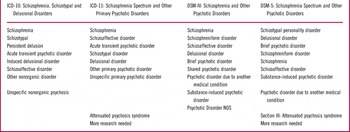
In the following section, we will illustrate the main changes of the chapter entitled “Schizophrenia Spectrum and Other Psychotic Disorders.” As DSM-IV was felt to be clinically useful with high reliability and fair validity, the changes in DSM-5 are modest with the aim of simplification and incorporation of the latest research.Reference Tandon, Gaebel and Barch 4 The new organization of the chapter follows the general DSM-5 concept to include developmental aspects of the respective disorders. Therefore, DSM-5 diagnostic chapters are arranged with respect to their appearance across the developmental course of life and the severity of the disease, earliest onset first.Reference Falkai and Wittich 1 Diagnoses will be briefly reviewed here as they appear in the manual (see Table 1).
Organization of the chapters regarding psychotic disorders in ICD-10/11 and DSM-IV/5

Schizotypal personality disorder
Schizotypal personality is classified in the chapter “Personality Disorders” and is only mentioned here due to its relationship to the ICD-10 diagnosis schizotypal disorder, which is described in the “Schizophrenia and Other Psychotic Disorders” chapter in ICD-10.
Delusional disorder
The requirement for non-bizarre delusion for this diagnosis was eliminated. A clearer discrimination of delusional disorders and psychotic variants of obsessive compulsive disorders or body dysmorphic disorders was introduced by the following exclusion criterion: Symptoms must not be better explained by conditions like obsessive-compulsive disorders or body dysmorphic disorders. Shared delusional disorders were subsumed in this chapter. 3
Brief psychotic disorder
No major changes were implemented.
Schizophreniform disorder
As long as the criteria changes for schizophrenia are considered, no major changes were made for this diagnosis.
Schizophrenia
To diagnose schizophrenia in DSM-5, at least 2 of 5 characteristic symptoms are mandatory (delusions, hallucinations, disorganized speech, grossly disorganized/catatonic behavior, or negative symptoms), and these must have persisted for a minimum of 1 month. One of them must be delusions, hallucinations, or disorganized speech. Continuous signs of the disturbance have to be present for 6 months.Reference Falkai and Wittich 1
DSM-5 has eliminated the diagnostic relevance of bizarre delusions for schizophrenia due to the difficult differentiation between bizarre and not bizarre.Reference Cermolacce, Sass and Parnas 5 Because of their unspecificity and questionable value for the diagnostic process, Schneiderian first rank symptoms, especially auditory hallucinations, lost their importance.Reference Shinn, Heckers and Öngür 6 , Reference Heckers, Barch and Bustillo 7
The heterogeneity and variety of schizophrenia, as well as the low lifetime stability of the symptoms, were given tribute by eliminating the subtypes described in DSM-IV. Subtypes were found to be of little to no clinical and scientific utility and did not show differences regarding sociodemographic parameters or cognitive outcome.Reference Carpenter and Tandon 8 They were of no prognostic use, and in several cluster analyses a classification on the basis of symptoms was not possible.Reference Keller, Fischer and Carpenter 9 – Reference Lykouras, Oulis, Daskalopoulou, Psarros and Christodoulou 11
Two negative symptoms have demonstrated increasing evidence as typical for schizophrenia and are therefore highlighted in DSM-5: avolition and diminished emotional expression.Reference Kring and Barch 12 , Reference Messinger, Trémeau and Antonius 13
In addition to the well-established symptoms of schizophrenia, cognitive impairment is newly implemented as a dimension. To describe the different phenotypes and the symptom switches over the course of schizophrenia, DSM-5 introduces a Scale to Assess the Severity of Symptom Dimensions (C-RDPSS) in Section 3. Clinicians can now rate 8 dimensions of schizophrenia (hallucinations, delusions, disorganized speech, abnormal psychomotor behavior, negative symptoms, impaired cognition, depression, mania) on a 5-level rating scale from 0 (not present) to 4 (severe). This individual assessment adds information that is relevant for clinical evaluation, prognostic considerations, treatment planning, and functional outcome.Reference Mattila, Koeter and Wohlfarth 14 Additionally, treatment response can be described more precisely.
Schizoaffective disorder
Due to the low reliability and validity of DSM-IV schizoaffective disorder, DSM-5 criteria were modified.Reference Malaspina, Owen and Heckers 15 DSM-5 requires that a major mood episode has to be present for a majority of the disorder’s total duration when criterion A (psychotic symptoms) of schizophrenia has been met. This should allow for a better differentiation between schizophrenia with mood symptoms and schizoaffective disorder.Reference Tandon 16 Schizoaffective disorders are seen as a longitudinal diagnosis, such as schizophrenia or bipolar disorders, and not as a cross-sectional phenomenon. With these changes, the Psychosis Work Group expects a higher diagnostic stability of this disorder.Reference Tandon 16
Substance-induced psychotic disorder
An additional criterion was introduced. Symptoms must induce clinically relevant suffering or influence functional outcome negatively. Apart from this, no changes were implemented.
Psychotic disorder due to another medical condition
The same change was established as for substance-induced psychotic disorders.
Catatonia
In DSM-5, catatonia becomes an additional code, which can now be described independently of underlying disorders such as schizophrenia, mood disorders, or general medical conditions. If 3 or more of the 12 symptom clusters (DSM-5), instead of 2 out of 5 (DSM-IV), are present, catatonia can be coded. Unspecific catatonia is used in the case of uncertainty regarding the underlying disorder or as a transient diagnosis if more information about the pathogenesis is needed.
Attenuated psychosis syndrome (APS)
APS is characterized by a clinical and functional relevant but alleviated experience of delusion, hallucination, or disorganized speech. Time criteria and symptom severity do not reach the intensity of another psychotic disorder. Due to its importance for the development of preventive strategies and early treatment, this entity was included into Section 3 and is regarded as an issue required for further study.
ICD-11
The planning process for the development of ICD-11 started in 2003. A series of 13 international conferences were held to obtain information and data, which were critically reviewed with respect to potential global utility.Reference Gaebel, Zielasek and Cleveland 17 Of special interest were biological markers and functional impairments.Reference First, Reed, Hyman and Saxena 2 ICD is a classification system developed for worldwide clinical use and public health questions, such as statistics and health policy, but also for research. Therefore it is required to be easy and practical, needs clear language, and must be useful for clinical decision making. So the aim of a new version is to incorporate diagnostic implications of the most recent research and to improve clinical utility without sacrificing validity and availability.Reference First, Reed, Hyman and Saxena 2 As stated in our introduction, ICD-11 is still in the development stage, therefore all proposed changes, which have so far been published or presented at meetings, have to be seen as a work in progress.
ICD-11 innovations
The chapter name will be changed from “Schizophrenia, Schizotypal and Delusional Disorders” to “Schizophrenia Spectrum and Other Primary Psychotic Disorders.” Non-primary psychotic disorders are coded in the context of other mental diseases, such as mood or personality disorders; secondary psychotic disorders due to substance abuse or somatic illness will be described in the respective chapters.Reference Gaebel, Zielasek and Falkai 18 All diagnoses will be specified by category name, relationship to ICD-10, definition, diagnostic guidelines, functional properties, code qualifiers (specifiers), and assessment issues.Reference Gaebel, Zielasek and Cleveland 19 The following paragraphs will outline the major changes regarding the diagnoses in this chapter.Reference Gaebel, Zielasek and Falkai 18
Schizophrenia
Symptoms and criteria will be revised in the following way: At least 2 symptoms have been present for 1 month, and 1 of them must be a core symptom. Core symptoms will be persistent delusions of any kind, persistent hallucinations of any kind, thought disorders, and distortion of self-experience. Negative symptoms, disorganized behavior, and psychomotor disorders are defined as additional symptoms. As discussed in the section “Changes in DSM-5,” subtypes will be taken out of ICD-11 as well. Instead, schizophrenia should be specified by 6 symptoms: positive, negative, depressive, manic, psychomotor, and cognitive deficits. The latter was introduced because of its importance in terms of clinical and functional outcome.Reference Green, Kern and Heaton 20 , Reference McGurk, Mueser, DeRosa and Wolfe 21 A course specifier, similar to DSM-5, will also be implemented. Following WHO practice, the Work Group for Psychotic Disorders does not recommend incorporating functional outcome as a diagnostic criterion for schizophrenia or any other mental disease.Reference Gaebel, Zielasek and Falkai 18
Schizoaffective disorder
As long the diagnostic criteria changes in the schizophrenia and mood disorder chapters are respected, the diagnostic parameters for schizoaffective disorder only change minimally. Noteworthy is a new time criterion that requires 4 weeks of simultaneous diagnoses of both schizophrenia and at least 1 moderate mood disorder. As lifetime symptoms can hardly be assessed reliably in schizoaffective patients, ICD-11 will conflict with DSM-5 and give up the longitudinal aspects of this disorder, in order to make the diagnostic process easier and to underline the cross-sectional approach.Reference Gaebel, Zielasek and Cleveland 17
Acute and transient psychotic and delusional disorders (ATPD)
Based on the ICD-10/F23 diagnosis “Acute Polymorphic Psychotic Disorder,” the ATPD chapter in ICD-11 will be completely reorganized. Diagnostic criteria, such as acute onset, brief duration, and clinical appearance, will stay the same, whereas the differentiation between schizophrenic and delusional aspects will be eliminated and the delusional subtype (ICD-10/F23.3) will be incorporated into the chapter “Delusional Disorders.” “Acute Psychotic Polymorphic Disorder” (APPD), without symptoms of schizophrenia, seems to have better outcome and to convert into a mood disorder more often.Reference Castagnini and Foldager 22 Therefore, the distinction between with and without symptoms of schizophrenia could be of prognostic value and will be kept in ICD-11. “ATPD with Symptoms of Schizophrenia and Acute Schizophrenia-Like Psychotic Disorder,” lasting less than 4 weeks, will be summarized as “Unspecific Primary Psychotic Disorders.” Schizophreniform disorder should no longer be diagnosed.
Schizotypal disorder
No changes are expected in this chapter
Delusional disorder
For simplification, 3 diagnoses with delusional aspects will be merged in this chapter: ICD-10/ F22 “Delusional Disorder,” F32.3 “Other Predominantly Delusional Disorder,” and F24 “Induced Delusional Disorder.”
Other primary and unspecific primary psychotic disorders
There will be no changes in these chapters. Unspecific psychotic disorders will be coded if there is not enough information or as an interim diagnosis until the diagnostic process is completed.
Catatonia
As subtypes of schizophrenia will be eliminated, catatonia is currently suggested to be described among the clinical psychomotor specifiers.
Attenuated psychosis syndrome (APS)
There will be no such chapter in ICD-11, but research in this field is important and required. Therefore APS, similar to DSM-5, will be placed in the category Mental Health States Requiring Further Study.Reference Gaebel, Zielasek and Falkai 18
Code qualifiers
Code qualifiers will be mainly used for schizophrenia and schizoaffective disorder but can also be used in other psychotic disorders and may be appropriate for other illnesses of the Mental and Behavioural Disorder chapter. They include qualifiers for symptoms, course of illness, and cognitive and functional outcome.Reference Gaebel, Zielasek and Falkai 18
Differences and Similarities Between DSM-5 and ICD-11
DSM and ICD are different in terms of intention, function, and purpose. ICD is a nomenclature that is used internationally, not only by specialists but also by other health workers and organizations. Therefore, it is more compact and easy to use, and characterizes disorders in a less detailed manner. DSM on the other hand focuses on scientific and teaching challenges, mainly targeting mental health professionals. Descriptions, etiological information, and comments, as well as diagnostic assessments and recommendations, are therefore more comprehensive.
As both work groups tried to harmonize the 2 systems as much as possible, the differences are fairly small in the respective psychotic disorder chapters. The new metastructure of the chapters in DSM-5 catches the eye first. The background of this new order is the idea to give credit to developmental aspects of the disorders. Diagnoses with early onsets are dealt with first. Additional information about development, course, and symptomatic lifetime changes of the disorder are given in the text.
Specific differences most commonly deal with time and duration criteria. This can for instance be seen in the cases of the DSM-5 diagnosis Brief Psychotic Disorder and the ICD-11 counterpart Acute and Transient Psychotic and Delusional Disorder. ICD-11 has a time criterion for schizophrenia of 1 month, whereas DSM-5 requires 6 months. So ICD-11 ATPD with symptoms of schizophrenia has to stay within this 1-month period, while DSM-5 splits this syndrome into 1 month of brief Psychotic Disorder and up to 6 months of Schizophreniform Disorder.
Regarding schizoaffective disorder, the longitudinal aspect will be taken out of ICD-11 in order to simplify the diagnostic process and to underline the transsectional approach. DSM-5 holds on to a more longitudinal approach, which makes necessary time-consuming history-taking with questionable value of information. The characterization of patients with both mood and psychotic disorders remains a clinical challenge.
The role of functional outcome remains a hotly debated issue. On the one hand, deficits are found consistently in schizophrenia. On the other hand, some patients with a considerable degree of typical symptoms may show a high level of functioning and would therefore not be eligible for healthcare benefits if they do not meet diagnostic criteria for a disorder. WHO has a separate classification system for functional impairment and disability. 23
In spite of these discrepancies, it is important not to lose sight of similarities between the 2 systems. Both eliminate the subcategories of schizophrenia, both underscore the relevance of dimensional aspects with symptom specifier/assessment, and both diminish the role of first rank symptoms and include cognitive impairments. Attenuated psychosis syndrome is considered highly important for further scientific investigation, even though it is not yet included as a diagnostic entity.
Conclusion
The changes in DSM-5 and ICD-11 represent no paradigmatic shift. Many specialists would have wished that the diagnostic process could be based more on a neurobiological fundamental. Although huge efforts are made in this direction, the exact neurophysiological underpinnings of schizophrenia remain elusive.Reference Heckers, Barch and Bustillo 7 For the time being, the available evidence does not allow for the introduction of biological markers to aid the individual diagnostic process.Reference Kupfer and Regier 24 To outperform well-introduced and validated diagnostic manuals in terms of higher reliability and validity is an ambitious challenge and not easy to reach. As the review process and the field trials for ICD-11 are not yet completed predictions regarding clinical utility, reliability, and validity seem premature. We do not expect major surprises regarding these parameters due to the modest changes so far discussed for ICD-11. The fact that 99.5% of DSM-IV schizophrenia patients meet DSM-5 criteria supports this conjecture.Reference Mattila, Koeter and Wohlfarth 14 One of the goals for DSM-5 and ICD-11 was to create more practical manuals. In this respect, the clinical utility of ICD-11 in terms of psychotic disorders may be improved because of the reduced count of diagnoses and the consolidation of disorders with delusional aspects. On the other hand, the dimensional approach implemented in both systems calls for time-consuming assessments and may therefore impede the clinical usability.Reference Gaebel, Zielasek and Falkai 18 Having said this, we strongly feel that the dimensional approach is justified by the considerable heterogeneity of symptoms and the course of illness of schizophrenia and other psychotic disorders.
Both systems so far ignore pre-psychotic prodromal syndromes. As a lot of research is done in this important field, so it would appear desirable to include these into the chapter for syndromes requiring further study.
Another issue of ongoing discussion is the role of functional outcome. In DSM-5, an impaired functional outcome is a mandatory criterion for schizophrenia, while the WHO argues against this.Reference Reed, Mendonça Correia and Esparza 25 Functional deficits do not occur in all schizophrenia patients and are far from specific for this diagnosis.Reference Nuevo, Chatterji and Verdes 26 This problem remains an unsolved issue, and further studies will hopefully shed more light on it.Reference Gaebel, Zielasek and Cleveland 17
On a related note, the role of cognitive impairment was carefully considered by both working groups. Due to the lack of specificity for schizophrenia, the role of cognitive impairment is not part of the core diagnostic criteria, but is given attention as a symptom specifier/assessment.Reference Tandon, Gaebel and Barch 4 , Reference Reichenberg, Harvey and Bowie 27
Some have questioned whether the modest innovations of the new diagnostic manuals justify the enormous consumption of financial and human resources. The diagnostic process remains an everyday challenge and depends greatly on the one who performs it. As we tend to find what we are looking for, it is important to critically reconsider familiar diagnostic practice from time to time and to systematically put it into context with the latest research. This assures the enhancement of diagnostic accuracy and the development of new research fields, in the interest of training clinicians better in the best interest of the patients for whom we care.
Disclosures
Falko Biedermann does not have anything to disclose. W. Wolfgang Fleischhacker has the following disclosures: Otsuka, consultant, principal investigator, research grant; Lundbeck, consultant, principal investigator, research grant; Janssen, consultant, research grant; Boehringer Ingelheim, consultant, research grant; Dainippon Sumitomo, consultant, honoraria; Teva, consultant, honoraria.