During early lactation in dairy cattle, the energy required for maintenance and milk energy output exceeds dietary energy intake (Bell, Reference Bell1995; Grummer, Reference Grummer1995) resulting in negative energy balance (NEB) and consequent body reserve mobilization. Numerous reports have indicated that the duration and extent of NEB delay the onset of cyclicity and reduce the likelihood of conception (Beam & Butler, Reference Beam and Butler1999; Diskin et al. Reference Diskin, Mackey, Roche and Sreenan2003) and also predispose the cow to health problems such as fatty liver and ketosis (Drackley, Reference Drackley1999). Efforts to overcome early post-partum NEB via dietary means have logically attempted to increase the energy density of the diet being fed. However, this approach has been largely unsuccessful. For instance, addition of fat to the diet increases the energy density of the diet, but is often associated with a modest reduction in dry matter intake (DMI) such that total energy intake remains unaffected (Staples et al. Reference Staples, Burke and Thatcher1998). Alternatively, where additional energy is ingested, this may be partitioned to increased milk production such that net energy balance is not improved (Santos et al. Reference Santos, Bilby, Thatcher, Staples and Silvestre2008).
Conjugated linoleic acids (CLA) are geometric and positional isomers of linoleic acid, and are normally produced in the rumen as intermediates in the biohydrogenation of linoleic acid to stearic acid (Bauman & Griinari, Reference Bauman and Griinari2000). Trans-10,cis-12 CLA is an isomer of CLA that inhibits milk fat synthesis (Baumgard et al. Reference Baumgard, Corl, Dwyer, Saebo and Bauman2000) and has been shown to reduce mammary milk fat synthesis in a dose-dependent manner (de Veth et al. Reference de Veth, Griinari, Pfeiffer and Bauman2004). This phenomenon has been observed in cows consuming both pasture (Mackle et al. Reference Mackle, Kay, Auldist, McGibbon, Philpott, Baumgard and Bauman2003; Kay et al. Reference Kay, Roche, Moore and Baumgard2006) and TMR diets (Bernal-Santos et al. Reference Bernal-Santos, Perfield, Barbano, Bauman and Overton2003; Odens et al. Reference Odens, Burgos, Innocenti, VanBaale and Baumgard2007) and at various stages of lactation. However, the dose of trans-10,cis-12 CLA necessary to evoke milk fat depression (MFD) immediately post partum (36·9 g/d; Moore et al. Reference Moore, Hafliger, Mendivil, Sanders, Bauman and Baumgard2004) was found to be greater than the dose necessary in established lactation (8·8 g/d; Perfield et al. Reference Perfield, Bernal-Santos, Overton and Bauman2002).
Fat is energetically the most expensive component of milk; daily milk fat secretion in early lactation cows represents up to 35% of net energy intake (Bauman & Currie, Reference Bauman and Currie1980). The milk fat depressing effects of trans-10,cis-12 CLA could therefore be used as a management tool to temporarily reduce milk energy output. Importantly, milk volume and milk protein concentration are not decreased by CLA supplementation, and MFD caused by trans-10,cis-12 CLA is reversible, with milk fat content returning to similar levels as control groups at the termination of supplementation (Castaneda-Gutierrez et al. Reference Castaneda-Gutierrez, Overton, Butler and Bauman2005).
Beneficial effects of CLA supplementation on fertility indices have been reported, including trends towards decreased interval to first ovulation, elevated plasma progesterone during the early luteal phase, increased plasma IGF-I and increased pregnancy rate (Bernal-Santos et al. Reference Bernal-Santos, Perfield, Barbano, Bauman and Overton2003; Castaneda-Gutierrez et al. Reference Castaneda-Gutierrez, Overton, Butler and Bauman2005; Castaneda-Gutierrez et al. Reference Castaneda-Gutierrez, Benefield, de Veth, Santos, Gilbert, Butler and Bauman2007); this was recently confirmed in a meta-analysis of five published studies (de Veth et al. Reference de Veth, Bauman, Koch, Mann, Pfeiffer and Butler2009). The objective of the present study was to determine the effects of feeding a concentrate pellet supplement containing lipid-encapsulated CLA (LE-CLA) on early lactation milk production, bioenergetic and metabolic status, and reproductive indices in dairy cows consuming a diet based on grass silage.
Materials and Methods
Animals and treatments
All experimental procedures involving animals were licensed by the Department of Health and Children, Ireland, in accordance with the Cruelty to Animals Act (Ireland 1897) and the European Community Directive 86/609/EC. Forty multiparous Holstein-Friesian cows were blocked on the basis of expected calving date, previous lactation milk yield and body condition score (BCS), and 32 primiparous Holstein-Friesian cows were blocked on the basis of expected calving date, BCS and body weight. Treatments were initiated during a 4-month period. Cows were then randomly assigned to receive 60 g of LE-CLA daily (Lutrell Pure; BASF SE, Ludwigshafen, Germany) or 60 g calcium salts of palm fatty acids (CSFA; Megalac; Volac Ltd., Hertfordshire, UK) daily (CTL) from parturition until 60 days in milk. To facilitate administration of the treatments, the fatty acid supplements were incorporated into concentrate pellets such that 2 kg of concentrate contained 60 g of LE-CLA or CSFA supplements, and concentrate pellets were fed using automatic feeders. A preliminary investigation indicated that the pelleting process resulted in a 13·4% loss of the trans-10,cis-12 CLA isomer recovered in the concentrate. To maintain the minimum targeted daily dose of 6 g of trans-10,cis-12 CLA, the incorporation of LE-CLA was increased to 80 g/d. LE-CLA contained a 50:50 mix of cis-9,trans-11 CLA and trans-10,cis-12 CLA, resulting in a daily intake of 6·9 g of each isomer after adjusting for losses incurred during pelleting. The protection technology for LE-CLA has been previously described (Perfield et al. Reference Perfield, Lock, Pfeiffer and Bauman2004). The cows were housed in a free stall cubicle shed and managed as a single group of animals throughout the study period. Three cows were removed from the study owing to illnesses unrelated to the experimental treatments.
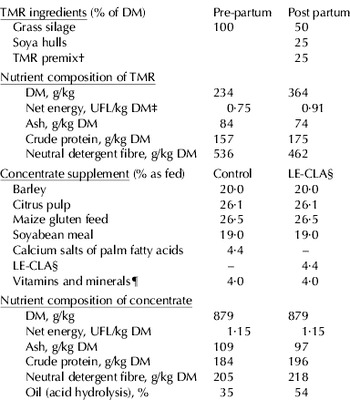
Individual dry matter itake (DMI) was measured daily from 3 weeks prior to parturition to 13 weeks post partum using the Griffith-Elder Mealmaster feeding system (Griffith Elder & Co Ltd, Suffolk, UK). Cows were housed on a straw bed for a variable period of 1–4 d around the time of parturition. Weekly samples of the feeds offered were dried and ground, and composited on a monthly basis for nutrient analysis. The DM, crude protein, neutral detergent fibre, ash and oil content of the feed samples were analysed as described by McNamara et al. (Reference McNamara, Butler, Ryan, Mee, Dillon, O'Mara, Butler, Anglesey, Rath and Murphy2003). The ingredient composition of the pre-partum and post-partum basal diets and the concentrate supplements are outlined in Table 1.
Ingredient and nutrient composition of the feeds offered

† Ingredient composition: 60% rolled barley, 36% soyabean meal, 4% vitamins and minerals
‡ UFL=unité fourragère lait; unit of net energy, equivalent to 1 kg of standard air-dried barley
§ Lipid-encapsulated conjugated linoleic acid
¶ Vitamin and mineral mix: 15 g/kg dicalcium phosphate, 8 g/kg limestone flour, 5 g/kg salt, 2·5 g/kg calcined magnesite, 80 mg manganous oxide, 200 mg copper sulphate, 125 mg zinc oxide, 18 mg potassium iodate, 20 mg sodium selenite (4·6%), 10 mg cobalt sulphate, 8 MIU/t vitamin A, 2 MIU/t vitamin D3, 15,000 IU/t vitamin E
Cows were fed daily at 9.00, and were allowed access to their fat supplements from 9.00 to 17.00. Cows consumed their allocated fat supplements in a single meal, and the allotted time allowed ample access time for all cows. Following parturition, cows were milked twice daily at 7.00 and 16.00. Milk yield was recorded daily at morning and evening milkings using electronic milk meters (Dairymaster, Causeway, Co. Kerry, Ireland). Milk composition (fat, protein and lactose) was determined on a weekly basis from successive morning and evening milk samples by automated infra-red absorption analysis using a Milkoscan 605 (Foss Electric, Hillerød, Denmark). Cow body weight (kg) and BCS (Lowman et al. Reference Lowman, Scott and Somerville1976) were recorded once a week from parturition until week 13 of lactation.
Energy balance was estimated as the difference between energy intake and the sum of energy requirements for maintenance and milk production, using the French net energy system (Jarrige, Reference Jarrige, Agabriel, Champciaux and Espinasse1989). This system uses unité fourragère lait (UFL) as the unit of net energy, which is equivalent to 1 kg of standard air-dried barley. The following equations were used to determine the energy required for maintenance and output in milk (O’ Mara, Reference O'Mara1997): energy required for maintenance (UFL/d)=1·4+0·6×BW/100; energy requirement for milk (UFL/kg of milk)=0·054×FC+0·031× PC + 0·028×LC−0·015; where FC=fat concentration (%), PC=protein concentration (%), and LC=lactose concentration (%).
During the period from day 21 before calving to day 28 post partum, blood samples were collected on three days per week (Monday, Wednesday and Friday). Thereafter, blood samples were collected every 2 weeks until 10 weeks post partum. In addition, blood samples were collected from each cow 3 times a week for 21 d after the first post-partum insemination for progesterone analysis. All blood samples were collected from the coccygeal vessels into vacutainers containing lithium heparin (Becton Dickinson, Plymouth, UK) between 7·00 and 8·00 after the morning milking but before feeding. The samples were immediately centrifuged at 2000 g for 15 min. Plasma was decanted into 1·5-ml tubes, sealed with an airtight cap, and stored at −20°C until analysis.
Hormone and metabolite analysis
Blood samples collected that were closest in proximity to days −14, −7, 0, 7, 14, 21, 28, 42, 56 and 70 relative to parturition were analysed for circulating concentrations of glucose, non-esterified fatty acids (NEFA), β-hydroxybutyrate (BHBA), insulin, and insulin-like growth factor-I (IGF-I). For example, mean actual sampling day for ‘day 7’ samples was day 7, with a range from day 5 to day 9. For ‘day 14’ samples, mean actual sampling day was day 14, with a range from day 12 to day 16. All other sample days followed a similar pattern. Plasma glucose, NEFA and BHBA concentrations were determined by enzymic colorimetry using an ABX Pentra autoanalyzer (ABX Mira, Montpellier, France) and the appropriate enzymic kits (glucose kits supplied by ABX Mira, Montpellier, France; NEFA kits supplied by Wako Chemicals GmbH, Neuss, Germany; BHBA kits supplied by Randox Laboratories Ltd., Crumlin, Co. Antrim, Northern Ireland). Plasma progesterone and insulin concentrations were measured using time-resolved fluoroimmunoassays (AutoDELFIA, PerkinElmer Life and Analytical Science, Turku, Finland) with the appropriate kits (Unitech BD Ltd., Dublin, Ireland). Circulating concentrations of IGF-I were determined by radioimmunoassay following ethanol:acetone:acetic acid extraction as previously described (Butler et al. Reference Butler, Pelton and Butler2004). The inter- and intra-assay coefficients of variation for progesterone, insulin and IGF-I were 5·0% and 4·6%, 4·4% and 5·0%, and 10·9% and 10·9%, respectively. The Revised Quantitative Insulin Sensitivity Check Index (RQUICKI) was used to assess insulin sensitivity in lactating dairy cows. The index values were calculated using the formula RQUICKI=1/[log(glucose) + log(insulin) + log(NEFA)] as described by Holtenius & Holtenius (Reference Holtenius and Holtenius2007).
Reproductive measurements and breeding management
Ovarian structures were examined by linear array ultrasonography using a 7·5-MHz transrectal transducer (Aloka SSD-900; Aloka Ltd., Tokyo, Japan). Ultrasound examinations commenced on days 8–10 post partum, and were carried out on 3 days a week (Monday, Wednesday and Friday) until first ovulation. Follicles were considered to be dominant when a diameter of >10 mm was reached in the absence of other large, growing follicles (Savio et al. Reference Savio, Boland, Hynes and Roche1990). Cysts were defined as anovulatory follicles >25 mm in diameter that persisted for at least 10 d in the absence of a corpus luteum (Garverick, Reference Garverick1997). Initiation of breeding commenced on a calendar mating start date, and continued for 15 weeks. Tail paint was used as a heat detection aid, and all cows were inseminated using AI following observation of standing oestrus, or removal of tail paint, or both. Pregnancy diagnoses were carried out at 30–36 and 60–66 d post-insemination. Visualization of a fluid-filled horn and a viable embryo were used for positive identification of pregnancy.
Milk fatty acid analysis
Milk samples were collected at 28 days in milk (DIM) (sd±2·2 d) and analysed for fatty acid composition using GLC, as described by Mohammed et al. (Reference Mohammed, Stanton, Kennelly, Kramer, Mee, Glimm, O'Donovan and Murphy2009). Briefly, milk lipids were extracted using a chloroform/methanol/water mixture and methylated using NaOCH3/methanol. Fatty acid methyl esters (FAME) were analysed using a Hewlett Packard Model 5890 Series II GLC, and identified by comparison with a GLC reference standard (#463) spiked with a mixture of 4 positional conjugated linoleic acid (CLA) isomers (#UC-59M), 21:0, 23:0, and 26:0 obtained from Nu-Chek Prep Inc, Elysian MN, USA. Identification of 16:1, 18:1, and 20:1 isomers was based on available isomers in the GLC reference standard (#463), comparison with published reports, and based on principles of silver-ion separation. Individual FAME were reported as a percentage of total FAME.
Statistical analysis
All statistical analyses were carried out using SAS (SAS System Inc., Cary NC, USA). Daily measurements of milk yield, DMI and energy balance were collapsed into weekly means. A test for normality was performed on all the blood analyte data and R-QUICKI values. Each of the variables had a non-normal distribution and was log-transformed prior to analysis to generate a normal distribution. Milk production, milk composition, DMI, cow body weight, body condition score, energy balance and blood analyte data were analysed using mixed models with repeated measures, using the satterthwaite adjustment to calculate denominator degrees of freedom. The appropriate covariance structure for each repeated measures analysis was identified based on Akaike's Information Criterion (AIC) model fit statistic. Measurements made during the final 3 weeks pre-partum were included as covariates in the models for glucose, NEFA, BHBA, IGF-I, insulin, DMI, cow body weight, body condition score (BCS) and calculated energy balance. Parity and calving day of year were included as adjustment variables in all repeated measures models; if non-significant, these variables were removed and the models were re-run. Peak NEFA concentration and energy balance nadir after day 1 of lactation were identified for all cows. Milk fatty acid composition, energy balance nadir, timing of energy balance nadir and peak NEFA concentrations were analysed using mixed models procedures with treatment as a fixed effect, block as a random effect, and calving day of year included as an adjustment variable. All values reported are least squares means and sem. Conception rate data were analysed using the Chi-square test, and values reported are treatment means. All other reproductive performance data were analysed using mixed models procedures. Data were considered significant when P<0·05, and a trend declared when P<0·1.
Results
Milk production, energy balance and body condition score
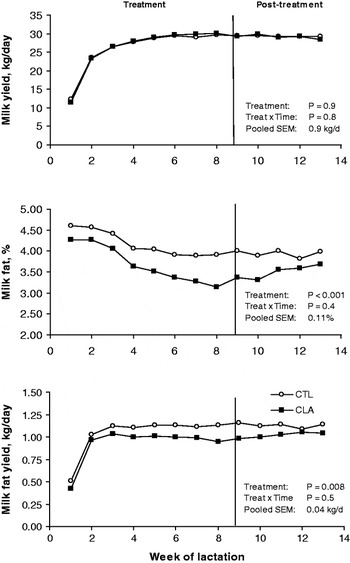
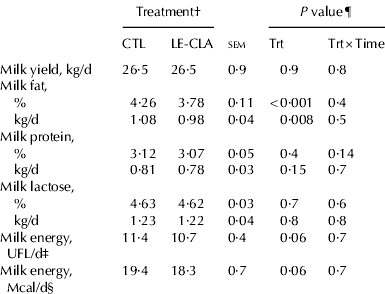
Milk production results are summarized in Table 2 and Fig. 1. Milk fat concentration was reduced by LE-CLA (treatment effect: P<0·001) but there was no treatment by time interaction. The greatest reduction in milk fat concentration occurred at week 8 post partum (15·7%) at the end of the supplementation period. Milk fat yield was also reduced by up to 15·2% during this period (P=0·008). Supplementation with LE-CLA ceased at 60 DIM, and thereafter milk fat concentration in LE-CLA cows began to return towards concentrations similar to the control group after week 10 post partum. Supplementation with LE-CLA had no effect on milk yield, the concentration or yield of milk protein, or the concentration or yield of milk lactose. Mean daily milk energy output tended (P=0·06) to be lower for cows on the LE-CLA treatment.
Temporal changes in milk yield, milk fat concentration and milk fat yield during the treatment and post-treatment periods. The treatment period lasted from parturition to 60 DIM, and cows were fed either 60 g/d of calcium salts of fatty acids (CTL) or 80 g/d of lipid-encapsulated conjugated linoleic acid (LE-CLA). All values are LSM.

Least squares means for milk yield and milk composition during the treatment periods
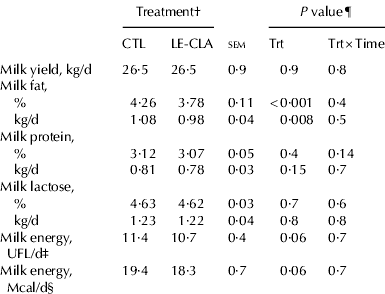
† CTL=Control; LE-CLA=Lipid-encapsulated conjugated linoleic acid
‡ UFL=unité fourragère lait; unit of net energy, equivalent to 1 kg of standard air-dried barley
§ Milk energy (Mcal/d)=((0·0929*Fat%)+(0·0563*Protein%)+(0·0395*Lactose%))*Milk yield
¶ Effect of time was significant (P<0·05) for all variables
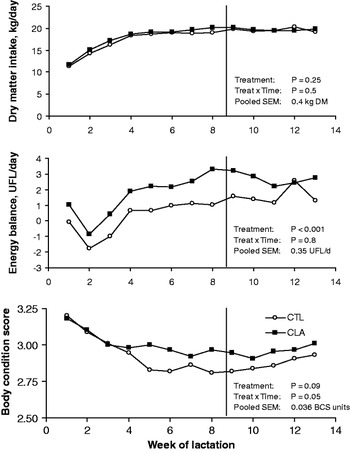
DMI was not affected by LE-CLA supplementation (17·2 kg/d v. 17·3 kg/d for CTL and LE-CLA respectively; Fig. 2). Mean energy balance was greater for the cows on the LE-CLA treatment (P<0·001; Fig. 2). Energy balance nadir tended to be less severe in LE-CLA cows (−4·29 UFL/d v. −3·18 UFL/d for CTL and LE-CLA respectively, P=0·09) but the timing of the NEB nadir did not differ (2·2 weeks after parturition v. 1·9 weeks after parturition for CTL and LE-CLA, respectively). Consequently mean post-partum BCS also tended to be greater for LE-CLA cows (P=0·09; Fig. 2). BCS declined in both treatments for the first 3 weeks of lactation (BCS change week 1 to week 3 CTL: 3·20 to 3·01, P=0·01; LE-CLA: 3·18 to 3·00, P=0·03). Thereafter LE-CLA cows did not lose any further BCS whereas control cows continued to mobilize body reserves until week 5 (BCS change week 3 to week 5 CTL: 3·01 to 2·83, P=0·02; LE-CLA: 3·00 to 3·00, P=0·99). This resulted in a lower mean nadir BCS in CTL cows during weeks 5 to 8 (week 5 to 8 BCS: 2·96 v. 2·83; treatment by time, P <0·05). Cow body weight (BW) was not affected by treatment, and there was no treatment by time interaction. Mean BW during the treatment period was 555·8 kg and 551·51 kg (CTL and LE-CLA, respectively).
Effect of treatment on dry matter intake, energy balance and body condition loss. The treatment period lasted from parturition to 60 DIM, and cows were fed either 60 g/d of calcium salts of fatty acids (CTL) or 80 g/day of lipid-encapsulated conjugated linoleic acid (LE-CLA). All values are LSM.

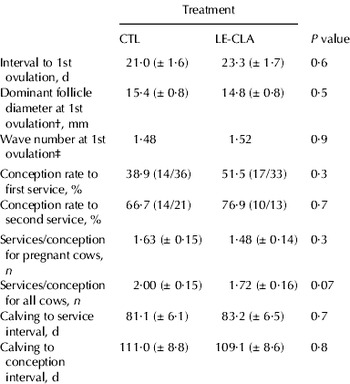
Reproductive performance of cows on the control (CTL) and lipid-encapsulated conjugated acid (LE-CLA) treatments

† The maximum diameter of the first post-partum ovulatory dominant follicle
‡ The follicle wave when the first post-partum ovulation occurred
Milk fatty acid analysis
LE-CLA supplementation reduced the proportion of most short- and medium-chain fatty acids in milk fat compared with CTL animals (Table 4). The proportion of 16:0 in milk fat was also decreased by LE-CLA supplementation (P=0·01). The proportion of trans-10,cis-12 CLA in milk fat was increased by LE-CLA supplementation (P=0·01), as were the proportions of other long chain fatty acids including 18:0, cis-9 18:1, 18:3 n-3 and 20:0 (all P <0·03). The proportion of cis-9,trans-11 CLA tended to be increased (P=0·06) by LE-CLA supplementation.
Milk fatty acid composition (g/100 g total fatty acids) of cows on the control (CTL) and lipid-encapsulated conjugated linoleic acid (LE-CLA) treatments at week 4 of lactation

Metabolites and metabolic hormones
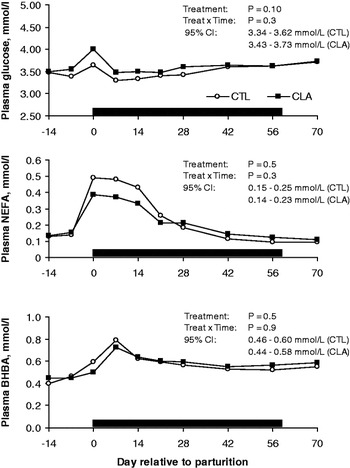
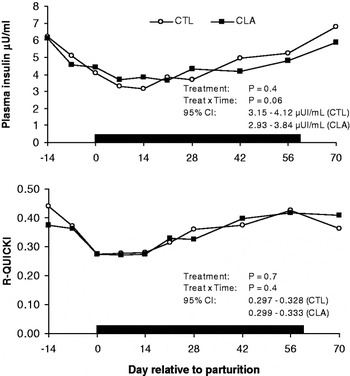
Plasma metabolite data are illustrated in Fig. 3. Plasma glucose concentrations were not affected by LE-CLA. No differences in mean circulating NEFA were detected using repeated measures analysis. Peak circulating concentrations of NEFA during the post-partum period were greater in CTL cows than in LE-CLA cows (0·69±0·06 v. 0·49±0·06 mmol/l, P=0·004) but the mean day when peak circulating NEFA was observed did not differ between treatments (6·8±1·1 v. 5·8±1·1 DIM). Plasma BHBA was not affected by treatment. Treatment by time interactions were not observed for any of the blood metabolites. Mean circulating concentrations of insulin and the calculated R-QUICKI index values were not different between treatments (Fig. 4). There were no effects of treatment or treatment by time interaction on circulating IGF-I concentrations. However, a significant (P<0·05) effect of parity was detected (128·6, 120·2 and 108·3 ng/ml for parity 1, 2 and ≥3 respectively). A treatment by parity interaction (P<0·05) was observed, whereby LE-CLA supplementation appeared to increase circulating IGF-I in parity 1 cows (135·1 v. 122·1 ng/ml) and parity ≥3 cows (117·2 v. 99·4 ng/ml), but resulted in reduced circulating IGF-I in parity 2 cows (111·6 v. 128·8 ng/ml).
Temporal changes in circulating glucose, NEFA and BHBA in cows supplemented with CTL and LE-CLA supplements. The treatment period lasted from parturition to 60 DIM (depicted by the solid black bar), and cows were fed either 60 g/d of calcium salts of fatty acids (CTL) or 80 g/d of lipid-encapsulated conjugated linoleic acid (LE-CLA). Glucose, NEFA and BHBA values were not normally distributed and were log-transformed prior to analysis to generate a normal distribution.

Plasma insulin concentrations and R-QUICKI values in CTL and LE-CLA supplemented cows. The treatment period lasted from parturition to 60 DIM (depicted by the solid black bar), and cows were fed either 60 g/d of calcium salts of fatty acids (CTL) or 80 g/d of lipid-encapsulated conjugated linoleic acid (LE-CLA). Upper panel: Insulin values were log-transformed prior to analysis to generate a normal distribution. Lower panel: R-QUICKI values were generated by taking both the logarithm and reciprocal of glucose×insulin×NEFA. The R-QUICKI values generated were not normally distributed, and were log-transformed prior to analysis.

Reproductive performance
Reproductive performance data are summarized in Table 3. There was no difference between treatments in the post-partum interval to onset of cyclicity (21·0±2·5 v. 23·3±2·6 d post partum for CTL and LE-CLA, respectively). Conception rates to first or second service were not affected by LE-CLA supplementation, but the number of services per conception tended to be reduced (P=0·07). Calving to service interval and calving to conception interval did not differ between the treatments (Table 3).
Circulating concentrations of progesterone during the first 21 d after insemination were not affected by LE-CLA supplementation, regardless of whether or not a pregnancy was successfully established.
Discussion
In the present study, LE-CLA supplementation during the first 60 d post partum reduced milk fat concentration, with maximal MFD (15·7%) observed at 8 weeks after parturition. The energy spared by reducing milk fat synthesis resulted in improved calculated energy balance status and BCS. The current study did not have enough animals to allow a robust statistical appraisal of effects of LE-CLA on reproductive performance (a power calculation based on the conception rates to first service observed in the current study with α=0·05 and 1−β=0·9 indicated ∼323 animals per treatment would be required). However the improvements in energy status and BCS provide a potential mechanism to improve fertility; this needs to be tested in a commercial trial where larger numbers of cows can be enrolled in a study.
In previous studies that commenced supplementation with CLA before or immediately after parturition, MFD did not occur immediately post partum. Bernal-Santos et al. (Reference Bernal-Santos, Perfield, Barbano, Bauman and Overton2003) fed 0 or 8·8 g/d trans-10,cis-12 CLA and Castaneda-Gutierrez et al. (Reference Castaneda-Gutierrez, Overton, Butler and Bauman2005) fed 0, 8·8 or 18·3 g/d trans-10,cis-12 CLA; they did not observe CLA-induced MFD until approximately the third week of lactation. In the current study, we observed a significant treatment effect on milk fat concentration, but there was no treatment by time interaction, which would suggest that LE-CLA reduced milk fat concentration at all timepoints. Moore et al. (Reference Moore, Hafliger, Mendivil, Sanders, Bauman and Baumgard2004) suggested that the mammary gland is less sensitive to LE-CLA-induced MFD during very early lactation. This was also observed by Castaneda-Gutierrez et al. (Reference Castaneda-Gutierrez, Overton, Butler and Bauman2005) and they speculated that mammary responsiveness and/or sensitivity to trans-10,cis-12 CLA during the early post-partum period is altered to support lactation. In the current study, the supplement provided an intake of 6·9 g/d of trans-10,cis-12 CLA. This dose is similar to that used by Castaneda-Gutierrez et al. (Reference Castaneda-Gutierrez, Benefield, de Veth, Santos, Gilbert, Butler and Bauman2007) but considerably less than used by Kay et al. (Reference Kay, Roche, Moore and Baumgard2006) and Odens et al. (Reference Odens, Burgos, Innocenti, VanBaale and Baumgard2007) who used doses of 20·9 g/d and 29·3 g/d, respectively. It is important to note that milk fat is economically important to dairy farmers. Extreme MFD may be undesirable, especially in regions where milk is primarily used for manufacturing purposes. The amount of LE-CLA supplement fed in the present study was chosen to induce sufficient MFD to potentially improve energy status, while not markedly decreasing income from milk.
Supplementation with LE-CLA improved calculated energy balance, and this was reflected in improved BCS in the LE-CLA supplemented cows compared with CTL animals. To our knowledge, improved BCS in early lactation dairy cows in response to CLA supplementation has not previously been reported. The improvement in energy balance can be directly attributed to MFD, as DMI and milk yield did not differ between CTL and LE-CLA treatment groups. This is consistent with previous research that has identified beneficial effects of feeding LE-CLA on energy balance indices (Kay et al. Reference Kay, Mackle, Bauman, Thomson and Baumgard2007; Odens et al. Reference Odens, Burgos, Innocenti, VanBaale and Baumgard2007). A recent report on the effects of trans-10,cis-12 LE-CLA on adipose tissue supports the effect of LE-CLA on BCS observed in the current study. Harvatine et al. (Reference Harvatine, Perfield and Bauman2009) investigated the expression of lipid-related genes in adipose tissue during trans-10,cis-12 CLA-induced MFD in mid-lactation dairy cows (i.e. in positive energy balance). Those authors identified a net energy excess caused by a decrease in milk fat synthesis, which was accompanied by increased expression of genes involved in the uptake, synthesis, desaturation and transport of fatty acids in adipose tissue, consistent with enhanced energy partitioning to body fat stores during CLA supplementation. In the current study, the cows were in early lactation NEB, but it is plausible that energy spared through the effects of LE-CLA on milk energy output could affect metabolic pathways in adipose tissue to reduce lipid mobilization in the same manner as observed by Harvatine et al. (Reference Harvatine, Perfield and Bauman2009).
Reduced severity of NEB should reduce the demand to mobilize adipose tissue reserves. We did not detect an effect of CLA on mean circulating NEFA concentrations during the supplementation period, but peak circulating NEFA concentrations were lower in CLA-supplemented cows compared with CTL cows. The literature is inconsistent with regard to the effect of LE-CLA on circulating NEFA concentrations; some reports identified a reduction in NEFA in response to LE-CLA supplements (Odens et al. Reference Odens, Burgos, Innocenti, VanBaale and Baumgard2007) while others reported no effect (Castaneda-Gutierrez et al. Reference Castaneda-Gutierrez, Overton, Butler and Bauman2005; Kay et al. Reference Kay, Mackle, Bauman, Thomson and Baumgard2007). Collectively, the results of the present and earlier studies indicate that (i) CLA acts to lower NEFA only if supplementation is initiated at or before parturition; (ii) reductions in NEFA are not detectable if circulating NEFA is already low at the start of the study (mid- to late-lactation cows in positive energy balance); and (iii) ability to detect an effect of CLA treatment on NEFA with a small number of cows per treatment is hindered by the high variability that is typically observed in circulating NEFA concentrations during the transition period. Lower circulating NEFA during the transition period may result in reduced liver uptake of NEFA and subsequent esterification to triglycerides, resulting in a beneficial effect on liver health status (Drackley, Reference Drackley1999).
We observed no differences in plasma glucose concentrations for LE-CLA supplemented cows compared with CTL cows. The literature is inconsistent on the effect of CLA on plasma glucose in early-lactation dairy cows. Odens et al. (Reference Odens, Burgos, Innocenti, VanBaale and Baumgard2007) observed greater plasma glucose in cows supplemented with a high dose of CLA, but other studies failed to detect a similar effect (Bernal-Santos et al. Reference Bernal-Santos, Perfield, Barbano, Bauman and Overton2003; Castaneda-Gutierrez et al. Reference Castaneda-Gutierrez, Overton, Butler and Bauman2005; Kay et al. Reference Kay, Roche, Moore and Baumgard2006). Odens et al. (Reference Odens, Burgos, Innocenti, VanBaale and Baumgard2007) attributed the greater circulating glucose concentrations to a possible decrease in peripheral tissue insulin sensitivity. However, studies where an insulin tolerance test was used to measure insulin sensitivity in cows either abomasally infused with CLA (Baumgard et al. Reference Baumgard, Corl, Dwyer and Bauman2002a) or fed LE-CLA (de Veth et al. Reference de Veth, Castaneda-Gutierrez, Dwyer, Pfeiffer, Putnam and Bauman2006) reported no difference in the fractional rate of change in circulating glucose following insulin administration. Similarly, LE-CLA supplementation did not affect the R-QUICKI index values in the present study, again suggesting that insulin sensitivity was not affected. It is possible that the effects of CLA on peripheral tissue insulin responsiveness are subtle, and cannot be detected using techniques such as the insulin tolerance test or the R-QUICKI index in lactating dairy cows.
The current study was not adequately powered to detect effects on reproduction-related variables. Accordingly, we did not observe any effect on the majority of the fertility measurements, with the exception of a trend for a reduced number of services per conception (for all cows, pregnant and non-pregnant) in LE-CLA supplemented cows. A limited number of published reports, all with low numbers of cows per treatment, have indicated statistical trends for beneficial effects of CLA on fertility indices (Bernal-Santos et al. Reference Bernal-Santos, Perfield, Barbano, Bauman and Overton2003, n=15/treatment; Castaneda-Gutierrez et al. Reference Castaneda-Gutierrez, Overton, Butler and Bauman2005, n=18/treatment; Castaneda-Gutierrez et al. Reference Castaneda-Gutierrez, Benefield, de Veth, Santos, Gilbert, Butler and Bauman2007, n=15/treatment). Beneficial effects included trends for reduced post-partum interval to first ovulation, numerical improvements in conception rate, and reduced number of services per conception. The data from these three studies were combined with data from de Veth et al. (Reference de Veth, van Straalen, Koch, Keller, Hayler and Pfeiffer2005) and Mann et al. (Reference Mann, Lock, Bauman and Kendall2007) in a recent meta-analysis (de Veth et al. Reference de Veth, Bauman, Koch, Mann, Pfeiffer and Butler2009) which indicated that the optimal dose for advancing the post-partum onset of cyclicity was 8 g/d of trans-10,cis-12 CLA; interval to first post-partum ovulation was reduced by 8 d in cows fed this dose (de Veth et al. Reference de Veth, Bauman, Koch, Mann, Pfeiffer and Butler2009). The optimal dose for improving conception was 10 g/d of trans-10,cis-12 CLA; this dose increased the probability of cows becoming pregnant (72% v. 91%) and reduced the time to conception (143 DIM v. 105 DIM) compared with cows receiving no supplement (de Veth et al. Reference de Veth, Bauman, Koch, Mann, Pfeiffer and Butler2009). In the current study, we did not observe an effect of LE-CLA feeding on post-partum onset of cyclicity; resumption of luteal activity occurred early post partum in both the LE-CLA and CTL treatment groups. Effects of LE-CLA on conception-related variables in the present study are generally in agreement with previous reports (Bernal-Santos et al. Reference Bernal-Santos, Perfield, Barbano, Bauman and Overton2003; Castaneda-Gutierrez et al. Reference Castaneda-Gutierrez, Overton, Butler and Bauman2005; Castaneda-Gutierrez et al. Reference Castaneda-Gutierrez, Benefield, de Veth, Santos, Gilbert, Butler and Bauman2007) and with the recent meta-analysis (de Veth et al. Reference de Veth, Bauman, Koch, Mann, Pfeiffer and Butler2009).
IGF-I is a polypeptide hormone, the circulating concentration of which is correlated with nutritional status (McGuire et al. Reference McGuire, Bauman, Dwyer and Cohick1995) and reproductive performance in dairy cattle (Taylor et al. Reference Taylor, Cheng, Pushpakumara, Beever and Wathes2004). Castaneda-Gutierrez et al. (Reference Castaneda-Gutierrez, Benefield, de Veth, Santos, Gilbert, Butler and Bauman2007) reported greater circulating IGF-I in LE-CLA supplemented cows compared with control cows, despite not detecting an effect on energy balance. In the current study, the effect of LE-CLA on circulating IGF-I concentrations appeared to differ by parity, but similar treatment by parity interactions were not observed in the analysis of energy balance and BCS. Further work is necessary to determine whether the effect of CLA on circulating IGF-I truly differs by parity.
Progesterone is a steroid hormone that is critical for successful establishment of pregnancy. In a synchronized cycle, Castaneda-Gutierrez et al. (Reference Castaneda-Gutierrez, Benefield, de Veth, Santos, Gilbert, Butler and Bauman2007) observed greater progesterone concentrations during the luteal phase in LE-CLA supplemented cows. In the current study, progesterone was measured for 21 d after insemination, but LE-CLA did not affect concentrations in cows that were subsequently diagnosed either pregnant or non-pregnant. Differences between the results of the current study and those of Castaneda-Gutierrez et al. (Reference Castaneda-Gutierrez, Benefield, de Veth, Santos, Gilbert, Butler and Bauman2007) in IGF-I and progesterone hormone profiles warrant further study.
The milk fatty acid results indicated that approximately 0·18 g of trans-10,cis-12 LE-CLA escaped biohydrogenation and was available for intestinal absorption, representing a transfer efficiency of 2·7%. Three other studies have fed LE-CLA supplements, reporting transfer efficiencies of 2·6% (de Veth et al. Reference de Veth, Castaneda-Gutierrez, Dwyer, Pfeiffer, Putnam and Bauman2006), 4·8% (Moallem et al. Reference Moallem, Lehrer, Zachut, Livshitz and Yacoby2010) and 7·9% (Perfield et al. Reference Perfield, Lock, Pfeiffer and Bauman2004). The variation in transfer efficiencies between studies may partly reflect differences in the technology used to protect CLA. The transfer efficiency in the present study was achieved despite pelleting the LE-CLA supplement, which could potentially lead to degradation of the lipid encapsulation protection owing to heating during the pelleting process. This may enhance the potential for practical application of the LE-CLA supplement used in the current study. Though it is likely that the pelleting process had some detrimental effect on rumen protection, under the conditions that LE-CLA was pelleted in this study, the supplement remained efficacious in reducing milk fat content.
The changes in milk fat composition in response to LE-CLA supplementation in the present study, i.e. decreasing proportions of short- and medium-chain fatty acids and increasing proportions of long-chain fatty acids, are consistent with other reports (Perfield et al. Reference Perfield, Bernal-Santos, Overton and Bauman2002; Mackle et al. Reference Mackle, Kay, Auldist, McGibbon, Philpott, Baumgard and Bauman2003; Castaneda-Gutierrez et al. Reference Castaneda-Gutierrez, Overton, Butler and Bauman2005). Collectively, these studies indicate that the reduction in milk fat synthesis during CLA supplementation is due to reductions in both the uptake of preformed fatty acids and, to a greater extent, mammary de-novo synthesis of short chain fatty acids. Baumgard et al. (Reference Baumgard, Matitashvili, Corl, Dwyer and Bauman2002b) demonstrated that trans-10,cis-12 CLA decreases milk fat synthesis through a reduction in mRNA expression for key enzymes involved in fat synthesis in the mammary gland, as well as enzymes involved in the uptake and transport of circulating fatty acids.
Conclusions
Supplementation with LE-CLA induced MFD in early lactation dairy cows, with no effect on milk yield, or the yield of milk protein or lactose. The reduction in milk fat output resulted in greater net energy balance in LE-CLA supplemented cows, and this was reflected in improved BCS. The number of services per conception tended to be lower in LE-CLA supplemented cows, although no other reproduction variables were changed. The current study goes beyond previous work by demonstrating effects on energy balance and BCS by feeding a small amount of supplemental LE-CLA in pelleted form. Because of the well-established relationship between energy balance and reproduction in lactating dairy cows, and a recent meta-analysis indicating that CLA can benefit reproduction, further work with a larger number of animals is necessary to fully determine the effects of LE-CLA on cow fertility.
The authors thank Mr JP Murphy (Teagasc, Moorepark), Mr J Kenneally (Teagasc, Moorepark) and the Moorepark farm staff for management and care of the animals. The technical assistance of Ms N Galvin (Teagasc, Moorepark), Mr L Siggens (Teagasc, Moorepark Food) and Ms N Hynes (UCD) is also appreciated. National Development Plan funding is gratefully acknowledged.