Implications
Milk and dairy products are a major source of saturated fatty acids (SFA) in the European human diet. Certain SFA have been found to increase the risk of cardiovascular disease (CVD), and therefore research has been directed towards developing sustainable strategies to decrease saturated fatty acid concentrations in milk and dairy products. This study examines the impact of replacing a commercially available, and widely used, fat supplement (calcium salts of palm oil distillate) with different forms of rapeseed on milk fat composition. Data indicated that processed rapeseeds could be used to alter milk fat composition as a part of an overall strategy for decreasing SFA in the human diet, to reduce CVD risk and associated healthcare costs.
Introduction
Dietary intervention studies have established that a reduction in saturated fatty acid (SFA) intake lowers cardiovascular disease (CVD) risk (Clarke et al., Reference Clarke, Frost, Collins, Appleby and Peto1997), with emerging evidence of improved insulin sensitivity (Vessby et al., Reference Vessby, Uusitupa, Hermansen, Riccardi, Rivallese, Tapsell, Nalsen, Berglund, Louheranta, Rassmussen, Calvert, Maffetone, Pederson, Gustafsson and Storlien2001). Reduction in SFA intake can be achieved by replacement of SFA with cis-monounsaturated fatty acids (MUFA) or polyunsaturated fatty acids (PUFA), and a number of studies have demonstrated that CVD risk factors are improved by replacement of SFA with MUFA (e.g. Kris-Etherton et al., Reference Kris-Etherton, Pearson, Wan, Hargrove, Moriarty, Fishell and Etherton1999). The model of Mensink et al. (Reference Mensink, Zock, Kester and Katan2003) suggests that replacing 2% of energy intake as SFA with cis-MUFA would reduce the risk of a CVD event by about 3%. Milk and dairy products are the major source of SFA in the European diet (Hulshof et al., Reference Hulshof, van Erp-Baart, Anttolainen, Becker, Church, Couet, Hermann-Kunz, Kesteloot, Leth, Martins, Moreiras, Moschandreas, Pizzoferato, Rimestad, Thorgeirsdottir, van Amelsvoort, Aro, Kafatos, Lanzmann-Petitory and van Poppel1999) and as a result, there is an urgent need to examine nutritional strategies for altering milk fatty acid composition to potentially improve long-term human health.
Including plant oils in the dairy cow diet is known to reduce milk fat 12:0, 14:0 and 16:0 content and, depending on the plant oil composition, enhance 18:0, cis-9 18:1 and PUFA concentrations. However, these changes are associated with an increase in milk fat trans fatty acid content due to incomplete rumen biohydrogenation of PUFA (Givens and Shingfield, Reference Givens and Shingfield2006; Chilliard et al., Reference Chilliard, Glasser, Ferlay, Bernard, Rouel and Doreau2007). Although evidence on the association between the intake of trans fatty acids from ruminant-derived foods and the risk of CVD suggests that they have rather innocuous or possibly protective effects (Jakobsen et al., Reference Jakobsen, Bysted, Andersen, Heitmann, Hartkopp, Leth, Overvad and Dyerberg2006; Chardigny et al., Reference Chardigny, Destaillats, Malpuech-Brugère, Moulin, Bauman, Lock, Barbano, Mensink, Bezelgues, Chaumont, Combe, Cristiani, Joffre, German, Dionisi, Boirie and Sébédio2008), there are still some uncertainties and concerns that the food labelling legislation may combine these trans fatty acids with those from industrial partially hydrogenated vegetable oils, known to be deleterious to health.
Due to the protective properties of the surrounding seed coat, it is possible that intact or processed oilseeds in the diet would result in reduced ruminal biohydrogenation of constituent unsaturated fatty acids, compared with plant oils, offering the opportunity to decrease milk SFA and enhance unsaturated fatty acids, while minimising associated increases in trans fatty acids. Several studies have examined the potential of including cis-9 18:1-rich rapeseed oil (DePeters et al., Reference DePeters, German, Taylor, Essex and Perez-Monti2001; Ryhänen et al., Reference Ryhänen, Tallavaara, Griinari, Jaakkola, Mantere-Alhonen and Shingfield2005), or whole and ground rapeseeds (Bayourthe et al., Reference Bayourthe, Enjalbert and Moncoulon2000) in the diet to simultaneously reduce SFA and increase MUFA in milk fat. However, there are few studies on the impact on milk trans fatty acid isomer concentrations (Collomb et al., Reference Collomb, Sollberger, Bütikofer, Sieber, Stoll and Schaeren2004), and direct comparisons of the efficacy of different types of rapeseed feeds in the diet on milk fat composition are also limited.
In the present experiment, milk production and milk fatty acid composition responses to replacing calcium salts of palm oil distillate (CPO) with whole rapeseeds, milled rapeseeds or rapeseed oil were evaluated in lactating cows fed maize silage-based diets.
Material and methods
Experimental design, animals and management
Four multiparous Holstein-Friesian cows of (mean ± s.e.) live weight 719 ± 37.7 kg, parity 4.8 ± 0.48, yield 40.8 ± 3.30 l and 103 ± 11.0 days in lactation were used. Animals were randomly allocated to treatments according to a 4 × 4 Latin Square design with 28-day experimental periods. Cows were housed in individual tie stalls, equipped with a rubber mattress and bedded with wood shavings. Clean water and trace mineralised blocks (Rockies (red), Tithebarn Ltd, Cheshire, UK) were available ad libitum. Cows were milked in situ at 0400 and 1600 h.
Experimental diets
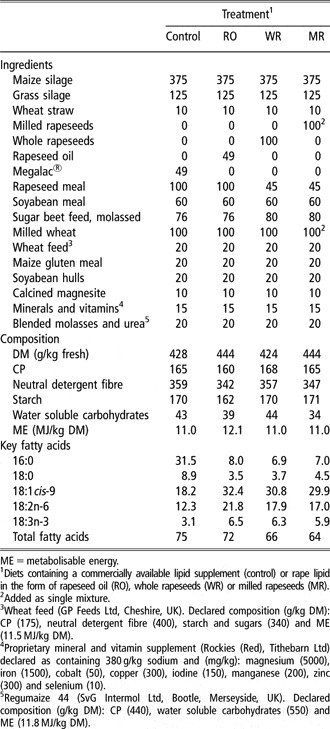
Diets were offered ad libitum as total mixed rations (TMR; forage : concentrate ratio 50 : 50 on a dry matter (DM) basis) with the forage consisting of maize silage (MS) and grass silage (GS; 750 and 250 g/kg of forage DM, respectively). Treatments consisted of a control diet (control) containing 49 g/kg DM of CPO (Megalac®; Volac International Ltd, Royston, UK) or the same basal diet with CPO being replaced by 49 g/kg DM of lipid derived from whole rapeseeds (WR), milled rapeseeds (MR) or rapeseed oil (RO). The rapeseeds used were a mixture of varieties Canberra and Liverpool and the milled rapeseed blend was prepared by processing the whole seeds with wheat grain (50 : 50, fresh-weight basis) in a machine which uses a combination of hammer (12 mm) and roller mills (processor model AFM 998Q; Buschhoft, GmbH & Co., Ahlen, Germany). Rapeseed oil was obtained from KTC Edibles Ltd (Moorcroft Drive, Wednesbury, UK). Diets were formulated using the Feed into Milk model (Thomas, Reference Thomas2004) to be isoenergetic and provide a mean predicted intake of 1 kg rapeseed lipid/day for treatments WR, MR and RO. Formulation of experimental diets is shown in Table 1. Cows were offered diets as equal meals at 0830 and 1600 h. Refusals were removed and weighed prior to the morning feeding.
Ingredient and chemical composition of experimental diets (g/kg dry matter (DM) or as stated)

ME = metabolisable energy.
1Diets containing a commercially available lipid supplement (control) or rape lipid in the form of rapeseed oil (RO), whole rapeseeds (WR) or milled rapeseeds (MR).
2Added as single mixture.
3Wheat feed (GP Feeds Ltd, Cheshire, UK). Declared composition (g/kg DM): CP (175), neutral detergent fibre (400), starch and sugars (340) and ME (11.5 MJ/kg DM).
4Proprietary mineral and vitamin supplement (Rockies (Red), Tithebarn Ltd) declared as containing 380 g/kg sodium and (mg/kg): magnesium (5000), iron (1500), cobalt (50), copper (300), iodine (150), manganese (200), zinc (300) and selenium (10).
5Regumaize 44 (SvG Intermol Ltd, Bootle, Merseyside, UK). Declared composition (g/kg DM): CP (440), water soluble carbohydrates (550) and ME (11.8 MJ/kg DM).
Experimental sampling
Individual feed components (GS, MS and concentrates) of the four TMR and feed refusals were sampled daily during the last 6 days of each experimental period, and bulked to provide composite samples. The DM contents of offered feeds were determined by oven drying at 100°C for 18 h to allow for adjustments of fresh weight inclusion rates, and to ensure that the composition of experimental diets was maintained. A daily sub-sample of the refused feed was dried at 60°C for 48 h to determine individual daily DM intakes. Samples of offered TMR and refusals (if appreciable) were retained at −20°C for subsequent chemical analysis.
Milk yield was recorded at each milking during the last 7 days of each treatment period. Samples of milk preserved with potassium dichromate (Lactabs (1 mg/ml); Thompson and Capper, Runcorn, UK) for the determination of fat, crude protein (CP) and lactose were also collected at this time from each cow at each milking. Additional samples of unpreserved milk were collected during the last 24 h of each experimental period, stored at −20°C until composited according to milk yield and submitted for analysis of fatty acid composition.
Chemical analysis
Chemical composition of oven dried (60°C), milled (1 mm screen) samples of forages and concentrates were determined using standard procedures outlined elsewhere (Kliem et al., Reference Kliem, Morgan, Humphries, Shingfield and Givens2008) for NDF, CP, water soluble carbohydrates, starch, metabolisable energy (ME) and fatty acid content.
Milk fat, CP and lactose were determined in preserved samples by near-infra red spectroscopy (Foss Electric Ltd, York, UK). Lipid in 1 ml milk was extracted and transesterified to fatty acid methyl esters (FAME; Kliem et al., Reference Kliem, Morgan, Humphries, Shingfield and Givens2008).
The distribution of conjugated linoleic acid (CLA) isomers in milk FAME was determined by HPLC, using four silver impregnated silica columns (ChromSpher 5 Lipids (250 × 4.6 mm, 5 μm particle size); Varian Ltd, Oxford, UK) coupled in series, using 0.1% (v/v) of acetonitrile in heptane as the mobile phase (Shingfield et al., Reference Shingfield, Ahvenjärvi, Toivonen, Ärölä, Nurmela, Huhtanen and Griinari2003 and Reference Shingfield, Reynolds, Lupoli, Toivonen, Yurawecz, Delmonte, Griinari, Grandison and Beever2005). Isomers were identified using an authentic CLA methyl ester standard (O-5632; Sigma-Aldrich, YA-Kemia Limited, Helsinki, Finland) and chemically synthesised trans-9, cis-11 CLA (Shingfield et al., Reference Shingfield, Reynolds, Lupoli, Toivonen, Yurawecz, Delmonte, Griinari, Grandison and Beever2005). Identification was verified by cross-referencing with the elution order reported in the literature using cis-9, trans-11 CLA as a landmark isomer.
Milk fatty acid composition was expressed as a weight percentage of total fatty acids using response factors derived from the analysis of a butter oil reference standard (CRM 164; Community Bureau of Reference, Brussels, Belgium). Concentrations of specific conjugated isomers in CLA supplements were calculated based on proportionate peak area responses determined by HPLC, and the sum of trans-7, cis-9 CLA, trans-8, cis-10 CLA and cis-9, trans-11 CLA weight percentage determined by Gas Chromatography.
Data analysis
Intake, milk production and milk fatty acid composition data were subjected to analysis of variance, using the general linear model procedure of Statistical Analysis Systems software package version 8.2 (SAS Institute, Cary, NC, USA), with a model that included the random effects of cow and fixed effects of period and treatment. Responses to replacing CPO in the diet with rapeseed feeds were evaluated using t-test statistics for pairwise comparisons of treatment means. No adjustment was made for multiple testing. Least square means ± s.e. were reported and treatment effects were considered significant at P < 0.05.
Results
All four experimental diets had a similar DM, CP, NDF, starch and ME content, but replacing CPO with milled rapeseeds or rapeseed oil resulted in a marginally lower dietary water-soluble carbohydrate concentration (Table 1). The WR and MR diets had a slightly lower total fatty acid content than the other two diets (Table 1). The predominant fatty acid in the control diet was 16:0, accounting for almost one third of total fatty acids, whereas cis-9 18:1 was the predominant fatty acid in RO, WR and MR diets.
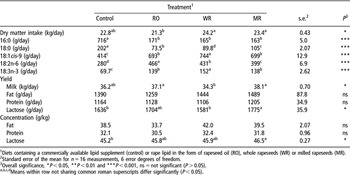
Replacing CPO in the diet with whole or milled rapeseeds had no effect (P > 0.05) on DM intake (Table 2), but the intake of RO was lower (P < 0.05) compared with WR and MR. As a result of differences in dietary lipid supplement composition, 16:0 intake was lower (P < 0.05) and ingestion of cis-9 18:1, 18:2n-6 and 18:3n-3 was higher (P < 0.05) for diets containing rapeseed feeds compared with the control (Table 2). Experimental treatments had no effect (P > 0.05) on milk yield compared with the control, while milk yield was lower (P < 0.05) for WR, than for RO or MR (Table 2). Treatments had no effect (P > 0.05) on milk protein or fat content, whilst milk lactose concentrations were higher (P < 0.05) for MR relative to those for the control.
Effect of replacing calcium salts of palm oil distillate with rapeseed feeds in maize silage-based diets on dry matter and fatty acid intake, milk yield and composition

1Diets containing a commercially available lipid supplement (control) or rape lipid in the form of rapeseed oil (RO), whole rapeseeds (WR) or milled rapeseeds (MR).
2Standard error of the mean for n = 16 measurements, 6 error degrees of freedom.
3Overall significance, *P < 0.05, **P < 0.01 and ***P < 0.001, ns = not significant (P > 0.05).
a,b,c,dMeans within row not sharing common roman superscripts differ significantly (P < 0.05).
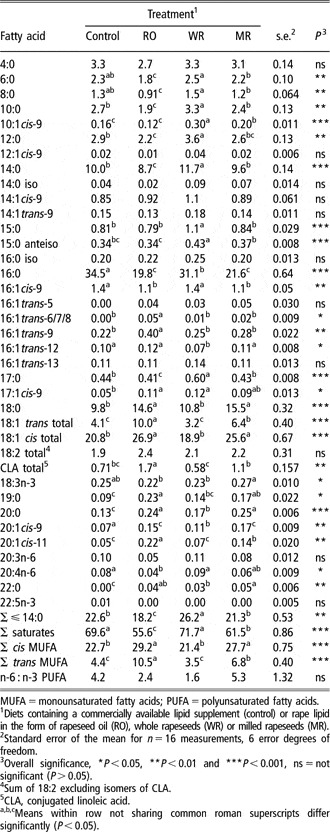
The extent of alterations in milk fatty acid composition following the replacement of CPO in the diet was dependent on the physical form of rapeseed feeds. Treatment diets RO and MR resulted in lower (P < 0.05) total milk SFA than the control diet due to reductions (P < 0.05) in milk 16:0 concentrations, more than compensating for the increases (P < 0.05) in 18:0 content (Table 3). Furthermore, treatment RO decreased (P < 0.05) milk 12:0 and 14:0 concentrations resulting in a lower milk total SFA content compared with WR or MR. Inclusion of whole rapeseeds at the expense of CPO decreased (P < 0.05) milk 16:0 concentrations, but had no effect on total SFA content (Table 3). RO also increased (P < 0.05) milk fat trans-6-8 16:1 and trans-9 16:1 content, and RO and MR decreased (P < 0.05) cis-9 16:1 content (Table 3). Milk 18:3n-3 content was higher (P < 0.05) with the MR diet compared with RO and WR, but overall there was no effect of treatments on milk fat n-6 : n-3 PUFA ratio (Table 3).
Effect of replacing calcium salts of palm oil distillate with rapeseed feeds in maize silage-based diets on milk fatty acid composition (g/100 g fatty acids)

MUFA = monounsaturated fatty acids; PUFA = polyunsaturated fatty acids.
1Diets containing a commercially available lipid supplement (control) or rape lipid in the form of rapeseed oil (RO), whole rapeseeds (WR) or milled rapeseeds (MR).
2Standard error of the mean for n = 16 measurements, 6 error degrees of freedom.
3Overall significance, *P < 0.05, **P < 0.01 and ***P < 0.001, ns = not significant (P > 0.05).
4Sum of 18:2 excluding isomers of CLA.
5CLA, conjugated linoleic acid.
a,b,cMeans within row not sharing common roman superscripts differ significantly (P < 0.05).
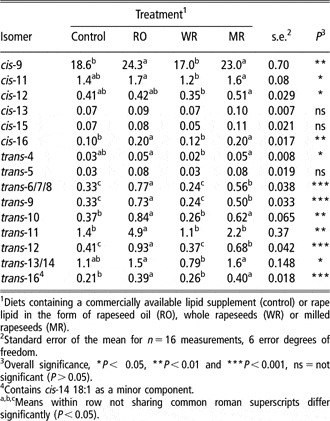
Substituting CPO for rapeseed oil and milled rapeseeds increased (P < 0.05) total cis- and trans-MUFA in milk (Table 3). The observed increases in cis-MUFA for RO and MR, relative to the control, were largely due to cis-9 18:1 enrichment (Table 4). The trans-11 18:1 isomer was the most abundant trans-MUFA in milk fat (Table 4). Several other trans 18:1 isomer concentrations were enhanced in response to RO and MR, compared with the control and WR treatments.
Effect of replacing calcium salts of palm oil distillate with rapeseed feeds in maize silage-based diets on milk 18:1 isomer composition (g/100 g fatty acids)

1Diets containing a commercially available lipid supplement (control) or rape lipid in the form of rapeseed oil (RO), whole rapeseeds (WR) or milled rapeseeds (MR).
2Standard error of the mean for n = 16 measurements, 6 error degrees of freedom.
3Overall significance, *P < 0.05, **P < 0.01 and ***P < 0.001, ns = not significant (P > 0.05).
4Contains cis-14 18:1 as a minor component.
a,b,cMeans within row not sharing common roman superscripts differ significantly (P < 0.05).
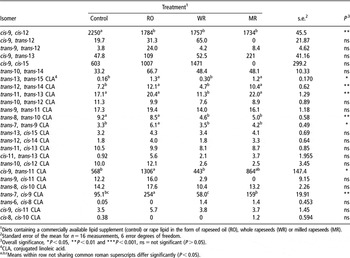
Replacing CPO with rapeseed feeds had relatively minor effects on milk fat 18:2 concentrations (Table 5), other than causing a reduction (P < 0.05) in cis-9, cis-12 18:2 and an increase in concentrations of specific CLA isomers. The RO diet resulted in higher (P < 0.05) milk fat proportions of cis-9, trans-11 CLA than WR and MR that were comparable (P > 0.05) to the control. Overall, treatments MR and RO tended to increase milk fat CLA isomer concentrations relative to the control and WR treatments (e.g. trans-13, trans-15 CLA and trans-12, trans-14 CLA). The RO treatment also increased (P < 0.05) trans-7, cis-9 CLA, the second most abundant CLA isomer in milk fat, relative to the control, MR or WR treatments.
Effect of replacing calcium salts of palm oil distillate with rapeseed feeds in maize silage-based diets on milk 18:2 isomer composition (mg/100 g fatty acids)

1Diets containing a commercially available lipid supplement (control) or rape lipid in the form of rapeseed oil (RO), whole rapeseeds (WR) or milled rapeseeds (MR).
2Standard error of the mean for n = 16 measurements, 6 error degrees of freedom.
3Overall significance, *P < 0.05, **P < 0.01 and ***P < 0.001, ns = not significant (P > 0.05).
4CLA, conjugated linoleic acid.
a,b,cMeans within row not sharing common roman superscripts differ significantly (P < 0.05).
Discussion
Even though diets were formulated to contain equal lipid amounts, there was a slight variation in the total fatty acid content of the diets, with the rapeseed-containing diets containing less total fatty acids than the RO and control diets. It is possible that the rapeseeds obtained for the study contained less total fatty acids than theoretical values used to formulate the diets suggested. Replacing CPO with whole and milled rapeseeds (WR and MR) in the diet had little effect on DM intake, but rapeseed oil reduced (P < 0.05) intake. Givens et al. (Reference Givens, Allison and Blake2003) recorded substantial DM intake reductions in cows fed cracked whole rapeseeds, providing greater amounts of rapeseed oil (1.21 kg/cow per day) than in the present study. A lower intake with diets containing rapeseed oil may reflect the negative effects of unsaturated fatty acids on rumen function (Palmquist, Reference Palmquist1994), and if so, suggests that both the WR and MR treatments provided some degree of rumen protection to the constituent oil. However, milk yield was lower (P < 0.05) for treatment WR compared with RO and MR. This may indicate that the seed coat of the WR reduced bioavailability of the oil, and hence energy, therein throughout the whole digestive tract. Low digestibility of whole rapeseeds was suggested as the reason for a lower milk yield when compared to similar diets containing processed rapeseeds (Bayourthe et al., Reference Bayourthe, Enjalbert and Moncoulon2000).
The reduction in milk fat total SFA in response to replacing CPO with rapeseed oil or milled rapeseeds was mainly due to reductions in short and medium chain (C4:0–16:0) fatty acids. These changes are consistent with the concept that inclusion of long chain (⩾18-carbon) unsaturated fatty acids in the diet decreases short and medium chain fatty acids in milk fat through inhibition of de novo synthesis in the bovine mammary gland (Hansen and Knudsen, Reference Hansen and Knudsen1987; Grummer, Reference Grummer1991; Doreau et al., Reference Doreau, Chillard, Rulquin and Demeyer1999). Substituting CPO with whole rapeseeds did not affect milk SFA content, which, coupled with relatively minor changes in milk trans fatty acid concentrations, suggests that lipid within intact rapeseeds was not only protected from rumen metabolism, but also poorly absorbed in the small intestine. At 28%, the efficiency of total 18-carbon fatty-acid transfer from the diet into milk for the WR treatment was lower (P < 0.05) than that of the other treatments (41%, 35% and 43% for the control, RO and MR, respectively), highlighting the limited bioavailablity of lipid in whole rapeseeds.
Milk fat from RO and MR, but not WR treatments contained increased concentrations of 18:0 despite a lower 18:0 intake. In vitro and in vivo studies have established that a high proportion of cis-9 18:1 is metabolised to 18:0 in the rumen (Harfoot and Hazlewood, Reference Harfoot and Hazlewood1997; Jenkins et al., Reference Jenkins, Wallace, Moate and Mosley2008), which is consistent with rapeseeds in the diet, substantially increasing 18:0 flow to the duodenum (Murphy et al., Reference Murphy, Udén, Palmquist and Wiktorsson1987). Overall, changes in milk SFA in response to RO and MR were in good agreement with earlier studies which have used equivalent dietary inclusions of oil from various rapeseed forms (Givens et al., Reference Givens, Allison and Blake2003; Ryhänen et al., Reference Ryhänen, Tallavaara, Griinari, Jaakkola, Mantere-Alhonen and Shingfield2005).
Replacing CPO with rapeseed oil or milled rapeseeds enhanced milk fat total cis-MUFA and cis 18:1 concentrations with the majority attributable to cis-9 18:1. These responses can be explained by a proportion of cis-9 18:1 in these feeds escaping ruminal biohydrogenation, and also to increases in the amount of 18:0 leaving the rumen, since more than 50% of cis-9 18:1 secreted in milk is derived from the action of stearoyl CoA (Δ9) desaturase on 18:0 in the mammary gland (Enjalbert et al., Reference Enjalbert, Nicot, Bayourthe and Moncoulon1998). A lack of effect of whole rapeseeds on milk fat total cis-MUFA concentrations (despite the greater intake of cis-9 18:1) provides further evidence of limited digestion and absorption of lipid within the intact rapeseeds. Bayourthe et al. (Reference Bayourthe, Enjalbert and Moncoulon2000) reported an increase in milk fat 18:0, and cis and trans 18:1 when cows consumed a whole rapeseed-supplemented diet when compared with a control diet. However, this control diet contained no lipid source at all, whereas the control diet in the current study contained a background level of rapeseed meal. Apparent discrepancies between studies may also be explained by the inclusion of rapeseed meal in combination with whole rapeseeds, resulting in almost a four-fold increase in cis-9 18:1 intake relative to the control (Bayourthe et al., Reference Bayourthe, Enjalbert and Moncoulon2000).
The decrease in milk fat cis-9 16:1 content with the RO and MR treatments is consistent with responses reported earlier (DePeters et al., Reference DePeters, German, Taylor, Essex and Perez-Monti2001), where a control diet (containing no supplemental lipid) was compared with a diet containing rapeseed oil. This MUFA is also a product of Δ9-desaturase and may reflect a decreased supply of 16:0 to the mammary gland, due to a decrease in circulating 16:0 from dietary sources or derived from de novo synthesis. The lower 16:0 (and cis-9 16:1) concentrations in milk from the RO and MR treatments was probably due, in part, to the reduction in de novo synthesis brought about by long chain unsaturated fatty acids. Also, the absence of the CPO supplement in all three treatment diets would affect the milk fat 16:0 content.
Replacing CPO with rapeseed products reduced milk fat 18:2n-6 concentrations despite dietary intake of this fatty acid being greater. Typically, inclusion of rapeseed lipid enhances milk fat 18:2n-6 content (Ryhänen et al., Reference Ryhänen, Tallavaara, Griinari, Jaakkola, Mantere-Alhonen and Shingfield2005). The reasons for the decrease observed in this experiment are not entirely clear, but may be related to the use of CPO in the control diet which also contains calcium salts of 18:2n-6, offering some protection from ruminal biohydrogenation relative to rapeseed oil or milled rapeseeds. Efficiency of transfer of 18:2n-6 from the control diet to milk was higher (P < 0.05) than that of the rapeseed diets (11% compared with 4.7%, 6.4% and 5.6% for the RO, MR and WR treatments, respectively). The CPO supplement contributed approximately 0.33 of the total amount of 18:2n-6 in the control diet on a g/kg DM basis, which is a substantial proportion to be protected from rumen metabolism.
The increases in milk-fat total trans fatty acids and CLA concentrations (Tables 4 and 5) with treatments RO and MR can be attributed to the formation of biohydrogenation intermediates arising from incomplete metabolism of unsaturated fatty acids in the rumen (Chilliard et al., Reference Chilliard, Glasser, Ferlay, Bernard, Rouel and Doreau2007; Jenkins et al., Reference Jenkins, Wallace, Moate and Mosley2008). Numerous in vitro and in vivo studies have established that trans-11 18:1 is a common intermediate of 18:2n-6 and 18:3n-3 metabolism in the rumen (Harfoot and Hazlewood, Reference Harfoot and Hazlewood1997; Palmquist et al., Reference Palmquist, Lock, Shingfield and Bauman2005). The majority of cis-9, trans-11 CLA in milk is synthesised from trans-11 18:1 via the action of Δ9-desaturase (Palmquist et al., Reference Palmquist, Lock, Shingfield and Bauman2005), suggesting any enrichment in this particular CLA isomer probably results from rumen metabolism of 18:2n-6 and 18:3n-3. The second most abundant CLA isomer, trans-7, cis-9 CLA, was highest in milk from the RO treatment, and is exclusively synthesised endogenously by Δ9-desaturase using trans-7 18:1 as a substrate (Corl et al., Reference Corl, Baumgard, Griinari, Delmonte, Morehouse, Yurawecz and Bauman2002). This 18:1 isomer has been identified during in vitro biohydrogenation from cis-9 18:1 (Mosley et al., Reference Mosley, Powell, Riley and Jenkins2002), and this may be reflected in the current study by the increased proportion of co-eluting 18:1 isomers trans-6, -7, -8 18:1, in milk fat from cows consuming the RO diet.
Higher concentrations of trans-MUFA and CLA in milk fat from RO than MR suggests a more extensive rumen biohydrogenation of unsaturated fatty acids with the RO diet. However, the mean daily secretion of 18:0 in milk on the MR treatment was higher than that of the RO diet (220 v. 175 g/day). The RO diet provided more PUFA, which may have contributed towards the higher milk fat trans fatty acid content. Concentrations of total trans 18:1 and CLA in milk fat for treatment RO were rather higher than those reported in the literature (4.3–6.8 and 0.31–1.02 g/100 g fatty acids, respectively; review of Givens and Shingfield, Reference Givens and Shingfield2006), although these studies tended to use lower rapeseed oil intakes which would account for differences between studies.
Replacing CPO with rapeseed oil or rapeseeds milled with wheat in maize silage-based diets reduced milk fat SFA including 16:0 (which imposes a negative effect on CVD risk; Mensink et al., Reference Mensink, Zock, Kester and Katan2003), enhanced milk cis-9 18:1 concentrations but also increased milk trans fatty acid content. In contrast, diets containing whole rapeseeds resulted in relatively minor changes in milk fat composition compared with a control diet containing CPO, implying that the bioavailability of lipid in intact oilseeds is much lower compared with rapeseed oil or processed rapeseeds. Milk from RO and MR treatments could, if replacing typical milk, make a useful contribution to public health nutrition and the implications of such changes have been discussed elsewhere (Givens, Reference Givens2008). Overall, inclusion of milled rapeseeds in the diet offered the best compromise with respect to reducing milk SFA and increasing cis-MUFA concentrations, whilst minimising associated increases in milk trans fatty acid content and detrimental effects on animal performance. Further research is required to establish the impact of incremental inclusion of rapeseeds milled with wheat in the diet, on bovine milk fatty acid composition.
Acknowledgements
This research was supported by LIPGENE (http://www.ucd.ie/lipgene/), an EU Sixth Framework Programme Integrated Project (2004–09). The authors gratefully acknowledge and appreciate the assistance of the late Colin Grayer for statistical support, and staff at the Centre for Dairy Research for care of the experimental animals.