Although an increased interest in empires has been observed in anthropological archaeology (Sinopoli Reference Sinopoli, Feinman and Price2001), with a few exceptions (Honeychurch and Amartuvshin Reference Honeychurch, Amartuvshin and Stark2006; Reference Honeychurch and Amartuvshin2007; Rogers Reference Rogers2007; Rogers, Ulambayar and Gallon Reference Rogers, Ulambayar and Gallon2005) nomadic empires remain largely unnoticed as subjects. Traditionally, anthropological theories of nomadic polities (Barfield Reference Barfield, Alcock, D'Altroy, Morrison and Sinopoli2001; Khazanov Reference Khazanov1994, 228–302) emphasize the impact of settled complex communities in modelling how empires should be ruled. In this paper, I will challenge these models through an investigation of urbanism in the Liao Empire, the predominant political power of northeast Asia established by the nomadic pastoralist Khitan in the early 10th century A.D. and maintained until the early 12th century (Twitchett and Tietze Reference Twitchett, Tietze, Franke and Twitchett1994).
Adopting the political-landscape approach developed by Adam Smith (Reference Smith2003), I will combine historical texts and new archaeological findings to examine aspects of contested perceptions of Liao cities in order to understand how urban landscapes emerged as political instruments in empire building. Subsequently, I will demonstrate that the nomadic Khitan did not simply emulate the political strategies of their settled southern neighbours, preferring instead to produce a radically new form of imperial practice that relied on a distinct relationship between ruling centres of power and urban places.
Nomadic empire, urban landscape and political practice
Nomadic empires challenge social scientists. On the one hand, ‘empire’ requires highly hierarchical, specialized and centralized political organizations (Eisenstadt Reference Eisenstadt1963); on the other hand, ‘nomadic’ society generally implies political organization based more or less on a segmentary system and local autonomy (Khazanov Reference Khazanov1994, 144–69). Therefore theories of nomadic empires often emphasize that their ruling strategies were borrowed from settled societies. For example, using the different relations between nomads and settlers, Anatoly Khazanov (Reference Khazanov1994, 231–33) distinguishes three main types of nomadic state/empire. While his typology elegantly demonstrates different patterns of social interaction in different nomadic complex societies, it regards the three trajectories as inevitable outcomes of unidirectional influence, i.e. the emulation of the political strategies of their settled neighbours by nomads, instead of new forms of imperialism produced by constantly negotiated social practices between them. In a similar approach, Thomas Barfield (Reference Barfield, Alcock, D'Altroy, Morrison and Sinopoli2001) argues for two major types of nomadic empire and, without taking into account internal developments, considers the formation of each as simply a structural response – though in different ways – to the external pressures from their imperial sedentary neighbours. In other words, the process of empire building within nomadic communities is supposedly dominated by the impact of the neighbouring settled polities.
Although researches carried out under these paradigms have produced many valuable insights, their theoretical contributions are limited. Fortunately, in recent years the anthropology and archaeology of nomadic eastern Inner Asia have moved quite far from traditional approaches. Instead of providing an age-old image of nomadic empires as ‘parasitic’ on their settled neighbours, which reverberates and reinforces the biases ingrained in most of the earliest written sources that, produced in sedentary societies, describe nomads as the ‘barbarian’ other, some works nowadays begin to propose new understandings of the nature and formation of the empire on the steppe.
Persuasively challenging the legitimacy of the traditional mode that, as a product of 19th-century evolutionist social theory, sees nomadic communities as non-state societies organized principally by kinship, David Sneath (Reference Sneath2007) argues that aristocratic power and statelike processes of administration were the true organizers of steppe life. This groundbreaking work not only successfully dispels the myths surrounding the history of steppe societies that has continued to distort scholarship in this field ever since the colonial era and reveals a new form of statelike power that was not conceived of before, but also effectively suggests the great potential for new perspectives on sociopolitical configuration in anthropology and archaeology that rewritings of our understanding of nomadic empires have.
Another example of the recent trend is Daniel Rogers's (Reference Rogers2007) retheorizing of eastern Eurasian steppe polities. While not disputing that empires originating in China exerted powerful influences throughout much of the steppe, he nonetheless emphasizes that the Inner Asian nomads did not hold a subordinate political, economic or military status other than in Chinese perceptions of northern peoples. Questioning the old pastoralist-versus-agriculturalist distinction, Rogers argues that the formation and fall of nomadic empires was a highly dynamic process involving the interplay of many factors, both external and internal, some of which were dependent on the decisions made by individual actors and others on the convergence of particular historical trajectories, economic capabilities and environmental constraints. Therefore he calls for more attention to continuity in cultural and social practices among the several polities dominating the region and to the internal organizational coherence of the steppe polities themselves.
Following these recent insights and the turn in anthropology and archaeology of colonialism that aims to criticize social evolutionism (e.g. Comaroff and Comaroff Reference Comaroff and Comaroff1991; Reference Comaroff and Comaroff1997; Dietler Reference Dietler and Cusick1998; Reference Dietler1999; Mintz Reference Mintz1985; Sahlins Reference Sahlins1985; Reference Sahlins1992) – another source of inspiration for this article – in the following discussion I will suggest that nomads did not passively emulate sedentary imperialism, but rather selectively and creatively adopted sedentary imperialism in a manner embedded within the social context of nomadic life. What would be selected or rejected was highly dependent on the nomads’ views of sedentary empires and their views on what nomadic empires could be. Political practices of nomadic empires emerged out of significant innovations serving to create nomads’ authority.
The Liao Empire is a perfect case to understand the formation and transformation of nomadic empires in their own terms. The history of eastern Inner Asia is characterized by the apparently cyclical or short-lived existence of a succession of polities beginning with the Xiongnu Empire (ca 200 B.C.–A.D. 155), the first significant consolidation of nomadic pastoralists on the steppe, following which, in chronological order, were the Xianbei (A.D. 155–235), Toba-Wei (A.D. 386–581), Jujan (A.D. 380–555), First Turk (A.D. 552–630), Second Turk (A.D. 683–744), Uighur (A.D. 745–840), Khitan-Liao (A.D. 907–1125), Mongol (A.D. 1206–1368), and Zunghar (A.D. 1625–1757). While some of these entities, including the Liao, are known archaeologically from several sites, others are known almost entirely from written records (Rogers Reference Rogers2007, 251).
The Liao Empire emerged in the same year that the Tang dynasty in the Chinese Central Plain finally collapsed. Controlling the Mongolian steppe, Manchuria, and a significant portion of the northern Chinese plain, it was the sole superpower in eastern Inner Asia and East Asia until the rise of the Song dynasty to its south in A.D. 960 (Twitchett and Tietze Reference Twitchett, Tietze, Franke and Twitchett1994; see figure 1). During the 10th century A.D. – even before the establishment of the empire – and the 11th century, many cities were constructed in the Liao domain, especially on the Liaoxi steppe of southeastern Inner Mongolia, the principle pasture and ancestral homeland – manufactured or not – of the nomadic Khitan. As Daniel Waugh (Reference Waugh2010, 105) notes, although there is substantial evidence of urban development in the precedent Uighur period, the Liao period seems to have been one of a much more systematic and impressive commitment to urban centres and serious architectural undertakings. It is plausible to suggest that under the Liao for the first time the population of the steppe area of Inner Mongolia came to have a significant urban component.
The Liao Empire with the Liaoxi steppe and major Liao cities.

Nonetheless, the ruling Khitan elite, a largely nomadic group, eschewed these new urban centres, maintaining their traditional mobile lifeways. The Khitan commoners also continued to live as pastoralists. The Liao steppe cities were mainly inhabited by transplanted settlers incorporated into the empire by conquest, and controlled and exploited by a small group of elites constantly moving across the extensive territories of the empire. While these cities did play a role in the political administration – governing the resettled subjects – the imperial centre was indeed the mobile royal court. Why did the Liao Empire, founded by nomadic elites, build its own cities yet not employ them as authoritative centres? What did urbanism consist of within the swirling social and political world of mobile pastoralism? In a recent article addressing a comparable case in a different context of time and place, Honeychurch and Amartuvshin (Reference Honeychurch and Amartuvshin2007, 58) propose that ‘the nature of the steppe city and its relationship to a mobile hinterland was an entirely novel form of central place innovated by steppe nomads specifically for negotiating a mobile sociopolitical and economic context’, namely urban centres assuming the role of impressive points of tether rather than permanent residences. Different from, but compatible with, this stimulating suggestion about steppe urbanism, an interpretation on Liao urbanism will be presented in this paper, emphasizing the ideological dimension of the nomadic Khitan's distinct sense of the relationship between nomadic empires and urban centers.
In his book The political landscape, Adam Smith (Reference Smith2003, 184–231) argues that urban landscapes are not simply an ‘expression’ of power, but are invented and built environments contributing to the making and remaking of political authority. As a space, the city is shaped by an innumerable collection of diverse political practices for constructing power relationships. The sense of the term ‘political landscape’ forwarded entails three dimensions in the spatial constitution of political authority: ‘an imaginative aesthetic guiding representation of the world at hand; a sensibility evoking responses in subjects through perceptual dimensions of physical space; and an experience of form that shapes how we move through created environments’ – or, more briefly, imagination, perception and experience (ibid., 10).
Working from the framework of political landscape defined by Smith, I am developing a lengthy project to understand how political practices worked through the Liao urban landscapes from all three dimensions. As one of the fundamental components of the project, this short paper will focus mainly on, but is not limited to, perceptions of the Liao cities in the Liaoxi steppe, in which imperial strategies of making and marking Khitan identity and legitimacy through a creative manipulation of eastern Eurasian and Chinese traditions were expressed. Spatial perception ‘describes the sensual interaction between actors and physical spaces. It is a space of signs, signals, cues, and codes – the analytical dimension of space where we are no longer simply drones moving through space but sensible creatures aware of spatial form and aesthetics’ (ibid., 73). The fostering of authority relations hinges on the production of everyday perceptions of relations of authority and subjection through the formation of environmental aesthetics.
Many sets of practices can contribute to the creation of an environmental aesthetic as a political instrument (for example, memorialization, emulation and authorization; see ibid., 136–39). Because the Liao cities emerged with a number of peculiar physical forms, I will present in the following discussion diverse practices involved in the production of perceptions of Liao cities according to urban forms they were applied to. Six aspects of urban planning will be analysed: settlement locations, city walls, architectural orientations, camping sites, spatial segregation and sacred places. I will demonstrate that the Liao emperorship was made and remade through the production and reproduction of landscapes and monuments, and that the guiding concern of the royal house was to combine Chinese urban planning with eastern Eurasian elements to create distinctive imperial Liao cities that could rouse perception of the empire as a universal one, while asserting its dominant Khitan identity. Particularly in the production of Buddhist space in Liao cities, we can clearly observe this fundamental spatial strategy of the Khitan rulers, i.e. to selectively adopt some elements of Chinese landscapes but refute others to produce unique Liao settlements.
Before entering the discussion, here I provide a few notes on the sources and method of this study. First of all, although more than 200 Liao cities have been identified, few have been systematically surveyed or excavated, and even fewer have been presented in detailed documentation (Kradin and Ivliev Reference Kradin and Ivliev2008; Waugh Reference Waugh2010, 105). Since archaeological work is still very preliminary, we know very little about these settlements beyond layout plans of a few of them through surface mapping, which are the focus of this analysis. Second, besides archaeological data, the textual sources, especially the Liao history, the official history of the Liao Empire compiled by the Mongol-Yuan scholars under imperial decree (Wittfogel and Feng Reference Wittfogel and Feng1949, 610–11), figure prominently in this article. Written in Chinese, the Liao history is permeated with sinitic cultural prejudices and Confucian moral judgements, so it is imperative to be critical of the historical records.
Settlement locations and ancestral worship
Urban planning always begins with the choosing of settlement locations. In this initial step, Khitan commemorative sites were consciously and deliberately manipulated in aid of royal political agendas. Among the emerging cities in the Liaoxi steppe, a large number were constructed at locales associated with Khitan ancestral memories in order to evoke an aesthetic perception of imperial legitimacy, even while the natural environments were so abominable that they rendered human inhabitation extremely difficult, if not impossible (Han Reference Han2006, 36–41).
For example, Yongzhou was constructed at the foot of the Muye hill, where the Sira Müren and Laoha rivers converged. In legend, the Qishou Khan, the semi-divine primogenitor of the Khitan, floated on the back of a white horse in the Laoha river, while a daughter of Heaven drifted in a carriage pulled by dark green cattle on the Sira Müren river. It was under the Muye hill that the two ancestors joined to create eight sons, whose descendants constituted the eight tribes of the Khitan. Throughout the Liao period, the Muye hill was worshipped as a sacred place and was preserved as a forbidden zone representing imperial power. The temple of the Qishou Khan, his wife and his eight sons was built at the top and emperors frequently visited it. The ceremony of sacrificing to Muye was one of the most complicated in the royal ritual system (Wittfogel and Feng Reference Wittfogel and Feng1949, 214–16). It was recorded that, after the conquest of the Mongolian steppe, Emperor Taizu (the founding father of the Liao Empire) returned with a jar of water from the Golden River and a rock cut from the Black Mountain, and placed them on the Muye hill, as a ritual performance claiming the Mongolian steppe an incorporated Liao territory. The conquest was memorialized by the transfer of rock and water, two essential symbols of land, and by the transformation of the Muye landscape (Tuotuo Reference Tuotuo1974, 20).
Clearly, the location of Yongzhou was chosen because it was crucial to the Khitan historical memory of ethnogenesis and to imperial identity. The ruins of this city have been discovered. Interestingly, the site is situated in the centre of the Kerqin sandy land, surrounded by boundless dunes (Jiang and Feng Reference Jiang and Feng1982). According to Liao documents, in order to enforce its legitimacy the court deliberately chose to build the city in an extremely harsh environment (Han Reference Han2006, 41). Moreover, 4,500 households of conquered Bohai settlers were transplanted there. Doubtless a large amount of material resources had to be regularly transported to the settlement for daily consumption. The practical consideration of economy was almost completely sacrificed for the political significance of the sacred ancestral landscape. Besides Yongzhou, the Longhua city, built where the Qishou Khan had resided, was also surrounded by dunes (Han Reference Han1999, 184).
Similarly, many other Liao cities were situated at places with ritual significance but which presented themselves as problems of no small magnitude from the perspectives of transport and economy. For instance, Qianzhou, the mausoleum-serving city attached to the tomb of Emperor Jingzong, was demoted from prefecture to county capital when the Jurchen Jin dynasty replaced the Liao, because it was only a little more than two kilometres away from another prefectural capital. In other words, cities were densely established in this area by the Liao government in order to create a sacred landscape. Eventually Qianzhou was abandoned because it was not situated along any route in the regional transport system (Jia Reference Jia2004, 268). It is almost beyond any doubt that rituality overwhelmed transport in the imperial consideration of locations for city making.
In total, the Treatise on geography in the Liao history records nine prefectural capitals in the Liaoxi steppe that were controlled either by the central government or by the emperor directly. The locations of seven out of these nine were associated with Khitan ancestral worship, which was rendered an important source of imperial legitimacy. During the ceremony of enthronement, sovereignty was presented as a mandate coming from royal ancestors, along with Heaven, Earth and Sun. Furthermore, royal policies were often justified by manipulating the sanctions of ancestors (Liu Reference Liu2002). Similarly, the choice of settlement locations was a political practice to produce the emerging cities as sacred landscapes embedded in the Khitan social memory that served to evoke an aesthetic perception of imperial legitimacy based on divine ancestors. On the other hand, as the next section will indicate, the Liao spatial practices also appropriated Chinese built aesthetics, which played an active and instrumental role in the (re)constitution of Liao authority.
City walls and the Chinese cosmology
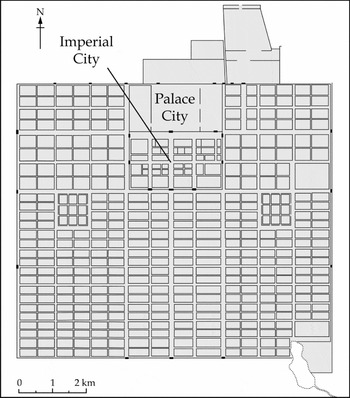
In the urban landscape, settlement walls are one of the most salient and impressive features, producing a powerfully perceptible boundary between the city and the countryside, marking inclusion and exclusion, and symbolizing the distinctive identity of urban dwellers. In the early Chinese model of urban planning, the massive square walls facing cardinal directions served as the fundamental instrument of creating, delineating and reproducing the proper spatial order set forth by the god(s). A city was thus shaped as a cosmogram where the rulers joined their realm to divinity (Wheatley Reference Wheatley1971). Particularly relevant to this discussion of Liao cities is Chang'an, the capital of the Tang dynasty in the Chinese Central Plain of whom the Liao claimed to be the successor (figure 2). Inside the almost all-embracing settlement walls of Chang'an, the Palace City, the residence of the royal family; the Imperial City, housing offices in the central government; and regular neighbourhood blocks constituted the urban space, all of which were rectangular enclosures (Heng Reference Heng1999).
Tang Chang'an (after Heng Reference Heng1999, 5, figure 6).

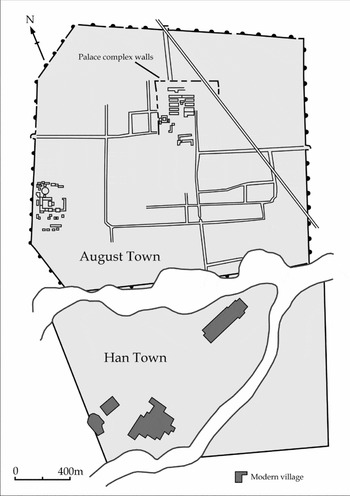
Since the Liao court made a significant effort to represent the empire as a heavenly ordained polity as the sedentary Chinese empires claimed to be, Chang'an became the primary model for the Liao Supreme Capital (Steinhardt Reference Steinhardt1997, 6; see figure 3 for the latter). The city walls are still visible today. The northern enclosure, the August Town, was close to a square. A walled palace complex was built slightly north of the centre of this section. Administrative offices, imperial workshops, temples sponsored by the empire or by members of the royal house, and residences for high-status elites were extensively constructed in the August Town (Tuotuo Reference Tuotuo1974, 440–41). The southern enclosure, i.e. the Han Town, was also close to a square. This section provided space for resettled populations (Neimenggu Reference Li and Wei1994). While the separation of the city into two major enclosures was not seen at Chang'an, the significance of which will be addressed below, the square ordering of walls and the nested plan seem to have been a deliberate tactic to affiliate the Supreme Capital with Tang Chang'an, the once-imagined centre of ‘all under Heaven’.
Liao Supreme Capital (after Zhongguo Dabaike 1986, 278).

Not only did the city walls of the Supreme Capital follow the Chinese model, but also many other emerging Liao cities were shaped as a square or rectangle with four sides facing the cardinal directions, when topography allowed (Feng Reference Feng1988). For example, the city walls of Yongzhou were very close to a square. The four sides were all lined along cardinal directions (Jiang and Feng Reference Jiang and Feng1982). Since the majority of residents in new Liao cities were resettled populations from the Chinese Central Plain, such an emulation of Chinese urban principles invited emotional attachment of transplanted dwellers to these Khitan settlements, and thus pacified and propitiated these emigrants who became subjects of an alien polity. On the other hand, following the imperial Chinese model, the city walls of Liao settlements also evoked a sensuous feeling of legitimacy of the empire.
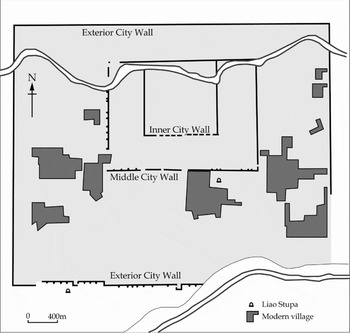
Nevertheless, the Khitan did not passively borrow Chinese built aesthetics, but creatively transformed them to serve the needs and interests of nomadic rulers. The Liao Central Capital, which was built in the early 11th century, is an excellent case to demonstrate this. Compared with the Supreme Capital and other early Liao cities, the most striking characteristic of the Central Capital is its threefold nested plan (figure 4). The exterior and middle enclosures were rectangles, while the inner one was a square. The middle and inner enclosures shared part of wall. The walls of all three enclosures perfectly followed the cardinal directions (Liaozhongjing Reference Weiyuanhui1961). Such a plan was an unprecedented feature of Bianliang, the imperial capital of the Northern Song, the Liao's rival polity in the Central Plain (A.D. 960–1127). It seems that the Central Capital was an imitation of Song Bianliang, instead of Tang Chang'an (Yang Reference Yang2003, 448–52). This remaking of imperial spatial strategy must be understood in the shifting historical context. As I argue elsewhere (Lin Reference Lin2010), the Liao emperor Shengzong built the Central Capital to compete with the Song dynasty for the Heavenly mandate. After its construction, the Song envoys always stopped at this capital on their trip to meet the Liao emperor travelling in the Liaoxi steppe. Besides the consideration of taming the subjects, very likely Shengzong intentionally designed the city walls to mimic the Song capital in order to impress the Song emissaries. Indeed, the Song historical documents show that the Song diplomats were very sensitive to the layout of the Liao Central Capital and did not hesitate to compare it with Bianliang (Jia Reference Jia2004, 61–67).
Liao Central Capital (after Liaozhongjing Reference Weiyuanhui1961, 35, figure 2).

In sum, while settlement locations were chosen to remake and enforce Khitan identity, the shape of Liao city walls adopted the Chinese rectilinear model, indicating that the Liao rulers deliberately combined different cultural elements to produce a distinct mode of perception, contributing to the making and marking of a new form of imperial ideology. This conclusion can also be well demonstrated by the observations of other aspects of Liao urban perceptions, such as the arrangement of architectural orientations addressed in the following section.
Architectural orientations and the Khitan identity
Spatial perceptions of directionality were politically significant in ancient China and its neighbours. In imperial Chinese urban planning, the ruler was placed in the centre, a position of consummate power, facing south. In other words, the north–south orientation was the organizing axis of a city as a microcosmic universe. Moreover, architecture was also primarily arranged along the north–south dimension, with the major entrances open to the south. As we can observe from Tang Chang'an, the axis of the city was the primary street that began with the gate in the middle of the southern exterior wall and ended in the palace complex in the north (figure 2). The summit of this axis was the primary hall in the complex where the imperial throne was situated. Sitting on the throne, emperors always faced south during imperial ceremonies or regular political meetings with high-status officials. This spatial model was maintained during the entire era of imperial China with only a handful of exceptions (Steinhardt Reference Steinhardt1990).
Liao cities were one such exception, in which the east was granted the consummate power, cosmically, symbolically and politically. The sun worship was of paramount importance in the traditional Khitan religion. Since the east is where the sun rises, the worship of the east became a critical component of the Liao royal ritual system. The Liao history records that ‘whenever sacrifices are offered, they [the participants] have to face east’ (Tuotuo Reference Tuotuo1974, 1542). It has also been pointed out that the Liao emperor entered from and faced the east when giving audience to the Song ambassadors (Chai Reference Chai, Zhang and Guo1990). The supreme role of the east in Khitan worship deeply impacted architectural orientations in Liao cities.
A Song ambassador recorded on his visit in A.D. 1008 that the principal structures of the Supreme Capital, where the emperor occasionally stayed, were several leather tents and two halls that all faced east. Additionally, another Song official observed that the inner city of the Liao Southern Capital was unusually located in the south-west of the city and that only its eastern gate was regularly open while the remaining three were normally inaccessible (Jia Reference Jia2004, 48, 108). Archaeologists have confirmed that a number of primary architectural structures were indeed opened to the east in the Supreme Capital (Neimenggu Reference Li and Wei1994).
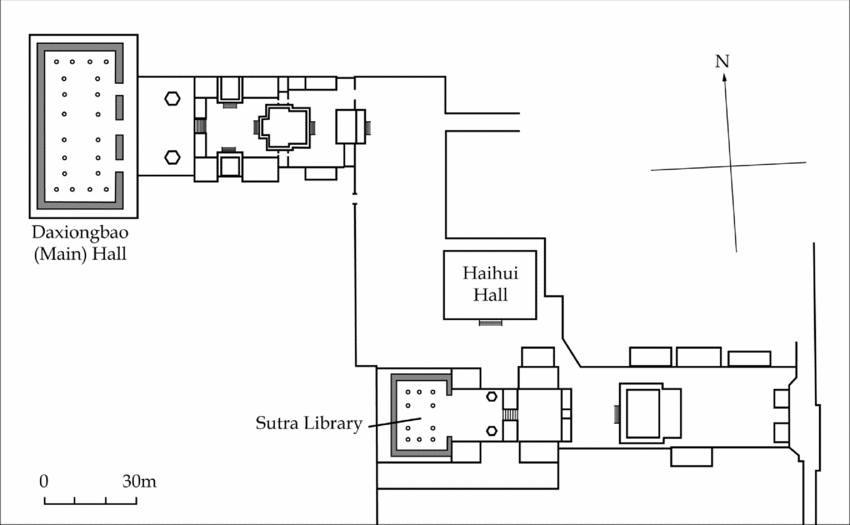
Since very little detailed information regarding the architectural remains in Liao cities has been published, here I limit discussion to one example from the Liao Western Capital to further demonstrate the compelling link between the distinctive east orientation, Khitan identity and imperial power. The Huayansi (Avatamsaka) Buddhist monastery, located in modern Datong, i.e. the Liao Western Capital, is one of the few extant temple complexes originally built during the Liao dynasty. The monastery began as part of a programme of religious building sponsored by Emperor Xingzong and remained a very populous religious site thereafter (Steinhardt Reference Steinhardt1997, 124–26).
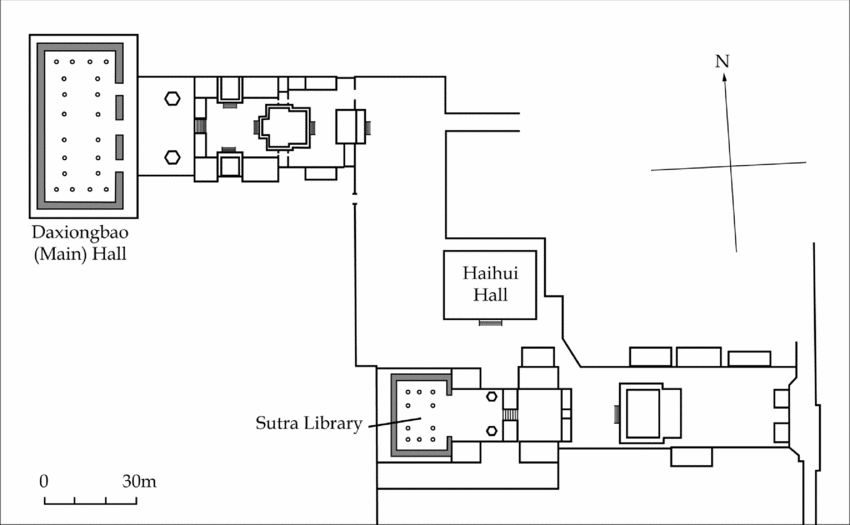
Scholars have paid special attention to Huayansi because of its peculiar orientation. Not only the entire monastery, but also two main buildings – the Daxiongbao hall and the Sutra library – are oriented toward the east (figure 5). As Nancy Steinhardt (ibid., 139) notes, ‘Chinese monastery and palace architecture is almost always oriented toward the south, the cardinal direction, whose associations with the Chinese ruler seated on his throne facing south are as old as the imperial tradition’. Therefore scholars unanimously interpret the eastward orientation as the result of the Khitan worship of the sun that was a crucial part of the imperial investiture rites. In other words, such an orientation was a representation of imperial power and identity (Ding Reference Ding1980; Yuan and Tang Reference Yuan and Tang1982).
The Huayansi Liao Buddhist Monastery (after Steinhardt Reference Steinhardt1997, 124, figure 118).
While the Liao eastward orientation represented an architectural discourse of belief through which the emperors and elites reasserted their unique identity, camping in cities was another peculiar practice that was an equally powerful way to politicalize the urban landscape in order for the rulers to construct their legitimacy through remaking the nomadic tradition.
Camping sites and the nomadic tradition
In the ancient Chinese discourse of ‘the city’, the central structure was the ruler's residence that was designated as gong, which literally means ‘imperial palace’ in Chinese. Manipulating this ideology, the Liao did build permanent structures for the emperors in cities and adopted the term gong for them. Nonetheless, these substantial buildings often remained unoccupied. According to historical sources, when the imperial court visited the Supreme Capital, for example, the royal house often camped in the palace complex. Consequently large open spaces were reserved particularly as camping sites. Moreover, administrative offices were also set up in tents inside the city walls. Archaeologists have not only verified this statement from the transmitted texts, but have also offered new information. In particular, the royal campsites were largely located in the north-east of the palace complex, and the northern part of the August Town also mainly served as campsites, likely for the Khitan elites and soldiers (Neimenggu Reference Li and Wei1994).
Such a pattern can also be observed at the Central Capital. An archaeological survey has concluded that between the outer and middle enclosures, residential buildings were concentrated in the south, while the north was mainly reserved for campsites. Only two substantial structures have been found between the middle and the inner enclosures, indicating that this area served as campsites too (Li Reference Li and Wu2007). Furthermore, even when the emperors went to cities located in the sedentary agricultural territories controlled by the Liao, they often rested in tents set up in them (Yang Reference Yang1991, 112–15). Therefore, the imperial practice of transforming a city to campsites seems to be a deliberate strategy of the Khitan rulers to reproduce the nomadic tradition to create their distinctive imperial identity and legitimacy.
As Rogers, Ulambayar and Gallon (Reference Rogers, Ulambayar and Gallon2005, 811) observe, in urban centres on the eastern Eurasian steppe, large areas are typically devoid of architectural evidence, implying the presence of tent neighbourhoods. Such a tradition of urban planning is testimony that eastern Eurasian nomads developed a unique way to legitimize their polities; that is, the making of an imperial genealogy through tent-living. Through situating tents alongside perennial buildings inside substantially walled and protected palace complexes, the centre of the world in the imperial Chinese imagination of political landscape, the Liao discourse of legitimacy was formed in the adoption, transferring and remaking of urban forms and symbols from both eastern Eurasian and Chinese political practices of place making. Nevertheless, as I will show in the next section, the Liao strategies were not designed to claim the equal statuses of the nomadic Khitan and the conquered settlers; rather, the nuanced way of creating an ethnic landscape in Liao cities suggests that the ultimate goal was to enforce the authority of the Khitan rulers.
Spatial segregation and ethnic boundaries
The Liao Empire governed an ethnically heterogeneous subject population. According to Wittfogel and Feng (Reference Wittfogel and Feng1949, 52–58), the population of the Khitan was only around one-quarter of that of the sedentary Han Chinese and Bohai together, the two other major ethnic groups in the Liao territories. Hence the Khitan rulers made efforts to consolidate power through representing themselves as universal emperors who transcended the ethnic boundaries, as the above discussion has demonstrated. On the other hand, they perfectly understood that one crucial foundation of this polity was the loyalty of the nomadic Khitan warriors. So a most critical issue for the imperial court was to achieve and maintain the Khitan constancy towards the royal house. The perception of the Khitan as a divinely superior ethnic group that collectively ruled was created as a fundamental instrument for this purpose and for convincing the non-Khitan subjects of the Khitan legitimacy. Therefore the ethnic differences between the Khitan and the others were (re)defined, (re-)created, and/or reinforced in the production of Liao urban landscapes.
Many Liao cities were composed of an August Town and a Han Town. August Towns were reserved for the Khitan, while the so-called Han Towns provided residential space for the Han Chinese and others. For example, at the Supreme Capital, around 7,000 households of Han Chinese and Bohai were resettled in the separate Han Town (Han Reference Han1999, 48–50). Given the impressive sizes of both the August Town and the Han Town, and the large population in the latter, it is remarkable that only one gate was opened on the 1.6-kilometre-long wall dividing them (Neimenggu Reference Li and Wei1994). This indicates an elaborate endeavour of the Khitan rulers to effectively control and reshape residents in the Han Town and to produce and reproduce the symbolic loftiness of lords against subjects, in this case the Khitan against the other ethnic groups, by restricting the latter's access to the August Town.
Spatial segregation not only served to highlight the Khitan identity, but also was manipulated as a political instrument of remaking ethnicity. Although the Khitan aristocrats occupied many important positions in the government, a large number of non-Khitan officials also rose to high posts. Throughout the imperial period, only four persons besides the emperors were honoured to establish ordo, a specific organization of elite cavalry guard. Among them two were empresses, one was a prince, and the other was a Han Chinese who can be considered the most powerful individual besides members of the royal family throughout the history of the Liao. The emperor also bestowed the imperial surname upon this Han Chinese and even commanded a male royal member to be adopted by him since he was heirless (Wittfogel and Feng Reference Wittfogel and Feng1949, 507–17). The incorporation of non-Khitans into the imperial lineage was not an experience limited to this apparently unique situation predicated on personal imperial patronage and cultural traditions of adult adoption, but was an aspect of imperial policy and law (Crossley Reference Crossley2010). Through a process of rebirth such as this, many non-Khitan elites were transformed into Khitan and presumably granted the privilege to reside in the August Town instead of the Han Town. In this sense, urban segmentation was also invented as one of the set of practices to reassign ethnic identity.
Additionally, the Liao rulers were clearly aware that the ethnic consciousness of non-Khitan subjects was potentially destructive of Khitan dominance, and therefore, in contrast, they cunningly mixed the Han Chinese, Bohai and other non-Khitan groups in Liao cities in order to anaesthetize the perception of distinct ethnic identities among these peoples and to decrease the potentiality of their resistances to Khitan power. When settlers were transplanted in new Liao settlements, it was extremely unusual for a single ethnic group to inhabit a city. In almost every case diverse peoples were transferred to one location (Zhang and Lai Reference Zhang and Lai2001, 10–67). It seems that the Khitan rulers masterfully created different forms of political practice involving ethnicity in the urban environment, producing a superior, cohesive and well-marked Khitan landscape on the one hand and a multiethnic non-Khitan landscape on the other. Such a twofold agenda was also adopted in the shaping of sacred places in Liao cities.
Sacred places and imperial propaganda
The last aspect of Liao urban landscapes I discuss is the making and remaking of religious and worship sites. Imperial control of religious and ritual discourses and activities is an important realm of political practices and has dramatic effects on the construction of power. The Liao urban ritual places were produced to be perceived as a landscape of a divinely ordered, coherent and peaceful world, in order to conceal conflicts and violence between rulers and subjects and between the Khitan and other peoples. The borrowing and transformation of Buddhist, Daoist and Confucian spaces especially, as a strategy to reshape vanquished settlers, accompanied the establishment of the Liao Empire and the extensive urbanization of the Liaoxi steppe from the very beginning. Below I first demonstrate how and why Buddhism, Daoism and Confucianism were incorporated in Liao urban landscapes, and subsequently turn to the role of imperial ancestral worship in the formation of built environments of Liao cities.
Buddhist, Daoist and Confucian landscapes Buddhism was introduced into the Liaoxi steppe with the arrival of Han Chinese and Bohai captives. The first Buddhist monastery, Kaijiao, literally meaning ‘the commencement of teaching’, was constructed in A.D. 902 when Longhua, the first urban settlement established by Emperor Taizu in the steppe, was built. This royally sponsored monastery does not indicate the conversion of Taizu to Buddhism, but reveals his political wisdom of pacifying captives by appealing to the religion of the conquered (Liu Reference Liu1996). In A.D. 909 Taizu sent a high-status Han Chinese official to establish a stele in another monastery built in Longhua to commemorate his achievements and virtues as a ruler. Again, in A.D. 912, Taizu sponsored the construction of a monastery, hosting dozens of captured Buddhist monks, named by him Tianxiong, meaning that Heaven aided the development of his martiality, in order to demonstrate and justify his military accomplishments in the name of Heaven (Tuotuo Reference Tuotuo1974, 4). Contested fields of divinity, rituality and monumentality, Buddhist sites occupied a central position in the urban planning of Liao cities.
However, in A.D. 918 Taizu decreed that both Buddhist and Daoist monasteries and a Confucian temple be built in the Supreme Capital, and personally made his pilgrimage to the latter while ordering the empress and heir apparent to offer sacrifices to the Buddhist and Daoist monasteries respectively. The production of Daoist and Confucian buildings besides the Buddhist site made and marked a new development of the imperial Liao concept of urban landscape and subsequently a transformation of imperial legitimacy and ideology. The Liao history (Tuotuo Reference Tuotuo1974, 1209) records an important conversation in the Liao court that runs,
Taizu asked his attending courtiers, ‘The ruler who receives the mandate should serve Heaven and revere the gods. I want to worship those who have great merit and virtue. Who is the foremost?’ All replied, ‘Buddha.’ Taizu said, ‘Buddhism is not a Chinese religion.’ Bei [Taizu's eldest son] said, ‘Confucius, the Great Sage, who commands the reverence of every age, should be the foremost.’ Taizu was greatly pleased and thereupon founded the Temple of Confucius. A decree ordered the imperial heir apparent to offer sacrifices in the spring and autumn (tr. Wittfogel and Feng Reference Wittfogel and Feng1949, 298).
Eventually, Taizu adopted the orthodox Chinese imperial ideology to legitimize Khitan rule. But I emphasize here that – unlike the text seems to suggest, undoubtedly under the influence of sinitic prejudice – he did not simply give unchallenged priority to Confucianism. The simultaneous sponsorship of Buddhism and Daoism indicates that the founding dynast manipulated and balanced diverse sources for legitimization. The Supreme Capital, where different monasteries and temples were located, was produced as a transformative social landscape in which religions were redefined for the emperor to reproduce himself.
Moreover, although the Liao court tended to develop Confucianism in order to create a pool of literati as candidates for imperial bureaucrats (Zhang Reference Zhang, Zhang, Huang and Yu2006), the Khitan elites usually sided with Buddhism. A historical document records a story that when a Khitan elite gave a banquet in a Confucian temple on the day when sacrifices to Confucius were supposed to be offered, a group of Khitan ladies, showily dressed, entered the hall where the sculpture of the bearded Confucius was erected. One lady asked who the bearded man was, and another answered that he was just the one who cursed ‘us barbarians’. In laughter these ladies left (Tao Reference Tao1988, 173). The stateliness, loftiness and sanctity of this spiritual space essential to Confucianism was destroyed, or redefined, by the consumption of food and entertainment, the dressing of female bodies and the satire of Confucius. True or not, this story reveals the tension between orthodox Confucianism and the legitimacy of a nomadic empire. Because of this, the royal house made enormous and continuous investments in Buddhist buildings, which were commonly considered to be representative of Liao cities in the writings of Song ambassadors (Jia Reference Jia2004, 102).
Indeed, all extant above-ground Liao buildings are Buddhist structures once standing in Liao cities (Steinhardt Reference Steinhardt1997). Among the ruins of the Central Capital, two Buddhist pagodas, as the only remaining Liao constructions besides city walls, stand tall, of which one is 80.2 metres above the ground, the third-highest ancient pagoda in China. The diameter of the foundation of this octagonal structure is 36.6 metres, and its volume is the largest among extant ancient Chinese pagodas (Wu Reference Wu1997, 70–126). Because pagodas were normally the highest buildings in a city, they tended to dominate the skyline and consequently to profoundly impact the perception of the built environment among residents and visitors alike.
Furthermore, Buddhist buildings were also manipulated as a political instrument for emperors to remake Khitan elites. It was recorded that the sovereign granted the petition of the son of a deceased high-status official to inscribe the meritorious service of his father on a stone that was erected in a Supreme Capital Buddhist monastery named Chongxiao, meaning ‘esteeming filial piety’, which indicated the approval of the act of this son (Tuotuo Reference Tuotuo1974, 1362–63). But filial piety was one of the core values of Confucianism and was incompatible with Buddhist thought. This suggests that a programme of Buddhist building sponsored by the royal court could be oriented towards the remaking of Buddhism in the formation of imperial ideology that was not the result of a process of systematic, coherent and abstract reasoning but contained a congeries of diffused sources, sometimes even contradictory, for practical political needs.
To sum up, the royal court deliberately sponsored diverse programmes of religious buildings in Liao cities, including structures for Buddhism, Daoism and Confucianism, all of which were referred to in legitimizing the empire. But different religions were not integrated in a smooth unfolding of an orderly and harmonious design. Instead, urban landscapes were developed in the competition, confrontation and collaboration of different beliefs and ideologies. As sovereigns, Liao rulers made efforts to shape and reshape religious sites as public spaces where imperial ideology and legitimacy were propagandized.
Imperial ancestral landscapes Besides the borrowing, transfer, transformation and remaking of forms of religious buildings, the Liao court also created many places for worshiping imperial ancestors in urban settings. While Buddhist, Daoist and Confucian temples served as public spaces, royal ancestral temples were normally located in the palace complex and therefore were not accessible to commoners. But, on the other hand and much more strikingly, new cities were continually built as monuments dedicated to deceased emperors. When an emperor met his death, as a rule a large walled settlement would be built beside the imperial mausoleum, together with which the city constituted the distinctive Liao monumental landscape transforming royal ancestors into deities. Such a dualism, with a living city and a mausoleum both devoted to the deceased emperor, was a peculiar political practice that by many means served to legitimate the royal house.
For example, only two kilometres east of the tomb of Emperor Taizu, Zuzhou was established to memorize him. It was a large, massively walled settlement. The city walls enclosed an area of around 18 hectares. The site was divided into the northern and the southern segments, and the quadrangle Palace City of around 4.4 hectares was situated in the centre of the former (Han Reference Han2006, 44). The major structures of the Palace City were a number of temples built to worship the founding emperor. The southern segment and the suburbs seem to be the residential areas for at least 3,000 households of resettled population, which were engaged in daily services for the mausoleum (Zhengxie 1999, 46–52).
Qingzhou is another instance of a monumental city dedicated to an emperor. The double enclosures were both quadrangles with sides perfectly following the cardinal directions. The exterior enclosure is 1,880 by 1,440 metres, and the interior one is 1,090 by 930 metres, with four gates all at the medians of the walls. Streets oriented east–west and north–south have been discovered. A pagoda has survived from a Buddhist monastery in the north-west of the inner enclosure (Zhengxie 1999, 53–55).
In sum, sacred places for ancestral worship, including monumental cities, occupied an eminent position in Liao urban ritual landscapes. These structures contributed to the making and remaking of a perception in which imperial legitimacy was sanctified by ancestral merits and divinity.
Conclusion
This paper has discussed how Liao urban landscapes were produced and reproduced in the formation of imperial identity, power and legitimacy. I have approached the transformative power of landscape as built environment by human agency from the perspective of spatial perception. Six forms of urban spatial order were analysed, including settlement locations, city walls, architectural orientations, campsites, spatial segregation and sacred places.
Settlement locations of Liao cities were largely chosen to reproduce the Khitan social memory of ancestors and subsequently to enforce imperial authority. Unlike settlement locations that provided a native source for the formation of a legitimating ideology, the shape of city walls was designed according to the Chinese model. In other words, the Chinese discourse was combined with Khitan elements to create the distinct imperial Liao urban landscape. This organizing tactic of spatio-political practices could also be observed in other aspects of urban perception. Architectural orientations and campsites in Liao cities were important foci of the imperial court to reinforce the identity of the nomadic Khitan. But the royal concern in spatial segregation was more comprehensive. On the one hand, the Khitan ethnicity was granted paramount status, and ethnic difference was distinguished and emphasized. On the other hand, ethnic boundaries were often transcended and ethnic distinctions were blurred. In terms of sacred places, diverse ideological discourses were manipulated in the production of ritual landscapes. As the result of negotiated political practices, sometimes a place was born to express contradictory religious thoughts. In short, the fundamental strategy of the Liao authority was to produce urban perceptions in which the rulers appeared as the universal emperors while maintaining their Khitan identity.
In mapping out these elements of the physical city, it is clear that the Liao urban landscapes were quite profoundly shaped by royal authority. However, I have not argued that the Liao rulers were the only locus of spatial production within the city. As Adam Smith (Reference Smith2003, 228–30) has noted, the subjects of a city are also deeply implicated in its creation, and the production of urban spatial perception cannot be located simply in an elitist account of urban politics centred on the ruler. Therefore a broader perspective to incorporate variously sited grass-roots agencies is desirable. Indeed, I have attempted to demonstrate the complex and dynamic interplay of the royal authority and other Khitan elites in the perceptions of the Confucian landscape in the above discussion. Nevertheless, for practical reasons – mainly the ruler's privileged controls over texts and the preliminary stage of archaeological work, this article has been largely confined to the royal apparatus.
Seen from the perspective of political productions, Liao urban landscapes did not emerge simply as by-products of a certain stage of social evolution, or as natural results of local ecological conditions, but rather were brought forth as one of the creative political instruments constitutive of authority formed and transformed by political practices. In this process, the traditions of nomadic pastoralism with ties to eastern Eurasia were manipulated and remade along with Chinese urban planning. This indicates that the nomadic Khitan did not simply emulate political strategies of settled agricultural polities in the heartland of China, but rather produced a radically new form of imperialism. Nomadic empires emerging in eastern Eurasia must be seen in a process of mutual co-constitution with their sedentary neighbours in the Chinese Central Plain and elsewhere. We should view these two intermingling social and cultural formations neither as distinct entities nor as a unidirectional impact of settled complex communities. Rather, we should understand the interconnections in much more fluid terms.
As hybrid political and social forms, nomadic empires have often been depicted as ‘parasitic’ on settled agricultural societies. But this paper has argued that the forces driving political formation within nomadic communities were not simply determined by external stimulus from their sedentary neighbours, but came from diverse interconnected sources. The production of political authority within nomadic empires often relied on a deliberately invented relationship between nomadic pastoralism, agriculture and urbanism, with all three creatively remade. Because of the passive role assigned to nomadic polities in traditional models, nomadic empires are still undertheorized in studies of the development of complex societies in general. As a concluding remark, I suggest that, contrary to the expectations of conventional understanding, studies of nomadic empires will not only contribute an important comparative perspective on the processes and practices of imperial formation, expansion and fall, but will also lead to a new theoretical approach of empire studies which will integrate urbanism with nomadism, agriculture with pastoralism and perhaps foraging, and other seemingly mutually exclusive social categories.
Acknowledgements
This article is largely based on the second section of chapter 4 of ‘Urban landscape and politics. The making of Liao cities in southeast Inner Mongolia’, my doctoral dissertation submitted to the Department of Anthropology at the University of Chicago in June 2009. I am indebted to Adam Smith, Anne Underhill and Kathleen Morrison for their creative pedagogy. Adam, along with the editors of this journal and two anonymous reviewers, also provided insightful comments on an earlier draft of this paper.