




No CrossRef data available.
Links between marital and parent–child interactions: Moderating role of husband-to-wife aggression
Published online by Cambridge University Press: 01 September 2004
Abstract
The present study examined how marital conflict may compromise parenting by identifying interdependencies across marital and parent–child subsystems in a sample of 86 two-parent families with a child aged 9–13. The study used direct observation of three family discussions to examine interdependencies across family subsystems. The study also assessed whether a history of husband-to-wife aggression strengthened interdependencies. Overall, families with husband-to-wife aggression showed a negative tone that pervaded throughout the family. Consistent with theories about physically aggressive men tending to withdraw from conflict, fathers who had engaged in husband-to-wife aggression showed an association between marital hostilities and lower levels of empathy toward their children. Consistent with stress theories, women who had been exposed to husband-to-wife aggression showed a link between marital hostilities and negative affect when interacting with their children. These findings illustrate how a history of exposure to marital aggression can create a family environment of multiple risks for children. For children in families with prior marital aggression, ongoing marital hostilities can be linked to the additional risk of erosions in parental support.This study was partially supported by a grant from the David & Lucile Packard Foundation, NIMH Grants R01MH36595 and F31MH10947, NICHD Grant K23HD041428, and a California State University, Fullerton, Junior Faculty Research Grant. We are grateful to our USC Family Studies Center colleagues who helped collect these data, to the dedicated groups of coders, and to the families who participated in the study.
Information
- Type
- Research Article
- Information
- Copyright
- © 2004 Cambridge University Press
Within the large sphere of influences on child development, family relationships contribute significantly to children's behavioral and developmental well-being (Caspi, 1993; Dishion, French, & Patterson, 1995; Reis, Collins, & Berscheid, 2000; Rutter, 1988; Sroufe, Carlson, & Shulman, 1993). In particular, interactions in the marital and parent–child subsystems provide important contexts for normal and abnormal child development (Buehler, Anthony, Krishnakumar, Stone, Gerard, & Pemberton, 1997; Cicchetti & Toth, 1995; Cowan & Cowan, 2002; Cummings & Davies, 1995; Emery, 1982; Gottman & Katz, 1989; Grych & Fincham, 1990; Margolin & Gordis, 2000). Family researchers initially studied family subsystems as separate entities, each having its own impact on child development. Recently, interest has focused on the impact of multiple family subsystems and the interdependencies among those family subsystems as they relate to child development (Cox & Paley, 1997; Hinde & Stevenson–Hinde, 1988; Margolin, 1981; McHale, Kuersten, & Lauretti, 1996).
The connection between the marital relationship and the parent–child relationship has received the most attention, largely because these two relationships are implicated, independently and in combination, in the development of child problems (Belsky, 1984; Erel & Burman, 1995; Grych & Fincham, 1990; Margolin, Oliver, & Medina, 2001). Erel and Burman's (1995) meta-analysis on the linkage between marital and parent–child subsystems reveals an “effect size of moderate magnitude,” but still leaves a number of issues to be examined regarding circumstances that potentiate connections between those family subsystems. The present study is designed first to examine connections among the marital and parent–child family subsystems. Second, the study explores whether a history of domestic violence in the family affects marital and parent–child interactions and potentiates connections across family subsystems.
Interdependencies Among Family Subsystems
Although several theories explain how transactions in one family subsystem influence another family subsystem, the idea of mutual influences originated with systems theory, which had, as its fundamental assumption, the concept that component parts of the family system are interdependent (Minuchin, 1985). With respect to the connection between marital tensions and parenting, this theory holds that difficulties in the marital relationship can lead to intensified parent–child relations. The intensification can be exhibited in parent–child relations that either are emotionally overinvolved or emotionally distant and conflictual (Haley, 1976). When clear boundaries exist between the marital and the parent–child subsystem, spouses have their own separate adult relationship, and also are available to meet the emotional and physical needs of their children. Without clear boundaries, conflict from the marital relationship may intrude upon the parent–child relationship and alter the nature of that relationship.
Emotion transmission or spillover theory (Erel & Burman, 1995; Margolin et al., 2001; Repetti, 1987) provides a related but distinct explanation for interdependencies among family subsystems. According to this theory, negative emotions experienced in one situation may increase a person's sensitivity to irritating or ambiguous stimuli in different situations or may cause that person to behave in a negative way in the later situation. The research on spillover has focused on demonstrating how events and emotions experienced in one context relate to a person's emotional reactions with family members in another context, and can even relate to the other family members' emotional reactions in return (Larson & Almeida, 1999; Repetti, 1989).
Although the spillover or spread of emotions can go in any direction, the most consistent pathways of influence have been demonstrated from the marriage to parent–child relations. Spouses' inabilities to regulate and control negative affect in the marriage have been shown to “leak out” and be expressed in other family relationships. Margolin, Christensen, and John (1996) collected daily report data showing that marital tensions were more likely to spill over and to increase the likelihood of parent–child tensions and sibling tensions than vice versa. Almeida, Wethington, and Chandler (1999) also report that marital emotions, especially husbands' emotions, influence parent–child interactions. Although spill over suggests a temporal connection between emotions experienced in two subsystems of the family, links between the marital relationship and the parent–child relationship also have been demonstrated through overall associations in emotional tone across family subsystems (e.g., Fauchier & Margolin, 2004; White, 1999). Comprehensive reviews (Crockenberg & Covey, 1991; Erel & Burman, 1995) support the overall linkage between marital relations and parent–child relations.
The specific mechanisms behind spill over can be quite varied. Spill over may not be due only to the continuance of negative affect, but may reflect a cognitive state in which one is preoccupied and self-absorbed. This negatively biased cognitive state could limit empathy and perspective taking, and be exhibited in a lack of accessibility in other relationships. Thus, despite considerable focus on the spread of conflict or other negative emotions, research has also shown spill over to be expressed through the withdrawal of positive emotions. Repetti (1994) and Repetti and Wood (1997), for example, provide evidence that parents' work stress spills over to parent–child relationships as withdrawal in some circumstances and anger in others. Within families, the research strongly supports links in which negativity in the marital relationship is associated with negativity in the parent–child subsystem, but also suggests that marital conflict is inversely associated with positive parent–child relationships. Parents experiencing high marital conflict appear to be more rejecting and hostile, as well as less warm, less available emotionally, and more withdrawn (Fauber, Forehand, Thomas, & Wierson, 1990; Fauchier & Margolin, 2004; Harold & Conger, 1997; Mann & MacKenzie, 1996). In contrast, some research also supports a compensatory effect in which high marital negativity is associated with a high level of positivity in parent–child relations, particularly the mother–child relationship (Belsky, Youngblade, Rovine, & Volling, 1991; Brody, Pillegrini, & Sigel, 1986; Mahoney, Boggio, & Jouriles, 1996).
Observational studies offer a unique window into the study of patterns of emotional contagion. Generally, higher levels of observed marital conflict are associated with either more rejecting behaviors or less involvement in parent–child relations. Kitzmann (2000) reported a connection between marital conflict and lower support and engagement from fathers but not mothers. Lindahl and Malik (1999) found that marital conflict related to rejecting, coercive, and nonsupportive behaviors for fathers, but related primarily to withdrawal for mothers. Katz and Gottman (1996) report that hostility observed in marital interactions was associated in triadic discussions with fathers' higher levels of intrusiveness and lower levels of positive involvement, and with mothers' derisive humor. Marital conflict thus has been linked to overtly negative as well as unsupportive parenting behaviors. Researchers have reported gender differences, but the nature of these differences is inconsistent across studies.
Role of Marital Violence in Links Between Marital Hostilities and Parenting
An important question regarding influences across family subsystems is why connections tend to be stronger in some families than in others (Larson & Almeida, 1999; Margolin et al., 1996; Margolin & Gordis, 2003). Why do negative emotions spread across family subsystems in some families but remain contained within one subsystem in other families? Patterson and Forgatch (1987, p. 8) describe the “cloud of unpleasantness” that comes to characterize certain families. This family characteristic is a combined outcome of family members' individual propensities for irritability as well as a mutual training process in the home in which negative interactions become normative in certain families (Patterson & Dishion, 1988). These patterns of mutual and multidirectional negative interactions may become quite pervasive if they are exhibited in routine communications, in addition to major conflicts.
A key purpose of this investigation is to examine whether the links between marital hostilities and parenting behaviors are stronger in families with a history of marital violence than in families with no such history. It is possible that if prior conflicts have become violent, those earlier experiences might affect how family members interact in later conversations, particularly conflictual ones. For most family members, the occurrence of marital violence is a fundamental violation of family members' expectations of support, understanding, and safety in the family environment, and creates a troubling situation for both the aggressor and the victim (Margolin & Gordis, 2000; Rosenbaum & Maiuro, 1989). Thus, once violence has occurred, each new conflict may elicit heightened apprehensions in family members about the risk to their own emotional and physical safety as well as to overall family stability. Perceptions of heightened risk, particularly if accompanied by heightened irritability or wariness, may strengthen the emotional connection between the marital and the parent–child subsystem.
There are likely to be differences between husbands and wives in the way that husband-to-wife aggression affects the link between marital hostilities and their parenting. In line with Engfer's (1988) “common factor” hypothesis, husbands who physically aggress against their wives may have a harsh, demanding interpersonal style in both marital and parenting interactions, exhibited as a negative tone in both interpersonal situations. Links involving withdrawal also might be expected in that physically aggressive men show a tendency to withdraw from even low level conflict, most likely as a way to avoid the escalation of conflict (Margolin, 1988). Links in women's behavior across family subsystems may be related to the stress of living with husband-to-wife aggression (Appel & Holden, 1998). As hypothesized by Levendosky, Lynch, and Graham–Bermann (2000), living with husband-to-wife aggression may lead to a sense of deprivation, heightened sensitivity to negative stimuli, and overall irritability that may be exhibited in the mother's parenting behaviors. Strict enforcement of rules also may be the mother's way to keep children in line in the face of an aggressive husband.
Data already exist indicating that marital violence relates to communication behaviors. As we might expect, observational coding of laboratory-based nonviolent marital discussions indicated that both husbands and wives from violent marriages display more overtly negative behavior, more angry affect, and more contingent, reciprocal reactions to each other's anger (Burman, Margolin, & John, 1993; Jacobson, Gottman, Waltz, Rushe, Babcock, & Holtzworth–Munroe, 1994; Margolin, John, & Gleberman, 1988). We know less about whether marital violence influences parent–child communications. Using coded interactions between mothers and children, Levendosky and Graham–Bermann (2000) reported that physical abuse experienced by mothers relates to mothers' lower warmth to children, but they found no effects for authority or control behaviors. Coded interactions also have shown that men's physical aggression toward their wives relates to fathers' authoritarian and controlling behavior with their sons but not their daughters; in the same study, men's physical aggression did not relate to mother–child communications (Margolin, John, Ghosh, & Gordis, 1996). In light of these findings that the occurrence of marital aggression can affect the nature of both marital and parent–child interactions, we address the question of whether husband-to-wife physical aggression creates an overall context for family interactions in which marital hostilities leak into parent–child interactions.
The present study
The present study uses observational data to examine links in communication behaviors across family subsystems. The study of communication processes offers a particularly useful means for examining influences across family subsystems. Family influences have been examined with different types of data (interview, questionnaire, daily diary, and observational), with each type of data having its own strengths and contributing its unique piece to the overall picture. Only observational data, however, provide a detailed analysis of the nature and quality of communication processes that is independent of the subjective impressions of the participating family members (Margolin, Oliver, Gordis, O'Hearn, Medina, Ghosh, & Moreland, 1998). Moreover, observed communication behaviors are a reflection of ongoing family dynamics that are frequently repeated and that set the overall emotional tone of a family.
We examine three separate discussions: marital, mother–child, and father–child. A methodological strength of this study is that the marital and parent–child discussions have been coded by two completely different sets of coders, thereby eliminating possible biases emanating from coders' recollections of a family in the other discussions. Because the nature of marital discussions is not the same as parent–child discussions, the different interactions are not measured on exactly the same scales. Nonetheless, the objective here is to examine two patterns of links across family subsystems. We examine both within-person and across-person associations by seeing whether husbands' and wives' marital hostilities relate to their own or each other's negative affect and empathy in parent–child discussions.
In sum, given that the study of relationships is essential to understanding development (Cox, Brooks–Gunn, & Paley, 1999), influences across family relationships constitute a defining feature of the relational context. Although the communications within each family subsystem are significant in and of themselves, children's overall experience of the family is best understood by taking into account multiple family subsystems and the connections between them (Minuchin, 1985). Toward this end, the present study examines two hypotheses concerning associations across family subsystems. First, we hypothesize that more marital hostility is associated with higher levels of parents' negative affect, and lower levels of empathy in the parent–child discussions. For this hypothesis, we test links across family subsystems within one spouse and from one spouse to the other. Second, we hypothesize that the previous occurrence of marital violence strengthens links between hostilities in the marital interaction and related parenting behaviors in parent–child discussions. Relatedly, we anticipate that families who have experienced husband-to-wife aggression, compared to those without husband-to-wife aggression, will exhibit high negativity in more family subsystems overall.
Method
Participants
Participants were 86 families with a target child ages 9–13 inclusive. This sample was a subset of a multistage research project examining marital and family conflict. We recruited 180 participant families for the original study through advertisements for a study of family relations. Participants in the original sample met the following criteria: (a) both parents read and spoke English fluently, (b) both adults were either the biological parents of the target child or had been living with the child since the child was 2 years of age, and (c) the parents had a telephone. We designed this phase of the study to examine half of the original sample intensively through observational methods. Of the 91 families who participated in the follow-up procedures, 86 had complete data from all of the observational tasks and thus provided the data described here.
The mean ages in this sample were 39.7 years (SD = 5.3) for wives, 43.0 years (SD = 6.1) for husbands, and 11.3 (SD = 1.1) for children. Wives' and husbands' mean number of years of education was 14.9 years (SD = 2.1) and 15.1 years (SD = 2.5), respectively. The mean monthly family income was $4673 (SD = $2231) with a range from $660 to $12,000 a month. Children in this sample comprised 52% boys and 48% girls. Seventy-one percent of the families were Caucasian, 20% African American, 1% Hispanic, and 8% biracial. For further information about the sample and procedures, see Gordis, Margolin, and John (1997, 2001).1
Although Gordis et al. (1997, 2001) examined the same sample, no overlap between this study and those studies exists. Gordis et al. (2001) examined child behavior problems as they related to hostility in marital and triadic family discussions. Gordis et al. (1997) investigated the effects of parents' marital aggression and observed hostility on children's observed distress during triadic family discussions.
Procedures
Family triads, including the father, mother, and target child, spent approximately 3 hr in the laboratory. Each family member independently completed questionnaires and answered interview questions. In addition to the self-report measures, the families participated in several structured videotaped discussions. The current research used videotapes of (a) separate 7-min dyadic discussions between each father and his child and each mother and her child concerning an interpersonal problem the child was having outside the family and (b) a 12-min marital discussion of a marital issue unrelated to the child.
Researchers helped parents and children choose topics for these discussions. For the parent–child discussions, children completed a checklist regarding interpersonal problems common to children and adolescents, indicating their level of concern about each problem and selecting one problem to describe to the investigator. This procedure ensured that the child had a definite problem in mind, and that the problem related to a situation outside of the home. For the marital discussion, each spouse independently completed an inventory of common topics of marital disagreement. To select husbands' and wives' topics for the marital discussion, investigators interviewed each spouse and presented the topics each had rated the highest in terms of how much spouses disagreed and how serious or upsetting the disagreement was. Each participant confirmed that the topic was conflictual, and gave details about the issue before the discussion. Couples then spent 12 min discussing these nonchild-related topics.
Measures
Domestic Conflict Index (DCI)
The DCI (Margolin, Burman, John, & O'Brien, 1990) is an inventory that assesses physical, verbal, and emotional aggression in a relationship. The measure consists of a list of 51 behaviors that includes a 14-item physical aggression index. Participants respond to the list, first indicating whether they have ever done the behavior to the spouse and next whether the spouse has ever done the behavior to them. If the behavior has occurred, participants indicate the frequency of the behavior during the previous 12 months. We treated the physical aggression index as a dichotomous variable, delineating groups in which husband-to-wife aggression had or had not occurred within the previous year. Of the 86 families, 59 indicated that no husband-to-wife physical aggression had occurred, and 27 indicated some such physical aggression within the previous year.
Observational data
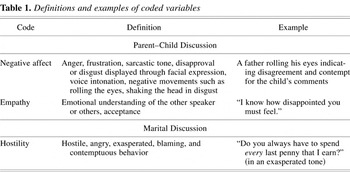
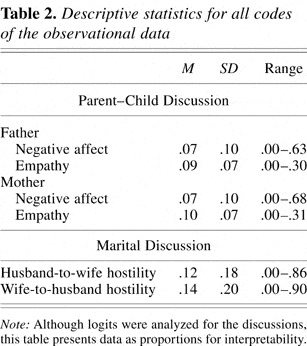
Two observational tasks provide the data for the current study. All coding for these tasks followed the procedures described in Margolin et al. (1998). Specifically, two coders, blind to the hypotheses of the study, independently coded each videotape. For all analyses, we used the mean of the two coders' ratings for each code. Separate, nonoverlapping groups of coders, all of whom were either undergraduate or post-BA level research assistants, coded the two tasks. All coders practiced coding with the protocol for their task on four to eight pilot tapes until they reached an acceptable level of competence. For the entire time that tapes were coded, each group held either weekly or biweekly training meetings led by the researchers to prevent coder drift, to check reliability, and to answer questions from the coders. Table 1 presents code definitions and examples for all the codes used in the current study, and Table 2 presents descriptive statistics, including the means, standard deviations, and ranges.
Definitions and examples of coded variables

Descriptive statistics for all codes of the observational data

Parent–child discussions
Research assistants transcribed the videotapes of the parent–child discussions and verified the transcripts for accuracy. Two coders coded each discussion independently, using a coding system developed expressly for this project. Coders assigned each speaker turn 1 of 19 content codes, 1 of 8 affect codes, and 1 of 6 listener affect codes, only some of which are examined here. We examined two parent summary codes: negative affect and empathy. Negative affect consists of the mean of four codes: withdrawal movement, negative voice, moderately negative movement, and very negative movement. Empathy is a summary of four codes: praise, emotional understanding or empathy for the other speaker, empathy toward others outside the discussion, and acceptance. Code reliabilities, established with intraclass coefficients as suggested by Shrout and Fleiss (1979), were .45 for mothers' negative affect, .51 for fathers' negative affect, .68 for mothers' empathy, and .76 for fathers' empathy. For each code in the parent–child discussions, we determined proportions of the number of speaker turns in a category relative to the total number of speaker turns. We reexpressed these proportions as logits for all analyses, as recommended by Mosteller and Tukey (1977) for the analysis of counted fractions.
Marital discussions
Coders used the Marital Coding System (Gordis, Margolin, & Garcia, 1996) to assess affect and content of marital discussions. Two coders independently evaluated each speaker turn for affect/style and verbal content using 1 of 21 codes. The hostility summary code included anger, exasperation, blame, contempt, and criticism. Code reliabilities, established with intraclass coefficients (Shrout & Fleiss, 1979), were .74 for husband-to-wife hostility and .74 for wife-to-husband hostility. As with the parent–child discussions, we counted proportions of the number of speaker turns in a category relative to the total number of speaker turns, and reexpressed these proportions as logits for the analyses. The use of t tests revealed that wives were more hostile to husbands than husbands were to wives, t (85) = 2.59, p < .05.
Results
Correlations between marital behavior and parent–child discussions
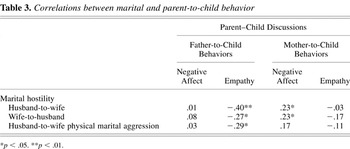
Correlation analyses, presented in Table 3, examined the association between husbands' and wives' hostility during marital discussions and parents' behavior during the parent–child discussions. Table 3 also presents correlations between husbands' physical marital aggression and parents' behavior during the parent–child discussions. Each parent's hostility toward the spouse was correlated with his or her behavior toward the child during the parent–child dyadic discussions. Specifically, husbands' hostility toward wives during the dyadic marital discussion was negatively correlated with husbands' empathy toward the child during the father–child discussion. Wives' hostility toward husbands during the marital discussion was positively correlated with negative affect toward the child during the mother–child discussion. As detailed in the table, each spouse's marital hostility also correlated with the other spouse's behavior toward the child during that spouse's dyadic parent–child discussion. Of note, husbands' empathy toward the child consistently correlated not only with their own marital hostility but also wives' marital behaviors, and with husbands' physical marital aggression assessed on the DCI.
Correlations between marital and parent-to-child behavior

We also examined the associations between husbands' physical marital aggression assessed on the DCI and husbands' and wives' behavior during the marital discussions. Husbands' aggression correlated positively with husbands' hostility toward wives (r = .47, p < .001) and with wives' hostility toward husbands (r = .48, p < .001) during marital discussions.
Regression analyses examining moderating effect of husbands' physical marital aggression on relation between marital and parent-to-child hostility
Regression analyses examined whether the occurrence of husbands' physical marital aggression during the previous year moderated the relation between each parent's hostility toward the spouse during the marital discussion and each parent's behavior toward the child during the parent–child discussion. We conducted within-parent analyses to examine whether husbands' marital aggression affected the relation between each parent's behavior with the spouse and that same parent's behavior toward the child. We also conducted across-parent analyses to examine whether physical marital aggression affected the impact of the hostility from the spouse on each parent's behavior toward the child.
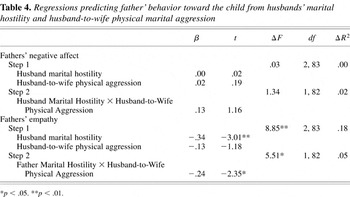
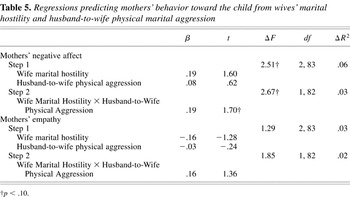
We regressed each parent-to-child behavior on that parent's hostility toward the spouse during the marital discussion and husbands' physical marital aggression (−1 = no aggression, +1 = some aggression during the previous year) in the first step, and the product of the two (created by multiplying the standardized hostility variable with the dichotomous physical aggression variable) in the second step. These regression equations are presented in Tables 4 and 5. For fathers (Table 4), the interaction between husbands' marital hostility and husband-to-wife aggression was negatively significant in predicting fathers' empathy toward the child during the father–child discussions. For mothers (Table 5), the interaction between hostility toward husbands and husbands' physical marital aggression was marginally significant in predicting mothers' negative affect toward the child during mother–child discussions.
Regressions predicting father' behavior toward the child from husbands' marital hostility and husband-to-wife physical marital aggression

Regressions predicting mothers' behavior toward the child from wives' marital hostility and husband-to-wife physical marital aggression

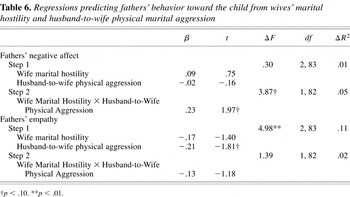
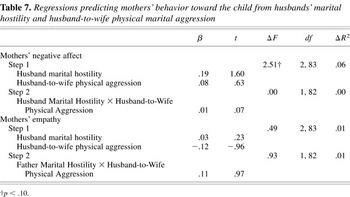
We also examined whether husbands' physical marital aggression moderated the crossover effects of the other parent's marital hostility on each parent's behavior toward the child. We regressed each parent-to-child behavior on the other parent's marital hostility and the interaction between that other parent's marital hostility and husband-to-wife aggression. These regression analyses appear in Tables 6 (effects on father-to-child behavior) and 7 (effects on mother-to-child behavior). We found only one interaction effect. The interaction between wife-to-husband marital hostility and husband-to-wife physical marital aggression was marginally significant in predicting fathers' negative affect during the father–child discussions.
Regressions predicting fathers' behavior toward the child from wives' marital hostility and husband-to-wife physical marital aggression

Regressions predicting mothers' behavior toward the child from husbands' marital hostility and husband-to-wife physical marital aggression

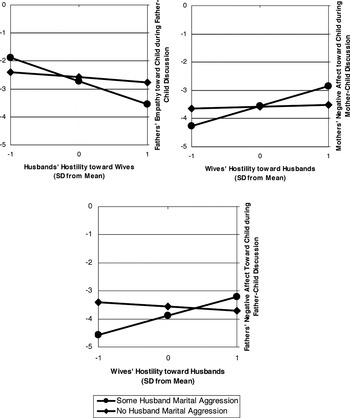
We plotted all significant and marginally significant interactions according to procedures described by Aiken and West (1991). Figure 1 presents the slopes of the relations between observed marital hostility and parent-to-child behavior at values representing any versus no husband-to-wife marital aggression during the previous year. Note that the parent-to-child behaviors are unstandardized logits, so that a score of zero corresponds to the behavior occurring in 50% of the speaker turns. Given the number of behaviors coded, one would expect all logits to be less than zero. The first graph presents the relation between husband-to-wife marital hostility and husbands' empathy toward the child in families with versus without husband-to-wife marital aggression. As depicted in the graph, the slope of the relation between husband-to-wife marital hostility and husbands' empathy toward the child is significant and negative at the value representing the presence of husband-to-wife marital aggression (B = −.84, t = −3.74, p < .01), whereas at the value representing no husband-to-wife aggression, the slope of the relation is nonsignificant (B = −.17, t = −1.01, p = .31). The second graph depicts the relation between wife-to-husband marital hostility and mothers' negative affect toward the child at values representing none versus any husband physical marital aggression. At the value representing some marital aggression, the slope of the relation between wives' marital hostility and mothers' negative affect is positive and significant (B = .71, t = 2.33, p = .022). At the value representing no husband-to-wife marital aggression, the relation is nonsignificant (B = .06, t = .26, p = .79). The third graph presents the relation between wife-to-husband marital hostility and fathers' negative affect during the father–child discussion at values representing none versus any husband physical marital aggression. At the value representing some marital aggression, the relation between wives' marital hostility and fathers' negative affect is significant and positive (B = .67, t = 2.03, p = .046). At the value representing no husband physical marital aggression, the relationship is nonsignificant (B = −.15, t = −.58, p = .56).

The relation between observed marital hostility and observed parent-to-child behavior as a function of the presence of husband-to-wife physical marital aggression.
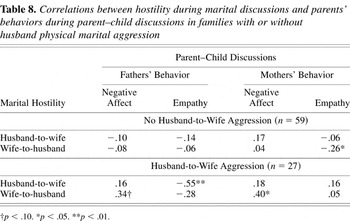
In light of these significant interaction terms, which are consistent with marital aggression moderating the relations between parents' hostility during the dyadic marital discussions and parents' behavior during the dyadic parent–child discussions, we examined correlations between the parents' hostility in the marital discussion and the parent–child discussions separately, depending on whether parents had reported any husband-to-wife physical marital aggression during the previous year. As Table 8 indicates, only one correlation was significant among families reporting no marital aggression, namely, a negative correlation between wives' hostility toward husbands and mothers' empathy toward the child during the dyadic parent–child discussion. Among families reporting husband-to-wife physical marital aggression, husbands' hostility toward wives negatively correlated with fathers' empathy toward children. Mothers' hostility toward husbands was positively correlated with their negative affect toward the child during the parent–child discussion. The correlation between wives' hostility toward husbands and fathers' negative affect toward their children approached significance.
Correlations between hostility during marital discussions and parents' behaviors during parent–child discussions in families with or without husband physical marital aggression

Husbands' physical marital aggression and pervasiveness of parents' negative behavior
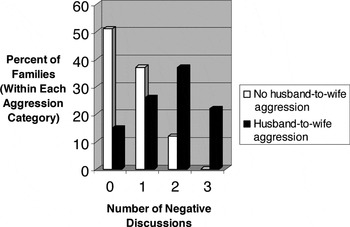
We examined the association between husbands' physical marital aggression and the number of discussions during which parents were relatively negative across the different settings. Figure 2 presents these findings. We considered marital discussions to be relatively negative if either the husband or wife scored at or above 1 SD above the mean on Hostility. We considered parents to be relatively negative during the parent–child dyadic discussions if they scored at or above 1 SD above the mean on negative affect, or at or below 1 SD below the mean on empathy toward the child. Thus, parents could be considered negative on 0, 1, 2, or 3 discussions. Figure 2 presents the percentage of families (within each aggression status) who had 0, 1, 2, or 3 negative discussions. A total of 34 families had no negative discussions (30 reporting no husbands' physical marital aggression and 4 reporting some husbands' physical marital aggression). A total of 29 had one negative discussion (22 without marital aggression vs. 7 with marital aggression); 17 had two negative discussions (7 without vs. 10 with marital aggression); 6 had 3 negative discussions (all of whom had reported at least one incident of husbands' physical marital aggression). A chi-square analysis of the number of discussions in which parents were relatively negative by the husbands' physical marital aggression was significant, χ2 (3) = 25.84, p < .001.

The pervasiveness of parents' negativity in families reporting any versus no husband-to-wife physical marital aggression.
Discussion
This study contributes to a growing literature on links across family subsystems showing that marital conflict disrupts the emotional tone in parent–child relations. Data from this study are based on direct observations of marital discussions, and discussions in which each parent interacted alone with the child. Nonoverlapping groups of trained observers assessed the marital and parent–child discussions to address the problem of reporter bias inherent in collecting data from any one family member or from any one set of coders (Bank, Dishion, Skinner, & Patterson, 1990). Consistent with the perspective that marital hostility can limit parents' emotional accessibility to their children, we examined whether negative marital behaviors were associated with both positive and negative parenting behaviors. We also examined whether associations between marital hostility and parenting were stronger in families that had experienced versus had not experienced husband-to-wife aggression.
Bivariate associations between marital hostility and parent–child behaviors occurred primarily for fathers' empathy and mothers' negative affect. Husband-to-wife and wife-to-husband hostilities in the marital discussions were associated with fathers' low expression of empathy in the father–child discussions. Husband-to-wife and wife-to-husband marital hostilities were associated with mother-to-child negative affect.
We obtain a clearer understanding of the link between marital hostilities and parent–child relations when we consider husband-to-wife aggression as a contextual variable for further family interactions. Moderation analyses indicate that husbands' marital hostilities link to lower father-to-child empathy only for families with a preexisting history of husband-to-wife aggression. Likewise, wives' marital hostilities have a marginal link to higher mother-to-child negative affect only in families that experienced husband-to-wife aggression. In a crossover finding unanticipated from the bivariate relations, wives' marital hostilities were marginally linked to fathers' negative affect toward the child only in families with husband-to-wife aggression.
The data in this study suggest that we should qualify the widely accepted assumption that marital conflict affects parenting. Marital hostilities appear to affect parenting primarily under certain conditions that put the family at risk for leakage across family subsystems. The data support the hypothesis that a background of husband-to-wife aggression places families at risk for marital hostilities intruding upon parent–child interactions in complicated and pervasive ways. The moderator analyses provide evidence that spouses' hostilities in the marriage affect their own parenting and, in one instance, carry over from wives' marital hostilities to fathers' negative affect. An equally important implication of the significant moderator analyses data, however, is the lack of support for intrusions across subsystems in families without marital aggression.
According to Patterson's (1982) coercion model, certain disruptive influences on the family system create an increased risk for multidirectional negativity throughout the family system. Theoretically, we can consider two possibilities—that husbands' marital aggression has direct effects on parenting or that it amplifies the leakage across family subsystems. Based on the data here, a history of husband-to-wife aggression appears to disrupt boundaries in the family system beyond its direct effects on parents' behavior. It should be noted, for example, that of the correlations between husbands' physical marital aggression and parent-to-child behaviors, only the association with fathers' empathy is significant. No direct relations are found for mothers' empathy, or for either parent's negative affect. In contrast to direct effects, moderating effects of husbands' marital aggression are found for fathers' empathy, mothers' negative affect and fathers' negative affect. Moreover, consistent with the idea of disrupted interaction processes throughout the family, the chi-square analysis indicates that husbands' physical marital aggression is related to the total number of negative discussions in the family. Fifty-seven percent of the families with physical aggression in the past year exhibited negative behavior in either two or three discussions, compared with 12% of the families without physical aggression. Although crucial data still are needed on the temporal connections across family subsystems, the findings presented here are consistent with the hypothesis that husbands' marital aggression increases the likelihood of negative interactions occurring in multiple family subsystems.
The question of whether marital conflict has a differential impact on mothers' versus fathers' parenting has been a topic of considerable interest (Coiro & Emery, 1998; Osborne & Fincham, 1996). Some studies suggest that father–child relations, compared to mother–child relations, are more sensitive to the effects of marital conflict (Brody et al., 1986; Jouriles & Farris, 1992; Margolin et al., 1996). However, reviews of multiple studies indicate minimal (Coiro & Emery, 1998) or no (Erel & Burman, 1995) differences in the extent of marital impact on mothers versus fathers. The data here do not indicate a differential strength of impact, but rather suggest that the impact of marital hostility takes a different form for fathers and mothers. Men's own marital hostility appears to compromise their parental empathy, but women's marital hostility appears to exacerbate their negative affect.
A likely explanation for the association between high marital hostility and low father–child empathy can be found in previous results that males, more than females, tend to become emotionally overwhelmed by marital conflict (Carrere & Gottman, 1999), and may rely on withdrawal as a common reaction to interpersonally demanding situations (Christensen & Heavey, 1990). The tendency to withdraw from tensions in the marriage may be reflected in a similar tendency to withdraw emotionally in parent–child interactions. Repetti (1994) hypothesizes that withdrawal serves a reparative function by helping someone who is aroused return to a calmer emotional and physiological state.
Although lack of empathy is not the same as withdrawal, these processes can serve similar functions of limiting one's emotional availability to others. As contrasted with topics for the marital discussions that had been selected because they were sources of conflict between the spouses, the topic for the parent–child discussions was not a parent–child conflict but rather a problem that the child experienced outside the family. In this situation, empathy would be a natural parental response indicating emotional involvement. Parents who were uncomfortable with the emotional demands of this situation or who felt inadequate to help the child may have maintained emotional distance through low empathy, particularly given that they could not simply withdraw into another physical location or alternate activity.
The moderator effect of husband-to-wife aggression further explains the association between marital hostility and fathers' low parent-to-child empathy in that emotional discussions can be particularly risky for men with a history of physical aggression. Male batterers have been described as demonstrating low empathy toward their wives (Rosenbaum & Maiuro, 1989). The majority of men who abuse their wives show high physiological reactivity in the context of marital conflict (Gottman, Jacobson, Rushe, & Shortt, 1995) and difficulty with emotion regulation (Delsol, 2003). As noted by Margolin (1988), the high relationship withdrawal characterizing men who physically abuse their wives is related to low relationship assertiveness, to high communication apprehension, and to the belief that conflict in relationships is destructive. Men who aggress against their wives, moreover, may lack the appropriate listening skills and conflict resolution skills for coping effectively with conflictual discussions (Ganley, 1989), thereby increasing the likelihood that conflict will, indeed, escalate. Low emotional accessibility in the parent–child interaction may be a protective style adopted by men who are easily aroused by conflict, have experienced conflict as destructive to their relationships, and therefore try to avoid conflict.
The moderator effects for men are somewhat complex if we take into account both within-person and cross-person effects. In maritally aggressive men, marital hostility emanating from the wife and marital hostility emanating from the husband appear to differentially compromise husbands' parenting behaviors: wives' marital hostilities are connected to fathers' child-directed negative affect, whereas their own marital hostilities are primarily connected to low levels of child-directed empathy. Although the data regarding the empathy finding are stronger and more consistent throughout the analyses, the marginal finding regarding husbands' negative affect is still worth noting. Because husbands' and wives' marital hostilities are related, at least some of the children from maritally aggressive homes are likely to experience both types of compromised parenting when interacting with their fathers—less empathy and more negative affect.
For mothers, hostility in the marital discussion relates to their negative behavior directed toward the child in the parenting discussion. Similar to previous findings showing continuity of negative affect across family subsystems (Harold & Conger, 1997; Mann & MacKenzie, 1996), mothers who express more hostility in a marital conflict also express more negative affect in the mother–child discussions. For mothers, as the ones likely to have greater parenting responsibilities, emotional disengagement from the child may not be an option, regardless of what is occurring in the marriage (Coiro & Emery, 1998).
The stress of living with an aggressive husband may best explain the moderating effect of husband-to-wife aggression on the association between marital hostility and mothers' negative affect to the child. A background of husband-to-wife aggression may amplify the meaning and emotional impact of ongoing marital hostilities. Even low level, nonabusive hostilities might increase sensitivity to negative or ambiguous interactions with other family members, and lead to heightened levels of negative affect and blame directed indiscriminately to other family members. The stress of living with husband-to-wife aggression may consume considerable energy and emotional resources, decrease mothers' patience, and increase their sensitivity to interpersonal demands (Appel & Holden, 1998; Margolin, 1998). Levendosky et al. (2000) further indicated that living with the threat of the husbands' aggression may result in a state of hyperarousal, constricted emotions, and irritability, all of which can compromise parenting. As illustrated by the data here, within the context of prior husband-to-wife physical aggression, marital hostilities might leak out and influence mother–child relations.
There are several limitations of this study that should be noted. First, because the data were collected at the same time, we cannot determine the direction of effects. For theoretical reasons and because of previous findings demonstrating greater spillover from the marriage to other family systems than vice versa (Margolin et al., 1996), we have presented the results with a slant toward looking at the ways that processes in the marital system intrude upon parent–child relations. Nonetheless, interpretation of these results must take into account reciprocal influences and the possibility that parent–child relations may also affect marital relations. Second, we have examined only one variable that strengthens the risk of emotional contagion across family subsystems, namely husband-to-wife aggression. Recent research has pointed to other significant stress factors, such as economic and parenting stresses (Margolin & Gordis, 2003), as well as other individual personality characteristics, such as depression and antisocial behavior (Davis, Hops, Alpert, & Sheeber, 1998; Levendosky, Huth–Bocks, Shapiro, & Semel, 2003; Simons, Wu, Johnson, & Conger, 1995) that might influence the transmission of affect and aggression across family subsystems. Alternatively, what appears to be leakage from one family subsystem to another actually could be due to a “third variable,” such as an antisocial personality disorder or poor emotion regulation, influencing one person's behavior in both the marital and the parent–child discussions (Appel & Holden, 1998; Engfer, 1988; Simons et al., 1995). Perhaps husband-to-wife aggression might actually be a proxy for an individual trait such as antisocial personality disorder.
Third, although several studies have demonstrated that interaction processes are related to children's behavioral, social, and emotional functioning (Gordis et al., 2001; Mahoney, Donnelly, Boxer, & Lewis, 2003), the present study does not directly assess whether links in interaction processes across family subsystems are related to children's functioning. Relatedly, this study does not address children's gender and age. It must be noted that child's gender sometimes plays a role in the association between marital conflict, parent–child interaction, and children's reactions (Davies & Lindsay, 2001; Gordis et al., 1997; Kerig, Cowan, & Cowan, 1993). Child age also may be an important variable affecting how marital conflict intrudes upon the parent–child relationship. In this study, we intentionally focused on early adolescence as a time in which children are still highly connected to their parents but also are experiencing the transition to middle school and more intense involvement with peers. The degree to which parents allow their marital processes to spill over into the parent–child relationship may depend on children's developmental stage, and their level of autonomy versus identification with parents.
Although not directly examining children's adjustment, the data presented here are congruent with a developmental psychopathology framework for understanding children's reactions to marital aggression. To understand children's adaptive and maladaptive reactions to marital aggression from a developmental psychopathology perspective, we need to examine multiple coinciding processes within the larger context of children's interpersonal relationships (Cicchetti & Toth, 1995; Rutter & Sroufe, 2000; Wolfe, Crooks, Lee, McIntyre–Smith, & Jaffe, 2003). Beyond the impact of exposure to marital aggression as a traumatic stressor in and of itself (Finkelhor & Dziuba–Leatherman, 1994; Margolin et al., 2001; Pynoos & Eth, 1985), marital aggression appears to erode important sources of support in children's environment. As shown here, children who are exposed to marital aggression also may be living in a family in which continued marital hostilities are accompanied by less parental empathy and more negative affect.
Children who already face the risk of exposure to marital aggression thus may experience compounding risks in the subtle everyday dynamics of family interactions. Although the episodes of marital aggression may not occur on a regular basis, the coinciding interactional patterns described here are likely to represent entrenched patterns of behavior. It is noteworthy that these processes can be observed even in the highly circumscribed conditions of 10–15 min, laboratory-based discussions during which the participants know their behaviors are being watched and recorded. The patterns observed here may actually underestimate naturally occurring negative interactions.
Despite considerable evidence that marital conflict is an important risk for children, the mechanisms that explain the transmission of risk from the marriage to the children still need further delineation. Demonstrating connections between marital and parent–child interaction processes is an important step in identifying such mechanisms. The parent-to-child discussions examined here represent a situation that parents frequently face and elicit behaviors potentially typical of overall parenting styles. Children's repeated exposure to interactional processes such as negative affect and low empathy may, over time, influence the children's own affective reactions, cognitions, and behaviors, even if the exposure to marital aggression is not related to diagnosable clinical problems. On the positive side, the identification of these behavioral links offers important opportunities for clinical interventions. Findings from this study highlight the need for interventions that increase parents' awareness of how their behavior in one family subsystem can influence their behavior in another family subsystem, and that interrupt links that potentially have a negative impact on the child.
References
REFERENCES
Aiken, L., &
West, S. G.
(1991).
Multiple regression: Testing and interpreting interactions.
Newbury Park, CA:
Sage.
Almeida, D. M.,
Wethington, E., &
Chandler, A. L.
(1999).
Daily transmission of tensions between marital dyads and
parent–child dyads.
Journal of Marriage and the Family
61,
49–61.CrossRefGoogle Scholar
Appel, A. E., &
Holden, G. W.
(1998).
The co-occurrence of spouse and physical child abuse: A review and
appraisal.
Journal of Family Psychology
12,
578–599.CrossRefGoogle Scholar
Bank, L.,
Dishion, T.,
Skinner, M., &
Patterson, G. R.
(1990).
Method variance in structural equation modeling: Living with
“glop.” In
G. R. Patterson (Ed.),
Depression and aggression in family interaction (pp.
247–279).
Hillsdale, NJ:
Erlbaum.
Belsky, J.
(1984).
The determinants of parenting: A process model.
Child Development
55,
83–96.CrossRefGoogle Scholar
Belsky, J.,
Youngblade, L.,
Rovine, M., &
Volling, B.
(1991).
Patterns of marital change and parent–child interaction.
Journal of Marriage and the Family
53,
487–498.CrossRefGoogle Scholar
Brody, G. H.,
Pillegrini, A. D., &
Sigel, I. E.
(1986).
Marital quality and mother–child and father–child
interactions with school-aged children.
Developmental Psychology
22,
291–296.CrossRefGoogle Scholar
Buehler, C.,
Anthony, C.,
Krishnakumar, A.,
Stone, G.,
Gerard, J., &
Pemberton, S.
(1997).
Interparental conflict and youth problem behaviors: A
meta-analysis.
Journal of Child and Family Studies
6,
233–247.CrossRefGoogle Scholar
Burman, B.,
Margolin, G., &
John, R. S.
(1993).
America's angriest home videos: Behavioral contingencies
observed in home reenactments of marital conflict.
Journal of Consulting and Clinical Psychology
61,
28–39.CrossRefGoogle Scholar
Carrere, S., &
Gottman, J. M.
(1999).
Predicting the future of marriages. In
E. M. Hetherington (Ed.),
Coping with divorce, single parenting, and remarriage: A risk and
resiliency perspective (pp.
3–22).
Mahwah, NJ:
Erlbaum.
Caspi, A.
(1993)
Why maladaptive behaviors persist: Sources of continuity and change
across the life course. In
D. C. Funder,
R. D. Parke,
C. Tomlinson–Keasey, &
K. Widaman (Eds.),
Studying lives through time: Personality and development (pp.
343–762).
Washington, DC:
APA.
Christensen, A., &
Heavey, C. L.
(1990).
Gender and social structure in the demand/withdraw pattern of
marital conflict.
Journal of Personality and Social Psychology
59,
73–81.CrossRefGoogle Scholar
Cicchetti, D., &
Toth, S. L.
(1995).
A developmental psychopathology perspective on child abuse and
neglect.
Journal of the American Academy of Child and Adolescent Psychiatry
34,
541–565.CrossRefGoogle Scholar
Coiro, M. J., &
Emery, R. E.
(1998).
Do marriage problems affect fathering more than mothering? A
quantitative and qualitative review.
Clinical Child and Family Psychology Review
1,
23–40.CrossRefGoogle Scholar
Cowan, P. A., &
Cowan, C. P.
(2002).
Interventions as tests of family systems theories: Marital and
family relationships in children's development and
psychopathology.
Development and Psychopathology
14,
731–759.CrossRefGoogle Scholar
Cox, M. J.,
Brooks–Gunn, J., &
Paley, B.
(1999).
Perspectives on conflict and cohesion in families. In
M. J. Cox &
J. Brooks–Gunn (Eds.),
Conflict and cohesion in families: Causes and consequences (pp.
321–344).
Mahwah, NJ:
Erlbaum.
Cox, M. J., &
Paley, B.
(1997).
Families as systems.
Annual Review of Psychology
48,
243–267.CrossRefGoogle Scholar
Crockenberg, S., &
Covey, S. L.
(1991).
Marital conflict and externalizing behavior in children. In
D. Cicchetti &
S. L. Toth (Eds.),
Rochester Symposium on Developmental Psychopathology: Vol. 3.
Models and integration (pp.
235–260).
Rochester, NY:
University of Rochester Press.
Cummings, E. M., &
Davies, P. T.
(1995).
The impact of parents on their children: An emotional security
hypothesis.
Annals of Child Development
10,
167–208.Google Scholar
Davies, P. T., &
Lindsay, L. L.
(2001).
Does gender moderate the effects of marital conflict on children.
In
J. H. Grych &
F. D. Fincham (Eds.),
Interparental conflict and child development: Theory, research, and
application (pp.
64–97).
Cambridge:
Cambridge University Press.
Davis, B. T.,
Hops, H.,
Alpert, A., &
Sheeber, L.
(1998).
Child responses to parental conflict and their effect on
adjustment: A study of triadic relations.
Journal of Family Psychology
12,
163–177.CrossRefGoogle Scholar
Delsol, C.
(2003).
Emotion regulation as a mediator between family-of-origin
aggression and marital aggression.
Unpublished dissertation,
University of Southern California.
Dishion, T. J.,
French, G. R., &
Patterson, G. R.
(1995).
The development and ecology of antisocial behavior. In
D. Cicchetti &
D. Cohen (Eds.),
Developmental psychopathology: Risk, disorder, and adaptation
(Vol. 2, pp.
421–471).
New York:
Wiley.
Emery, R. E.
(1982).
Interparental conflict and the children of discord and divorce.
Psychological Bulletin
92,
310–330.CrossRefGoogle Scholar
Engfer, A.
(1988).
The interrelatedness of marriage and the mother–child
relationship. In
R. A. Hinde &
J. Stevenson–Hinde (Eds.),
Relationships within families: Mutual influences (pp.
104–118).
Oxford:
Clarendon Press.
Erel, O., &
Burman, B.
(1995).
Interrelatedness of marital relations and parent–child
relations: A meta-analytic review.
Psychological Bulletin
118,
108–132.CrossRefGoogle Scholar
Fauber, R.,
Forehand, R.,
Thomas, A. M., &
Wierson, M.
(1990).
A mediational model of the impact of marital conflict on adolescent
adjustment in intact and divorced families: The role of disrupted
parenting.
Child Development
61,
1112–1123.CrossRefGoogle Scholar
Fauchier, A., &
Margolin, G.
(2004).
Affection and conflict in marital and parent–child
relationships.
Journal of Marital and Family Therapy
30,
197–212.CrossRefGoogle Scholar
Finkelhor, D., &
Dziuba–Leatherman, J.
(1994).
Victimization of children.
American Psychologist
49,
173–183.CrossRefGoogle Scholar
Ganley, A. L.
(1989).
Integrating feminist and social learning analyses of aggression:
Creating multiple models for intervention with men who batter. In
P. L. Caesar &
L. K. Hamberger (Eds.),
Treating men who batter: Theory, practice and program (pp.
196–235).
New York:
Springer.
Gordis, E. B.,
Margolin, G., &
Garcia, H.
(1996).
Marital coding system.
Unpublished manuscript,
University of Southern California, Los Angeles.
Gordis, E. B.,
Margolin, G., &
John, J.
(1997).
Marital aggression, observed parental hostility, and child behavior
during triadic family interaction.
Journal of Family Psychology
11,
76–89.CrossRefGoogle Scholar
Gordis, E. B.,
Margolin, G., &
John, R. S.
(2001).
Parents' hostility in dyadic marital and triadic family
setting and children's behavior problems.
Journal of Consulting and Clinical Psychology
69,
727–734.CrossRefGoogle Scholar
Gottman, J. M.,,
Jacobson, N. S.,
Rushe, R. H., &
Shortt, J. W.
(1995).
The relationship between heart rate reactivity, emotionally
aggressive behavior, and general violence in batterers.
Journal of Family Psychology
9,
227–248.CrossRefGoogle Scholar
Gottman, J. M., &
Katz, L. F.
(1989).
Effects of marital discord on young children's peer
interaction and health.
Developmental Psychology
25,
73–381.Google Scholar
Grych, J. H., &
Fincham, F. D.
(1990).
Marital conflict and children's adjustment: A
cognitive–contextual framework.
Psychological Bulletin
108,
267–290.CrossRefGoogle Scholar
Haley, J.
(1976).
Problem-solving therapy.
San Francisco, CA:
Jossey–Bass.
Harold, G. T., &
Conger, R. D.
(1997).
Marital conflict and adolescent distress: The role of adolescent
awareness.
Child Development
68,
333–350.CrossRefGoogle Scholar
Hinde, R. A., &
Stevenson–Hinde, J. (Eds.).
(1988).
Relationships within families: Mutual influences.
Oxford:
Clarendon Press.
Jacobson, N. S.,
Gottman, J. M.,
Waltz, J.,
Rushe, R.,
Babcock, J., &
Holtzworth–Munroe, A.
(1994).
Affect, verbal content and psychophysiology in the arguments of
couples with a violent husband.
Journal of Consulting and Clinical Psychology
62,
982–988.CrossRefGoogle Scholar
Jouriles, E. N., &
Farris, A. M.
(1992).
Effects of marital conflict on subsequent parent–son
interactions.
Behavior Therapy
23,
355–374.CrossRefGoogle Scholar
Katz, L. F., &
Gottman, J. M.
(1996).
Spillover effects of marital conflict:
In search of parenting and
coparenting mechanisms. In
J. P. McHale &
P. A. Cowan (Eds.),
Understanding how family-level dynamics affect children's
development: Studies of two-parent families (pp.
57–76)
San Francisco, CA:
Jossey–Bass.
Kerig, P. K.,
Cowan, P. A., &
Cowan, C. P.
(1993).
Marital quality and gender differences in parent–child
interaction.
Developmental Psychology
29,
931–939.CrossRefGoogle Scholar
Kitzmann, K. M.
(2000).
Effects of marital conflict on subsequent triadic family
interactions and parenting.
Developmental Psychology
36,
3–13.CrossRefGoogle Scholar
Larson, R. W., &
Almeida, D. M.
(1999).
Emotional transmission in the daily lives of families: A new
paradigm for studying family process.
Journal of Marriage and the Family
61,
5–20.CrossRefGoogle Scholar
Levendosky, A. A., &
Graham–Bermann, S. A.
(2000).
Behavioral observations of parenting in battered women.
Journal of Family Psychology
14,
80–94.CrossRefGoogle Scholar
Levendosky, A. A.,
Huth–Bocks, A. C.,
Shapiro, D. L., &
Semel, M. A.
(2003).
The impact of domestic violence on the maternal–child
relationship and preschool-age children's functioning.
Journal of Family Psychology
17,
275–287.CrossRefGoogle Scholar
Levendosky, A. A.,
Lynch, S. M., &
Graham–Bermann, S. A.
(2000).
Mothers' perceptions of the impact of woman abuse on their
parenting.
Violence against Women
6,
248–272.Google Scholar
Lindahl, K. M., &
Malik, N. M.
(1999).
Observations of marital conflict and power: Relationship with
parenting in the triad.
Journal of Marriage and the Family
61,
320–33.CrossRefGoogle Scholar
Mahoney, A.,
Boggio, R. M., &
Jouriles, E. N.
(1996).
Effects of marital conflict on subsequent mother–son
interactions in a clinical sample.
Journal of Clinical Child Psychology
25,
22–271.Google Scholar
Mahoney, A.,
Donnelly, W. O.,
Boxer, P., &
Lewis, T.
(2003).
Marital and severe parent-to-adolescent physical aggression in
clinic-referred families: Mother and adolescent reports on
co-occurrence and links to child behavior problems.
Journal of Family Psychology
17,
3–19.CrossRefGoogle Scholar
Mann, B. J., &
MacKenzie, E. P.
(1996).
Pathways among marital functioning, parental behaviors, and child
behavior problems in school-age boys.
Journal of Clinical Child Psychology
25,
183–191.CrossRefGoogle Scholar
Margolin, G.
(1981).
The reciprocal relationship between marital and child problems. In
J. P. Vincent (Ed.),
Advances in family intervention, assessment and theory
(Vol. 2, pp.
131–182).
Greenwich, CT:
JAI Press.
Margolin, G.
(1988).
Interpersonal and intrapersonal factors associated with marital
violence. In
G. T. Hotaling,
D. Finkelhor,
J. T. Kirkpatrick, &
M. A. Straus (Eds.),
Family abuse and its consequences: New directions in research (pp.
203–217).
Newbury Park, CA:
Sage.
Margolin, G.
(1998).
Effects of domestic violence on children. In
P. K. Trickett &
C. J. Schellenbach (Eds.),
Violence against children in the family and the community (pp.
57–101).
Washington, DC:
APA.
Margolin, G.,
Burman, B.,
John, R. S., &
O'Brien, M.
(1990).
The Domestic Conflict Index.
Unpublished manuscript,
University of Southern California, Los Angeles.
Margolin, G.,
Christensen, A., &
John, R. S.
(1996).
The continuance and spillover of everyday tensions in distressed
and nondistressed families.
Journal of Family Psychology
10,
304–321.CrossRefGoogle Scholar
Margolin, G., &
Gordis, E. B.
(2000).
The effects of family and community violence on children.
Annual Review of Psychology
51,
445–479.CrossRefGoogle Scholar
Margolin, G., &
Gordis, E. B.
(2003).
Co-occurrence between marital aggression and parents' child
abuse potential: The impact of cumulative stress.
Violence and Victims
18,
243–258.CrossRefGoogle Scholar
Margolin, G.,
John, R. S.,
Ghosh, C. M., &
Gordis, E. B.
(1996).
Family interaction process: An essential tool for exploring
abusive relations. In
D. D. Cahn &
S. A. Lloyd (Eds.),
Family violence from a communication perspective (pp.
37–58).
Thousand Oaks, CA:
Sage.
Margolin, G.,
John, R. S., &
Gleberman, L.
(1988).
Affective responses to conflictual discussions in violent and
nonviolent couples.
Journal of Consulting and Clinical Psychology
56,
24–33.CrossRefGoogle Scholar
Margolin, G.,
Oliver, P. H.,
Gordis, E. B.,
O'Hearn, H. G.,
Medina, A. M.,
Ghosh, C. M., &
Moreland, L.
(1998).
The nuts and bolts of behavioral observation of marital and family
interaction.
Clinical Child and Family Psychology Review
1,
195–213.CrossRefGoogle Scholar
Margolin, G.,
Oliver, P. H., &
Medina, A. M.
(2001).
Conceptual issues in understanding the relation between
interparental conflict and child adjustment: Integrating developmental
psychopathology and risk/resilience perspectives. In
J. H. Grych &
F. D. Fincham (Eds.),
Interparental conflict and child development: Theory, research, and
application (pp.
9–38).
Cambridge:
Cambridge University Press.
McHale, J. P.,
Kuersten, R., &
Lauretti
(1996).
New directions in the study of family level dynamics during
infancy and early childhood. In
J. P. McHale &
P. Cowan (Eds.),
Understanding how family-level dynamics affect children's
development studies of two-parent families (pp.
5–26).
San Francisco, CA:
Jossey–Bass.
Minuchin, P.
(1985).
Families and individual development: Provocations from the field of
family therapy.
Child Development
56,
289–302.CrossRefGoogle Scholar
Mosteller, F., &
Tukey, J. W.
(1977).
Data analysis and regression: A second course in statistics.
Menlo Park, CA:
Addison–Wesley.
Osborne, L. N., &
Fincham, F. D.
(1996).
Marital conflict, parent–child relationships, and child
adjustment: Does gender matter?
Merrill–Palmer Quarterly
42,
48–75.Google Scholar
Patterson, G. R.
(1982).
Coercive family processes.
Eugene, OR:
Castalia.
Patterson, G. R., &
Dishion, T. J.
(1988).
Multilevel family process models: Traits, interactions and
relationships. In
R. A. Hinde &
J. Stevenson–Hinde (Eds.),
Relationships within families: Mutual influences (pp.
283–310).
Oxford:
Clarendon Press.
Patterson, G. R., &
Forgatch, M.
(1987).
Parents and adolescents living together: Part 1. The basics.
Eugene, OR:
Castalia.
Pynoos, R. S., &
Eth, S.
(1985).
Children traumatized by witnessing acts of personal violence:
Homicide, rape, or suicide behavior. In
S. Eth &
R. S. Pynoos (Eds.),
Post-traumatic stress disorder in children (pp.
17–44).
Washington, DC:
APA.
Reis, H. T.,
Collins, W. A., &
Berscheid, E.
(2000).
The relationship context of human behavior and development.
Psychological Bulletin
126,
844–872.CrossRefGoogle Scholar
Repetti, R. L.
(1987).
Links between work and family role. In
S. Oskamp (Ed.),
Family processes and problems: Social psychological aspects (pp.
98–127).
Newbury Park, CA:
Sage.
Repetti, R. L.
(1989).
Effects of daily workload on subsequent behavior during marital
interaction: The roles of social withdrawal and spouse support.
Journal of Personality and Social Psychology
57,
651–659.CrossRefGoogle Scholar
Repetti, R. L.
(1994).
Short-term and long-term-processes linking job stressors to
father–child interaction.
Social Development
3,
1–15.Google Scholar
Repetti, R. L., &
Wood, J.
(1997).
Effects of daily stress at work on mothers' interactions with
preschoolers.
Journal of Family Psychology
11,
900–1008.Google Scholar
Rosenbaum, A., &
Maiuro, R. D.
(1989).
Eclectic approaches in working with men who batter. In
P. L. Caesar &
L. K. Hamberger (Eds.),
Treating men who batter: Theory, practice and program (pp.
165–195).
New York:
Springer.
Rutter, M.
(1988).
Functions and consequences of relationships: Some
psychopathological considerations. In
R. A. Hinde &
J. Stevenson–Hinde (Eds.),
Relationships within families: Mutual influences (pp.
332–353).
Oxford:
Clarendon Press.
Rutter, M., &
Sroufe, A.
(2000).
Developmental psychopathology: Concepts and challenges.
Development and Psychopathology
12,
265–296.CrossRefGoogle Scholar
Shrout, P. E., &
Fleiss, J. L.
(1979).
Intraclass correlations: Uses in assessing rater reliability.
Psychological Bulletin
86,
420–428.CrossRefGoogle Scholar
Simons, R. L.,
Wu, C.,
Johnson, C., &
Conger, R. D.
(1995).
A test of various perspectives on the intergenerational
transmission of domestic violence.
Criminology
33,
141–171.CrossRefGoogle Scholar
Sroufe, L. A.,
Carlson,, E., &
Shulman, S.
(1993).
Individuals in relationships: Development from infancy through
adolescence. In
D. C. Funder,
R. D. Parke,
C. Tomlinson–Keasey, &
K. Widaman (Eds.),
Studying lives through time: Personality and development (pp.
315–342).
Washington, DC:
APA.
White, L.
(1999).
Contagion in family affection: Mothers, fathers, and young adult
children.
Journal of Marriage and the Family
61,
284–294.Google Scholar
Wolfe, D. A.,
Crooks, C. V.,
Lee, V.,
McIntyre–Smith, A., &
Jaffe, P. G.
(2003).
The effects of children's exposure to domestic violence: A
meta-analysis and critique.
Clinical Child and Family Psychology Review
6,
171–187.Google Scholar
Definitions and examples of coded variables
Descriptive statistics for all codes of the observational data
Correlations between marital and parent-to-child behavior
Regressions predicting father' behavior toward the child from husbands' marital hostility and husband-to-wife physical marital aggression
Regressions predicting mothers' behavior toward the child from wives' marital hostility and husband-to-wife physical marital aggression
Regressions predicting fathers' behavior toward the child from wives' marital hostility and husband-to-wife physical marital aggression
Regressions predicting mothers' behavior toward the child from husbands' marital hostility and husband-to-wife physical marital aggression
The relation between observed marital hostility and observed parent-to-child behavior as a function of the presence of husband-to-wife physical marital aggression.
Correlations between hostility during marital discussions and parents' behaviors during parent–child discussions in families with or without husband physical marital aggression
The pervasiveness of parents' negativity in families reporting any versus no husband-to-wife physical marital aggression.
 You have
Access
- 48
- Cited by