INTRODUCTION
Sexism in language as an index of gender inequality in society has been intensely debated in the last four decades. Research in the 1970s highlighted differences between the sexes in speech, language use, and nonverbal communication, and raised awareness of the political implications of such differences in terms of female subordination and male dominance (e.g. Lakoff Reference Lakoff1973, Reference Lakoff1975; Thorne & Henley Reference Thorne and Henley1975). This was followed by inquiries in the 1980s in a wide range of disciplines into the mutual constitution of gendered language and gendered social practice and social structure (e.g. Spender Reference Spender1980; Thorne, Kramarae & Henley Reference Thorne, Kramarae and Henley1983; Graddol & Swann Reference Graddol and Swann1989). Building on the momentum of the second-wave feminist movement, research on linguistic sexism galvanized support for language reform, which gave rise to the institutionalization of nonsexist language use (Frank Reference Frank and Hellinger1985). Early Anglo-American feminist work on language and gender rippled through continental Europe, inspiring both research and language activism (Hellinger Reference Hellinger1985), and spurring interests in non-European languages (Hellinger & Bußmann Reference Farrer2002, Reference Hellinger and Bußmann2003). The 1990s saw increased empirical nuance in investigations of linguistic sexism in discourse analysis (Goodwin Reference Goodwin1990; West Reference West1992), and in experimental research on the behavioral impact of sexist language use (Hamilton, Hunter, & Stuart-Smith Reference Hamilton, Hunter, Stuart-Smith, Chrisler and Howard1992; LaFrance & Hahn Reference LaFrance, Hahn, Roman, Juhasz and Miller1993). At the same time, fresh theoretical perspectives on gender and language were put forth, allowing for the reconceptualization of theoretical constructs and assumptions that had dominated previous scholarship (Henley & Kramarae Reference Henley, Kramarae, Coupland, Giles and Wiemann1991; Gal Reference Gal and Di Leonardo1991; Eckert & McConnell-Ginet Reference Eckert and McConnell-Ginet1992; Cameron Reference Cameron, Johnson and Meinhof1997). In particular, awareness of the nonhomogeneity of gender categories and interests in the role of language in the discursive construction of gender identities ushered in the ‘third wave’ feminist study of language and gender (Eckert & McConnell-Ginet Reference Eckert and McConnell-Ginet2016:41). As Cameron (Reference Cameron2006:75) noted, a ‘binary’ and ‘global’ view of gender gave way to a focus on local communities of practice.Footnote 1
Research on language and gender in Chinese has produced abundant data on gender asymmetry. Specifically, the writing system indicates traces of earlier matriarchy (T'sou Reference T'sou1981; Ettner Reference Ettner, Hellinger and Bußmann2002), perverse patriarchal imaginations of femininity, and stereotypes of female vice and virtue (Tan Reference Tan1990; Ettner Reference Ettner, Hellinger and Bußmann2002). Naming practices and terms of address suggest gender bias in the lexicon (Tang Reference Tang1982; Farris Reference Farris1988; Tan Reference Tan1990; Blum Reference Blum1997; Ettner Reference Ettner, Hellinger and Bußmann2002; Zhang Reference Zhang, Hellinger and Bußmann2002). Word order conventions point to sexism in grammar and formulaic language (Shih Reference Shih1984; Farris Reference Farris1988; Moser Reference Moser1997; Ettner Reference Ettner, Hellinger and Bußmann2002). Discourse studies reveal gender differences in speech acts and pragmatic strategies (Liao Reference Liao1994, Reference Liao1997; Hong Reference Hong1997). Sociolinguistic inquiries shed light on sex as a variable in language attitude (Lung Reference Lung1997a,Reference Lungb), phonetic variation (Chen Reference Chen1985; Cao Reference Cao1986, Reference Cao1987; Hu Reference Hu1991), final particle uses in Cantonese (Chan Reference Chan, Wertheim, Bailey and Corston-Oliver1998, Reference Chan, He and Hu2000, Reference Chan, Hellinger and Bussmann2002) and Mandarin (Shih Reference Shih1984; Liao Reference Liao1997), as well as speech style (Light Reference Light1982; Farris Reference Farris, Johnson and Chiu1995; Chuang Reference Chuang2005; Hardeman Reference Hardeman2013).Footnote 2
While gender asymmetry in Chinese has garnered attention in research, that asymmetry is rarely scrutinized in light of the underlying structural discrimination in society. With the exception of a few studies that touch upon issues of gender identity, power, and the political economy of gender in contemporary China (Zhang Reference Zhang, Hellinger and Bußmann2002; Hong Fincher Reference Hong Fincher2014; Jing-Schmidt Reference Jing-Schmidt2016; Yueh Reference Yueh2017), most studies take an ahistorical view of the problem and are reluctant to confront the changing sociopolitical and socioeconomic context of gender dynamics.
A glimpse at the trajectories of change in the status of Chinese women in the last 100 years shows a history of early progress followed by stagnation and recent decline. The early twentieth century saw the end of polygyny and foot binding, two major evils of the Chinese patriarchy. Women stepped out of their domestic ‘seclusion and concealment’ to seek education and employment (S. Mann Reference Mann2011:12). The communist mass mobilization further pushed for women's liberation to promote family-based production and social stability. Because gender equality in its own right was never intended as part of the socialist agenda, however, the revolution of Chinese women remained ‘unfinished’ or ‘postponed’, to use the respective title keywords of Andors (Reference Andors1983) and Wolf (Reference Wolf1985). The political-ideological ‘resolution of the women question in China’, Andors (Reference Andors1983:168) hoped, ‘is to be dependent upon the future success of economic modernization’.
Fast forwarding to postreform China, gender inequality continues after three decades of economic boom. Although education has strengthened female earning potentials and the ability to be economically independent, the gender wealth gap, prohibitive real estate prices, and rampant consumerism fuel the chase for economic security and luxury (Tsai, Yang, & Liu Reference Tsai, Yang; and Liu2013; Li Reference Li2014; Yu Reference Yu2014). Because such resources are controlled by elite men, economic and social autonomy remains elusive to Chinese women (Hong Fincher Reference Hong Fincher2014). Paradoxically, women as victims of institutionalized gender parity are the primary target of attack for the perceived moral decline in society and are ‘subject to greater condemnation’ than men (Osburg Reference Osburg2013:182). More unfortunately, unaware of their common plight and the societal origin of the injustice, women often join this chorus of condemnation and actively engage in self-discrimination and mutual sabotage. Sisterhood, self-determination of goals and strategies for social change, and an alternate vision of the future—the essential ingredients of a feminist consciousness prescribed by Lerner (Reference Lerner1993:274)—are still out of reach to Chinese women. Without confronting this reality, and without interrogating the gender order and the political economy of gender as part of the larger social structure, an explanation of linguistic sexism remains incomplete.
This study examines emerging verbal misogyny in wireless China against the background of the larger social dynamic and social structure of postreform Chinese society. We focus on a category of gendered pejorative personal labels in the pattern of [X – biăo] where biăo ‘slut’ is a morphologized sexual slur.Footnote 3 We propose a sociomorphology of [X – biăo], an approach we define as a socially situated analysis of a morphological phenomenon the explanation of which requires an examination of the larger social structure and societal dynamics. Based on data from Weibo, the Chinese microblogging platform, we argue that [X – biăo] constructs a misogynistic person category that reflects, reproduces, and reinforces a gender order characterized by lopsided allocation of power and other social resources.
DATA AND METHODS
Jing-Schmidt & Hsieh (Reference Jing-Schmidt, Hsieh, Huang, Jing-Schmidt and Meisterernst2018) argue that neologisms, more than any other linguistic elements, ‘instantly and immediately reflect changes in society and its zeitgeist’. Chinese cyber neologisms are the products of massive networked communication and self-communication by grassroots language users and as such capture the pulse of contemporary Chinese society in its unique social dynamics.
The data used for this study were collected from the online microblogging application known as Weibo, the Chinese counterpart of Twitter. Weibo provides large records of collective language and discourse organically occurring in the Chinese online network community. The data are publicly available. We used a third-party microblog search engine, ZhongsouFootnote 4 to collect Weibo blogposts that included the character 婊 biăo ‘female prostitute’ as the keyword. Data retrieval was conducted on July 4, 2016 through a keyword search using the online search engine. To avoid retrieval of duplicate items, we refined the search to ‘original’ (原创) blogposts so all reposts (blogposts that include and comment on an original blogpost) would be automatically removed. The search returned blogposts in reverse chronological order from the most recent posts to older ones. We collected the first 1,000 blogposts, which were posted between the time period of May 25 and July 4, 2016. The texts of the blogposts, along with the links to the original Weibo blogposts and the timestamps of those blogposts were gathered. To analyze the usage pattern of the neologisms along gender lines, we conducted an automatic mass retrieval of the gender information on the authors of the 1,000 blogposts via the Application Programming Interface (API) of Weibo. Of the 1,000 retrieved blogposts, eight items contained no gender information and were eliminated from the analysis. The remaining blogposts were then manually inspected and annotated, whereby a total of 426 tokens that did not match the pattern [X – biăo] were eliminated. The remaining 575 tokens made up the dataset for the analysis.
The sociomorpological analysis draws on two types of frequency data. The type frequency of the category [X – biăo], namely the number of different tokens observed in the X slot, determines the productivity of the category, that is, its ability to admit new members, and informs us of the strength of the category as a schematic pattern (Bybee Reference Bybee1995, Reference Bybee2006, Reference Bybee2010). The token frequency, namely the total number of times a given type is observed in the data, indicates the level of entrenchment of that individual type in the category (Bybee Reference Bybee2007). The analysis of the role of gender in the usage of the category [X – biăo] is based on descriptive statistics of gender ratios, including the ratio of total female-produced items to total male-produced items, and the ratio of unique female users to unique male users in the data. The overall gender ratio in the general population of active users of Weibo, reported in the 2016 Weibo Users Report,Footnote 5 was used as baseline data.
As noted previously, data from Weibo are publicly available. Nevertheless, presenting such data in an academic publication may make it ‘accessible to a wider public than what might have been originally intended’ (Markham & Buchanan Reference Markham and Buchanan2012:6). Thus, care must be taken to protect user privacy in publication. We adopted a process-based ethical practice that recognizes the ambiguity of expectations of privacy in the digital age and makes situated ethical decisions on a case-by-case basis (McKee & Porter Reference McKee and Porter2009). In this study, we focused on word-level frequency distributions and general gender ratios of usage, which are measurements of ‘aggregated and de-identified data’ (Markham & Buchanan Reference Markham and Buchanan2012:9). When presenting specific blogposts as examples in the analysis, ensuring anonymity was our priority. Due to the online searchability of direct quotes, publishing such quotes could make users easily identifiable (Markham Reference Markham2012). To safeguard user privacy, we prepared our examples as follows. We determined the online availability of blogposts we intended to quote by searching for them in Weibo. The search was conducted in July 2017 and repeated in January 2018. An exact return indicated availability, and failure to obtain an exact return indicated unavailability, which in Weibo can occur for reasons related to deletion, censorship, or account deactivation. Blogposts confirmed as unavailable were presented as direct quotes in Chinese characters, with pinyin and translations provided; those confirmed as available were paraphrased in translations.
THE SLUTTIFICATION OF WOMEN: A SOCIOMORPHOLOGY
The morpheme biăo in [X – biăo] is originally the noun stem of the word biăo-zi, which the Xinhua dictionary with English translation (2000:42) defines as a ‘derogatory name for jìnǚ “female prostitute”’.Footnote 6 This definition indicates that the ‘lexical gender’ of biăo is female in the sense that it has a ‘lexical specification’ of female as ‘referential gender’ (Hellinger & Bußman Reference Hellinger, Bußmann, Hellinger and Bußmann2002:7). Its written character 婊 combines the female radical 女 n ǚ ‘female’ and the phonetic part 表 bi ă o ‘outside’. This orthographic form makes explicit the lexical gender of the morpheme, which has no male counterpart. The debut of bi ă o as a part of [X – biăo] occurred with the incidental coinage of the concept of lǜchá-biăo ‘green-tea slut’. According to baidu.baike.com, this neologism popped up in 2013 and immediately went viral on the internet following salacious reports of a high-end lifestyle festival for the Chinese new rich where female models reportedly exchanged sex for money. Given this context, the neologism is a spontaneous compound of two noun stems: lǜchá ‘green tea’ is a metaphor of the virginal appearance of the young models and bi ă o refers to their sexual behavior. The neologism is an ‘ad hoc concept’ in the sense that it is ‘created spontaneously for use in specialized contexts’ (Barsalou Reference Barsalou1983:211). However, its creation unleashed the linguistic productivity of bi ă o ‘slut’, leading to its morphologization and the creation of a misogynistic person category.
The morphologization of biăo
As is well known in cognitive psychology, frequency as a structural property of a category has effects on the learning and cognitive representation of that category (Rosch & Mervis Reference Rosch and Mervis1975; Harris, Murphy, & Rehder Reference Harris, Murphy and Rehder2008). Table 1 shows a total of seventy-eight distinct types of [X – biăo] in the data.
Types of [X – biăo] ranked by token frequency.

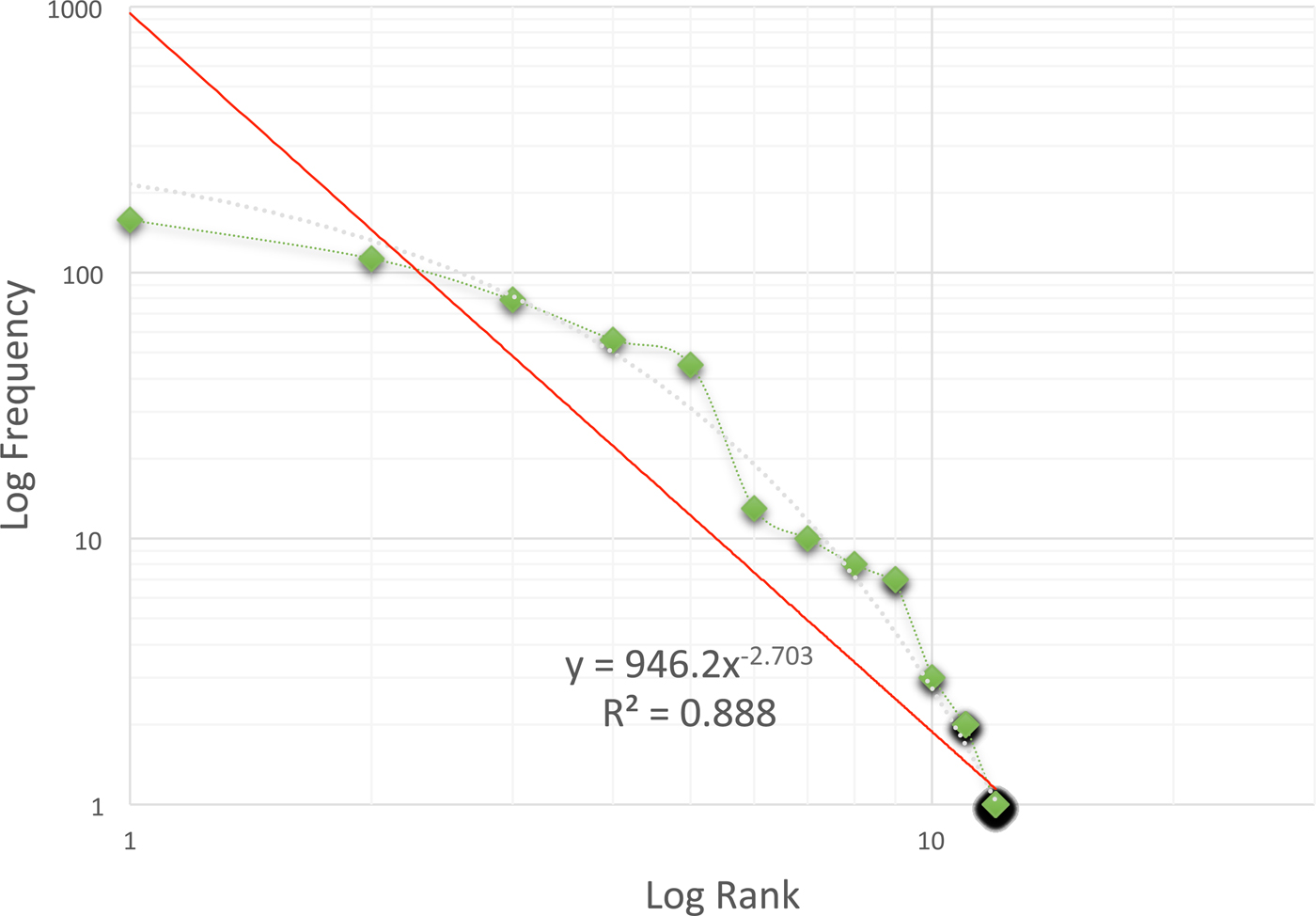
The seventy-eight types are not equally frequent. A closer examination shows a highly skewed distribution. Five high-frequency items, bolded in Table 1, though only 6% of the seventy-eight types, have a total of 451 tokens and account for 78% of the entire dataset. By contrast, a large number of items, sixty-two (78%) out of seventy-eight, occur only once in the data, making up only 11% of the dataset. This skewed frequency distribution approximates Zipf's Law, a power law that captures a basic fact of natural language: A small number of high-frequency items account for most tokens in a corpus while a large number of items are very low in frequency (Zipf Reference Zipf1936).Footnote 7 Figure 1 offers a log-log plot that visualizes this skewness toward the high-frequency items of high rank in the upper left space, and a massive aggregation of one-off coinages in the bottom right, visualized as a dark shadow surrounding the diamond-shaped marker of the twelfth rank.
Rank vs. frequency distribution of distinct types in the [X – biăo] category.

This distribution indicates two things. First, the top five items are very popular in Weibo. Second, there is a high spontaneity with which bloggers coin diverse new items in the [X – biăo] pattern. These are rarely re-used and are marginal in the category. How do we understand this distribution in terms of the cognitive representation and morphological status of [X – biăo] as a conceptual category? The entrenchment of the high-frequency items makes these items likely models on which new items are created by analogy (Bybee Reference Bybee2006, Reference Bybee2007). The overall high type frequency of the category as well as the diversity of the marginal members point to the morphological productivity of the category as a strengthened schematic pattern with increased generalizability (Bybee Reference Bybee1995, Reference Bybee2006, Reference Bybee2007). What this means with regard to the morphological status of biăo is its change from a noun stem to a productive derivational suffix. Such a categorial shift is known as morphologization (Hopper & Traugott Reference Hopper and Traugott1993).
Morphologization comes with the semantic abstraction of referential meaning (Heine, Claudi, & Hünnemeyer Reference Heine, Claudi and Hünnemeyer1991). In the case of biăo, this can be seen in the loss of the literal reference to prostitution, which is available in the initial compounding of lǜchá-biăo ‘green-tea slut’. As a result of this semantic abstraction, only the lexical gender of biăo is retained in the suffixal form. With the meaning of biăo broadened, lǜchá-biăo ‘green-tea slut’ has come to refer to a woman perceived as a seductress under the disguise of sexual purity. The semantic abstraction of biăo is more evident in subsequent coinages. For example, xīngzuò-biăo ‘horoscope slut’ labels a woman who is interested in horoscopes, nǚquán-biăo ‘women's-rights slut’ labels a woman who advocates for women's rights, lǚxíng-biăo ‘travel slut’ labels a woman who enjoys traveling, zìpāi-biăo ‘selfie slut’ labels a woman who has a penchant for taking selfies, and kă-biăo ‘credit-card slut’ is tagged onto a woman who uses a credit card. In these examples, biăo performs no literal denotation of sexual behavior. Rather, it serves as a personizer that labels the person category of women.
Ungerer (Reference Ungerer2002) describes suffixation as conceptual recategorization whereby the categories being constructed obtain conceptual stability from derivation based on personizers. With the morphologization of biăo as a female personizer, the category [X – biăo] stabilizes a gender bias. But there is more to this category than its gender bias: The gendered labels carry the stigma of female sexuality as their connotation.
The pejorative connotation of the category [X – biăo]
In addition to semantic abstraction, morphologization is often accompanied by a persistence of the inferential association or connotation of the original meaning (Hopper Reference Hopper, Traugott and Heine1991; Hopper & Traugott Reference Hopper and Traugott1993). Hopper & Traugott (Reference Hopper and Traugott1993) show that the persisting association constrains the abstract meaning resulting from morphologization. In fact, there is evidence of such constraints in grammaticalization in general, that is, in the change from content to functional words, especially when the change is pragmatic in nature (Sweetser Reference Sweetser1990; Traugott & Dasher Reference Traugott and Dasher2002; Jing-Schmidt Reference Jing-Schmidt2010; Jing-Schmidt & Kapatsinski Reference Jing-Schmidt and Kapatsinski2012).
With regard to biăo, the negative perception and evaluation associated with its original referential meaning persists in its suffixal form as pejoration with an allusion to sexuality, which renders the entire category [X – biăo] pejorative. That is to say, the category [X – biăo] not only constructs a gendered person category, but also disparages the totality of its membership. This pejorative connotation is most evident in the five top-ranked items. Xīnjī-biăo ‘cunning slut’ is used to label a woman perceived as someone who deploys the art of calculation and cunning to gain a competitive edge against her female rivals. Nǚshén-biăo ‘goddess slut’ labels a classy and beautiful woman perceived as potentially culpable of monopolizing male attention. As noted previously, lǜchá-biăo ‘green-tea slut’ labels a woman perceived to be a manipulative temptress under the disguise of sexual purity. Guīmì-bi ă o ‘best-girlfriend slut’ essentializes the perception of some women as boyfriend-stealing backstabbers under the disguise of intimate friendship. Shèngmŭ-biăo ‘holy-mother slut’ reviles a woman perceived as a moral hypocrite. Note the emphasis we place on the perceived qualities of the percepts being labelled to underscore the subjective nature of the labeling practice and the disdain it conveys. Consider the following blogposts, paraphrased in (1) and (2).
(1) ‘I am honestly disgusted to be categorized as green-tea slut! But men just adore green-tea sluts, what can I do!’
(2) ‘First let me clarify that I am no holy-mother slut! I just want to say that cats and dogs have always been our pets and companions, they are not domestic fowls intended for consumption!’
In (1) the blogger's contempt for green-tea sluts is clear from the conveyance of disgust about being called one. This negative emotion conflicts with the recognition that the object of disdain enjoys romantic advantages on the heterosexual market. In (2) the blogger makes a statement against cruelty towards pets, and prefaces the statement with a disclaimer that preempts the accusation of being a holy-mother slut, for fear of being perceived as sanctimonious. Such a disclaimer is unnecessary unless the label has a pejorative connotation and inspires negative perception.
The semantics of the root X
To the extent that the top-ranked items are most representative of the pejorative connotation of the [X – biăo] category, they are the semantic prototypes or best exemplars of the category. As such they are more entrenched, easier to remember, and can facilitate the learning of similar items in the category (Rosch & Mervis Reference Rosch and Mervis1975; Hintzman Reference Hintzman1988; Nosofsky Reference Nosofsky1988; Bybee Reference Bybee2007). As shown earlier, these prototypes are the most frequently used members of the category. There is cross-linguistic evidence that word frequency is determined by semantics (Calude & Pagel Reference Calude and Pagel2011). If this is true, the greater popularity of the prototypes should be interpreted as their greater meaning potentials. As is clear from the discussion earlier, each of the prototypical items essentializes a negative stereotype and carries a ‘condemnatory moral overtone’, to use Wajnryb's (Reference Wajnryb2005:133) characterization of slut as a sexual slur. An important aspect of the negative stereotype is perceived deceit and calculation. While xīnjī-biăo ‘cunning slut’ explicitly encodes calculation, the other items display a semantic tension between X and biăo. The loftiness of nǚshén ‘goddess’, the purity of lǜchá ‘green tea’, the sisterliness of guīmì ‘best girlfriend’, and the sacredness of shèngmŭ ‘holy mother’ stand in contradiction to the allusion to sexuality latent in biăo and its negative connotation. This semantic tension invites the inference of ‘fakeness’ in the sense that a woman thus labeled is deceitful or hypocritical, an inference that matches the age-old and perhaps universal stereotype that women exercise their ‘natural cunning’ to obtain male adoration, in the words of Wollstonecraft (Reference Wollstonecraft1792/1996:25). In this light, the popularity of the prototypes in Weibo can be understood as their potential to sluttify women with negative stereotypes and in terms of the consensual nature of those stereotypes in Weibo, an important point to which I return in a later section.
A prototype category is a fuzzy category in which members more or less share family resemblance in the sense of Wittgenstein (Reference Wittgenstein1953) (Rosch & Mervis Reference Rosch and Mervis1975). There is a cluster of items in the data that share the inference of perceived hypocrisy and resemble one another in that morphemes in the X slot refer to a worthy cause or an endeavor that empowers women. These items sluttify women for their pursuit of positive values and their effort toward self-empowerment, for example, dàodé-biăo ‘morality slut’, liángxīn-biăo ‘conscience slut’, zhèngyì-biăo ‘justice slut’, nǚquán-biăo ‘women's-rights slut’, wéiquán-biăo ‘rights-advocacy slut’, and jìnéng-biăo ‘skill-and-ability slut’.
As noted previously, the bulk of the [X – biăo] category are one-off coinages. These low-frequency items fall into a mixed bag, both formal and semantic, whereby the linguistic materials in the slot X come in all sizes, structures, and parts of speech, and refer to any number of qualities, activities, situations, persons, and objects, and so on. Nevertheless, they are related to the prototypes and to one another by family resemblance and share a morphological schema as well as a general pejorative sense. A girl busy with digital-age activities may be sluttified as a zìpāi-biăo ‘selfie slut’, quànshān-biăo ‘advise-(someone)-to-delete-(blogposts) slut’, and shàngfēn-biăo ‘record-(game)-score slut’, and one who is in favor of a certain lifestyle may be branded as a lǚxíng-biăo ‘travel slut’, xīnjù-biăo ‘new-theater slut’, or kă-biăo ‘credit-card slut’. If she does not engage in interesting activities, a woman still risks being sluttified, as a wúliáo-biăo ‘boredom slut’. The incoherence goes on: She who appears strong and forthright is called a hànzi-biăo ‘dude slut’ while she who looks gentle and coy is tagged with bìngjiāo-biăo ‘sickly-coquette slut’. She who is free of experience is labeled értóng-biăo ‘child slut’ and she who is experienced is called guòláirén-biăo ‘old-hand slut’. Even as a passive experiencer of things that happen to her, such as physiological or psychological conditions, a woman can get sluttified, for example, as a tòngjīng-biăo ‘menstruation-pain slut’ and mìkŏng-biăo ‘trypophobia slut’. So, what makes a slut? The columnist Jessica Valenti replies, ‘the only rule, it seems, is being female’.Footnote 8 Indeed, the above semantic analysis confirms the ‘sluts = female’ bias.
The representation of morphology reflects basic cognitive organizational principles (Bybee Reference Bybee1995). The diversity of X means that the paradigmatic link between items in the category gets repeated and gains strength in cognitive representation, which increases categorical robustness and facilitates the creation of still more new items (Nosofsky Reference Nosofsky1988; Lavie Reference Lavie2005; Bybee Reference Bybee2007). This is exactly what led to the morphologization of biăo. Recall that the process started with the emergence of the ad hoc concept of lǜchá-biăo ‘green-tea slut’. Once created to describe a person or a phenomenon, a noun essentializes what it describes, thereby constructing a substantive entity or a trait that exists beyond its referent (Gelman Reference Gelman2003). The specific representation of this trait is stored in memory and can have a long-term effect on social judgment (Rothbart & Lewis Reference Rothbart and Lewis1988; Smith & Branscombe Reference Smith and Branscombe1988; Smith Reference Smith1991; Smith, Stewart, Buttram, & Tesser Reference Smith, Stewart, Buttram; and Tesser1992). Specifically, when encountering a new target person, ‘information from stored representations that are similar to the target will be used to make judgments and inferences about the target’ (Smith & Zarate Reference Smith and Zarate1992:4).
This process illustrates the exemplar model of social categorization, whereby an exemplar is defined as ‘a cognitive representation of an object of the same type as the current target of judgment’ (Smith & Zarate Reference Smith and Zarate1992:4). The exemplar model maintains that people store individual exemplars in memory as social judgments, and make subsequent categorization and evaluation decisions based on similarity comparisons with stored exemplars. Importantly, the categorization and evaluation of new exemplars are not based on their own attributes, but on the reminiscence of a stored exemplar. Furthermore, the retrieval of stored information is determined by a range of social and motivational factors related to the perceiver's own experience, prejudice, social context, and intergroup dynamics. The rapid morphologization of biăo as a pejorative personizer and the proliferation of the category [X – biăo] based on an incidental coinage instantiate the process of exemplar replication, expansion, and diffusion.
Having shown that [X – biăo] is a morphologically productive category that churns out a variety of ‘badge[s] of degradation’ (Tirrell Reference Tirrell, Hendricks and Oliver1999:52) for women, let us now investigate how these pejorative badges are used in Weibo.
USAGE PATTERNS IN WEIBO AS A COMMUNITY OF DISCOURSE PRACTICE
Wenger (Reference Wenger1998:139–40) proposes the notion of a community of practice, treating it as a social space in which knowledge is ‘discursively constructed, organized and negotiated through mutual engagement’. Similarly, Eckert & McConnell-Ginet (Reference Eckert and McConnell-Ginet1992:464) define a community of practice as ‘an aggregate of the people who come together around mutual engagement in an endeavor’, which produces ‘beliefs, values, power relations—in short practices’. Weibo can be considered a community of discourse practice in the sense that bloggers engage in discourse around shared topics and concerns and in this process construct and negotiate meaning and knowledge.
Usage patterns of the gendered pejorative labels
Sexism is often taken to be an ‘index of the ongoing conflict between men and women, particularly in the public sphere’ (Mills Reference Mills2008:2). However, little has been said about the part that women play in sexist discourse and its public reproduction. The quantified Weibo data shows both similarities and differences in the way women and men use the pejorative labels.
A comparison of the gender ratio of the total tokens in the dataset and the general gender ratio in the Weibo population of active users showed no significant difference (X2 = 0.183, df = 1, p = 0.669). Similarly, there was no significant difference between the gender ratio among the unique users in the dataset and the general gender ratio in the Weibo population of active users (X2 = 0.02, df = 1, p = 0.887). A closer examination of the gender ratio in the use of the five prototypes also showed no significant difference (X2 = 0.000, df = 1, p = 1.000). However, the same test in the cluster of [X – biăo] items with a root denoting worthy cause and female empowerment, such as n ǚ quán-bi ă o ‘women's rights slut’ and zhèngyì-bi ă o ‘justice slut’, yielded a statistically significant difference (X2 = 30.721, df = 1, p < 0.000), suggesting that men and women used items in this category differently. Specifically, men are nine times as likely to use items in this category as women.
These results suggest two important patterns. First, both women and men participate in the pejoration of women in the Weibo community. Critically, women are just as likely as men to use the gendered labels including the highly pejorative prototypes, and therefore are complicit in the misogynistic practice of verbal pejoration of women. Second, gender plays a prominent role in the attitude toward female empowerment and the pursuit of worthy cause: Men are the primary attackers of women who strive for values of goodness, dignity, and empowerment.
In addition to the above patterns, we found instances of pragmatic expansion in the use of the gendered pejorative labels. Specifically, some labels are used for men or gender-unspecified entities, as in (3) and (4).
(3) 男主说白了就是个圣母婊, 这种人在乱世竟然能活下来才是奇迹
Nánzhŭ shuō-bái-le jiù shì ge shèngmŭ-biăo, zhè zhŏng rén zài luànshì jìngrán néng huó-xiàlái cái shì qíjì
‘The male protagonist is honestly a holy-mother slut, that this kind of people could even survive the troubled times is a real miracle.’
(4) ‘The Japanese invite Obama to Hiroshima, the Americans invite Abe to Pearl Harbor… such a pair of cunning sluts; is it even possible anymore to be pleasant friends?’
In (3) the blogger criticizes the self-righteousness of the male protagonist of a TV show, calling him ‘holy-mother slut’. In (4) the blogger complains about the eagerness with which Japan and the US reconcile over WWII by calling the two countries a pair of ‘cunning sluts’, implying that they behave in a manipulative way, which is presumably unpleasant for China.
This expansion of the referential reach of the female pejorative labels means that these labels are taking on the function of generics, the way masculine generics in European languages refer to both men and women (e.g. the German indefinite pronoun man, as in Man muss arbeiten ‘One has to work’, grammaticalized from the personal noun Mann ‘man, husband’). While both the masculine generics in European languages and the biăo-suffixed female generics in Chinese create gender bias, there is a fundamental difference in the kind of gender bias they create. The former facilitate the development of a ‘people = male’ bias that perpetuates male dominance and female invisibility (Silveira Reference Silveira1980; Hamilton Reference Hamilton1988, Reference Hamilton1991; Merritt & Kok Reference Merritt and Kok1995). The latter facilitate a ‘treacherous people = female’ bias, which is a generalization of the ‘sluts = female’ bias as a result of the semantic abstraction and the persistence of the pejorative connotation of biăo. This bias generates female visibility in a negative light and reinforces prejudice against women.
A significant gender difference was found in the generic usage data with the gender ratio in Weibo population as baseline (X2 = 7.031, df = 1, p = 0.008). Specifically, the generic uses are generated by male bloggers three times as frequently as by female bloggers. To explain this gendered distribution, we need to understand the effect of female generics. Essentially, the female generics serve at one and the same time both feminization, that is, demasculinization, and the pejoration of male or gender-unspecified referents. The effect resembles shaming a man by calling him a ‘bitch’. What happens is, by tagging these individuals with a feminizing pejorative epithet, the speaker delivers an intentional affront to their masculinity. This act of pejorative feminization accomplishes what B. Mann (Reference Mann2014:193) terms a ‘shame-to-power conversion’ on which the very manhood of the actor depends. Seen in this light, the gender difference in the generic use of the gendered pejorative labels makes sense. It offers a glimpse at the way men in the Weibo community construct their masculinity by appropriating a device of female pejoration. It bears repeating that the offensive potential of the generic use and its ability to enlarge the actor's own manhood by way of feminizing other men presupposes the power of such uses to humiliate women in the first place.
Practices of sluttification in the Weibo community
Social labeling is a discursive practice that creates stereotypic models of self and others. As McConnell-Ginet (Reference McConnell-Ginet, Holmes and Meyerhoff2003:69) states, the practice of social labeling opens ‘a window on the construction of gendered identities and social relations in social practice’. The way the category [X – biăo] is used in social labeling must be understood in light of the mutual discursive engagement in Weibo as a community of discursive practice, in light of the shared knowledge and normative beliefs in that community and, ultimately, in light of the social relations and gender order they reveal and reproduce.
A common discourse focuses on how to spot a perfidious temptress, labeled as xīnjī-biăo ‘cunning slut’, nǚshén-biăo ‘goddess slut’, lǜchá-biăo ‘green tea slut’, or guīmì-biăo ‘best friend slut’. Women and men are equally interested in this discourse, though for different reasons. Women are spooked by the omnipresence and invasiveness of seductive women, as one female blogger laments in (5) below.
(5) 绿茶婊数不胜数, 心机婊防不胜防
Lǜchá-biăo shŭbùshèngshŭ, xīnjī-biăo fángbùshèngfáng!
‘Green tea sluts are innumerable, cunning sluts are undeterrable!’
Women engage in the social sanction of the threatening women by developing and sharing techniques of spotting, preventing, handling, and even counterattacking them. While such discourse is often frivolous, involving stereotypes, for example, of how a xīnjī-biăo ‘cunning slut’ is cleverly made up, or strategically positions herself in a group photo to make her face look smaller and thus cuter than the others, it occasionally gets philosophical when women wonder why society produces so many lǜchá-biăo ‘green tea sluts’, and why men adore them. Thus, the discourse is driven by what McGarty, Yzerbyt, & Spears (Reference McGarty, Yzerbyt and Spears2002:14) call ‘objective conflicts of interest’ between women who feel disadvantaged by their female rivals in competition for men's adoration—a limited romantic and, by extension, economic resource. Keenly aware of such conflicts of interest, some female bloggers claim that only women know how to spot a nǚshén-biăo ‘goddess slut’. Men who participate in the ‘slut spotting’ discourse tend to treat it as a heuristic for understanding female behavior, as in (6).
(6) 凡是打不开瓶盖的女孩都是心机婊, 你看他们拆快递的水平, 那是刚刚的!
Fánshì dă-bù-kāi pínggài-de nǚhái dōu shì xīnjī-biăo, nǐ kàn tāmen chāi kuàidì de shuǐpíng, nà shì gānggāng-de!
‘All girls who can't open a bottle cap are cunning sluts; look at the fortitude with which they open express post packages!’
One recurrent blogpost that urges fellow bloggers to ‘value life’ and ‘stay away from cunning sluts’ has become a collective heuristic for self-protection. Whether female or male, all participants in the discourse take the misogynistic labels as given, and share the stereotypes they represent. In other words, the stereotypes embedded in these labels are consensual. Haslam, Turner, Oakes, Reynolds, & Doosje (Reference Haslam, Turner, Oakes, Reynolds and Doosje2002:161) argue that shared stereotypes not only allow individuals to represent the social world in order to understand it, but enable them to ‘act meaningfully and collectively within it’. The discursive practice of slut spotting in the Weibo community is a collective act that relies on the consensual stereotypes constructed by the gendered pejorative labels. That collective act in turn reinforces those consensual stereotypes.
The collective discourse about spotting a seductress and preventing her infiltration into one's relationship comes with the collective bashing of such a female, again by women. They hold her responsible for male sexual interest in her, and for her calculated submission to rich and powerful men. Thus, when discussing nǚshén-biăo ‘goddess slut’, they describe her as a dreadful shé-xiē měinǚ ‘snake-scorpion beauty’, and wàibiăo kuānróng dàdù, nèixīn àncáng shājī ‘tolerant and gracious on the outside, malicious and cruel on the inside’. At the same time, beliefs and values surrounding femininity are negotiated in the community. Some women warn men of the danger of alluring temptresses, as in (7), while others argue that men desire just that kind of allure, as in (8) and (9).
(7) 女神婊到处都是!男同胞们, 可长点心吧, 这样的女的不要接触的好
Nǚshén-biăo dàochù dōushì! Nán tōngbāo-men, kě zhăng diăn xīn ba, zhèyàngde nǚde bùyào jiēchù de hăo
‘Goddess sluts are everywhere! Guys, be careful! Better stay away from such women.’
(8) 女人眼里的心机婊, 往往是男人眼里的傻白甜
Nǚrén yănlǐ de xīnjī-biăo, wăngwăng jiù shì nánrén yănlǐ de shă-bái-tián
‘A cunning slut in the eyes of women is often a naïve-fair-sweetie in the eyes of men.’
(9) 以前觉得绿茶婊千夫指, 现在觉得只有比不过的女人指, 男人还是爱的
Yǐqián juéde lǜchá-biăo qiānfū zhǐ, xiànzài juéde zhǐyŏu bĭ-bù-guò de nǚrén zhĭ, nánrén hái shì ài de.
‘(I) used to believe that green-tea sluts are widely condemned, now (I) think only lesser women denounce (them); as for men, they just adore (them).’
Aware of this male perspective, some women delight in their knowledge of skills that define just the kind of temptress desired by men. In the same vein, some women rave about beauty products that help them ‘master feminine body discipline’ (Bartky Reference Bartky1990:73) in order to become a wánměi lǜchá-biăo ‘perfect green-tea slut’. Others are downright proud of their own xīnjī-biăo ‘cunning slut’ capacities.
In sum, the usage patterns of these misogynistic labels in the context of Weibo are complex. They are not just indexical of the conflict between men and women, as Mills (Reference Mills2008) says of linguistic sexism. They are as much an index of the ongoing conflict between women who compete for men in their struggle for emotional and economic resources. For women in the Weibo community, the personal remains the personal, and is nowhere near the political.
DISCUSSION
Derivational morphology has not been systematically studied as an area in Chinese where sexism is particularly salient. This study has filled the gap by proposing a sociomorphology that treats word formation as part of the mutual constitution of language and gender order. Eckert & McConnell-Ginet (Reference Eckert and McConnell-Ginet2016:22) define gender order as ‘a system of allocation, based on sex-class assignment, of rights and obligations, freedoms and constraints, limits and possibilities, power and subordination’, and argue that it is ‘supported by—and supports—structures of convention, ideology, emotion, and desire’. In the context of contemporary China, rising wealth inequality goes hand in hand with growing gender inequality. These two conditions shape the power structure and gender order by which female sexuality is exchanged as a commodity and consumed by elite men.
Since the beginning of the reform era in 1978, China has undergone an unparalleled economic boom. This development is accompanied by an equally unprecedented widening of the wealth gap, which has become most substantial in the last two decades. The top 10% wealth share rose from 40% in 1995 to 67% in 2015, while the middle 40% and bottom 50% wealth shares collapsed (Piketty, Yang, & Zucman Reference Piketty, Yang and Zucman2017). At the same time, gender inequality in China has deepened since the reform (Erbaugh Reference Erbaugh1990; Berna Reference Berna2013). Within the last decade, China's rank in the global ranking of gender equality index fell from rank 63 in 2006 to rank 91 in 2015 (The global gender gap report 2015:140). While many factors contribute to gender inequality, the most salient and measurable form of it is the wage gap (Chen, Ge, Lai, & Wan Reference Chen, Ge, Lai and Wan2013; He & Wu Reference He and Wu2017). Furthermore, although the surge in real-estate wealth accounts for up to 50% of the Chinese wealth increase in the last two decades (Piketty et al. Reference Piketty, Yang and Zucman2017), women were denied a fair share of that growth, which aggravated the gender wealth inequality (Hong Fincher Reference Hong Fincher2014).
Unsurprisingly, the most dramatic accumulation of private wealth in China's history has a male bias. In fact, as Osburg (Reference Osburg2009) argues, an ‘elite masculinity’ has been erected and is upheld by the new wealth and its associated power and clout. Young and attractive women from all walks of life are absorbed into the orbit of this elite masculinity, as objects of male desire and symbols of male status. The status of these women is ‘defined by their position within a matrix of wealth, femininity, and sexuality’ (Osburg Reference Osburg2013:114). A direct consequence of this elite masculinity, Osburg observes, is ‘a Darwinian struggle among women over the patronage of men’ (Osburg Reference Osburg2013:130) in a ‘market that trades in attractiveness for material comfort’ (Osburg Reference Osburg2013:133). The commodification of sexuality has been noted in sociological studies on Chinese sexuality in the postreform era as part of a larger social turbulence marked by surging divorce rates, normalization of premarital sex, rampant extramarital sex, and the return of prostitution (Farrer Reference Farrer2002; Farrer & Sun Reference Farrer and Sun2003; Jeffreys Reference Jeffreys2006, Reference Jeffreys2010; Parish, Laumann, & Mojola Reference Parish, Laumann and Mojola2007; Zhang, Parish, Huang, & Pan Reference Zhang, Parish, Huang and Pan2012; Ruan Reference Ruan2013). These social issues and the tendency of sexual commodification in particular have been attributed to Chinese moral decline as a result of the capitalist market reform (Wang Reference Wang2002). While moral decline is a conspicuous social reality in postreform China, it does not capture the social problems at a finer granularity. What is ignored is something more profound: gender and power disparity. It is female sexuality that is being exchanged in material transactions, and it is elite masculinity that dominates those transactions.
The gender material inequality characterized by male wealth concentration shapes the gender order in postreform China. Critically, the masculinization of wealth and power has shattered the ‘May 4th dream of removing material transactions from marriage and sexual relationships’ (Osburg Reference Osburg2013:128), has undone the promise of socialist China that women hold up half the sky, and has resurrected patriarchal structures that subjugate and condemn women to male predation. Female economic dependence takes away women's epistemological agency and emotional autonomy and facilitates female sexual objectification, self-objectification, and sexual commodification.
Sexual objectification occurs when ‘a woman's sexual parts and/or sexual functions are separated out from her person, reduced to the status of mere instruments, or else regarded as if they are capable of representing her’ (Bartky Reference Bartky1990:35). In the market realities of sexuality in postreform China, women are not just sexual objects, they are sexual commodities to be acquired, kept, and exchanged (Zheng Reference Zheng2006, Reference Zheng2009). For elite men, the most desirable category of women is characterized by youth, beauty, and sexual purity (Osburg Reference Osburg2013). That is, the kind of women that fit the stereotypical imagery of the virginal lǜchá-biăo ‘green-tea slut’. For a young woman looking to succeed in this market economy, catering to the desire of elite men or, to use the words of De Beauvoir (Reference De Beauvoir1949/2011:347), ‘modeling herself on his dreams’, becomes a rational strategy. She has to make ‘herself prey in order to make a catch’ (Reference De Beauvoir1949/2011:349). In doing so, women engage in self-objectification by treating themselves as an object to be evaluated on the basis of appearance (McKinley & Hyde Reference McKinley and Hyde1996; Fredrickson & Roberts Reference Fredrickson and Roberts1997). This explains young women's obsession with competitive femininity, with the art of seduction, and with artifacts and methods designed to disguise and improve the female body and to transform it into a perfect object of male desire. Understood in the larger societal context, women's sexual objectification is the product of women's inferiority in the gender power hierarchy, and their self-objectification is the internalization of that inferiority (Bearman, Korobov, & Thorne Reference Bearman, Korobov and Thorne2009).
Schlegel & Barry (Reference Schlegel and Barry1986:147) argue, ‘where men control women's subsistence, men also control their sexuality’. The truism that ‘modes of production and reproduction’ underlie ‘the Eurasian pattern of female dependency and subordination’ (Harris Reference Harris and Miller1993:72–74) is as true as ever in the context of twenty-first-century China. The formation and usage of the misogynistic labels cannot be explained in isolation from the socioeconomic relationship of subservience and domination that is at the core of the social structure and gender order of postreform China. The ubiquity of female pejoration we see in the Weibo data is symptomatic of an enduring misogynistic tendency to blame women for moral decline in Chinese society, and it perpetuates a gender order the quintessence of which is a relationship of subservience and domination.
While the lexical pejoration of women is well documented across languages, little beyond the anecdotal has been reported on how derogatory epithets are actually used in a community. Our study has filled the gap. Our findings are consistent with the point made by Graddol & Swann (Reference Graddol and Swann1989:132) that it is ‘at least an over-simplification’ to consider men as the ‘sole inventors and validators’ of sexist language. The common sluttifying discourse practiced by men and women is driven by mutual concerns among members of Weibo as a community of discourse practice. The discourse practices such as slut spotting and slut bashing are performed as a way of ‘engaging those concerns’ (Eckert & McConnell-Ginet Reference Eckert and McConnell-Ginet2016:46). Importantly, the gender stereotypes and normative beliefs shared by members of the community sanction their collective discursive act of sluttifying woman. That discursive act reproduces those gender stereotypes and beliefs that constitute the discriminatory gender order.
CONCLUDING REMARKS
Language use is a habitual act, which makes it hard to eliminate verbal misogyny when it becomes part of the lexicon. Although the lexicographical fate of the pejorative labels remains to be seen, their morphological productivity suggests their popularity in the Chinese online community. Additionally, the unique mediality of wireless communication influences language use. The speed and reach of networked mass communication make it easy for catchy neologisms to proliferate, especially those that capture common concerns in the community (Jing-Schmidt & Hsieh Reference Jing-Schmidt, Hsieh, Huang, Jing-Schmidt and Meisterernst2018). By contrast, the anonymity of virtual discourse takes away the social inhibitions that in traditional face-to-face interaction compel language users to heed interaction rituals. As a result, anonymity can lead to blunter sexism (Bernstein, Monroy-Hernández, Harry, André, Panovich, & Vargas Reference Bernstein, Monroy-Hernández, Harry, André, Panovich and Vargas2011; Herring & Stoerger Reference Herring, Stoerger, Ehrlich, Meyerhoff and Holmes2014), and can be ‘used as a shield from behind which to offend, attack, defame, and harass others’ (Hardaker & McGlashan Reference Hardaker and McGlashan2016:92). All of this can contribute to the persistence of verbal misogyny in wireless China.
Chinese women have come a long way from their feet-bound past and still have a long way to go toward gender parity. Obtaining institutional support and harnessing collective activism for nonsexist language will be crucial to success.Footnote 9 This task is for women to start. Critically, in order to ‘think their way out of patriarchal gender definitions and their constraining impact’ (Lerner Reference Lerner1993:220), women must first speak their way out of those definitions by quitting complicity in verbal misogyny.