Introduction
Local chickens in Bangladesh are indigenous and are typically reared under a scavenging production system. Traditionally they perform a variety of functions, e.g. laying eggs, hatching chicks, brooding and caring for them. Due to these multiple activities, hens are limited in expressing their full egg production potential (Sarkar and Bell, Reference SARKAR and BELL2006). Consequently the output of scavenging chicken is low.
Egg production and liveability are the main determinants of profitability of family chickens. Chicks mortality accounts for the highest numerical and economic losses in this production system (Aichi, 1995), although improved management practice interventions can successfully increase the production potential of local chickens. It has been observed that shortening the rearing period of chicks and supplementing the hens with home-grown feed during incubation result in better egg production. Supplementation using balanced feed helps to reduce the mortality of scavenging chicks.
Based on these facts, the following strategy can be adopted to increase the production potential of these birds.
• Separation (weaning) of newly hatch chick from broody hens at an early age
• Creep feeding of chicks with balanced feed
• Feed supplementation of broody hens during the incubation period.
To test the above strategy, the following has been assessed:
- •
1. productivity and economic return of family chickens under existing traditional husbandry practices in rural conditions, and
2. modalities of management interventions that contribute to an increase in production potential of indigenous breed chickens to achieve an economically viable return.
Assessing productivity of Bangladesh small scale poultry farming
A random survey across 30 households in four upazilas (sub-districts) namely, Chagalnayan (12 households), Dagonbhuyan (6 households), Chatkhil (6 households) and Roypur (6 households) in the Feni, Noakhali and Luxmipur districts of Bangladesh, was conducted to assess the productivity and economic return of local chickens under existing traditional management systems. Data were collected from individual households on the size, structural pattern, productivity and economic return of the family flocks.
Two phases of management intervention experiments were conducted for testing the first and second management strategies listed above. The first phase was a pilot exercise and the second phase was undertaken to confirm and validate the results. Each phase of the experiment consisted of two sets of studies; the effect of weaning of chicks on egg production of hens, and the effect of creep feeding on survival and growth performance of scavenging chicks.
The first phase experiment was conducted in 5 upazilas for a period of 12 months on 150 households with 30 households per upazila. The experiment conducted in phase 1 was repeated in phase 2 across a considerably larger numbers of households for confirmation. Essentially the same procedures were followed for another 12 months in 15 upazilas on 375 households with 25 households per upazila. For testing the third strategy, a feeding trial was conducted on 15 households in Chatkhil upazila for a period of two months.
The first and second phase studies both involved placement of newly hatched chicks and a broody hen in locally made, low cost houses (about 500-1000 BDT each). This was followed by separation of the chicks from the broody mother five days after hatching in summer and 10-15 days after hatching in winter. Chicks from individual households were kept confined for up to 4 weeks, as this is considered to be the period when they are most vulnerable. After that, semi-scavenging management practices were followed. The houses are made from locally available materials and were found to be effective for rearing chicks. Rice straw cover with gunny bags was used as bedding material. Chicks were supplied with feed that contained 22-23% CP and 3100-3200 ME kcal/kg. Feed was offered at 10g per bird per day for the first week, followed by a 5g weekly increment. Birds were vaccinated against Newcastle disease and fowl pox.
Broody hens separated from chicks, were kept out of sight of the chicks and were placed in isolation for 4- 5 days where they were provided with 30-40g layer mash per bird/day containing 17% CP and 2800 kcal ME/kg. Afterwards the hens were allowed to move freely. The aim of separating them from their chicks was to encourage them to cease being broody and to re-commence laying as quickly as possible.
Procedures associated with the feeding trials involved the selection of households and dividing the selected households into five dietary groups with three women in each group. Each household was treated as a replicate with three incubating hens. The treatment groups were offered 40, 60, 80 or 100g respectively per hen per day of a layer mash containing 18% CP and 2800 Kcal ME/kg. The control group was provided with home grown feed and the quantity offered was as typically provided by the villagers (whole/broken rice and rice polish containing 9% CP). The objective of the trial was to know the effect of different levels of feed on body condition and on subsequent egg production of broody hens following incubation.
Productivity and out put of indigenous chickens under a traditional management system
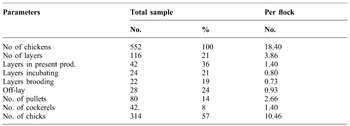
In the 30 households under study there were a total of 552 chickens; a mean of 18.4 chickens per household flock and a maximum and minimum of 37 and 7 birds per flock respectively. The proportion of laying hens in the flock also showed considerable variation. Flock dynamics and the availability of scavengable feeds essentially determined egg production. It was recorded that many of these flocks contained a significant proportion of non-laying hens which share the feed provided for productive birds but yield no eggs. The size, structure and dynamics of family flocks are presented in Table 1. It was noted that the mean number of layers per flock was only 3.9 (21% of the flock) and the proportion of layers that were observed to actually be in-lay was 36%.
Size, structure and dynamics of village chicken flocks.

Bessei (Reference BESSEI1990) reported that average rural chicken flocks in Bangladesh comprise of 20 birds. Rushton (Reference RUSHTON1996) reported an average of 3.49 and 2.22 mature hens in village flocks in Ethiopia and Gambia respectively. Aichi (1995) reported a flock dynamics figure of 20% in African village flocks. Data obtained from the study described above on the parameters of size, structure and flock dynamics show reasonable agreement with these findings.
Productivity of family chickens
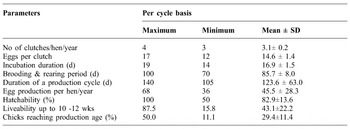
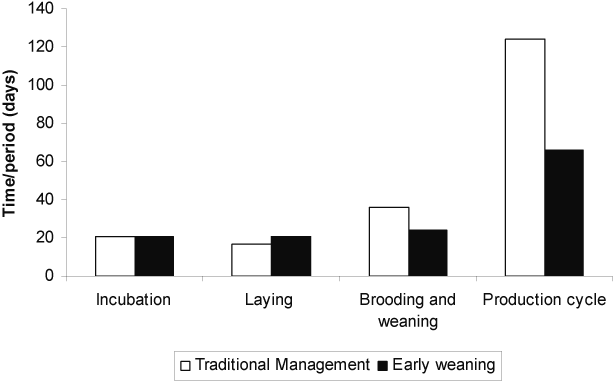
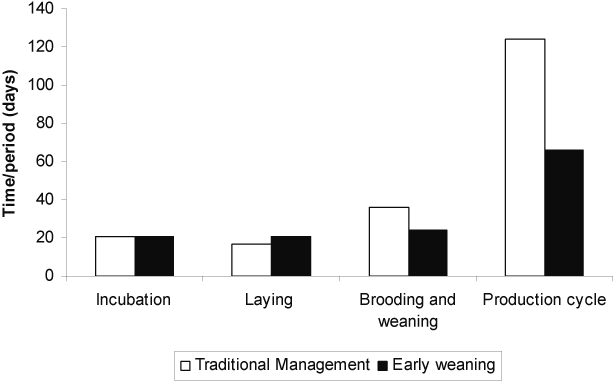
Almost 86% households under study harvest only three clutches of eggs per hen per year with 12 to 17 eggs in each clutch. Incubation duration varies from 14 to 19 days with a mean of 16.9 days. Average duration of a production cycle was found 124 days with a maximum and minimum of 140 and 105 days respectively. Average egg production was 46 eggs per hen per year. Productivity of family flocks is shown in Table 2. Average hatchability was 83% but chick mortality was high (57%) up to 10-12 weeks of age. Of the chicks surviving at this age, only 29% reached sexual maturity.
Productivity of family chicken flocks.

Wilson (Reference WILSON1979) reported 90% hatchability of village chickens in Sudan and Bourzat and Saunders (Reference BOURZAT and SAUNDERS1990) found hatchability to range from 60 to 90% in village hens in Burkina Faso. Van Veluw (Reference VAN VELUW1987) and Wilson et al. (Reference WILSON, TRAORE, KUIT and SLINGERLAND1987) reported mortality figures of 50 and 56% in village flocks in Ghana and Mali respectively. Tibamanya et al. (Reference TIBAMANYA, ALEMU and PERES1994) found that free-range local chickens in Tanzania take from 108 to 161 days to complete a production cycle with approximately three production cycles per year and a mean annual egg production per hen of about 45 eggs. Sonaiya (Reference SONAIYA2005) reported an almost identical clutch frequency in Nigerian chickens to that found in the present study. The Bangladeshi findings also agree with those of Huque et al. (Reference HUQUE, EBADUL and RIGOR1990), Ahmed and Hasnath (Reference AHMED and HASNATH1983), Bessei (Reference BESSEI1988), Todelle et al. (Reference TODELLE, ALEMU and PERES2000) and Shawkat et al. (Reference SHAWKAT, HOWLIDER and CHWALIBOG2001).
Economic returns from local chickens under traditional management systems
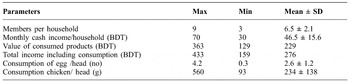
Economic returns from local chicken flocks has been estimated in terms of both cash income and household consumption of eggs and chickens. Average monthly income per household, from a flock of 18.4 chickens, was found to be only 276 BDT (70 BDT= 1 USD) including the value of eggs and chickens consumed. This is the equivalent of BDT 3310 per year. Annual per capita consumption of eggs and chickens was 32 kg and 2.8 kg respectively (Table 3).
Cash income comprises only BDT 558 (46.5 x 12) per year which was only 16.8% of total income. From the results of the study it is therefore evident that economic returns from and productivity of traditionally managed village chicken flocks, are low.
Monthly income and household consumption of eggs and chickens.

Effect of weaning on egg production of family chickens
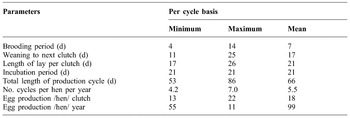
Early weaning of chicks from the mother hen at an early age shortens the length of the production cycle of the broody hen. Early weaning resulted in production cycles of from 53 to 86 days with a mean of 66 days. This shortening of the production cycle results in an increase in clutch frequency and egg production of the flock. The number of clutches per hen per year ranged from 4.2 to 7.0, with a mean of 5.5. Egg produced per clutch varied from 13 to 22 with a mean of 18. With early weaning, egg production per hen per year ranged from 55 to 110 with a mean of 99, more than a doubling in annual production compared to hens under traditional management. (45.5) (Table 4).
Effect of early weaning on productivity of local chickens.

A comparison of production cycles of local chickens under traditional management and with early weaning is presented in Figure 1. The total length of the production cycle was reduced by 53% under early weaning practices. Early weaning of chicks thus appears to be a successful tool for increasing the productivity of local chickens. This increased productivity of local chickens through early weaning is supported by the findings of Prasetyo et al. (Reference PRASETYO, SUBIHARTA and SABRANI1985) and Huque et al. (Reference HUQUE, EBADUL and RIGOR1990) and is cost effective and sustainable.
Comparison of production parameters for chickens under traditional management systems and early weaning.
Effect of creep feeding on performance of village chicks
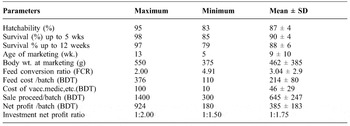
High mortality of chicks is the main constraint to the expansion of family flocks. Creep feeding with a balanced diet significantly increases liveability and growth of scavenging chicks (Table 5).
Effect of creep feeding on liveability and growth of chicks.

Creep feeding increases survival rate of chicks with rates varying from 83 to 95% with a mean of 87%. Average FCR was 3.04.while the investment: profit ratio was 1:1.75. The Highest income was BDT 924 with a mean of BDT 385 per batch (about 52-56 BDT /chick), and it was observed that income increased proportionately with increasing number of chicks reared by the household. Hence, creep feeding of chicks significantly increased household income, but the number of chicks reared appeared to be the main determinant of income.
Effect of feed supplementation of broody hens on egg production
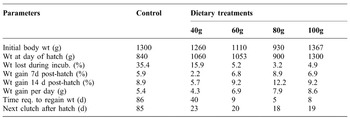
Village women typically offer little or no feed to broody hens during incubation, which results in enormous loss in body weight of the hen over this period. It was found that hens lost between 18 and 35% of their body weight (mean 27%) during incubation (Sarkar, unpublished). Feed supplementation of broody hens helps to reduce their body weight loss and influences the subsequent commencement of lay and consequently the clutch interval. The effect on the bodyweight of hens during incubation when given different feeding regimes is shown in Table 6. Time taken to regain the weight lost during incubation decreased from 86 days in the control group to 40, 9, 5 and 8 days respectively in the groups given 40, 60, 80 and 100g of commercial layer diet per bird per day. Body weight loss was a minimum (3.22%) in the group fed on 80g feed and highest (35.38%) in the control group.
Body weight loss in incubating hens and rate of regain.

Results show that 60g feed supplementation per hen per day dramatically reduced both body weight loss of hens during incubation and the time interval to the next clutch. There was no additional benefit of feeding the hens more than this daily allowance. In fact 40 g supplemental feed/day resulted in a similar interval to next clutch, but the birds on this feeding level took significantly longer time to regain body weight than those given 60g /day.
Income and household consumption of eggs and chickens under an improved management system
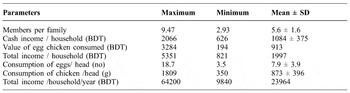
Data on income and consumption of eggs and chicken by the households under study are presented in Table 7. Monthly household income from chickens reared under improved management systems varied from 821 to 5351 BDT with a mean of 1997 BDT. Average annual per capita consumption of eggs and chickens were 95.2 and 10.5 kg respectively.
The economic output of a family flock comprising an average of 18.4 chickens ranges from 3310-5196 BDT per year under traditional management. Improved management practices, including early weaning, creep feeding and supplemental feeding of the hen during incubation, can result in a mean household income of 23964 BDT per year, an approximate six-fold increase.
Monthly household income and consumption of eggs and chickens.

Weaning, creep feeding of chicks and feed supplementation of broody hens during incubation appear to be effective tools for increasing egg production, liveability of the birds and the profitability of small-scale poultry production to a point where such systems could be considered as an economically viable and sustainable enterprise for rural households in Bangladesh.
Conclusions
Family chicken farming is an important economic activity to the subsistence rural households of Bangladesh. Notwithstanding the traditional view that local chicken production can never be a viable farming enterprise due to their low productivity under traditional systems of management, recent studies have demonstrated that improved management interventions in the form of early weaning, creep feeding of chicks and supplemental feeding of hens during the incubation period, have the capacity to impact dramatically on profitability and income generation. Such a change allows for the recognition of small-scale poultry production as an economically viable and sustainable enterprise for rural households in Bangladesh.
Acknowledgements
A large number of beneficiaries, development workers and technical staffs were involved in this research programme. The list will be too large to mention here. We sincerely express our gratitude, and would like to acknowledge their contributions. We thank SLDP-2 authority for its support for the conduct of the experiments in its project area. We express our gratitude to Danida and the Danish Embassy, Dhaka, Bangladesh for their financial assistance and active support in conducting the experiments.