Clinical Implications
-
• Harm Avoidance was the basic concept of the previous classification of obsessive-compulsive disorder (OCD), whereas the actual classification allude to the animal model of Dysfunctional Grooming.
-
• The importance of glutamatergic and dopaminergic circuitries as pathways beyond the serotoninergic mechanisms has been shown. These are now identified as targets in OCD treatments.
-
• The dorsal striatum and the accumbens connection with orbito-frontal cortex (OFC) that correlated to a failure in the rewarding signals is in the pathophysiology in OCD patients.
-
• Given these findings, non-invasive neuromodulations such as transcranial magnetic stimulation (TMS) are now purposed in OCD, with different targets and paradigms.
Introduction
During the past several years, research on obsessive-compulsive disorder (OCD) has embraced a multidimensional approach, evaluating neurobiological, genetic, and molecular mechanisms involved in the pathophysiology of the disorder. Given the aim to complement contributions from clinical observations and neuroscientific findings with the purpose of finding new therapeutic compounds, a review of recent findings concerning targets for therapeutics and pharmacological treatment is presented. Particular attention is given to transcranial magnetic stimulation (TMS) as an encouraging treatment for compulsivity and impulsivity typical of OCD and related disorders.
Brief Review of Targets for Therapeutics
Neurotransmitter systems, molecular pathways, and brain circuitry
The Diagnostic and Statistical Manual of Mental Disorders, 5th edition (DSM-5) has been recently published with much fanfare, although some of the early promise from the research planning agendaReference Kupfer, First and Regier 1 on the use of endophenotypes or “external validators” of syndromal descriptions were ultimately not included in this edition. The research domain criteria (RDoC) classification has been presented as a complementary and noncompeting framework for this goal. Nevertheless, DSM-5 does reflect an advancement in the scientific assessment of clinical manifestations of brain disease, the clustering of related categories of illnesses, and the introduction of dimensional measures. OCD is now considered separate from the anxiety disorders, and obsessive-compulsive (OC) and related disorders include body dysmorphic disorder (BDD), hoarding, trichotillomania, skin picking, OCD due to or induced by substances, and other specified OC related disorders such as body-focused repetitive behavior disorder and obsessional jealousy. This clustering is based on both clinical similarities and presumed underlying fronto-striatal circuitry dysfunction, and is consistent with genetic research, which was ultimately not included as a DSM-5 diagnostic validator.
Genetic and molecular targets
The most convincing evidence of a familial risk for OCD came from a recently published study that showed that the risk for first-degree relatives was significantly higher than that for second- and third-degree and nonbiological relatives, and the second-degree relatives had higher risk for OCD than third-degree relatives despite different degrees of shared environment. Separate twin modeling analyses confirmed that familial risk for OCD was largely attributable to additive genetic factors, with no significant effect of shared environment.Reference Mataix-Cols, Boman and Monzani 2 OCD subjects are apparently inclined to assortative mating, since nonbiological relatives (spouses or partners who have at least 1 child together) also had a higher risk for OCD.Reference van Grootheest, van den Berg, Cath, Willemsen and Boomsma 3 OCD is associated with multiple genes, most of which have a modest association with OCD. A genetic multimodal liability has been demonstrated in a recent genome-wide association study (GWAS),Reference Stewart, Yu and Scharf 4 which has led to a greater understanding of pathophysiology in many disorders. Although no single nucleotide polymorphisms (SNPs) were identified to be associated with OCD at a genome-wide significant level in a combined trio–case–control sample, a highly significant enrichment of methylation in the frontal lobe was reported within the top-ranked SNPs (P < 0.01). This involvement of frontal lobe genetics has been interpreted as having a broad role in gene expression in the brain, and it is consistent with the general hypotheses and therefore in the etiology of OCD.
OCD has been inconsistently associated with serotonin-related polymorphisms (5-HTTLPR and HTR2A) and, in males only, with polymorphisms involved in catecholamine modulation (COMT and MAOA). Nonsignificant trends were also reported for 2 dopamine-related polymorphisms (DAT1 and DRD3) and a glutamate-related polymorphism (rs3087879). The neuronal glutamate transporter gene SLC1A1 is a candidate gene for OCD based on linkage studies and convergent evidence implicating glutamate in the etiology of the disease, and it is the only genomic region with a consistently demonstrated OCD association, in particular when analyzing male-only probands. However, specific allele associations have not been consistently replicated, and recent OCD genome-wide association and meta-analysis studies have not incorporated all previously associated SLC1A1 SNPs.Reference Stewart, Mayerfeld and Arnold 5 Future studies with sufficient power to detect small effects are needed to investigate the genetic basis of OCD subtypes, such as early vs late onset OCD.
The OC and Related Disorders section in DSM 5 alludes to “dysfunctional grooming” as a prototype of OCD to a greater degree than harm avoidance, which was referred to when OCD was included in the anxiety section of the Diagnostic and Statistical Manual of Mental Disorders, 4th edition (DSM-IV). Thus, translational approaches to the investigation of molecular pathways adopted from animal models to translate data from neurofunctional and genetic studies is extremely informative in addressing specific candidate genes to probe in human subjects. These studies have 2 major tautological limitations. First, in mouse models, we are limited to grooming and other repetitive behaviors, while it is impossible to determine the subjective experience (core in OCD in humans) of the animal motivating the behavior.Reference Abramowitz, Deacon and Olatunji 6 However, the validity of OCD animal models is more convincing when the evidence for concurrent anxiety (increased face validity) or biological evidence of cortico-striatal dysfunction (construct validity) is included. Second, “knock out” approaches are limited, since single-gene variation may not grab more subtle changes in gene expression that are implicated in complex traits. In addressing these limitations, there has been a consistent proliferation of findings that may improve the understanding of the role of glutamate dysfunction in leading to obsessive-compulsive symptoms.
Hox gene
It was has been shown Hox genes are involved in organizing body plans by providing positional values along the major axes of the embryo,Reference Capecchi 7 but it was quite unexpected that disruption of a Hox gene leads to pathological grooming.Reference Greer and Capecchi 8 Hox genes also have direct roles in the formation of the hematopoietic system, and, with respect to Hoxb8, they are involved in maintenance and differentiation of myeloid progenitor cells, as well as one of the two known sources of microglia.Reference Chen, Tvrdik and Peden 9 , Reference Antony 10 Hoxb8 is functionally related to a neural circuit that serves as a behavioral regulator of the grooming in the adult brain, thus bridging OCD phenomena.
SAPAP3 and SAPAP4 and the response to SSRIs
In mice, genetic deletion of SAPAP3, a synapse-associated protein 90/postsynaptic density protein 95-associated protein 3 that is an excitatory postsynaptic protein, correlates to OCD-like behaviors that are rescued by striatal expression of SAPAP3, which demonstrates the importance of striatal neurotransmission for OCD-like behaviors.
SAPAP3 is a well-known scaffolding protein that is highly expressed in striatal excitatory synapses, which normally inhibit the mGluR5-driven endocytosis of AMPA-type glutamate receptors AMPARs.Reference Wan, Feng and Calakos 11 Of interest is the response to fluoxetine, as reduction of OC features has been reported in this model.Reference Welch, Lu and Rodriguiz 12
Of even greater interest in the striatum, there are two main excitatory synaptic circuits: corticostriatal and thalamostriatal. Either or both of these circuits could potentially contribute to the OCD-like behaviors of SAPAP3 knockout (KO) mice. In a recent study,Reference Wan, Ade and Caffall 13 it has been reported that SAPAP3 deletion reduces corticostriatal alpha-amino-3-hydroxy-5-methyl-4-isoxazole-propionic acid–type glutamate receptor-mediated synaptic transmission, while corticostriatal synapses and thalamostriatal synaptic activity is unaffected by SAPAP3 deletion. At the molecular level, another SAPAP family member, SAPAP4, is present at thalamostriatal, but not corticostriatal, synapses, which is consistent with a molecular rationale for the functional divergence we observe between thalamic and cortical striatal circuits in SAPAP3 KO mice, and provides evidence that SAPAP isoforms may be localized to synapses according to circuit-selective principles.
SLITRK5
The loss of a neuron-specific transmembrane protein, SLIT and NTRK-like protein-5 (SLITRK5), leads to a different OCD-like model in mice, where increased anxiety-like behaviors are presented, and which are alleviated by the SSRI fluoxetine. SLITRK5(–/–) mice show selective over-activation of the orbitofrontal cortex, abnormalities in striatal anatomy and cell morphology, and alterations in glutamate receptor composition, which contributes to deficient corticostriatal neurotransmission.Reference Shmelkov, Hormigo and Jing 14
D1CT-7 and the dopaminergic system
Campbell etal.Reference Campbell, de Lecea and Severynse 15 described D1CT-7 transgenic mice as the first genetic mouse model for OCD, and tics expressed it with an intracellular form of cholera toxin (CT) under the control of the D1 promoter. The CT toxin is a neuropotentiating agent that chronically activates stimulatory G-protein (Gs) signal transduction and cyclic adenosine monophosphate (cAMP) synthesis. The use of a D1 promoter restricts CT expression to D1 dopamine receptor subtype positive (D1+) neurons. D1CT-7 mice led to a wide range of compulsive behaviors and repetitive behaviors, including nonaggressive biting of siblings and repetitive leaping.Reference Campbell, de Lecea and Severynse 15 Furthermore, D1CT-7 mice also display tic-like movements with a juvenile age of onset more prevalent in males. These features make the D1CT-7 mouse a suitable model for Tourette syndrome (TS), a disorder that frequently co-occurs with OCD in humans.Reference Nordstrom and Burton 16 Since the expression of CT in the brain of these mice overlaps with regions implicated with OCD, the authors suggest that chronic potentiation of D1+ neurons leads to over-activation of glutamatergic output to the striatum. Adding a noncompetitive N-methyl-D-aspartate (NMDA) receptor antagonist to indirectly stimulate cortical-limbic glutamate output has also been shown to increase compulsive-like behavior in the D1CT-7 model.Reference Nordstrom and Burton 16 , Reference McGrath, Campbell, Parks and Burton 17 A DRD4 VNTR polymorphism is associated with OCD, and the presence of the 2R allele was significantly associated with the symmetry dimension, which might represent a more homogeneous subtype of OCD with a genetic etiology.Reference Taj M J, Viswanath and Purushottam 18 In summary, Hoxb8, SAPAP3, and SLITRK5 lead to pathological behaviors, including adult-onset excessive grooming with mild-to-severe hair loss and self-injury. In 2 of the models, the SAPAP3-deficient and the SLITRK5-deficient mice, the abnormal grooming behaviors are associated with enhanced anxiety, and these pathological behaviors can be curtailed with subchronic administration of a SSRI, suggesting the predictive validity of such models.
Brain areas and circuitries involved in OCD
The possible role of amygdala in OCD
Amygdala activation does not play a central role in the pathophysiology of OCD, as is seen in other anxiety disorders.Reference Cannistraro and Rauch 19 Even though there is some evidence to associate OCD with enhanced amygdala activation, but not just in response to aversive stimuli,Reference Mataix-Cols, Cullen and Lange 20 – Reference Simon, Kaufmann and Musch 22 the amygdala plays a central role in the identification of threat and stress,Reference LeDoux 23 and in the development of fear and arousal.Reference Davis 24 The hyper-activation of the amygdala in response to threat of punishment has been hypothesized to contribute to the exaggerated emotional response to negative stimuli exhibited by OCD patients,Reference Mataix-Cols, Cullen and Lange 20 which could mediate their tendency to over-estimate threat signals and possibilities.Reference Sookman and Pinard 25
The crucial role of the striatum in OCD
While amygdala importance appears to be reduced, most neurobiological theories of OCD attribute a crucial role to the striatum, especially to its dorsal part in the pathophysiology.Reference Saxena, Brody and Schwartz 27 , Reference Menzies, Chamberlain and Laird 28 The ventral striatal nucleus accumbens is regarded as a core feature of the neural reward system,Reference Depue and Collins 29 – Reference Haber and Knutson 31 and thus the current example of its poor response to rewarding outcome in OCD patients may reflect a failure in the rewarding signals in OCD patients.Reference Szechtman and Woody 32
Imbalance in responsiveness to threat vs reward in OCD has been recently addressed as the core dysfunction. A recent behavioral study found that OCD patients respond faster than controls in avoiding negative stimuli and slower in approaching positive stimuli, which can be interpreted as representing a motivational bias toward potential negative vs positive stimuli in OCD.Reference Endrass, Kloft and Kaufmann 33 Abnormal neural responsivity in OCD patients to threat and reward was also exemplified here at the circuit level via reduced limbic–frontal functional and structural connectivity, and has been correlated with symptom severity. Reduction in either functional or structural connectivity is regarded as an indication of disruptions in information processing between distant brain regions.Reference Harrison, Soriano-Mas and Pujol 30 , Reference Beaulieu 34 , Reference Sporns 35
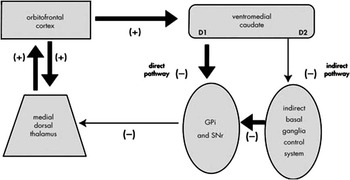
Another core feature in models of OCD is related to disrupted neural circuitry and thus reduced information processing between limbic and frontal regions. This model implies that deficiencies in connectivity may lead to imbalanced limbic responsivity and reduced integrity of amygdala–prefrontal fiber tracts associated with impaired down-regulation of anxietyReference Banks, Eddy and Angstadt 36 , Reference Kim and Whalen 37 and top-down regulation failure of limbic activity by frontal brain areas correlated with pathological emotional responses.Reference Phillips, Drevets and Rauch 38 All these effects happen according to the most commonly reported brain abnormality in OCD, ie, hyper-activation of the neural feedback circuit that includes frontal, limbic, and striatal structures (see Figure 1), as a result of a compensatory, even if insufficient, attempt of the frontal cortical regions to regulate the unbalanced limbic responsivity.
Brain circuitries and pathways involved in OCD. In OCD, the direct pathway is strongly activated in relation to the indirect pathway resulting in OFC-subcortical hyperactivity. Large arrows represent inputs that are strengthened in patients with OCD. GPi = globus pallidus internal segment; SNr = substantia nigra reticulata. Reproduced with permission from Stein (2006).Reference Stein 26

The negative correlation found between limbic–frontal connectivity strength, both structural and functional, to symptom severity adds further support to this hypothesis, as indeed the dysfunctional hyper-activation in OCD seems to normalize with successful treatment with either CBTReference Brody, Saxena and Schwartz 39 or a pharmacological agent.Reference Saxena, Brody and Schwartz 27 , Reference Saxena and Rauch 40 – Reference Milad and Rauch 43 The specific relationship of the amygdala to the dorsal anterior cingulate cortex (dACC) and of the nucleus accumbens (nACC) to the OFC is still to be clarified. The repeated demonstration of anterior cingulate cortex (ACC) hyperactivation in OCD patients was interpreted as underlying their ongoing subjective constant sense that something is not right or is wrong even when there is not.Reference Aouizerate, Guehl and Cuny 44 – Reference Fitzgerald, Welsh and Gehring 46
The relation of the OFC to the nACC may be mediated through their shared involvement in reward processing as well,Reference Kringelbach 47 as both regions displayed reduced activation in response to reward in OCD,Reference Remijnse, Nielen and van Balkom 48 – Reference Figee, Vink and de Geus 50 forming a unified dysfunctional circuit to mediate the “destructive risk aversion.” With consequent inadequate response to threatening and rewarding cues in the environment, 2 of the main components contribute to elevated risk aversion, greatly impairing daily function in OCD patients. Accurate identification of the dysfunctional neural indices that underlie such abnormal behavior allow for a more specific and possibly more effective approach in future therapy, either by identifying neural predictors of treatment responseReference Rauch, Dougherty and Cosgrove 51 , Reference Hendler, Goshen and Tzila Zwas 52 or individually localizing neural targets to optimize neuromodulatory invasive or non-invasive, circuit-based neuromodulatory interventions.
The increased regional metabolic activity in the orbitofrontal cortex and caudate in OCD patients versus controls, in both resting and symptomatic states, has been one of the most replicated findings in psychiatric imaging since the publication of Insel's commentary “Towards a Neuroanatomy of Obsessive-Compulsive Disorder“ 20 years ago.Reference Insel 53
Orbitofrontal 5-HT1BRs in OCD pathophysiology and treatment
A recent experiment was conducted in mice that have chronically received the SRI clomipramine or the noradrenaline reuptake inhibitor (NRI) desipramine. The mice were examined for 5-HT1BR-induced OCD-like behavior, or 5-HT1BR binding and G-protein-coupling in the caudate-putamen, nucleus accumbens, and orbitofrontal cortex. Separate mice were tested for OCD- or depression-like behavior with a weekly follow-up for 56 days of SRI treatment. Finally, OCD-like behavior was assessed following intra-orbitofrontal 5-HT1BR agonist infusion or intra-orbitofrontal 5-HT1BR antagonist infusion coupled with systemic 5-HT1BR agonist treatment. Effective, but not ineffective, OCD treatments reduced OCD-like behavior in mice with a time course that parallels the delayed therapeutic onset in OCD patients and down-regulated 5-HT1BR expression in the orbitofrontal cortex. The intra-orbitofrontal 5-HT1BR agonist infusion induced OCD-like behavior, and the intra-orbitofrontal 5-HT1BR antagonist infusion blocked OCD-like effects of systemic 5-HT1BR agonist treatment.
These results indicate that orbitofrontal 5-HT1BRs are necessary and sufficient to induce OCD-like behavior in mice, and that SSRI pharmacotherapy reduces OCD-like behavior by desensitizing orbitofrontal 5-HT1BRs, which is consistent with an essential role for orbitofrontal 5-HT1BRs in OCD pathophysiology and treatment.Reference Shanahan, Velez and Masten 54
The fronto-striatal model of obsessive-compulsive disorder (FSMOCD) has been investigated in human trough event-related potential (ERP) studies, which have provided further insight about the involvment of the ACC, basal ganglia (BG), and OFC and their related cognitive functions, such as monitoring and inhibition.Reference Melloni, Urbistondo and Sedeño 55
The ERPs study included the error-related negativity (ERN), N200, and P600, where both N2 responses during conflict tasks and enhanced P600 during working memory (WM) tasks have been documented. There is converging evidence from the ERP study (especially regarding ERN and N200 amplitude enhancement), with neuroimaging and neuropsychological findings suggesting abnormal activity in the OFC, ACC, and BG in OCD patients; for a review see Melloni etal.Reference Melloni, Urbistondo and Sedeño 55 Other areas, such as the dorsolateral prefrontal and parietal cortex, might be involved in executive function (EF) deficits, suggesting the existence of a self-monitoring imbalance involving inhibitory deficits and executive dysfunctions. OCD patients present an impaired ability to monitor, control, and inhibit intrusive thoughts, urges, feelings, and behaviors. By summarizing all these findings in a model, we may figure out all the OCD dysfunctions as a chain of events that is triggered by an excitatory role of the BG (associated with cognitive or motor actions without volitional control) and inadequate inhibitory activity of the OFC, as well as excessive monitoring of the ACC to block excitatory impulses, and that interacts with the reduced activation of the parietal-dorsolateral prefrontal cortex (parietal-DLPC) network, leading to executive dysfunction.
Based on this growing background of research, several treatment options are now available for OC and related disorders.
Therapeutics of OCD
Meta-analyses of CBT with ERP and drug trials of SSRI and clomipramine have reported effect-sizes demonstrating equivalent efficacy for these treatments in OCD. CBT or SSRI pharmacotherapy usually constitute the first-line recommended treatments without predictors to a preferential response. Individual preference or therapist availability lead the choice of modality for adult first-line treatment, while for children and adolescents, due to concerns about the potential adverse effects associated with SSRIs, the recommendation is that CBT should be used as first-line treatment in children with OCD.
However, compared to SSRIs, CBT is less cost-effective, according to health-economic analysis, which is an especial consideration in this age of economic crisis. A secondary analysis of a large, randomized, placebo-controlled treatment trial reported that hoarding and symmetry symptoms predicted a poorer overall outcome with SSRIs, and hoarding responds poorly to CBT.
Monotherapy or combination treatment?
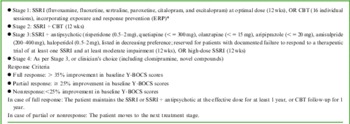
According to current guidelines, the evidence supporting the additional benefit of combining CBT with medication is not sufficiently strong; therefore based on a cost-effectiveness assessment, CBT or pharmacotherapy should initially be provided as a monotherapy. As OCD typically responds slowly to treatment, at least 12 weeks of medication at optimized dosage and 16 hours of CBT with ERP are required to test efficacy. Combination strategies (eg, CBT + SSRI) are recommended only in severe illness or in cases that fail to respond to monotherapy (see Table 1).
Evidence-based treatment algorithm for translational OCD studies

*For adolescents, CBT is usually used first line.
(from “Evidence-based treatment-pathways for translational studies in Obsessive-Compulsive Disorders,” Fineberg NA, Pallanti S, Reghunandanan S.Reference Fineberg, Pallanti, Reghunandanan, Baldwin and Leonard 56 )
SSRI = selective serotonin reuptake inhibitors; CBT = cognitive behavioral therapy; ERP = exposure and response prevention; Y-BOCS = Yale-Brown Obsessive Compulsive Scale.
Resistant OCD
Definition of resistance in OCD
The definition of treatment resistance, representing an inadequate response following an adequate trial of treatment with good adherence, should usually be made in relation to a specific treatment or series of treatments. Pallanti etal.Reference Pallanti, Hollander and Bienstock 57 proposed the introduction of operational criteria for assessment of stages of response and suggested that it should be seen as a continuum from remission to refractoriness. Treatment resistance may be defined as less than 25% improvement in baseline Yale-Brown Obsessive Compulsive Scale (Y-BOCS). Though the terms “resistance” and “refractory” are sometimes used interchangeably, treatment resistance may be defined as nonresponse following an adequate trial of one SSRI, while treatment refractoriness refers to a lack of response to several trials of evidence based treatment; according to Pallanti etal.,Reference Pallanti, Hollander and Bienstock 57 these should include 3 SSRI agents, augmentation trials with 2 antipsychotics, and at least 20–30 hours of CBT.
Increasing dose for resistant OCD cases?
SSRIs show evidence of efficacy compared to placebo across the full range of approved doses. Only a limited number of fixed-dose studies has suggested that higher doses of some SSRIs (escitalopram, fluoxetine, paroxetine) are more efficacious than lower doses. Yet higher doses are associated with a greater adverse effect burden, and it would be helpful to know in advance whether or not dose escalation is required for an individual patient. There have been no dose-finding studies of clomipramine. Daily doses ranging from 75 mg to 300 mg of clomipramine have been found to be effective, though doses exceeding 250 mg should only be used with caution. Some research suggests that intravenous administration of drugs may have a better effect than oral administration in OCD patients. Intravenous (iv) citalopramReference Pallanti, Quercioli and Koran 58 and iv pulse loading with citalopramReference Fineberg, Pallanti, Reghunandanan, Baldwin and Leonard 59 and clomipramineReference Koran, Aboujaoude and Ward 60 have been reported only in limited samples. Also, some advantage in terms of relapse prevention in the maintenance phase has been reported.Reference Ross, Fallon, Petkova, Feinstein and Liebowitz 61
Targeting other 5HT receptors
Ondansetron is a 5-HT3 receptor antagonist that has been shown to reduce the reinforcing effects of a variety of abused drugs, including alcohol and amphetamines. In a study that examined the influence of ondansetron monotherapy in 8 OCD patients, 3 of the 6 patients who completed the study achieved a clinically significant response. Pallanti etal.Reference Pallanti, Bernardi, Antonini, Singh and Hollander 62 conducted a single-blind trial in 14 patients with OCD who were treatment resistant and were receiving treatment with SSRIs and antipsychotic augmentation. Nine (64.3%) of the patients showed treatment response, and none of the patients experienced symptom exacerbation or significant adverse effects.
Granisetron, another 5-HT(3) receptor antagonist, has been adjunct to SSRI in patients with severe OCD in a double-blind, placebo-controlled trial in a short-term treatment and has been reported as effective, but this compound deserves further investigation.Reference Askari, Moin and Sanati 63
Dopaminergic augmentation (SSRI)
Involvement of the dopamine system in OCD symptoms has been consistently reported, and modest usefulness of atypical antipsychotics to augment the response to SSRIs has been shown by 3 meta-analyses.Reference Hollander and Pallanti 64 Adding antipsychotics to SSRIs might be an effective strategy to augment the response in treatment-resistant OCD patients, especially for those with comorbid tic disorder who respond better to antipsychotic augmentation. Evidence that the population of patients who has OCD plus tic disorder is unique and responds differently to standard treatment is also found among pediatric patients. Basal ganglia have a significant patho-physiological impact at least on specific subgroups of patients. Not only are movement disorders more common in OCD and schizophrenia, but they have prognostic implications (ie, only OCD patients with movement disorder respond to typical neuroleptic augmentation strategies).Reference Kaplan and Hollander 65
In conclusion, augmentation of ongoing serotonergic treatment with an antipsychotic for treatment-resistant OCD patients is one of the most studied and well documented strategies. However, it is important to note that the effects are modest and might be driven by a specific subtype (eg, tic-related disorders), and that there are long-term consequences to the use of atypical antipsychotics; these may include a significantly higher rate of increased body mass index, elevated fasting blood glucose, elevated triglycerides, and total cholesterol levels. These data emphasize the importance of the assessment of the metabolic and nutritional aspects in the management of treatment-resistant OCD patients who receive augmentation treatment with an atypical antipsychotic.
On the other hand, 2 small, double-blind, placebo-controlled, single-dose, crossover studies found dextroamphetamine (d-amphetamine) 30 mg to be clearly superior to placebo in relieving symptoms of OCD, and a 5-week, double-blind, caffeine-controlled study to test the hypothesis that d-amphetamine, added after an adequate SSRI or serotonin-norepinephrine reuptake inhibitor (SNRI) trial, is more effective than caffeine in reducing residual OCD symptoms of moderate or greater severity. At week 5, the responders’ mean Y-BOCS score decreases were 48% (range 20–80%) for the d-amphetamine group (last observation carried forward) and 55% (range, 27–89%) for the caffeine group.Reference Koran, Aboujaoude and Gamel 66 Augmentation with dopaminergic agents might be an option in OCD patient partial- or nonresponders to SSRIs or SNRIs.
Glutamatergic augmentation
Glutamate-modulating drugs have been investigated in open-label augmentation studies, the rationale being that an SSRI in OCD reduces the glutaminergic tone in the cortical striatal network. In these pilot studies, topiramate (a glutamate agonist)Reference Mowla, Khajeian, Sahraian, Chohedri and Kashkoli 67 and riluzole (a glutamate antagonist)Reference Grant, Lougee, Hirschtritt and Swedo 68 have been reported to be effective in some resistant OCD patients or, in the case of topiramate, at least on the compulsive features.Reference Berlin, Koran and Jenike 69
A noncompetitive glutamate antagonist, memantine, has also been examined as augmentation in treatment-resistant OCD patients receiving SSRIs. In a small, open-label trial, almost half of the patients had a meaningful improvement in symptoms.Reference Aboujaoude, Barry and Gamel 70 In a single-blinded, case-control study of memantine augmentation among severe OCD patients, Y-BOCS score decreases were 7.2 among the cases and 4.6 among the control patients receiving standard treatment.Reference Abudy, Juven-Wetzler and Zohar 71 Another studyReference Feusner, Kerwin, Saxena and Bystritsky 72 compared the efficacy of memantine in OCD and generalized anxiety disorder. Ten OCD subjects and 7 generalized anxiety disorder subjects received 12 weeks of open-label memantine, as either monotherapy or augmentation of their existing medication. Among the OCD group, the average improvement in the Y-BOCS score was 4.75 (40.6%).
Consistent with the hypothesis of a glutamatergic involvement in OCD, a small recent study demonstrated some improvement in OCD severity with intravenous ketamine. Rapid anti-OCD effects from a single intravenous dose of ketamine can persist for at least 1 week in some OCD patients with constant intrusive OC thoughts. This first randomized, controlled trial represents “a proof of concept “that a drug affecting glutamate neurotransmission can reduce OCD symptoms without the presence of an SRI.Reference Rodriguez, Kegeles and Levinson 73
CBT augmentation
One of the recent promising fields of investigation, even though currently there is less enthusiasm about it, is cycloserine. Cycloserine is an NMDA partial agonist. NMDA (glutamate) receptor stimulation has been linked with amygdala neural plasticity and fear extinction effects. Since cycloserine has been used for years in humans to treat tuberculosis and is not associated with significant adverse effects, at weight-dependent dose, there was no obstacle for carrying out clinical research with this compound, even in children and adolescents, who are difficult to treat.Reference Farrell, Waters and Boschen 74 Cycloserine has been administered before an exposure task in various anxiety disorders in the hope that stimulation of the NMDA receptor might extinguish fear. The preliminary results were mixed, and so further research, especially in the early phases of treatment, is needed.
When and how to augment or switch
If a patient has been treated for several months and has not yet responded to treatment with several SSRIs, the physician should perform a careful reassessment of resistant and/or residual clinical symptoms and any comorbid conditions to determine which next-step treatment would be the most appropriate.Reference Pallanti, Hollander and Goodman 75 At this point, there is not a universally prescribed “next step.”
Obsessive Compulsive Spectrum Disorders: The Compulsive Side of the Coin
Hoarding
Compulsive hoarding, which is characterized by the acquisition of and failure to discard a large number of possessions, is increasingly recognized as a significant public health burden. Thus, evidence that hoarding lead to its own diagnosis is introduced in DSM-5.0. The dimension as a common affective-motivational underpinning bridging OCD to hoarding has been addressed in the incompleteness/“not just right experiences” (NJREs). While the belief that hoarding does not respond to SSRIs has been contradicted,Reference Saxena 76 a novel treatment approach for obsessive compulsive personality disorder (OCPD) that focuses on habituation to NJREs may be useful.Reference Ecker, Kupfer and Gönner 77
Body dysmorphic disorder
A Cochrane Review on body dysmorphic disprder (BDD) and a treatment practice guideline on OCD and BDD from the United Kingdom's National Institute for Health and Clinical Excellence (National Health Service) recommend CBT, which might be adapted to specifically target BDD symptoms (and SSRIs as first-line treatments for BDD.
Most published studies of CBT for BDD have included cognitive restructuring, exposure (eg, to avoided social situations) and response (ritual) prevention (eg, not seeking reassurance) that are tailored specifically to BDD symptoms. Additional strategies (used in combination with the above approaches) include perceptual retraining with mirrors, habit reversal for BDD-related skin picking or hair plucking, cognitive approaches that target core beliefs, incorporation of behavioral experiments into exposure exercises, motivational interviewing tailored to BDD, and these approaches.
This hypothesis is supported by clinical observations and neurocognitive (eg, fMRI) research findings that indicate that persons with BDD excessively focus on detail rather than on larger configural elements of visual stimuli.
Patients with delusional BDD beliefs are as likely to respond to SSRI monotherapy, because they are patients with nondelusional beliefs. In adults, relatively high SSRI doses are often needed, and a 12–16 week trial is recommended to determine efficacy.
Hair pulling disorder (HPD) and skin-picking disorder (SPD)
Hair pulling disorder (HPD; also known as trichotillomania) has been classified as an impulse control disorder in the Diagnostic and Statistical Manual of Mental Disorders, 4th edition, text revision (DSM-IV-TR), 78 but only recently has it included in the OC-related disorders. A narrower, though still somewhat broadly defined, phenotype of HPD (ie, focused pulling) is characterized by a dysfunctional pleasure-seeking behavior (eg, pulling in an effort to obtain pleasure/gratification). Grant etal.Reference Grant, Odlaug and Potenza 79 have proposed that pleasure- or novelty-seeking, which has been associated with increased substance use,Reference Lange, Kampov-Polevoy and Garbutt 80 are common to some people with HPD. These authors suggest that an addiction model may be appropriate for conceptualizing HPD among these patients. For example, Schlosser etal.Reference Schlosser, Black, Blum and Goldstein 81 found that the first-degree relatives of patients with HPD were more likely to present with substance-related disorders than healthy controls.
More recently, hair pulling disorder and skin picking have been categorized with OC-related disorders in the DSM-5 82 and are considered to be an expression of dysfunctional grooming.
A recent cluster analysis also revealed that HPD falls within a nosology referred to as disorders of reward deficiency (eg, Tourette's disorder, pathological gambling, hypersexual disorder),Reference Lochner, Hemmings and Kinnear 83 which implies dysfunction of the dopamine (DA) reward system in the brain.Reference Blum, Braverman and Holder 84 Genes related to the DA pathway (ie, DRD1-5, DAT1, DBH, COMT) have been strongly linked to impulsivity, novelty seeking, and reward deficiency.Reference Laine, Ahonen and Rasanen 85 – Reference Loos, Pattij and Janssen 90 In addition, naltrexone, a pharmacological agent that is often used for the treatment of opioid dependence, may be efficacious for the treatment of HPD,Reference O'Sullivan, Philips and Keuthen 91 which implies dysregulation of the mesolimbic DA circuitry.Reference Grant, Odlaug and Potenza 79 A recent systematic review concluded that clomipramine was the most efficacious pharmacological intervention for HPD.Reference Bloch, Landeros-Weisenberger and Dombrowski 92
Evidence suggests that the 2 disorders, HPD and SPD, co-occur more often than can be expected by chance, have substantial similarities in a variety of clinical characteristics (eg, symptom presentation and course of illness), and may have some distal risk factors in common (eg, genetic vulnerabilities). Implications for classification in the DSM-5, clinical management, and research on etiology were discussed recently.Reference Snorrason, Belleau and Woods 93
Results show that behavior therapy (habit reversal) has consistently been shown to be effective. SSRIs seem not to work, but preliminary data suggest that other drugs (eg, N-acetylcysteine) may benefit some patients.Reference Snorrason, Belleau and Woods 93
Treatment of Comorbidity
Comorbidity is common in OCD, and the nonresponse related to the presence of comorbid conditions requires adjustment of the treatment.Reference Pallanti, Grassi, Sarrecchia, Cantisani and Pellegrini 94
Bipolar spectrum, attention deficit disorder, addiction, etc
There are high rates of comorbidity in OCD with both depressive disorders (DD; 50%) and bipolar disorder (BPD; 10%).Reference Timpano, Rubenstein and Murphy 95
Assessment in these cases requires special considerations. Treatment of the affective instability has to be treated first, then the OC symptoms. Moreover, Centorrino etal.Reference Centorrino, Hennen and Mallya 96 suggest that comorbid BPD-OCD patients may be clinically more similar to BPD than OCD patients, and that BPD-OCD comorbidity may not negatively impact the long-term clinical outcome.
Venlafaxine should not be considered as a first-line medication treatment for patients with OCD. However, in specific clinical situations (eg, co-morbid OCD with attention-deficit hyperactivity disorder [ADHD]), venlafaxine might be considered, alongside other components such as amphetamine or methylphenidate that can serve both as augmentation for OCD and for treating ADHD.
As a first-choice mood stabilizer to target both impulsivity and affective instability, lithium might be a good option, since it is the only drug reported to be effective both in impulse control disorders, specifically pathological gambling,Reference Hollander, Buchsbaum and Haznedar 97 and in adult ADHD.Reference Dorrego, Canevaro, Kuzis, Sabe and Starkstein 98
OCD, addiction to substances, and not-substances
As compulsive behavior is common both in OCD and in addiction, it has been hypothesized that the opioid antagonist naltrexone may be effective in OCD. In a double-blind treatment trial with once a week oral morphine,Reference Koran, Aboujaoude and Bullock 99 a significant reduction of OCD symptoms in some treatment-resistant OCD patients was reported. Although the mechanism of action is unknown; the involvement of μ-agonists and glutamate antagonists has been hypothesized but deserves clarification.
In another small, placebo-controlled investigation, the effect of naltrexone augmentation to SSRI treatment was compared with placebo. Naltrexone was associated with an increase in depression and anxiety among OCD patients, without any significant effect on Y-BOCS scores in this small study.Reference Amiaz, Fostick, Gershon and Zohar 100
TMS for Compulsivity and Impulsivity
Previous studies
Over the last decade, a wealth of studies on TMS treatment in OCD has accumulated. Most have investigated the left dorsolateral prefrontal cortex (DLPFC), the supplementary motor area (SMA), and the orbitofrontal cortex (OFC) as target areas in the treatment of OCD. Though a complete review has been presented by Jaafari etal.,Reference Jaafari, Rachid and Rotge 101 we briefly summarize the most important findings of the studies.
The most consistent number of studies investigated the DLPFC as the target area, either bilaterallyReference Greenberg, George and Martin 102 , Reference Sachdev, McBride and Loo 103 or on a specific side (RDLPFC).Reference Sachdev, McBride and Loo 103 – Reference Prasko, Pasková and Záleský 107 The findings mainly suggest moderate effects of stimulation on obsessions and compulsionsReference Sachdev, McBride and Loo 103 or no improvement of OCD symptomatology.Reference Alonso, Pujol and Cardoner 104 , Reference Prasko, Pasková and Záleský 107 , Reference Sachdev, Loo and Mitchell 108
SMA trials were all conducted with low-frequency repetitive transcranial magnetic stimulation (rTMS). Most studies come from the work of Mantovani etal.,Reference Mantovani, Lisanby and Pieraccini 109 – Reference Mantovani, Westin and Hirsch 112 whose main results appear to be significant reductions of Y-BOCS scores and modest reductions of OCD symptoms.
Regarding OFC trials, since obsessions and compulsions seem to be mediated by hyperactivity in the orbitofrontal-subcortical circuits and increased functional activity in the OFC,Reference Alptekin, Degermenci and Kivircik 113 – Reference Ruffini, Locatelli and Lucca 116 the trials were conducted using low-frequency (1 Hz) rTMS on this area. The main result was a global reduction of Y-BOCS scores in the active group compared to the sham group.
In conclusion, the results do not yet supporting the inclusion of TMS in the toolbox for OCD, but they do appear to be promising. Different modalities of stimulation might be more suitable for specific subtypes or dimensions of OCD, such as the SMA for more impulsive (including Tourette syndrome), or DLPF and OFC for more anxiety or obsessive features. Also, new generation devices and coils would help to reach new targets such as the ACC or the insula.
Conclusion
While waiting for new compounds, research has focused on identifying the new targets of the cures for OCD, either CBT or drugs, in terms of circuitries and neurotransmitters. The road toward these new treatments has been already drawn, and the DSM-5 new classification is oriented in this direction, while RDoC criteria encourage translational effort from behavioral dimensions toward definition of the circuitries involved.
Disclosures
Stefano Pallanti does not have anything to disclose.
Dr. Hollander has the following disclosures: Research Grants: Transcept, Roche, Brainsway, Forest. Consulting: Transcept, Roche.