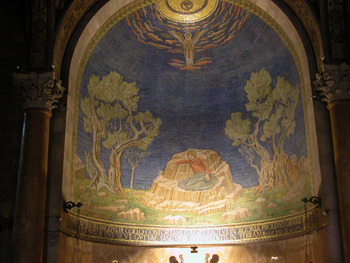
The Holy Land, as the birthplace of Christianity and the home of its holiest places, is a fascinating laboratory for exploring how holy places are created, constructed, and manipulated. In a way, it is a model for the creation of any holy site, albeit a disproportionate one due to the uniqueness of the Holy Land. The region is unparalleled because it hosts Christendom's holiest sites despite the fact that, for most of its existence, the Holy Land was under foreign, Muslim, non-Christian rule. This article demonstrates how a holy place belonging to one religion is handled when governed by a different religion.
The mere fact that the Holy Land, while under Muslim rule, did not belong to any particular Christian denomination caused various Christian sects to compete over the ownership of the holy places, primarily from the Mameluk period onwards. It also created competition between European Christian nations, as seen through religious and building activities starting in the second half of the nineteenth century. Naturally, this led to a complex web of politics which affected the construction of new churches in holy places, primarily affecting the choice of locations, the questions of their authenticity and ownership, the artistic style and decorations of the churches, etc. A thorough examination of the processes that led to the rebuilding of one of the most important churches for the Catholic world, the Church of Gethsemane in Jerusalem, could shed new light on the conflicts and political struggles common to many other holy sites and churches rebuilt during the modern era and located in the Holy Land.
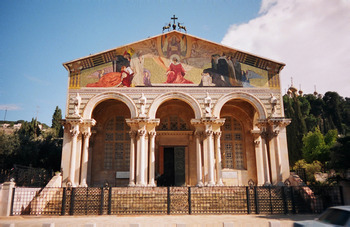
The Church of All Nations in Gethsemane.

Gethsemane, one of the most sacred places for Christendom, is identified with the site of Jesus' agony and arrest (Mt 26:36–56, Mk 14:32–50, Lk 22:39–54, Jn 18:1–12). It is considered one of the main holy places, marking the beginning of the Passion of Christ that revealed both his divine and human natures. The opportunity to rebuild the Church of Gethsemane (also known as the Church of All Nations and the Church of the Agony of Christ) presented itself to the Franciscan Custody, the Catholic order and the owner of the holy site of Gethsemane, in the early twentieth century, after the First World War. The Ottoman empire had collapsed and the Holy Land was finally occupied by a Christian nation (albeit a Protestant one) for the first time since the Crusader period. This turbulent post-war period led the Franciscan Custody into new conflicts with the Protestant British administration of Palestine. However, some of the political issues which influenced the rebuilding of the sacred sites continued regardless of the change of government: the tense relations with the Greek Orthodox Church; the struggle between the Italians and the French over visibility and presence in the built landscape of the holy city of Jerusalem; and the need of the Franciscan Custody to prove the authenticity of the holy evangelical sites in its possession that was threatened by modern scholars.
The goal of the present article is twofold: first, to examine and analyse the political processes that preceded the construction of the sanctuary of Gethsemane in Jerusalem, deconstructing and uncovering layers of conflicts and interests which led to its formation and present shape. It is argued that the reconstruction of the basilica of Gethsemane, and hence the concretization in stone of some of the most depicted evangelical traditions, was not merely the result of an ecumenical consideration. In fact, it reflects the narrow, and sometimes very down-to-earth, interests of various denominations and political forces. Yet, those interests influenced and shaped the final outcome no less than did artistic and religious sentiments.
Second, this article compares the reconstruction of the Church of Gethsemane to other cases in which national and religiously symbolic churches were erected, particularly the Church of the Holy Sepulchre in Jerusalem, Sacré-Coeur in Paris, and the Cathedral of Christ the Saviour in Moscow.Footnote 1 It demonstrates how the political process of building a sanctuary in the Holy Land, in a highly contested space, is a far more complex and multi-layered phenomenon than that of erecting churches in the setting of a national homeland.
I
The first and possibly the most fundamental issue prior to the rebuilding of a holy site would be determining its precise location, an issue that led to a conflict within the Franciscan Custody of the Holy Land, the official guardian of the holy places for the Catholic Church up to the present day.
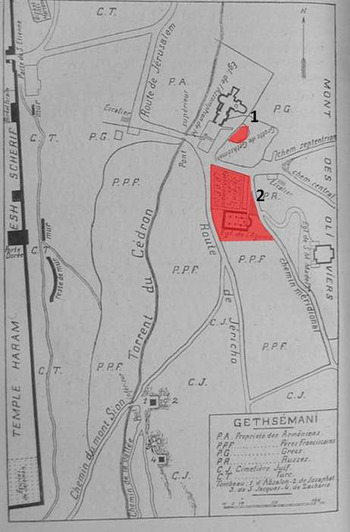
The site which was identified with Gethsemane and its surroundings were gradually acquired by the Custody from the seventeenth to the nineteenth centuries. However, by the time the church was to be built it was no longer believed to be the authentic site of the agony of Christ. The change occurred because the ancient tradition regarding the site was split between two geographical locations within Gethsemane: the garden and the cave. During the Byzantine period, the place of the agony of Christ was identified in the southern part of the garden, where the pilgrim Etheria described the ‘graceful’ church already in the fourth century. The nearby cave was identified with the site of Jesus' betrayal and arrest, and following this identification it was probably adjusted to liturgical needs and transformed into a chapel. During the Crusader period, the cave continued to be identified with the place where Jesus left his disciples and the site of his arrest, and the garden with his agony. The Crusaders erected a church on this latter site, which was constructed on top of the Byzantine ‘graceful’ church but with a rather different orientation, and it was most likely destroyed towards the end of the twelfth century.Footnote 2 Apparently, the tradition shifted locations with the arrival of the Franciscans in Jerusalem in the mid-fourteenth century. The Franciscans, the only Catholic order in the Holy Land after the expulsion of the Crusaders, interchanged the traditions regarding the sites and began identifying the cave with the site of Jesus' agony and prayer. Although some of the pilgrims continued to consider it as the site of the arrest, this identification was gradually transferred to the area of the garden and the cave was identified solely with the agony.Footnote 3 The Orthodox Church, however, did not forsake the ancient identification of the southern end of the garden with the agony of Christ and continued to situate the arrest in the cave. In the nineteenth century, the Greek Orthodox and the Armenians used to come and pray on the site of the garden next to a pillar, which they referred to as ‘the Pillar of Judas' Kiss', situated on the edge of the Franciscan property. Near this pillar, the Franciscans accidently discovered the remains of the Crusader church in 1891, mistakenly taken for the Byzantine ‘graceful’ church described by Etheria.Footnote 4 If that was indeed the ‘graceful’ church, it was, in all probability, the place of the agony.
The discovery of an ancient church in the area challenged the official stance of the Franciscans, and doubts about the authenticity of the cave as the site of the agony penetrated the ranks of the Custody itself. The timing was highly untoward since the Franciscans already faced a campaign against the authenticity of the holy places in their possession. Ever since the mid-nineteenth century, the authenticity of the Catholic holy places in the Holy Land had been questioned by historians, geographers, and biblical scholars, not to mention Protestant, Orthodox, and even Catholic ecclesiastics.Footnote 5 The Custody struggled to prove the authenticity of the holy sites in its possession and to strengthen the shaken foundation of its identity as the official guardian of the holy places. The possibility that the Custody had acquired an inauthentic site was not an option to be considered, and the offence was even greater when doubt came from within its ranks, from its own clergy and scholars. Franciscan archaeologist Barnabas Meistermann, who served in the Custody of the Holy Land and partly excavated the Crusader church in Gethsemane in 1909, was convinced by the archaeological evidence which proved that the garden was the original site of Jesus' agony, and he intended to publish this information in his guidebook, Guida di Terra Santa.Footnote 6
The ancient churches in Gethsemane. In black, the Byzantine church, and in red, the Crusader church.

The mere idea of shifting the tradition and moving it to a different location, albeit one that was nearby, alarmed the head of the Franciscan Custody, Roberto Razzoli (custos 1906–13), who hurriedly condemned the idea of transferring the identification of the holy site from the cave to the southern part of the garden. The terminology he used demonstrated the anticipated damage this would cause the Custody, the fear of modern and new ideas regarding the ancient traditions, and concern for his own authority. Separation of the tradition from the topos could have severe implications. Meistermann's ideas about the site of Gethsemane and a few other identifications of questionable nature (such as the church of Mensa Christi in Nazareth and the Cave of the Shepherds near Bethlehem) were termed ‘audacious’.Footnote 7 Razzoli protested against what he considered a scandalous novelty of the ‘new place of the Agony’ (my emphasis). He threatened Meistermann that should he not cease spreading his ideas among the students and the pilgrims he would be dismissed from his teaching post and be ‘hurled into some isolated convent of the Custody’.Footnote 8
The sites identified with Gethsemane. In red, the site of the cave (1) and the site of the garden (2).

The conflict within the Custody over the topos, the authentic site of the evangelical event, therefore reflected significant questions regarding the essence of the Franciscan Custody as the guardian of the holy evangelical traditions and the sites identified with them, the legitimacy of scholarly research which provides new answers to ancient questions, and the issue of the authority of the head of the Custody over his clergy. The First World War put an end to the debate, and the new custos, Ferdinando Diotallevi (custos 1918–24), accepted and permitted shifting the tradition regarding the agony of Christ to its old-new site in the southern part of the garden of Gethsemane. Once more the sites exchanged traditions. The site of the agony is shown today at the southern part of the garden, the place where the Franciscans constructed the new Church of the Agony, the former Franciscan site of the betrayal and the arrest. The arrest and the betrayal, on the other hand, moved back to the cave, the former Franciscan site of the agony.
The following table shows the shifting of the traditions:Footnote 9

It is important to note that the cave is situated about 100 metres from the garden. The distance between the sites is therefore negligible. Both sites continued to be held sacred after the interchange of the traditions and both were connected to the evangelical presence of Jesus. And yet, moving the tradition elsewhere meant admitting that the Franciscans were mistaken about the initial identification of the site with the specific tradition, and if they were wrong once they could err again regarding other holy places. In this case, the implications could be momentous, not only for the custodians of the holy places but for the entire Catholic Church. At the very time when the Custody was already subjected to criticism by Protestants, as well as by scholars and researchers, regarding the authenticity of the holy places it possessed, at the very time when it was prepared to set the ancient tradition in stone by building new churches, it could not allow itself to lose face and admit that for centuries it had venerated a mistaken holy place.
But could the Custody allow itself to cling to what was an apparently erroneous perception despite the evidence supplied by modern scientific archaeological research? Would it not appear ridiculous negating what seemed to be clear-cut proof? The decision was a serious one and the position adopted depended on the specific person involved. Razzoli could not cede the ancient tradition to what he perceived as a new modernistic one. Diotallevi, eight years later, accepted as fact that the site of the garden had been venerated by Christians ever since the fourth century as the place of Christ's agony and decided to build the new Church of Gethsemane there. Despite the fears expressed by Razzoli, the transition was smooth. The site of the garden was already considered authentic by both Greek Orthodox and Protestants and the authority of the Custody was not impaired. However, while this conflict was solved, others which influenced the timing of the rebuilding of the church and its final shape were only beginning.
II
One issue which delayed the rebuilding of the church for several years was the conflict between the Franciscans and the Greek Orthodox over a small relic in the garden of Gethsemane – the Pillar of Judas' Kiss. Prior to the rebuilding of the new Church of Gethsemane, the Custody decided to conduct archaeological excavations on the site of the garden in order to expose the church discovered in 1891 and use it as the foundation and the outline for the new church.
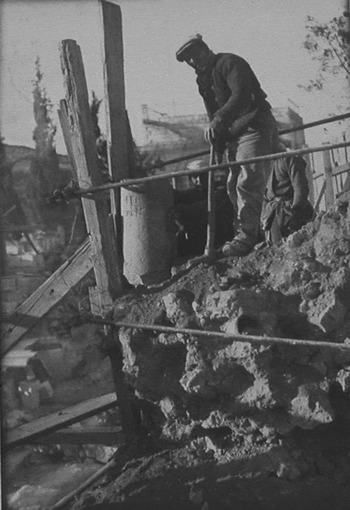
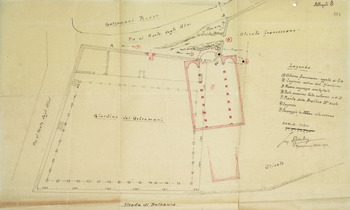
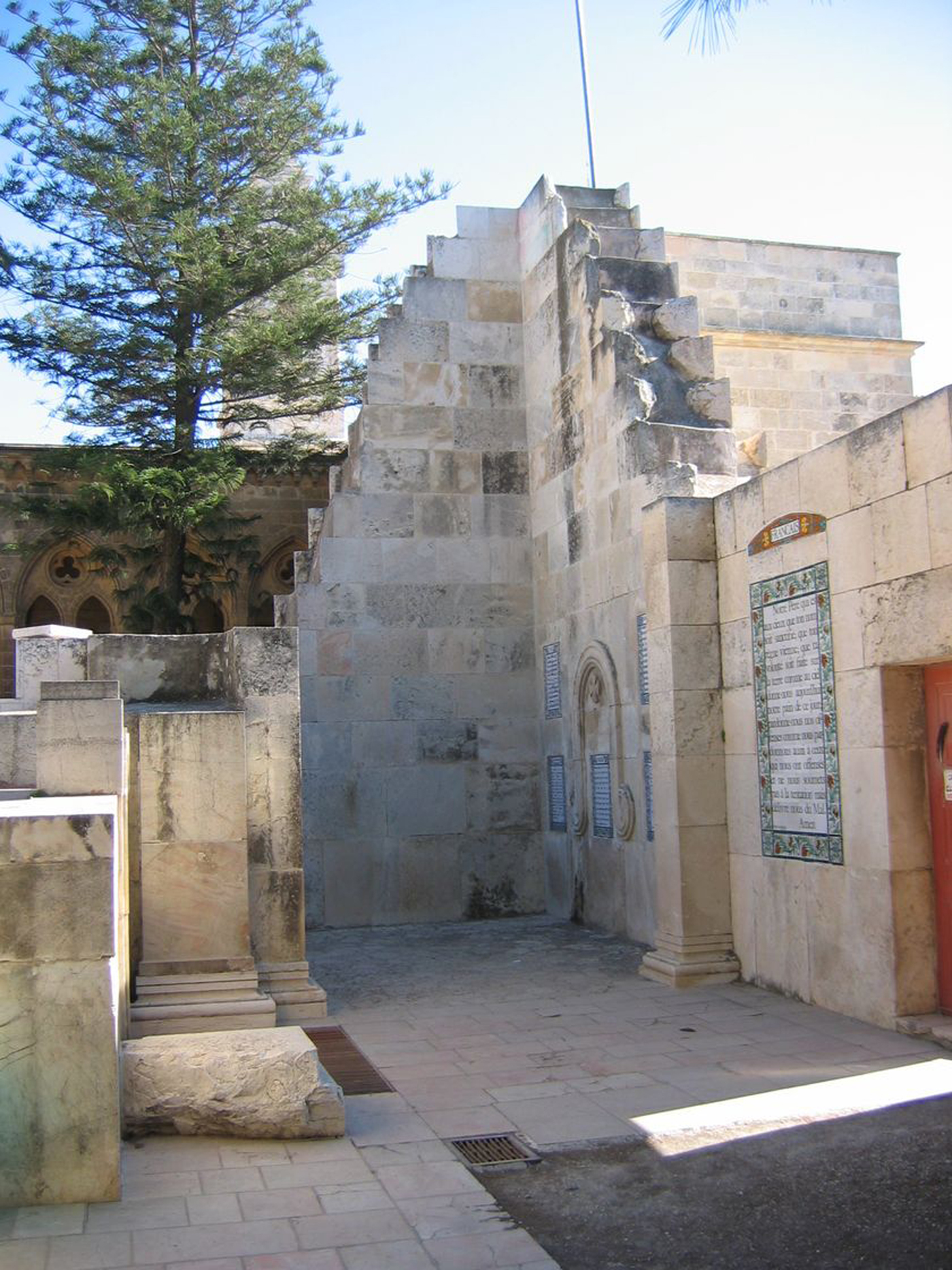
To make way for the excavations and the new church, the Custody had to remove from the site the Pillar of Judas' Kiss, venerated by the Orthodox churches, that was embedded in the wall surrounding the Franciscan property. The Orthodox claimed ownership of the pillar while the Franciscans maintained that it was situated on their property and that they had placed it on the outer side of the wall for the convenience of the visitors only in the mid-nineteenth century.Footnote 10 Just over a year after the British conquest of Jerusalem, the Catholics and the Greek Orthodox closed ranks against the common Protestant threat and were ready to resolve the issue peacefully. Therefore, at the beginning of 1919, Catholic and Greek Orthodox representatives met and managed to resolve the situation. Greek Orthodox Patriarch Damianos I (patriarch 1897–1931) declared that he had no objection to the transfer of the pillar to another accessible area. The pillar was removed about fourteen metres north of its original position and placed in the outer wall of the Franciscan property.Footnote 11 As it turned out, the new location was highly unfortunate. Since 1919, the site had been excavated by the Franciscan archaeologist Gaudentius Orfali who exposed the remains of what turned out to be the Crusader church, and not the Byzantine church as was originally thought. In August 1920, during the laying of the foundations for the new church, the remains of the real Byzantine ‘graceful’ church came to light. The discovery of the ancient church was yet another proof of the authenticity of the garden site and it was decided to build the new church on the remains of the Byzantine church, not the Crusader one. However, this was a mixed blessing, because the orientation of the Byzantine church differed from that of the Crusader church, pointing east-north-east while the Crusader edifice faced south-east, creating an angle of 13°. It turned out that the apse of the ‘graceful’ church lay beneath the new location of the Pillar of Judas' Kiss and the public alley leading to it through a rocky area called ‘the rock of the apostles', identified with the place where the three apostles who accompanied Jesus to the site fell asleep.Footnote 12 In order to expose the apse, the pillar had to be removed once again and the alley partially destroyed.
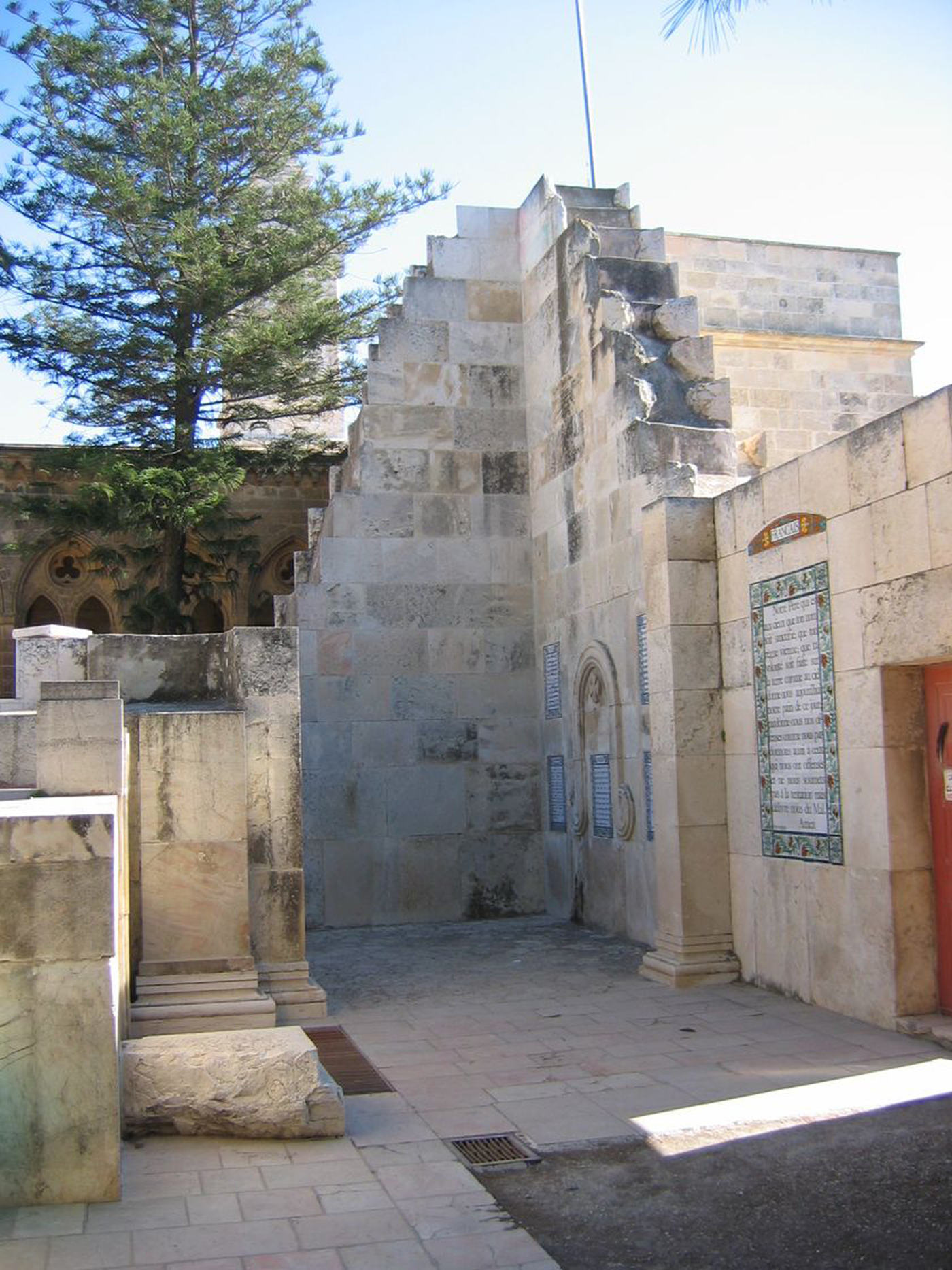
The transfer of the pillar to its final location 1923.

The Greek Orthodox were not as conciliatory this time, using physical violence against the archaeologists on the site and demanding that the British authorities suspend the excavations immediately.Footnote 13 The Latin and Greek patriarchs appointed revision committees to resolve the situation, but the conflict only became more severe. The Greek Orthodox began claiming the rights not only to the pillar, but also to the entire area of the garden and the church where construction was now suspended. The conflict with the Greek Orthodox was finally resolved only in October 1923. The Franciscans ceded them the Catholic Church's rights of worship in the Greek Viri Galilei Church, situated atop the Mount of Olives, along with a significant payment under the table of 30,000 francs to the engineer of the Greek convent. In return, the Franciscans received the consent of the Orthodox patriarch to destroy the alley and move the pillar to its new, and so far final, location.Footnote 14
Over the course of time, the pillar lost its significance, and apparently even its sacredness. It is embedded in the outer wall of Gethsemane facing the narrow alley descending from the Mount of Olives and the entrance to the Russian Church of Mary Magdalene. Once worshipped and revered, and today a completely forgotten relic, the pillar bears silent witness to the power of a built monument. Orthodox groups which nowadays frequent the area of Gethsemane searching for the place of Christ's agony visit the garden with its ancient olive trees, the witnesses (according to tradition) to Christ's prayer and suffering. These groups often extend their visit into the Catholic Church as well. The small pillar, once the focus of their worship and the subject of rivalry between Orthodox and Catholics, has been overshadowed by the newly built church. Apparently, relations between traditions and sites have their own dialectics. Traditions lead to the creation of a built landscape, but the built landscape in its turn creates a visual and conceptual impact that encourages the creation of traditions. The pillar was an important relic when there was nothing more than olive trees in the garden of Gethsemane. Once a church was built, albeit a Catholic one, it replaced the pillar as a memorial of agony for the Orthodox. As of today, the small pillar is completely forgotten and the new Church of the Agony in Gethsemane is overcrowded with pilgrims and tourists, both Catholic and Orthodox.
The locations of the pillar of Judas' kiss. The original location (1), the location after the first transfer on top of the Byzantine apse (2), the rock of the apostles (3), and the passage through the rock of the apostles to the Pillar (4).

III
Permission to build the church was granted by the British in 1922.Footnote 15 However, this was not the end of the negotiations between the British administration and the Custody regarding the new church. Another conflict influenced its final shape. This conflict was based on different theological perceptions of holy places which led to the restrictions on the dimensions, and especially the height, of the new church. The case of Gethsemane demonstrates how difficult it was to separate the perceptions of what is best for the city plan, the landscape, and the holy places from values rooted in Protestant theology.
Ronald Storrs, the governor of Jerusalem, was altogether reluctant to build a church on the site of Gethsemane. According to his understanding, the site, which he perceived to be authentic, should remain wide open, unbuilt, and as near as possible to the way it looked in the time of Jesus:
The Custos, while disposed to agree in private conversation…that Terra Santa was over-doctored, over-priested…and over-policed, somehow could not perceive that it was also somewhat heavily over-churched [my emphasis]…The thrice holy site of Gethsemane I longed to save, so temporized and discouraged…My prayer that it should be allowed to remain as it was in the time of Christ [my emphasis] was a final proof of the narrowness of my outlook…the Civil Government were most reluctantly obliged to cede permission for the Ingeniere Architetto Signor Barluzzi to hide by masonry from the kneeling pilgrim yet one more of ‘those holy fields’.Footnote 16
This perception was rooted in Storrs's Protestant view of the Holy Land and holy places. It is difficult to generalize, since the diversity of theological views among Protestants is very great. However, some Protestants, especially evangelical Protestants from Britain, opposed the search for the holy places already from the dawn of the Reformation following Luther and Calvin.Footnote 17 In their opinion, pilgrimages were intended to be journeys of the spirit and not of the flesh. The Holy Land was transformed into a kind of metaphor.Footnote 18 The negative attitude of those Protestants towards the holy places in the Holy Land was further intensified by the fact that prior to the nineteenth century they had no foothold in Palestine and therefore no possession in the traditional holy places.
Maurice Halbwachs wrote that in order to set a certain truth in the collective memory of a group it should be presented in a concrete form of an event, an image, or a site.Footnote 19 The Catholics and the Orthodox were not content with that kind of concretization and turned the holy place into a site which commemorates not only the evangelical truth but also reflects the institutional domination of its owners. In the eyes of the Protestants, the evangelical story was appropriated by these institutions that turned it to their own interests.Footnote 20 As the Protestants were interested in direct connection with the Holy Land, a church built in the holy place was perceived as an intermediary that intervened and separated the pilgrim from the original site. Moreover, the Protestants took an interest in archaeological remains from the time of Jesus. They searched for the original stones and tended to disregard the remains of later periods, including those of the ancient Crusader and Byzantine churches which, in their understanding, only interfered with the truth of the Gospels and contaminated the purity of the space.Footnote 21 They preferred the open scenery of the Sea of Galilee, the archaeological remains in Capernaum, and the open landscape of the Mount of Olives, including the unbuilt garden of Gethsemane. It is worth stating that the Protestant vision was a central feature of British imperial rule over Palestine throughout its early years.Footnote 22 The British would probably have preferred to prevent the Franciscans from building the church if they could. But the Custody presented a document which proved its ownership of the site and thus the issue could not be considered as a status quo conflict, regardless of attempts by the Greek Orthodox to claim rights to the site.Footnote 23
Though there were no legal means to prevent the Franciscans from rebuilding their church on their land, one could at least diminish its size and impact on the built landscape. Therefore, in 1920, Storrs claimed that the church proposed by the Franciscans for the site was too tall, although its height was only sixteen metres. The (Jewish) high commissioner, Herbert Samuel, mentioned in a conversation with Custos Diotallevi that if St Francis himself was building this church he would be satisfied with a more modest building. Samuel stated that if it was up to him he would provide the Franciscans with the requested authorization, but he expected that the plan would attract much criticism since the landscape of the Mount of Olives was ‘already corrupted by the new Russian church’ (the Church of Mary Magdalene, just above Gethsemane).Footnote 24
When the new plan for the church, that followed the general outline of the Byzantine church, was submitted to the British administration, it was accompanied by erroneous calculations that increased the width of the church by 1·20 metres. Harry Charles Luke, Storrs's assistant, sought to reduce the size of the church, claiming that it was incompatible with the urban planning of the city. This he did by requesting the architect to confine himself to the size and proportions of the Byzantine church. However, the Latin patriarch, Luigi Barlassina (patriarch 1920–47), who was aware of the miscalculations, instructed the architect to submit the exact same plan with the correct calculations which seemingly reduced the size of the church. The British did not notice that the plan had not undergone any change and approved it in January 1922, a fact noted by Barlassina with much satisfaction in his report to the Holy See.Footnote 25 The new church, therefore, does not precisely follow the Byzantine outline and is extended towards the west.
Apart from the perceptions deriving from their values rooted in Protestant tradition, the British were convinced that the Church of Gethsemane was being used as a means of furthering Italian politics. When Storrs met with Pope Benedict XV (pope 1914–22) in 1921, he submitted a memorandum regarding the meeting, mentioning at its end that throughout the audience the pope made no sort of allusion to the building at Gethsemane.Footnote 26 Later, when Italian Cardinal Oreste Giorgi was appointed head of the Vatican mission which arrived in Palestine to consecrate the church, the British representative in the Vatican, Cecil Dormer, reported that ‘it seems probable that advantage will be taken of the mission to push Italian politico-religious interest. Neither Cardinal Giorgi nor the Vatican are likely to lend themselves to this; but my informant tells me that demonstrations of “italianità” will be numerous'.Footnote 27 He also stated that although the Italian press reported that the mission affords new proof of the interest which the pope takes in the Holy Land, in fact he trusted that:
The Pope is showing no enthusiasm in the building of these new basilicas, and feels that the money which they will cost could have been spent more wisely elsewhere. The whole scheme is regarded largely as one of ‘italianità’, and it is doubtful whether the present Pope [Pius XI, pope 1922–39] would have sanctioned it had his hands not been tied by a promise of his predecessor.Footnote 28
IV
While the British efforts to limit the size of the church mainly influenced its height, the major influence on the simple decision to construct the church, on its architecture and artistic decorations, came from the arena of Italian nationalism. Ironically enough, there is probably no other church erected in the holy places in the Holy Land, except for the Church of the Beatitudes, that bears the marks of Italian nationalism more than the Church of Gethsemane, which received a most compelling name, ‘The Church of All Nations’.
It was planned by Antonio Barluzzi, a young Roman architect who first arrived in Palestine in 1912 to help his older brother, Giulio, build the first Italian hospital in Palestine in Jerusalem. While in Palestine, he was approached by Custos Razzoli with a request to propose a plan for the Church of the Transfiguration on Mount Tabor. Barluzzi submitted the plan which was approved, but then the First World War broke out and he had to return to Italy to join the war effort.Footnote 29
Originally, Barluzzi was requested to submit solely a plan for the Church of the Transfiguration. Immediately after the end of the war, the new custos asked him to present another plan, this time for the Church of Gethsemane. What led to the addition of that church to the original request?
The answer is multi-faceted. Primarily, Custos Razzoli, who commissioned the church on Mount Tabor, would never consider building a church at the southern end of the garden of Gethsemane for the reasons described above, while the new custos, Ferdinando Diotallevi, apparently supported Meistermann's theory regarding the tradition of the site of the agony. The political situation had changed as well. Palestine was finally occupied by a Christian nation, and it seemed that there was a golden opportunity finally to rebuild the sanctuaries on top of the ruins of ancient churches in the holy places. But there was yet another reason: an initiative by the archbishop of Toulouse to build in Jerusalem, atop the Mount of Olives, a church dedicated to the Sacred Heart of Jesus in Gethsemane.
In 1872, after the Franco-Prussian war, the archbishop of Paris vowed to erect on top of Montmartre the famous Church of the Sacré-Coeur.Footnote 30 Similarly, even partly by the same people, a French brotherhood called ‘Gethsemane’ was established during the First World War which vowed to build a church dedicated to the sacred and agonizing heart of Jesus on the Mount of Olives. It was hoped that this act would bring blessings upon the Allied forces and ensure their victory. In fact, the idea went back even further. Already in 1885, two French ecclesiastics, Hériot Bunoust and Abbot Louis Monier, founded a periodical entitled Gethsemane and the World whose goal was ‘to justify the choice of Gethsemane and to celebrate in fiat of the Agony the supreme effort of the love of the Sacred Heart’. To this purpose, they purchased a tract of land below the site of Gethsemane in the Valley of Kidron (Jehoshaphat) and raised the initial funds to build a new church there. However, the project was never truly initiated and finally the Custody purchased this tract and added it to those it owned around the area of Gethsemane.Footnote 31 The idea was revived in January 1917 when Augustin Germain, the archbishop of Toulouse, made a public vow in the Chapel of the Visitation in Toulouse to build the church in Jerusalem. He justified this act: ‘Through the national basilica in Montmartre, France recognized the kingdom of the Sacred Heart over the country and the Catholic World. By the means of the basilica in Jerusalem France will declare the kingdom of the Sacred Heart to the entire world.’Footnote 32 It was decided to build the new church on the remains of the Byzantine Eleona Church erected by Helena, the mother of Constantine, in the fourth century on the summit of the Mount of Olives. The remains of the ancient church were located in the cloister of the Carmelite convent of Pater Noster, on grounds belonging to the French government.
To understand the problematic nature of the French initiative, it should be borne in mind that in 1740 the French were awarded the protectorate over all the Catholic clergy of every nationality in the Ottoman empire, a situation that invested France with absolute pre-eminence over any other political power in the region. In 1905, France and Italy signed an agreement which enabled Italian religious institutions to come under the protection of Italy. When the First World War broke out, the Ottoman government abolished the Capitulations, and Italy argued that this act deprived the French religious protectorate of its legal basis.Footnote 33 The polemics surrounding this issue ended in 1922 when all the Capitulations were annulled at the San Remo Conference. However, this dispute was at its peak at the time the French decided to build the Church of the Sacred Heart on top of the Mount of Olives and the Custody decided to build the Church of Gethsemane at its foot.
Although the Custody was considered an international organization and the Vatican's representative in the area, it often promoted Italian interests locally. Between 1746 and 1980, the custos was always an Italian by virtue of a papal decree; the official language of the Custody is Italian to this day, and most of its members traditionally have been Italians, since it formed part of the Franciscan Order, an Italian one. Therefore, the Custody could not avoid expressions of Italian nationalism among its ranks and was considered one of the main Italian political instruments by Italy, France, and Britain.Footnote 34 It seems that the decision taken by Diotallevi to build the Church of Gethsemane immediately after the war ended was a reaction to the French initiative. As soon as he heard of it, he declared that the new basilica should be built by the Franciscans on the remains of the ancient church in Gethsemane.Footnote 35 He immediately wrote to the Vatican and to the archbishop of Toulouse, calling upon them to join forces and build the Church of Gethsemane together. The archbishop dismissed his claims, asserting that there was a vow to fulfil and that the French initiative should not be combined with any other similar undertaking. He also ignored the request of the pope and the secretary of state of the Vatican in July 1919 to transfer the money collected for the Church of the Sacred Heart to the Franciscans.Footnote 36 As it was important to establish facts on the ground, as early as 17 October 1919 the cornerstone of the Church of Gethsemane was laid by the Italian Cardinal Giustini (cardinal 1914–20). Upon the initiative of Diotallevi, Giustini arrived in Palestine on a pontifical mission to celebrate 700 years of the presence and activity of the Custody in the Holy Land.Footnote 37 Regardless of the international Catholic character of his visit, Giustini arrived on board the Italian warship Il Quarto, flying both the papal banner and the Italian flag. He toured Palestine in the car of the Italian consul. His visit was so overtly Italian that the commander of the Italian warship wrote to the minister of the navy that he recommended granting Diotallevi a decoration for initiating the journey and bestowing upon it an Italian character. Diotallevi indeed received this decoration after a while.Footnote 38
Giustini's visit infuriated the French and Spanish consuls and even the British, who complained afterwards to the Holy See that the purpose of his visit was to increase Italian influence in Palestine. In response, the secretary of state of the Vatican, Pietro Gasparri (secretary of state 1914–30), issued a sharp letter condemning the manifestations of Italian nationalism at the celebrations.Footnote 39
In January 1920, a short time after Giustini laid the cornerstone for the sanctuary of Gethsemane, another cardinal arrived in Jerusalem to lay another cornerstone – this time for the French church. Despite the objection of the Vatican to the construction of the Church of the Sacred Heart on the Mount of Olives, the cornerstone ceremony was conducted by French Cardinal Louis Ernest Dubois (cardinal 1916–29).Footnote 40 Diotallevi reacted by sending multiple letters to the Holy See, describing the act as a French national initiative with the sole goal of promoting French interests in Palestine. He claimed that there was no reason to build a church commemorating Jesus' aching heart while the real event of Jesus' agony took place several metres away, in Gethsemane. He feared that Catholic resources would be directed to the French church instead of the holy places. He maintained that this would increase the influence of the Greek Orthodox in the churches with joint ownership,Footnote 41 and claimed (not unlike Storrs, for that matter) that there were already a great number of churches in the holy places in Jerusalem.Footnote 42
Despite Diotallevi's efforts, construction work on the French church began in 1926 in the area donated by the French government inside the court of the Carmelite cloister of Pater Noster above the grotto of Eleona. The grotto was restored and construction of the walls of the new church around it was begun by the French Order of the White Fathers. The unexpected palliative for Diotallevi's concern arrived when the French ran out of money in the middle of construction. In the meantime, a new archbishop, Jules-Géraud Saliège, was appointed in Toulouse. Apparently, Saliège did not attribute the same importance to building the church and therefore did not allocate any money for the initiative. For a while, other French agents tried to get the pope's blessing and raise funding from the international Catholic community, but in 1933 the Holy See accepted the opinion of the apostolic delegate in Cairo, Valerio Valeri, that it was essentially and exclusively a French undertaking of a seemingly international character. The Vatican refused to support the works and the unfinished church remains on the site of Pater Noster to this very day.Footnote 43 In contrast, the initiative of the custos was successful.
It is difficult to ignore the fact that the Church of Gethsemane was also heavily influenced by nationalism, Italian in this case. The architect chosen by the Custody to rebuild the Church of Gethsemane was, as noted, Antonio Barluzzi, who had previously constructed the Italian hospital in Jerusalem and left for Italy with the outbreak of the First World War. In 1917, he was sent back to Palestine with an Italian regiment which joined the allied forces and entered Jerusalem in December 1917 with General Edmund Allenby, thus playing a role in the delivery of Jerusalem from Ottoman rule. Barluzzi was sent back to Palestine at the request of the secretary of the National Association for Assistance to Italian Missionaries (ANSMI). The association's goal was to free Italian missionaries abroad from foreign influence, while supporting and using them to promote Italian national interests. They commissioned Barluzzi to build the Italian hospital in Jerusalem prior to the outbreak of the war, and after the war, throughout his long sojourn in Palestine, he built several other buildings for the association, including the Italian hospital in Amman, several schools, and the Church of the Beatitudes on the site of the Sermon on the Mount. In the early post-war period, due to the absence of an Italian consul, for several months Barluzzi acted as an unofficial representative of Italy in Palestine; he was also an honorary vice-consul from 1922 and the secretary of the Fascist cell of Jerusalem for a decade (1926–36). Barluzzi was an ardent Italian nationalist and translated his national feelings into architectonic and artistic features.Footnote 44
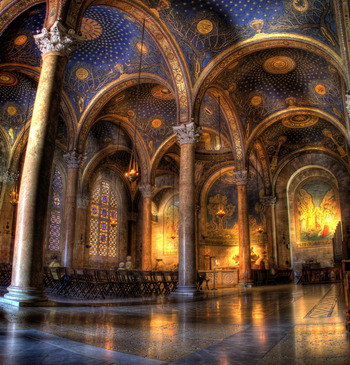
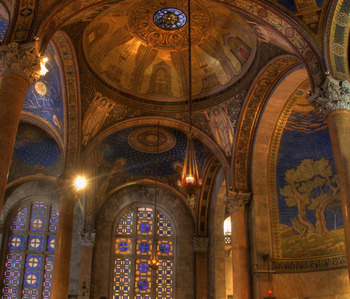
Although the new church was built upon the Byzantine one and followed its general outline, Barluzzi was not inclined to reconstruct the Byzantine features or style. Instead, he adopted what he called ‘the style of Roman buildings from Jesus' period’, employing what he described as Roman-Classical elements in free use and maintained that only the mosaics of the domes show a Byzantine influence.Footnote 45 The Roman style was presented as a universal style (an interesting perception per se), but it is difficult to overlook the context of an Italian architect building in Roman style. Of the twelve nations which donated the money for the church's twelve domes, Italy received the central and highest dome, above the sacred rock of the agony. This dome was decorated with glittering golden mosaic, unlike the dark identical domes donated by the other nations.Footnote 46
The unfinished Church of the Sacred Heart of Jesus in the cloister of the French Church of Pater Noster.
The identical domes of the church.

The ‘Italian’ dome of Gethsemane.

When the proposal of Italian artist Giulio Bargellini was chosen for the mosaic of the church's façade, Barluzzi wrote him that he was filled with pride that in the presence of all nations a work of Italian art would decorate the church situated opposite the walls of Jerusalem and the Mosque of Omar (sic), one of the loftiest artistic manifestations of Muslim art.Footnote 47 Many nations donated funds for the construction of the church, giving it one of its names – The Church of All Nations – and while their national emblems appear on the domes of the church and the mosaics of the apses, yet all works of art were executed solely by Italian artists. The side apses were decorated by Mario Barberis, the mosaics on the domes are by Pietro D'Achiardi, the iron lattice around the holy rock by Alberto Gerardi, the doors planned by Adelchi Ricci were executed by Giuseppe Tonini who also created the statues of the four evangelists in the façade, and the mosaics of the tympanum were done by Giulio Bargellini. Even part of the materials came from Italy while the architect, foreman, engineer, and the firm which executed the mosaics were all Italian.Footnote 48
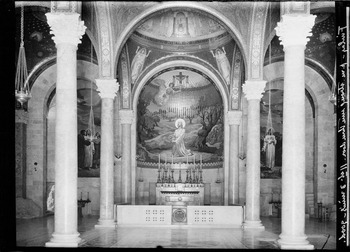
One of the most striking manifestations of Italian nationalism and its influence on the decoration of the church was probably the struggle over the main apse of the church. The decoration of the main and the side apses was at first commissioned from the artist Mario Barberis in 1923. His work, however, was criticized by many art critics and the Custody announced a competition between various nations for the main apse.Footnote 49 This occurred when the Custody was headed by a new custos, Aurelio Marotta (custos 1925–31), whose relations with Barluzzi were very tense. That was the only episode in Barluzzi's career in which he did not himself choose the artist. It is not clear if there actually was a competition; however, in 1929, the Hungarians, who were pre-chosen for execution of the main apse by the Custody, sent artist Endre Muzsinszki-Nagy (1886–1975) to examine Gethsemane and proposed producing his painting in mosaics at their own expense. In 1931, he submitted his work to the Custody and, although not considered good enough, in 1932 it was hung in the main apse of the church to be exposed to public judgement. As often happens, the temporary became permanent and the painting remained inside the church up to 1949. Once Barluzzi returned to work for the Custody, with the appointment of the new custos, Nazareno Jacopozzi (custos 1931–7), he conducted an unceasing crusade against the painting by the Hungarian artist. Apart from artistic reservations, it was clear that his main concern was the fact that the painter was not an Italian. In a letter to an Italian archaeologist, Roberto Paribeni, he wondered how one could allow a foreign, non-Italian artist to execute the most important work of art in the church.Footnote 50 Together with Italian consul Luigi Gabrielli, he submitted a memorandum to the Italian foreign ministry in which he described the unfolding of events, stating that he had managed to postpone the decision and to present new sketches by Italian artists to the commission appointed by the Custody, stressing the predominant interest of Italy to ensure that the apses would be decorated by the works of Italian artists.Footnote 51
After submitting the memorandum, he wrote in a letter to his brother Giulio: ‘I initiated the attack against the Hungarian sketch, or better said, the defence of our artistic Italian rights in Gethsemane.’Footnote 52 The importance attributed by Barluzzi to execution of the apse by Italian nationals is evident in his letter to artist Adalberto Migliorati, who was interested in submitting his proposal for the apse in 1935, a short time after the beginning of the Italian campaign in Ethiopia: ‘Dear Professor, while our soldiers show the world the military value of Italy, I ask you to demonstrate that the artists of the new Italy have no lesser value than that of the Italian soldiers.’Footnote 53
Barluzzi convinced the custos to turn to the pontifical commission for sacred art, established to provide a response to problems related to ecclesiastical art in Italy and exceptionally authorized by the pope to deal with a church in the Holy Land. The commission supported Barluzzi's stand and, despite fierce objections by the Hungarians, after eighteen long years Barluzzi won his national campaign against Muzsinszki-Nagy. Pietro D'Achiardi, who had already done the mosaics for the church's domes, created the painting for the main apse according to a sketch by Barluzzi. It was executed in the studio of the Vatican, and the Hungarians, who funded the apse, placed there their national emblem, just as was the case with the other works of art in the church.Footnote 54
Italy and the Italian media related to the church as a jewel of Italian art in Palestine. During his visit to the Holy Land in 1928, the Italian crown prince, Humbert II, donated two silver lamps made in a ‘Roman style’ to the church that were described as a symbolic gift: ‘Lamps which the homeland will never be allowed to be extinguished.’Footnote 55 Barluzzi's churches in Gethsemane and on Mount Tabor were described as beneficial to the good name and prestige of Italy. It was claimed that the churches leave an ‘unerasable mark of Italian art, Catholic faith, and Franciscan piety’.Footnote 56 They were declared a ‘monument of Italian and Franciscan tenacity’, a ‘peak of art and religion’, and the ‘victory of Christian and Italian art above all’. Morsani, who wrote one of the most effusive articles, ended it with an ardent statement: ‘In the name of the energy, tenacity, patience, power, all the best qualities of our race, we salute both basilicas as a great and beautiful work, therefore in the most royal meaning of the word – a Roman creation.’Footnote 57
The work of Muzsinszki-Nagy decorating the apse of Gethsemane.

The main apse of the church after the redecoration by Pietro D'Achiardi.

V
The Church of Gethsemane is a case-study demonstrating the complexity of simultaneously occurring political conflicts which eventually led to its construction and final shape. An interesting comparison could be made to a yet even more sacred Christian monument, the most sacred place of Christendom, the Church of the Holy Sepulchre in Jerusalem. In his book describing the long process which led to the restoration of the church, which was severely damaged in the 1927 earthquake, Raymond Cohen exposed the underlying interests, conflicts, and negotiations between the three major Christian communities which have rights of possession in the church: Latin, Greek Orthodox, and Armenian.Footnote 58 In the Holy Sepulchre, a set of autonomous Christian communities pursues particular rather than general interests. Each community has a strong sense of history and identity separating it from the others. These communities within the church co-exist in a kind of peculiar ‘anarchical society’, a society without a ruler. Each community is supported by external power or powers (for example, the Franciscans represent the Catholic Latin Church and therefore are supported by the Vatican and by Catholic nations). The church is guarded or policed by the state. Therefore, the state intervened in the crisis and served as a mediator, enforcing that the necessary repairs to ensure the safety of the visitors would be made. In a church which is contested by several rival Christian communities and supervised by Protestant (British), Muslim (Jordanian), or Jewish (Israeli) governments, the conflicts are bound to be complex and simultaneous, and co-operation is mandatory when the church edifice is in peril. As Cohen stated, the Holy Sepulchre's restoration is a paradigm of conflict management.Footnote 59
While the politics behind the processes of restoration and rebuilding of the holy places in the Holy Land is for most parts complex and simultaneous,Footnote 60 it seems that the political processes which led to the construction of important churches in Europe were quite different.
In his exemplary article, David Harvey analysed the process which led to the construction of the Sacré-Coeur, the basilica that strategically and symbolically dominates the northern skyline of Paris. He demonstrated how the church was perceived as a political symbol of the power struggle between republican and monarchist elements of Parisian society, between right and left, the bourgeoisie and the working class. In the conclusion of his article Harvey stated that ‘All history is, after all, the history of class struggle.’Footnote 61 Although the class struggle was definitely a major factor in the area of Palestine in the 1920s, this struggle was manifested in other emerging ideologies or new ‘secular religions’ such as Zionism, the relations between the British ruling class and the indigenous population, etc. It was even later manifested in the case of some of the sanctuaries built by the Catholics in Israel, such as the Church of the Annunciation.Footnote 62 However, of all the power struggles described above, class struggle was not a factor in the process of rebuilding the Church of Gethsemane. Apparently, one could argue against Harvey's statement that a Marxist analysis is suitable for all case-studies. It is also difficult to imagine that every single geographical site would retain and demonstrate all the ideological perceptions prevalent in a certain place in a specific period of time. It is only natural to assume that each monument and site was affected by only some of the processes and manifested a different ideological mixture. One theoretical approach cannot serve as a litmus paper for historical-geographical analysis equally applicable to every period, every place, and every monument.
In his article tracing the history of the construction and the rebuilding of the Cathedral of Christ the Saviour, Sidorov, unlike Harvey, placed the reconstruction of this national monument in context of the changing politics of scale. Using the church as a case-study, he demonstrated how the changing form of national monumentalization in Russia can be better understood when the corresponding spatial and social changes taking place in the nation are taken into account.Footnote 63
The politics of scale could apply, to an extent and with a different orientation, in the case of the Church of Gethsemane, playing on the various politics ranging from those of international and national character to local and even internal politics. However, while Sidorov presented the history of one site that served as a setting for different monuments throughout a certain period of time and reflected changing political and national interests, the overall process in the case of Gethsemane is more complex and less linear than the cross-section made by Sidorov. Analysis of the case of Gethsemane requires a deconstruction of various political processes which occurred simultaneously in order to understand better how each process affected the final shape of the church.
A major difference between the three case-studies is the degree of holiness. Unlike Gethsemane, neither Sacré-Coeur nor the Cathedral of Christ the Saviour are holy places. It is true that Montmartre had been a site of martyrdom for Christian saints long ago and also represented secular martyrs, the conservative French army generals arrested on Montmartre and executed by the working-class mob shortly prior to the rebuilding of the church, who ‘died in order to defend and save Christian society’.Footnote 64 And yet it is not comparable to the sacredness of Gethsemane, the place where Jesus shed his blood, the starting point of his Passion.
Interestingly enough, the size and visual impact of the churches in Paris and Moscow are much greater than those of the Church of Gethsemane, one of the most sacred and famous sites for Christians throughout the world. The Holy Land, regardless of its enormous importance, is not the national homeland of any Christian nation and for centuries was governed by non-Christian rulers. At the beginning of the British Mandate, when Christians ruled the area for the first time after more than seven centuries, it seemed that Christians could finally build whatever they wanted in the holy places and the limitation on size and impact of the sacred places no longer existed. One would expect that the size of churches in the holiest places for Christendom would surpass, or at least be equal to, major non-sacred places such as Sacré-Coeur, the cathedral of Moscow, and even sacred places dedicated to secondary saints when compared to Jesus himself, such as the sanctuary of Lourdes. However, the situation was more complex. First of all, Great Britain was only a temporary mandatory authority and not the omnipotent power. Nor could it build whatever it pleased using the money of British taxpayers in the Holy Land, which was not even a British colony (nor, on the other hand, could the British restrict the building of other communities on privately owned land, beyond the issues deriving from municipal planning). Moreover, it must be borne in mind that in the case of Gethsemane the Holy Land itself is a factor. The land of Jesus dictates a certain modesty of future churches, not only reflecting the political scales referred to by Sidorov, such as the modest size of the political entity of British Palestine, or the larger Christian ‘Holy Land’ that extended to both sides of the Jordan River and into southern Syria and Lebanon and northern Egypt. In the Holy Land, the scales of the past dictated the scales of the future. As demonstrated in the case of Gethsemane, most of the sanctuaries which were rebuilt during the modern period, including the Church of Gethsemane, were built on the remains of previous Byzantine and Crusader churches, the size and orientation of the previous churches dictating the size and orientation of the modern ones. The past was not only symbolically present in the setting of the Holy Land; it physically dominated and shaped the present and the future of the sacred sites, serving for the most part as a limitative factor.
The multi-layered politics that influenced the building of the Catholic sanctuaries was more than the relations described above between the local authorities (the British) and the ecclesiastical organizations interested in reconstructing the churches on sites in their possession. It included a national politics outside the national homeland of the organizations which rebuilt those churches. In the case of Gethsemane, France and Italy continued a previous trend in which national powers built churches and missionary institutions in the Holy Land from the mid-nineteenth century on, hoping to gain a foothold in the sacred space, influence the local population, and promote their culture and values while awaiting the inevitable death of the ‘sick man on the Bosporus’ (the Ottoman empire). This pattern was still evident amongst European powers after the disintegration of the Ottoman empire during the early years of the British Mandate and in certain cases even throughout the Mandate period.Footnote 65
The politics of contested spaces which belonged theoretically to all of Christendom but practically were purchased and legally owned by one of the denominations led to conflicts between those denominations, in the case of Gethsemane the Greek Orthodox and the Roman Catholics. The different theological perceptions and understandings of how the holy places should be preserved and presented to the faithful, such as those of Catholics and Protestants, led as well to a conflict situation intensified by the fact that the ruling British authority was for the most part Protestant with a very explicit agenda regarding the holy sites.
The internal Franciscan politics dealing with questions of the authenticity of the holy sites reflected, in fact, a much larger issue that preoccupied the Catholic Church in the modern period: the complex relations with the modern world and the challenges it posed to the Catholic Church, including issues raised by modern scientific research.
The political processes which influenced the rebuilding of the sanctuaries of Gethsemane and the Holy Sepulchre were multiple, complex, and simultaneous, unlike the case-studies presented by Harvey and Sidorov.
VI
This article examines the rebuilding of one of Christianity's major sanctuaries in the world, the church dedicated to the agony of Christ in Gethsemane, through the prism of political power struggles. It describes the decision-making processes that accompanied the choice of place, the resolution to build the church anew, the timing of the construction, and the choices relating to its height, style, and works of art.
True, construction of a holy place such as this entails more than conflicts and momentary interests. It involves a true commitment to God and to the evangelical event that took place at the site; it manifests the resolution to set the evangelical event and its atmosphere in stone; it reflects the approaches to sacred art and architecture and other issues which could not be demonstrated here due to the nature of the medium. This article deliberately focuses on political conflicts and national needs and interests which influenced the rebuilding of the sanctuary. It shows how creation of a holy site, sacred to nearly the entire Christian world (including not only the Catholics, owners of the site, but also the Orthodox and Protestant denominations), was influenced by mundane conflicts deriving from political interests, power struggles, ego, fear, and other very down-to-earth feelings. The current analysis demonstrates the complexity and simultaneity of the politics that preceded the reconstruction of the sanctuaries rebuilt in the Holy Land throughout the modern period as well as the uniqueness of the Holy Land itself, which in fact contributed to and shaped their final outcome.
Moreover, the article reveals the simultaneous multi-layered nature of those political conflicts in places like Gethsemane and the Holy Sepulchre, unlike the case-studies examined by Harvey and Sidorov. The distinctive setting of the Holy Land encouraged complex political relations which were manifested in the built sacred landscape. The fact that the Holy Land did not fully belong to any distinct Christian nation created duplications of sacredness. Sacred time was duplicated with repeated holidays according to Julian and Gregorian calendars. Similarly, sacred space was duplicated with the creation of different Orthodox and Catholic sites dedicated to the same evangelical tradition. Additionally, the political conflicts in the holy places multiplied, creating an agglomeration of various political tensions which were reflected in the same sacred site and influenced the construction of the same church.
Although the story of each monument is different and has its own complicated blend of ideologies and political power struggles, the case-study of the Church of Gethsemane reflects processes that also occurred in the rebuilding of other modern sanctuaries in the Holy Land.