Introduction
One of the problems in the agricultural sector is diseases caused by parasitic nematodes that infect agricultural crops or animals, causing economic losses. In the livestock sector, infection with the sheep parasitic nematode Haemonchus contortus is the most important health problem in most places that have summer rains and in tropical and subtropical areas (Salas-Zapata et al., Reference Salas-Zapata, Velásquez-Vélez, Herrera-Ospina, Ríos-Osorio and Polanco-Echeverry2016). Clinically, it is characterized by some signs of poor digestion and anaemia, and it is more severe in young animals (Abbott et al., Reference Abbott, Taylor and Stubbings2012).
Regarding the agricultural sector, the false aggrading nematode Nacobbus aberrans is one of the main species responsible for losses of numerous crops in Mexico (Rodríguez-Chávez et al., Reference Rodríguez-Chávez, Franco-Navarro and Delgado2019). This highly destructive nematode has polyphagous habits, and its host range is wide; it parasitizes approximately 84 species of cultivated plants and weeds, belonging to 18 different families, and the main crops attacked are potatoes (Solanum tuberosum), tomatoes (Solanum lycopersicum), beetroot (Beta vulgaris), chilis (Capsicum annuum) and beans (Phaseolus vulgaris) (Gómez-Valdez, Reference Gómez-Valdez2016). Parasitic nematodes are controlled using chemical drugs mostly derived from macrocyclic lactones by fermentation by actinomycetes of the genera Streptomyces and Saccharopolyspora (Rodríguez-Vivas et al., Reference Rodríguez-Vivas, Arieta-Román, Pérez-Cogollo, Rosado-Aguilar, Ramírez-Cruz and Basto-Estrella2010, Reference Rodríguez-Vivas, Rosado-Aguilar, Ojeda-Chi, Pérez-Cogollo, Trinidad-Martínez and Bollo-González2014). However, the excessive use of these drugs, due to their high efficacy and high commercialization, has generated what is known as anthelmintic resistance (González-Garduño et al., Reference González-Garduño, Torres-Hernández, López-Arellano and Mendoza-de-Gives2012). For this reason, alternative control methods have been explored, such as phytotherapy, and according to Romero-Benavides et al., (Reference Romero-Benavides, Ruano, Silva-Rivas, Castillo-Ventimilla, Vivanco-Jaramillo and Bailon-Moscoso2017), 80% of the world's population still relies upon plants for primary healthcare; even today in Western medicine, and despite progress in synthetic chemistry, approximately 25% of prescription medicines are still derived either directly or indirectly from plants.
Plant-based therapies have numerous advantages over commercial anthelmintics as they are biodegradable, do not cause environmental damage and have less residues (Rocha et al., Reference Rocha, Lemos, Vieira, Braz-Filho, Freitas, Glória and Santos2020); moreover, their effects are attributed to secondary metabolites present in different parts of plants (Marie-Magdeleine et al., Reference Marie-Magdeleine, Udino, Philibert, Bocage and Archimede2010). Several studies evaluating the nematicidal potential of medicinal plants have been reported – for example, Rocha et al., (Reference Rocha, Lemos, Vieira, Braz-Filho, Freitas, Glória and Santos2020) evaluated the chemical composition, nematicidal activity and effects of Cymbopogon citratus extracts on the morphology of eggs and infective larvae in sheep. Ali et al., (Reference Ali, Rooman, Mussarat, Norin, Ali, Adnan and Khan2021) conducted a literature search, reporting that plant species identified with promising in vitro anthelmintic activity against H. contortus are Lachesiodendron viridiflorum (Kunth) P.G. Ribeiro, L.P. Queiroz & Luckow (syn. Piptadenia viridiflora (Kunth) Benth.), Cymbopogon schoenanthus (L.) Spreng., Allium sativum L., Lippia origanoides Kunth (syn. Lippia sidoides Chem.) Artemisia absinthium L., C. citratus (DC) Stapf, Eucalyptus staigeriana F. Muell. ex F.M. Bailey, Artemisia herba-alba Asso and Corymbia citriodora (Hook.) K.D. Hill and L.A.S. Johnson, while A. herba-alba, Calotropis procera, C. citriodora, Lysiloma latisiliquum (L.) Benth. and Euphorbia helioscopia L. were reported with high in vivo efficacy. Attention to plants with anthelmintic properties is mainly due to the appearance and extension of parasite populations resistant to anthelmintics. Researchers from Yucatan have reported the anthelmintic effect of plant extracts on H. contortus, highlighting the ethanolic and hexanic extracts of L. latisiliquum, Laguncularia racemosa, Rizophora mangle, Avicennia germinans, Theobroma cacao and Coffea arabica (Sepúlveda-Vázquez et al., Reference Sepúlveda-Vázquez, Torres-Acosta, Sandoval-Castro, Martínez-Puc and Chan-Pérez2018). The Moringa oleifera Lam. plant, commonly known as moringa, holds economic and social importance due to its contents of proteins, fibre, carbohydrates, amino acids, vitamins, minerals and secondary metabolites, which explain its uses as food to combat malnutrition, a treatment for diseases, a soil fertility improver, a raw material for the food industry, an agent for the elaboration of cosmetics and an agent for the treatment of contaminated water (Velázquez-Zavala et al., Reference Velázquez-Zavala, Peón-Escalante, Zepeda-Bautista and Jiménez-Arellanes2016; Nogueira et al., Reference Nogueira, Alencar and Santos2017). Research on the potential of M. oleifera for the food industry has been conducted, due to its antioxidant, anti-inflammatory and bactericidal properties (Doménech-Asensi et al., Reference Doménech-Asensi, Durango- Villaadiego and Ros- Berruezo2017). Studies have shown that it possesses bioactive compounds such as tannins, saponins, polyphenols, phenolic glycosides, cardiac glycosides, isocyanates, sterols and glycosterols, fatty acids and alkaloids that can be considered ‘nutraceuticals’, as they are useful for both nutrition and human health (Velázquez-Zavala et al., Reference Velázquez-Zavala, Peón-Escalante, Zepeda-Bautista and Jiménez-Arellanes2016). However, the determination of the chemical composition, secondary metabolites and nutritional value of plants is among the most important results, due to their effect on the physiology, production and health status of animals; on the other hand, the anthelmintic activity of many plants used locally by different cultures has not been experimentally corroborated, and in most cases the active metabolites and their mechanisms of action are unknown. For this reason, there is scientific interest in the study of ethnobotanical practices for the development and promotion of effective drugs based on the active principles of locally available plants (Mayoral-Peña et al., Reference Mayoral-Peña, Piña-Vázquez, Gómez-Sánchez, Salazar-Olivo, Aguilar-Tipacamú and Arellano-Carbajal2017). Therefore, the aim of the present study was to evaluate, in vitro, the nematicidal activity of M. oleifera leaf extract against eggs and larvae of agriculturally important nematodes.
Material and methods
Collection of M. oleifera leaves
Moringa oleifera leaves were collected between February and April 2018, in the municipality of Tlayacapan, located in the north-eastern part of the state of Morelos, Mexico (18°57′N, 98°59′W). The leaves were washed only with water and left to dry in the shade at room temperature for five days; when they reached a constant weight, they were crushed. The samples were stored at room temperature in plastic bags until use.
Obtaining organic extract
A sample of 329 g of dried leaves of M. oleifera was subjected to extraction by maceration with constant agitation (95 rpm) and using ethyl acetate (EtOAc), at 30°C for 48 h. Subsequently, the sample was filtered by gravity and the filtrate was concentrated in vacuo at 40–45°C.
Obtaining H. contortus eggs
For egg collection, a parasite-free male donor sheep was artificially infected with 350 infective H. contortus larvae (L3) per kilogram of body weight. After a period of 21 days post-infection, faecal samples were collected directly from the animal's rectum to perform an EPG count (the number of eggs per gram of faeces) using the McMaster technique to confirm positivity for infection (Bauer et al., Reference Bauer, Pomroy, Gueydon, Gannac, Scott and Pfister2010; Torres-Acosta et al., Reference Torres-Acosta, Chan-Pérez, López-Arellano and Rodriguez-Vivas2015). Once positivity was confirmed, samples were collected again from the rectum and macerated with water, until a homogeneous mixture was obtained, which was sieved and washed with water in meshes with different opening sizes (400, 120, 100 and 35 microns). The filtrate was then collected and centrifuged with 40% sucrose at 3500 rpm for 5 min, thus recovering the eggs remaining in the concentration gradient that had formed. The eggs were then subjected to 3–5 washes with distilled water and then centrifuged for 5 min at 3500 rpm to remove as much sucrose and faecal residue as possible (Liébano et al., Reference Liébano, López-Arellano, Mendoza-de-Gives and Aguilar-Marcelino2011; Torres-Acosta et al., Reference Torres-Acosta, Chan-Pérez, López-Arellano and Rodriguez-Vivas2015).
Obtaining H. contortus infective larvae
To obtain infective larvae, faeces were collected from the animal with the help of a basin and coprocultives were made, which were incubated at 27 ± 1°C for seven days (Jackson & Hoste, Reference Jackson, Hoste, Vercoe, Makkar and Schlink2010). After the incubation period, the larvae were recovered using the Baermann funnel technique (MAFF, 1986; Torres-Acosta et al., Reference Torres-Acosta, Chan-Pérez, López-Arellano and Rodriguez-Vivas2015). Once the larvae were obtained, the sheath was removed using 0.187% hypochlorite, to which the larvae were exposed for 5 min; subsequently, three washes with distilled water for 1.5 min at 3500 rpm were performed to remove the sodium hypochlorite (Pineda-Alegría et al., Reference Pineda-Alegría, Sánchez, González-Cortazar, Zamilpa, López-Arellano, Cuevas-Padilla, Mendoza-de-Gives and Aguilar-Marcelino2017).
Obtaining eggs and second-stage juvenile larvae (J2) of N. aberrans
To obtain eggs and J2 of N. aberrans, gilled roots of S. lycopersicum mill with gilled roots that contained the nematode were used. The population was increased from a single mass of eggs, and the eggs were extracted using the method described by Vrain (Reference Vrain1977) and incubated at 28°C in Petri dishes with sterile distilled water, until hatching and the obtaining of juveniles was performed following the technique described by Villar-Luna et al. (Reference Villar-Luna, Zavaleta-Mejía, Rojas-Martínez, Gómez-Rodríguez, Reyes-Trejo and Hernández-Anguiano2009). All of this was carried out by Dr Olga Gómez at the Colegio de Postgraduados (COLPOS), Campus Montecillo, State of Mexico.
In vitro tests
In vitro assessment of ethyl acetate extract's effects against H. contortus and N. aberrans eggs
Bioassays against the eggs of both nematodes were carried out in 96-well plates. For the in vitro tests, n = 4 (four wells per concentration) were used; 50 μL of EtOAc extract at final concentrations of 20, 10, 5, 2.5 and 1.25 mg/mL and 50 μL of an aqueous suspension containing 100 eggs were placed in each well. Two negative controls were used: (1) distilled water and (2) Tween 4%. A positive control, a commercial anthelmintic (ivermectin) at 5 mg/mL, was also used. The plates were incubated at 28°C for 12 h for N. aberrans and 48 h for H. contortus (Pineda-Alegría et al., Reference Pineda-Alegría, Sánchez, González-Cortazar, von Son-de Fernex, González-Garduño, Mendoza-de Gives, Zamilpa and Aguilar-Marcelino2020). At the end of the confrontation time, ten aliquots of 10 μL were taken from each well and placed on a slide, which was observed under an optical microscope. This was done to quantify the number of unhatched eggs, larval eggs and first-stage larvae (L1) that managed to hatch in each aliquot.
The percentage of egg-hatching inhibition (EHI) was calculated using the following modified formula (Vargas-Magaña et al., Reference Vargas-Magaña, Torres-Acosta, Aguilar-Caballero, Sandoval-Castro, Hoste and Chan-Pérez2014):

In vitro assessment of ethyl acetate extract's effects against H. contortus larvae and N. aberrans juveniles
The activity against the infective larvae (L3 and J2) of both nematodes was evaluated in 96-well plates. Fifty microliters of EtOAc extract at different final concentrations (20, 10, 5, 2.5 and 1.25 mg/mL) and 50 μL of an aqueous suspension containing 100 infective larvae were placed in each well. Two negative controls were used: (1) distilled water and (2) Tween 4%. A positive control, a commercial anthelmintic (ivermectin) at 5 mg/mL, was also used (Pineda-Alegría et al., Reference Pineda-Alegría, Sánchez, González-Cortazar, von Son-de Fernex, González-Garduño, Mendoza-de Gives, Zamilpa and Aguilar-Marcelino2020). The plates were incubated at 28°C for 24 h for the juvenile N. aberrans and 72 h for the infective H. contortus larvae. At the end of the confrontation time, ten aliquots of 10 μL were taken from each well and placed on a slide, which was observed under an optical microscope. This was done to quantify the number of live and dead larvae again in each aliquot. The percent of mortality was calculated using the following formula (Vargas-Magaña et al., Reference Vargas-Magaña, Torres-Acosta, Aguilar-Caballero, Sandoval-Castro, Hoste and Chan-Pérez2014; Pineda-Alegría, Reference Pineda-Alegría, Sánchez, González-Cortazar, Zamilpa, López-Arellano, Cuevas-Padilla, Mendoza-de-Gives and Aguilar-Marcelino2017):

Phytochemical assays
Phytochemical analysis of the EtOAc leaf extract of M. oleifera was performed to determine the presence of triterpenes and steroids, flavonoids, carbohydrates, coumarins, saponins and alkaloids, using the following methods (Audu et al., Reference Audu, Mohammed and Kaita2007; Vimalkumar et al., Reference Vimalkumar, Hosagaudar, Suja, Vilash, Krishnakumar and Latha2014; Pant et al., Reference Pant, Pant, Saru, Yadav and Khanal2017; Shaikh & Patil, Reference Shaikh and Patil2020).
The Lierbermann–Burchard reaction for steroids or terpenes: 5 mg of the extract was placed in a test tube, and a 1 mL mixture of chloroform, acetic anhydride and sulfuric acid was added. Green fluorescence indicated the presence of steroids, and pink fluorescence indicated the presence of terpenoids.
The Shinodas reaction for flavonoids: 5 mg of the extract was placed in a test tube, and some solid Mg fragments and a few drops of hydrogen chloride were added. Red–magenta fluorescence indicated the presence of flavonoids.
Molisch's test for carbohydrates: 5 mg of the extract was placed in a test tube, and alpha-naphthol and concentrated sulfuric acid were added. A violet coloration confirmed the presence of carbohydrates.
Coumarins: 5 mg of the extract was placed in a test tube, and 1 mL of sodium hydroxide was added. A yellow coloration indicated the presence of coumarins.
Saponins: 5 mg of the extract was placed in a test tube, and 1 mL of distilled water was added. The presence of bubbles indicated the presence of saponins.
Alkaloids: 5 mg of the extract was placed in a test tube, and iodine and potassium iodide were added. The formation of a precipitate indicated the presence of alkaloids.
Gas chromatography coupled to mass spectrometry
Gas chromatographic–mass spectrometric analyses for the EtOAc leaf extract of M. oleifera were performed on a Thermo Scientific TRACE GC with an ITQ900 ion trap mass detector (Thermo Electron Corporation, Milan, Italy). The carrier gas was helium, with a flow rate of 1 mL/min. The column used was TRACE-5MS (30 m, 0.25 μm film and 0.25 mm internal diameter). The program used was full scan, started at a temperature of 50°C, which was maintained for 1 min; subsequently, a temperature ramp with an increase of 7°C/min up to 300°C was applied. The 300°C temperature was maintained for 5 min. The interface temperature was 280°C, and the mass temperature was 200°C.
Data analysis
The data were transformed using a normality test and subsequently analysed by analysis of variance using a completely randomized factorial design in the SAS V9 program (SAS, 2009), where the factors were the extract, concentration and nematode. Additionally, the Tukey statistical test was used for the comparison of means.
Results
Egg hatching test and mortality of H. contortus larvae
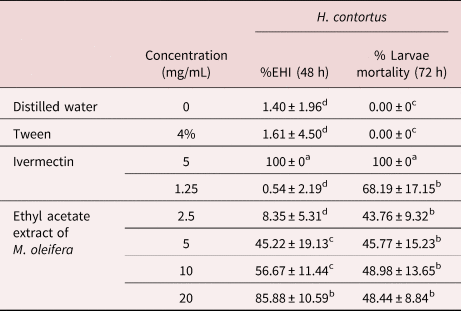
Table 1 shows the values for the EHI and mortality of the H. contortus larvae. For the EHI, the highest percentage was observed at concentrations of 85.88 to 20 mg/mL, while the lowest percentage was observed for 0.54 to 1.25 mg/mL, at 48 h post-confrontation. For the L3 larval mortality, the highest percentage was 68.19% at 1.25 mg/mL, and the lowest was 43.76% at a concentration of 2.5 mg/mL at 72 h post-confrontation.
Percentages of egg hatching inhibition (EHI) and larval mortality of ethyl acetate extract of M. oleifera leaves at different concentrations against H. contortus at different times.

Same letters in the column indicate that the values do not differ statistically, according to Tuckey's test; n = 4; ten aliquots per well.
Egg hatching test and mortality of N. aberrans larvae
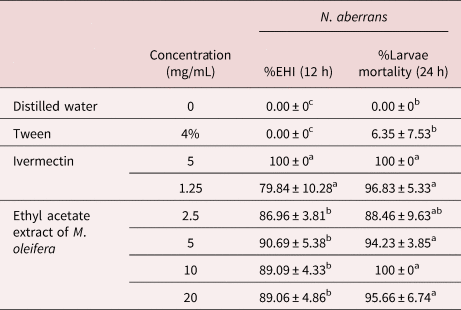
Table 2 shows the values obtained in the egg hatch and mortality test for N. aberrans. At the concentrations evaluated, the highest percentage of EHI was 90.69% at 5 mg/mL, and the lowest was 79.84% at 1.25 mg/mL at 12 h post-confrontation. Regarding juvenile mortality, the highest percentage was 100% at 10 mg/mL, and the lowest was 88.46% at 2.5 mg/mL at 24 h post-confrontation.
Percentages of egg hatching inhibition (EHI) and larval mortality of EtOAc extract of M. oleifera leaves at different concentrations against N. aberrans.

Same letters in the column indicate that the values do not differ statistically, according to Tuckey's test; n = 4; ten aliquots per well.
Qualitative analysis for determination of compounds
Different phytochemical compounds were found: triterpenes, steroids, flavonoids and coumarins were present, while carbohydrates, saponins and alkaloids were absent.
Gas chromatography coupled to mass spectrometry
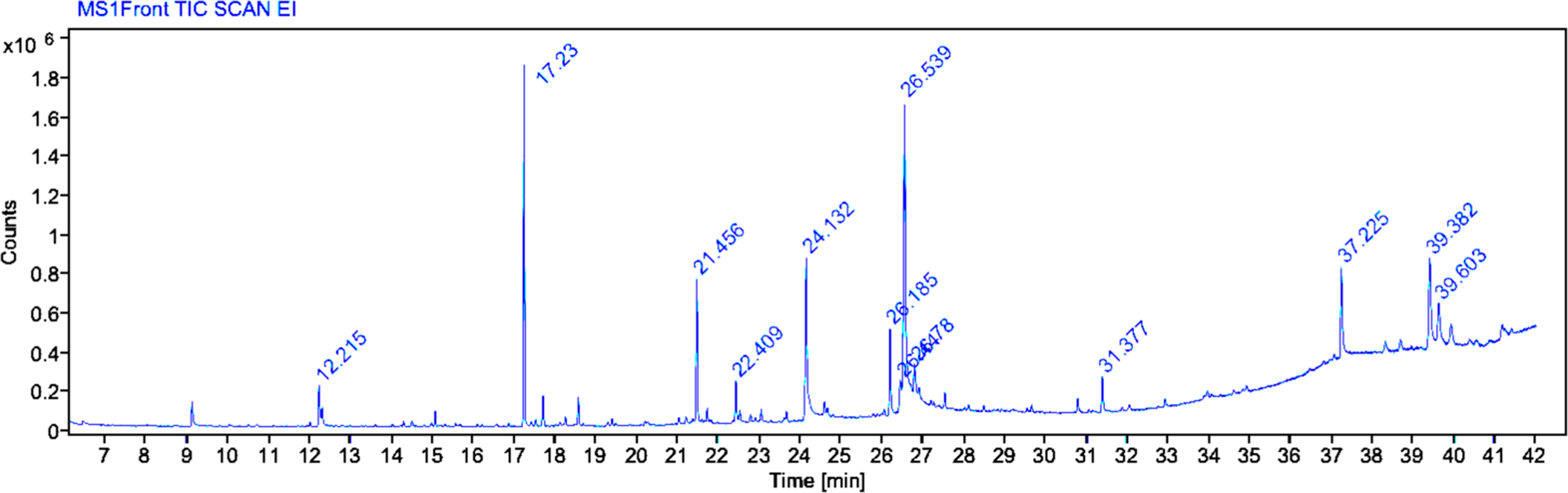
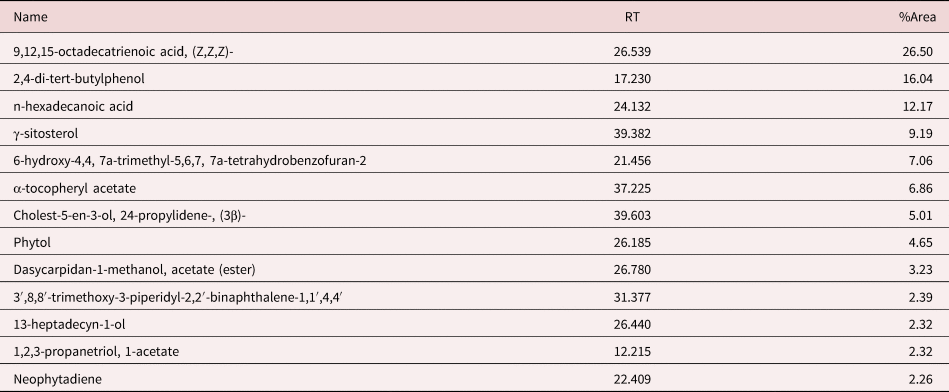
In the analysis by gas chromatography–mass spectrometry (fig. 1; table 3), 13 compounds contained in the EtOAc leaf extract of M. oleifera were identified; among the major compounds were 9,12,15-octadecatrienoic acid, (Z,Z,Z)-, n-hexadecanoic acid and 2,4-di-tert-butylphenol, and the minor compounds included phytol, γ-sitosterol and α-tocopheryl acetate.
Gas chromatography–mass spectrometry chromatogram of ethyl acetate extract of M. oleifera leaves.

Compounds identified in EtOAc extract of M. oleifera leaves by gas chromatography–mass spectrometry analysis.

RT, retention time.
Discussion
Due to the problems of nematode resistance against anthelmintics, the search for alternative nematode-control agents of natural origin has been stimulated, as is the case for the use of medicinal plants. Moringa oleifera contains bioactive compounds present in the leaves, seeds, roots, flowers and bark with anthelmintic activities (Cabardo & Portugaliza, Reference Cabardo and Portugaliza2017). In the EHI test for H. contortus, the EtOAc extract showed an efficacy of 85.88% and in the larvicidal test, a mortality of 68.19% was obtained, so it is deduced that the plant M. oleifera has nematicidal effects, as reported by Mbogning-Tayo et al. (Reference Mbogning-Tayo, Wabo-Poné, Komtangi, Yondo, Ngangout and Mbida2014), who evaluated the efficacy of an aqueous extract, as well as an ethanolic extract, of M. oleifera against the eggs, larval eggs, and L1 and second-stage larvae (L2) of H. contortus in vitro. Their results showed that the ethanolic extract obtained from the leaves of M. oleifera was more efficient in inhibiting the eggs, resulting in 60.3% and 92.8% inhibition at 3.75 and 5 mg/mL, respectively, and it also inhibited the hatching of H. contortus eggs at 5 mg/mL by 99%. As for the activity against larvae, the ethanolic extract was also more effective, inducing 98.8% and 100% mortality in L1 and L2 larvae at 5 mg/mL, respectively. On the other hand, Puerto-Abreu et al. (Reference Puerto-Abreu, Arece-García, López-Leyva, Roche, Molina, Sanavria and da Fonseca -Adivaldo2014) evaluated the in vitro effects of aqueous extracts of M. oleifera and Gliricida sepium on the development of the exogenous stages of gastrointestinal strongyles of sheep; they reported that the two plants inhibited the egg hatching capacity, with a higher inhibition rate for M. oleifera, and larval migration, with migration-inhibition rates above 97%. In another study by Cabardo & Portugaliza (Reference Cabardo and Portugaliza2017), the anthelmintic activity of ethanolic and aqueous extracts of M. oleifera seeds against the eggs and L3 of H. contortus was evaluated; ovicidal effects of 95.89% at 15.6 mg/mL and 81.72% at 15.6 mg/mL were observed. As for the larvicidal effect, the ethanolic extract resulted in 56.94% and 56.11% mortality at 7.8 and 15.6 mg/mL, respectively, in contrast to the aqueous extract, which produced a mortality of 92.50% at 7.8 mg/mL. There is little information about studies on plant nematodes where extracts of M. oleifera have been used; however, Sousa et al. (Reference Sousa, Souza, Gifoni, Dias, Freitas, Oliveira and Vasconcelos2019) evaluated and characterized the nematicidal effects against Melidogyne incognita of proteins exuded from the seeds of M. oleifera, which presented ovicidal activity and caused 100% mortality in J2. The difference between the results obtained and those reported in the different studies is due to the type of solvent used to perform the extraction, since in the present study an apolar extract was used and the secondary metabolites obtained have the same apolar nature. The results of the qualitative analysis for the determination of compounds agree with those reported by Linares-Rivero et al. (Reference Linares-Rivero, Quiñones-Gálvez, Pérez-Martínez, Carvajal-Ortiz, Rivas-Paneca, Cid-Valdéz, Pérez-Gómez, La-Rosa-González and Capdesuñer-Ruiz2018), with the presence of triterpenes, steroids, flavonoids, tannins, phenolic compounds and volatile coumarins and the absence of saponins being demonstrated. Khandelwal et al. (Reference Khandelwal, Rishi and Khurana2014) reported the presence of phenols, alkaloids, flavonoids, steroids, tannins, saponins and cardiac glycosides. Another study by Guaycha-Pérez et al. (Reference Guaycha-Pérez, Jaramillo-Jaramillo, Cuenca-Buele, Tocto-León and Márquez-Hernández2017) reported the presence of triterpenes, steroids, flavonoids and alkaloids in leaf extracts of M. oleifera, which is in line with the results of the present study. The gas chromatographic analysis coupled to mass spectrometry of the EtOAc leaf extract of M. oleifera revealed the presence of 13 compounds, and Barreto et al. (Reference Barreto, Freitas, Silveira, Bezerra, Nunes and Gramosa2009) analysed the essential oils of the leaves, flowers and fruits of M. oleifera by gas chromatography coupled to mass spectrometry, finding the main constituents to be phytol (21.6%) and thymol (9.6%) in the leaves, octadecane (27.4%) and hexadecanoic acid (18.4%) in the flowers, and docosan (32.7%) and tetracosan (24.0%) in the fruits. On the other hand, Vats & Gupta (Reference Vats and Gupta2017) reported the presence of phytol at 23.54% in a hydroethanolic extract of M. oleifera leaves in addition to the antioxidant properties of the leaves. In a study by Fujimoto et al. (Reference Fujimoto, Abe, Mizukubo and Seo2021), the authors mention that phytol is a constituent of chlorophyll and a precursor of tocopherols, in the roots parasitized by the root-knot nematode Meloidogyne spp. The application of sclareol, a diterpene that has been shown to induce resistance of Meloidogyne spp. dependent on the ethylene phytohormone, the roots of the bean plant (Arabidopsis thaliana) increased the content of phytol in the roots accompanied by a decrease in chlorophyll in the aerial parts. On the other hand, exogenously applied phytol inhibited the penetration of Meloidogyne spp. in the roots without showing nematicidal activity. This phytol-induced inhibition of the penetration of Meloidogyne spp. was attenuated in the A. thaliana mutant ein2-1 insensitive to the ethylene phytohormone, while exogenously applied phytol improved the production of α-tocopherol and the expression of VTE5, which is a gene involved in the production of tocopherol in the roots of A. thaliana. The α-tocopherol exerted an induction of resistance to Meloidogyne spp. similar to that of phytol and showed a greater accumulation in the roots inoculated with the nematode. Furthermore, the VTE5 mutant showed no inhibition of Meloidogyne spp. penetration in response to phytol. The results of this study suggest that exogenously applied phytol induces resistance to Meloidogyne spp. dependent on Arabidopsis mutant ein2-1, possibly through tocopherol production. Another study by Bakare & Ghareeb (Reference Bakare and Ghareeb2019) reported the presence of 9,12,15-octadecatrienoic acid in a methanol extract of M. oleifera leaves, with the difference that the plant was grown in Saudi Arabia and reported the antioxidant and antimicrobial activity of the extract. Alvindia & Mangoba (Reference Alvindia and Mangoba2020) identified 43 chemical constituents in Philippine native Moringa based on gas chromatographic–mass spectrometric analysis. The seven major compounds were as follows: oleyl alcohol, methyl ether (18.16%), γ-sitosterol (7.29%), 3-heptanol,6-methyl (6.88%), linalool oxide (4.95%), benzyl-o-β-d-glucoside (4.83%), formic acid 2-methyl-(1,3)dithian-2-yl methyl ester (3.51%) and nonadecanoic acid (3.15%). They also evaluated the fungitoxic effects of M. oleifera extracts in vitro and in vivo against Colletotrichum gloesporioides, a pathogenic fungus causing anthracnose in mango fruits. For the other compounds identified, we did not find a study reporting the presence of these compounds in extracts of M. oleifera leaves, so this study could serve as a reference for future research on the identification of compounds from EtOAc extracts of M. oleifera. Plant extracts exhibit two main characteristics; firstly, they are safe and environmentally friendly, and secondly, they show less resistance development against target pests and degrade naturally (Kimbaris et al., Reference Kimbaris, Siatis, Daferera, Tarantilis, Pappas and Polissiou2006; Koul & Walia, Reference Koul and Walia2009). A complex compound or mixture of compounds will further enhance their effect on target organisms because such complexities are favourable in the broad target spectrum, as different organisms respond differently to individual compounds (Alvindia & Mangoba, Reference Alvindia and Mangoba2020). Mancilla-Montelongo et al. (Reference Mancilla-Montelongo, Castañeda-Ramírez, Torres-Acosta, Sandoval-Castro and Borges-Argáez2019) mention that groups of secondary metabolites that have been implicated in anthelmintic activity include acetogenins, alkaloids, terpenoids, polyphenols and both flavonoids and non-flavonoids; furthermore, they state that studies of tropical plants have reported in vitro anthelmintic activity of non-flavonoid polyphenols, including the biological activity of arbutin, caffeic acid, chlorogenic acid and derivatives of caffeoyl and coumaroyl acids against H. contortus and coumarin against Cooperia punctata, whereby anthelmintic activity was associated with an isolated metabolite found in a fraction rich in a few compounds.
In conclusion, the results of the present study show that an EtOAc leaf extract of M. oleifera Lam. has an effect against two nematodes of agricultural importance (H. contortus and N. aberrans) in vitro, in addition to containing coumarins, flavonoids, triterpenes, steroids and compounds such as 9,12,15-octadecatrienoic acid (Z,Z,Z), 4-di-tert-butylphenol, n-hexadecanoic acid, γ-sitosterol and phytol, which could be the compounds responsible for the nematicidal activity; however, it is important to continue studies to demonstrate nematicidal activity using in vivo models.
Financial support
We gratefully acknowledge financial support from Instituto Nacional de Investigaciones Forestales, Agrícolas y Pecuarias (INIFAP), Mexico (Fiscal Project 834432984).
Conflicts of interest
None.
Ethical standards
The sheep were strictly maintained under the NORMA OFICIAL MEXICANA (Official Rule Number) NOM-051-ZOO-1995 (http://www.senasica.gob.mx) and to the LEY FEDERAL DE SANIDAD ANIMAL (Federal Law for Animal Health) DOF 16-02-2018 (http://www.diputados.gob.mx/LeyesBiblio/ref/lfsa.htm). These guidelines specify that all the procedures performed in studies involving animals must follow the Federal Law and Official Rule strictly in accordance with the ethical standards of INIFAP. Furthermore, guidelines regarding animal welfare and unnecessary animal suffering are Good Management Practices policies that are well established at our institution. Thus, this is to certify that the animals used in the procedures performed for the generation of results included in the manuscript were handled and treated in accordance with the ethical standards and by strictly following the aforementioned Federal Law and Official Rule.