Methicillin-resistant Staphylococcus aureus (MRSA) frequently causes severe community- and healthcare-associated infections worldwide. Increased mortality, prolonged hospital stay, and greater expenses are correlated with the higher incidence of MRSA infection.Reference deKraker, Wolkewitz and Davey 1 The prevention of transmission of both healthcare- and community-associated MRSA infections is a challenging but common target of infection control (IC).Reference Diekema and Edmond 2 Several bundle strategies with distinct components have been described in the past decade, in both endemic and nonendemic settings, which aim to decrease emergence and prevent the spread of MRSA;Reference van Rijen and Kluytmans 3 – Reference Tomic, Svetina Sorli, Trinkaus, Sorli, Widmer and Trampuz 9 however, reports on the long-term success of such programs are scarce.Reference Rodríguez-Baño, García and Ramírez 10 Guidelines issued by the Centers for Disease Control and Prevention (CDC) and others from Europe recommend contact precautions and their strict enforcement by healthcare institutions to effectively reduce the spread of MRSA.Reference Muto, Jernigan and Ostrowsky 11 – 13 However, some randomized controlled clinical trials have not yielded convincing evidence that strict infection control sufficiently reduced the rate of nosocomial transmission.Reference Huskins, Huckabee and O'Grady 6 , Reference Huang, Septimus and Kleinman 8 , Reference Harris, Pineles and Belton 14 Therefore, an optimum approach to MRSA IC has not yet been established, and the most crucial components of the distinct bundle strategies remain unknown. Consequently, the composition, applicability, and success of these policies vary greatly across healthcare settings at both international and national levels.Reference deKraker, Wolkewitz and Davey 1 , Reference Climo, Yokoe and Warren 4 – Reference Rodríguez-Baño, García and Ramírez 10
Several methods have been proposed for monitoring the incidence of nosocomial MRSA, including voluntary and mandatory MRSA screening for colonization. The rate of blood-culture–positive MRSA that originates from screening programs is the measure of MRSA infection least prone to bias. However, MRSA colonization rates are influenced by the method of routine admission screening used and subsequent adherence to isolation procedures. The incidence of MRSA bloodstream infection (BSI) shows high geographical variability as well as temporal variation.Reference Diekema, Pfaller and Schmitz 15 Despite a slight decrease of MRSA BSI rates in the United States and in Europe, the prevalence is still very high.Reference Landrum, Neumann and Cook 16 , Reference deKraker, Jarlier, Monen, Heuer, van de Sande and Grundmann 17 In contrast, Scandinavian countries and the Netherlands continue to report low incidences of MRSA BSI, possibly due to nationwide long-term and intensive IC efforts.Reference van Rijen and Kluytmans 3 In this study, we studied the incidence of MRSA BSI to assess the long-term effectiveness of our continuously upgraded bundle strategy in a setting in which the IC policy has been rigorously enforced over the past 20 years.
METHODS
Study Design and Setting
We prospectively collected BSI data from January 1, 1993, to December 31, 2012, from all blood cultures obtained at the University Hospital Basel (UHB). UHB is a large tertiary care center with a median bed capacity of 855 and 5 intensive care units (ICUs); currently, the facility has >32,000 admissions per year. All microbiology results are transferred daily to the hospital epidemiology surveillance computer system (Hybase, Telekom, Germany), which automatically generates a daily watch list and statistical analysis of >30 pathogens under surveillance to identify and monitor any trends. Positive blood cultures are recorded both in a manual log book and in an electronic database.
All MRSA-positive patients are consecutively followed by the IC team for >30 days after discharge. In addition, MRSA patients are identified either by a notation on the chart prior to 1999 or electronically thereafter. Any readmission of a MRSA patient triggers an automatic Email to the IC staff. Additional patient data were extracted from the original files or digitalized medical charts and microbiology and pathology reports available in the Hospital Patient Management System of UHB. Data were recorded as part of the quality assurance program and the national surveillance program for multidrug-resistant invasive pathogens.
Study Population
All patients with S. aureus bloodstream infection (SAB), including MRSA, admitted to UHB between 1993 and 2012 were included. Clinical and laboratory data related to BSI were recorded using a case report form as part of a continuous quality improvement program. Any epidemiological link was routinely investigated to assess any potential route of transmission, and each MRSA strain routinely underwent molecular typing by pulsed-field gel electrophoresis (PFGE).
Vertical and Horizontal Infection Control Measures
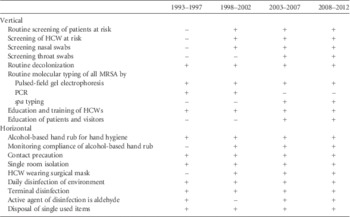
Implementation of the current strict IC program at USB started in 1993 based on adapted CDC recommendations. We defined vertical and horizontal IC components according to Wenzel et alReference Wenzel and Edmond 18 in Table 3. Since 1997, vertical components encompassing MRSA-targeted interventions have been implemented, eg, the screening of patients and healthcare workers (HCWs) at risk. Patients are considered at risk if prior MRSA colonization was documented or if they were transferred from institutions with a known elevated prevalence of MRSA, especially from all southern European countries.
Active MRSA surveillance was established in 1993. All HCWs with unprotected exposure to an MRSA-colonized or infected patient and new staff HCWs previously working in healthcare institutions with elevated rates of MRSA were screened by taking nasal swabs (1993–1997) and nares and throat swabs after 1997. If HCWs were MRSA positive at those sites, then further cultures from axillae, groin, rectum, and vagina were obtained. MRSA-positive HCWs were removed from direct patient care until 3 negative cultures for MRSA became available, and a routine decolonization program was offered similar to the treatment for MRSA patients as previously described.Reference Buehlmann, Frei, Fenner, Dangel, Fluckiger and Widmer 20 We provided routine training for medical staff and HCWs regarding technical issues associated with MRSA colonization and infection.
Admission screening of patients was generally performed within 24 hours and included swabs from both anterior nares and throat (with wound swabs if applicable) as described by Mertz et al.Reference Mertz, Frei and Jaussi 19 From 2002 onward, MRSA-positive patients have undergone a standardized 5-day decolonization treatment including a chlorhexidine mouth rinse, total-body wash with chlorhexidine soap, and mupirocin nasal ointment as described previously.Reference Buehlmann, Frei, Fenner, Dangel, Fluckiger and Widmer 20 Intestinal tract, urinary tract, and vaginal colonization are treated with oral vancomycin, cotrimoxazole, and povidone-iodine solution, respectively.Reference Buehlmann, Frei, Fenner, Dangel, Fluckiger and Widmer 20 An easy-to-read information flyer for patients and visitors is available in 6 languages.
Horizontal IC components have included universal hand hygiene using alcohol-based hand rub, which was introduced in 1967 and enforced after 1993. This component includes regular compliance audits and education of HCWs and medical students for proper hand hygiene technique based on the recommendations of World Health Organization.Reference Tschudin Sutter, Frei, Dangel and Widmer 21 , Reference Widmer, Conzelmann, Tomic, Frei and Stranden 22 Barrier precautions for HCWs caring for MRSA-colonized or -infected patients have consisted of wearing gloves, gowns, and (since 1997) surgical masks meeting European Standard EN 14683 type IIR requirements. Strict contact isolation in single rooms and disposal of single-use items are basic horizontal measures applied over the entire study period. Environmental disinfection is performed daily at this facility, including terminal disinfection with an aldehyde-containing agent.
Microbiology
Blood cultures were performed using the BacT/ALERT Blood Culture System (bioMérieux, USA). Staphylococcus aureus was identified with standard methods including Gram staining, catalase production, and commercial agglutination tests. Susceptibility testing was conducted according to the guidelines of the Clinical and Laboratory Standards Institute (CLSI). From June 2011 onward, minimal inhibitory concentration results were interpreted according to the standards of the European Committee on Antimicrobial Susceptibility Testing (EUCAST).
In MRSA cases, additional tests were performed to detect the presence of aurease (Rapidec Staph, bioMérieux, France), and MRSA-Screens (Denka Seiken, Japan) were used to detect penicillin-binding protein 2a. Most methicillin-resistant isolates were additionally confirmed by PCR for mecA and femA genes as described elsewhere.Reference Strandén, Frei, Adler, Flückiger and Widmer 23 , Reference Strandén, Frei and Widmer 24 For MRSA screening, a highly selective enrichment broth was used as described previously in detail.Reference Mertz, Frei and Jaussi 19 Since 1993, 1 MRSA isolate per patient per episode per year was typed using PFGE and interpreted using GelCompar (Applied Maths, Belgium). All strains were stored at −80°C.
Definitions
SAB was defined as at least 1 positive blood culture with S. aureus with associated systemic inflammatory response syndrome. Nosocomial MRSA BSI was defined using CDC criteria: a BSI detected >48 hours after admission to the unit, unless the patient was known to have MRSA previously or the molecular analysis did not provide any evidence for nosocomial transmission (as defined elsewhere).Reference Fluckiger and Widmer 25 Patients who had multiple positive cultures were considered to have had a single episode if <7 days passed before a new positive blood culture was detected. The incidence of MRSA BSI was expressed per 10,000 patient days.
Statistical Analysis
Incidence (per discharge and per patient days) and temporal trends of MRSA BSI were compared using linear regression or the χ2 test to determine trends. The χ2 or Fisher’s exact test was used for categorical variables. The Mann-Whitney test was applied for continuous variables. All analyses were performed using SPSS version 21 software (SPSS, IBM, Inc., Chicago, IL).
RESULTS
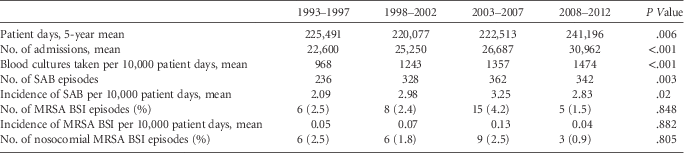
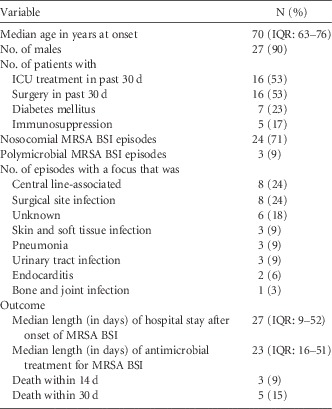
During the 20-year study period, 540,669 blood samples were cultured. The number of patients admitted to the hospital increased steadily from 21,320 in 1993 to 32,507 in 2012, resulting in a total admission number as 505,889 (P<.001, Table 1). The number of blood cultures from 1993 to 2012 showed a steady annual rise from 865 to 1,568 blood cultures drawn per 10,000 patient days and from 17,201 to 38,029 in absolute numbers (Figure 1). In total, we identified 1,268 episodes of SAB from 1,204 patients. MRSA accounted overall for only 34 episodes (24 nosocomial episodes) from 30 patients (Table 1). Underlying diseases basically remained unchanged in patients with MRSA BSI (Table 2).
Absolute number of blood cultures and blood cultures per 10,000 patient days taken in University Hospital Basel from 1993 to 2012. The y axis shows the absolute number of blood cultures, whereas the secondary y axis shows the number of blood cultures per 10,000 patient days.

Numbers of Patient Days, Blood Cultures, Overall Staphylococcus aureus Bloodstream Infection Episodes (SAB), and Methicillin-Resistant Staphylococcus aureus Bloodstream Infection Episodes (MRSA BSI) in University Hospital Basel from 1993 to 2012 in 4 Consecutive 5-Year Periods

NOTE. SAB, Staphylococcus aureus bloodstream infection; MRSA BSI, methicillin-resistant Staphylococcus aureus bloodstream infection.
Baseline Characteristics of 34 Episodes from 30 Patients Diagnosed with Methicillin-Resistant Staphylococcus aureus Bloodstream Infections (MRSA BSI) in a Single-Centre Study over a Period of 20 Years

NOTE. IQR, interquartile range; ICU, intensive care unit; MRSA BSI, methicillin-resistant Staphylococcus aureus bloodstream infection.
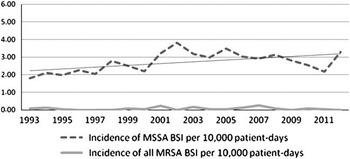
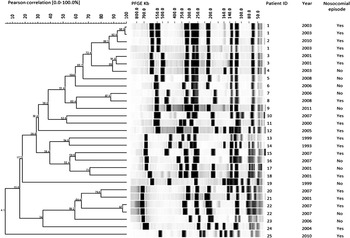
The incidence of MRSA BSI per 10,000 patient days per year varied between 0 and 0.27, and this rate remained stable with no significant variation throughout the observation period (P=.882; Figure 2). A total of 29 isolates from 34 episodes of MRSA in 25 patients underwent molecular typing by PFGE. Isolates of 5 patients between 1993 and 1996 were not available. No clusters were identified during the study period among cases (Figure 3). The components of the comprehensive infection control bundle to prevent MRSA transmission were continuously improved over the past 20 years (Table 3).
Incidence (expressed in 10,000 patient days) of methicillin-resistant (MRSA) and methicillin-sensitive Staphylococcus aureus bloodstream infection (MSSA BSI) from the University Hospital Basel from 1993 to 2012.

Pulsed-field gel electrophoresis (PFGE) analysis, patient identification number (Patient ID), year of onset of bloodstream infection (year) and mode of acquisition of 29 methicillin-resistant Staphylococcus aureus isolates collected from 25 patients with bloodstream infection in University Hospital Basel between 1993 and 2012. Notably, 1 isolate per patient and year are listed, resulting in a multiple PFGE pattern from the same patient, (patient 1 and 3) as documentation of long-term colonization.

Vertical and Horizontal Components of Bundle Controlling Methicillin-Resistant Staphylococcus aureus Transmission Applied in University Hospital Basel between 1993 and 2012

NOTE. HCW, healthcare workers; MRSA, methicillin-resistant Staphylococcus aureus; PCR, polymerase chain reaction.
DISCUSSION
This observational study demonstrates that long-term control of MRSA is feasible with a strictly enforced bundle consisting of multiple vertical and horizontal infection control interventions. No other intervention programs were implemented during the study period that might have had an impact on rates of nosocomial BSI, such as bundles to reduce central line– associated BSIs. In contrast, other institutions and countries that do not follow this rigid policy against spread of MRSA report increasing rates of MRSA. Soon after publishing CDC guidelines to prevent MRSA spread in 2003, the upward trend for MRSA BSI rates has ceased, and surveillance studies now show a trend toward MRSA reduction in the United States and Europe.Reference Landrum, Neumann and Cook 16 , Reference deKraker, Jarlier, Monen, Heuer, van de Sande and Grundmann 17 But the extent to which the components may have contributed to the overall decline have not yet been defined. A 4-year nationwide campaign for the improvement of hand hygiene in the United Kingdom resulted in a significant reduction of MRSA BSI from 1.88 to 0.91 per 10,000 patient days. This result was regarded as an important national success of infection control.Reference Stone, Fuller and Savage 7 European countries with low rates of MRSA BSI, including the Netherlands and Scandinavian countries (<1% of all SABs), follow a “search and destroy policy.”Reference van Rijen and Kluytmans 3 In the Netherlands, a recent paper reported the MRSA BSI rate to be as low as 0.18 episodes per 100,000 inhabitants.Reference van Cleef, van Benthem, Haenen, Bosch, Monen and Kluytmans 26 Throughout our study period, the incidence of MRSA BSI (mean over 20 years: 0.08 cases per 10,000 patient days) remained low, while the incidence of methicillin-sensitive S. aureus BSI significantly increased. This low MRSA rate is compelling evidence in a nonendemic setting that such an approach may limit MRSA despite the fact that the UHB is surrounded by countries with MRSA endemic hospitals <10 miles from the UHB.Reference Chaberny, Sohr, Rüden and Gastmeier 27 , Reference Jarlier, Trystram and Brun-Buisson 28 Therefore, our reinforced bundle plays a major role in effectively maintaining long-term control of MRSA. Its success was also confirmed by the implementation of this bundle in a hospital with high rates of MRSA,Reference Tomic, Svetina Sorli, Trinkaus, Sorli, Widmer and Trampuz 9 and similar policies are in place with minor variations in the aforementioned low-incidence countries. 29 , 30
We share the opinion of Wenzel and EdmondReference Wenzel and Edmond 18 that horizontal components of an IC program should be a major area of focus, but we also strongly believe that the vertical approach (ie, the “search and destroy” approach) is an additive component that is key for long-term success. A vertical “search and destroy” approach may be appropriate in low-prevalence situations, whereas horizontal strategies are more effective in a high-prevalence situation.
The horizontal components of a MRSA bundle include contact precautions to prevent spread of multidrug-resistant organisms as one of the most substantial weapons of the IC armamentarium. However, in the context of MRSA, evidence is conflicting regarding the effectiveness of contact precautions. Recently, 3 cluster-randomized interventional trials of ICUs from the United States and 1 trial from Europe have evaluated the effect of universal screening and barrier precautions in ICUs. Huskins et alReference Huskins, Huckabee and O'Grady 6 reported no reduction of the incidence of MRSA in the intervention group. Harris et alReference Harris, Pineles and Belton 14 showed fewer MRSA acquisitions if all HCW patient contacts occurred with “universal glove and gown use,” but the authors also discussed other explanations, eg, that fewer patient visits and improved hand hygiene might have reduced MRSA acquisition. The European Working Group found that screening with either rapid or conventional methods plus isolation did not succeed in reducing transmission of multidrug-resistant bacteria.Reference Derde, Cooper and Goossens 31 The impact of routine wearing of surgical masks when caring for patients colonized or infected with MRSA has not yet been investigated in conclusive randomized trials. The most effective horizontal component to prevent transmission of multidrug-resistant pathogens and healthcare-associated infections is likely the appropriate practice of hand hygiene. Derde et alReference Derde, Cooper and Goossens 31 clearly showed a direct correlation between improvement of hand hygiene and decrease of acquisition of multidrug-resistant bacteria including MRSA in ICUs. The national “cleanyourhands” campaign also confirmed the important role of reinforced hand hygiene in significantly decreasing the incidence of MRSA BSI (P=.02).Reference Stone, Fuller and Savage 7 Continuous training that includes monitoring to improve technique and adherence is necessary to maintain persistent compliance.Reference Widmer, Conzelmann, Tomic, Frei and Stranden 22 , Reference White, Statile and Conway 32
Jain et alReference Jain, Kralovic and Evans 5 reported a nationally implemented MRSA bundle in Veterans Affairs hospitals that significantly reduced the rates of MRSA BSI (P<.0001). The bundle, consisting of universal nasal screening, barrier precautions, improved hand hygiene, and institutional culture change, was studied over 33 months to assess the major impact of the bundle. Our more complex bundle dynamically evolved over a period of 20 years and has remained stable during the last decade.
Our bundle additionally encompasses vertical components such as screening of patients and HCWs at risk, education of patients and visitors, training of HCWs, and implementation of effective decolonization protocols. Notably, in all of the cluster-randomized trialsReference Huskins, Huckabee and O'Grady 6 , Reference Harris, Pineles and Belton 14 , Reference Derde, Cooper and Goossens 31 and interventional studiesReference Jain, Kralovic and Evans 5 reported, only nares were screened at admission and throat swabs were omitted. We believe that our practice of additionally screening throats, which is closely related to the MRSA policies in the Netherlands, has significantly better sensitivity for detecting carriersReference Mertz, Frei and Jaussi 19 , Reference Mertz, Frei and Periat 33 , Reference Marshall and Spelman 34 and potential sources in the long term. Notably, universal screening has an immense ecological impact; benefits do not outweigh costs; therefore, selective screening of patients and HCWs at risk is a rational strategy.Reference Hubben, Bootsma and Luteijn 35
Our search for potential sources of transmission required the use of PFGE, which has better discriminatory power than PCR methods. These techniques might be replaced in the future by next-generation sequencing. Another element that distinguishes our policy from most other approaches (but is similar to the Dutch guidelines) is decolonization of carriers.Reference Strandén, Frei and Widmer 24 , Reference Crnich, Duster, Warrack, Maki and Safdar 36 Our implementation of decolonization treatment has been extremely successful but requires considerable resources.Reference Buehlmann, Frei, Fenner, Dangel, Fluckiger and Widmer 20 One key element shared with the Dutch guidelines is the inclusion of HCWs in screening and decolonization programs. In addition, the Dutch approach also routinely uses nose and throat screening to improve MRSA detection sensitivity.Reference Mertz, Frei and Jaussi 19
Our bundle was also successfully implemented in a foreign and highly endemic setting, providing further evidence that this approach is not unique to one institution or a particular country.Reference Tomic, Svetina Sorli, Trinkaus, Sorli, Widmer and Trampuz 9 However, the introduction of this rigorous bundle can amplify the incidence of MRSA at first by increasing the identification of unrecognized cases that maintain endemic MRSA rates. Subsequently, with strict enforcement of the bundle, incidence declined and sustained low rates were achieved.
The key components of our bundle that differ from other bundles are the following: selective screening of patients and HCWs at risk, routine screening of the throat, and highly effective treatment for the decolonization, and wearing of surgical masks by HCWs (but not by visitors).
An important strength of this study is the precise data on SAB and MRSA BSI incidence included over 20 years. Additional key strengths are the large size of the patient cohort and the persistent and unwavering leadership of the IC team. Limitations include the observational, single-center study design and the limited generalizability of the study.
In conclusion, our study indicates that low MRSA BSI incidence is achievable by practicing a “search and destroy” approach and by accomplishing a strict IC policy. In such a setting, a long-term observational study may provide important additional information compared with randomized controlled clinical trials, where strict enforcement of IC practices is more difficult to achieve. We also believe that the impact of the vertical components of our bundle on the long-term control of MRSA may have been underestimated; this hypothesis requires further investigation.
Acknowledgments
We acknowledge the contribution of the Infection Control Team of University Hospital Basel to this work.
Financial support: No financial support was provided relevant to this article.
Potential conflicts of interest: All authors report no conflicts of interest relevant to this article.