


INTRODUCTION
Activists power American democracy—and democracies around the world—by taking actions designed to make their voices heard in the political process. Activists are not born, however, they are made. Research shows that the vast majority of activists get involved through civic associations, but we have little experimental research on how these organizations shape activism (Bimber et al. Reference Bimber, Flanagin and Stohl2012; Munson Reference Munson2009; Verba et al. Reference Verba, Schlozman and Brady1995). Drawing on data from three field experiments showing that creating a relational organizational context makes targets more likely to sign petitions, recruit others, and attend meetings, this article argues that civic organizations can have a powerful impact on activism. The article thus builds on and extends a burgeoning body of experimental research on the social basis of political participation to examine forms of activism that are increasingly common modes of citizen involvement in the 21st century (Bedolla and Michelson Reference Bedolla and Michelson2012; Green and Gerber Reference Green and Gerber2008; Rogers et al. Reference Rogers, Gerber, Fox and Shafir2012; Rolfe Reference Rolfe2012; Sinclair Reference Sinclair2012). This article is distinct from that body of research in two particular ways, however. First, it looks not at voting as an outcome but instead at broader forms of political activism, and second, focuses on organizational context as an independent variable. By providing experimental evidence of the effect of organizational context (and the strategic choices organizations make to shape that context) on activism, the article introduces a new set of variables related to organizational context to consider in understanding why people participate.
Why study activism? Studying activism as a phenomenon distinct from voter turnout is important for several reasons (Verba Reference Verba2003). First, by signing petitions, attending meetings and events, calling elected officials, and asking others to join with them in organizational activity, activists play multiple important roles in the functioning of our democracy (Fung Reference Fung2003; Skocpol Reference Skocpol2003). Studies show that they have policy impacts disproportionate to their size (Baumgartner et al. Reference Baumgartner, Berry, Hojnacki, Kimball and Leech2009, 151, 156–7), they affect the behavior and attitudes of others (Bond et al. Reference Bond, Fariss, Jones, Kramer, Marlow, Settle and Fowler2012; Sinclair Reference Sinclair2012; Zuckerman Reference Zuckerman2005), and, by developing and exercising their own agency as citizens through civic organizations, activists create an informal social infrastructure, a civic space, that undergirds and enables our democracy (Barber Reference Barber2003; Orum and Dale Reference Orum and Dale2009; Pateman Reference Pateman1970; Putnam Reference Putnam2001; Tocqueville [1835–40] Reference Tocqueville1969). Second, some studies of trends in political behavior show that even as voter turnout has stagnated since the 1950s, participation in nonelectoral forms of political activism has increased (Dalton Reference Dalton2009; Oser et al. Reference Oser, Leighley and Winneg2014; Zukin et al. Reference Zukin, Keeter, Andolina and Jenkins2006). Political activism, as distinct from voting, in other words, is potentially becoming a more prevalent way for citizens to engage with American democracy. Third, and relatedly, we should study activism as a distinct phenomenon because we cannot assume that findings related to voting import directly to other forms of activism. Voting is a very particular political act that is unlike other forms of activism in that it happens during a confined time period, with a fixed end, and often has high levels of media attention.
Why focus on the impact of organizational context on activism? Democratic theorists have long highlighted the role of civic organizations in acting as a crucible for developing the motivations and capacities Americans need to engage in democracy (Andrews and Edwards Reference Andrews and Edwards2004; Fung Reference Fung2003; Pateman Reference Pateman1970; Tocqueville [1835–40] Reference Tocqueville1969). Civic organizations shape the activism of millions of Americans each year (Current Population Survey 2008–2009). Seventy-nine percent of activists report getting involved through a civic organization (Verba et al. Reference Verba, Schlozman and Brady1995).Footnote 1 The World Values Survey finds that the average American belongs to 1.98 voluntary associations, almost twice the global mean (Bimber et al. Reference Bimber, Flanagin and Stohl2012). Civic and political organizations themselves expend copious resources seeking to engage people in activism, constantly building relationships with, canvassing, and otherwise reaching out to prospective activists. The role of civic organizations in cultivating activism has been studied by democratic theorists examining the role civic organizations can play as Tocquevillian schools of democracy, by sociologists studying the ability of social movements and other protest organizations in shaping activism, and by psychologists examining the role of interpersonal interactions in motivating action (see, e.g., Barber Reference Barber2003; Fung Reference Fung2003; Polletta and Jasper Reference Polletta and Jasper2001; Thomas et al. Reference Thomas, McGarty and Mavor2009; Zomeren et al. Reference Zomeren, Postmes and Spears2008). Yet, despite these multiple strands of research and the ubiquity of real-world political organizations seeking to cultivate activism, there have been few experimental studies of the role civic organizations can play in developing activism.
Existing studies of organizations rely on observational data that predate the Internet revolution, or ignore the larger strategic context within which organizational choices are nested. Previous research demonstrates that a core strategy organizations use to build their activist base involves building relationships with potential activists (Knoke Reference Knoke1981; Polletta and Jasper Reference Polletta and Jasper2001; Warren Reference Warren2001). Much of this research, however, draws observational data from older civic organizations or social movements operating without the use of modern technologies (e.g., Barakso Reference Barakso2004; Knoke Reference Knoke, Rossi, Useem and Wright1990; Rothenberg Reference Rothenberg1992; Warren Reference Warren2001). Modern online technologies, however, often dominate the interactions that contemporary civic organizations have with many of their members. Only a tiny percentage of the people most organizations claim as members actually engage in offline activity (e.g., Andrews et al. Reference Andrews, Ganz, Baggetta, Han and Lim2010; Baggetta et al. Reference Baggetta, Han and Andrews2013). The intensive, face-to-face, ritualistic interactions of the past are gone (Schier Reference Schier2000; Skocpol Reference Skocpol2003). In its place are short, online interactions competing with numerous other stimuli in a crowded information environment for attention (Bimber et al. Reference Bimber, Flanagin and Stohl2012; Karpf Reference Karpf2012). Some studies have argued that organizations can shape these interactions in ways that have “beneficial internalities,” or downstream effects that help cultivate a longer-term relationship between the organization and the member, but not all organizations do so (Han Reference Han2014; Tufekci Reference Tufekci2014). Experimental research that has examined the effect of things like social pressure on voting often ignore the larger organizational context within which these tactical approaches are nested (e.g., Gerber et al. Reference Gerber, Green and Larimer2008).
This article thus develops a new, organizational approach to understanding activism in the modern era by focusing on the interaction between modern civic organizations and potential activists. Instead of thinking about activism as only the product of an individualized, rational cost-benefit calculation, this article develops a relational model of activism rooted in organizational context. Historically, much research on participation has adopted a cost-benefit approach to understanding participation, seeking to identify the individual traits (such as civic resources or free time) and contextual characteristics (such as reduced barriers to voting) that reduce the costs of participation (e.g., Schlozman Reference Schlozman, Katznelson and Milner2003; Verba et al. Reference Verba, Schlozman and Brady1995), or the kinds of motivations that can intensify its benefits (Han Reference Han2009; Miller Reference Miller2005; Wilson Reference Wilson1973). By conceptualizing the choice to participate as a rational cost-benefit calculation, this research has mostly overlooked the dynamic interactions—such as those that occur with civic organizations—that can also influence the choice to act (Bedolla and Michelson Reference Bedolla and Michelson2012; Rogers et al. Reference Rogers, Gerber, Fox and Shafir2012). A growing body of experimental research on voter turnout has brought questions about organizations to the fore—but existing studies have focused mostly on voter mobilization, instead of examining the relationship between organizations and activism more broadly (see, e.g., Arceneaux and Nickerson Reference Arceneaux and Nickerson2009; Green and Gerber Reference Green and Gerber2008; Nickerson Reference Nickerson2008). This article fills these gaps by looking empirically at the effect civic organizations can have on people's propensity for activism.
The article proceeds as follows: the next section delineates a new, relational approach to understanding activism rooted in organizational context. Subsequent sections describe three different experimental studies designed to test this approach. Within each experiment, the article describes the specific hypothesis to be tested, the experimental design, and the results. The article concludes with a discussion of the broader implications of these findings.
AN ORGANIZATIONALLY BASED, RELATIONAL MODEL OF ACTIVISM
For years, cost-benefit models dominated our understanding of political participation, and resource mobilization and political process models dominated our understanding of activism arising from social movements and other forms of collective behavior (for classic formulations of these schools of thought, seeMcAdam Reference McAdam1988; Schlozman Reference Schlozman, Katznelson and Milner2003; Snow and Soule Reference Snow and Soule2010; Verba et al. Reference Verba, Schlozman and Brady1995). These models led researchers to focus on the individual traits (such as free time, or civic skills) that lowered the costs of participation or the structural, contextual factors that made activism more likely by enabling actors to act on grievances either by lowering the costs of acting or giving them the resources to act.
Although these models produced rich insights about the who and how of participation, they have led scholars to adopt an individualistic approach to understanding participation that limited examination of certain research questions. In particular, these models have been unable to answer three important questions: First, why do people act when it is not rational for them to act? Beginning with Olson's work on free-riders, social scientists have asked why people choose to take civic and political action when the probability of their actions making a difference is vanishingly small (Olson Reference Olson1965; also see Rogers et al. Reference Rogers, Gerber, Fox and Shafir2012 for a discussion of why simply expanding our understanding of benefits does not answer all of these questions). Second, how do people's motivations to act emerge? American democracy has never been a spectator sport. For years, millions of people have taken part in civic and political life in many different ways. Where do these motivations to engage in activism originate? Third, why do civic organizations make the choices they do? The empirical reality of politics shows that civic and political organizations expend copious resources seeking to engage people in political action. Yet, these models have been largely silent on what kinds of strategic choices are most effective.
Examining organizational efforts to create social, relational conditions for participation is one way to address gaps in the previous research. This article does not argue that the resources and benefits associated with the cost-benefit model do not matter; indeed a robust body of research shows that selective incentives and the resources people have can play an important role in reducing the costs of participation. Yet, even among those who have resources, there is wide variability in whether or not they participate. This article examines why by arguing that there is an additional set of variables related to organizational context that also matter.
Why do relational conditions within organizations matter? A burgeoning body of experimental research has brought to the fore the social basis of participation (Green and Gerber Reference Green and Gerber2008; Rolfe Reference Rolfe2012; Rosenstone and Hansen Reference Rosenstone and Hansen1993; Sinclair Reference Sinclair2012). This research argues that the choice to participate is not the product of a cost-benefit calculation but instead a “dynamic expression of social identities” (Rogers et al. Reference Rogers, Gerber, Fox and Shafir2012). The motivation to act, in other words, is not formed in isolation; instead, it is the product of myriad social interactions (Marcus Reference Marcus2002; Nussbaum Reference Nussbaum2001; Rolfe Reference Rolfe2012). As Rogers, Gerber, and Fox (Reference Rogers, Gerber, Fox and Shafir2012, 7) write, the dynamic nature of the choice to act means that “events that occur before and after the moment when a person decides to vote can affect whether or not she actually follows through and casts a vote.” Whether people are motivated to engage in activism, then, is not a fixed trait, but instead the product of a series of social interactions that vary in terms of how likely they are to occur, and their ability to prompt activism. People are more likely to participate when someone asks them to participate, and these effects—in voting, at least—are intensified the more personal the ask is (Green and Gerber Reference Green and Gerber2008).
Civic organizations present a particularly rich environment for the social interactions that can shape activism to emerge. Unlike voting, activism can occur through multiple venues and over a long period of time. Because of the longer time horizon of activism relative to voting, there is time for organizations to shape the kind of relationships they form with potential activists. Observational studies of older civic organizations argue that one key way in which they cultivated activism among their members was by creating social relationships with and among members (Knoke Reference Knoke1988; Rothenberg Reference Rothenberg1992; Warren Reference Warren2001). This research has shown how organizations can create frames that shape how participants understand their actions and their role within those actions, create ritualized interactions that affect an individual's willingness to identify with the organization, and structure social interactions that make increased activism more (or less) likely (Baggetta et al. Reference Baggetta, Han and Andrews2013; Han Reference Han2014; Snow and Benford Reference Snow and Benford1988). Yet, these organizations are changing. Research on the changing landscape of civic organizations has shown that the way they interact with members, the kinds of requests for action that they make, and the very way they conceive of membership has become more fluid and more focused on timely events (Bimber Reference Bimber2003; Bimber et al. Reference Bimber, Flanagin and Stohl2012; Karpf Reference Karpf2012). These changes leave open questions about the causal effect of organizational behavior, particularly in modern civic organizations that are seeking to create online appeals for action that can have broader relational effects downstream (Han Reference Han2014). How do civic organizations create relational conditions and foster activism in this new information environment?
What does it mean to create relational conditions within an organization? Organizational behavior scholars have argued that the complexity of simultaneously acting, overlapping factors within one organization that influence outcomes makes it analytically challenging and practically less useful to focus on isolating the causal effect of any one factor in determining a particular organizational outcome (Hackman Reference Hackman2002). Instead, these scholars argue, it is more useful to consider whether the organization can create a set of conditions that make certain outcomes—such as activism, or engagement by members—likely. Creating relational conditions, then, refers to the organization's attempt to create a larger context within which people feel like the social relationships they desire (with each other and with the organization) are more likely to emerge.
Social relationships are a distinct kind of relationship because they are not based purely on transactional exchanges. I may, for instance, have a relationship with my mechanic that is based on a contractual exchange of goods for services. Social relationships, in contrast, are more open-ended, focused not on protection of individual interests, but instead on providing people within the relationship the sense that they will be mutually responsive to each others’ needs in ways that protect and enhance their welfare (Reis et al. Reference Reis, Clark, Holmes, Mashek and Aron2004). Within civic and political organizations, these kinds of relationships are a crucial way to generate the learning and Tocquevillian transformation of interests that many democratic organizations seek (Ganz Reference Ganz2009; Warren Reference Warren2001).Footnote 2 Yet many civic and political organizations maintain a purely transactional relationship with members, simply asking them to donate money or take action without being responsive to members’ needs in return (Han Reference Han2014).
What are characteristics of the kinds of relational conditions organizations want to create? To build these kinds of social relationships, social psychologists have found that people engage in behaviors that demonstrate their relational value and make it more likely others will want to affiliate with them (Baumeister and Leary Reference Baumeister and Leary1995; Leary Reference Leary1995; Leary Reference Leary, Fiske, Gilbert and Lindzey2010; Williams Reference Williams2001). Previous research finds that people who appear to be more open, friendly, interested, and pleasant, for instance, are more likely to build relationships because they seem like they will be good relational partners (Leary Reference Leary, Fiske, Gilbert and Lindzey2010; Mehrabian Reference Mehrabian1969). A key aspect of creating relational value is demonstrating responsiveness (Clark and Lemay Reference Clark, Lemay, Fiske, Gilbert and Lindzey2010, Leary Reference Leary, Fiske, Gilbert and Lindzey2010; Reis et al. Reference Reis, Clark, Holmes, Mashek and Aron2004). Responsiveness can take multiple forms, from helping partners meet needs they cannot meet alone, to demonstrating enthusiasm for a partner's goals, to demonstrating interest in choices they make, to recognizing a shared past (Clark and Lemay Reference Clark, Lemay, Fiske, Gilbert and Lindzey2010; Reis et al. Reference Reis, Clark, Holmes, Mashek and Aron2004). Relatedly, another way people can demonstrate relational value is by prompting others to talk about themselves, to be what social psychologists call “openers,” who are people who invite others to open up to them (Leary Reference Leary, Fiske, Gilbert and Lindzey2010; Miller et al. Reference Miller, Berg and Archer1983). This article examines whether organizations can similarly demonstrate relational value by creating relational conditions of openness, responsiveness, and the like. Just as people can create relational value to make it more likely others will want to affiliate with them, can organizations do the same?
In doing so, this article examines the way modern civic organizations create a relational context that facilitates activism. Twenty-first century civic and political organizations frequently send messages to their lists asking people to take actions like signing a petition. They can send these messages in ways that not only achieve the instrumental goal of generating action, but also have beneficial downstream effects like creating a relational context (Han Reference Han2014; Tufekci Reference Tufekci2014). The overarching hypothesis tested in all of the field experiments asks whether civic organizations who make requests for action in ways that create relational conditions will be more likely to generate activism. Each experiment tests a particular tactic for creating those relational conditions. Taken together, the studies show that when civic organizations create the conditions that make it more likely social relationships will emerge, they are more likely to engage those subjects in acts of civic and political activism. The studies that follow examine three forms of activism that are prevalent among civic organizations in the 21st century: asking people to sign petitions online, asking them to reach out and recruit others, and asking them to attend a face-to-face meeting. All three of the studies examine interventions designed to cultivate relational conditions to see if it makes it more likely that people will sign the petition, recruit others, or attend meetings.
STUDY 1
One key aspect of building relationships is demonstrating responsiveness (Leary Reference Leary, Fiske, Gilbert and Lindzey2010). Feeney (2004) finds that an important aspect of responsiveness is endorsing partners’ goals and providing them with opportunities to pursue those goals. This study looks particularly at whether this form of responsiveness makes it more likely people will sign a petition. The core hypothesis tested in this study is that endorsing a person's goals and giving them the opportunity to pursue those goals will make the person more likely to sign the petition. In examining the hypothesis, the study also examines the difference between generically recognizing a person's goals and specifically recognizing them. Given the importance of personalized communications in previous research on voter mobilization (Bedolla and Michelson Reference Bedolla and Michelson2012; Green and Gerber Reference Green and Gerber2008), the study also examines whether personalized references to people's particular goals makes it more likely they will take advantage of the opportunities for action offered to them.
The Setting: The study was conducted within a professional organization of doctors and medical students. This organization, called the National Association of Doctors (NAD) in this article to retain anonymity, was dedicated to getting more doctors and medical students involved in progressive health reform at the local, state, and national level.Footnote 3 The study was conducted in the spring of 2011, about a year after President Obama's signature health reform bill (the Patient Protection and Affordable Care Act, or the ACA) had passed. The ACA was facing numerous challenges that spring, as members of Congress sought to repeal it, governors and state legislatures were deciding whether or not to accept the provisions of the ACA for their states, and the constitutionality of the individual mandate was being challenged in the Supreme Court. In this climate, the NAD launched a petition drive among its members to demonstrate that physicians were in support of the ACA. They sent the initial request to sign the petition to the entire membership list via email. A week later, they sent a reminder email to people who had not yet signed the petition. The study was conducted as part of the reminder email.
Study Population: The study was conducted with 3,750 members of the organization. This subset of members was selected from the organization's larger membership list because all of these people had responded to at least one of the open-ended response questions on surveys the organization had produced within the past year, and had not yet signed the petition. The NAD disseminated these surveys a few times a year to get a sense of what the issues were that members cared about, and to gauge members’ reactions to timely news events. All of these surveys included spaces for members to leave open-ended responses about their view on various issues. 3,750 members had, in the 12 months prior to the study, completed at least one of the open-ended response questions, but had not yet signed the petition.
Randomization: The list of 3,750 members was arrayed in an Excel spreadsheet, and a uniform random number between 0 and 1 was assigned to each individual. The list was then ordered by the random number, and divided into three equally sized groups of 1,250 people each.
Treatments: Each participant received one of three reminder messages. The first group (the “standard message group”) received the standard reminder message (full text of the message is included in the Appendix). This message asked members to sign the petition, but did not reference their particular goals in any way. Instead, the message appealed to members’ ideological concerns, saying things like “Do we stand by and lose an unprecedented opportunity to transform the way we care for our patients? Do we turn away as misinformation and ideology threaten to control the system and deny care to millions?” The standard reminder ended by asking members to sign a petition demanding “that our political leaders put the health of Americans first.” This message was addressed personally to each recipient, using his or her first name.
The second group (“generic goals message”) received the same standard message with an additional paragraph appended to the beginning of it. That additional paragraph was intended to reference people's goals by generically referencing their past survey responses and offering them the opportunity to take more action consistent with their past actions. This message read as follows:
Dear [INSERT NAME]—As an adviser to the National Association of Doctors, I've appreciated how you've shared your thoughts on the health system with us in the past. I thought of you when I saw this email that the National Association of Doctors sent last week. Signing this pledge gives you the chance to stand up for your values as a doctor. Whether or not you always agree with how health reform has progressed, signing the pledge below gives us the chance to recommit to our values and reclaim our role as physicians. Will you do it?
The third treatment group (“personalized goals message”) received the standard message with the paragraph below appended to the beginning of the message. This paragraph, like the generic goals message, was designed to reference particular goals people had and offer them the opportunity to act on their professed values. Unlike the generic goals message, however, it personalized the reference to people's past responses to survey questions, by quoting from an excerpt of their comments.
Dear [INSERT NAME]—As an adviser to the National Association of Doctors, I've appreciated how you've shared your thoughts on the health system with us in the past. I thought of you when I saw this email that National Association of Doctors sent earlier in the week. Signing this pledge gives you the chance to stand up for your values that you expressed when you wrote that:
you want reform that “provides a basic level of coveragefor all Americans and those in need without discrimination on basis of race, socioeconomic status, ability to pay, etc.”
Whether or not you agree with how health reform has progressed, signing this pledge gives us the chance to recommit to our values and reclaim our role as physicians. Will you do it?
Results: The National Association of Doctors has its own internal tracking system to monitor responses to online requests for activism. Using this tracking system, I gathered data on all study subjects to assess which ones signed the petition and which ones did not. Figure 1 shows the results of the study.Footnote 4 3.7% of members of the standard message group signed the pledge, while 8.9% of subjects receiving the generic goals message and 11.0% receiving the personalized goals message signed the pledge. Both goals message groups are statistically different from the control group (p < 0.001) and statistically different from each other in a one-tailed t test (p = 0.073). In other words, people who received personalized goals messages were almost three times as likely to sign the petition as those who received the standard message. Those who received generic goals messages were more than twice as likely to sign the petition as those who received the standard message.
Percent of Subjects Signing Petitions in Each Treatment Group after Receiving a Standard Message versus a Message Reinforcing their Goals

STUDY 2
Another way to create relational conditions is to recognize a shared past and implied future (Cialdini and Goldstein Reference Cialdini and Goldstein2004; Clark and Lemay Reference Clark, Lemay, Fiske, Gilbert and Lindzey2010; Leary Reference Leary, Fiske, Gilbert and Lindzey2010). A longer time horizon is a key feature distinguishing relationships from incidental social interactions. I can have a social interaction with the cashier as I buy my groceries, but there is no recognition of past or future interactions in this exchange. Relationships, however, are distinct because the parties have shared experiences in the past, and are implied to have more in the future. This study examines whether organizations that reference this past and implied future in their outreach to members are more likely to generate activism. In particular, the study tests whether reaching out to a group of new members to an organization and recognizing their unique status as new members and their entrance into a broader community of people leads them to be more likely to reach out and recruit others. This study captures people right after they joined the National Association of Doctors to signal, from the outset, that the organization recognized their status as new members into the community.
The Setting: This study was conducted in June of 2011 with the National Association of Doctors. During the summer of 2011, Congress was engaged in budget negotiations over the debt ceiling that considered, among other things, drastic cuts to Medicare, Medicaid, and other publicly funded health programs. The National Association of Doctors wanted to add their voice to the debate and demonstrate that the professional physician community did not support these proposed cuts. They began circulating an online petition among their members near the end of June of 2011, with the hopes of delivering it by July. The first request to sign the petition went out during the third week of June, and a reminder email was sent to those who had not yet signed the following week. The study was conducted as part of the reminder email.
Study Population: The study was conducted among 118 new members. Like many modern civic organizations, the National Association of Doctors does not have formal application processes for joining; people can become “members” simply by taking action with the organization, such as attending an event, signing a petition, or visiting the website (Bimber et al. Reference Bimber, Flanagin and Stohl2012; Karpf Reference Karpf2012). These 118 people had “joined” the organization by signing the last petition the National Association of Doctors had distributed but had not yet signed the petition to oppose the proposed budget cuts. (There were also an additional seven people who had joined during the last petition drive, but they signed the Medicare/Medicaid petition during the third week of June, when the first request for action went out. These seven were not included in the study.)
Randomization: The list of 118 names was arrayed in an Excel spreadsheet and a uniform random number between 0 and 1 was assigned to each name. Then the list was reordered according to the random number. The first half of the list was assigned to the first treatment group, and the second half of the list was assigned to the second treatment group. Each group had 59 subjects.
The Treatments: The National Association of Doctors wanted to use the petition as an opportunity to recruit new members. Thus, they asked each new member to recruit three other people to the NAD by asking them to sign the petition. The first group (the “standard message” group) received an email asking them to take a stand to protect Medicare and Medicaid by reaching out to three doctors and asking them to sign the petition (the full text of the standard message is in the Appendix). The standard message did not reference the target's status as a new member and instead opened with a line that appealed to members’ ideological motivations: “We need to take a stand to protect Medicare and Medicaid from being dismantled by Congress.”
The second group (the “new member message”) received an identical message, except that the first paragraph was different. The new member message specifically referenced targets’ status as a group of new members. Instead of opening with an appeal to targets’ ideological motivations, this email opened with a reference to the fact that they were part of a group of new members. The opening paragraph read:
You and 125 others around the country just joined our movement of thousands by taking a stand to protect Medicare and Medicaid in our latest petition effort. Welcome! The National Association of Doctors is a grassroots movement of over 15,000 doctors and medical students like you and me who are working together to improve the health of the nation and make sure everyone has access to affordable, high quality care. We're thrilled to have you join us with your experiences, ideas, and power to make a difference - especially in this critical time.
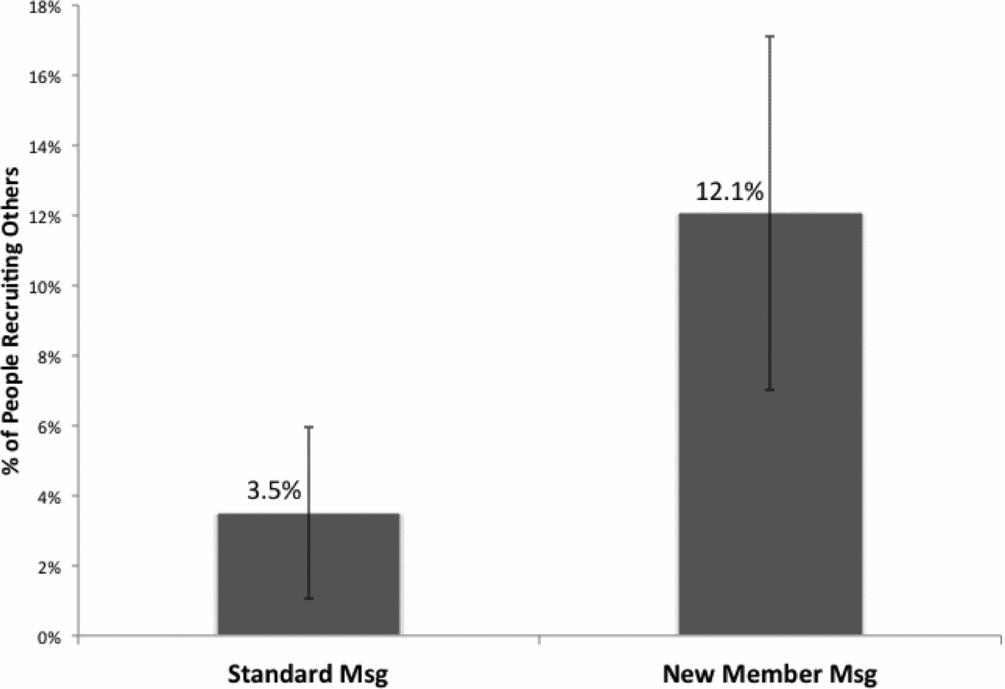
The Results: The results of the study show that referencing subjects’ past actions makes them more likely to sign up to recruit others. The National Association of Doctors had online tracking data that allowed them to see who distributed the petition to others and who did not. Using those data, we were able to see that while the standard and new member message groups were equally likely to open the email message, members of the new member message group were three times as likely to recruit others to sign the petition. The difference in rates of action was about eight percentage points (see Figure 2, p=.09).
Percent of Subjects Reaching Out to Recruit Others after Receiving a Standard Message versus a New Member Message

STUDY 3
An important way that people can create relational value and prompt others to want to affiliate with them is to act as “openers,” or people who invite others to talk about themselves and their thoughts (Miller et al. Reference Miller, Berg and Archer1983). Civic organizations and political organizers often use this strategy by asking people to reflect on actions they have taken (Klandermans Reference Klandermans, Snow, Soule and Kriesi2007; Warren Reference Warren2001; Zomeren et al. Reference Zomeren, Postmes and Spears2008). Organizers often call it “reflection,” referring to the process of reflecting back on a participatory act with an individual to help that individual develop a larger sense of meaning around that act. It is through reflection that organizers seek to develop longer-term relationships with subjects. This study examines the hypothesis that engaging in reflection with participants makes them more likely to attend a follow-up meeting.
The Setting: The study was conducted in May 2011 in a local branch of the National Association of Doctors. Like many civic organizations, the National Association of Doctors is a federated organization, with national, state, and local branches. One of the local branches, located within a major metropolitan area, hosted a panel discussion with prominent local politicians to discuss issues related to health reform in that local area. They invited all of their members in the geographic area to attend the panel discussion. 144 members of the National Association of Doctors showed up. The local branch of the NAD hosted a follow-up meeting two weeks after the event to make plans for what they could do to take action around implementing health reform in their area. The follow-up meeting was first announced to the room full of attendees at the panel discussion. Then, a round of phone calls were made a week after the panel discussion (and a week before the follow-up meeting) reminding attendees about the follow-up meeting. The study was conducted as part of this round of reminder calls.
Study Population: All 144 people who attended the panel discussion were included in the study.
Randomization: The list of names was matched to the database NAD keeps of people who have previously taken action with them. Of the 144 names, 75 names matched existing names in the database and 69 did not. Those groupings were used to create blocks for randomization, to differentiate between those who had previously taken action with NAD and those who had not. Within each block, the names were arrayed in an Excel spreadsheet and a uniform random number between 0 and 1 was assigned to each name. Then, the list was ordered by the random number. In the first block of 75, the first 37 people were assigned to the first treatment group, and the second 38 people were assigned to the second treatment group. In the second block of 69, the first 34 people were assigned to the first treatment group, and the second 35 people were assigned to the second treatment group. In total, there were 71 people in the first treatment group and 73 in the second treatment group.
The Treatments: The first treatment group (standard group) received a standard reminder phone call. The script for this phone call (whether it was a message or an actual conversation) was as follows:
“Hi [INSERT TARGET NAME]. This is [INSERT CALLER'S NAME] calling from The National Association of Doctors. We wanted to thank you for coming to the town hall meeting with [elected official's name redacted for anonymity] last Wednesday. [Elected official's name] said that doctors don't participate enough in voicing their concerns about how our health system should be reformed. So, as we mentioned, we are having a follow-up meeting on [date, time and location redacted for anonymity] to plan the next steps we as doctors can take to make health reform a reality in our communities. We hope to see you there!”
The second treatment group (reflection group) received the same reminder call, but an additional invitation to engage in a conversation reflecting on the target's participation in the panel discussion was appended to the message. The script for the phone message in the second treatment group read as follows:
“Hi [INSERT TARGET NAME]. This is [INSERT CALLER'S NAME] calling from The National Association of Doctors. We wanted to thank you for coming to the town hall meeting with [elected official's name redacted for anonymity] last Wednesday. As [elected official's name] said, you already made a difference by showing up. But we want to do more. [Elected official's name] said that doctors don't participate enough in voicing their concerns about how our health system should be reformed. So we want to learn from your experience about how you think we can make your voice more powerful. Do you have 10–15 minutes when you could call me at [INSERT PHONE NUMBER] to find a time to talk about your experiences? And don't forget: we are having a follow-up meeting on [date, time and location redacted for anonymity] to plan the next steps we as doctors can take to make health reform a reality in our communities. We would love to hear from you before then so please call at [INSERT PHONE NUMBER]. Thanks!”
If the organizer reached the target during that initial phone call, then the script above was adjusted to invite the target to participate in a 10–15-minute phone conversation about their experiences on the spot. At the end of the conversation, the organizer reminded the target about the upcoming meeting. During the phone conversation itself, the organizer was instructed to ask the target the following questions:
-
• What were your goals and objectives in attending the event?
-
• Did you feel like you accomplished them? Why or why not?
-
• What do you think worked well from the event?
-
• What do you think could be improved for the future?
-
• This was an important opportunity for elected officials to hear from doctors on the front lines. By attending the event, you made your voice heard. What else can you do to impact the process?
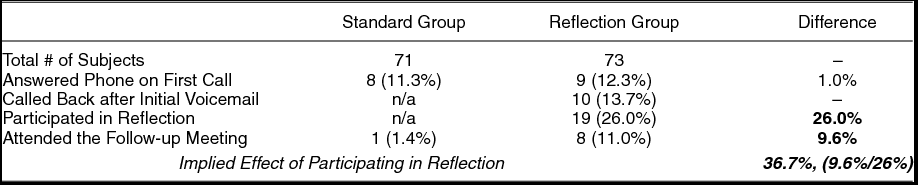
The Results: Table 1 provides some descriptive data showing how the study unfolded. All 144 people in both the standard group and reflection group were called and invited to the follow-up meeting. Among those, eight people (11%) from the standard group and nine people (12%) from the reflection group answered the phone when first called. Those in the standard group were simply invited to the follow-up meeting, while those in the reflection group were additionally asked to reflect on their experience at the first meeting. Everyone who did not answer their phone was left a voicemail; the difference between the groups was that the voicemail message asked those in the reflection group to call the organizer back to share their reflections on the first meeting. An additional 10 people from the reflection group (13.7%) called the organizer back to reflect, resulting in 19 total people (26% of the reflection group) who participated in the reflection. In the end, one person from the standard group (1.4%) and 8 people from the reflection group (11.0%) attended the follow-up meeting.Footnote 5
Study 3 Description

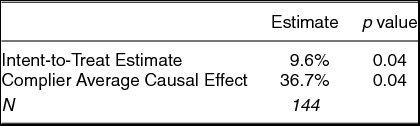
The intent-to-treat effect of asking someone to participate in a reflection was about 9.6% (the difference between the percentage of people attending the follow-up meeting in the reflection group versus the standard group). Only 26% of people in the reflection group, however, actually “complied” by participating in a reflection.Footnote 6 Thus, the implied effect of participating in the reflection is about 36.9%. To calculate the uncertainty associated with these estimates, I used randomization inference under the sharp null hypothesis of no effect (Gerber and Green Reference Gerber and Green2012). The calculations were conducted with the ri package for R (Aronow and Samii Reference Aronow and Samii2012). Table 2 shows the results using randomization inference. The average treatment effect (ATE) in this case is 9.55 percentage points and the complier average causal effect (CACE) is 36.7%, meaning that compliers in the treatment group were 36.7 percentage points more likely to attend the follow-up meeting. The two-tailed p value for these estimates is 0.04. It is important to note that people in both groups received personal phone calls inviting them to attend the follow-up meeting. Yet, subjects in the standard group were much less likely to attend the follow-up meeting. Asking people to reflect on their experience and to contextualize the meaning of their participation had a powerful effect on whether people attended a follow-up meeting.
Study 3 Experimental Results

Note: The estimates in this table are obtained using the ri package for R by Aronow and Samii, which bases estimates on randomization inference under the sharp null hypothesis of no effect.
DISCUSSION AND CONCLUSION
The three studies described above all provide evidence consistent with the idea that civic organizations can facilitate activism by cultivating relational conditions. By demonstrating responsiveness and openness towards their members, recognizing a shared past and implied future, and asking members to engage in reflection, the National Association of Doctors was able to increase their likelihood of signing petitions, recruiting others to take action, and show up to a face-to-face meeting. Within this particular population, the magnitude of these results is striking—in the first two studies, demonstrating responsiveness and a relational future increased their likelihood of participation by five to eight percentage points. In the third study, which involved a personal phone conversation, the size of the complier average treatment effect was almost 37 percentage points.
Each of the experimental manipulations was relatively simple, however, and the key takeaway should not be the value of those specific tactics. As Karpf (Reference Karpf2012) writes, there is a phenomenon of “advocacy inflation,” in which the value of specific tactical innovations used to generate activism declines as more organizations adopt them. Instead, organizations should seek to understand the underlying principles (such as the importance of relational culture) that make certain tactics more strategically valuable than others, so that they can build on those principles without copying other organizations. Obviously, further studies are needed to corroborate these findings, but taken together, the studies provide initial evidence that creating a relational context within an organization can have a powerful effect on activism itself.
As with any field experiments, important limitations to these studies exist. All of these studies were conducted within the context of the National Association of Doctors. This organization is politically progressive and draws on a highly educated, well-resourced population with a strong collective identity. The strength of the collective professional identity of doctors and medical students likely increased the magnitude of the effects. How might these strategies work in different populations that are less resourced, hold different ideologies, or recruit people based on issues, not professional identities? Qualitative data on the importance of relationships in multiple organizations and movements intimates that the effects are likely to be robust across multiple constituencies (Ganz Reference Ganz, Messick and Kramer2004; Han Reference Han2014; Smock Reference Smock2004; Warren Reference Warren2001; Wilson Reference Wilson1973), but further research is needed to verify this. In addition, these studies looked only at the short-term effects of these interventions. For organizers, however, they are interested in cultivating activism not only in the short-term but also in the long-term. How effective are these strategies over time? The longer time horizon is one facet of activism that distinguishes it from voting—while voting happens once, activism takes place over long periods of time. Can civic organizations play a role in developing durable levels of civic participation? Last, the subjects in these studies are all people who had taken some initial action to either join the National Association of Doctors (Studies 1 and 2) or attend an in-person event (Study 3). How might these findings generalize to a broader population of people who have not shown initial interest in taking any kind of civic or political action? Further studies on a broader population of people can help investigate these questions.
Despite these limitations, these results have several important implications for our understanding of activism, and civic engagement more broadly. First, these findings add to existing research challenging traditional models of participation that view it solely as a cost-benefit calculation. The cost-benefit model is not incorrect, it simply leads scholars to ask a different set of questions about participation that examine it in a more individualistic, tactical way. These studies demonstrating the strong influence of organizational context on people's choice to participate points to the idea that the choice to participate can be a more dynamic, social act. The findings in this study thus look beyond traditional approaches to understanding the sources of activism, which tend to focus more on static individual or contextual traits. Instead, these studies imply that political activism is the result of dynamic social interactions that emerge from interaction between a recruiter and a target. In doing so, it reinforces an emerging body of research on the sources of voting. These studies are the first, however, to look at it in the context of political activism.
Second, these findings highlight an understudied influence on participation—political organizations. Much research on participation has focused on individual or contextual factors that influence participation, with less attention to the organizational factors. Yet, civic organizations are the conduit through which millions of Americans get involved in politics—and that number seems to be increasing as nonelectoral forms of participation become more common. These studies show the importance of studying the organizational influences on participation, even in the modern era. Two of the studies relied on online interventions to create a relational context among a group of people who never formally joined an organization—even in that context, we found powerful effects of organizational context.
Finally, while highlighting the importance of studying activism as an outcome, these studies also underscore the need for more research in this area. Myriad political organizations expend copious resources—money, time, manpower, and the like—seeking to get more people to get involved in political activism. Yet, scholars have devoted less time to it. The study of political activism brings together threads of research in multiple fields—from research on political participation, to social movements, to civic engagement, and, more recently, voter mobilization. Activism is arguably fundamental to making democracy work—indeed, de Tocqueville famously wrote that it was Americans’ propensity for joining with others to exercise their voice that made democracy flourish. In addition, activism is on the rise. As technology changes the landscape of politics, it also makes activism more likely. But what organizational and psychological processes underlie the choice to act? This article begins to answer that question and, in doing so, hopefully opens avenues for multiple strands of research.
APPENDIX A: STUDY 1 STANDARD REMINDER MESSAGE:
Subject: Take a Stand for Patients
Health care is at a crossroads. The nation needs us to stand up now for the values we hold dear: justice, integrity, and compassion.
Tell the public and politicians in all 50 states to focus on people and health, not political games.
In the 11 months since health reform passed, millions have gotten help, and important innovations are being fostered. The biggest parts of reform have yet to come, and we know that we have a long way to go to fix our system.
Yet in states across the country, politicians are debating whether health care should be priority. Medicaid cuts are looming from Florida to California. Women's health services for millions could be eliminated by Congress. Newly opened community health centers may have to shut their doors. Dr. Don Berwick, a nationally recognized leader in quality improvement, is being used as a political chess piece and may not get as far as a Senate confirmation hearing.
As physicians and medical students, it's clear we have a choice to make.
Do we stand by and lose an unprecedented opportunity to transform the way we care for our patients? Do we turn away as misinformation and ideology threaten to control the system and deny care to millions?
Or do we rise to the occasion by taking a stand to demand that our political leaders put the health of Americans first?
We choose to take a stand. Will you join us?
We'll deliver our pledge to the public and to political leaders in all 50 states and ask them to stand with us the week of March 23!
[Signed by national leaders of the NAD]
APPENDIX A: STUDY 2 STANDARD MESSAGE
Dear [NAME],
We need to take a stand to protect Medicare and Medicaid from being dismantled by Congress. Nearly 1000 physicians and medical students have already taken action, and we know there are many out there who need a way to speak up and protect their patients, too.
Can you help us reach 500 new physician and medical student activists taking a stand for our patients? Ask 3 more doctors and medical students to sign today!
Make sure all our colleagues know what's at stake in the current federal budget negotiations. If the current House Republican proposal goes through:
-
• Medicare becomes a voucher system. Seniors would end up spending over two-thirds of their income on health care. As a result, many would drop their coverage.
-
• Medicaid becomes a block grant program. An estimated 44 million people will lose access to health insurance when states drop their Medicaid enrollment.
-
• Funding for CHIP would effectively be repealed, causing over 7 million children to lose health insurance.
We need as many doctors and medical students as possible to spread the word and sign our petition. Will you help build this campaign? Recruit your friends to get involved. Download our sign up sheet that you can email or snail mail back to us! We're already turning heads in Washington with this effort, and we're getting ready to release the petition to the media and to Congress on July 12. Contact us to get more involved!
Thank you for all you do,
[name redacted]
P.S. Want to learn more? Visit our information page on Threats to Medicare and Medicaid.




Comments
No Comments have been published for this article.