Introduction
The telecom industry is an interesting case for exploring the dramatic changes for workers and unions resulting from the processes of privatization, technological innovation, market liberalization, and globalization. In Brazil, where telecommunications were a state monopoly inscribed in the country's constitution, its privatization during the neoliberal ascendancy of the 1990s confronted workers and unions with unprecedented challenges, which were heightened by the far-reaching technological changes in the industry worldwide.
During the twentieth century the telecom industry experienced ongoing technological change; however, in the last thirty years, these changes accelerated as a result of the shift from analog to digital technology known as “digitalization.” In the process, the industry's nature, structure, and identity were completely redefined. Digitalization expanded the industry's scope, permitting an increase and diversification of the range of services made available to customers through changes in software, and thus increased the industry's potential profits. Telecom firms, which traditionally operated as public or private monopolies, faced competitors ready to provide new services to untapped markets, mainly composed of corporations eager to use those services in more efficient and affordable ways. The breakup of national monopolies became unavoidable.
The boundaries between sub-sectors of the information industry—landline phone service, cell phones, cable television, computer and information services, publishing, broadcasting, and entertainment—have tended to collapse. As a result, the old term, “telecom industry,” has been replaced by a new term, “info-communication industry.”Footnote 3 The changes meant industry workers' knowledge and skills based on mechanical technology became obsolete, as a new paradigm emerged relying on computer and software technology that eliminated a significant percentage of previous engineering and technical jobs.
Despite the importance of technological innovation in explaining changes in the telecom industry, we cannot understand the sector's pattern of restructuring without considering the effects of market liberalization and globalization on firms as both processes have altered managerial philosophies and the relationships between enterprises. This feature of the industry combined with digitalization to make its restructuring pattern different from other sectors, like automobiles, where restructuring did not change the industry's identity.
While scholars have debated about the nature and extent of globalization—itself a controversial concept—scholars have often pointed out its negative effects on local actors. Despite the power asymmetries that tend to characterize global-local relations, these inequities do not necessarily imply a top-down process; global-local interactions are dialectical, as subordinate actors tend to react to global pressures by creating alternatives that could become opportunities. This seems especially true for telecom unions in Brazil, where technological change, privatization, and globalization have had contradictory effects on the telecommunications industry.
This article presents a narrative of technological change, privatization, and globalization as they have affected Brazil's telecommunications industry. It is divided into three parts. The first section presents a brief account of the general process of privatization in Brazil and in the telecom industry, in particular. Next, I discuss changes in work and employment relations by focusing on a subcontractor that works primarily for one privatized phone company, analyzing changes in the workplace in light of the increasing importance of subcontracting. The third part focuses on problems unions face and the strategies they are adopting to overcome their difficulties and regain the importance they had before the industry's reconfiguration. A final section explores implications of the article's findings, which are based on semistructured interviews with industry managers and workers and published company and union documents.Footnote 4
The Process of Privatization in Brazil
Privatization became an issue in Brazil at the beginning of the 1980s, during the final years of the military regime that ruled the country for two decades, within a context of deepening fiscal crisis.Footnote 5 In July 1981, the Special Commission for Privatization was created with the goal of preventing the creation of new public enterprises, and privatizing existing firms for which there was no clear rationale for keeping them under government control. Only twenty small enterprises were privatized from 1981 to 1984, however, and the plan was considered a failure. The 1988 Constitution inaugurated a newly democratic political environment, following more than twenty years of military dictatorship (1964–1985), but maintained a statist approach toward economic policy. As late as 1988, it was clear that privatization was not a value for most government officials or societal actors in a country where the state had played a leading role in the economy for half-a-century. A common view was that privatization, which was equated with a transfer of public enterprises to foreign control, would be a threat to the national interest—a nationalistic concern near and dear to both the rightist military and their leftist antagonists.
The late 1980s, however, were marked by a serious economic crisis with inflation soaring to eighty percent per month. In 1990, Fernando Collor was elected president on a platform of neoliberal solutions to this chronic crisis. By then, high inflation, the fiscal crisis and the country's inability to obtain foreign loans made it clear that the state could not maintain the leading economic role as it had during the previous five decades. Economic stability, a key economic and political goal, was increasingly associated with freeing the state from the economic burden of unprofitable state enterprises.
The Collor administration began a new National Privatization Plan, but two years later, the president faced impeachment and removal from office for corruption. The privatization plan, however, remained in effect, and from 1991 to 2000, 130 state firms were privatized. Eighty of these firms were sold off between 1995 and 1998, during the administration of President Fernando Henrique Cardoso, when ports, railroads, electric power generation, and telecommunications were privatized. New local and foreign players emerged in a new economic environment that brought deep changes for markets, firms and workers.
The success of the privatization program during the mid-1990s resulted, in large part, from the success of Cardoso's economic policy, which succeeded in stabilizing the economy. This success gave his administration enough legitimacy to win congressional approval for the privatization even of the symbolic Brazilian Telecom System (Telebras), a state monopoly whose status was guaranteed in the 1988 Constitution and was an issue for nationalists and leftists alike. The mid-1990s privatization program also benefited from the collapse of the Soviet Union, which undermined the belief on the left in the efficacy of state control of the economy. Last, but not least, in the 1990s, globalization and market liberalization increased competition between enterprises and made efficiency and productivity essential to firm profitability.
It became evident that these goals would be difficult to achieve in state enterprises whose results tended to be impaired by political interference. Brazil's 1990s privatization program was one of the largest in the world,Footnote 6 generating US$82.1 billion in revenue and shifting $18.1 billion in public debt to the private sector.Footnote 7
Restructuring in telecommunications, which began in the US and Great Britain in the mid-1980s, became a global trend in the 1990s. However, the nature and scope of the process varied with each national setting.Footnote 8 Restructuring of telecommunications in countries like Brazil had different motivations than in highly industrialized countries: it was due not only to the government's inability to finance the industry—a problem which began in the late 1970s and worsened in the 1980s—but also from a lack of local expertise in information technology. Restructuring assumed a defensive character and fostered political controversy since it involved the total transfer of state ownership to private business groups, many of which were foreign. Opponents of privatization, who came mainly from the left and nationalist groups, saw the privatization of the state monopoly as an imposition from abroad and, as such, a threat to national sovereignty. They argued that TelebrasFootnote 9 should remain public due to its economic and strategic importance, which would give the government bargaining power to negotiate technology transfers and international partnerships.
The state, privatized firms, and unions each responded to privatization differently. Government officials argued that the sale of state holdings to foreign firms would allow the government to capture scarce resources to repay public debt and help the integration of global and local markets through the intervention of large multinational firms, thereby contributing to a change in the country's business culture.Footnote 10 Pressed by financial difficulties and wishing to obtain maximum returns from privatization, the state did not negotiate employment and Research and Development policies with privatized firms, sacrificing both worker and union interests in the process.Footnote 11
Private firms wishing to win public approval and facing strict control from the government regulatory agency, the National Telecommunications Agency (ANATEL), made efforts to improve the industry's performance through large investments that allowed them to expand and improve services beyond the goals imposed by ANATEL.
To achieve greater flexibility and higher profitability, privatized firms in Brazil adopted the “lean production” model, housing a small group of skilled workers in a few high revenue-generating activities, such as planning, product development, marketing, and sales. As a consequence, outsourcing expanded, not only in routine tasks, but also in high skill services such as management of a phone company's internal network. Subcontractors now maintain a much larger workforce than do lead firms.
Opponents of privatization, from nationalists to leftists (unions included), were isolated and had little influence on the process, which eroded union power. In this regard, Brazil is different from Mexico, where the privatization of the public phone company (Telmex) included the participation of both between labor and management, who negotiated in an atmosphere of mutual trust. The unfavorable environment in Brazil put the opposition, especially the unions, on the defensive. In the sections below, I examine the consequences of the privatization and liberalization of telecommunications in Brazil, exploring its changing structure, the growing importance and evolving character of subcontracting, and the implications of these changes for workers and unions.
The Restructuring of the Telecommunications Sector in Brazil
Different paths leading to the deregulation of telecommunications markets have differing implications: the continental-European “model” (Germany and France) sought to preserve the public monopoly for the basic network while deregulating value-added services, while the American “model” opened up the whole system to competition, resulting in fragmentation of the network. The privatization of the Brazilian telecommunications system followed the American model.
This choice met with some criticism. Unions acknowledged the need to open up services to competition at the present stage of technological change and capital mobility, but they wanted to preserve the country's control over a basic infrastructural area like telecommunications through the creation of a national phone company, “Brasil Telecom.” They rejected the government's proposal to break up the system, arguing that the country could not sell its telecommunications system to foreigners, but should maintain control over the system, including technological know-how. They also argued that a large national company could successfully participate in the global market. Some leftist groups and Telebras employees tried to block the government's sale of the firm through noisy public protests and law suits, but were unsuccessful in this effort.
Telebras was privatized in July 1998, much later than telecom privatization in other Latin American countries, like Chile (1987), Argentina (1990) and Mexico (1990). The country was divided into four segments (three regional areas—São Paulo, Center-South, and East-North—and one national long-distance carrier). A duopoly model was created, in which the privatized firms operate as public utilities and are required to provide universal service and satisfy quality targets imposed by ANATEL, while new firms entering the market are free from obligations imposed on privatized firms.
The Brazilian government had initiated its role in telecommunications in 1962. The state created Embratel, the public long distance carrier, in 1965 and the telecommunications ministry in 1967. Telebras, the state holding company, was created in 1972 to complete the Brazilian Telecommunications System. The system included twenty-seven local phone companies that served their respective regions; Embratel, which was responsible for long distance calls, data transmission and other special services; and the Center for Research and Development.
Until the mid-1960s, sixty-eight percent of the telecommunications services were provided by the Companhia Telefônica Brasileira (CTB), a subsidiary of the Canadian Traction, Light, and Power Company. The quality of services was poor,Footnote 12 and tele-density (telephones per 100 inhabitants) was one of the lowest in the world. In 1961, teledensity was 38 in the US; 9.6 in Germany; and 6.0 in Argentina; but only 1.4 in Brazil.Footnote 13
In the early 1960s, satellite communications became available and the telecommunications industry assumed a new national security role. In the face of the evident failure of the private companies to run the system efficiently and to enable its expansion and modernization, a virtual consensus formed around the idea the state intervention was needed to modernize the country's telecom system.Footnote 14
During the 1970s, Telebras expanded quickly. In the 1980s, however, the growing inflation drove the government to control prices of public services, seriously limiting the capital available for new investments in telecommunications. In this context, it was difficult to expand digitalization or install fiber-optic cables. As a result, Telebras was unable to provide more complex services. From 1990–1995, annual investment increased to US$3.4 billion, but was still below the level reached twenty years before. Moreover, it was estimated then that an average annual investment of $9.1 billion was needed to modernize and expand Brazil's telecommunications network.Footnote 15
The situation of Telebras during the 1990s helped make the case for privatization: teledensity was very low (six lines per hundred inhabitants), placing Brazil in fifty-seventh place globally in access to land line phones and thirty-third in access to cellular phones.Footnote 16 Quality and productivity (eleven employees per thousand inhabitants) was also low. There was also unequal access to phones across income groups. In 1998, sixteen percent of the highest-income population had eighty percent of the residential telephone lines, with an average of two telephone lines per family;Footnote 17 and fifty-two percent of the lowest income population had two percent of residential telephones, with an average of one line per hundred families.Footnote 18 Services were concentrated in urban areas and only two percent of rural households had access to a telephone line.
The opportunities for expanding the system were impressive given the shortage of services and Brazil's huge geographical expanse and large population.Footnote 19 Telebras required high skills in management and technological planning among its executives and professionals, but as a state enterprise, it was responsive to neither market pressures nor consumer needs. In fact, it was often at the center of political disputes aimed at gaining control over executive positions.
The deficiencies of Telebras helped make telecommunications a success story of Brazil's privatization program, but that was not the only reason for its success. The process was carefully planned with the previous creation of ANATEL as the state regulatory agency.Footnote 20 After privatization, the industry experienced a new growth cycle. The level of investment was impressive. From 1998–2003, private investment in the industry reached more than US$50 billion: $21.362 billion went for the purchase of the Telebras system (privatization auction plus transferred debts), and $9.813 billion from concessions sold to new entrants, totaling $31.175 billion to the government.Footnote 21
Approximately $15 billion, however, was invested in new infrastructure. The peak of investments was in 2001, when companies were making efforts to anticipate universal service targets imposed by ANATEL. A new cycle of investments started in 2004 to foster the expansion of new technologies related to the so-called third generation wireless network: between 2004 and 2005, wireless firms invested $18 billion. The other privatized firms continue to invest (although less so than the wireless companies) in expanding the data communications system—the largest part of their gross income—and bandwidth. In 2005, privatized firms invested $6 billion in these areas.
The industry's performance also changed profoundly: in 1996, teledensity in landline phones was 10.4; by the end of 2002, it had almost tripled, reaching 29.0. The same is true for cellular phones, whose teledensity increased by a factor of five in five years, growing from 4.5 in 1998, to 26.2 in 2003 and to 53.2, in 2006. Since 2004, teledensity in wireless has been higher than for landlines, and the network has become entirely digital. In 2005, the teledensity in landlines was 21.5 while wireless was 46.6. This is a global trend, but in Brazil it was accentuated in great part due to a wireless prepaid system that makes cellular phones affordable to low-income groups.Footnote 22
Productivity growth in the industry has also been impressive. Worker productivity (lines in service per employee) increased significantly in all companies due to new technology, downsizing, and outsourcing. In one of the privatized firms, lines in service per employee were only 471 in 1998, but increased to 1701 by 2002.
Privatization and restructuring had considerable implications for the workforce, for they implied a deep change in employment and work relations: functions and skills related to mechanical technology became obsolete and new activities related to information technology emerged. Downsizing in the privatized firms provides remarkable evidence of this process. Privatization was preceded by a reduction of staff through the implementation of voluntary retirement and redundancy programs. Workers' participation in these programs resulted not only from the appeal of financial compensation but also from management pressure. Downsizing continued long after privatization. However, there is a distinction between functions that were eliminated because of the introduction of new technology and functions that were subcontracted. Subcontracting in telecommunications after privatization and market liberalization became common in the industry worldwide; in Brazil, however, it assumed greater proportions, with around four or five times the number of the employees in lead firms.
There were also significant changes in the age breakdown of workers: by 2002, workers aged eighteen to twenty-nine had become the largest age cohort, while employees aged forty to forty-nine years old, had become the smallest. The number of older workers, particularly those over fifty, declined sharply, many having accepted early retirement. There was also a significant increase in the workers' level of formal education. From 1995–2002, the number of employees with eight years or less of school fell from twenty-seven percent to eight percent of the work force in the sector. During the same period, college-educated employees increased from twenty-five to forty-two percent of the workforce.Footnote 23
Before privatization, wages in telecom were above Brazil's average. After privatization, wages continued to rise due to the industry's expansion and increasing demand for labor until 2001, the end of the boom period. There was also a change in income distribution with a significant increase in the percentage of those earning lower wages: in 1997, thirty percent of the workforce earned less than seven times the minimum wage and seventy percent earned more this figure; by 2002, the former group reached sixty percent, and the latter fell to forty percent. At the same time, there is evidence of the concentration of the highest remuneration among managers at the top, especially through bonuses, resulting in an increase in the gap between the lowest and highest earners, to $3000 versus $150,000. At Tele São Paulo in 2004, the difference between the lowest and highest wages was 500 percent.Footnote 24 There was also a change in the gender composition of the workforce: between 1995 and 2002, women increased from thirty-four to forty-one percent of the workforce. It is likely that this difference resulted from changes in job content and the growth in the sales force.
Subcontracting
Subcontracting became a strategy for enterprises as they tried to adjust to changing markets governed by competitiveness, price, quality, and diversification. In addition to taking advantage of lower-cost labor, subcontracting can allow firms to replace vertically-integrated bureaucratic structures with more market-oriented internal organization. This is especially true for firms in the Information Technology (IT) sector; with shifting definitions and boundaries, these firms need to be on the cutting edge of ideas and technology, but do not want to face the fixed costs and risks of an in-house structure. By subcontracting, the lead firm can be up-to-date with knowledge and new technology without being involved in the production process. This is also true for labor issues ranging from training to securing a supply of skilled labor (a problem in the telecom sector). Management activities are also significantly reduced as well as investments in equipment, which is owned by the subcontractors.Footnote 25
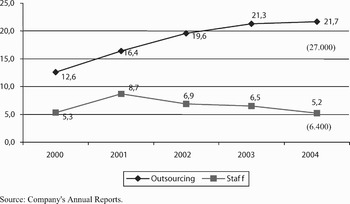
Subcontracting increased both quantitatively and qualitatively in the telecom industry. In quantitative terms, as shown in Chart 1, from 2000 to 2004, in the Center-South firm, the percentage spent on operational costs for outsourcing is much higher than for in-house staff, as is true for all the privatized telecom incumbent companies in Brazil.
Operational Costs in One Incumbent (%)

In qualitative terms, subcontracting became wider in scope, including not only peripheral activities such as installation and maintenance of the external network (digging trenches, building underground chambers, laying the ducts to carry cables) but also other services such as the management of the internal network, a core activity.
In the period before privatization, subcontracting in telecom, in Brazil as elsewhere, was very restricted since the monopoly system was structured as a vertically integrated bureaucracy. After privatization, in Brazil, subcontracting increased significantly, with the emergence of numerous small firms performing non-core activities, characterized by precarious working conditions, and often operating without legal regulation. More recently, the subcontracting process has assumed a more rational character: the numerous small firms were replaced by a small number of partners, which are now responsible for important activities, such as the management of an internal network. The responsibilities for the governance of the production process migrated from the lead firm to the subcontractor; the former exercises a coordinating function instead of providing a service or a product.
In the new configuration, the lead firm tends to focus on marketing, financing, and investments instead of operational activities, while the subcontracting firm assumes the responsibility for achieving the performance and quality targets. In that model, the core firm seeks to focus on commercial activities instead of production.
In my case study, the subcontractor, created in 2003, is a subsidiary of Ericsson, a European-based leader in the world market of telecom equipment—a very different situation from before when there were literally hundreds of small Brazilian firms, many of which paid their workers off-the-books. Ericsson's subsidiary operates the internal network responsible for the effective functioning of the telecom services in the area covered by the lead firm. The management of the internal network demands technological know-how and the capacity to maintain it twenty-four hours a day, 365 days per year. Technological innovation for this kind of function is constant; as part of the transnational Ericsson Group, the subcontractor can respond to these rapid changes.
Performance is assessed via indicators of quality and efficiency, which can be checked online and monitored by the lead firm (for instance, one important indicator is the amount of time the network was off). The targets required are two-fold: the indicators imposed by ANATEL, especially those concerning quality and customer service, are set thirty percent higher by the lead firm as a way to face increasing competition. In order to increase productivity, the subcontractor needed to make large investments in equipment and workforce training, since higher rates of productivity demand knowledge to improve the management process.
The relationship between the two firms is cooperative and responsibility is shared since the subcontractor operates a core activity, on whose effective functioning the success of the business depends, as it faces fierce competition. However, even though it is part of a large transnational group, the subcontractor is subordinated to the lead firm. The renewal of annual contracts is not guaranteed, causing great stress in the workplace since the firm's existence depends on that contract. Additionally, the core firm always demands higher targets than required by ANATEL, which may result in work intensification.
To operate the internal network, the employees need a reasonable capacity to think abstractly and creatively to prevent or solve problems, allowing them to decide on the best solution. In general, the employees interviewed expressed a high level of work satisfaction, acknowledging the opportunity to update their technical knowledge and to perform challenging and skill-intensive tasks in a context that favors creativity and autonomy. But they complained about low wages and fringe benefits as well as about the wage inequality among employees sometimes performing the same function. Clearly, the industry's restructuring resulted in deep changes in work and employment conditions. These changes had dramatic implications for unions.
Industrial Relations
To understand the changes in industrial relations in the telecom industry, it is necessary to understand Brazil's history of state-regulated labor organization. For most of the past century, labor relations was conceived of as a corporatist system that would be an instrument of class collaboration aimed at assuring social peace. This system was institutionalized in the late 1930s and early 1940s during the dictatorship of populist Getulio Vargas. A union's mobilization capacity was limited by the state, whose Labor Courts (Justiça do Trabalho) had the power to arbitrate conflicts between capital and labor, preventing any direct negotiations. This system, which is still operative, created a culture of subordination to the state: unions were legally recognized by the Ministry of Labor and their financing was guaranteed by the state through a compulsory annual union tax paid by each worker, whether or not they were union members. Therefore, unions did not depend on organizing and mobilizing workers in order to finance their activities. The labor laws also established a local closed shop: one union represented a whole professional category of workers (or industry) in each municipality.
Despite the persistence of corporatist legal structures (the Labor Courts, the closed shop, and the union tax), unions in Brazil experienced significant changes beginning in the late 1970s, when the so-called new unionism, originating with the metalworkers of the large and modern auto industry, merged with the democratization movement, making unions important social and political actors. Their demands were not restricted to better working and employment conditions; they also assumed a more autonomous and adversarial role in relation to capital, the state and the military regime of the era. One of the leaders of the new unionism was Luis Ignacio Lula da Silva, the metalworkers' union leader, who is today Brazil's president.
The Central Unica dos Trabalhadores (CUT), founded by Lula in 1983, represented this new unionism, one independent of the state. The other important national labor confederation, Força Sindical (FS), formed in 1991, opposed the CUT's adversarial attitude, adopting a more pragmatic stance based on compromise and negotiation. Today, as a result of the impact of neoliberalism and globalization, the CUT and FS have moved closer together in their strategies and tactics. This is particularly true in the case of the telecom sector, as illustrated by the two most important telecom unions: the Telecom Workers' Union, Rio de Janeiro (Sinttel-RJ), affiliated with the CUT; and the Telecom Workers' Union, São Paulo (Sintetel-SP), affiliated with FS.
Telecom unions had an influential role before privatization since they represented a large and stable workforce, and collective bargaining was centralized so that equal benefits were guaranteed for different groups of workers. Unions negotiated with just two public enterprises: the regional subsidiary of Telebras, and the long distance carrier, Embratel. Union-management relations bordered on paternalism, though they were not free of conflict: contract negotiations might get resolved in the Congress or in the Labor Ministry, underscoring the politicization of labor relations.
After privatization, the unions had to negotiate with several firms representing different segments of the sector: landline, wireless, call centers, and several subcontractors. Decentralization and the diversity of firm types produced distinct results across unions and affected their membership levels as it became difficult to negotiate for and organize such a segmented and geographically dispersed workforce.
Other difficulties emerged in negotiations with a diverse range of private companies; these companies were often consortia including several unknown partners, some of which were transnationals. In this context, it was difficult for unions to determine groups' identities and thus to anticipate managers' orientations and planning strategies.
The unions seem to be losing their ability to represent some groups of workers because many employees are young, more educated, have little connection to union traditions, and some (like call-center employees) view their jobs as temporary and seek to leave the industry. As noted above, after privatization, traditional phone companies where unions were concentrated saw drastic workforce reductions; while employment grew in new segments like wireless companies and call centers, where workers are younger and do not identify with unions. Besides, differences in skills, remuneration, and career perspectives among employees are obstacles to the emergence of a culture of collectivism and identification with unionism. Additionally, private companies tried to restrict unions' activities in the workplace.
Facing all these changes, unions were forced to adjust their attitudes. First, they moved from a dualistic perspective that saw relations with management as either antagonistic or collaborative (especially in the CUT's case), to a more pragmatic position based on negotiation. Second, they broadened the range of workers they sought to organize as they began to understand firms as service chains: they now sought to organize the subcontracted workers that they had previously ignored. A good example of unions' changing attitude was the negotiation of the agreement on Profit Sharing and Meeting Targets (PRSP) despite strong union opposition, in which some leaders claimed, “it represents a submission to capitalist principles.” But, as the president of the Telecom Union, Rio de Janeiro (Sinttel-RJ) stressed: “Today, PRSP is the only thing that unifies the workforce, from top to bottom, since all employees are interested in that bonus.”Footnote 26 Additionally, they acknowledged that participation in the PRSP can become a contract demand that favors workers if used as an opportunity to disclose the firm's profits.
Now that employers are multinational firms such as Telefonica de España (operating in Brazil and several other Latin American countries), Portugal Telecom and Telecom Italia Mobile, among others, unions are considering the possibility that the PRSP and its distribution should be considered in global terms. In that sense, improvements in productivity and profits can be in workers' interests and, as such, unions can claim the right to intervene in the decisionmaking process.
Soon after privatization, the collective agreements signed by telecom unions and phone companies evidenced the changes and losses unions experienced. Additionally, the results of negotiations varied without any clear relationship to which union workers were affiliated with. These diverse results were due to the decentralization of negotiations.
Unions and workers experienced many losses in benefits and changes in working conditions. First, flexible forms of remuneration replaced across-the-board wage increases. Second, pay varied based on whether or not workers meet targets, mainly calculated according to the PRSP. Third, wages and the criteria for determining their value vary across firms, and negotiated increases were not added to base salaries. Fourth, several benefits were eliminated, such as wage increases pegged to inflation, annual seniority-based wage increases, vacation bonuses, and overtime pay above the legal minimum. Finally, many contract clauses were eliminated, such as limits on firms' ability to outsource functions (an important union demand), as well as workers' right to know the criteria used to define performance and promotion.
Comparing the collective agreements, one observes a great diversity of results: disparity in wage increases; training and professional development programs for employees affected by new technology were negotiated in some agreements, and not others; “banking hours” (a practice unionists disapprove of) was established in some agreements, but not others. It is important to mention that the contract clause reducing working hours (forty hours per week against the legal forty-four hours) without wage reduction was maintained in all agreements (excepted in subcontracting firms).
The 2000 agreement signed by the Porto Alegre Telecom Union (Sinttel-RS, affiliated to CUT) and three subcontractors was the first contract between subcontracting firms and a telecom union. Initially, subcontractor managers did not welcome unions, and the collective agreements were very limited in range, guaranteeing workers just their minimum legal rights. However, the contracts were relevant for securing rights not enforced until then, including: legal registration of the work contract, payment of the minimum wage for specific jobs, maintaining maximum weekly working hours, overtime pay, enforcement of health and safety norms in the workplace, workers' reimbursement for work-related expenses (private automobile and phone use during working hours), meal bonuses, granting permission for workers to seek medical care during working hours, and maintaining job security for union leaders.
More significant than these immediate gains was the union's changing attitude: for the first time, it was concerned with organizing workers in subcontracting firms who found themselves unprotected and excluded from telecom unions. To represent subcontracted workers, the unions had to change their statutes, since workers were performing activities considered unrelated to the telecom sector (the majority worked in call centers or did construction such as laying down cables), and other unions claimed their representation. Today, the reality is different: subcontractors are now large, modern firms. Unions are now negotiating fringe benefits for subcontracting workers, including their participation in profit-sharing. The importance of these achievements is the possibility they open of reducing the gap between workers in lead and subcontractor firms. Unions now acknowledge that they had mistakenly ignored workers in other segments of the service chain.
In other countries in Latin America, such as Argentina, Peru, and Chile, unions continue to have difficulties representing workers in subcontracting enterprises, despite the presence of the same lead firm as in Brazil, Telefonica de España. According to the director of union relations in São Paulo Telecom Union (Sintetel-SP), his colleagues in the other Latin-American countries want to eliminate subcontracting, instead of negotiating better working conditions. According to him, eliminating subcontracting is out of question in today's circumstances; insisting on that goal would lead unions to defeat.Footnote 27
Argentine telecom unions, in contrast to their Brazilian counterparts, are in a very difficult position: they did not represent workers in wireless firms and call centers (these segments are represented by commercial workers' unions), and workers in subcontracting firms are represented by construction unions. Besides, the relationships between lead firms and unions are also difficult, both in Argentina and Peru.Footnote 28
Analysis of recent collective agreements signed between telecom unions and the lead and subcontracting firms in Brazil show that differences in the content of collective agreements regarding benefits and employment conditions are mainly between lead firm and subcontracting workers, but differences are also found among the lead firms and among the subcontracting firms themselves, demonstrating diversity in the same segment. Moreover, despite their initial losses, unions were able to obtain some recent gains.
Examining recent agreements, one observes several differences between the privatized phone companies and wireless firms. First, on average, workers in the privatized landline firms have a shorter work day than in the wireless firms. However, workers in wireless firms have received higher wage increases than those in privatized landline firms, bank hours in lieu of overtime pay, and do not enjoy profit-sharing (although this was implemented without negotiation in one firm). Landline firm employees enjoy benefits related to the length of the work day and overtime pay that are unavailable to workers in wireless firms. There are also differences among subcontracting firms in the nature of activities performed and the uses of information technology.
The differences between the collective agreements show the diverse results of collective bargaining that could be attributed to a given firms' technological level, the kind of services it offers and workers’ skill levels. These factors, however, are not sufficient to explain the divergent outcomes, as differences are also found among firms within the same segment.
It is possible that the favorable outcomes achieved in the collective agreements in the wireless segment and in one of the two subcontracting firms appear unrelated to the degree of union influence in each firm. In all of these cases, the union's rate of membership affiliation is low. The apparently favorable situation in the wireless segment could be attributed to the characteristics of its workers. First, employees are young, skilled, and not necessarily loyal to particular firms. Second, they are committed to upgrading their skills, not just to retain their jobs, but to widen their opportunities on the job market. This strategy ends up favoring both the firm and its employees. The firm can improve its performance, while employees' higher skill levels may favor their upward mobility within the firm or in the external labor market.
Recruitment and retention of skilled employees has been a problem for wireless firms. Therefore, employees' disinterest in unions in that segment could be explained, in part, by the position they enjoy in the labor market as skilled information technology workers, which guarantees them fringe benefits offered by the company in order to attract them. However, some wireless employees who were interviewed acknowledged the need for greater union involvement, but also noted the gap between the union's goals (wage increases and universal benefits) and their own (job security and different benefits based on the demands of particular groups of workers).Footnote 29
In one of the wireless firms (VIVO), downsizing has been significant (1,500 jobs were lost in three years) due to the company's joint venture and its loss of market share. Other wireless operators are increasing their market share. Employees are aware of this process and are always keeping an eye on the labor market. In this context, unions may lose ground: they still have a traditional discourse based on a lifetime job in one firm. Paradoxically, in 2004, a wireless firm (VIVO, owned by a consortium led by Portugal Telecom and Telefonica, the largest wireless operator in the country) signed a nationwide collective agreement with twenty three unions in the nineteen states where the company operates; something that was unique in Brazil's telecom industry after privatization.
The favorable conditions negotiated between the subcontracting firm studied and unions can be attributed to the fact that its workers perform core activities. The firm already offered some benefits to the workers; however, it was only established three years ago and it is possible that the union did not have enough time to develop a membership campaign. Despite the improvements in employment and working conditions in the subcontracting firm, the collective agreement does not guarantee the same benefits as in lead firms, especially regarding working hours.
The majority of the skilled employees interviewed that work in the subcontracting firm acknowledge unions' importance for defending workers' interests, but almost all of them expressed dissatisfaction with their union's policies and actions: they criticized the unions' excessively political focus, its lack of communication with employees, and union officials' lack of awareness of conditions in their workplace. This assessment of the union's limitations could also be related to its recent involvement in what is a new firm.
The negotiating strategy of Brazilian telecom unions, however, does not exclude preparing for conflicts: “it is difficult to have open conflict…we seek to find ways to avoid it; however, there are situations when conflict is the only option.”Footnote 30 For example, in 2003, São Paulo Telecom Union (Sintetel-SP) struck against three Telefonica subcontracting firms to obtain the right to represent their employees. The union won its demand, putting an end to a two-year dispute with a construction union. As a consequence, in April 2004, Sintetel-SP signed a collective agreement with all three subcontracting firms. A similar case occurred in 2005: the union tried without success to negotiate with one foreign subcontractor for more than six months and then decided to go on strike. According to union officials, the situation improved after the strike, though they believe that excessive mobilization can limit their success.
After privatization, unions acknowledged that they had to develop a different logic. In negotiations, they found that private firms could respond more quickly than the state bureaucracy. They also learned that it would be easier to negotiate variable payments in the form of bonuses or rewards than fixed benefits. Union negotiating teams thus have to consider more variables than in the past. Instead of across-the-board wage increases, they have to discuss productivity levels, efficiency and quality and their relationship to the kind and value of bonuses or rewards received. They also need to consider the demands of different segments of the workforce as well as their criteria for making concessions. Collective bargaining becomes a more complex task, demanding new competencies. It requires not only political skills but also knowledge of the firm's finances and corporate culture. The unions also learned that large telecom transnationals are eager to finance cultural and social activities that unions could use for developing educational and cultural programs for workers and the community.
Global Capital, Global Labor Organization
The increasing globalization of the economy and the growing power of transnationals have also brought a global response from Brazilian telecom unions: they are trying to organize globally in order to ensure that basic principles and standards of good practices in employment and industrial relations be respected in all the countries where the transnational corporations operate. To accomplish those objectives in the service sector, where enterprises are becoming increasingly global, the Union Network International (UNI) was created, symbolically on January 1, 2000. UNI covers a range of industries including commerce, finance, telecom, postal, computers, industry white-collar staff, business services, graphics, media, and entertainment. Its main objective is to establish an ongoing relationship between local unions and transnational companies, aiming at the negotiation of global framework agreements. These agreements are not supposed to substitute for direct negotiations between companies and unions at the national or workplace level. They were conceived as a way to guarantee a homogeneous framework concerning workers' rights among a transnational company's subsidiaries around the world.
In 2000, Telefonica de España (represented by its world CEO and Human Resources manager) met with UNI and the unions representing employees in Spain and in Latin-American subsidiaries to create the Telefonica Ibero-American Workers' Group (Grupo Ibero-Americano de Trabajadores de Telefonica [GITT]).Footnote 31 Since then, GITT has been meeting once a year to discuss working conditions in the Telefonica subsidiaries and in their subcontractors. GITT follows the UNI's objectives: to get the company to respect the same standards in all the countries where it operates, ensuring that workers' rights of representation are guaranteed. GITT also aims at gaining information about the corporation's global policies and plans in each country, particularly regarding their implications for employees (for example, workforce reductions).
GITT has held meetings in São Paulo, Rio de Janeiro, Buenos Aires, Madrid, Lima, México City, and Santiago of Chile. In 2000, Telefonica and UNI signed an Ethical Protocol, based on the International Labour Organization's core labor standards, to be followed by all Telefonica subsidiaries worldwide. Telefonica has agreed to consult with UNI unions on matters affecting employees, to bargain with unions and to hold annual meetings to inform them about future corporate plans. The Protocol has been renewed each year. Telefonica also agreed to audit working conditions in the first and second tiers of subcontracting firms. In 2001, as a follow-up to the Protocol, Telefonica signed the United Nations Global Compact, agreeing to inform the unions about the company's progress concerning the implementation of the Compact's principles, which include core labor standards as well as standards for human rights and the environment.Footnote 32
According to Telefonica's 2005 Annual Report, the policy of dialogue has contributed to better industrial relations, as illustrated by the decline in the number of hours workers were on strike in Argentina, and the negotiation of collective agreements in subcontracting firms in Brazil.Footnote 33 The GITT agenda, however, has repeatedly included complaints from Latin-American unions about the growth of subcontracting and the persistence of precarious work and industrial relations standards in the subcontracting firms. Problems of workers' representation in subcontractors also have been continuously reported: for instance, in Argentina, subcontracted workers are not represented by telecom unions, but by construction and commercial workers' unions. Workplace problems have also been reported in Peru, Chile, and Puerto Rico. The unions have demanded action from Telefonica to resolve those problems.
The problems raised by unions during the past meetings, however, seem not to have been solved, since the same issues reappeared in the eleventh GITT meeting, held in Santiago, Chile, in January 2007. Among the main subjects brought up by the unions at this meeting were: precarious working conditions in subcontracting firms serving Telefonica; union-busting tactics in Telefonica subsidiary Atento in Puerto Rico,Footnote 34 and Telefonica's violation of the Global Conduct agreements during a strike by subcontracted workers in Argentina. Telefonica's global CEO, César Alierta, responded that he agreed with the unions' concerns about the growth of subcontracting, but that there is no alternative way to reduce costs and maintain the company's competitiveness.Footnote 35
Have UNI and GITT's efforts to improve working conditions been innocuous and without effect? In subcontracting firms, the problem cannot always be resolved by Telefonica. This is the case in Argentina and Chile, where one of the main problems is that telecom unions (with a long tradition of representing telecom workers) cannot legally represent subcontracted workers. The “low road” working conditions in subcontracting firms in Argentina, Chile and Peru can result from the structure of numerous small, precarious subcontracting firms prevailing in these countries.
A clear result of GITT actions, however, was observed in Chile, when Ability (a Brazilian subcontracting firm working for Telefonica) opened a subsidiary there a few months ago, and Sintetel-SP, brokered the meeting between labor and management, thereby facilitating negotiations. Another positive example was in Peru, where the relationship between Telefonica's transnational subsidiary and its workers improved significantly after the arrival of a Brazilian manager (an old telecom employee) to occupy an executive position in the local subsidiary and to negotiate with its workers.
In the case of Brazil, after 2000, evidence shows that there was a significant improvement in the relationship between unions and Telefonica, and between unions and subcontracting firms. This result reflected the improvement in work and employment conditions, especially for subcontracted workers. For example, in 2005, the profit-sharing program was implemented in all subcontracting firms on a provisional basis, and formalized through collective negotiations in 2006.
These gains, however, cannot be attributed to GITT alone, but also to the Brazilian unions' strategies and perhaps to the country's institutional environment. With regard to union strategies, as soon as the telecom unions (affiliated either to the CUT or Força Sindical) understood that they had lost the battle and that privatization was a reality, they made the necessary statutory changes that would give them the right to represent all subcontracting employees, thus avoiding the latter's representation by other unions. This strategy made a great difference, since it made it easier for the telecom unions to gain Telefonica's support in guaranteeing them access to subcontracting firms. Another factor that might have benefited Brazilian unions (affiliated either to CUT or to Força Sindical) was their decision to adopt a pragmatic approach, while not abandoning the use of strikes when negotiations failed.
With regard to the impact of Brazil's institutional framework, one has to consider the role of ANATEL, which, despite existent problems, has been effective in imposing strict quality targets on telecom companies, contributing to a more careful selection of subcontracting firms. Moreover, Brazilian legislation makes the lead firm responsible for what occurs in the whole productive chain. In addition, the Lula government, led by the Worker's Party, is very sympathetic to unions, which employers have to take into account.
The importance of the social, political, and institutional factors in explaining, in part, the differences in employment and work conditions among Telefonica subcontracting firms across countries, does not ignore Telefonica's responsibility for this lack of uniformity. The company makes no effort to comply with signed agreements in defense of decent work conditions and the right to collectively bargain in subcontracting firms. Any effort in that direction would increase labor costs, which could undermine Telefonica's competitiveness.
What were positive outcomes of the UNI/GITT and Telefonica experience? Global experiences like this one work at the level of a basic framework. The basic principles can be extended or not, depending on the conditions in each case. Despite these limitations, international meetings are an opportunity not only for exchanging information, identifying problems, and sharing expertise, but also for legitimating union demands and providing unions with global visibility when firms do not comply with agreed-upon standards and principles. Moreover, in the meetings, the workers and unions are acknowledged as legitimate partners. The emphasis on corporate conduct stimulated by intergovernmental organizations such as the International Labour Organization (ILO), United Nations (UN), and Organization for Economic Cooperation and Development (OECD), can have positive results. For them to be effective, however, it is necessary to have a viable monitoring system, although so far even this has seemed insufficient to assure changes in corporate conduct by transnationals, their subsidiaries and subcontractors.
Final Considerations
New technology, privatization, and the restructuring of the telecommunications industry in Brazil have produced mixed results for workers, consumers, and unions. The provision of services was substantially improved and, especially, the alternative of prepaid wireless phones favored low-income groups who were practically excluded from telecom services before privatization.
Digitalization was responsible for transforming job content and skills requirements, while eliminating functions, resulting in workforce reductions. Privatization, market liberalization, and globalization compelled firms to restructure, meet customer demands, shift from technical to customer-based solutions, reduce operating costs, and increase quality, productivity, and competitiveness. Competition became the driving force of change in the sector. Marketing and sales (almost nonexistent in the past) became a growing and important area in the industry, creating new jobs requiring different skills.
Numerical and functional flexibility became crucial for firms to be able to react quickly to continuous change, reduce costs, and maintain profitability. Flexibility increased workers' tasks and interdependence among workers, but favored less-rigid structures and greater work autonomy, thus constituting a positive motivating factor for workers. However, functional flexibility and its positive results do not correspond to a high performance strategy, nor does it represent a way to create workplace citizenship: telecom employees are constantly threatened with dismissal; to keep their jobs they have to conform entirely to the firm's productivity demands at great personal cost. Today's telecom workplace is characterized by increasing demands on employees in terms of time constraints, long working hours, intensified work rhythms, and a lack of job security. The greater the market pressures, the greater the strain on employees, regardless of whether they are in lead or subcontracted firms.
In more general terms, restructuring in Brazil's privatized telecom industry shows that skills are not a guarantee for enhanced working conditions, in contrast to what some believed in the 1980s and 1990s, when many scholars focused on whether or not deskilling was occurring in firms. Other variables, such as control over one's own work time and job security seem to be equally important as the skill content of jobs.
Unions are being forced to change with the same speed and intensity as firms did. They have moved from a culture based on nationalism, collectivism, class conflict, homogeneity, and rigidity toward a more realistic and pragmatic perspective whereby they attempt to develop new strategies that include both a local and a global view of their problems. This new perspective focuses on the differentiation between different segments of workers, and stresses pluralism, flexibility, and contingency. They are learning to act along a continuum from cooperation to confrontation according to the circumstances. Such an approach requires new social and political concepts, and above all, radical cultural change.
It is interesting to note that managers of global firms have also changed their attitudes. They came to Brazil ready to explore good business opportunities, including a huge market, favorable competitive conditions, and cheap labor. Telefonica de España in São Paulo at first tried to dispense with unions, a behavior unimaginable in Spain itself. The union, however, was able to negotiate with the firm, and today their relationship with management is one of mutual respect. These experiences illustrate how complex the process of globalization, technological change, and restructuring has been. They also underscore that it would be a mistake to consider global-local relations only from a top-down perspective. Brazilian telecom workers and their unions, despite the challenges they faced in this new era of privatization, technological change, and globalization, remained protagonists of their own destinies.