Implications
The results show that unweaned calves fed an experimental low starch, high molasses, high-fibre starter concentrate along with grass hay will grow normally and develop their forestomacs as well as if they were fed a traditional starter concentrate with high-starch low-fibre content and at the same time increase intestinal villi number. This finding challenges the current dogma that calves preferably should be fed starch-rich concentrate to develop their rumen function and thus opens for alternative ways of feeding unweaned calves.
Introduction
Traditional starter concentrates for dairy calves are rich in easily fermentable starch to initiate rumen short-chain fatty acid (SCFA) production and to stimulate ruminal development from birth to weaning (Warner et al., Reference Warner, Flatt and Loosli1956; Tamate et al., Reference Tamate, McGilliard, Jacobson and Getty1962; Lesmeister and Heinrichs, Reference Lesmeister and Heinrichs2005). However, a high starch intake and SCFA production in young calves may cause decrease in rumen pH (Beharka et al., Reference Beharka, Nagaraja, Morrill, Kennedy and Klemm1998), and induce subacute rumen acidosis (Kristensen et al., Reference Kristensen, Sehested, Jensen and Vestergaard2007). Recent data from our group (Kristensen et al., Reference Kristensen, Sehested, Jensen and Vestergaard2006) suggest that digestible fibres and molasses sugars in a calf concentrate can replace barley and wheat starch, and that such an alternative concentrate with low-starch content could prevent subacute rumen acidosis and still allow normal rumen papillae development at weaning. However, few studies have been published about effects of low-starch concentrates on performance of preweaned dairy calves (Lesmeister and Heinrichs, Reference Lesmeister and Heinrichs2005; Hill et al., Reference Hill, Bateman, Aldrich and Schlotterbeck2008).
Addition of molasses at 2% to 5% of dry matter (DM) in concentrates is common practice for technical reasons and to increase palatability and energy density of the feed. Addition of molasses at 12% of DM to a calf concentrate resulted in increased ruminal development, but tended to lower concentrate intake and growth performance post-weaning as compared to a 6% molasses concentrate (Lesmeister and Heinrichs, Reference Lesmeister and Heinrichs2005).
Others have investigated the effect of digestible fibre supplementation on rumen environment and growth performance and noted a positive effect on rumen environment (Bodas et al., Reference Bodas, Giráldez, López, Rodríguez and Mantecón2007; Porter et al., Reference Porter, Warner and Kertz2007) and either positive (Miller et al., Reference Miller, Martin and Fowler1969), negative (Bodas et al., Reference Bodas, Giráldez, López, Rodríguez and Mantecón2007) or no-effect (Porter et al., Reference Porter, Warner and Kertz2007; Hill et al., Reference Hill, Bateman, Aldrich and Schlotterbeck2008) on weight gain of calves and lambs.
Dietary fibre content has been shown to affect intestinal villi characteristics in pigs. Thus, the inclusion of fibre was found to alter intestinal cell turnover and increase width of intestinal villi and depth of intestinal crypts in jejunum and ileum (Jin et al., Reference Jin, Reynold, Redmer, Caton and Crenshaw1994). High-fibre diets were also found to cause losses of the villi epithelium (Moore et al., Reference Moore, Kornegay, Grayson and Lindemann1988), but Jin et al. (Reference Jin, Reynold, Redmer, Caton and Crenshaw1994) could not confirm this finding. Such intestinal data are not available for preweaned calves, but it is likely that intestinal characteristics could also be affected in this species.
The concentrate intake in preweaned calves depends on the milk allowance (Khalili et al., Reference Khalili, Crosse and Varvikko1992; Terré et al., Reference Terré, Devant and Bach2007). The actual milk allowance therefore affects the relative developmental changes in the reticulo-rumen part compared with the small intestine part (Baldwin et al., Reference Baldwin, McLeod, Klotz and Heitmann2004).
If an alternative starter concentrate with low-starch and high-fibre content should be of any relevance in dairy calf feeding, it has to fulfil several criteria, that is, not affect calf performance and health negatively and to have some positive physiological effects on either ruminal development or small intestinal function.
We hypothesize (i) that a low-starch starter concentrate in which starch is substituted by fibres and molasses will develop the rumen similar to a traditional high-starch starter concentrate and (ii) that a higher fibre intake might also stimulate intestinal villi growth and thus nutrient absorption rate.
The objective of this study was to investigate the effect of an alternative experimental low-starch concentrate with high-fibre and high-molasses content in comparison with a traditional high-starch concentrate on the gastrointestinal development during the pre-weaning period (5.5 and 8 weeks of age) of dairy calves. The two concentrates were offered to calves fed at either a high or a low milk allowance to study the gastrointestinal effects when dry feed intake constitutes either a small or a substantial proportion of the net energy intake of the preweaned calf, respectively.
Material and methods
Animals, treatments, housing, feeding and health of calves
In total, 32 Danish Holstein bull calves were used for the experiment. Within 6 to 8 h after birth, the calves were fed 4 l colostrum and then moved to the experimental barn, and kept in single pens (150 cm × 150 cm) allowing physical contact between calves. Pens were bedded with straw and equipped with two troughs for concentrate and hay and a bucket for water.
The calves were divided into eight blocks of four calves based on birth date. Calves were born consecutively over a 2-month period, and the first four calves born were allocated to block 1, the next four to block 2 and so on. Within a block, the four calves were allocated to one of four treatment groups in a 2 × 2 factorial design. The first born calf in the block was allocated to traditional concentrate and 2 × 3.2 kg of whole milk (HIGH-TRA), the next to traditional concentrate and 2 × 1.6 kg of whole milk (LOW-TRA), the third to experimental concentrate and 2 × 3.2 kg of whole milk (HIGH-EXP) and the fourth to experimental concentrate and 2 × 1.6 kg of whole milk (LOW-EXP). Using this approach and a fixed date for slaughter of a given block, there was a small but systematic bias in age at slaughter (1 to 10 days difference in age at slaughter within the eight blocks) between treatment groups, which was adjusted for by using age at slaughter as a covariate in most of the statistical analyses (see below).
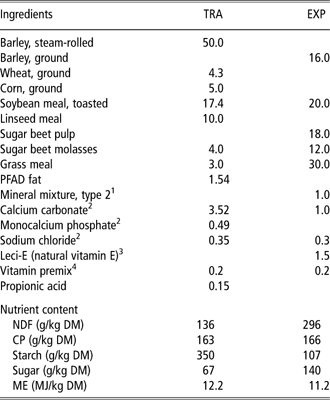
During the experimental period, calves were fed milk two times a day. All calves were fed 2 × 3.2 kg of colostrum until day 3 and 2 × 3.2 kg cow’s whole milk until day 13. For the calves allocated to LOW, the amount of milk was reduced by 50% from day 14. Whole milk (13.5% DM, 216 g digestible crude protein (CP), 287 g crude fat and 365 g lactose per kg DM) was supplied at 0815 h and 1645 h immediately after milking and was kept at 35°C to 38°C before being fed individually to the calves in nipple-buckets. Calves had free access to either a commercial traditional concentrate (TRA; Grønkalv, Valset, DLG Amba, Copenhagen, Denmark) or an alternative experimental (EXP; Table 1). Both concentrates were pelleted with a pill diameter of 3 mm, but in addition the TRA contained 50% rolled barley. All calves had free access to water and to artificially dried chopped grass hay (Dangrønt Products A/S, Ringkøbing, Denmark) from day 1. The hay contained 90% DM, 120 g digestible CP, 81 g sugars, 16 g fatty acids and 417 g digestible fibres/kg DM and had a metabolizable energy (ME) content of 9.8 MJ/kg DM. Fresh concentrates and hay was supplied daily immediately after the morning milk feeding. Orts were removed and recorded twice a week. Fresh water was given in buckets three times a day; after each milk feeding and at noon.
Ingredients, composition and nutrient content of the two concentrates
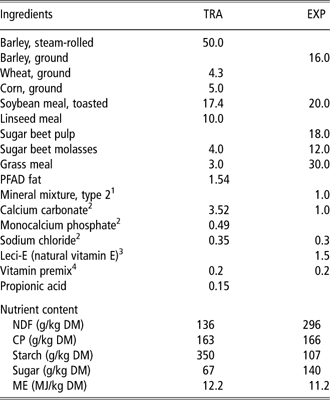
TRA = Traditional concentrate; EXP = Experimental concentrate; PFAD = palm fatty acid distillate; DM = dry matter; ME = metabolizable energy.
1Per kg: 130 g Ca, 130 g P, 60 g Mg and 40 g Na.
2Per kg: 380 g Ca in calcium carbonate, 170 g Ca and 220 g P in monocalcium phosphate and 380 g Na in sodium chloride.
3Natural vitamin E; Per kg of DM: 75 mg of RRR-α-tochopheryl acetate.
4Per kg of DM: 5 mg of Cu (from copper sulphate), 40 mg of Zn (from zinc oxide), 50 mg of Fe (from ferrous sulphate), 0.1 mg Co (from cobalt sulphate), 0.27 mg of I (from calcium iodate), 40 mg of Mn (from manganese oxide), 0.40 mg of Se (from selenium selenite), 10 kIU of vitamin A, 100 mg of all-rac-α-tochopherol acetate, 5 mg of thiamine (vitamin B1), 1 kIU of cholecalciferol (vitamin D3) and 37 mg of RRR-α-tochopheryl acetate.
Health status of calves was generally good from day 14 onwards, but was less good during the first 2 weeks of age, when 2 to 4 calves in all treatment groups suffered from diarrhoea and thus received electrolyte treatment (Diakur, Boehringer Vetmedica GmbH) twice daily between the two reduced (2 l) daily milk allowances and in most cases also antibiotics (Norodine Vet, Colinovina Vet or Aquacycline Vet, twice daily per os for 3 days) and an NSAID (Metacam, first day s.c.). A total of 28 first cases and eight cases of re-treatment of diarrhoea were recorded, more than 80% of the first cases was seen in week 1. The diarrhoea cases were evenly distributed on the two age groups and could not be related to dietary treatments. Pneumonia and diphtheria were seen in three and one cases, respectively, and were treated with antibiotics, and were not related to dietary treatments. Three calves died within the first 1 to 2 weeks of life. One calf was culled during the experiment because of general weakness and poor performance due to chronic pneumonia. A total of 28 calves (seven HIGH-TRA, seven LOW-TRA, eight HIGH-EXP and six LOW-EXP) completed the experiment and were included in the data set.
The experiment included two age groups, as four blocks were harvested at 38 ± 2 days (n = 12) and four blocks at 56 ± 2 days (n = 16) of age.
Sampling procedures and measurements
Samples of feeds and orts (pooled per treatment group) were collected for DM and chemical analysis weekly. Content of DM was measured based on a representative 100-g sample dried at 60°C for 48 h in a forced air oven. Composite feed samples of concentrates and hay, respectively, were analysed for crude ash, neutral detergent fibre, CP and starch as described previously (Kristensen et al., Reference Kristensen, Sehested, Jensen and Vestergaard2007) and the results were used to calculate nutrient and energy contents (Table 1).
The calves were weighed at birth and weekly until the end of the experiment. The final weight was recorded the day before and on the day of slaughter.
The calves were harvested in blocks with one or two blocks per slaughter date. Calves were euthanized by captive bolt stunning and exsanguination. The visceral organs, except for the heart and lungs, were removed immediately and the empty body weight (EBW) including hide, hoofs, head and tail was recorded. The compartments of the gastrointestinal tract were separated by strings and dissected into reticulo-rumen, omasum, abomasum and small and large intestine (caecum, colon and rectum). Weight of organs was registered with and without gut fill. A digesta sample from the reticulo-rumen was squeezed and used for pH measurements.
The reticulo-rumen was rinsed in warm tap water and macroscopically examined by two individual trained evaluators for papillary aggregation (i.e. plaque formation), oedema and necrosis on five-point scales (0 = normal, 1, 2, 3, 4 = severe aggregation, oedema or necrosis). The length of 10 randomly selected papillae at each of four different anatomical sites (two sites in atrium (i.e. cranial rumen sac); ventrally, laterally, and two sites in the ventral rumen sac; ventrally, laterally) was measured with a ruler. Shape of papillae was evaluated on a four-point scale describing increased papillae area (1 = short, thin, 2 = short, leaf-shaped, 3 = long, thin, 4 = long, leaf-shaped). A circular area of 9.8 cm in diameter of rumen tissue was cut-off in the ventral atrium. The epithelium with papillae part was stripped off the muscle layer, weighed and dried in a forced air oven at 90°C for 48 h, and weighed dry to get a representative measure of total rumen epithelium mass (Volmerhaus and Schnorr, Reference Volmerhaus and Schnorr1967).
The kidneys were dissected into organ and perirenal fat. The length of small intestine was measured and samples were collected from the duodenum (20 cm posterior to the pylorus), jejunum (at 50% of the small intestinal length) and ileum (20 cm anterior to the ileocecal junction).
The tissue samples for morphological and histological analysis were fixed in 10% neutral buffered formaldehyde for 24 h. Subsequently the tissue samples were cleaned of remaining digesta using deionized water and dehydrated and infiltrated with paraffin wax. A slide was prepared from each sample. It contained 6 to 8 sections that were 5 μm thick and were made at least 50 μm apart. Slides were stained using the periodic acid-Schiff’s reaction (Kiernan, Reference Kiernan1990). Histomorphometrical analyses were conducted with a computer-integrated microscope and an image analysis system (Quantimet 500 MC, Leica, Cambridge, UK) with a monitor. The histomorphometrical measurements were performed as previously described (Hedemann et al., Reference Hedemann, Mikkelsen, Naughton and Jensen2005). In short, 15 well-oriented villi and crypts were selected on each slide and for each villus and crypt the area of mucin granules with a clear positive reaction for neutral mucins were determined. Villus height and area and crypt depth and area were measured as well. Furthermore, the villi and crypt density were determined as the number of villi or crypts appearing over a defined distance, and the thickness of the muscularis externa was measured.
Statistical analyses
Body weight (BW), average daily gain (ADG), weight of organs, hay and concentrate intake and histomorphometrical parameters of intestines were expressed as least squares means ± s.e. Probability levels at or below 0.05 were considered significant.
For analysing the effects of treatments on ADG, final BW, organs weight, rumen pH and histomorphometry of the intestines, the statistical model included the fixed effects of milk allowance, type of concentrate, slaughter age group and their two- and three-way interactions. Birth weight, expressed as the difference between the calf’s BW and the mean BW of all calves at birth, was included as a covariate in the analyses of ADG. Actual age at slaughter (within slaughter age group) was included as a covariate in the analyses of final BW, EBW and the organ and tissue weight and size data recorded post mortem. The covariate adjusted for the differences in age at slaughter between treatment groups resulting from the procedure for allocating calves systematically on experimental groups. Most covariates were far from being significant, and only for muscle thickness in ileum the covariate was significant. The data were analysed using the GLM procedure of SAS (version 9.1, SAS Institute Inc., Cary, NC, USA).
For analysing the effects of treatments on milk, hay and concentrate intake the statistical model was extended to also include the weekly recordings/animal as repeated measures, its two- and three-way interaction with milk allowance and type of concentrate and the random effect of calf within treatment group. Birth weight was included as a covariate to adjust for small random differences in BW at start (see Table 2). All 28 calves were included when analysing weeks 1 to 5 and the 16 calves harvested at 56 days of age when analysing weeks 1 to 8. Data were analysed using the MIXED procedure of SAS (version 9.1, SAS Institute Inc.).
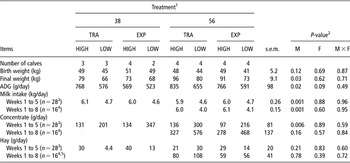
BW, ADG and intake of milk, concentrate and hay in 38- and 56-day-old bull calves fed two types of concentrate (TRA or EXP) at two milk allowances (HIGH or LOW)
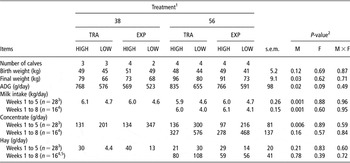
TRA = Traditional concentrate; EXP = Experimental concentrate; ADG = average daily gain.
1Treatments were TRA and EXP fed at 2 × 1.6 kg milk/day (LOW) or 2 × 3.2 kg milk/day (HIGH).
2Effects were milk allowance (M), type of concentrate (F) and interaction between milk allowance and type of concentrate (M × F).
3Milk × week interaction (P < 0.004 to 0.001) for milk, concentrate and hay intake.
4Week effect (P < 0.001) for milk, concentrate and hay intake.
5Concentrate × week interaction (P < 0.08) showing a larger increase in hay intake in TRA compared with EXP calves with age.
Results
Feed intake, BW and daily gain
As planned actual milk intake was similar between HIGH and LOW until 14 days of age (5.9 v. 5.8 kg/day). From 14 days of age, the actual milk intake was 6.2 and 3.6 kg/day for HIGH and LOW, respectively (P < 0.001) with no differences between calves fed TRA or EXP concentrate or harvested at 38 or 56 days of age. The maximum difference in milk allowance between HIGH and LOW calves (6.4 and 3.2 kg/day, respectively) were obtained from week 4 and on. Thus, the milk allowance was 22% lower across weeks 1 to 5 (P < 0.001) and 33% lower across weeks 1 to 8 (P < 0.001) for LOW compared with HIGH. Across weeks 1 to 5, the concentrate and the hay intake increased significantly with week of age (both P < 0.001) and there was a significant milk × week interaction (P < 0.001 and P < 0.004, respectively) showing a more pronounced increase in both dry feeds at LOW compared with HIGH milk allowance with increasing age. Concentrate intake was higher in weeks 1 to 5 (P < 0.006) and also numerically higher across weeks 1 to 8 (P < 0.16) at LOW compared with HIGH milk allowance, whereas hay intake was not affected by milk allowance. There was a tendency for a concentrate × week interaction for hay intake (P < 0.08) showing the largest increase in TRA compared with EXP calves. Across weeks 7 to 8, TRA calves consumed 238 g/day of hay compared with 141 g/day in EXP calves. Overall, concentrate, hay and milk intake were not different between calves fed TRA or EXP (Table 2).
BW at slaughter and EBW were both reduced (P < 0.03 and P < 0.006) and ADG was 20% lower (P < 0.02) for LOW compared with HIGH milk allowance. There was a tendency for reduced ADG in EXP compared with TRA calves (P < 0.09).
Forestomachs and other visceral organs
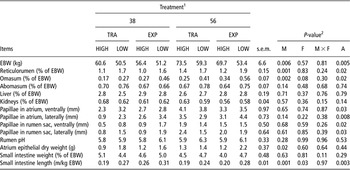
The weight of the reticulo-rumen was not affected by type of concentrate (Table 3). However, the weight of the omasum tended to be higher for EXP compared with TRA (P < 0.08). LOW compared with HIGH milk allowance had a positive effect on weight of the reticulo-rumen (P < 0.001) and the omasum (P < 0.002), whereas weight of the abomasum was not affected by milk allowance (P = 0.14). The length of papillae in the rumen, measured at four different sites of the rumen, was not different between TRA and EXP or between HIGH and LOW. In addition, papillae shape was generally not affected (data not shown). Only in ventral rumen sac, LOW compared with HIGH milk allowance showed slightly more developed papillae (1.9 v. 1.5; P < 0.05). However, the weight of the epithelial tissue sample from ventral atrium was higher for LOW compared with HIGH (P < 0.02). Rumen pH (as measured post exsanguination) was normal (6.0 ± 0.1) and not affected by either concentrate type or milk allowances. Aggregation (0.3 to 0.7), oedema (0.5 to 0.6) and necrosis (0.1) were only observed in few cases and in mild forms and were generally not affected by the dietary treatments (data not shown). Only papillae aggregation in atrium was significantly affected, being relatively more pronounced, but still at a low level, in LOW compared with HIGH calves (1.0 v. 0.4; P < 0.04).
Weight of EBW and organs as a percentage of EBW, length of rumen papillae and weight of atrium epithelium in 38- and 56-day-old calves fed two different types of concentrate (TRA or EXP) at two milk allowances (HIGH or LOW)

TRA = Traditional concentrate; EXP = Experimental concentrate; EBW = empty body weight.
1Treatments were TRA and EXP fed at 2 × 1.6 kg milk/day (LOW) or 2 × 3.2 kg milk/day (HIGH).
2Effects were milk allowance (M), type of concentrate (F) and interaction between milk allowance and type of concentrate (M × F) and age group (A).
Both concentrate type and milk allowances (P < 0.01) affected small intestine length/kg of EBW, as EXP had a longer intestine compared with TRA (P < 0.03) and LOW had a longer small intestine compared with HIGH (P < 0.001). Weight of liver and kidneys as the percentage of EBW was not affected by any of the treatments.
Weight of reticulo-rumen and omasum, length of all four papillae measured, papillae shape in lateral atrium and small intestinal length were all increased with age at slaughter (P < 0.05).
Morphology of the small intestinal mucosa
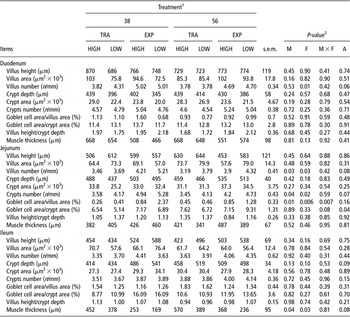
Morphology of the small intestinal mucosa in 38-day-old and 56-day-old calves is presented in Table 4. In duodenum, the type of concentrate affected villi number per millimetre, which was seen as a higher number of villi for EXP compared with TRA (P < 0.01). There was no other effect of type of concentrate and generally no effect of milk allowances on the duodenal characteristics. A tendency for a decrease in the number of duodenal villi with age was observed (P < 0.06).
Morphology of the small intestinal mucosa in duodenum, jejunum and ileum in 38- and 56-day-old calves fed two different types of concentrate (TRA or EXP) at two milk allowances (HIGH or LOW)

TRA = Traditional concentrate; EXP = experimental concentrate.
1Treatments were TRA and EXP fed at 2 × 1.6 kg milk/day (LOW) or 2 × 3.2 kg milk/day (HIGH).
2Effects were milk allowance (M), type of concentrate (F) and interaction between milk allowance and type of concentrate (M × F) and age (A). For muscle thickness in ileum, the covariate (age at slaughter) was significant P < 0.05.
Jejunum was the most affected site in this experiment. Villi number was affected by both milk allowance and type of concentrate. Thus, the villi number was greater for EXP compared with TRA (P < 0.03) and for LOW compared with HIGH (P < 0.03). Neither villi area nor height was affected by the treatments. An interaction between type of concentrate and milk allowance was observed for the ratio between goblet cell area and villus area; being highest for EXP-LOW and lowest for TRA-HIGH (P < 0.007). The crypt number was also affected by milk allowance and type of concentrate, as the number of crypts per millimetre was higher for EXP compared with TRA (P < 0.02) and higher for LOW compared with HIGH (P < 0.04). For the ratio between goblet cell area and crypt area there was a tendency for an interaction between concentrate and milk (P < 0.08), and an effect of age (P < 0.04) was also observed. A tendency for jejunal villi number (P < 0.08) and jejunal crypt number (P < 0.07) to decrease with age was also noted.
In ileum, crypt depth tended to be affected by type of concentrate, being greater for EXP compared with TRA (P < 0.10). Smooth muscle thickness was affected by type of concentrate, being higher for TRA compared with EXP (P < 0.03) and by milk allowance; being higher for HIGH compared with LOW (P < 0.04). Crypt depth and muscle thickness both tended to increase with age (P < 0.08).
Discussion
Effects of type of concentrate
It should be emphasized that in the present experiment, we studied the effects of two very different calf concentrates differing not only in their proportions of nutrients but also poses large differences in ingredients and physical composition. Therefore, it can be difficult to separate the effects caused by fibre, sugar and starch content as well as those caused by ingredients due to this confounding. Therefore, several factors individually and combined could be part of the different responses obtained. Below, we will focus on the major differences: that the TRA concentrate was rich in starch, and the EXP concentrate was rich in sucrose, originating from molasses, and rich in digestible fibres, originating from sugar beet pulp and grass meal.
The type of concentrate did not affect the concentrate and hay intake or the BW of the calves at 38 or 56 days of age, but ADG tended to be lower with EXP compared with TRA. These results are in accordance with results from other studies where concentrates with molasses content of 12% compared with 6% did not affect dry matter intake (DMI) and weight at weaning (Lesmeister and Heinrichs, Reference Lesmeister and Heinrichs2005). However, in contrast to this study the high- v. low-molasses concentrates applied by Lesmeister and Heinrichs (Reference Lesmeister and Heinrichs2005) also had a high content of starch and a low NDF content, and no hay was offered in their study. In a study by Hill et al. (Reference Hill, Bateman, Aldrich and Schlotterbeck2008) a tendency for decreased DMI and a 9% lower ADG was observed for calves fed concentrates with a high (10%) compared with a low (5%) molasses content during the pre-weaning period, but similarly to Lesmeister and Heinrichs (Reference Lesmeister and Heinrichs2005), both concentrates used by Hill et al. (Reference Hill, Bateman, Aldrich and Schlotterbeck2008) had low-fibre content (6% soluble fibre) and a high starch content (40% to 42%).
In other studies, the effect of fibre addition to the concentrate was investigated. Thus, the addition of 10% cottonseed hulls to a calf concentrate which increased crude fibre from 4% to 8% increased DMI and weight gain, when concentrate was the only dry feed offered (Miller et al., Reference Miller, Martin and Fowler1969). In addition, Porter et al. (Reference Porter, Warner and Kertz2007) noted numerically increased DMI in preweaned calves fed calf concentrates with high compared with low fibre content. In a study by Bodas et al. (Reference Bodas, Giráldez, López, Rodríguez and Mantecón2007) with lambs, substitutions of barley in the concentrate with sugar beet pulp (12% of the concentrate) decreased DMI and weight gain, but these lambs were also offered roughage. Data from these experiments combined seem to follow the pattern that feed intake increases with increased fibre content at low fibre levels of the diet, and decreases with increased fibre content at high fibre levels of the diet (Jahn et al., Reference Jahn, Chandler and Polan1970).
For the hay intake, there was a tendency for a concentrate type × week interaction resulting in a 40% lower intake in EXP compared with TRA during weeks 7 to 8 (Table 2). Although hay only accounted for 10% to 12% of the dry feed ME intake, this suggests an overall lower energy intake from dry feed (i.e. concentrate and hay) with the EXP concentrate. However, for evaluating the effects of the type of concentrate on ruminal development and intestinal morphology, it is important to underline that the intake of concentrate (and of milk and hay) and the growth rate were not significantly different between TRA and EXP calves. Thus, the effects observed can be related primarily to the type of concentrate per se and not to the level of intake.
The weight of the forestomachs was generally not affected by the type of concentrate. In accordance with these findings, both TRA and EXP concentrates stimulated the papillae development of the forestomachs similarly as seen for both lengths and shapes of papillae in atrium and in the ventral rumen sac. These findings suggest that sufficient SCFA and especially butyrate from microbial fermentation, which is important for the morphological development of the epithelium (Sander et al., Reference Sander, Warner, Harrison and Loosli1959; Tamate et al., Reference Tamate, McGilliard, Jacobson and Getty1962; Zitnan et al., Reference Zitnan, Voigt, Schönhusen, Wegner, Kokardova, Hagemeister, Levkut, Kuhla and Sommer1998) has been produced both in TRA and EXP-fed calves. From an investigation with rumen-fistulated pre-weaned calves fed a similar type of EXP concentrate with low-starch (70 g/kg DM) but with 18 instead of 12% molasses, we found that there was a higher relative proportion of butyrate (and acetate and lower proportion of propionate) in the rumen of EXP compared with TRA-fed calves in the weeks before weaning and a high total rumen SCFA concentration on both feedings and similar papillae development at weaning (Kristensen et al., Reference Kristensen, Sehested, Jensen and Vestergaard2006). In sheep fed grass silage, addition of sucrose to the ration increased rumen butyrate (Chamberlain et al., Reference Chamberlain, Robertson and Choung1993). Based on the available evidence, we expect that total SCFA in the rumen would be high on both EXP and TRA feeding because both high-starch concentrates (Kristensen et al., Reference Kristensen, Sehested, Jensen and Vestergaard2007) and high-compared with low-molasses (Lesmeister and Heinrichs, Reference Lesmeister and Heinrichs2005) concentrates increase total rumen SCFA concentrations. It is a novel finding that a low-starch concentrate like EXP can develop the rumen papillae as the dogma for calf feeding has for many years highlighted the necessity of starch for the proper and fast development of rumen papillae and thus rumen functions (Sander et al., Reference Sander, Warner, Harrison and Loosli1959; Tamate et al., Reference Tamate, McGilliard, Jacobson and Getty1962; Stobo et al., Reference Stobo, Roy and Gaston1966; Zitnan et al., Reference Zitnan, Voigt, Schönhusen, Wegner, Kokardova, Hagemeister, Levkut, Kuhla and Sommer1998; Hill et al., Reference Hill, Bateman, Aldrich and Schlotterbeck2008), but part of the effects seen with EXP compared with TRA can probably be ascribed to the higher molasses, that is, sucrose content. We have not been able to find studies that investigated comparable types of concentrates for preweaned calves on ruminal development.
Feeding EXP compared with TRA resulted in increased length of the small intestine per kg of EBW, but did not affect the total mass of the small intestine (Table 3). Research by Baldwin (Reference Baldwin2000) in which isocaloric diets for lambs based on either milk replacer only or pelleted concentrates only indicated that the physical form of the diet did not change intestinal mass. However, although intestinal tissue mass are not changed, the capacity for nutrient assimilation may be affected by the nutrients supplied to the small intestine as shown for the Na-glucose co-transporter in lambs (Shirazi-Beechey et al., Reference Shirazi-Beechey, Hirayama, Wang, Scott, Smith and Wright1991). The density and length of the villi and the density and depth of the crypts are indicators of nutrient absorption rate (Mir et al., Reference Mir, Bailey, Mir, Morgan Jones, Douwes, McAllister, Weselake and Lozeman1997), and the proximal part of the small intestines was found to be most responsive to changes in type of concentrate consumed (Mir et al., Reference Mir, Bailey, Mir, Morgan Jones, Douwes, McAllister, Weselake and Lozeman1997; Zitnan et al., Reference Zitnan, Kuhla, Nürnberg, Schönhusen, Ceresnakova, Sommer, Baran, Greserova and Voigt2003). In the present experiment, the sizes of villi and crypts were not affected by type of concentrate used, but the number of jejunal villi and crypts increased in calves-fed EXP compared with TRA. Furthermore, the ratio of goblet cell area to villi area was also greater for EXP compared with TRA. A possible explanation for the higher area of goblet cells and greater villi number can be the result of the epithelium repair process. Some authors linked increased number of villi goblet cells with epithelium renewal process in induced injury in rats intestines (Ikeda et al., Reference Ikeda, Yang, Tong, Nishimaki, Masuda, Takeo, Kasai and Ihoh2002) or as an effect of increased activity of the extrusion zones during the intestinal adaptation to feed introduction in pigs (Skrzypek et al., Reference Skrzypek, Piedra, Skrzypek, Wolinski, Kazimierczak, Szymanczyk, Pawlowska and Zabielski2005). The dietary fibre content (NDF), which was markedly higher in EXP compared with TRA, has also been shown to affect intestinal villi characteristics in different species probably due to altered nutrient flow to the small intestines. In the study by Jin et al. (Reference Jin, Reynold, Redmer, Caton and Crenshaw1994) the inclusion of fibre was found to alter intestinal cell turnover and increase width of intestinal villi and depth of intestinal crypts for jejunum and ileum in growing pigs. In the study by Moore et al. (Reference Moore, Kornegay, Grayson and Lindemann1988), high-fibre diets were found to cause losses of the villi epithelium in pigs, but Jin et al. (Reference Jin, Reynold, Redmer, Caton and Crenshaw1994) could not confirm this finding. Comparable studies are not available for preweaned calves. However, some specific dietary factors, including CP concentration (Montagne et al., Reference Montagne, Crévieu-Gabriel, Toullec and Lallès2003), nature of the proteins (Seegraber and Morrill, Reference Seegraber and Morrill1982; Zitnan et al., Reference Zitnan, Kuhla, Nürnberg, Schönhusen, Ceresnakova, Sommer, Baran, Greserova and Voigt2003; Kuhla et al., Reference Kuhla, Rudolph, Albrecht, Schoenhusen, Zitnan, Tomek, Huber, Voigt and Metges2007) or addition of plant extract to milk (Margerison et al., Reference Margerison, Reynolds and Laven2008) have all been shown to cause some intestinal alterations in calves. To explain the cause of the alterations observed in these and in the present experiment further research is needed.
It has not been possible to find any evidence why both low milk feeding and the alternative concentrate seem to reduce smooth muscle thickness in ileum.
Effects of milk allowance
The two types of concentrates were tested at two different milk allowances resulting in a lower overall milk intake in LOW compared with HIGH calves. In addition, ADG was reduced by 20% in LOW compared with HIGH calves. A lower ADG with decreased milk allowance was in accordance with previous studies (Baker et al., Reference Baker, Le Du and Barker1976; Abdelsamei et al., Reference Abdelsamei, Fox, Tedeschi, Thonney, Ketchen and Stouffer2005; Kristensen et al., Reference Kristensen, Sehested, Jensen and Vestergaard2007), and suggests that calves at this developmental stage and age cannot fully compensate for a markedly lower milk intake by increasing their dry feed intake. The actual concentrate intake was 114% higher in weeks 1 to 5 and 73% higher across weeks 1 to 8 for LOW compared with HIGH. Overall, the total net energy intake has been estimated to be 14% lower for LOW compared with HIGH calves in the present experiment (Puggaard, Reference Puggaard2008), which is in good agreement with the observed reduction in ADG.
The effect of milk allowance on concentrate intake corresponds well with previous studies (Khalili et al., Reference Khalili, Crosse and Varvikko1992; Jasper and Weary, Reference Jasper and Weary2002; Khan et al., Reference Khan, Lee, Lee, Kim, Kim, Ki, Park, Ha and Choi2007; Kristensen et al., Reference Kristensen, Sehested, Jensen and Vestergaard2007) in which reduced milk intake caused greater concentrate intake. The LOW calves were also characterized by a heavier reticulo-rumen and omasum compared with HIGH calves in agreement with results from a previous experiment using different milk allowances (Kristensen et al., Reference Kristensen, Sehested, Jensen and Vestergaard2007).
Intestinal anatomical differences were also observed between the two different milk allowances, likely because dry feed intake was rather different. Thus, LOW compared with HIGH resulted in a higher ratio of small intestine length to EBW and in increased number of villi and crypts in the jejunum, as well as the increased ratio of goblet cells area to villi area. Villus height and crypt depth was not affected by milk allowance, which is in accordance with previous findings (Velayudhan et al., Reference Velayudhan, Daniels, Horrell, Hill, McGilliard, Corl, Jiang and Akers2008). The shorter villi in ileum compared with duodenum and similar crypt depths across locations seen in this study are also in accordance with previous findings in 8-day-old (Bühler et al., Reference Bühler, Hammon, Rossi and Blum1998) and 63-day-old calves (Velayudhan et al., Reference Velayudhan, Daniels, Horrell, Hill, McGilliard, Corl, Jiang and Akers2008).
Conclusion
In conclusion, our results show that at a given milk allowance, the alternative experimental low-starch, high-fibre, high-molasses concentrate (EXP) results in slightly lower overall growth performance, but similar ruminal development at weaning compared with that of the traditional high-starch, low-fibre, low-molasses concentrate (TRA) when fed along with ad libitum hay. The differences in the intestinal mucosa characteristics observed for the two types of concentrate were not reflected in changed calf growth rates. The LOW compared with the HIGH milk allowance stimulated the calves to eat more concentrate and this enhanced the rumen and the small intestinal development. Calves at the LOW milk allowance were not able to fully compensate for the lower milk level by consuming correspondingly more dry feed energy, resulting in lower growth rates compared with calves on the HIGH milk allowance.
Acknowledgements
The study received financial support from Danish Cattle/Kvaegafgiftsfonden, Grant 1-30, 2007–2008 and from the Faculty of Agricultural Sciences, Aarhus University. The technical assistance of Lisbeth Marcher, Kasper B. Poulsen (Faculty of Agricultural Sciences, Aarhus University) and Ewa Wojciechowicz (Laboratory of Electron Microscopy, Wroclaw University of Environmental and Life Sciences) and the contribution to statistical analysis of Lars B. Gildbjerg (The Faculty of Agricultural Sciences, Aarhus University) are greatly acknowledged.