Introduction
Addiction is characterized by a lack of sensitivity to natural rewards and increased salience attribution to cues that predict drug reward or ‘drug cues’ (Goldstein & Volkow, Reference Goldstein and Volkow2002). Relapses following abstention are often attributed to drug cues (Shiffman et al. Reference Shiffman, Paty, Gnys, Kassel and Hickcox1996), as these carry incentive salience (Robinson & Berridge, Reference Robinson and Berridge1993) and bias attention (Field & Cox, Reference Field and Cox2008), an effect modestly related to increases in subjective craving (Field et al. Reference Field, Munafò and Franken2009). However, an interaction between alternative reward processing and salience attribution to drug cues has not yet been demonstrated in addicted individuals. If the presence or absence of salient drug cues in an addict's environment could influence their ability to make inferences about the value of alternative rewards, this could impact dramatically on their choice to continue self-administering that drug or to pursue motivationally blunted alternatives and escape a cycle of addictive behaviour through prolonged abstinence.
Compared with satiation, nicotine abstinence disrupts reward processing according to effort-related speeding on a behavioural task (e.g. Al-Adawi & Powell, Reference Al-Adawi and Powell1997; Powell et al. Reference Powell, Dawkins and Davis2002a) and an increased tendency to discount financial rewards that are temporally delayed (Mitchell, Reference Mitchell2004; Field et al. Reference Field, Santarcangelo, Sumnall, Goudie and Cole2006). In addition, abstinence can exacerbate the attention-grabbing properties of drug-related words or pictures (e.g. Gross et al. Reference Gross, Jarvik and Rosenblatt1993; Field et al. Reference Field, Mogg and Bradley2004; also see Mogg & Bradley, Reference Mogg and Bradley2002) and attenuate the attention-grabbing properties of motivationally important words (Powell et al. Reference Powell, Tait and Lessiter2002b). As such, we hypothesized that salient drug cues would interfere with smokers' ability to make accurate inferences about financial value during abstinence, but not satiation. In this study, we used previously established associative learning processes (overshadowing, blocking) to investigate this hypothesis since they have been shown to occur in cues predicting rewarding outcomes and are highly dependent on the salience of the cues employed in the task.
Overshadowing (Mackintosh, Reference Mackintosh1976) occurs when one cue prevents a simultaneously presented cue from being associated with an outcome. For example, if a health inspector was investigating cases of food poisoning and noted that somebody had become ill after eating two foods together (e.g. ham and egg), they might consider each food to be equally important in causing the illness. Alternatively, if one food were particularly unusual or salient (e.g. ostrich egg) it could overshadow the other food (ham) and become judged as more important in causing the illness. Overshadowing has been shown to be highly dependent on cue salience. For example, in humans a visually salient cue will overshadow a less salient cue in predicting an outcome (Denton & Kruschke, Reference Denton and Kruschke2006; Heckler et al. Reference Heckler, Kaminski, Sloutsky, Sun and Miyake2006). Overshadowing is thought to be caused by changes in selective attention rather than the predictive nature of cues, since it can take place after a single training conditioning trial (Mackintosh & Reese, Reference Mackintosh and Reese1979).
Blocking (Kamin, Reference Kamin, Mackintosh and Honig1969) occurs when prior training that a cue predicts an outcome (A→outcome) interferes with learning that a new cue (B) predicts the same outcome when both cues are presented together (A+B→outcome). For example, a health inspector might have records that a patient became ill after eating (i) ham alone and later (ii) ham and egg together. In this case, learning that the egg was responsible for the illness would be blocked compared with a scenario in which the first record was omitted. Blocking has been used as an example of prediction error learning, since an outcome that is already predicted (no prediction error) can prevent further learning about that outcome (Rescorla & Wagner, Reference Rescorla, Wagner, Black and Prokasy1972). However, salience can resemble validity in associative learning (Hall et al. Reference Hall, Mackintosh, Goodall and Dal Martello1977) and visual salience can ‘protect’ items from being blocked themselves or, conversely, can act to increase the magnitude of blocking when they block a less salient item (Denton & Kruschke, Reference Denton and Kruschke2006; Heckler et al. Reference Heckler, Kaminski, Sloutsky, Sun and Miyake2006). These effects are likely to be caused by changes in selective attention, since blocked cues are attended to less than control cues during learning according to indices of eye tracking (Kruschke et al. Reference Kruschke, Kappenman and Hetrick2005; Wills et al. Reference Wills, Lavric, Croft and Hodgson2007; Beesley & Le Pelley, Reference Beesley and Le Pelley2011).
In line with the role of salience in associative learning, we predicted that, in abstinent smokers, smoking-related cues would overshadow neutral cues predicting the same financial reward and that blocking would be increased when a smoking cue blocked a neutral cue, but decreased when a neutral cue blocked a drug cue. Additional measures included a dot probe task to index attentional bias and subjective measures of craving and dependence.
Method
Design and participants
A between-subject design compared 24 controls (reporting never to have smoked tobacco more than once per month during lifetime), 24 satiated smokers (‘smokers’) and 24 smokers instructed to abstain for at least 12 h prior to testing (‘abstainers’). Single blind conditions were used, such that the experimenter who administered the test battery was unaware of satiated/abstaining group membership, which was randomly assigned. Inclusion criteria for both smoking groups were reporting to: (i) have consumed at least 10 cigarettes per day for at least 1 year; (ii) smoke a first cigarette within 1 h of waking; (iii) not currently be using nicotine replacement therapy. Inclusion criteria for all three groups were: (i) normal or corrected to normal vision; (ii) fluent spoken English. Exclusion criteria for all three groups were a lifetime diagnosis of: (i) a learning impairment; (ii) a mental health problem; (iii) a substance abuse problem. All participants provided written, witnessed, informed consent. This study was approved by the UCL Psychology and Language Sciences Ethics Committee.
Drug Cue Reward Prediction Error Task (DCRPET)
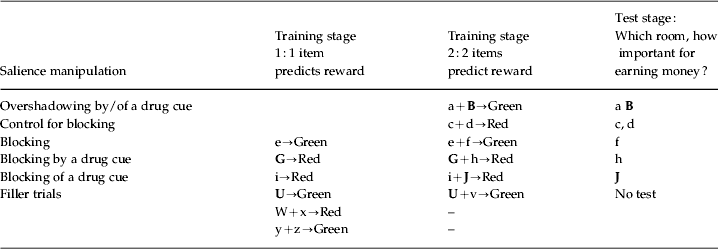
This was a computer-based task. Participants were asked to imagine that they were a cleaner and had to learn to place household items (pictures of standard household objects or smoking items) in either a ‘red room’ or a ‘green room’ (trial structure is shown in Fig. 1). Correct choices were rewarded with money that accumulated during the course of the task. The ‘cleaning’ scenario was chosen in order to create a plausible framework in which both smoking and neutral items could predict reward, while avoiding any connotations of health or addiction (e.g. allergic reactions resulting from drugs; Matute et al. Reference Matute, Arcediano and Miller1996). Stimuli were colour photographs of household items (12 neutral items, e.g. hammer, book, desk light, shaver) and four smoking items (cigarette pack, single cigarette, ashtray, lighter), all chosen to be white, grey or silver in colour in order to control for perceptual salience. Each time the experiment was run, these items were randomly assigned to the 12 neutral and four smoking cues used in the DCRPET (task design shown in Table 1).
Trial structure of the Drug Cue Reward Prediction Error Task. This example demonstrates a neutral cue being blocked by a drug cue. In training stage 1, it is learnt that the lighter belongs in the red room (G→red), and, in training stage 2, it is learnt that both the lighter and the pen belong in the red room (G+h→red). At the test stage, ratings of how important the pen was for earning money reflect the degree of blocking by the lighter.

Design of Drug Cue Reward Prediction Error TaskFootnote a

a The task consisted of three stages (training stages 1 and 2 and the test stage). The correct choice of room for each trial type is shown following the arrow (red or green) and smoking cues are shown in bold upper case letters.
Trials were randomized within each of six blocks per training stage. Items were presented either on their own or in pairs (pairs were counterbalanced for left/right display position). Each trial required an alternative forced choice between the red or green room. After a choice was made, visual feedback on the screen showed the amount of money available on that trial (either 5p or 10p; financial value did not differ across items) in colour of the correct room. When responses were correct, visual feedback was accompanied by an auditory cash register ‘ching-ching’ sound. When choices were incorrect, the amount of money that could have been won was superimposed by a black cross and a low amplitude ‘thud’ sound was played.
In the test stage, participants were instructed that they would be asked to judge individual items once for: (i) the correct room they belonged in (red/green); (ii) how important they were for earning money when placed in that room, from 0 to 100 in 10% intervals. Importance ratings had 10% added to them in order to weight 0% importance ratings towards the correct/incorrect choice. Incorrect choices were negatively scored (see Beesley & Le Pelley, Reference Beesley and Le Pelley2011 for a similar method). Positive scores on this measure, therefore, reflected high perceived reward value for an item, while low or negative scores indicate that participants did not value that item in gaining reward. The scores for ‘overshadowed’ or ‘blocked’ scores can be compared with scores for ‘control’ cues in order to assess overshadowing and blocking: scores for overshadowed or blocked cues should be lower than those for control cues.
Dot probe
A computer-based task was used to assess attentional bias towards smoking-related stimuli. Participants were instructed that they would see two pictures on the screen, which would either be shown for a short or a long time. They were told that the pictures would disappear and an asterisk would appear either on the left or the right of the screen and that they were required to press the appropriate key (left or right) corresponding to the asterisk's location. Stimuli were colour photographs that were organized in pairs, such that 10 smoking-related items were paired with 10 neutral items matched for visual composition and complexity. Each pair of pictures was shown twice for 250 ms and twice for 2000 ms to index automatic and strategic processing respectively. Left/right screen position for the pair of pictures and the location of the probe were counterbalanced across stimulus presentation. A further 80 neutral items were used as fillers, again organized in pairs matched for perceptual characteristics, and counterbalanced for left/right screen position and probe location. A practice session of 10 neutral items was used prior to the test and a short break was provided halfway through the task.
Tobacco Craving Questionnaire-Short Form (TCQ-SF)
This 12 item short form of the 47 item TCQ (Heishman et al. Reference Heishman, Singleton and Moolchan2003) has been shown to be as valid and reliable as the original scale. Each item is rated from 1 (strongly disagree) to 7 (strongly agree). Confirmatory factor analysis yields a four factor solution: emotionality; expectancy; compulsivity; purposefulness. In order to match the test battery across groups, this scale was adapted for controls by relating questions to tea/coffee drinking (e.g. ‘I would be less irritable right now if I could drink a tea/coffee right now’). Data are not reported for controls.
Fagerstrom Test of Nicotine Dependence (FTND)
A scale of nicotine dependence shown to be a reliable indicator of smoking behaviour according to biochemical verification, the FTND (Heatherton et al. Reference Heatherton, Kozlowski, Frecker and Fagerstrom1991) consists of six items scored between 0 and 3, with scores range from 0 (low dependence) to 10 (high dependence).
Wechsler Test of Adult Reading (WTAR)
The WTAR (Wechsler, Reference Wechsler2001) provides an estimate of verbal IQ. Participants are required to read a list of 50 words aloud; each correct pronunciation scores 1 point.
Procedure
Prior to testing, an assistant used a handheld smokerlyser (Bedfont Scientific Limited, UK) to assess exhaled CO levels. A threshold of ⩾11 ppm CO was used to exclude any abstainers suspected to have smoked within 12 h prior to testing, consistent with previously used cut-off criteria (e.g. Dawkins et al. Reference Dawkins, Acaster and Powell2007). In order to maintain blind conditions, both abstainers and smokers rinsed their mouths with mint mouthwash before testing began. Participants were then taken to a test laboratory where they completed the DCRPET, TCQ, N-back, dot probe and the WTAR. A number of other assessments were administered and will be reported elsewhere. Completion of the test battery took around 110 min.
Statistical analyses
All analyses were carried out using Statistical Package for Social Sciences (SPSS version 14; SPSS Inc., USA). One way analyses of variance (ANOVA) were used for demographic, craving and CO data (Kruskal–Wallis where data were non-parametric). Both training and test stage data from the DCRPET were analysed using repeated measures ANOVA. For analysis of blocking, the same control cue score was compared against each of the three blocked cue scores. A priori planned orthogonal contrasts were therefore used to compare: (i) the control cue score to all three blocked cues together; (ii) the neutral blocked cue to the other two blocked cues; (iii) the neutral cue blocked by a drug cue with the drug cue blocked by a neutral cue. Bonferroni-corrected t tests and non-parametric Mann–Whitney U tests were used to explore significant interactions or simple effects. For the dot probe task, participants' median reaction times to correctly identified probes were prepared in line with Mogg et al. (Reference Mogg, Garner and Bradley2007) using an inverse transformation to reduce the influence of skew and outliers (Ratcliff, Reference Ratcliff1993). Automatic and strategic attentional bias were investigated in repeated measures ANOVA models with validity (valid trial, invalid trial) as a within subject factor, with raw scores presented in tables and text for clarity.
Results
Participants and smoking behaviour (Table 2)
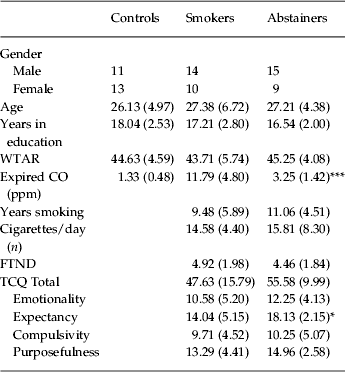
One participant in the abstainer group was excluded after providing a CO level ⩾11 ppm and subsequently replaced, but all other abstainers gave levels in accordance with instructions not to smoke (⩽6 ppm). The three groups did not differ in any demographic variables and the two smoking groups did not differ in indices of smoking behaviour or level of dependence. Further, no participants in either smoking group reported current use of smoking pharmacotherapy (e.g. varenicline, bupropion). A Kruskal–Wallis test revealed group differences in expired CO (χ2=56.322, p<0.001). Bonferroni-corrected Mann–Whitney U tests (α level adjusted to 0.016) showed that CO levels were higher in smokers compared with both controls (U 48=0.000, p<0.001) and abstainers (U 48=23.00, p<0.001), and in abstainers compared with controls (M 48=56.000, p<0.001). Mann–Whitney U tests revealed that abstainers showed a trend for higher craving than smokers as indexed by total TCQ score (U 48=195.500, p=0.055) and significantly higher craving than smokers in the expectancy subscale of the TCQ (U 48=149.500, p=0.004). However, no group differences were found for the emotionality, compulsivity or purposefulness subscales.
Means (s.d.) for demographics, smoking behaviour and craving for controls (n=24), smokers (n=24) and abstainers (n=24)

WTAR, Wechsler Test of Adult Reading; FTND, Fagerstrom Test of Nicotine Dependence; TCQ, Tobacco Craving Questionnaire.
* p<0.05, **p<0.01, ***p<0.001.
DCRPET
Learning during training stages
Six (block; 1 to 6)×3 (group) repeated measures ANOVA (RMANOVA) were used to assess learning to items during training stages 1 and 2. All models found significant effects of block (all p's <0.001; reflecting increased accuracy over successive blocks) but no effects of group or interactions. Accuracy was high by block 6 (all items >85% correct), indicating that participants showed excellent learning of task contingencies.
Overshadowing (Fig. 2)
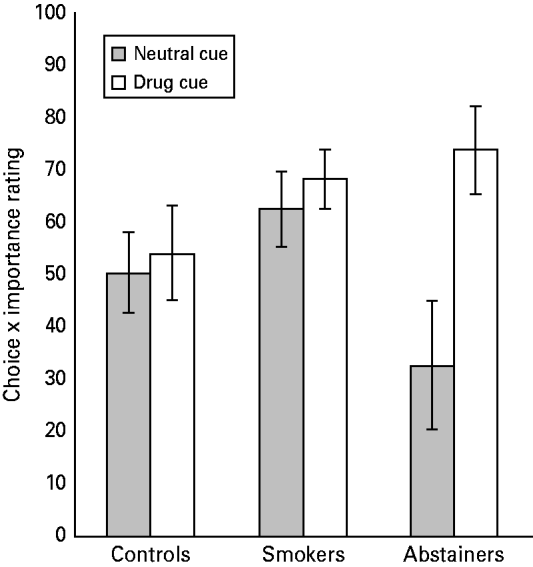
In order to assess overshadowing, test scores for the two cues from the drug cue induced overshadowing pair were compared across groups. One smoker and one abstainer were excluded for individual scores that were >2.5 s.d. from the group mean. A 2×3 RMANOVA with item (neutral and drug) as a within-subject factor and group (controls, smokers, abstainers) as a between-subject factor found a significant item×group interaction (F 2,67=3.833, p=0.027) and a main effect of item (F 1,67=6.978, p=0.008), reflecting higher ratings for the drug cue than the neutral cue. In order to explore the interaction, paired t tests were conducted to compare ratings with the neutral and drug items in each group. Only one significant comparison emerged. In abstainers, the drug cue was rated higher than the neutral cue (t 22=–3.208, p=0.004), indicating that the drug cue significantly overshadowed the neutral cue in this group.
Drug cue induced overshadowing according to choice×importance ratings for the neutral cue and drug cue in each group. Error bars show±1 s.e.

Blocking (Table 3)
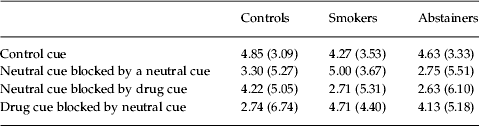
In order to assess blocking, ratings to all three blocked cues were compared with the mean of the two control cues. Since the same control cue score was used as a comparison for scores to each of the three blocked cue scores, a RMANOVA with a priori planned orthogonal contrasts compared: (i) the control cue score to all three blocked cues together; (ii) the neutral blocked cue to the other two blocked cues; (iii) the neutral cue blocked by a drug cue with the drug cue blocked by a neutral cue. One control was excluded for scoring >2.5 s.d. from the group mean. A significant main effect of contrast (i) was found (F 1,68=4.088, p=0.047), indicating a main effect of blocking, whereby all blocked cues were rated lower than the control cues. No significant effects were found for contrasts (ii) or (iii) and no significant item×group interactions emerged for contrasts (i), (ii) and (iii).
Group means (s.d.) for choice×importance ratings to the control cue and blocked cues (neutral cue blocked by a neutral cue, neutral cue blocked by a drug cue, drug cue blocked by a neutral cue)

Dot probe (Table 4)
Analysis of reaction times to probes following images shown for a short (250 ms) exposure time revealed a significant group×validity interaction (F 2,69=3.831, p=0.026) but no other significant effects. Paired sample t tests split by group were used to explore this interaction and showed that reaction times were faster to probes following cigarette images than neutral images in abstainers (t 23=2.545, p=0.018) only. At the long (2000 ms) exposure time, no significant interactions or effects emerged.
Reaction times to probes replacing images on valid and invalid trials following at short (250 ms) or long (2000 ms) exposure in controls, smokers and abstainers

a Abstainers showed faster reaction times to probes following valid trials compared to invalid trials at a short exposure (p=0.018), reflecting an attentional bias to drug cues.
Correlations
Pearson correlations were conducted between the degree of drug-cue induced overshadowing (choice×importance score to the drug cue – choice×importance score to the neutral cue), attentional bias at the short exposure time, craving (TCQ expectancy), nicotine dependence (FTND) and carbon monoxide level in the abstainer group only. Carbon monoxide level correlated positively with both TCQ expectancy craving (r=0.501, p=0.013) and level of drug-cue induced overshadowing (r=0.471, p=0.023). No other correlations reached significance.
Discussion
There were three main findings in this study. First, in abstinent smokers but not satiated smokers or controls, smoking-related cues overshadowed neutral cues in perceived reward value, despite the two types of cues having an identical associative history of rewards. Second, all three groups exhibited blocking and the use of drug cues as reward predicting cues did not interact with blocking in any group. Third, abstaining smokers but not satiated smokers or controls showed an attentional bias towards cigarette-related images displayed for a short duration.
The three groups did not differ in age, gender, years in education or pre-morbid IQ and the two smoking groups did not differ in any index of smoking behaviour. Mean Fagerstrom scores in both groups reflected moderate dependence (Vink et al. Reference Vink, Willemsen and Boomsma2005). Carbon monoxide levels were reliably different across groups and confirmed that abstainers had refrained from smoking for at least 12 h prior to the study commencing. Abstainers showed higher craving than satiated smokers according to the ‘expectancy’ subscale of the TCQ-SF (Heishman et al. Reference Heishman, Singleton and Pickworth2008), which relates to ‘wanting’ aspects of addiction (Robinson & Berridge, Reference Robinson and Berridge1993).
DCRPET
Analysis of responses made during training stages 1 and 2 of this associative learning task showed that participants were able to learn correct responses to all items presented.
Choice×importance scores obtained during the test stage, reflecting the perceived reward value of individual items, were used to assess overshadowing and blocking. When comparing these test scores to two items presented as a pair with the same outcome (a smoking-related image and a neutral image), the cigarette image overshadowed the neutral image as indexed by higher reward value, in the abstaining smokers only. To the author's knowledge, this is the first study to find an interaction between exposure to salient drug cues and alternative reward processing in addicted individuals. It is noteworthy that carbon monoxide levels, which provide a biological measure of recent smoking behaviour, were positively related to both cigarette craving and drug-cue induced overshadowing, sharing around 25% of the variance in both cases. A significant effect of blocking was observed similarly across all three groups. This effect did not interact with group or item presented. These findings suggest that salient drug cues do not interact with associative blocking in a reward learning paradigm.
Attentional bias
Abstaining smokers, but not satiated smokers or controls, showed faster reaction times to a probe replacing cigarette-related images than neutral items shown for a short (250 ms) duration. An automatic bias amongst abstaining compared with satiated smokers has been previously been shown towards cigarette-related stimuli using eye tracking (Field et al. Reference Field, Mogg and Bradley2004); however, to our knowledge these results offer the first behavioural evidence of an increased automatic attentional bias due to tobacco deprivation using a dot probe paradigm. Automatic attentional bias has previously been shown amongst satiated smokers compared with controls (e.g. Ehrman et al. Reference Ehrman, Robbins, Bromwell, Lankford, Monterosso and O'Brien2002; Mogg & Bradley, Reference Mogg and Bradley2002; Bradley et al. Reference Bradley, Field, Mogg and De Houwer2004). However, the relationship between craving and attentional bias is not clear cut, since it has been previously found that lighter/less dependent smokers show stronger bias for smoking-related images than heavier/more dependent smokers (Hogarth et al. Reference Hogarth, Mogg, Bradley, Duka and Dickinson2003; Mogg et al. Reference Mogg, Field and Bradley2005), consistent with a transition from incentive salience to habit based responding after extensive heavy smoking (di Chiara, Reference di Chiara2000). No bias was shown in either smoking group when images were shown for a longer (2000 ms) exposure in order to tap into strategic processing. Although attentional bias at a long exposure has been demonstrated behaviourally in satiated smokers (Bradley et al. Reference Bradley, Mogg, Wright and Field2003, Reference Bradley, Field, Mogg and De Houwer2004), gaze duration using eye tracking provides a more direct measure of strategic bias in smokers (e.g. Mogg et al. Reference Mogg, Bradley, Field and de Houwer2003; Kwak et al. Reference Kwak, Na, Kim, Kim and Lee2007) and can be sensitive to the effects of tobacco abstinence (Field et al. Reference Field, Mogg and Bradley2004). It should also be noted that task demands have differed between studies; we employed a left/right forced choice response based on probe location similar to Ehrman et al. (Reference Ehrman, Robbins, Bromwell, Lankford, Monterosso and O'Brien2002), while others (e.g. Mogg et al. Reference Mogg, Bradley, Field and de Houwer2003) have incorporated choices that may not be detectable in peripheral vision (e.g. upwards or downwards arrow).
An attentional account of drug cue–reward interactions
Evidence for disrupted reward processing following tobacco deprivation in this study is in agreement with previous demonstrations that abstinence reduces reward responsivity (Al-Adawi & Powell, Reference Al-Adawi and Powell1997; Powell et al. Reference Powell, Dawkins and Davis2002a) and increases temporal discounting of reward (Mitchell, Reference Mitchell2004; Field et al. Reference Field, Santarcangelo, Sumnall, Goudie and Cole2006). Indeed, reduced reward thresholds to natural reinforcers are a hallmark feature of drug withdrawal (Koob & Le Moal, Reference Koob and Le Moal2005). The current study found no differences between the three groups in the processing of rewards predicted by neutral cues alone according to test scores to neutral items only. Rather, aberrant reward processing was selective to competition between neutral and drug-related cues in abstaining smokers. This highlights the importance of interactions between drug-cue or drug salience and the motivation to act in pursuit of natural rewards. Overshadowing is highly dependent on the perceptual salience of cues employed in associative learning tasks (Mackintosh & Reese, Reference Mackintosh and Reese1979; Denton & Kruschke, Reference Denton and Kruschke2006; Heckler et al. Reference Heckler, Kaminski, Sloutsky, Sun and Miyake2006) and, taken together with evidence for an automatic attentional bias in abstaining smokers only, these results suggest a role of attention in drug cue×reward processing interactions. This is in agreement with previous evidence that smoking-related images can increase neural activity in areas implicated in both reward anticipation and selective attention amongst smokers (Due et al. Reference Due, Huettel, Hall and Rubin2002).
Our findings that drug cues can modulate overshadowing but not blocking may be due to inherent differences between these processes. Overshadowing can occur after one conditioning trial (Mackintosh & Reese, Reference Mackintosh and Reese1979) and is thought to rely on the ‘intrinsic salience’ or physical aspects of the cues employed. In contrast, blocking may rely on ‘acquired salience’ since prior learning must be integrated with later conditioning during successive training sessions (Cassaday & Moran, Reference Cassaday, Moran, Lubow and Weiner2010). These processes can be pharmacologically dissociated: abolished blocking due to amphetamine administration can be restored with D2 antagonist pretreatment (Crider et al. Reference Crider, Solomon and Mcmahon1982), while disrupted overshadowing following amphetamine treatment can be restored with co-administration of a D1 but not D2 antagonist (O'Tuathaigh & Moran, Reference O'Tuathaigh and Moran2002). This suggests that D1 and D2 receptors control overshadowing and blocking respectively, in agreement with a role of prefrontal D1 but not D2 receptors controlling selective attention (Granon et al. Reference Granon, Passetti, Thomas, Dalley, Everitt and Robbins2000).
Kalivas et al. (Reference Kalivas, Volkow and Seamans2005) hypothesized that, in the healthy brain, an abundance of D2 receptors on glutamatergic neurons projecting from the prefrontal cortex to the nucleus accumbens would allow a range of motivationally salient stimuli to initiate behaviours. However, during withdrawal from chronic drug treatment, D1 receptors may be preferentially up regulated and as a result only motivationally strong stimuli (e.g. drug cues) might activate these D1 receptors sufficiently to initiate behaviour (e.g. drug seeking). Tentatively, drug-cue induced overshadowing and automatic attentional bias amongst abstaining smokers might be explained by D1 receptor up regulation in prefrontal cortex, confining selective attention to intrinsically salient drug cues.
Implications and limitations
The findings of this study extend previous demonstrating for salience attribution to drug cues, by providing evidence that drug cues can alter inferences of financial value to other non-drug cues predictive of the same reward. Previous treatment strategies have proposed that (i) the reward value of a drug should be decreased while (ii) that of alternative rewards should be increased (Volkow et al. Reference Volkow, Fowler, Wang and Swanson2004). However, these approaches have been considered in isolation and our results suggest that a synthesis of these approaches is needed. Pharmacological attempts to increase the value of natural rewards (such as dopamine agonists; Kosten et al. Reference Kosten, George and Kosten2002) have been disappointing to date, but community-based reinforcement approaches have shown promising effects (Curran & Drummond, Reference Curran and Drummond2005). Further, it has been shown that the rate at which money is temporally discounted in smokers can predict choices between smoking or earning money in a laboratory model of abstinence reinforcement (Dallery & Raiff, Reference Dallery and Raiff2007). Our results suggest that interventions aimed at drug cues, such as cue exposure therapy (O'Brien et al. Reference O'Brien, Childress, McLellan and Ehrman1990), disrupting reconsolidation (Lee et al. Reference Lee, Di Ciano, Thomas and Everitt2005) or attentional bias training (Attwood et al. Reference Attwood, O'Sullivan, Leonards, Mackintosh and Munafo2008), might have secondary effects on reward function in contexts where drug cues are present.
In terms of limitations, abstinent and satiated smokers were compared independently, so although the two groups did not differ in smoking behaviour or dependence levels, between-subject variation cannot be ruled out in interpreting effects due to abstinence. However, the repeated use of an associative learning task might lead to carry over effects in a within-subject design and there are only a limited number of discrete and conceptually different smoking cues that could potentially be used to create different task versions. Despite these limitations, the study had a number of important strengths. First, smokers were randomly allocated to an abstinent or satiated group. Second, all assessments took place under blind conditions and, third, a within-subject saliency manipulation was used, in contrast to previous investigations in humans that have investigated salience between subjects (Denton & Kruschke, Reference Denton and Kruschke2006; Heckler et al. Reference Heckler, Kaminski, Sloutsky, Sun and Miyake2006).
Conclusions
In summary, despite showing no differences in learning during an instrumental learning task, abstinent smokers but not satiated smokers nor controls attributed higher reward value to cigarette-related items than neutral items that were equally predictive of reward. This drug cue induced overshadowing was correlated with expired CO, which, in turn, was correlated with craving in abstaining smokers. This study provides the first evidence that drug cues are able to interact with reward processing in a drug-using population and support a role of attention in this relationship.
Acknowledgements
This work was supported by an MRC/ESRC interdisciplinary studentship awarded to T.P.F. We thank James Bisby, Lorna Stewart and Hannah Powles for their assistance in screening participants in order to maintain blind conditions.
Declaration of Interest
None.