INTRODUCTION
The crocodile shark, Pseudocarcharias kamoharai (Matsubara, Reference Matsubara1936), is a member of the monotypic family Pseudocarchariidae (Lamniformes). It is a small, uncommon, pelagic–oceanic shark having a circum-tropical distribution, usually found offshore, at depths ranging from the surface to 590 m (Compagno et al., Reference Compagno, Dando and Fowler2005). Even though P. kamoharai is distributed worldwide in oceanic tropical waters, reports from the Indian Ocean are few and patchy, including from South Africa (D'Aubrey, Reference D'Aubrey1964), Madagascar (Compagno, Reference Compagno1984), Seychelles (Nevill, Reference Nevill2007), Maldives (Adam et al., Reference Adam, Merrett and Anderson1998), Pakistan (Osmany, unpublished data), Sri Lanka (Moron et al., Reference Moron, Bertrand and Last1998), Malaysia (Ahmad & Lim, Reference Ahmad and Lim2012), Indonesia (White, Reference White2007), Australia (Last & Stevens, Reference Last and Stevens2004; Ariz et al., Reference Ariz, Delgado de Molina, Ramos and Santana2006). Kizhakudan (Reference Kizhakudan2011) reported P. kamoharai off Chennai which confirms its distribution in the Bay of Bengal. The IUCN Red List of Threatened Species lists the status of P. kamoharai as ‘Near Threatened’ (Compagno & Musick, Reference Compagno and Musick2005).
MATERIALS AND METHODS
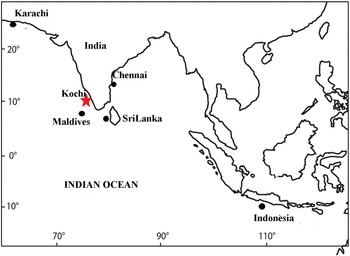
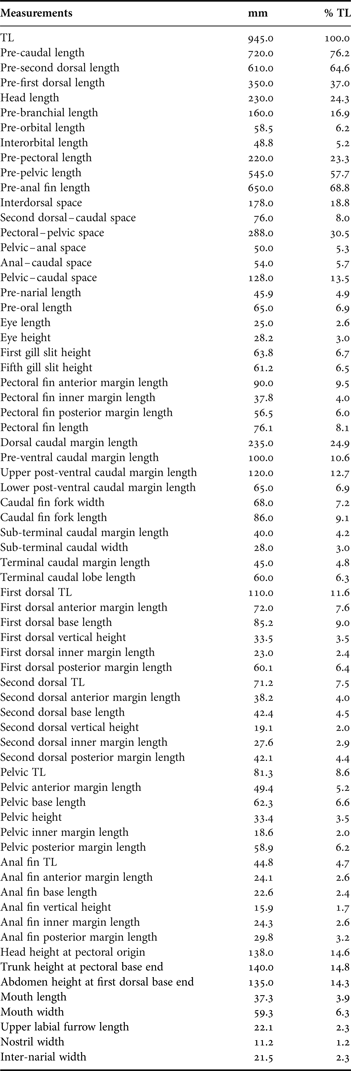
On 12 October 2010 a single specimen of Pseudocarcharias kamoharai (94.5 cm total length (TL), female) was collected (A.K.V. & B.K.K.) from Cochin fisheries harbour, Kochi, Kerala, India (Figure 1) from the by-catch of a deep-water shrimp trawler operated off Cochin at depths of 300–500 m. Measurements (Table 1) were taken and the specimen identified following Compagno (Reference Compagno1984).
Distribution of Pseudocarcharias kamoharai in and around Indian waters.

Morphometric measurements of Pseudocarcharias kamoharai from deep waters off south-west coast of India (in mm and % TL (total length)).

There is no commercial targeted fishery for P. kamoharai, but it is a common by-catch in the pelagic tuna longline fishery (Hazin et al., Reference Hazin, Couto, Kihara, Otsuka and Ishino1990) and it is usually discarded due to small size and low quality of meat (Compagno, Reference Compagno1984). Records of P. kamoharai are limited and fewer than 50 specimens exist in museum collections (Compagno & Musick, Reference Compagno and Musick2005). This report of P. kamoharai from waters off the south-western coast of India indicates a wider distribution than previously known.
RESULTS
SYSTEMATICS
Order LAMNIFORMES
Family PSEUDOCARCHARIDAE
Species Pseudocarcharias kamoharai (Matsubara, Reference Matsubara1936)
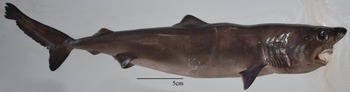
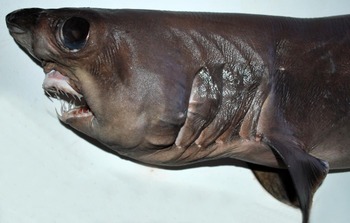
(Figures 2 & 3)
Synonyms: Carcharias kamoharaai Matsubara, Reference Matsubara1936; Carcharias yangi Teng, 1959; Odontaspis kamoharai (Matsubara, Reference Matsubara1936); Pseudocarcharias pelagicus Cadenat, 1963; Pseudocarcharias yangi (Teng, 1959).
Pseudocarcharias kamoharai, Arabian Sea, collected off Cochin (lateral view).

Pseudocarcharias kamoharai, head lateral view.

MATERIAL EXAMINED
94.5 cm TL, female.
DIAGNOSIS
A small, slender-bodied shark with a cylindrical trunk and large eyes without nictitating membrane. Head short, with moderately long and bluntly pointed snout. Teeth long, without lateral cusps. Jaws highly protrusible. Pectoral fins small. Gill slits long, extending onto dorsal surface of head. Dorsal fins without spines. Second dorsal fin smaller than first, its origin in the inner margins of pelvic space. Pre-caudal pits present. Lateral keels on caudal peduncle not well developed. Caudal fin asymmetrical.
COLOUR
Dark grey-brown dorsally, pale ventrally.
REMARKS
The biology of deep-water chondrichthyans is poorly studied and, based on available information, most are categorized as vulnerable to high level exploitation (Kyne & Simpfendorfer, Reference Kyne, Simpfendorfer, Carrier, Musick and Heithaus2010). Pseudocarcharias kamoharai is reported as ovoviviparous, bearing up to four pups at a time (Oliveira et al., Reference Oliveira, Hazin, Carvalho, Rego, Coelho, Piercy and Burgess2010; Dai et al., Reference Dai, Zhu, Chen, Xu and Chen2012). The diversity of deep-sea chondrichthyan fauna of the Indian exclusive economic zone still remains largely unexplored and the recent reports of several deep-sea elasmobranchs (Akhilesh et al., Reference Akhilesh, Hashim, Bineesh, Shanis and Ganga2010; Babu et al., Reference Babu, Ramachandran and Varghese2011) from southern India indicate rich diversity.
ACKNOWLEDGEMENT
We are grateful to the Director, Central Marine Fisheries Research Institute (CMFRI), Kochi.
FINANCIAL SUPPORT
The authors gratefully acknowledge the financial support given by the Ministry of Earth Sciences/CMLRE, Government of India.