





Introduction
E-governmentFootnote 1 initially focused on delivering information and services through ICT (information and communication technology) platforms, and has evolved into e-governance, which extends its remit to foster democratic innovations such as e-participation and e-voting. These innovations aim to enhance citizen engagement in policymaking and governance processes. The UN (2014) defines e-participation as “the process of engaging citizens through ICTs in policy decision-making and service design and delivery to make it participatory and deliberative.” Le Blanc (Reference Le Blanc2020, 28) emphasizes its transformative potential, highlighting its capacity to leverage citizens’ skills and cooperation to create public value.
Numerous European initiatives, such as e-petition and e-consultation mechanisms, have sought to optimize e-governance platforms (Panopoulou et al. Reference Panopoulou, Tambouris and Tarabanis2010; Macintosh et al. Reference Macintosh and Whyte2008; European Commission, 2021; Karkin and Cezar Reference Karkin and Cezar2024). These efforts aim to transform governance by increasing transparency and fostering citizen participation (Gherghina et al. Reference Gherghina, Ekman and Podolian2020). However, the effectiveness of e-governance in enhancing engagement remains uneven, particularly in post-communist countries like Albania, where limited infrastructure, low digital literacy, and entrenched bureaucratic practices hinder progress. In such contexts, e-governance holds significant promise, especially for diasporas in Western Europe with greater access to infrastructure and higher levels of digital literacy, enabling their participation in political processes from afar.
Scholars such as Gamlen et al. (Reference Gamlen, Cummings, Vaaler and Rossouw2013) and Varadarajan (Reference Varadarajan2010) argue that digital platforms blur the boundaries between domestic and international domains, allowing diasporas to engage in governance in innovative ways. A recent example of this was also shown by Karabegović (Reference Karabegović2025) in relation to the social media activities of a Bosnian diaspora politician in Germany. Ponzanesi (Reference Ponzanesi2020) describes this as “diasporic digitality,” where technology fosters transnational political participation. This resonates with the rise of ICT platforms that have transformed diasporas from passive observers to active challengers of governance policies (Brinkerhoff Reference Brinkerhoff2009; Uysal Reference Uysal and Popkova2025).
However, the existing literature still primarily focuses on the economic contributions of diasporas, with limited exploration of reciprocal political participation enabled by e-governance platforms. For instance, transnationalism (Vertovec Reference Vertovec1999; Tedeschi, Vorobeva, and Jauhiainen Reference Tedeschi, Vorobeva and Jauhiainen2022) and institutional theories (Gamlen, Cummings, and Vaaler Reference Gamlen, Cummings, Vaaler, Alonso and Mylonas2021; Bauböck Reference Bauböck2010) emphasize the state’s role in managing diaspora relations but overlook the agency of diasporas as active stakeholders. Much of the existing literature on diaspora representation focuses either on the lack of political participation of diverse groups in the origin state that eventually leads to exodus, or on the limitations of their political participation as ethnic minorities in their new countries of residence.
Until very recently, diaspora or migration literature has generally centered on domestic and foreign policies (Adamson Reference Adamson and Checkel2013; Adamson and Han Reference Adamson and Han2024) that determine the scope of diaspora representation in host countries (Shain Reference Shain1994; Mearsheimer and Walt Reference Mearsheimer and Walt2007; Alonso and Mylonas Reference Alonso and Mylonas2019). While exposure theory, resistance theory, and transferability theory (Gherghina and Tseng Reference Gherghina and Tseng2016) similarly address how host-country institutions influence migrants, they, too, fail to capture how digital governance empowers diasporas in their countries of origin.
A growing body of research focuses on diaspora entrepreneurs and their role in economically and politically shaping governance. Koinova’s (Reference Koinova2013, Reference Koinova2021) work has been particularly instrumental in highlighting how diasporas strategically engage with their homelands, often balancing economic pragmatism with political ambitions. These contributions demonstrate that diasporas do not merely influence their origin states economically (Zapata-Barrero and Rezai Reference Zapata-Barrero and Rezaei2020) but also push for governance reforms by leveraging transnational networks. (Zapata-Barrero et al. Reference Zapata-Barrero, Gabrielli, Sánchez-Montijano and Jaulin2014)
What has been primarily neglected in this literature is how diaspora members also gain political participation from a distance in return for their influence on and contributions to their home country, and how e-government platforms possess transformative power in facilitating this dynamic. Our study highlights ICT’s role in this process, showing how digital platforms enable diasporas to achieve reciprocal gains by participating politically in return for their economic and social contributions to the homeland.
Although e-governance has enriched the scope of political participation for diaspora minorities in everyday life, this has not yet been evidenced, developed, or substantiated as an area of research through case studies and empirical data. In this article, we aim to answer the question: How does e-governance increase diaspora communities’ political participation? To do so, we analyze forty in-depth interviews with members of the Albanian diaspora in the UK and political elites in Albania. The study covers a period of ten years, starting with government policies and diaspora engagement reports from 2013 to 2023 to capture significant developments in e-government, which also coincides with the Socialist Party being in power, ensuring a consistent analytical framework for examining progress. Through this decade-long analysis of Albanian diaspora engagement, we explore how e-government platforms like e-Albania transform political participation. By employing stakeholder theory (Scholl Reference Scholl, Schmid, Stanoevska-Slabeva and Tschammer2001; Ashaye and Irani Reference Ashaye and Irani2019; Freeman et al. Reference Freeman, Jeffrey, Andrew, Bidhan and Simone2010), we provide a framework for understanding how diasporas influence governance through digital platforms and argue that digital platforms enable diasporas to assert agency, fostering reciprocal gains in political participation and governance innovation.
Our research makes two distinct contributions to the literature. The first is empirical. By focusing on the case of Albania and its diaspora, we demonstrate that post-communist countries in Eastern Europe — such as Albania, with large diaspora populations in developed countries and a recent surge in e-governance platforms — offer an excellent context for researching the relevance and significance of e-governance for diaspora participation. The second is theoretical. By focusing on the political participation gains achieved by the Albanian diaspora through e-governance, this article introduces a stakeholder-oriented framework from business studies into the literature on diaspora engagement. Foundational studies such as Wescott and Brinkerhoff (Reference Wescott and Brinkerhoff2006) and later works such as Kesavan, Uppal, and Pandey (Reference Kesavan, Uppal and Pandey2022), with recent examples from Poland and the Polish diaspora (Nowosielski and Nowak Reference Nowosielski and Nowak2022). Conceptualized e-government primarily as a state-led tool for administrative reform and diaspora-driven economic development, a focus that reflected the priorities and technological capacities of the time. While these contributions remain analytically important, they offer limited insight into how contemporary, platform-based governance infrastructures shape diaspora political agency. Systematic empirical research examining how e-government platforms mediate claims-making, accountability, and political participation among diasporas remains scarce, particularly in post-communist settings. Addressing this gap, the present study examines how e-government platforms enable diasporas not only to access services but to regain political participation and negotiate their relationship with the homeland state.
The remainder of the article proceeds as follows. First, we provide a contextual background on Albania, its e-government initiatives, and its engagement strategies with its diaspora in the UK. Next, we introduce stakeholder theory from business studies to engage with political participation and diaspora engagement literature. Using this theoretical framework, we explore diaspora members’ and government officials’ primary motives and capabilities in developing and using e-governance as a deliberative and participatory process. To illustrate these motives and capabilities, we present a thematic analysis of qualitative interviews conducted with 40 stakeholders in 2023. We conclude by explaining the significance of our findings for broader scholarship.
Contextual Background: E-Albania and its diaspora in the UK
Albania provides a compelling context for examining the intersection of e-governance and diaspora engagement. Decades of communist rule (1944–1991) instilled deep mistrust in state institutions, shaping Albanians’ political attitudes and engagement (Tarifa, Reference Tarifa1995). The transition to democracy has been fraught with systemic corruption, economic stagnation, and political instability, leading to significant outmigration (Vullnetari Reference Vullnetari2007). A Gallup World Poll (2010–2015) revealed that 56 percent of working-age Albanians expressed a desire to migrate, underscoring limited socio-economic opportunities, particularly for younger generations (Gedeshi and King Reference Gedeshi and King2018). As a post-communist country, Albania exemplifies the challenges faced by nations transitioning from systemic oppression and widespread distrust of public authorities to modern governance frameworks.
Historically characterized by corruption, Albania’s governance structures are undergoing significant reforms aimed at promoting transparency and accountability. The Albanian government under the Socialist Party has embraced e-governance as a key strategy for modernization and reform. Since 2013, successive Socialist governments led by Edi Rama have promoted e-governance to combat corruption, enhance institutional efficiency, and strengthen ties with the Albanian diaspora. One of the most notable initiatives has been the development of the e-Albania platform, which consolidates numerous public services into a unified digital interface (Tomorri and Keco Reference Tomorri and Keco2023; Keco et al. Reference Keco, Tomorri and Tomorri2023). These reforms align with broader trends in global governance, where digital platforms are increasingly employed to facilitate citizen participation and address issues of representation, particularly for transnational communities like diasporas. In parallel, the Socialist government has organized three high-profile Diaspora Summits to foster connections with Albanian communities abroad (Drosopoulos and Rruplli Reference Drosopoulos and Rruplli2024). In this context, digital governance holds the promise of transforming traditional governance approaches, rebuilding trust, and enhancing civic engagement. This makes Albania an ideal setting to explore the potential of e-governance to address governance deficits while fostering stronger connections with its diaspora.
While these summits have raised the profile of the government’s outreach efforts, their tangible outcomes remain limited. Critics argue that such initiatives are often symbolic, with limited progress on substantive issues such as diaspora voting rights and direct political representation. The recent decision to facilitate diaspora voting in Albania’s 2025 parliamentary elections marks a potential turning point, further illustrating the importance of e-governance in addressing diaspora demands (Drosopoulos and Rruplli Reference Drosopoulos and Rruplli2024). However, one clear motive for the Albanian government’s diaspora engagement policies remains the significant contribution the diaspora makes to Albania through financial remittances (Ostergaard-Nielsen Reference Ostergaard-Nielsen2002; King Reference King2005; Prelec and Marovic Reference Prelec and Marović2021; Gamlen Reference Gamlen2014). Financial remittances remain the most common form of diaspora contribution, supporting families and relatives in their country of origin. The advent of ICT platforms and globalization has made money transfers quicker and more efficient. Globalization has also facilitated the movement of people and contributed to a robust remittance infrastructure that benefits families back home. During the COVID-19 pandemic, remittances to Albania saw a notable increase, as reported by the National Bank of Albania (2021).
In addition to financial remittances, Albanian diasporas also bring social remittances, which are essential for understanding their role as agents of social and political change (Nyberg Sørensen, Reference Nyberg Sørensen2004, Dushi Reference Dushi2025). In Albania, these social remittances include the transfer of knowledge, practices, and democratic values, often driven by younger and more digitally engaged diaspora members. In many cases, the long-term effects of social remittances surpass those of financial contributions (Kapur Reference Kapur2004; Tataj and Akbaş Reference Tataj and Akbaş2025). E-government platforms, such as e-Albania, amplify these social remittances by enabling the diaspora to actively participate in policy discussions, digital reforms, and governance initiatives.
So far, the literature on the subject is sporadic and fails to provide a systematic investigation of a wide variety of economic and political interests of actors in the development of e-governance, how and why this development is mainly steered by Albanian minorities abroad, and most notably what it means for their political representation back home. For Albania, which has a large and active diaspora, particularly in Western Europe and North America, the potential of e-governance to foster political participation and representation is particularly significant.
The focus of this study on Albanians, especially in the UK, stems from several key factors. The UK is home to a diverse and dynamic Albanian diaspora, including both established communities and recent migrants, shaped by distinct historical migration patterns. Unlike older diaspora communities in Italy or Greece, the UK’s Albanian diaspora began to grow significantly in the late 1990s, spurred by the collapse of Albania’s pyramid savings schemes in 1997, the Kosovo war in 1999, and secondary migration from other European countries (King and Mai Reference King and Mai2008). This relatively young diaspora, concentrated largely in London and its surrounding regions (Vathi and King Reference Vathi and King2013), offers a microcosm of the broader Albanian diaspora, showcasing varying levels of integration, digital literacy, and political engagement. Compared to their counterparts in other host countries, it can be asserted that Albanians in the UK are generally digitally literate (Kostovicova Reference Kostovićova2003; Ramku and Mehta Reference Ramku and Mehta2025), reflective of the UK’s advanced digital infrastructure (Balliu Reference Balliu2023), and are increasingly visible in political and social advocacy. Moreover, the UK’s multicultural and democratic environment provides a unique context for examining diaspora engagement, particularly in leveraging e-governance platforms like e-Albania. The historical trajectory of this community, from political refugees and economic migrants to digitally proficient stakeholders in Albania’s democratic processes, further illustrates their significance as a case study for understanding the intersections of migration, governance, and diaspora engagement.
By focusing on Albania and its diasporas in the UK, we not only provide such an empirical analysis for the first time but also show that post-communist countries in Eastern Europe might be an ideal context for further investigation and set an example for future research on e-governance and the political representation of diasporic minorities.
Theoretical framework: Stakeholder theory meets diaspora politics
Diaspora engagement has traditionally been examined through theoretical frameworks such as transnationalism and institutional theory, which have provided valuable insights into the connections between diasporas, their countries of origin, and their host countries. Transnationalism, as defined by Vertovec (Reference Vertovec1999), focuses on the multidimensional ties that span nation-states, highlighting diasporas’ cultural, social, and political interactions across borders. Similarly, institutional theory emphasizes the role of state apparatuses — such as ministries and agencies — in managing diaspora relations, focusing on mechanisms such as legal protections, social security, and electoral participation from afar (Délano and Gamlen Reference Délano and Gamlen2014; Bauböck Reference Bauböck2010; Itzigsohn and Villacrés 2008; Gamlen Reference Gamlen2014).
While these frameworks have advanced our understanding of diaspora dynamics, they tend to cast diasporas as passive participants within state-centric paradigms. For instance, Adamson and Han (Reference Adamson and Han2024) describe how states often treat diasporas as “economic assets” that facilitate trade, investment, or diplomatic objectives, viewing them as extensions of state power rather than independent actors. Galstyan and Ambrosini (Reference Galstyan and Ambrosini2023), Gamlen (Reference Gamlen2014), and Bhagwati (Reference Bhagwati2003) similarly explore how governments extend their influence over diasporas through policies that foster identification and discipline, illustrating the dynamic interplay between state strategies and diaspora agency.
Traditional theories examining diaspora political participation—such as exposure theory, resistance theory, and transferability theory — have also contributed to this discourse. Exposure theory suggests that migrants’ interactions with the institutions and values of their host countries influence their behaviors, often leading to increased political participation and integration. By contrast, resistance theory argues that migrants retain the values of their countries of origin, resisting change even when exposed to new environments. Transferability theory, meanwhile, proposes a middle ground, suggesting that migrants adapt and modify pre-existing values to new contexts (Gherghina and Tseng Reference Gherghina and Tseng2016). These theories provide a nuanced understanding of diaspora behavior, but they are limited in their ability to capture the complex dynamics of digitalization and the active role of diasporas in shaping governance processes.
Stakeholder theory: A new lens for diaspora engagement
To address these limitations, this study adopts stakeholder theory (Freeman et al. Reference Freeman, Jeffrey, Andrew, Bidhan and Simone2010) to explore the interactions between diasporas and e-governance platforms, such as e-Albania. Stakeholder theory focuses on identifying key stakeholders, understanding their interests, and analyzing how they influence and are influenced by institutional strategies. It offers a robust framework for examining relationships between political elites responsible for developing e-government platforms and diaspora members who use these platforms to engage in governance processes.
The stakeholder theory recognizes diasporas as key actors with distinct needs and interests, positioning them as active contributors rather than passive recipients of state initiatives. Mutual Influence: Stakeholders influence each other’s goals, creating a dynamic interplay between the state’s economic objectives and the diaspora’s political aspirations.
This theoretical approach also emphasizes how stakeholders can co-create value, such as through enhanced e-government platforms that meet the needs of both the government and diasporas. By applying stakeholder theory to diaspora engagement, this study highlights how e-Albania has transformed the traditional state-diaspora relationship. E-government platforms are not merely tools for economic efficiency; they also serve as venues for negotiation, where diasporas press for political participation, transparency, and accountability. This shift repositions diasporas as central stakeholders who influence governance processes and assert their agency in shaping public policy.
Stakeholder theory in the context of e-governance
Several studies (Freeman et al. Reference Freeman, Jeffrey, Andrew, Bidhan and Simone2010; Rose et al. Reference Rose, Flak and Sæbø2018; Raha et al. Reference Raha, Hajdini and Windsperger2021) highlight the utility of stakeholder theory in understanding public sector organizations, particularly in the context of e-governance. Scholl (Reference Scholl, Schmid, Stanoevska-Slabeva and Tschammer2001) and Balta and Krcmar (Reference Balta, Krcmar, Parycek, Glassey, Janssen, Jochen Scholl, Tambouris, Kalampokis and Virkar2018) argue that applying stakeholder analyses to e-government projects ensures that diverse interests are accounted for, leading to more inclusive and effective service delivery. Ashaye and Irani (Reference Ashaye and Irani2019) underline the importance of engaging a wide range of stakeholders to navigate the challenges of e-governance, such as ensuring transparency, accountability, and equitable access.
In the case of Albania, stakeholder theory reveals how e-Albania facilitates the inclusion of diasporas in governance processes, addressing their demands for greater representation while serving the government’s interest in maximizing economic contributions. By focusing on the interactions between diasporas and the Albanian government, stakeholder theory uncovers how these relationships can shape the success or failure of e-governance initiatives. Proper identification of stakeholders, analysis of their interests, and effective engagement strategies are critical to achieving the goals of platforms like e-Albania.
Bridging migration and e-governance studies
Until recently, few studies have linked diaspora and e-governance research (Zapata-Barrero and Rezaei Reference Zapata-Barrero and Rezaei2020). By applying stakeholder theory, this study contributes a fresh perspective, demonstrating how diasporas, as key stakeholders, influence the development of e-governance platforms and public service delivery. Recognizing diasporas as critical stakeholders highlights their potential to innovate governance processes and redefine state-diaspora relations.
Stakeholder theory provides an original and valuable lens for analyzing diaspora engagement in the age of digitalization. By applying this framework, our study reveals the reciprocal relationship between the Albanian government and its diaspora, showing how e-governance platforms like e-Albania serve as arenas for negotiation and contestation. This perspective not only enriches the academic discourse on diaspora engagement but also offers practical insights for developing more inclusive and participatory governance practices. Recognizing diasporas as stakeholders in their countries of origin enables governments to leverage their unique capabilities, fostering stronger political, social, and cultural ties in a transnational context.
Methodology: A qualitative journey into diaspora engagement with the host country in the age of e-governance
Data collection methods and time frame
To understand the development of e-government platforms in Albania, their use by the Albanian diaspora, the diaspora’s demands for digital reforms, and the government’s responses, a comprehensive and multi-source data collection process was employed. This included quantitative and qualitative methods, integrating complementary sources to provide a robust and nuanced analysis. Ethical approval for the study was obtained from the (institution name anonymized for peer review), ensuring that all research activities adhered to established ethical guidelines and standards.
The study began by operationalizing the progress of e-government in Albania and its adoption by the diaspora between 2013 and 2020. Secondary data was gathered from key sources, including the Albanian Department of Public Administration Annual Monitoring Report (2021) on the Cross-Cutting Public Administration Reform Strategy and the European Commission’s e-Government Benchmark Report (2021), which documented Albania’s transition into a new era of digital governance. While these reports provided valuable insights into the scale and efficiency of e-government adoption, they did not address the motives, interests, or barriers experienced by users of these platforms.
Qualitative data collection
To address the gaps in existing data, semi-structured qualitative interviews were conducted with two key stakeholder groups: the Albanian diaspora in the UK and the Albanian political elite. The focus was on capturing the perspectives of these groups regarding the development and use of e-governance platforms, as well as the interplay between their roles.
Interviews with the Albanian diaspora targeted members residing in the UK, identified through organizations acknowledged by the Albanian government. These organizations included groups based in London, such as Ardhmëria, Faik Konica, Mother Teresa Albanian Union, the Shpresa Programme, the Anglo-Albanian Association, and the Ismail Qemali Foundation, as well as groups outside London, such as the Besa Association, Albanian Orphans Mission, The Albanian Project, and the Midlands Ethnic Albanian Foundation. A stratified sampling technique informed by stakeholder theory was employed, dividing participants into two categories: leaders of diaspora organizations and general diaspora members. (See Appendix 1, Table A1.)
A total of 20 interviews were conducted with Albanian diaspora members in the UK, aged between 19 and 82. Seven participants were women, and thirteen were men, with most holding university degrees or professional certifications. This group largely consisted of individuals employed in managerial roles or as business owners, reflecting their active engagement with e-governance platforms. However, this sample underrepresented less-educated or lower-skilled members of the diaspora. To address this limitation, interview questions included prompts that encouraged participants to reflect on the experiences of less digitally literate friends and family members. This approach provided valuable insights into the barriers and challenges faced by those unable to participate fully in digital governance initiatives.
Fieldwork in Albania involved interviews with 20 members of the political elite in 2023, conducted in Tirana. These interviews were conducted in Albanian to ensure respondents’ comfort and facilitate in-depth discussions. Participants included government officials, opposition parliament members, political researchers, and representatives from e-Albania. Five respondents were women and fifteen were men, with educational backgrounds ranging from bachelor’s degrees to PhDs. This diverse group offered nuanced insights into the motivations, challenges, and strategies driving the government’s e-governance initiatives.
Supplementary data sources
To complement the primary data, qualitative information was gathered from publicly available documents and meeting records between the Albanian government and diaspora representatives obtained from Agjencia Kombetare e Diaspores, AKD, and Diaspora Sub-committee meeting minutes. Policy documents from institutions such as Ministri i Shtetit për Diasporën, Agjencia Kombëtare e Shoqërisë së Informacionit, and e-Albania provided additional context on the government’s formal engagement with the diaspora. These sources included Annual Reports of the National Diaspora Agency until 2023, National Diaspora Strategy Document and Action Plan, as well as Albanian State Diaspora Policy briefs.
Method of analysis
The study employed thematic analysis to examine patterns and themes emerging from the interview data. Three primary themes — Digital Awareness and Engagement, Political Participation, and Economic Benefits — were identified. These themes were validated through triangulation with findings from the content analysis of secondary documents.
Thematic analysis was conducted using NVivo software, with a deductive approach grounded in stakeholder theory. Stakeholder theory informed the coding framework by emphasizing key attributes such as stakeholder engagement, participation, and public value creation. Codes such as “e-service,” “e-Albania,” and “vote” were categorized into broader themes, including Digital Awareness and Engagement and Political Participation.
By using these codes, we analyzed the varying perspectives of diaspora members and political elites. For example, diaspora respondents frequently emphasized Political Participation, with 18 out of 24 under 45 years old highlighting e-voting and public consultations as critical mechanisms for engagement. By contrast, political elite respondents prioritized Economic Benefits, particularly those affiliated with the ruling Socialist Party, who often discussed remittances and investment.
Stakeholder theory also informed the examination of demographic and contextual factors, such as age, education, and political affiliations, to understand how these variables shaped engagement with e-government platforms. For instance, the theme of Economic Benefits was often linked to government officials who framed the diaspora’s role primarily in terms of economic contributions, while younger diaspora members saw digital platforms as avenues for political advocacy.
Triangulation
The integration of data from interviews, government reports, and policy documents ensured the validity of findings through triangulation. While the sample predominantly included highly educated and digitally literate diaspora members, this reflects the unique demographic profile of the Albanian diaspora in the UK compared to other host countries like Greece and Italy, where the diaspora tends to skew older and less digitally proficient. To mitigate this limitation, the study incorporated indirect perspectives on less digitally literate diaspora members through targeted questions.
By combining existing institutional data, qualitative interviews, and thematic analysis grounded in stakeholder theory, this study provides a comprehensive understanding of how e-governance platforms like e-Albania facilitate engagement between the diaspora and the Albanian government. The methodological approach highlights the reciprocal nature of this engagement, offering insights into the motivations and challenges of stakeholders while addressing inclusivity and accessibility in digital governance.
Findings and analysis. Threads of participation: Insights from interviews and data
Our analysis reveals significant variability in how e-Albania is perceived and used, shaped by the stakeholder roles of respondents — whether they are part of the diaspora in the host country or the political elite in the homeland. These roles significantly influence how e-governance is predominantly understood and engaged with. Our analysis shows that homeland politicians tend to focus on the financial contributions of the diaspora, viewing e-government platforms primarily as tools to enhance remittance flows and economic ties. In contrast, diaspora members, particularly younger and more digitally literate individuals, see these platforms as opportunities to participate in the political life of their homeland.
Demographic factors such as age and length of residence in the UK further compound these differences. The interplay between stakeholder roles and other factors, such as political ideology, income, and age, adds further complexity to these dynamics. These findings underline the need for a nuanced approach to diaspora engagement that accounts for the diverse roles, needs, and challenges faced by different groups. The coding process of the interviews generated three main themes: Digital Awareness and Engagement, Political Participation, and Economic Benefits (see Table 1). These themes will be explored in detail below.
Thematic Analysis of Interview Data. Sample No. 40

Table 1. Long description
The table consists of six columns: Codes, Themes, Example Quotes or excerpts, Number of People to Express Theme, Patterns in Associated Characteristics, and Number of References.
* Row 1: Digital Awareness and Engagement. Codes include e-service, e-Albania, portal, feedback, helpline, remote access, I D details, faster service, and p d f format documents. It cites Participants 4, 6, 7, 10, and 28. 38 people expressed this theme with 71 references. No distinct pattern in user characteristics was indicated.
* Row 2: Political Participation. Codes include Vote, voice, inclusion, e-voting, diaspora digital space, Albanian language teaching, political change, and civil rights. It cites Participants 6, 7, 13, and 17. 24 people expressed this theme with 42 references. Patterns show 18 out of 24 were from the diaspora, 12 out of 20 were younger than 45, and 12 out of 20 had resided in the U K for under 10 years.
* Row 3: Economic Benefits. Codes include Remittances, transaction or transfer, financial benefits for Albania, economic contribution, investment incentives, entrepreneurship, tourism, and trade relations. It cites Participants 15, 18, 27, and 28. 18 people expressed this theme with 44 references. Patterns show 15 out of 20 belonged to the political elite, 13 out of 20 were affiliated with the Socialist Party and held government positions, and 3 out of 10 had affiliations with the opposition party.
Rethinking diaspora engagement and political participation in the age of e-governance
The literature emphasizes the transformative potential of e-governance in improving public service delivery and fostering citizen engagement (Le Blanc Reference Le Blanc2020; Gherghina et al. Reference Gherghina, Ekman and Podolian2020). A significant majority of our respondents recognized that e-Albania enables them to participate in the socio-political and economic life of their country of origin, altering perceptions of what participation means and how it can be facilitated beyond traditional methods such as political activism, elections, and protests. Our findings support these claims while introducing original contributions that highlight the challenges posed by demographic disparities and the nuanced ways in which digital governance platforms like e-Albania influence diaspora engagement.
Thirty-five out of forty respondents expressed familiarity and enthusiasm for the e-Albania platform, which consolidates numerous services — including taxation, healthcare, and customs — into a unified digital interface. A political elite participant (P4) observed:
Online services that the Albanian government has been introducing for the past ten years in terms of tax, procurement, health, customs, and courts have been promoted as e-services, but now the government is trying to merge all these separate institutions under the e-Albania portal.
However, despite the platform’s promise, our findings also reveal concerns about accessibility and inclusivity for different segments of the diaspora population. While e-governance has the potential to empower diaspora communities, it may also reinforce existing disparities and introduce new challenges to their political participation.
Our findings in this section offer two novel perspectives. First, they highlight the empowerment of diasporas through e-governance by demonstrating how digital platforms like e-Albania can provide unprecedented opportunities for engagement, even for those who are geographically distant or politically marginalized. Second, they propose new ways of approaching widely accepted factors — such as age, education, and residency status — that have traditionally been understood to influence diaspora participation in the life of their countries of origin. By showing how these factors interact with digital governance in complex and often unexpected ways, this study reframes our understanding of diaspora engagement in the digital age.
From engagement to empowerment
The transformative potential of remote access emerged as a recurring theme in our interviews. A diaspora participant (P7) stated: “e-Albania reduces admin, it reduces expenses without having to attend various offices or having to queue and repeat those visits several times.” This quote highlights the efficiency gains of digital governance, aligning with existing literature on its ability to streamline bureaucratic processes (Macintosh et al. Reference Macintosh and Whyte2008). Our analysis, however, extends this understanding by demonstrating how these efficiencies uniquely benefit diasporic users who face additional barriers to accessing in-person services.
The challenges faced by irregular migrants were particularly revealing. One participant, who lacked legal status in the UK, viewed e-governance as a vital tool for maintaining connections with their homeland while avoiding interaction with host country authorities. A diaspora respondent (P20) stated:
e-Albania is a lifeline to me. It makes it possible to deal with documents without going to embassies or consulates, where I might face questions about my status here…I have heard from friends who got the same status as me that they have used e-Albania to get temporary ID documents and then collect[ed] them from the Albanian embassy in London without any issues.
These accounts highlight the critical role of e-governance platforms in circumventing geographical boundaries and legal vulnerabilities. This finding provides an original contribution to the literature by demonstrating how e-governance serves as a safe and accessible alternative for vulnerable groups who are otherwise excluded from traditional modes of service delivery. While existing literature focuses on the efficiency and inclusivity of e-governance (Le Blanc Reference Le Blanc2020), it has yet to address the unique benefits for irregular migrants.
Rethinking the Age, Education, and Residency of Diasporas in the Digital Era
Our analysis reveals that demographic factors, including age, residency status, education, and digital literacy, significantly influence perceptions of and access to digital governance platforms. This finding contributes new insights to existing scholarship on the roles these factors play in shaping diaspora political participation.
Despite most respondents being educated to university level, digital literacy remains a concern. A diaspora respondent (P6) noted: “e-Albania could surely do better by opening offices to inform and train citizens because in the UK alone, out of 200,000 Albanians, only 40% are educated, and the rest are uneducated.” Another respondent (R6) added: “Now the non-literate diaspora members will have to leave work for the day to go to the embassy and to be then told to use e-Albania, which is unfair.” These statements highlight the challenges faced by diaspora members with inadequate education and digital literacy, who often lack the support needed to navigate digital platforms. Similarly, older respondents such as P12 and P19 cited mistrust and technological challenges as barriers. Many of these participants relied on family members or helplines to navigate the platform, reflecting generational disparities in digital competence.
These nuances challenge and refine dominant narratives in the literature, which often assume predictable and uniform patterns of engagement among diasporic groups based on factors such as age, political ideology, or education level. For example, Sheffer (Reference Sheffer2003) famously asserted that “core groups in older and dormant diasporas became more assertive and politically active in the political and socioeconomic arenas.” While such observations offer valuable insights into traditional patterns of diaspora engagement, our findings on the role of digital governance in the political participation of diaspora members suggest a significant shift. In the age of e-governance, factors such as age or education interact in unpredictable ways. For example, as explained above, older diaspora members, who have traditionally been more politically active in their host countries, may now exhibit different behaviors regarding political participation in their homelands through e-governance platforms, particularly when settled in their host countries for long periods. Meanwhile, younger or irregular migrants engage differently, often prioritizing access to services and maintaining connections with their homeland over direct political participation.
This dynamic diverges from the literature’s emphasis on social integration and interpersonal relationships as primary determinants of political engagement. Instead, our findings highlight how digital governance reshapes the interplay of these variables, introducing new avenues for participation, redefining political engagement, and exposing disparities in access and impact.
Our findings offer an original perspective on how e-governance platforms influence the activities and perceptions of younger generations within the Albanian diaspora, too, challenging some of the commonly accepted premises about younger diaspora engagement. Younger respondents, such as P9 and P16, who demonstrated higher levels of digital literacy, expressed optimism about e-Albania’s potential. However, some younger respondents who had lived in the UK for more than ten years reported a diminished need for e-Albania, often prioritizing their social and legal status in the host country over active engagement with Albanian services. As P23 remarked, “I don’t really use e-Albania unless I need something specific. I’m settled here now, and most of my needs are met locally.”
This finding contrasts with existing literature that emphasizes the pivotal role of second-generation diaspora youth in maximizing home-country interests, such as Vathi and King’s (Reference Vathi and King2013) exploration of young Albanians’ return visits as moments of cultural and national reconnection. Similarly, Orjuela, Wackenhut, and Hirt (Reference Orjuela, Wackenhut and Hirt2025) and Arkilic (Reference Arkilic and Kennedy2022) highlight the strategic value of younger generations for fostering transnational ties. However, these studies primarily focus on in-person or symbolic engagements, overlooking the role digitalization can play in sustaining and shaping these connections.
In the context of Albania — a post-communist country grappling with political liberalization — e-governance platforms like e-Albania provide a unique mechanism for engaging younger, digitally literate populations. Unlike the traditional emphasis on physical return or cultural diplomacy, e-governance offers a pathway for younger diaspora members to contribute to their homeland’s socio-political and economic landscapes without requiring direct physical or symbolic presence.
Our findings identify a critical gap in the literature: while much attention has been given to the second-generation diaspora’s potential as agents of home-country interests, the impact of digital platforms remains underexplored. As such, this study advances the discourse by situating digital governance as a transformative tool, one that not only fosters connectivity but also challenges assumptions about generational engagement and its dependence on traditional modes of participation. By revealing the nuanced ways in which digital literacy, residency duration, and host-country priorities intersect, our research reframes younger diaspora engagement in the digital age, offering new insights into its implications for Albania’s political and social development.
By addressing how e-governance has been utilized by some diaspora members and perceived as a barrier by others, our findings inform the evolution of e-Albania into a more inclusive platform. Such a platform could serve as a model for other post-communist countries grappling with similar challenges. While highlighting the transformative potential of e-governance in reshaping traditional diaspora behaviors, our analysis also tempers overly optimistic perspectives by emphasizing the critical need to address demographic disparities to fully realize its potential.
Political participation
While diaspora use of e-Albania is often first expressed through transactional interactions, such as requesting documents or managing property matters, the evidence in this study indicates that these interactions can become politically consequential. In the Albanian case, transactional engagement creates repeated digital encounters with the state that can increase visibility, normalize contact, and generate expectations of responsiveness. This process matters politically because it produces a platform-mediated relationship through which diaspora actors articulate claims, challenge institutional practices, and press for reforms such as remote voting and consultative inclusion. In this sense, e-Albania functions not only as an administrative interface but also as an infrastructural precondition for digitally mediated claims-making.
The second theme, political participation, focuses on accessible platforms for voting, policy feedback, and civic engagement for citizens, regardless of geographic or digital barriers. Digital governance initiatives, such as e-Albania, are increasingly perceived as tools for bridging the gap between Albania and its diaspora, fostering inclusion in political processes, and enhancing democratic consolidation. However, significant challenges remain in fully realising this potential.
Among the 40 respondents, 24 expressed a desire for more inclusive and effective mechanisms for engaging in Albania’s political processes, with 18 of these participants being diaspora members. Their responses shed light on both the challenges they face and the opportunities that digital platforms like e-Albania could offer to enhance their involvement. This emphasizes the diaspora’s strong aspirations for meaningful political engagement. By examining political participation, this study contributes to existing literature by highlighting the transformative impact of e-governance on diaspora engagement.
As discussed earlier, the transformative potential of e-governance in facilitating diaspora political participation extends beyond administrative efficiency to encompass substantive democratic engagement. The 2025 Albanian parliamentary elections provide compelling empirical evidence of this shift. For the first time, Albania implemented diaspora voting through a dedicated Electronic Platform of Electoral Registration of Immigrants (PER), enabling 245,935 diaspora members to register and participate in the electoral process, a figure representing approximately 6.6 percent of the total electorate (International Foundation for Electoral Systems 2025). Notably, 78 percent of registered diaspora voters exercised their voting rights, with over 180 thousand votes received by post, demonstrating a substantial appetite for political participation among diaspora communities (Balkan Web 2025).
In addition, our findings also demonstrate a) how technology expands the scope of political engagement, challenging traditional definitions focused primarily on voting and lobbying, and b) how e-governance platforms foster a shared digital identity, unifying diaspora members around governance issues and blurring distinctions between politically active diasporas and other migrants. As one respondent remarked, “E-Albania can act as a hub that connects all actors, making them part of decision-making processes and public consultations” (P7). This broadening of political participation goes beyond traditional activism, encompassing advocacy, accountability, and digital citizenship.
This perception of the platform as a participatory hub is reinforced by diaspora testimony that explicitly frames e-Albania as a channel for political voice and influence. As one diaspora respondent argued, “E-Albania could be the bridge that finally gives us a voice in political decision making from abroad.” (R22).
This statement is analytically important because it demonstrates that diaspora users do not conceptualize the platform solely as a tool of bureaucratic convenience. Instead, they interpret the platform as a mechanism through which political subjecthood can be exercised across borders, particularly in contexts where physical participation is costly and institutional responsiveness has historically been weak.
Moreover, diaspora participants described digital engagement through e-Albania as a mechanism of accountability that reshapes how corruption, discretion, and institutional power are experienced and contested. A long-settled diaspora respondent working in the UK public sector explained that “reducing the contact points with officials has had a positive effect in reducing corrupt practices because it limits the opportunities for bribery and undue influence” (R5). In the Albanian context, this represents more than a service delivery benefit. It signals a political shift in the terms of state-citizen interaction, where auditability and traceability create new grounds for claims about procedural justice and institutional integrity. These findings demonstrate that e-governance platforms can function as democratizing infrastructures by enabling diaspora actors to demand fair treatment, contest discretionary practices, and evaluate institutional performance from abroad.
Expanding the Concept of Political Participation
Diaspora engagement is not limited to demands for voting rights but includes broader aspirations such as representation in decision-making processes and governmental support for cultural and linguistic preservation. As one participant noted, “Diaspora do not have the right to vote, to get involved in decision-making, to get elected, to be represented … overall, we do not have many of these rights” (P6). This sentiment reflects long-standing marginalization due to institutional barriers and a lack of political will.
While frustrations with the lack of voting rights were evident, progress is being made. The Albanian government’s decision to implement postal and electronic voting for the 2025 parliamentary elections marks a critical step toward addressing diaspora exclusion.
The significance of the 2025 reform is not only procedural but also relational. It signals that diaspora claims regarding enfranchisement have moved from symbolic recognition to institutional accommodation. The interviews show that long before the reform was announced, diaspora actors framed e-Albania as the technical and political infrastructure through which remote voting could become feasible and legitimate. As one respondent stated, “If e-Albania were to get to a level where people could e-vote … it would be a massive step toward democracy consolidation.” (R7). Read together, these accounts demonstrate a sequence in which sustained digitally mediated interaction generates expectations of inclusion, which then become articulated as concrete policy demands, culminating in institutional change.
However, as another participant observed, “Diaspora engagement is not just about voting but also about participating in decision-making processes through platforms like e-Albania” (P21). This highlights the potential of digital platforms to facilitate broader political participation, enabling diasporas to contribute to policy discussions and public consultations beyond election cycles.
The e-Albania platform incorporates a dedicated public consultation portal (konsultimipublik.gov.al), established under Law No. 146/2014, which provides a formal mechanism for diaspora engagement in policymaking processes (Open Government Partnership 2018). This portal enables diaspora members to participate in consultations on draft legislation and government strategies, offering a venue for claims-making and advocacy that extends political participation beyond the electoral cycle. While initial adoption of the consultation portal was limited, recent developments suggest growing recognition of its potential as a channel for diaspora input on policy matters affecting the homeland.
Additionally, advocacy for systemic reforms, such as reducing corruption and enhancing transparency, emerged as a key form of engagement. For instance, one respondent described e-Albania as “a platform that can be accessed from anywhere in the world… linking diaspora, third parties, and citizens residing in Albania” (P2). This finding aligns with Bauböck’s (Reference Bauböck2010) concept of expansive citizenship but challenges his emphasis on voting as the primary mode of transnational engagement.
Technology as a Mediator of Diaspora Identity and Political Participation
E-governance platforms like e-Albania are reshaping diaspora identity, fostering a connection to the home country even among those not traditionally politically active. One participant emphasized the importance of e-voting, stating, “If e-Albania [were to] get to a level where people could e-vote … it would be a massive step toward democracy consolidation” (P7). This reflects the unifying potential of digital tools, particularly in mobilizing diaspora communities around shared goals.
The study builds on Brinkerhoff’s (Reference Brinkerhoff2009) framework of “digital diasporas,” which suggests that technology enables innovative ways to maintain ties with home countries. However, this research moves beyond Brinkerhoff by demonstrating that e-governance platforms also redefine political participation, challenging established distinctions between diasporas and non-political migrants. As one participant argued, “Democracy starts with freedom to act, do business freely, transparency, and trust in public institutions. For diaspora, this relates to how they are encouraged to contribute” (P6).
Historically, diasporas were distinguished from migrants by their political activism, as argued by Burgess (Reference Burgess2014). E-governance platforms disrupt this binary by enabling non-political migrants to engage in governance unintentionally. For instance, accessing administrative services via e-Albania can raise awareness of governance issues and encourage advocacy for systemic reforms. This evolution highlights how e-governance democratizes access to political participation, transforming passive migrants into engaged diaspora members.
The rapid adoption of e-governance platforms has expanded the boundaries of diaspora political participation, blurring distinctions between politically active diasporas and other migrants. Platforms like e-Albania exemplify how digital tools can redefine engagement, fostering advocacy, accountability, and broader participation in governance processes. These findings challenge traditional frameworks of diaspora political participation, offering new insights into their evolving roles and the transformative potential of e-governance.
Revisiting the State-centric and Economic Lenses of Diaspora Engagement
The Albanian government’s approach to diaspora engagement reveals a complex interplay between economic strategy and political participation. While digital platforms like e-Albania are widely seen as opportunities for bridging gaps in governance and fostering representation, our findings suggest that political elites often view these platforms primarily as tools for enhancing the economic contributions of the diaspora.
By acknowledging the role of diaspora in the country’s economic strategy, Albania can explore new avenues for investment, development, and innovation, which would bring more economic benefits to the nation and its global community. A complex interplay exists between political aspirations and economic realities shaped by diaspora communities and the Albanian political elite. Eighteen respondents were discussing economic benefits, with 15 being political elite members. Their discussions centered around key areas such as tourism, entrepreneurial opportunities, remittances, and investment flows, cornerstones of Albania’s economic lifeline.
For the government, these platforms represent efficient tools for enhancing remittances and investments, as noted by a political respondent (P15) who shares a common sentiment among the political elite by asserting that the “Diaspora businessmen should invest in Albania rather than in other countries,” urging the diaspora to invest back home while failing to acknowledge the root cause of the lack of such investments in Albania. Similarly, a political elite respondent (P27) proposed creating “a portal dedicated to the diaspora where all investment opportunities, along with policy consultations, are accessible.” This vision stresses the importance of digital governance in facilitating investment and enhancing economic opportunities.
Furthermore, another political elite respondent (P28) shares the efforts that the government is undertaking to not only engage the diaspora but also showcase its potential as a promoting vehicle of Albania in the form of “We are persistently trying our best to engage [the] diaspora and make it a promoter of Albania in the world, and we believe that this will happen.”
These narratives highlight the government’s tendency to prioritize promotional and economic goals and align with existing scholarship, such as Gamlen (Reference Gamlen2014) and Prelec and Marovic (Reference Prelec and Marović2021), which argue that origin states frequently prioritize financial remittances and investment over political representation.
On the other hand, as can be seen from interviews with P6 and P7 highlighted in the previous section, diaspora participants stress the importance of e-governance platforms facilitating e-voting and policy consultations, rather than serving exclusively as conduits for economic transactions, echoing Shain and Barth’s (Reference Shain and Barth2003) critique of states’ utilitarian views of diasporas as economic resources rather than political stakeholders.
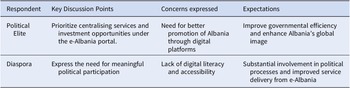
This divide highlights fundamental differences in priorities and approaches and reflects a broader tension in the literature between the economic instrumentalization of diasporas and their aspirations for meaningful political inclusion (See Table 2). As Cohen (Reference Cohen1996) and Koinova (Reference Koinova2013) argue, diasporas are not merely economic agents but active participants seeking to influence governance and policy-making. While those previous studies highlight the potential dual roles that diasporas can play as political influencers and economic contributors, our findings shed new light on the reciprocal and transactional relationship between diaspora and home country governments facilitated by e-governance platforms.
Stakeholders and Motives Matrix in Diaspora Engagement

Table 2. Long description
The table consists of four columns: Respondent, Key Discussion Points, Concerns expressed, and Expectations. It contains two data rows.
* Row 1: Respondent is Political Elite. Key Discussion Points: Prioritize centralising services and investment opportunities under the e-Albania portal. Concerns expressed: Need for better promotion of Albania through digital platforms. Expectations: Improve governmental efficiency and enhance Albania’s global image.
* Row 2: Respondent is Diaspora. Key Discussion Points: Express the need for meaningful political participation. Concerns expressed: Lack of digital literacy and accessibility. Expectations: Substantial involvement in political processes and improved service delivery from e-Albania.
For political elites, e-governance is a tool for maximizing economic transfers; for the diaspora, it is a means of advocating for greater political participation. This interplay challenges traditional narratives in the literature, which often depict diaspora engagement as unidirectional — states harnessing diaspora resources without reciprocating political concessions (Adamson and Han Reference Adamson and Han2024; Gamlen Reference Gamlen2014).
Instead, our study reveals a push-pull dynamic where diasporas use e-platforms to press for systemic reforms, greater transparency, and representation. Although the push-pull dynamic between states and diasporas may not be entirely new, our study illustrates how e-platforms in particular serve as arenas where political elites and diasporas negotiate their agendas and use these platforms not only to meet government expectations of economic contributions but also to demand accountability, transparency, and inclusion. The unique characteristics of e-governance platforms — such as their ability to transcend geographical boundaries, enable real-time interactions, and provide formal recognition — elevate the diaspora’s position from passive contributors to active stakeholders. Unlike traditional mechanisms, these platforms facilitate inclusive, data-driven, and transparent engagement, empowering diasporas to advocate for systemic reforms and equitable representation in governance processes.
By highlighting this reciprocal relationship, our findings contribute to rebalancing the discourse on diaspora engagement. While the existing literature has focused extensively on the economic and political instrumentalization of diasporas (Shain Reference Shain1994; Prelec and Marovic Reference Prelec and Marović2021), our study demonstrates that e-governance platforms can also be sites of negotiation and contestation in several respects.
The Albanian government has actively promoted the e-Albania platform to facilitate services such as document retrieval, property registration, and investment management for diaspora members. While the platform primarily aims to encourage economic contributions, it also opens a channel for diasporas to express concerns and participate in consultations. For example, our interviews revealed that diaspora members use e-Albania to participate in discussions about economic investment zones, while also raising issues about corruption or governance inefficiencies through surveys and other feedback mechanisms.
Similarly, property ownership and inheritance issues are highly relevant to the Albanian diaspora, many of whom own property in Albania. The e-Albania platform provides a digital avenue to manage such transactions remotely. While using the platform for property-related services, diaspora members get to highlight issues with unclear land ownership laws or corruption in local governance, pushing for legal reforms to secure their investments. As P2 stated, thanks to e-Albania, “now you don’t have to pay an officer to get a service that should normally be free of charge. In that sense, there is an impact on corruption. … Improving digital services would bring less corruption and more saved costs, which can be invested back [into] services for citizens.”
The Albanian government has launched initiatives to attract diaspora entrepreneurs, such as creating investment zones and offering incentives for starting businesses in Albania. (The Albanian National Diaspora Strategy 2021-2025). Several electronic platforms are used to streamline grant applications and business registrations (Barjaba Reference Barjaba, Vershinina, Rodgers, Xheneti, Brzozowski and Lassalle2021a, Reference Barjaba2021b). Diaspora members may apply for grants but they are using the very e-platforms as an opportunity to simultaneously push for reforms to improve the ease of doing business, such as simplifying bureaucracy, combating nepotism, As P15 sheds light on, “Unfortunately, the embassies do not do enough to attract best diaspora talents to contribute back home, but they are busier with personal gains and nepotism rather than serving diaspora and Albania,” highlighting a shared recognition of the diaspora’s economic potential, alongside the systemic inefficiencies that hinder meaningful engagement.
Our findings reveal that the Albanian government has clearly strong incentives to engage its diaspora due to their significant economic contributions, primarily through remittances and e-governance platforms, which make this clearly easier for them. However, as our argument highlights, the diaspora sees these initiatives as an opportunity to press for political inclusion and influence. E-governance platforms like e-Albania not only facilitate this engagement but also create a space for negotiating this transactional relationship. By enabling both sides to pursue their respective agendas, the platforms inherently elevate the diaspora’s position in shaping governance and reforms.
This finding also highlights the need for structural reforms to foster trust and collaboration, essential elements for unlocking the diaspora’s economic contributions. While the government sees platforms like e-Albania as tools for efficiency, the diaspora envisions them as vehicles for empowerment. Achieving alignment between these perspectives would not only enhance Albania’s international image but also address the diaspora’s aspirations for substantive participation, offering a new framework for understanding the transformative potential of e-governance in diaspora engagement.
Conclusion
Towards Inclusive Governance: Lessons from Albania’s Digital Experiment
Our research sheds new light on the dynamic and transactional relationship between the Albanian government and its diaspora, facilitated by the transformative potential of e-governance platforms such as e-Albania. While the Albanian government developed and improved e-Albania primarily to maximize economic contributions and streamline public services (Tomorri and Keco Reference Tomorri and Keco2023; Keco et al. Reference Keco, Tomorri and Tomorri2023), our findings reveal that the diaspora has strategically leveraged these platforms to press for greater representation, political participation, and systemic reforms in their homeland. This dual purpose has redefined the engagement between diaspora communities and their home country, illustrating the reciprocal nature of this interaction — a dynamic that challenges the traditional literature portraying diaspora engagement as predominantly unidirectional, with states harnessing diaspora resources without reciprocating political concessions (Adamson and Han Reference Adamson and Han2024; Gamlen Reference Gamlen2014).
The originality of our findings lies in highlighting the pivotal role of e-governance platforms in elevating the diaspora’s position from passive contributors of financial and social remittances to active stakeholders in governance. Unlike traditional diaspora engagement mechanisms, e-Albania transcends geographical boundaries, enabling real-time interaction and providing formal recognition to diaspora voices. By doing so, these platforms empower the diaspora to demand accountability, transparency, and inclusion, while simultaneously addressing deeply rooted issues of corruption and nepotism within Albania’s political culture. This directly addresses a critical gap in the literature: whilst foundational accounts of diaspora engagement have emphasized remittances, symbolic outreach, and electoral mobilization (Ostergaard-Nielsen Reference Ostergaard-Nielsen2002; King Reference King2005; Gamlen Reference Gamlen2014), our findings demonstrate that political participation may also emerge through repeated digital interactions that produce visibility, expectations of responsiveness, and mechanisms of accountability.
This study also shows the broader significance of demographic factors — such as age, education, and digital literacy — in shaping how different diaspora groups perceive and utilize e-governance platforms. Younger and digitally literate members of the diaspora have emerged as key actors, advocating for reforms through digital consultations, e-voting initiatives, and policy feedback mechanisms. In contrast, older and less digitally literate diaspora members face barriers to engagement, highlighting the need for targeted outreach and inclusive design in e-governance initiatives. The findings reveal how technology redefines political engagement, moving beyond conventional activities like voting and lobbying. E-governance platforms not only create a shared digital identity but also blur the lines between politically active diasporas and those traditionally seen as disengaged. Notably, older generations, once deeply involved in their home country’s politics, are now less likely to participate in consultations via e-governance, challenging widely accepted norms. Meanwhile, younger generations and irregular migrants, previously viewed as peripheral to home-country politics (Vathi and King, Reference Vathi and King2013; Orjuela, Wackenhut, and Hirt Reference Orjuela, Wackenhut and Hirt2025), are leveraging e-platforms to engage with their homeland in dynamic and innovative ways. This pattern complicates traditional diaspora participation theories — exposure theory, resistance theory, and transferability theory (Gherghina and Tseng Reference Gherghina and Tseng2016) — by introducing digital mediation as a variable that reshapes how age, settlement duration, and political ideology influence engagement.
The policy implications of our findings are also significant. By illustrating how the Albanian diaspora has successfully leveraged e-Albania to advance their demands for political inclusion, this study provides a framework for other countries seeking to engage their diasporas more effectively. The culmination of this push for inclusion is exemplified by the Albanian government’s landmark decision to implement postal and electronic voting for the 2025 parliamentary elections. This development validates our argument and represents a major step toward more inclusive governance and reform in Albania. It also signals a victory for the diaspora in their ongoing fight against corruption and nepotism, demonstrating the tangible impact of their advocacy through digital platforms.
In a broader scholarly context, our research challenges traditional narratives of diaspora engagement that depict it as predominantly unidirectional, with states harnessing diaspora resources without reciprocating political concessions. Instead, our study reframes diaspora engagement as a dynamic interplay, where e-governance platforms serve as arenas for negotiation and contestation. By showing how digital governance tools can facilitate both economic development and political empowerment, our findings contribute to rebalancing the discourse on diaspora engagement. Traditional frameworks such as transnationalism and institutional theory (Vertovec Reference Vertovec1999; Délano and Gamlen Reference Délano and Gamlen2014; Bauböck Reference Bauböck2010) have provided valuable insights into diaspora dynamics, yet they tend to cast diasporas as passive participants within state-centric paradigms. Our application of stakeholder theory to diaspora engagement moves beyond these limitations, recognizing diasporas as key actors with distinct needs and interests who actively shape governance processes (Freeman et al. Reference Freeman, Jeffrey, Andrew, Bidhan and Simone2010).
This study addresses an unresolved gap in the diaspora and e-governance literature by demonstrating that platform-based governance infrastructures can mediate a transition from transactional engagement to politically consequential claim-making. While foundational accounts of diaspora engagement often emphasize remittances, symbolic outreach, or electoral mobilization, the findings here show that political participation may also emerge through repeated digital interactions that produce visibility, expectations of responsiveness, and mechanisms of accountability. In the Albanian case, diaspora actors interpret e-Albania not only as an efficiency tool but as a potential route to political voice and institutional recognition, a dynamic that is reflected in the policy trajectory toward diaspora postal and electronic voting in 2025. This represents the first empirical analysis linking diaspora engagement and e-governance studies in a post-communist context, directly responding to the call by Zapata-Barrero and Rezaei (Reference Zapata-Barrero and Rezaei2020) for research that bridges these previously disconnected fields.
Ultimately, e-Albania has become more than just an administrative tool; it has evolved into a space where political elites and diasporas negotiate their agendas and influence the future of governance in Albania. As such, this study highlights the transformative potential of e-governance in fostering inclusive and reciprocal relationships between states and their diasporas. For Albania, aligning the government’s economic priorities with the diaspora’s aspirations for representation will not only enhance its global standing but also lay the groundwork for meaningful reforms and more inclusive governance in the years to come.
Disclosure
No potential conflict of interest was reported by the author(s). Any opinions expressed in this article are those of the authors and do not necessarily represent the views of the institutions with which they are affiliated or employed.
Appendix 1
Respondents’ General Profile Table
Respondents’ General Profile.

Table A1. Long description
The table contains seven columns: I D, Role, Stakeholder, Education, Gender, Age, and Years In U K.
Section 1: Diaspora Stakeholders (R 5 to R 40)
* R 5: Immigration Lead for Albania at Home Office, B A, Male, 49, 20 years in U K.
* R 6, R 7, R 16: Diaspora Leaders awarded by Government, education levels B A or Other, ages 25 to 55, 5 to 25 years in U K.
* R 9: Professor at Birmingham University, P h D, Male, 61, 15 years in U K.
* R 19 to R 25, R 31 to R 35, R 40: Diaspora Members with roles including Writer, Publisher, or Unregulated. Education ranges from B A to P h D. Ages range from 19 to 82. Years in U K range from 1 to 32.
* R 26: Diaspora Member, P h D, Male, 38, 7 years in U K.
Section 2: Political Elite Stakeholders (R 1 to R 39)
* This group includes a Local Council Director, Legislators, Non-Government Advisors, Cultural Diplomat, E-Albania Director, Diaspora Agency Director, Think Tank Leader, Cabinet Members, and Policy Advisors.
* Education: Predominantly M A, B A, and P h D.
* Gender: Mixed male and female.
* Age: Ranges from 30 to 65.
* Years In U K: All entries in this section are marked with a dash, indicating no data or not applicable.



 Open access

