Although pearls were likely esteemed by the earliest people to find them, their small size and fragility contribute to the rarity of archaeological examples and the subsequent limits to our understanding of their human use before recent eras. Pearls are often associated with peoples and cultures of the Old World, but Indigenous peoples of the Americas also valued pearls, along with nacreous marine shells. Indigenous views of value were attached to the qualities of pearls that correspond to light, life, fertility, and association with the spiritual world. These qualities gave the pearl value beyond mere monetary worth (Saunders Reference Saunders1998, Reference Saunders1999).
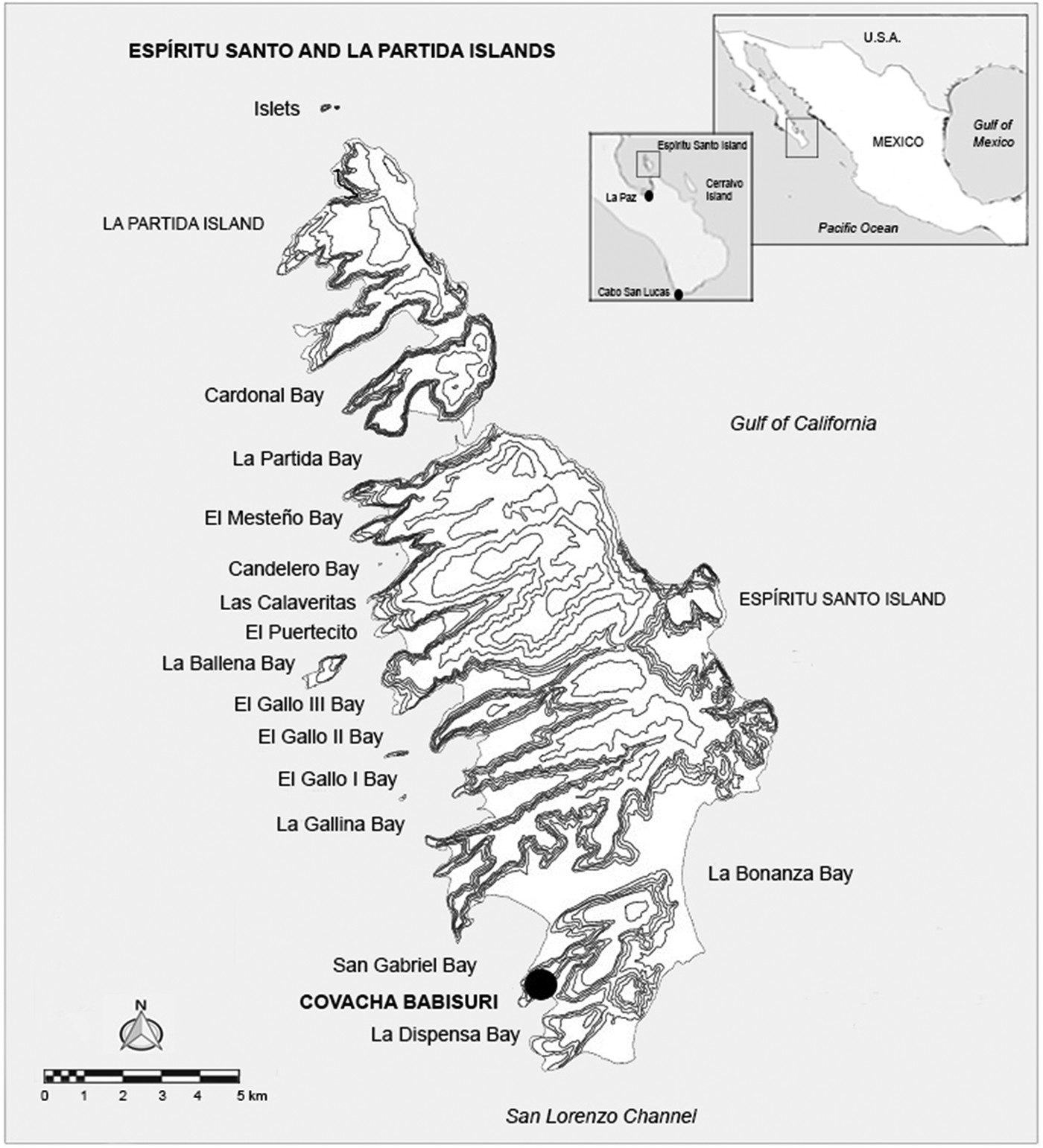
In this article, we present AMS radiocarbon dates for two incised pearls from the Covacha Babisuri site on Espíritu Santo Island, off the southeast coast of Baja California, México (Figure 1). Fifteen modified pearls were recovered from deposits dated between ca. 12,000 BP and the Historic Era. Because artifacts of this size and shape can easily filter into lower levels, associated dates are not ideal for establishing their chronologies. AMS radiocarbon dating of two of the modified pearls allowed us to confirm that at least some of the grooved pearls were manufactured during the Early Holocene. Details of the entire pearl artifact assemblage were presented by Fujita and colleagues (Reference Fujita, Cáceres-Martínez and Ainis2017). Space restrictions limit us to only presenting the two pearl dates (Table 1), but additional dates for this site can be found in Fujita and Melgar (Reference Fujita and Melgar2014) and Fujita and colleagues (Reference Fujita, Cáceres-Martínez and Ainis2017).
Map of the Covacha Babisuri site on Espíritu Santo Island (drawn by Karim Bulhusen and adapted from Fujita and colleagues [Reference Fujita, Cáceres-Martínez and Ainis2017:Figure 1]).

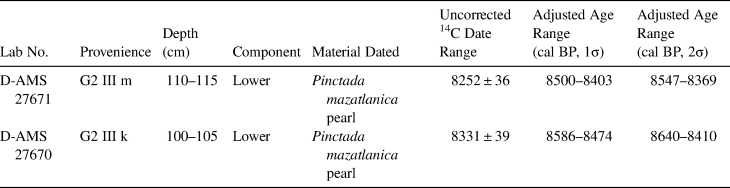
Associated and Direct Dates for Pearl Artifacts from the Covacha Babisuri Site.

Note: Dates were calibrated using Calib 7.0.4 (Stuiver and Reimer Reference Stuiver and Reimer1993, Reference Stuiver and Reimer2014), and adjusted with a ΔR of 253 ± 18 (14CHRONO; Frantz et al. Reference Frantz, Kashgarian, Coale and Foster2000).
Site Chronology and Context
The Covacha Babisuri site is a multicomponent rockshelter (~10 m asl, ~5 m deep, 10 m long, and ~2.3 m high along the dripline) formed of Miocene volcanic conglomerates. It is located on the southwest coast of Espíritu Santo Island, in the northeastern corner of La Dispensa Bay, with at least 14 other caves and rockshelters containing ample evidence of human occupation (Fujita Reference Fujita1995; Fujita and Poyatos de Paz Reference Fujita and de Paz1998). What is now an island was once connected to the Baja California peninsula until ca. 8500 BP and has been shown to contain extensive evidence of Early Holocene occupations (Fujita Reference Fujita2010).
Abundant archaeological materials, including faunal remains, lithic artifacts and debitage, and milling stones, were present on the surface, as well as on the platform and slope outside the dripline. Excavations were conducted in the late 1990s and between 2001 and 2006 (Fujita Reference Fujita2008). Almost 42 m2 of sediment and archaeological materials were excavated from the rockshelter, following a 1 × 1 m unit grid and proceeding in 5 cm levels within stratigraphic components. Based on cultural materials and stratigraphic descriptions, three primary components were identified during excavations (Strata I, II, and III), but pearls were only uncovered in the lower two. More than 100 conventional and AMS radiocarbon dates revealed occupations spanning ca. 12,000 cal BP to the sixteenth century and the use of fossil shells (ca. > 47,500–35,500 RCYBP) for tools and containers during the earliest occupations (see Fujita and Melgar Reference Fujita and Melgar2014).
The Pearl Assemblage
Fifteen whole and fragmented pearls from pearl oysters (Pinctada mazatlanica) and a chocolate clam (Megapitaria sp.) pearl were recovered from the site. Seven of the pearls were near complete, whereas the others exhibited varying degrees of fragmentation and exfoliation. Most were spherical in shape, although oval and rectangular forms were also present. Many of the pearls seemed “smoked,” although this likely occurred inadvertently when the mollusks were placed on a fire to open them (Kunz Reference Kunz1890). Pearl circumference ranged from 12.5 mm to 36.8 mm, and the grooves showed relative homogeneity, suggesting that specialized tools were used in their manufacture. Morphometric analyses and statistical measures for all modified pearls found at the site have been published elsewhere (Fujita et al. Reference Fujita, Cáceres-Martínez and Ainis2017).
Description of Dated Pearls
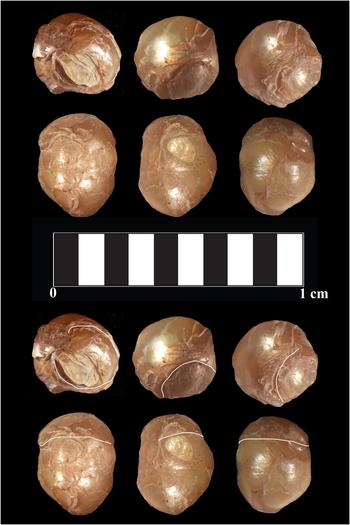
For this study, we dated two modified pearls found in the lowest component (Stratum III) of the Covacha Babisuri deposits (Figure 2). Specimen #1015 from Stratum III/Level k was found at a depth of 100–105 cm below the surface. This modified pearl measures 25.1 mm in circumference with an incised surficial channel measuring 1.2 ± 0.29 mm wide at the surface and 0.4 ± 0.13 mm wide at its base. The groove position was characterized as being carved into the “top” of the pearl, rather than centrally located. Specimen #1054 was found in Stratum III/Level m (110–115 cm below the surface) and measures 27.3 mm in circumference, with an incised channel measuring 1.5 ± 0.09 mm wide located near its “top.” Both dated specimens were categorized as “spherical” with a “light golden” to “golden” color and a smoky luster (see Fujita et al. Reference Fujita, Cáceres-Martínez and Ainis2017:Tables 2 and 5).
Composite figure detailing the two pearls dated in this study. The pearl on the top row is specimen #1015, and the pearl on the second row is specimen #1054. We duplicated the images below the scale and added line drawings demarcating the groove on each specimen (photos and composite by A. Ainis).

Methods and Results
Pearls, being composed of calcium carbonate, have been shown to be suitable for radiocarbon dating (Krzemnicki et al. Reference Krzemnicki, Cartier and Hajdas2017) and thus were dated directly to determine their age. Following a brief 10% HCl bath and rinsing with deionized water to remove their outer layers, the pearls were air-dried. Powdered carbonate samples were then drilled from the pearl interior using a Sherline Model 5410 Micromill with sterilized 0.5 mm carbide drill bits; these samples were placed in sterilized glass vials before being sent to the DirectAMS laboratory in Seattle, Washington, for analysis.
Uncorrected 14C date ranges for both specimens (D-AMS 027670 = 8331 ± 39 and D-AMS 027671 = 8252 ± 36) suggest similar depositional chronologies. Dates were calibrated using Calib 7.04 and adjusted using the standard Delta R of 253 ± 18 for the La Paz region (14CHRONO; Frantz et al. Reference Frantz, Kashgarian, Coale and Foster2000). Calibration results showed that both pearls dated to within a hundred years of each other, with overlapping ranges spanning roughly 8590 to 8400 cal BP (Table 1). Although the two dated pearls were uncovered during excavations of the lower levels of Unit G2, the radiocarbon dates are slightly earlier than associated dates. This suggests that the pearls may have filtered through deposits to some degree but remained in relatively good depositional context. Though we cannot apply these dates to the other pearl artifacts at this site, these two were found in the deepest context, suggesting the others are likely younger. Direct dates of these specimens confirm that pearl modification was occurring at least 8,500 years ago on Espíritu Santo Island and likely continued during the Middle Holocene as suggested by a number of similar pearl artifacts found in other components of this site and other sites in the region.
Discussion
Archaeological Accounts of Pearls: Regional Perspective
Though far from abundant, perforated and grooved pearls have been noted in Alta California and on the California Channel Islands slightly north of the Baja California peninsula (Koerper and Desautels-Wiley Reference Koerper and Desautels-Wiley2010). Ground and perforated abalone pearls were reported from various contexts on San Miguel Island (Heye Reference Heye1921; Holmes Reference Holmes, Díez and de la Fuente1997). Examples from San Nicolas Island include a grooved spherical pearl from a late Holocene site (Cannon Reference Cannon2006) and a large perforated and grooved baroque abalone pearl from a cached feature (Ainis et al. Reference Ainis, Guttenburg, Vellanoweth, Erlandson, Kendig, Colston and Thomas2017). Pearl ornaments have also been recovered from archaeological contexts along the Pacific coast of México, where they have been found in association with funerary contexts and dated to a later time period (see Fujita et al. Reference Fujita, Cáceres-Martínez and Ainis2017).
Recently, natural and modified pearls (including grooved specimens) have been found in archaeological sites in the Cape Region of Baja California Sur. Dates from associated archaeological components range from ca. 4,800 to 600 years ago (Fujita et al. Reference Fujita, Cáceres-Martínez and Ainis2017), illuminating the relatively deep history of pearl modification by Indigenous people along the lower Gulf of California—a practice that we now know began more than 8,000 years ago.
Ethnohistoric Accounts of Indigenous Use of Pearls
Indigenous grooving of pearls and their use as body ornamentation are well recorded in early historical accounts by expedition members, traders, and Jesuit fathers in the Cape Region. Accounts from the early 1600s reveal that the Indigenous people of the region wore grooved pearl necklaces and bracelets and hung grooved pearls from their ears, noses, and hair (Del Barco Reference Del Barco1973; Mathes Reference Mathes1970; Vetancurt Reference Vetancurt1961).
Pearls in both Baja California Sur and Alta California were grooved, and ethnohistoric accounts of both areas describe similar wand-like artifacts with pearls adorning one end. However, grooved pearls were found in older contexts in Baja California Sur than in Alta California (Bravo Reference Bravo and León-Portilla1970; Koerper and Descautels-Wiley Reference Koerper and Desautels-Wiley2010). Similarly, circular shell fishhooks from archaeological contexts of the Baja peninsula were also found to predate those of similar form in Alta California (Des Lauriers Reference Des Lauriers2010; Des Lauriers et al. Reference Des Lauriers, Davis, Turnbull III, Southon and Taylor2017; Fujita Reference Fujita2014; Rick et al. Reference Rick, Vellanoweth, Erlandson and Kennett2002). Although there are many connections between the marine-oriented cultures of Alta and Baja California, just how deeply these connections go remains to be seen.
Conclusion
The dating of grooved pearls from the Covacha Babisuri site confirms the notion that Indigenous peoples began modifying pearls at least 8,500 years ago. Modified pearls recently recovered from additional sites in Baja California and dated to the past ca. 4800 years imply that this practice continued through the Middle and possibly Late Holocene periods (Fujita et al. Reference Fujita, Cáceres-Martínez and Ainis2017:65). Accounts of traditional pearl ornaments in the Cape Region during the Historic Era suggest this practice continued relatively unaltered for thousands of years. Consistency in the type and form of pearl modification speaks to the resilience of this practice and suggests at least some degree of cultural continuity in the region. Our study contributes to understanding the antiquity of pearl ornament manufacture in the Americas and currently presents the oldest reported direct dates for modified pearls in the world.
Acknowledgments
Permission for exportation and analysis was given by the Archaeological Council of the INAH, letter No. 401.35.16-2018/247, February 13, 2018. Data are from Poblamiento de América visto desde la isla Espíritu Santo, B.C.S., financed by INAH (2001–2008), and Registro y excavación de sitios arqueológicos del Municipio de La Paz, B.C.S., financed by INAH (2018). Additional funding and support were provided by California State University, Los Angeles, and the University of Oregon. We thank Karim Bulhusen for creating Figure 1.
Data Availability Statement
The complete morphometric results and descriptions of all pearls from this assemblage were published in Fujita and colleagues (Reference Fujita, Cáceres-Martínez and Ainis2017). Additional details concerning the Covacha Babisuri site were published in Fujita and Melgar (Reference Fujita and Melgar2014) and Fujita and colleagues (Reference Fujita, Cáceres-Martínez and Ainis2017). The dating results from Table 1 are on file in the laboratories of INAH, Mexico City, México; DirectAMS, Washington, DC; and Beta Analytic, Miami, Florida.