Introduction
Abnormalities in emotion regulation have been shown to predict the emergence and maintenance of several psychiatric disorders (Aldao & Nolen-Hoeksema, Reference Aldao and Nolen-Hoeksema2010). Emotion regulation refers to the use of strategies to control the frequency, duration, or intensity of emotional response (Gross, Reference Gross1998). Although several theoretical models of emotion regulation have been proposed, the extended process model proposed by James Gross has received the most empirical attention. Gross (Reference Gross2015) proposes that separate, but interactive systems for emotion generation and regulation exist. Both of these systems unfold over a cycle that involves four components: (1) World (W), which consists of internal and external stimuli that give rise to Valuation; (2) Perception (P), which includes the processing of personally salient emotional stimuli from the environment or internally generated mental representations that are gated into working memory where they can then be subjected to more elaborative processing; (3) Valuation (V), which involves the determination of whether W is good or bad for the individual based on a cost-benefit analysis of past experiences and the current context. This stage also evaluates the discrepancy between the current state and the goal state generated in W (e.g. I feel angry now; my goal is to not feel angry). If the discrepancy is determined to be above a critical threshold, then the cycle will identify a target goal (e.g. reducing anger) and proceed to the next step where the goal can be acted upon; (4) Action (A) involves the initiation of a response to reduce the discrepancy identified in the V stage. Once A is complete and a new W is created, the emotion generation sequence may restart. However, when the first W, P, V, A emotion generation cycle identifies a goal to change the current emotional state, emotion regulation processes are then initiated in the form of a second-order W, P, V, A cycle. When engaged, the second-order system can activate one of five emotion regulation strategies (situation selection, situation modification, attentional deployment, cognitive change, and response modulation). These strategies are completed over three sequential stages of emotion regulation: identification (i.e. after an emotion is detected, determining whether to regulate or not), selection (i.e. choosing a contextually appropriate emotion regulation strategy), and implementation (i.e. executing the strategy that has been selected). When these stages are active over a prolonged period of time and deemed ineffective at changing one's emotion to a desired state, two emotion regulation monitoring dynamics are used to initiate a new emotion regulation attempt: switching (attempting a new strategy or tactic) and stopping (discontinuing an emotion regulation attempt). Abnormalities at any one of the three stages (identification, selection, implementation) or either monitoring dynamic (switching, stopping) could be expected to contribute to the types of emotion regulation difficulties that occur in many forms of psychopathology (see Sheppes et al. Reference Sheppes, Suri and Gross2015).
Although several etiological models of schizophrenia (SZ) emphasize the role of heightened stress reactivity in the emergence and maintenance of psychotic disorders (Walker & Diforio, Reference Walker and Diforio1997; Walker et al. Reference Walker, Mittal and Tessner2008), relatively few studies have evaluated emotion regulation in SZ and no study has systematically evaluated whether abnormalities occur at the three stages of Gross’ model (identification, selection, implementation) or during monitoring dynamics (switching, stopping). To date, most published studies have evaluated self-reported emotion regulation strategy use via questionnaires. Results are inconsistent, with some studies reporting no group differences between SZ patients and healthy controls (CN) (Henry et al. Reference Henry, Rendell, Green, McDonald and O'Donnell2008; Badcock et al. Reference Badcock, Paulik and Maybery2011; Perry et al. Reference Perry, Henry and Grisham2011; Rowland et al. Reference Rowland, Hamilton, Lino, Ly, Denny and Hwang2013; van der Meer et al. Reference van der Meer, Swart, van der Velde, Pijnenborg, Wiersma and Bruggeman2014), and others finding less frequent use of reappraisal and greater use of suppression in SZ (Livingstone et al. Reference Livingstone, Harper and Gillanders2009; van der Meer et al. Reference van der Meer, van't Wout and Aleman2009; Kimhy et al. Reference Kimhy, Vakhrusheva, Jobson-Ahmed, Tarrier, Malaspina and Gross2012; Horan et al. Reference Horan, Hajcak, Wynn and Green2013). Inconsistent findings across questionnaire studies may reflect differences in sample demographics, symptom profiles, antipsychotics, phase of illness, and proportion of schizoaffective v. schizophrenia diagnosis (Kimhy et al. Reference Kimhy, Vakhrusheva, Jobson-Ahmed, Tarrier, Malaspina and Gross2012). Lower self-reported use of reappraisal and greater use of suppression have been inconsistently associated with a range of poorer clinical outcomes in SZ (Henry et al. Reference Henry, Rendell, Green, McDonald and O'Donnell2008; van der Meer et al. Reference van der Meer, van't Wout and Aleman2009; Perry et al. Reference Perry, Henry and Grisham2011; Kimhy et al. Reference Kimhy, Vakhrusheva, Jobson-Ahmed, Tarrier, Malaspina and Gross2012; Butler et al. Reference Butler, Gross and Barnard2014). A similar pattern of emotion regulation abnormality is observed in individuals with schizotypal traits or those at clinical high risk for psychosis (i.e. a prodromal syndrome), who also inconsistently demonstrate lower self-reported use of reappraisal and greater use of suppression that predicts a range of clinical outcomes in some studies but not others (Van Rijn et al. Reference Van Rijn, Schothorst, Wout, Sprong, Ziermans and van Engeland2011; Van der Velde, Reference Van der Velde, Swart, van Rijn, van der Meer, Wunderink and Wiersma2015; Kimhy et al. Reference Kimhy, Gill, Brucato, Vakhrusheva, Arndt and Gross2016).
Findings from laboratory-based studies are more consistent. Neuroimaging studies indicate that ineffective use of reappraisal to decrease negative emotion is associated with hypofrontality and reduced cortico-limbic coupling (Morris et al. Reference Morris, Sparks, Mitchell, Weickert and Green2012; van der Meer et al. Reference van der Meer, Swart, van der Velde, Pijnenborg, Wiersma and Bruggeman2014). Electrophysiological studies find that SZ patients fail to reduce the amplitude of the late positive potential event-related potential component while implementing reappraisal (Horan et al. Reference Horan, Hajcak, Wynn and Green2013; Strauss et al. Reference Strauss, Catalano, Llerena and Gold2013a, Reference Strauss, Kappenman, Culbreth, Catalano, Lee and Goldb; Sullivan & Strauss, Reference Sullivan and Strauss2017) or directed attention strategies (Strauss et al. Reference Strauss, Kappenman, Culbreth, Catalano, Ossenfort and Lee2015). Pupillometry measurements recorded while participants attempted a directed attention strategy indicate that emotion regulation efforts may be ineffective because SZ patients exert less effort during implementation (Strauss et al. Reference Strauss, Kappenman, Culbreth, Catalano, Ossenfort and Lee2015). Thus, prior studies suggest that emotion regulation abnormalities result from reduced emotion regulation effort or adequate effort but reduced effectiveness of strategies that are implemented.
Although the implementation stage appears to be abnormal in SZ, the integrity of other emotion regulation stages has yet to be determined. Sheppes et al. (Reference Sheppes, Suri and Gross2015) proposed that two types of problems occur at the identification stage of Gross’ model: a threshold for regulation (i.e. a level of emotional intensity) that is too high or a threshold that is too low. An excessively high threshold would result in very few emotion regulation attempts. Several factors could cause a threshold that is too high in SZ, including poor emotional awareness (Baslet et al. Reference Baslet, Termini and Herbener2009; Kimhy et al. Reference Kimhy, Vakhrusheva, Jobson-Ahmed, Tarrier, Malaspina and Gross2012), failure to attend to external emotional cues (Strauss et al. Reference Strauss, Catalano, Llerena and Gold2013a, Reference Strauss, Kappenman, Culbreth, Catalano, Lee and Goldb), and difficulty detecting subtle bodily changes and interoceptive cues that signal the presence of an emotional response (Ardizzi et al. Reference Ardizzi, Ambrosecchia, Buratta, Ferri, Peciccia and Donnari2016). Patients might also have a threshold to regulate that is too high if they fail to sufficiently value the goal to regulate their emotions or if they fail to act on goals they have generated because of psychological inertia (i.e. the tendency to continue acting as one previously has) or the belief that emotions are immutable and therefore not worth trying to control. Such psychological phenomenon might be expected to travel with avolition (Foussias & Remington, Reference Foussias and Remington2010). In contrast, a threshold for regulation that is too low would cause patients to have an excessive number of emotion regulation attempts. This might result from factors such as increased engagement of attention to unpleasant stimuli (Moritz & Laudan, Reference Moritz and Laudan2007), decreased disengagement of attention to unpleasant stimuli (Strauss et al. Reference Strauss, Llerena and Gold2011), or overvaluing the goal to control negative emotions.
Several types of problems during the selection phase could also give rise to emotion regulation abnormalities in SZ. One possibility is that SZ patients represent too few strategies to choose from in a given context. This could be because their toolbox of potential strategies to select from is smaller, resulting in over-reliance on one strategy that they apply indiscriminately to all situations. Such a reduced repertoire may arise from limited knowledge of emotion regulation strategies and the corresponding contexts in which they should be applied (Kee et al. Reference Kee, Horan, Salovey, Kern, Sergi and Fiske2009; Green et al. Reference Green, Bearden, Cannon, Fiske, Hellemann and Horan2012). Alternatively, if SZ patients have an abnormality in representing the value of individual strategies in relation to the current context, they could select too many strategies and have an excessive number of regulation attempts.
Abnormalities in monitoring dynamics might also be expected in SZ. Gross proposes that switching problems can take one of two forms: difficulty with switching (i.e. neglecting to change strategies when they are ineffective at changing emotion) or difficulty with settling (i.e. continual switching of the chosen emotion regulation strategy before changes in emotion occur) (Gross, Reference Gross2015). Stopping is the discontinuation of the emotion regulation strategy. It is preceded by the acknowledgment that emotional experience has fallen below the threshold set by the identification stage (i.e. emotion regulation was successful). According to Gross’ (Reference Gross2015) model, SZ patients could experience difficulties in stopping in one of two forms: stopping too soon or stopping too late. Either could result in an increased number of emotion regulation attempts. If SZ patients stop too soon, the early termination may fail to allow the emotion regulation strategy to achieve its intended effect, resulting in continued elevations in negative emotion. This continuous elevation may then result in repeated attempts to regulate due to the fact that the negative emotion intensity remains above the target threshold. Conversely, failing to stop (i.e. stopping too late) would result in continued effort applied to a strategy after the target emotional goal had already been achieved. Such a difficulty could be due to an inability to recognize that the signal to stop an emotion regulation attempt has occurred (e.g. interoceptive signals). Continuing to regulate emotion for too long may have a variety of negative consequences for adaptive functioning, including the depletion of cognitive resources, continued activation of the sympathetic nervous system, diminished motivation to complete other goals (since this goal is perceived as still active), and impaired social interactions (Gross, Reference Gross2015).
In the current study, we used ecological momentary assessment (EMA: Shiffman et al. Reference Shiffman, Stone and Hufford2008) to determine whether implementation failures reflect inadequate effort, or adequate effort but poor effectiveness, as well as whether abnormalities exist at each of the stages of emotion regulation proposed in Gross’ (Reference Gross2015) model (identification, selection, implementation) and processing dynamics (switching, stopping). EMA is a naturalistic method that uses mobile technology [e.g. cell phones, personal device assistants (PDAs)] to distribute surveys that individuals complete in the context of everyday life. The method has been used extensively in SZ and has demonstrated adequate reliability, validity, tolerability, and compliance (Granholm et al. Reference Granholm, Loh and Swendsen2008; Ben-Zeev, Reference Ben-Zeev2012; Granholm et al. Reference Granholm, Ben-Zeev, Fulford and Swendsen2013; Ben-Zeev et al. Reference Ben-Zeev, Brenner, Begale, Duffecy, Mohr and Mueser2014). However, it has yet to be used to study emotion regulation in SZ. EMA offers several novel means of evaluating whether problems occur with identification, selection, implementation, and monitoring dynamics. For example, it is possible to examine the identification stage by determining the level of negative emotion intensity (i.e. threshold to regulate) at which individuals begin to exert high levels of emotion regulation effort. The selection stage can be evaluated by examining the number of strategies attempted at any given reporting time point. Implementation can be examined by concurrently measuring emotion regulation effort and negative emotional intensity and determining whether effort levels predict reductions in negative emotion across time. Processing dynamics can be evaluated by examining the types of strategies that individuals switch between within a given context and whether they continue exerting emotion regulation effort even when emotional intensity has reduced. Other methods (e.g. functional magnetic resonance imaging, electroencephalography, questionnaires) do not offer the luxury of examining each of these components of Gross’ model simultaneously, or for testing the multiple ways in which abnormalities at each stage could happen.
The following hypotheses were made:
(1) Consistent with prior studies indicating increased negative emotion reactivity in SZ (Myin-Germeys et al. Reference Myin-Germeys, Delespaul and deVries2000), patients were expected to evidence elevated intensity of in-the-moment negative emotion compared with CN;
(2) Consistent with prior pupillometry findings (Strauss et al. Reference Strauss, Kappenman, Culbreth, Catalano, Ossenfort and Lee2015), SZ patients were expected to evidence reduced emotion regulation effort compared with CN;
(3) Given the high frequency of avolition in SZ (Foussias & Remington, Reference Foussias and Remington2010), patients were expected to display abnormalities at the identification stage characterized by a threshold for regulation that is too high;
(4) Given prior studies indicating a reduced fund of emotion regulation knowledge in SZ (Kee et al. Reference Kee, Horan, Salovey, Kern, Sergi and Fiske2009), patients were expected to display abnormalities at the selection stage characterized by attempting fewer strategies than CN;
(5) The combination of emotional reactivity and regulation was expected to predict severity of psychotic symptoms.
Exploratory analyses were also conducted to evaluate: (1) monitoring dynamics to determine whether SZ patients continue exerting emotion regulation effort after negative emotion intensity was at zero, (2) whether context differentially influenced emotion regulation effort in SZ patients v. CN, and (3) whether strategies implemented at one time point had a lasting reduction in negative emotional intensity at subsequent time points.
Method
Participants
A total of 30 individuals meeting Diagnostic and Statistical Manual of Mental Disorders, Fourth Edition, Text Revision (DSM-IV-TR: American Psychiatric Association, 2000) criteria for schizophrenia (n = 20) or schizoaffective disorder (n = 10) (SZ) and 30 CN completed study procedures. SZ were recruited from outpatient mental health clinics in upstate New York and advertisements posted on television and the Internet. All patients were evaluated during periods of clinical stability, defined as no change in medication type or dose within the past 6 weeks. Diagnosis was established via a best-estimate approach based on psychiatric history and confirmed using the Structured Clinical Interview for DSM-IV (SCID: First et al. Reference First, Spitzer, Gibbon and Williams2002).
CN were recruited through printed, online, and television advertisements and word of mouth among enrolled participants. All CN underwent a diagnostic interview, including the SCID-I and SCID-II (Pfohl et al. Reference Pfohl, Blum and Zimmerman1997), and did not meet criteria for any current Axis I disorder or Axis II DSM-IV-TR schizophrenia-spectrum personality disorder. CN also had no family history of psychosis and did not meet lifetime criteria for psychotic disorders.
No participants met criteria for substance dependence in the last 6 months and all denied lifetime history of neurological disorders (e.g. traumatic brain injury, epilepsy). Written informed consent was obtained for all participants for a protocol approved by the Binghamton University Institutional Review Board.
Procedures
Procedures were conducted in three phases, a pre-EMA initial laboratory visit, 6 days of in vivo EMA, and a post-EMA final laboratory visit. Participants were paid $20 hourly for their participation in the laboratory, and were paid $20 per day of completed surveys. Participants were paid for the EMA portion of the study when they came back in to the laboratory to return the PDA.
Phase 1: initial laboratory visit
The first phase consisted of a pre-EMA initial study visit to the laboratory. In this visit, all participants provided written informed consent. Diagnostic interviews were completed for all participants. SZ were also rated on the following symptom and functional outcome assessments: Brief Negative Symptom Scale (BNSS: Kirkpatrick et al. Reference Kirkpatrick, Strauss, Nguyen, Fischer, Daniel and Cienfuegos2011; Strauss et al. Reference Strauss, Hong, Gold, Buchanan, McMahon and Keller2012a, Reference Strauss, Keller, Buchanan, Gold, Fischer and McMahonb), Brief Psychiatric Rating Scale (BPRS: Overall & Gorham Reference Overall and Gorham1962), Psychotic Symptoms Rating Scale (PSYRATS: Haddock et al. Reference Haddock, McCarron, Tarrier and Farragher1999), and Level of Function Scale (LOF: Hawk et al. Reference Hawk, Carpenter and Strauss1975)Footnote †Footnote 1.
Participants were then provided with an electronic Palm Pilot Personal Digital Assistant (PDA) (version m500). The PDA was preprogrammed with the open-source Experience Sampling Program software (ESP: http://www.experience-sampling.org). This software restricted use of the PDA to the researcher-generated EMA-specific questions and allowed participant responses to be stored on the PDA for secure download by the research team upon the participant's final laboratory visit. The PDAs were not connected to the Internet in order to protect participant privacy. Participants received instruction in the use of the PDA, which included an introduction to the PDAs and an overview/explanation of the type of questions that would be asked. Participants were also introduced to the vibration and beep emitted by the PDA that signaled survey availability. Participants were given an opportunity to try out the survey function on the PDA and ask questions prior to leaving the laboratory. Follow-up calls were made to the participants during the day following their initial laboratory visit in order to answer any questions and check on the proper functioning of the PDA. Participants were also provided with a phone number to call in case they experienced any problems with the PDA or surveys.
Phase 2: ecological momentary assessment
During the 6-day EMA period between laboratory visits, surveys were administered four times per day between 9 : 00 and 21 : 00 hours at quasi-randomized times within specified epochs (9 : 00–12 : 00, 12 : 01–15 : 00, 15 : 01–18 : 00, 18 : 01–21 : 00 hours), for a total of 24 surveys across the 6 days. Participants had 15 min to initiate the survey upon hearing the beep signaling its availability. Attempts to answer the survey after 15 min were not accepted, but the next survey would initialize as scheduled irrespective of the missed survey. Once initialized, participants were able to take as much time as needed to answer the questions. Surveys prompted between 9 : 00 and 18 : 00 hours focused on in-the-moment reports. The evening survey (18 : 01 pm–21 : 00 hours) included questions that required the participant to retrospectively report on experiences throughout the day. Overall, participants were prompted to provide three in-the-moment reports and one retrospective report at the end of the day.
Surveys probed for the following information:
1. Emotional intensity reports. In-the-moment and end-of-day reports of positive and negative emotional intensity were captured using the modified Differential Emotions Scale (mDES: Fredrickson et al. Reference Fredrickson, Turgade, Waugh and Larkin2003). There were five negative emotions (anger, fear, sadness, shame, anxiety) rated at each prompt. For in-the-moment surveys, participants were directed to rate the present intensity (i.e. how the participant was feeling at the time of the beep) of each emotion on a scale ranging from 0 (not at all) to 4 (extremely). End-of-day questions required rating emotions across the day. A mean composite score was calculated for negative emotion intensity at each in-the-moment and end-of-day survey.Footnote 2
2. Emotion regulation reports. At each in-the-moment survey, participants were asked to indicate how much they were using each of six emotion regulation strategies using a 0 (not at all) to 4 (extremely) scale since the time of the last probe. For the end-of-day surveys, participants were asked to indicate how much they used each of the six emotion regulation strategies in general across the course of the day, using the same scale. The six strategies included (actual descriptions shown to participants are shown in quotations): (1) expressive suppression: ‘How much were you HIDING EXPRESSIONS (trying not to show emotions on the outside)’; (2) reappraisal: ‘How much were you REAPPRAISING THE SITUATION (thinking about the situation differently’); (3) soothing: ‘How much were you SOOTHING FEELINGS (trying to calm your body by taking deep breaths or relaxing your muscles)’; (4) distraction: ‘How much were you DISTRACTING (turning attention away from what is making you feel emotional’; (5) interpersonal: ‘How much were you SHARING FEELINGS (talking about your feelings to others)’; (6) situation modification: ‘How much were you AVOIDING THE SITUATION (removing yourself from the situation that caused the emotion)’. Emotion regulation strategies selected for this study were modeled after Gruber et al. (Reference Gruber, Kogan, Mennin and Murray2013), which probed strategies relevant to Gross’ process model. An interpersonal strategy was also added based on proposals that this might reflect an additional strategy not covered in Gross’ model.
3. Context reports. Participants were prompted to provide information about their current activities, whereabouts, and companions at the time of each beep for in-the-moment surveys only. They were also asked to provide an emotional context for the survey (i.e. if the most emotional event during the past hour was positive, negative, or neutral). Activities assessed included 13 non-exclusive categories: nothing, recreation, errands/chores, resting/sleeping, bathing, socializing, working, exercising, shopping, using the Internet, watching TV or listening to music, eating, or smoking. Possible whereabouts included four non-exclusive categories: home, work, family/friend home, or public place. Possible social companions included five categories: no one (alone), family, friends, coworkers, or strangers. These social, emotional, and goal-directed activity contexts were selected for exploratory analyses as each of these has been found to differentiate patient and control groups in prior studies with regard to emotional intensity. The procedures for determining goal-directed v. non-goal-directed contexts were modeled after Gard et al. (Reference Gard, Kring, Gard, Horan and Green2007). Activities assessed as goal-directed included recreation, errands/chores, bathing, socializing, working, exercising, shopping, and eating; activities assessed as non-goal-directed included doing nothing, resting/sleeping, using the Internet, watching TV or listening to music, and smoking.
Phase 3: final laboratory visit
The third phase included a final visit to the laboratory occurring 1 week after the initial study visit, where participants returned the PDAs to the laboratory. Neuropsychological functioning was evaluated at this time via the MATRICS Consensus Cognitive Battery (MCCB: Nuechterlein et al. Reference Nuechterlein, Green, Kern, Baade, Barch and Cohen2008).
Data analysis
IBM SPSS Statistics 23.0 was used to conduct all analyses. Data were first examined for normality and transformed using square root transformations if needed. Any instances where data have been transformed are noted in tables. Linear mixed modeling (LMM) with an autoregressive covariance structure was performed to examine group (SZ, CN) differences in emotion intensity (hypothesis 1), emotion regulation strategy use (hypothesis 2), whether groups differed in the threshold needed to engage emotion regulation effort (hypothesis 3), and strategy selection (hypothesis 4). Analyses were nested within day and within individual. For all LMM analyses, maximum likelihood estimation was employed to account for missing data, and we employed a fixed model with a random slope. A two-group (SZ, CN) X 6 emotion regulation strategy (distraction, reappraisal, expressive suppression, soothing, interpersonal, and situation modification) repeated-measures analysis of variance (ANOVA) was used to examine emotion regulation effort recorded during the end-of-day retrospective surveys. To evaluate hypothesis 4 (strategy selection), the number of strategies selected at each survey was computed for each subject (i.e. coded as selected if regulation effort was a score of 1 or above) and LMM examined group effects. Finally, to evaluate hypothesis 5, hierarchical regression was used to evaluate the proportion of variance in positive symptom scores that was accounted for by emotion regulation and the combination of regulation and reactivity. Analyses for hypotheses 2–5 were also conducted using only time points where negative emotion intensity was >1. The pattern of results and interpretation did not change (see online Supplemental Materials).
Results
EMA compliance and demographics
Upon study completion, two SZ and one CN were excluded for failing to achieve minimum compliance with the study questionnaires, defined a priori as responding to <25% of the total number of surveys administered (based on Gruber et al. Reference Gruber, Kogan, Mennin and Murray2013). One additional CN was excluded from analyses due to a malfunctioning PDA that produced double surveys per time point. The remaining participants constituted the final sample (SZ: n = 28; CN: n = 28), which did not differ on age, parental education, sex, or ethnicity; however, SZ had significantly lower personal education than CN (see Table 1). All primary analyses were conducted on this final sample.
Demographic characteristics of study participants

SZ, schizophrenia; CN, control.
A total of 87.5% and 90.2% of surveys were completed by CN and SZ, respectively. Groups did not differ in the total number of in-the-moment or end-of-day surveys completed. These percentages are comparable to survey completion rates of other EMA studies in schizophrenia (e.g. Swendsen et al. Reference Swendsen, Ben-Zeev and Granholm2011; Sanchez et al. Reference Sanchez, Lavaysse, Starr and Gard2014; Depp et al. Reference Depp, Moore, Dev, Mausbach, Eyler and Granholm2016; Moran et al. Reference Moran, Culbreth and Barch2017).
Hypothesis 1: emotional intensity
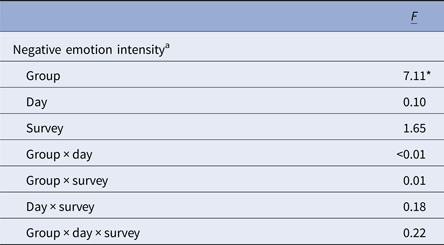
LMM revealed a significant group x valence interaction. The between-subjects effect of group was significant. Consistent with hypotheses, SZ reported significantly greater negative emotion than CN (SZ M = 0.82, s.d. = 0.09; CN M = 0.29, s.d. = 0.08). The main effects of survey and day were non-significant, as were their relevant interactions (see Table 2).
Linear mixed modeling results: emotion intensity

a Scores for the negative emotion composite transformed via a square root transformation to achieve normal distribution. Raw data results still significant. *p < 0.05.
Hypothesis 2: emotion regulation effort
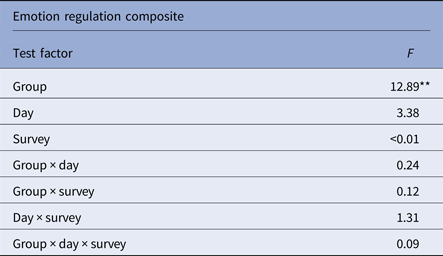
For the emotion regulation composite, there was a significant between-subjects effect of group. No interactions were significant. The main effect of group indicates that SZ had more effortful emotion regulation attempts than CN across time points.
For individual strategies, SZ reported more use of distraction, reappraisal, suppression, soothing, and situation modification than CN; however, groups did not differ in interpersonal emotion regulation (see Table 3 and Fig. 1). The pattern of findings did not change when only instances where subjects reported emotional intensity >0 were analyzed (online Supplementary Material)Footnote 3.
Comparison of emotion regulation strategy use by SZ and CN reported. In-the-moment and retrospectively at end-of-day. Note: a, in-the-moment; b, end-of-day; SZ, schizophrenia; CN, control. *p < 0.05, **p < 0.01.

Linear mixed modeling results: in the moment emotion regulation strategy use

**p < 0.01.
With regard to the retrospective reports, there was a significant between-subjects effect of group, F(1, 50) = 7.85, p < 0.01, d = 0.79; however, the within-subjects effect of strategy was non-significant, F(5, 250) = 2.57, p = 0.06, d = 0.45. The group x strategy interaction was also non-significant, F(5, 250) = 0.65, p = 0.58, d = 0.23. Post hoc analyses indicated that SZ retrospectively reported more effortful use of distraction, soothing, and situation modification than CN (see Fig. 1).
To follow-up this result, which was contrary to hypotheses, we conducted post hoc exploratory analyses using time-lagged correlations that more directly test the influence of emotion regulation on emotional experience at each time point. A total of 24/28 SZ and 23/28 CN were included in these analyses, with a total of 232 consecutive prompts used in SZ patients and 225 in CN (i.e. on average there were 9.67 consecutive reports used in SZ and 9.78 in CN throughout the 6 days). Several steps were used in the time-lagged analyses. First, two data points were calculated at each survey time point: (1) the mean emotion regulation (i.e. composite, averaging across all six strategies) effort exerted at time t; (2) the difference in the average of negative emotion intensity (composite score, averaging across the five discrete categories) between time t and time t + 1. Second, the correlation between these two variables was then calculated and correlation coefficients were determined (CN: r = −0.29, SZ: r = −0.08). Finally, ANOVA indicated that there was a statistically significant group difference in the strength of correlation between emotion regulation effort and the decrease in negative emotion intensity across time, F(1, 45) = 4.90, p < 0.04, d = 0.60. These findings suggest that emotion regulation efforts decreased negative emotion intensity to a greater extent in CN than SZ.
Hypothesis 3: identification threshold
The between-subjects effect of group was significant, F(1, 60.66) = 8.34, p < 0.01, d = 0.79 and there was a significant within-subjects effect of intensity, F(4, 853.59) = 36.73, p < 0.001, d = 1.65. The group x intensity-level interaction was non-significant, F(4, 853.59) = 1.53, p = 0.19, d = 0.34. Groups significantly differed in emotion regulation effort at peak intensity levels of 0, 1, 2, and the average of levels 3 and 4. Thus, findings suggest that SZ have a lower threshold needed to regulate than CN and exert higher emotion regulation effort at all levels of intensity (see Fig. 2).
Emotion regulation identification threshold. Note: SZ, schizophrenia; CN, control. **p< 0.01.

Hypothesis 4: strategy selection
At each survey, the average number of strategies selected by CN was 1.81 (s.d. = 0.30) and 3.03 for SZ (s.d. = 0.30). The group difference was statistically significant, F(1, 53.92) = 8.42, p < 0.01, d = 0.79. Thus, SZ selected more strategies in a given context than CN.
Hypothesis 5: proportion of variance in psychosis scores accounted for by emotional reactivity v. emotion regulation
Hierarchical linear regression was conducted in two steps, where emotion regulation effort was entered in block 1 and negative emotion intensity was added in block 2. PSYRATS total score served as the dependent variable. In model 1, emotion regulation effort accounted for 25.2% of the variance in positive symptoms, F(1, 25) = 8.09, p < 0.01 (b = 13.92, β = 0.052). In model 2, the combination of emotion regulation effort and negative emotion intensity accounted for 36.5% of variance in positive symptoms, F(1, 25) = 6.60, p < 0.01 (emotion regulation b = 3.25, β = 0.12; negative emotion intensity b = 14.78, β = 0.51). The addition of negative emotion intensity therefore accounted for an additional 11.3% of variance (F-change [1, 25] = 4.07, p = 0.055). These findings indicate that emotion regulation is a significant predictor of positive symptoms; however, the combination of emotional reactivity and emotion regulation is most predictive.
Exploratory analyses
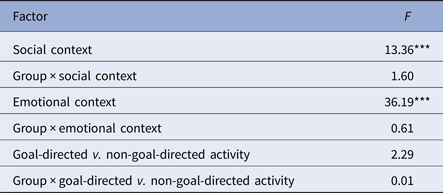
Exploratory analyses of the effects of context on emotion regulation effort revealed no significant interactions between group and social, emotional, or goal-directed activity contexts (see Table 4).
Linear mixed modeling results: emotion regulation strategy use in social, emotional, and goal-directed activity contexts

Dependent variable = emotion regulation composite. ***p < 0.001.
We also ran exploratory correlations between emotion regulation effort and negative symptoms, disorganized symptoms, functional outcome, and neurocognition. None of these correlations were significant.
Discussion
Several significant findings emerged. Consistent with hypotheses, SZ demonstrated heightened negative emotion reactivity and the combination of increased negative emotion reactivity and emotion regulation effort was significantly predictive of positive symptom severity. However, the nature of emotion regulation effort abnormalities was contrary to hypotheses: SZ reported greater emotion regulation effort than CN for five of the six emotion regulation strategies investigated (situation modification, distraction, soothing, reappraisal, suppression). There were no group differences in interpersonal emotion regulation, which may reflect reduced opportunity for social interaction.
Since negative emotion intensity was elevated in SZ across contexts, these results suggest that these emotion regulation efforts are ineffective, despite patients’ best efforts to reduce them. Post hoc, exploratory time-lagged correlations supported these conclusions, indicating that emotion regulation effort exerted at time t did not result in the same magnitude of decrease in negative emotion from time t to t + 1 in SZ compared with CN. These results suggest an impairment at the implementation stage of emotion regulation, consistent with laboratory-based studies (Morris et al. Reference Morris, Sparks, Mitchell, Weickert and Green2012; Horan et al. Reference Horan, Hajcak, Wynn and Green2013; Strauss et al. Reference Strauss, Catalano, Llerena and Gold2013a, Reference Strauss, Kappenman, Culbreth, Catalano, Lee and Goldb; van der Meer et al. Reference van der Meer, Swart, van der Velde, Pijnenborg, Wiersma and Bruggeman2014; Strauss et al. Reference Strauss, Kappenman, Culbreth, Catalano, Ossenfort and Lee2015; Sullivan & Strauss, Reference Sullivan and Strauss2017). However, results contradict previous pupillometry findings indicating that patients exert inadequate effort while implementing strategies (Strauss et al. Reference Strauss, Kappenman, Culbreth, Catalano, Ossenfort and Lee2015), potentially signifying a disconnect between subjective and objective emotion regulation effort in SZ.
Abnormalities were also observed at the identification and selection stages. However, the nature of these abnormalities was contrary to hypotheses. At the identification stage, SZ displayed a threshold for regulation that was too low, rather than too high, and they selected too many, rather than too few, strategies in each context. Abnormalities at the identification and selection stages may go hand-in-hand, such that a low threshold results in the identification of more instances of negative emotion that need to be regulated and subsequently more regulation attempts. There are several plausible explanations for identification (e.g. increased engagement and decreased disengagement of attention to unpleasant stimuli, interoceptive awareness, overvaluing the goal to regulate) and selection stage (e.g. reduced emotion regulation knowledge) abnormalities, which should be explored in future studies.
Deficits in monitoring dynamics were also observed. Two dynamics are proposed in Gross’ model: switching and stopping. Switching problems can take two forms: difficulty with switching (i.e. neglecting to change strategies when they are ineffective at changing emotion) or difficulty with settling (i.e. continual switching of the chosen emotion regulation strategy before changes in emotion occur) (Gross, Reference Gross2015). Our results suggest that SZ have difficulties with settling, rather than switching, because patients applied a wider range of strategies per context than CN. Stopping (i.e. the discontinuation of an emotion regulation strategy) may also be abnormal in SZ. According to Gross, stopping problems may result from stopping too soon or stopping too late. Results indicated that SZ had a relatively high level of emotion regulation effort at negative emotion intensity levels of zero, consistent with stopping too late. Such a difficulty could be due to an inability to recognize that the signal to stop an emotion regulation attempt has occurred (e.g. interoceptive signals). Continuing to regulate emotion for too long may be costly, taxing already limited cognitive resources (Sullivan & Strauss, Reference Sullivan and Strauss2017).
When interpreting these findings, the following limitations should be considered: (1) several contextual factors that were not explored in the current study may influence emotion regulation (Jaya et al. Reference Jaya, Ascone and Lincoln2016a, Reference Jaya, Hillmann, Reininger, Gollwitzer and Lincolnb; Lamster et al. Reference Lamster, Lincoln, Nittel, Rief and Mehl2017); (2) the study duration and number of EMA reports may have been lower than what is necessary to comprehensively measure emotion dynamics. Similarly, the follow-up, exploratory time-lagged analyses should be interpreted with caution due to the limited number of time points on which they were based; (3) the mDES may not have contained enough anchor points to precisely investigate negative affect variability and reduce skew; (4) the present findings relied solely on participant report. Mobile psychophysiological measurements should be incorporated in future studies; (5) emotional awareness has been found to predict emotion regulation in past studies (Kimhy et al. Reference Kimhy, Vakhrusheva, Jobson-Ahmed, Tarrier, Malaspina and Gross2012). By providing participants with emotion labels and strategies that they did not have to self-generate, emotion regulation abnormalities driven by emotional awareness may have been minimalized. Future studies should examine the role of emotional awareness across the stages of Gross’ model.
Despite these limitations, findings suggest that it is not only emotional reactivity that plays a role in psychosis, but also dysfunctional emotion regulation. EMA has helped to clarify the meaning of abnormalities found in prior studies using questionnaires, which provided no indication of which stage of Gross’ model is abnormal in SZ. EMA has yielded the new insight that all three stages, as well as monitoring dynamics, are abnormal in SZ and predictive of psychotic symptoms.
Supplementary material
The supplementary material for this article can be found at https://doi.org/10.1017/S0033291717003865