Introduction
One of the greatest challenges in plant ecology is determining the consequences of seed predation and dispersal for the population dynamics of plants, especially when frugivorous species have a dual functional role in the interaction networks (Xiao et al. Reference Xiao, Zhang and Krebs2013, Bogdziewicz et al. Reference Bogdziewicz, Crone and Zwolak2020). Scatter-hoarding rodents play a dual role because, in addition to preying on many species’ seeds of large-seeded plants, they also disperse them (Donatti et al. Reference Donatti, Guimarães and Galetti2009, Haugaasen et al. Reference Haugaasen, Haugaasen, Peres, Gribel and Wegge2010). Seed predation occurs because scatter-hoarding rodents, as granivorous animals, consume mainly seeds rather than fruit pulp. However, scatter-hoarding rodents are recognised as dispersers when they remove and bury seeds for later consumption but do not recover them (Gomez et al. 2019, Smythe Reference Smythe1978). Many reasons prevent seeds from being retrieved, such as hoarders forgetting the cache places, hoarders dying, or seeds germinating (Lichti et al. Reference Lichti, Steele and Swihart2017). Outcomes of seed predation and dispersal by scatter-hoarding rodents have significant consequences for the plant regenerations process, changing seed survival rates and seedlings establishment.
The balance between the costs and benefits of interactions between large-seeded plant species and scatter-hoarding rodents is highly dependent on the ecological context (Zwolak & Crone Reference Zwolak and Crone2012). One of the main factors that can influence this interaction is the change in resource abundance. Changes in seed abundance can affect seed fates, such as predation and dispersal, due to density-dependent effects (Jones & Comita Reference Jones and Comita2010, Lichti et al. Reference Lichti, Steele and Swihart2017, Wang Reference Wang2020). Seed predators might react to changes in seed abundance in two not mutually exclusive ways, which are explained by the Predator–Satiation (PS) and Predator–Dispersal (PD) hypotheses. According to the PS hypothesis, synchronised large seed production results in high seed survival because seed production exceeds the consumption capacity of granivorous animals (Silvertown Reference Silvertown1980, Kelly & Sork Reference Kelly and Sork2002). Although the PS hypothesis has been widely tested in temperate and tropical forests (Visser et al. Reference Visser, Muller-Landau, Wright, Rutten and Jansen2011, Xiao et al. Reference Xiao, Zhang and Krebs2013), it does not consider the benefits of seed dispersal and caching because the satiation of predators occurs before seed removal. Alternatively, the PD hypothesis predicts that a larger proportion of seeds should be dispersed in years of greater seed abundance (Kelly & Sork Reference Kelly and Sork2002, Vander Wall Reference Vander Wall2002). To the PD hypothesis, the satiation occurs after caching and not during the harvesting phase (Vander Wall Reference Vander Wall2002, Xiao et al. Reference Xiao, Zhang and Krebs2013, Zwolak et al. Reference Zwolak, Bogdziewicz, Wróbel and Crone2016), leading to greater survival of cached seeds and, consequently, more effective seed dispersal.
The outcome of seed–scatter-hoarding rodents’ interactions in density-dependence contexts can be helpful for re-establishing ecological functions in areas undergoing natural restoration. For instance, increasing seed dispersal in high tree-density areas can improve seedling survival by reducing dispersal limitation through seed removal to safer locations (Hirsch et al. Reference Hirsch, Kays, Pereira and Jansen2012). Furthermore, seeds dispersed and buried are more likely to germinate and establish because they are protected from desiccation and mortality due to natural enemies (Kuprewicz Reference Kuprewicz2015). On the other hand, the decrease of seed removal or consumption in high tree-density areas can decline seedling survival due to the high mortality rate of non-dispersed seeds close to the parent tree (Comita et al. Reference Comita, Queenborough, Murphy, Eck, Xu, Krishnadas, Beckman and Zhu2014). In this context, the reproductive success of plants depends on the seed fate in areas of high resource abundance with distinct consequences to seedling survival. Previous studies have addressed the effects of changes in resource abundance, focussing on the interaction between scatter-hoarding rodents and nuts (Haugaasen et al. Reference Haugaasen, Haugaasen, Peres, Gribel and Wegge2010, Xiao & Huang Reference Xiao and Huang2020) and often estimating only seed removal rates and dispersal distance (Vieira et al. Reference Vieira, Ribeiro and Iob2011, Jansen et al. Reference Jansen, Visser, Wright, Rutten and Muller-Landau2014). However, more detailed information is needed regarding which mechanism and how resource abundance alters seed fate in seed–rodent interactions.
Due to the high nutrient content in their seeds and the high quantity of fruits produced, Joannesia princeps Vell (Euphorbiaceae) is a remarkable candidate for studying the relationships between large-seeded tropical trees and large rodents in density-dependence contexts (Cid et al. Reference Cid, Figueira, Mello, Pires and Fernandez2014). Furthermore, J. princeps is one of the few species that produce fruits in our study site from April to June. In this setting, we investigated seed removal and fate across a range of J.princeps tree densities in a forested fragment in the southern Atlantic Forest. We were particularly interested in understanding how the variation in the population density of J. princeps affects the probability of seed removal, consumption, burial, and dispersal. We hypothesised that scatter-hoarding rodents would be satiate in areas with high seed abundance. Thus, we expect (i) a lower seed removal or consumption probability if the PS hypothesis were supported or (ii) a higher seed dispersal or burial probability if the PD hypothesis is supported.
Material and methods
Study site and species
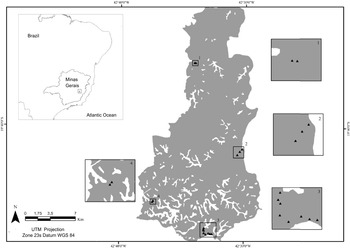
This study was conducted in the Rio Doce State Park (RDSP), located in southeastern Brazil at Minas Gerais State (19º48'S 42º38'W; Figure 1). This Park represents the larger protected fragment of Atlantic Forest in the State with approximately 36,000 hectares (ha). The vegetation consists of Semidecidual Submontane Seasonal Forest that underwent a natural regeneration process after the last fire in the 1960s. The Park presents secondary forests interspersed with stretches of primary forests (Stallings et al. Reference Stallings, Fonseca, Pinto, Aguiar and Sábato1990). Analysis of the landscape dynamics revealed that RDSP underwent minimal changes in the landscape between 1985 and 2015, and the human-altered uses are almost insignificant concerning the total area of the native forest (Oliveira et al. Reference Oliveira, Carvalho-Ribeiro and Maia-Barbosa2020).
Locations of the 15 plots (sample units) in the trails Juquita (1), Campolina (2), Mombaça (3), and Vinhático (4). The marks indicate georeferenced points of main Joannesia princeps trees established between January and June 2016 at Rio Doce State Park, Minas Gerais, Brazil. Inserts in the upper left corner show the location of the state of Minas Gerais in Brazil and, within the state, the location of the Rio Doce State Park.

Joannesia princeps is an endemic and common tree in the Brazilian Atlantic Forest, acting as a pioneer or early secondary species in secondary forests (Lopes et al. Reference Lopes, Silva, Souza and Meira Neto2002). In secondary forests, the adult individuals present a height between 15 and 20 m and a diameter between 40 and 60 cm (Lorenzi Reference Lorenzi1998). Flowering occurs between June and December, and fruits mature between March and July in the Atlantic Forest of Minas Gerais State, Brazil (Carvalho Reference Carvalho and Vencato2005, Lorenzi Reference Lorenzi1998). The fleshy fruits are divided into exocarp, open in four woody valves, and indehiscent hard-husked endocarp containing two to three seeds. The endocarps present mass of 54.29 ± 11.45 g (mean ±SD, n = 439), length of 60.96 ± 6.26 mm (mean ±SD, n = 319), and diameter of 58.66 ± 5.66 mm (mean ±SD, n = 442).
Agoutis are known to be the only dispersers of J. princeps seeds in the Atlantic Forest (Galetti et al. Reference Galetti, Brocardo, Begotti, Hortenci, Rocha-Mendes, Bernardo, Bueno, Nobre, Bovendorp, Marques, Meirelles, Gobbo, Beca, Schmaedecke and Siqueira2017, Mittelman et al. Reference Mittelman, Kreischer, Pires and Fernandez2020). The Azara’s agouti (Dasyprocta azarae Lichtenstein) is a scatter-hoarding rodent that weighs from 1 to 4 kg and is found in forest and savannah habitats in southeast South America (Catzeflis et al. Reference Catzeflis, Patton, Percequillo and Weksler2016). As scatter-hoarding rodents, they have the behaviour of storing seeds as a food reserve. Food reserves are formed by one or more seeds stored on the soil surface, which can be recovered for later consumption mainly during periods of scarcity (Smythe Reference Smythe1978). Joannesia princeps fruits show primary dispersal by gravity (barochory) and secondary dispersal by scatter-hoarders behaviour (synzoochory) (Carvalho Reference Carvalho and Vencato2005). After primary dispersal, only the endocarp and the seeds within it tend to remain on the forest floor to be transported by dispersers. The pulp of the J. princeps fruit is not widely consumed by frugivores and is quickly perishable after falling to the ground. Although agoutis interact with a wide variety of large-seeded species, only recently have the interactions between J. princeps seeds and agoutis received more attention. In areas undergoing natural restoration, agoutis have recovered dispersal interactions with J. princeps seeds and improved recruitment of their seedling (Mittelman et al. Reference Mittelman, Kreischer, Pires and Fernandez2020).
Sample design and density of trees
To estimate the density of J. princeps trees, we recorded all adult individuals (DBH > 40 cm) in 15 fixed plots of 2500 m2 that were located on a flat floor and had at least two adult J. princeps trees (Figure 1). Due to the absence of phytosociological studies that could inform about the variation of J. princeps density, we established the plots in the main trails of the RDSP where we already had previous knowledge of J. princeps presence. The centres of each plot were separated by at least 200 m. This distance is approximately the diameter of a circular area of three hectares which is a proxy to home ranges described for agoutis (Silvius & Fragoso Reference Silvius and Fragoso2003), making each fixed plot a spatially independent sampling unit. An adult J. princeps tree was chosen as the central plot tree. From this tree, a 25-m radius was established in the four cardinal directions, forming four quadrants of 25 m × 25 m each, totalling an area of 2500 m². This radius represents a realistic spatial scale at which agoutis can respond to food abundance (Hirsch et al. Reference Hirsch, Kays, Pereira and Jansen2012).
Seed fate experiment
At the end of the fruiting period, between June and July 2016, we collected, pulped, and dried intact non-infested seeds for the seed fate experiment. We placed between 31 and 33 seeds distributed in three trees at least 5 m apart in each plot. The seeds were distributed around a young tree for plots with only two adult trees (DBH < 40 cm). The seeds distributed in each plot were selected randomly, numbered for individual recognition, and positioned at 1 m from the trunk tree (initial position). We used the spool-and-line method to track seed fate (Forget & Wenny Reference Forget, Wenny, Forget, Lambert, Hulme and Vander Wall2005) with a line length of 50 m. To determine the seed fate, we attached spool lines to 492 experimental seeds and tracked them. Seed fates were checked 40 days after the beginning of the experiment. The time interval established was sufficient to verify the final dispersal events without underestimating them since, for this species, over 95% of cache predation events (recovery and predation of seeds after burial) occur before 40 days (Mittelman et al. Reference Mittelman, Pires and Fernandez2021b).
We considered as removed seeds those found at 0.5 m or more from the initial position, with the other seeds being classified as non-removed. Removed seeds were classified as either dispersed or consumed at their final locations. Seeds were considered dispersed when found intact on the soil surface or buried. Consumed seeds were those found with the endocarp destroyed without seeds in its interior (Figure S1). The removed and lost seeds could not be classified concerning their final location. However, they were considered as removed seeds. We used the signs and marks left on seeds to identify mammal groups that potentially could remove J. princeps seeds.
After the seed removal and fate experiment, we collected available seeds on the surface and below the soil in 64 quadrants (1 m²) distributed randomly and stratified inside the central area of each plot. Seed collection was used to investigate whether plots with high tree density also had high seed abundance. We found that tree density and seed abundance were positively correlated (Spearman correlation = 0.50; P < 0.001). Since we observed this correlation and because J. princeps disproportionally determines the resource abundance in the areas where it is present, we used J. princeps tree density as a proxy for seed abundance in the area.
Besides using signs and marks left on the seeds, we also used cameras as a complementary method to confirm which mammal species interact with J. princeps seeds. In September 2016, shortly after the seed fate experiment, we installed a camera trap (Bushnell® Trophy Cam Natureview-Kansas, USA) in front of the central tree of each plot (n = 15). About 20 seeds, without any tracking, were placed below each central tree. In each central tree, cameras were placed approximately 40 cm from the ground and set to record 30 s HD videos, with an interval of 60 s between videos. All cameras were set to operate 24 hr/day for 31 consecutive days.
Data analysis
We built generalised linear mixed models (GLMMs) with a binomial response to estimate the probability of seed removal, consumption, burial, and dispersal as a function of tree density (fixed effect), using the site as a random factor (n = 4; Figure 1). To test the PS hypothesis, we analysed the probability of seed removal and consumption as a function of tree density. To test the PD hypothesis, we built models testing the probability of seed dispersal and burial as a function of tree density. For the PD hypothesis, we constructed two distinct models for each seed fate (dispersal or burial) probability. The first model concerns all experimental seeds, and the second concerns only removed seeds (excluding the lost seeds – Table S1). Here, using removed seeds can better test the PD hypothesis because this hypothesis predicts that satiety occurs after the removal phase increasing the survival of already dispersed seeds (less buried seeds are retrieved and consumed) (Vander Wall Reference Vander Wall2002, Zwolak et al. Reference Zwolak, Bogdziewicz, Wróbel and Crone2016). We checked for heteroscedasticity, under/overdispersion, and residual correlation in all models. Models were built with the lme4 package in R software (Bates et al. Reference Bates, Mächler, Bolker and Walker2015, R Core Team 2022).
Results
We tracked the fate of 461 seeds of J.priceps in RDSP. Unfortunately, one of our plots had the experimental seeds disrupted because of anthropic interference. From a total of 461 experimental seeds, 158 seeds were removed (34.3%). We tracked the final fate of 158 removed seeds, most of which were consumed (n = 88, 19.1%). Of those seeds dispersed (removed and intact, n = 44), 28 (6.0%) were buried, and the remaining seeds were found on the soil surface (n = 16; 3.4%). Buried seeds were intact and non-infested. A small percentage of removed seeds went missing (n = 26; 5.6%) (Figure 2).
Joannesia princeps seed fate experiments. Sankey diagram shows the proportions and absolute numbers for each fate (non-removed, removed, consumed, lost, and dispersed) after 40 days of exposure at Rio Doce State Park, Minas Gerais, Brazil. The beige and dark green colours represent removed and non-removed seeds, respectively. The red colour represents removed seeds that were consumed, and the light green colours indicate removed seeds that were dispersed. The blue color represents the removed seeds that were lost. The seeds buried and seeds on the soil surface were classified as dispersed seeds.

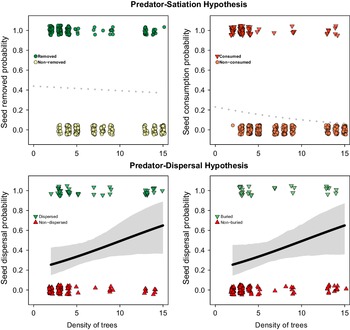
We recorded 312 visits by frugivorous to J. princeps trees using camera traps (Table S2). However, only visits by agoutis resulted in interactions with the seeds of J. princeps. These interactions were of harvest, consumption, or removal of seeds in front of the cameras (Figure S2). Regarding the first prediction tested, we observed that the probability of seed removal and consumption was not related to tree density (Figure 3a and b – Table 1). However, testing the second prediction, we observed that the seed dispersal and burial probability increased significantly with tree density when only removed seeds were considered (Figure 3c – Table 1; GLMM fixed effect: z value = 3.043; P = 0.002; df = 1). Concerning all experimental seeds, the probability of seed dispersal and burial was not associated with tree density (Table 1).
Removed, consumed, and dispersal probability of Joannesia princeps seeds by agouti as a function of the number of trees in fixed plots of 2,500m² at Rio Doce State Park, Minas Gerais, Brazil. A. The beige and dark green dots represent the removed and non-removed seeds, respectively. B. The orange dots represent the non-consumed and the red triangles indicate consumed seeds. C. The green and red triangles represent dispersed and non-dispersed seeds, respectively. D. The light green and red triangles represent buried and non-buried seeds, respectively. The dotted black line represents trends in GLMM global prediction for Predator–Satiation Hypothesis. The filled black line is the GLMM global prediction for the Predator–Dispersal Hypothesis with the bootstrap estimates (gray lines).

Summary and analysis of deviance of mixed models to assess the effect of tree density on teed removal, consumption, dispersal, and burial at Rio Doce State Park, Minas Gerais, Southeastern Brazil

The random effect for all models was (1|g1) [intercept varying among g1] when g1 = site (n = 4). df = degrees of freedom; Chisq = type II Wald chi-square tests; Pseudo R ² = conditional (R ²c) and marginal (R ²m) coefficient of determination for generalised mixed-effect models; SE = standard error. R = Considering only removed seeds. T = Considering all experimental seeds. In all models (except the removed–non-removed model), lost seeds were excluded from the analyses.
Discussion
Our results reveal an increase in the probability of seed dispersal as a function of tree density. However, resource abundance did not affect the probability of seed removal or consumption. The direction and magnitude of interactions involving plants and scatter-hoarding rodents have recently been the subject of discussions in the literature (Zwolak & Crone Reference Zwolak and Crone2012, Bogdziewicz et al. Reference Bogdziewicz, Crone and Zwolak2020, Moore & Dittel Reference Moore and Dittel2020). Nevertheless, these empirical findings have not considered the real context in which interactions occur, failing to include density-dependent effects (Moore & Dittel Reference Moore and Dittel2020). In the density-dependence context, our findings support the PD hypothesis (without support for the PS hypothesis). There was an increase in the probability of burial from removed seeds, but there was no increase in pre-dispersal seed survival (via decreasing seed removal or consumption). These results can have significant consequences on plant populations’ dynamics and seedlings’ recruitment rates (Xiao et al. Reference Xiao, Zhang and Krebs2013).
We observed positive density-dependence effects on seed fate in a high tree density context, with an increasing seed burial probability. Until recently, most studies did not approach the interaction between scatter-hoarding rodents and plants through a context-dependent point of view, failing to include density-dependence effects (Zwolak & Crone Reference Zwolak and Crone2012, Bogdziewicz et al. Reference Bogdziewicz, Crone and Zwolak2020). Some tree species that depend on scatter-hoarding animals for seed dispersal produce massive crops at irregular intervals. Producing more fruit than predators can consume has been explained as a strategy to increase animal dispersal and reduce predation (Kelly & Sork, Reference Kelly and Sork2002). Although we tested hypotheses related to variations in resource production, we emphasise that resource abundance was not manipulated in this study. Instead, we used tree density as a proxy for resource abundance. Another mechanism that increases the number of dispersed seeds in high-resource areas is the diminishing of pilferage rates of seeds in the cache. In areas of high seed abundance, the intrinsic value of the seed tends to be lower, which reduces the likelihood of cache pilferage by other competitors (Moore et al. Reference Moore, McEuen, Swihart, Contreras and Steele2007). With lower cache pilferage, scatter-hoarding rodents need to harvest seeds less often. In the end, more seeds can remain stored in caches in areas with high seed abundance (Vander Wall Reference Vander Wall2002, Jansen et al. Reference Jansen, Bongers and Hemerik2004).
In our study, PD hypothesis was the main mechanism to explain how resource abundance alters seed fate in seed–rodent interactions. Although PD and PS hypotheses assume that satiety occurs in high seed abundance scenarios, the main difference is in the rodent response. Seed dispersal will not always be maximised in the density-dependence context: granivorous can be satiated during seed removal phase, decreasing harvested seeds, and increasing seed survival without necessarily an increase in dispersal (PS hypothesis). Alternatively, satiation can occur after the seed is cached, increasing seed survival through dispersal or burial (PD hypothesis). In the PD hypothesis, seed survival is often attributed to a lower probability of seed consumption due to low levels of seed removal from caches (Li & Zhang Reference Li and Zhang2007, Xiao et al. Reference Xiao, Zhang and Krebs2013). In areas with high tree density and resource abundance, a low proportion of the seed crop can be enough to satiate predators, and thus seeds will be spared. With predators satiated, there is an increase in the rates of dispersal and burial from removed seeds. Besides, cached seeds are more likely to remain stored in the soil if other non-harvested seeds are still available. In the end, density dependence increases effective dispersal and consequently improves the survival of cached seeds. These distinct responses are essential for plant demographics because cached seeds are dispersed and have greater chances of germination and seedlings establishment than non-dispersed seeds.
We show that consumption and dispersal of J. princeps seeds were performed only by agoutis. This singular interaction between agouti and agouti-tree (popularly known as “cotieira”) is corroborated by Mittelman and colleagues (2020) in Atlantic Forest. The outcomes of these interactions are essential for the current context of most of the Atlantic Forest, which is present in small fragments (Ribeiro et al. Reference Ribeiro, Metzger, Martensen, Ponzoni and Hirota2009) and often with the absence of large frugivorous animals (Galetti et al. Reference Galetti, Brocardo, Begotti, Hortenci, Rocha-Mendes, Bernardo, Bueno, Nobre, Bovendorp, Marques, Meirelles, Gobbo, Beca, Schmaedecke and Siqueira2017). In these small fragmented forests, many large-seeded species can exhibit seed dispersal limitations, and scatter-hoarding rodents are often the only dispersers of these plant species (Jansen et al. Reference Jansen, Hirsch, Emsens, Zamora-Gutierrez, Wikelski and Kays2012). Although there is no direct evidence pointing out that J. princeps was dispersed by megafaunal frugivore, J. princeps’ fruit traits (colour, fruit mass, fleshy pulp, seed size, number of seeds, and thickness of endocarp) fit the description by Guimarães et al. (Reference Guimarães, Galetti and Jordano2008) of type 1 megafauna fruits. Furthermore, compiled evidence suggests that agoutis act as substitute dispersers of megafauna fruits as they are the only species able to disperse the largest seeds in the Neotropics (Mittelman et al. Reference Mittelman, Dracxler, Santos-Coutinho and Pires2021a). Therefore, the singular interaction between agouti and agouti tree is an essential match for reducing dispersal limitation and improving seedling survival in Atlantic Forest fragments (Mittelman et al. Reference Mittelman, Kreischer, Pires and Fernandez2020).
The maintenance of ecological functions performed by scatter-hoarding rodents is paramount for plant species regeneration. Since only buried J. princeps seeds can germinate and establish new seedlings (Mittelman et al. Reference Mittelman, Kreischer, Pires and Fernandez2020) and agoutis seem to be the only animal able to do so, they provide a fundamental service to the plant. J. princeps seed dispersal decreases the risk of density-dependent mortality and increases the chances of germination and the establishment of large-seeded plants in safe locations (Haugaasen et al. Reference Haugaasen, Haugaasen, Peres, Gribel and Wegge2010; Mittelman et al. Reference Mittelman, Dracxler, Santos-Coutinho and Pires2021a). Although seed dispersal rates were greater in high tree-density areas, we did not examine seedlings’ recruitment success concerning conspecific parental trees. These results would be essential to assess the probability of seeds stored survival and emerging as seedlings (Jansen & Forget Reference Jansen, Forget, Borges, Charles-Dominique, Forget and Théry2001). Nevertheless, agoutis usually transport seeds to areas with a lesser number of adult conspecifics (Hirsch et al. Reference Hirsch, Kays, Pereira and Jansen2012). Thus, agouti dispersal is likely to help seeds in these high tree-density areas by reducing aggregation and thus minimising negative-density dependence factors causing seed and seedling mortality.
We show that density-dependent contexts, such as tree density, affected seed fate by increasing the probability of seed dispersal through buried seeds. Furthermore, agoutis were the only species that interacted with J. princeps seeds. Our findings support the notion that ecological interactions are vital for ecosystem functioning, exemplified by the necessity that J. princeps has of agoutis for its dispersal. In the long term, the presence of agoutis can be fundamental for the occurrence of J. princeps, minimising the probability of local extinction through the dispersal of their seeds, mainly in areas of high tree density.
Supplementary material
For supplementary material accompanying this paper visit https://doi.org/10.1017/S0266467423000068
Acknowledgments
We would like to thank National Council for Scientific and Technological Development (CNPq) for the scholarship. We thank all the members of Laboratório de Ecologia de Vertebrados LEVE-UFSJ and ECMVS-UFMG for their help with fieldwork, in particular Maria Tereza for identified cutieiras trees. We are still grateful to the members of RDSP (Vinícius, Mirlaine, Élida, Cimar, Sr. Antônio, Silas, Perpétuo, Liban, and Cláudio) for their collaboration with the infrastructure and logistics of fieldwork, mainly Lino and Neymar for having climbed cutieiras trees and collected the experimental fruits. Finally, we would like to thank Ricardo Arrais, Alexandra Cumerlato, and Álvaro Silva for their help with installing camera traps. Viana-Junior AB thanks the receiving a young researcher scholarship from the FAPESPA (Fundação de Amparo a Pesquisa do Estado do Pará) by grant #026/2021, process 2021/658276, by way of the project “Training of Human Resources for the Development of Science in the Amazon”.
Author contributions
Fernanda Cristina Souza: Conceptualisation and design of the study, Data collection, Writing-Reviewing, and Editing. Arleu Barbosa Viana-Junior: Formal analysed and interpreted the data, Writing-Reviewing, and Editing. Fernando Cesar Cascelli de Azevedo: Conceptualisation, Provision of study materials, Writing-Reviewing and Editing, Supervision, Project Administration, and Funding acquisition. Pedro Mittelman: Support with data analyses, Writing-Reviewing, and Editing.
Financial support
This research received no specific grant from any funding agency, commercial, or not-for-profit sectors.
Conflict of interest
The authors declare none.