The regularisation of the cathedral chapter of Sées in 1131 marks a key moment in the ecclesiastical history of medieval France. The replacement by Bishop John de Neuville (1124–44), brother of Arnulf of Lisieux (1141–81), of the secular canons of his cathedral with regular canons brought from the abbey of Saint-Victor of Paris, heralded not only one of the rare instances of such a reform north of the Loire valley,Footnote 1 but also a new period of rapid and fruitful expansion of the Augustinian movement in wider Normandy. The singular significance of this event has, of course, not escaped the attention of historians, who have sought better to establish the reform at Sées within its religious and political context.Footnote 2 The difficulties caused by the regularisation, in particular the disputed episcopal elections of the twelfth and early thirteenth centuries, have also been the subject of recent study, most notably by Jörg Peltzer.Footnote 3 What has hitherto received comparatively little scholarly attention is the effect that this reform had on the chapter at Sées and on the administrative life of the diocese. This is not to say that such issues do not figure in the discussion of the events of this period. Those interested in the reform of 1131 have long commented on what are assumed to have been its far-reaching consequences, noting, for example, how the requirement to elect archdeacons from among the canons must have affected the administration of the diocese,Footnote 4 or how the chapter, like many other regularised communities, seems, at least in the period after 1200, to have occupied a marginal place in the benefice system that was central to the workings of the medieval Church.Footnote 5 The observations made in this regard, however, are typically limited to general remarks situated within the framework of much broader studies.
The aim of this article, therefore, is to examine these issues in detail for the first time. It will do so by looking primarily, though not exclusively, at the acta of the bishops of Sées for the period up to 1220, that is, to the end of the reign of Bishop Silvester, the last bishop of the diocese whose election took place before the loss of Normandy to Philip Augustus in 1204. This corpus of almost 400 texts contains a wealth of information concerning the bishops and their administration of the diocese in the near-century following the events of 1131. Despite its significance, however, such material has featured only infrequently in previous discussion of the reform, due in large part to the fact that the vast majority (almost three-quarters) of it has never been published before.Footnote 6 Although the difficulties associated with charters require a cautious approach to this kind of evidence, it will be shown that the systematic analysis of these documents, in conjunction with material from elsewhere, can offer fresh insights into the impact of the regularisation upon various aspects of life in the diocese. Extensive use will be made of the acta witness lists to trace the evolution of the episcopal household, a key element in the administrative life of any diocese, and to examine the extent to which its composition reflected the changes brought about by the reform. This article will also use the acta to shed new light on the activities of the bishops during these years. It will pay particular attention to the relationship between bishop and chapter, and will show that these prelates, whose careers were often overshadowed by the contentious nature of their elections, were, in certain instances, supportive not only of the reform established within their cathedral, but also of the wider Augustinian movement. It will conclude by briefly considering what, if anything, the example of Sées can tell us about the regularisation of cathedral chapters in the Middle Ages.
Situated between the dioceses of Le Mans, Chartres, Bayeux, Lisieux and Évreux, the diocese of Sées occupied a place of strategic significance on the frontiers connecting Normandy with Greater Anjou and the Chartrain. Its earliest bishops, who can only be identified with any certainty from the beginning of the sixth century, were initially styled episcopus de Uxuma (Exmes),Footnote 7 only adopting the title of episcopus Sagiensis from 541 onwards, a duality that suggests the development of churches at both sites.Footnote 8 Little is known about the Merovingian bishops beyond their names. The same is essentially true for those of the Carolingian era. As elsewhere in the region, the diocese suffered as a result of the Scandinavian incursions of the ninth century. Bishop Hildebrand (850/3–83) was forced into exile at Moussy-le-Neuf,Footnote 9 in the diocese of Meaux, while Adelelme, his successor, was captured and sold into slavery.Footnote 10 The latter's death in around 910 began a vacancy in the see that would last until around 990.Footnote 11 The first bishop to re-establish an episcopal presence in the city was Azo (c. 990–c. 1015). He is known only for the rebuilding of the cathedral, which he accomplished in part by tearing down the walls of his city.Footnote 12 But if Orderic Vitalis is to be believed, the disorganisation of the diocese was such at this time that a part of it was incorporated into that of Lisieux on the grounds that its residents did not know who their bishop was.Footnote 13 The real reason for the reallocation of these lands was, however, probably as much political as ecclesiastical, since it helped to contain the ambitions of the powerful family of Bellême, whose influence in the diocese had been growing since the early eleventh century.Footnote 14 The episcopal seat itself was occupied during these years by two men related to the family, namely Sigefrid (c. 1017–c. 1025) and Ivo (c. 1047/8–c. 1071), the latter of whom was also lord of Bellême,Footnote 15 and although ducal authority in the diocese was in part restored under William the Conqueror (1035–87), circumstances rapidly deteriorated during the reign of his son, Robert Curthose (1087–1106).Footnote 16
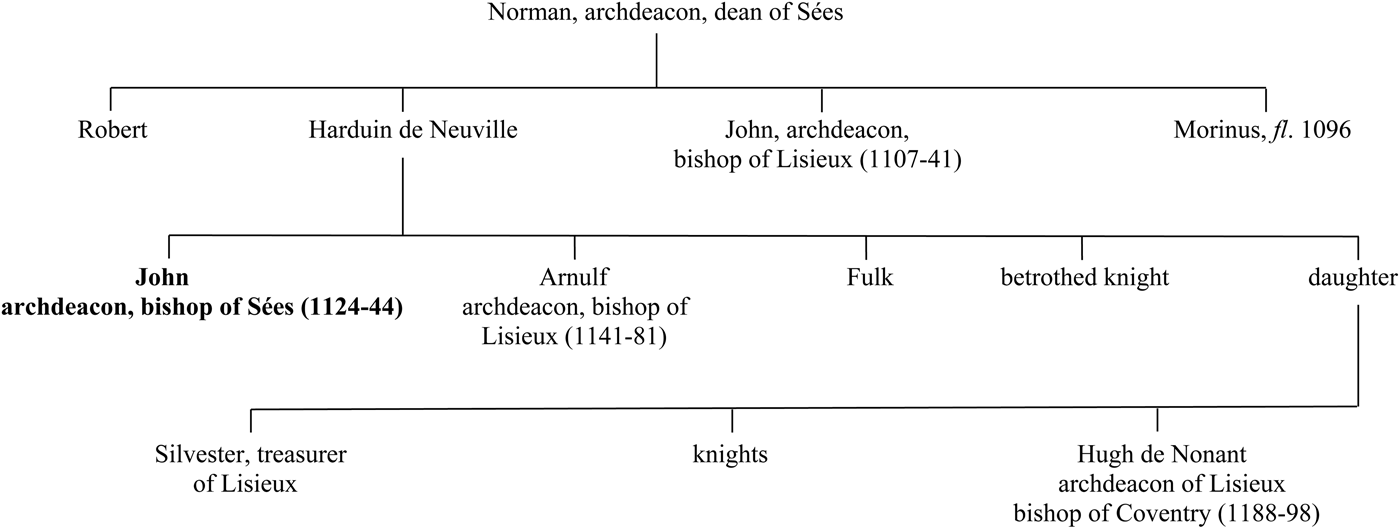
It is in the context of these difficulties, which saw Robert ii de Bellême (1077–1112) force Bishop Serlo d'Orgères (1091–1123) into exile in England in 1103/4, that the reform of 1131 must be seen. Serlo's successor, John, who was an archdeacon at Sées, belonged to a family long established in the ecclesiastical and secular life of the city (see fig. 1). His grandfather, Norman, had been dean of the cathedral chapter, while his namesake uncle, whom he had succeeded as archdeacon, had been elected bishop of Lisieux (1107–41), serving as chief justiciar in Normandy under Henry i (1100–35).Footnote 17 Such familial connections, it has been suggested, must have appealed greatly to the king-duke, who no doubt saw John's election to the episcopate as a means by which further to reduce the influence of the Bellême in the diocese and to bring greater stability to the duchy's southern frontier.Footnote 18 It is likely that similar considerations guided the regularisation of 1131. This is not to suggest, of course, that reforming zeal did not play any role whatsoever. Monarchs throughout Europe, including Henry's neighbours in France and Scotland, played a leading role in promoting the fashion for Augustinian houses,Footnote 19 and the conquest of Normandy in 1105–6, where volatility under Curthose had previously hampered the spread of a reform movement,Footnote 20 presented the king-duke with the opportunity to create a network of regular communities similar to those that he had helped to establish in England.Footnote 21 Bishop John, on the other hand, was not only an active member of Henry's court, but his election to the episcopate coincided with the rise of a number of reform-minded bishops in the Anglo-Norman realm and beyond,Footnote 22 among whom were his uncle at Lisieux and his diocesan neighbour, Geoffrey de Lèves, bishop of Chartres (1115–49), both of whom had unsuccessfully tried to reform their chapters.Footnote 23 But neither Henry nor John can have been unaware that the chapter at Sées was in many ways a Bellême institution. It owed its establishment and early endowment to William i de Bellême (c. 1005–c. 1035),Footnote 24 and while the family's influence over the chapter was not in the twelfth century what it had been in the eleventh, it is likely that the opportunity to do away completely with Bellême interests in the prebendal church, and to place a new group of canons there under episcopal authority was, as has been noted elsewhere, one that appealed both to king-duke and bishop.Footnote 25 It was certainly a policy familiar to Henry, who, it has been argued, used the implantation of Augustinian canons in the priory (later cathedral chapter) at Carlisle to help stabilise this part of England's volatile northern frontier.Footnote 26
Family tree of John de Neuville, bishop of Sées.

But the changes wrought at Sées helped to create as many difficulties as they resolved. Bishop John was by no means ignorant of this. The idea of a wholesale replacement of the secular canons had clearly been met with some opposition, so the act of reform therefore allowed those who did not wish to take up the habit to retain their status, on condition that their prebends passed to the regular community upon their deaths.Footnote 27 The pre-1131 chapter was allegedly able to support only thirteen canons,Footnote 28 and it is possible that Bishop John, who, according to Orderic Vitalis, had ascended to the episcopate in his youth,Footnote 29 expected the transition to be complete within his lifetime. The secular canons, however, clearly maintained a significant presence right up to his death. Indeed, it was from among their number that the next bishop, Gerard ii (1144–57), was chosen. The details of his contested election, which was eventually confirmed by Pope Eugenius iii (1145–53) in 1147, are so well known that they do not need to be rehearsed here.Footnote 30
The internal dynamics of the chapter inherited by the new bishop and his attitude towards it have, by comparison, received relatively little attention. The episcopal acta offer crucial – although sometimes conflicting – evidence in this regard. On the one hand, the acts issued by Gerard in favour of the chapter show that he was among its more generous benefactors.Footnote 31 The style of his acts has also been shown to reflect, in certain instances, that of the papal chancery, suggesting engagement with currents of reform on a wider level.Footnote 32 But the witness lists paint a somewhat different picture. These testify to the exclusion from the bishop's entourage of certain key figures in the reformed chapter and to the elevation of those who had close ties not only to the bishop, but also to what remained of the secular community. It has already been noted elsewhere how the prior Garin, who had been brought to Sées by Bishop John from Saint-Victor,Footnote 33 and who had been thwarted in his attempts to elect John's successor canonically,Footnote 34 is noticeably absent from Gerard's charters following his election.Footnote 35 Likewise, the chanter, who appears regularly before 1131,Footnote 36 is to be found among the witnesses of only two of the bishop's acts.Footnote 37 Garin's fate is in fact unknown, but by around 1148 he had been replaced by Henry,Footnote 38 who, as archdeacon, had seemingly been among those to sanction Gerard's election.Footnote 39 Later evidence shows that Henry was allowed to remain as archdeacon while prior,Footnote 40 a unique occurrence in the history of the chapter that perhaps suggests that the new bishop was unwilling to trigger the election, as required by the terms of the reform,Footnote 41 of a regular canon to what would have otherwise been a vacant archdeaconry.
Henry was not the only archdeacon important to Gerard. William, archdeacon of Eraines/Exmes,Footnote 42 who had been in post since the end of the eleventh century and thus had longstanding ties to the secular community, seems to have played some role in his election,Footnote 43 while Roger, archdeacon of Sées, the bishop's brother,Footnote 44 was accused by Arnulf of Lisieux of being a key supporter of Gerard's candidacy.Footnote 45 Whatever his role in these events, the election of a relative to this archdeaconry, which is probably that which had been occupied by various members of Arnulf's family, including the bishop of Lisieux himself,Footnote 46 represented a direct challenge to the influence in Sées of those principally responsible for its reform. Henry, William and Roger, along with their colleague Amaury, archdeacon of Bellême, whose election also took place before 1131,Footnote 47 formed the core of Gerard's entourage. They appear, often all together, in all but one of the bishop's twelve acts to survive with a witness list,Footnote 48 while they also accompanied him to important events, such as the Council of Reims in 1148.Footnote 49 Only Hugh, archdeacon of Corbon, is conspicuously absent from the bishop's acts.Footnote 50 The reason for this is not clear, although it is possible that his election had taken place after the reform but before Gerard's election.Footnote 51 His apparent exclusion from the episcopal household therefore stands as perhaps further proof of the bishop's desire to surround himself with men whose loyalties lay with him and the secular community, rather than the reformed chapter.
Of course, the frequent appearance of archdeacons in the bishop's entourage at this point in the twelfth century would, in any other diocese, hardly be worthy of note. But circumstances under Bishop Gerard seem to suggest that the reform had little impact, at least in its first two decades, upon this aspect of the administrative life of the diocese. The archdeacons, moreover, are not the only individuals with ties to the old secular community who appear frequently alongside the bishop. Six canons feature among the witnesses of an act given in around 1154, of whom three are specifically identified as seculars: William de Pont-Audemer, Hugh, nephew of Bishop Serlo, and Garin Monk (‘monachus’).Footnote 52 Their appearance not only testifies to the continued existence of rival parties within the chapter over twenty years after the reform, but evidence from the bishop's acta shows that it was these individuals, and not their regular counterparts, two of whom are also identified in the act, who counted among the important members of his entourage. We know, for example, that William served Gerard as chaplain,Footnote 53 while Garin, who is perhaps to be identified with the canon of that name mentioned in an act of Bishop John,Footnote 54 figures regularly among the witnesses of the bishop's acts.Footnote 55 A canon Hugh also appears in three of Gerard's charters, on one occasion next to Garin Monk,Footnote 56 and although it is impossible to be certain of his identity, the bishop's tendency to surround himself with individuals with links to the old secular community suggests that this individual is most likely the same as that identified as the nephew of Bishop Serlo.Footnote 57
Canons are, with the exception of an act of 1153,Footnote 58 otherwise rare witnesses to Gerard's charters.Footnote 59 This is not to say that their apparent exclusion from his household means the bishop took steps to undermine the regular chapter. Gerard's acts in its favour have already been noted, while according to Arnulf of Lisieux, writing in early 1161, the chapter was able to accommodate almost three times the number of canons it had been before the reform.Footnote 60 Nothing in the diplomatic record allows us to confirm this statement, although the act of 1153 is witnessed by ten canons, to whose names can be added a further five active in the same period.Footnote 61 Little else is known of these individuals. Their toponymics, however, reflect a body composed almost exclusively of people recruited from within the diocese, a not entirely surprising fact, but one that suggests that of those canons who had been brought from Saint-Victor in 1131, none remained.Footnote 62 The chapter at Sées may not, therefore, have been impoverished during Gerard's reign, but the picture that emerges from the acta of this period is that of an institution isolated from its ‘mother house’ and governed by a man who, although he had been required to become a regular himself,Footnote 63 seems to have remained a secular at heart.
It was perhaps in an attempt to re-establish links with Paris, not to mention adhere to their electoral traditions, that the regular canons, following the death of Bishop Gerard in 1157, chose as his successor Achard, abbot of Saint-Victor (1155–61). Their efforts would be frustrated once again, however. This time their opponent was Henry ii (1154–89), who wished to elect Froger, his almoner, to the episcopal seat. The two sides remained deadlocked for over two years, with the king eventually emerging victorious.Footnote 64 His candidate, whose election took place on 20 December 1159,Footnote 65 is without doubt the most interesting occupant of the bishopric during the twelfth century. Apparently from the region near Lisieux, he had served as domesticus to Bishop Arnulf, who had perhaps endowed him with the prebend of La Pommeraye.Footnote 66 His career then took him to England, where he became archdeacon of Derby, before finally entering into the king's service.Footnote 67 As bishop, what little his contemporaries said of him is overwhelmingly negative. For his former master, Froger was a constant enemy of the reform established by his brother,Footnote 68 while the bishop's involvement in the Becket controversy led one of the archbishop's adherents to brand him ‘the butcher of Sées’ (‘carnifex Sagiensis’).Footnote 69 It was perhaps on account of the persistent attacks of Bishop Arnulf, who claimed that the new bishop was openly supporting the anti-pope Victor iv,Footnote 70 that Froger sought at first to resign his see, a request that was denied by Alexander iii (1159–81).Footnote 71
But while the new bishop was in many ways a worldly man who spent much of his time at the royal court,Footnote 72 he was clearly not disinterested in religious affairs, showing a particular interest in the reformed orders. He had been, since his days as archdeacon of Derby, a generous patron of the Cistercian abbey of Mortemer, to which he bequeathed various gifts, including a New Testament in two volumes. As bishop, he gave £800 for the completion of the abbey church and dedicated the chapel of the infirmary.Footnote 73 He also came to an agreement with Abbot William (1180–1200) concerning their respective possessions at Roule.Footnote 74 Froger seems likewise to have had a particular attachment to the Premonstratensian order. For reasons that are not entirely clear, but which were perhaps linked to the nature of his election as bishop, he seems to have made a canonical profession either at the abbey of Cappenberg or perhaps that of Arnstein.Footnote 75 He is commemorated in the necrology of the abbey of Prémontré as a generous benefactor,Footnote 76 while his name is recorded in the obituaries of numerous Premonstratensian houses, from that of Silly,Footnote 77 in his own diocese, to Saint-Jean de La Castelle in Gascony.Footnote 78
A close analysis of Froger's acta also shows that he was, despite the accusations levelled at him by Arnulf of Lisieux, a generous supporter not only of the regular canons of his chapter, but also of the wider Augustinian movement. This is not to say that the new bishop did not take certain steps that sometimes ran contrary to the terms of the reform of 1131. The election of his nephew, John, to the archdeaconry of Eraines/Exmes, which Arnulf claimed the bishop had succeeded in having secularised with the pope's blessing, was clearly intended to strengthen his position in the chapter,Footnote 79 a fact reflected by John's appearance in more than half of his uncle's acts with a witness list (twenty-five of forty-seven acts).Footnote 80 In decrying John's election, the bishop of Lisieux went on to dismiss Froger's suggestion that he had been forced to take such action because of a lack of qualified clergy.Footnote 81 Such claims, however, may not have been as far from the truth as Arnulf suggested. We have already noted the seemingly parochial recruitment of the canons under Bishop Gerard, and it is entirely possible that his successor, himself a former archdeacon conscious of how the reform would impact this aspect of the administrative life of his diocese,Footnote 82 acted as he did not only out of self-interest, but also because he found none among his chapter with the experience necessary to occupy such a demanding position. Even the bishop of Lisieux himself was forced to admit that the duchy's regular communities struggled to attract recruits,Footnote 83 a statement that, as will be seen below, seems to have held true for the chapter of Sées. Froger's replacement of the prior, moreover, whom Arnulf claimed had been ousted because he dared complain about the bishop's conduct, must surely be seen as intended to resolve the irregularity of Henry's dual status as both prior and archdeacon.Footnote 84 His replacement, John, alleged by Arnulf to be a simpleton (‘idiota’), not only went on to serve the chapter without issue well beyond Froger's death,Footnote 85 but his intermittent appearances in the bishop's acts suggests that he was not, as the bishop of Lisieux implied, one of Froger's close adherents.Footnote 86 In contrast, Archdeacon Henry continued regularly to witness the bishop's acts.Footnote 87 Any ill feeling that may have arisen between the two as a result of the bishop's actions must, therefore, soon have been forgotten.
Froger also took steps to build a good relationship with his chapter. He granted to the canons the churches of Saint-Sauveur-de-Carrouges and of Ners, as well as a yearly income from the mill of Pussou for the celebration of his anniversary.Footnote 88 It was also thanks to him that the episcopal residence at Fleuré became part of the cathedral's possessions.Footnote 89 The bishop even worked with his canons to endow other Augustinian institutions within the city. According to a mention of a lost act, it was Froger, who, in 1180, founded the hospital (later priory) of Sainte-Croix de Sées, whose brothers had adopted the Augustinian rule, granting to them, with the consent of the canons of his cathedral, the churches of Belfonds and Vieux-Pont, along with various other possessions.Footnote 90 Elsewhere, such was the bishop's largesse, according to Robert de Torigni, that he not only improved the cathedral church, greatly enlarging its temporal possessions, but also left behind an enormous treasure of gold and silver.Footnote 91 It was no doubt thanks to such munificence that the canons of Saint-Victor, to whom Froger gave sixty marks of silver, remembered the bishop as a ‘special friend’ (‘specialis amicus’) in their obituary.Footnote 92
But if Froger seems to have maintained a good relationship with his chapter, the bishop's acta reveal that its members played only a marginal role in his household. The infrequent appearances of Prior John in Froger's acts have already been noted. The chanter, on the other hand, second dignitary of the chapter,Footnote 93 is completely absent from the witness lists. This stands in stark contrast to neighbouring dioceses, such as Avranches and Coutances, where these figures appear frequently in the acts of their bishops.Footnote 94 Besides the acts attested by Prior John, only four others are known to include the subscription of a member of the chapter.Footnote 95 The core of Froger's household was, like that of his predecessor, initially formed by the archdeacons. The most important of these was his nephew John, archdeacon of Eraines/Exmes, who appears in over half his uncle's acts with a witness list. Herbert, archdeacon of Corbon, is the next most frequent attester (fourteen acts), followed by Henry, archdeacon of Houlme (eleven acts), and Roger, archdeacon of Sées (eight acts).Footnote 96 Their attestations, and those of their successors, suggest, however, that it was during Froger's episcopate that the terms of the reform began finally to have an effect on the place of the archdeacons in the machinery of diocesan governance. Only Archdeacon John, whose career continued into the 1190s,Footnote 97 is known to have witnessed his uncle's acts throughout his episcopate. Roger and Henry, on the other hand, both of whom had links to the old secular community, seem to have died towards the end of the 1160s.Footnote 98 Their successors are almost unknown. Henry de Alneto, who followed Roger as archdeacon of Sées, appears in only one of Froger's acts,Footnote 99 while the next mention of an archdeacon of Houlme is known thanks only to an act of Walter, archbishop of Rouen (1185–1207).Footnote 100 Likewise, the successor of Amaury, archdeacon of Bellême, whose last known mention dates to 25 December 1155,Footnote 101 is entirely absent from Froger's acts (nor can he be found anywhere else, for that matter). The reason for the apparent exclusion of these archdeacons from the bishop's household is unknown. It seems most likely, however, that Roger, Henry and Amaury had all been succeeded by regular canons, causing a fundamental shift in the relationship between bishop and archdeacon. As for Herbert, archdeacon of Corbon, the frequency of his attestations, which are conspicuously high given the relative unimportance of his archdeaconry,Footnote 102 perhaps suggests that, like Archdeacon John, he was related to the bishop in some way.Footnote 103 No precise date can be given for his death, but it was probably shortly after 1170, his last datable appearance.Footnote 104 As elsewhere, his immediate successor is also unknown.Footnote 105
It was no doubt in response to these changes that Froger began to develop around him a close circle of clerks. Six of these individuals are conspicuous by the frequency of their attestations: Robert de Jort, Odo d'Orgères, Osbert de Canon, Peter de Coutances, Ralph de Mesnilgerberto and Thomas de Saint-Paul.Footnote 106 Their careers, which sometimes saw them involved in matters well beyond the confines of the episcopal household, are examined in detail elsewhere.Footnote 107 In this respect, the episcopal entourage at Sées began to reflect those of English bishops unfortunate enough to preside over monastic chapters, who, early on in the twelfth century, had to create large clerical households to help them with their administrations.Footnote 108 Of the other frequent attesters of Froger's acts, those individuals associated with the Augustinian priory of Sainte-Barbe-en-Auge stand out. Two canons in particular, namely Walter and Herbert, figure often enough among the witnesses of the bishop's acts to suggest that their appearance is more than just coincidental,Footnote 109 while Daniel, prior of Sainte-Barbe, is also witness to three charters.Footnote 110 Froger was a generous patron of the priory, granting it various churches and issuing a general confirmation of its possessions.Footnote 111 Robert of Beckford (Becchefort), who appears among the witnesses of six of the bishop's acts, can also be tied to Sainte-Barbe. Of English origin, his toponymic indicates that he was associated with a manor belonging to the priory.Footnote 112 Never is he referred to with an ecclesiastical title (or a secular one, for that matter), but it seems likely that he is the same as Robert of Beckford (Becquefort), later prior of the house of regular canons at Saint-Lô de Bourg-Achard, who is mentioned in an act of Robert de Neubourg, dean of Rouen.Footnote 113 His appearance in Froger's acts not only provides further evidence of the bishop's close links with Sainte-Barbe, a regular house that lay outside his diocese, but also suggests that his household was a place where Augustinian careers could be nurtured.
The death of Bishop Froger in 1184/5 brought about yet another vacancy in the episcopal see. Little is known of these years, except that the diocese seems to have been administered by Odo d'Orgères, one of Froger's clerks, who served as its guardian (‘custos’).Footnote 114 The circumstances surrounding the election of the next bishop, Lisiard (1187/8–1201), who had been a secular canon at the cathedral of Le Mans, are obscure.Footnote 115 His relationship with the regular chapter seems nevertheless to have been a good one, despite the accusations levelled against him after his death.Footnote 116 His general confirmation of the chapter's possessions,Footnote 117 which were also confirmed during his episcopate by Innocent iii (1198–1216) and taken under the protection of King John (1199–1216),Footnote 118 shows that it had become, with forty-two churches, by far the largest patron in the diocese.Footnote 119 Like his predecessor, Lisiard granted to the canons an income for the celebration of his anniversary,Footnote 120 while he also appears to have worked with them to establish regular institutions elsewhere in the diocese, converting, according to tradition, the leper house of Chartrage at Mortagne into an Augustinian priory affiliated with the chapter of Sées.Footnote 121 It is also possible that it was thanks to Lisiard's connections in the diocese of Le Mans, which the bishop continued to cultivate following his election,Footnote 122 that the canons came to possess an island in the vicinity of Beaumont-sur-Sarthe.Footnote 123
It was under Lisiard, however, that both the chapter's complexion and its relationship with the bishop seem to have entered the state in which they would henceforth remain. Members of the chapter appear to have been all but excluded from the bishop's entourage.Footnote 124 Dignitaries such as the archdeacons, who played such an important role in the households of previous bishops, likewise feature only rarely in Lisiard's acts.Footnote 125 Such developments were not, of course, unique to Sées, and in many other dioceses the changing role of the archdeacon, whose status as the bishop's pre-eminent administrative officer began to be challenged towards the end of the twelfth century, is reflected by their gradual disappearance from the episcopal acta.Footnote 126 But with the bishops of Sées becoming increasingly unwilling or unable to install their own candidates, vacant archdeaconries were seemingly filled with men chosen from among the cathedral canons, who, judging from what little information survives, seem themselves to have been recruited from among the lower ranks of local society.Footnote 127 As a result, the archdeacons of this period, when compared to their counterparts elsewhere in the Anglo-Norman realm, cut rather unimpressive figures. In many instances their careers are known thanks only to a solitary reference, while none, with the exception of Archdeacon Silvester, who later became bishop of the diocese, seem to have been promoted to higher office.Footnote 128 The archdeacons of Sées are also unusual, when compared to their colleagues elsewhere in Normandy and England, in that not one of them in the period before 1220 seems to have held the title of magister.Footnote 129 It was perhaps on account of a lack of such adequate training, which in itself appears to reflect the inability of the chapter to recruit persons of a certain calibre, that the pope seems only rarely to have appointed the archdeacons of the diocese to act as judge-delegates.Footnote 130 Evidence of their administrative activities is, moreover, extremely sparse,Footnote 131 and by the thirteenth century the archdeacons had apparently become such marginal figures that the occupants of certain archdeaconries are unknown for many decades.Footnote 132
The core of Lisiard's household was, as a result of these developments, composed almost entirely of clerks. These included individuals inherited from his predecessor, such as Odo d'Orgères, and those related to the local nobility, like Peter de Saint-Loyer, uncle of Hodelina, wife of Ralph de Montgommery. The bishop's entourage also included members of his immediate family, such as his nephews Geoffrey and Raymond.Footnote 133 But if men like Odo and Peter, both of whom appear in more than half of Lisiard's acts with a witness list, were seemingly of critical importance to the bishop, the evidence suggests that the circumstances created at Sées by the reform meant that it was, by and large, a place where the rewards for such individuals were extremely limited. Indeed, of the bishop's 152 acta to survive, only one concerns the presentation of an episcopal clerk to a benefice,Footnote 134 while no such act of patronage is to be found among the charters of his two predecessors. Such circumstances stand in stark contrast to those elsewhere in the Anglo-Norman realm, where members of the episcopal household were not only instituted in various churches, but were sometimes succeeded there by their relatives.Footnote 135 Of course, the regularisation of the chapter presented limitations in this regard, since there was little benefit to be had in elevating clerks to be canons when their possessions were to be held in common,Footnote 136 but those English prelates faced with monastic chapters overcame similar problems by securing prebends or dignities for their clerks at secular cathedrals elsewhere, or by persuading local monastic houses to present these individuals to their rectories or vicarages.Footnote 137 The apparent failure of the bishops of Sées to act similarly is hard to explain, although it is possible that the chapter's position as by far the largest patron in the diocese served to intensify competition for what benefices remained.Footnote 138
If Lisiard's death in late September 1201 brought about yet another disputed election at Sées, the man eventually chosen to replace him was, for the first time since the reform, a member of the chapter.Footnote 139 Bishop Silvester (1202–20), formerly archdeacon of Sées, had been elected by the prior, and confirmed by Innocent iii, following the death of the original candidate, Ralph de Merula, during a trip to Rome. Silvester's career had begun under Bishop Froger, whom the editors of the Gallia Christiana claimed was his uncle.Footnote 140 Evidence from the bishop's own acta reveals, however, that his familial connections were, like at least two of the other chapter members nominated for the vacant bishopric, very local indeed.Footnote 141 But while the new bishop may have been, to borrow the expression of the prior of Sées, ‘from the bosom of the church’ (‘de gremio ecclesie’),Footnote 142 the circumstances of his election had caused a bitter rift within the chapter. It seems that tensions were still running high a decade later, since in June 1212 the pope instructed the bishops of Bayeux and Coutances, along with the abbot of Perseigne, to investigate (apparently false) accusations, perhaps made by disgruntled elements within the chapter, that Silvester and the prior, John, were guilty of ‘perverse acts’ (‘perversis actibus’).Footnote 143 Unfortunately, the episcopal acta do not allow for much insight into the internal dynamics of the chapter at this time. None of the bishop's eighty-one acts for which we have a complete or partial text contain a witness list, an absence that is noteworthy even for a period when such methods of corroboration were becoming increasingly unusual.Footnote 144 It is therefore all but impossible to reconstruct Silvester's household and to see whether certain individuals appear at his side more frequently than others.
The bishop was, nevertheless, a generous patron of the chapter, issuing confirmations of its possessions,Footnote 145 and granting to it various benefices that he had acquired at Bursard.Footnote 146 He likewise gave to the prior and canons all the fruits and revenues (‘fructus et proventus’) of the church of Valframbert, which he had purchased from the monks of Saint-Martin de Sées for the sum of £400.Footnote 147 By 1207 he had also instituted Prior John to serve as his official,Footnote 148 a move that suggests that the bishop, unlike his immediate predecessors, perhaps intended to staff his household with people from within the chapter.Footnote 149 Notwithstanding the inquiry of 1212, Silvester's reign was, moreover, otherwise uneventful. He proved himself to be a very capable administrator who also took the time to engage with the wider ecclesiastical developments of his era, ensuring that his city played a role in their dissemination.Footnote 150 It has been suggested, however, that the choice of his successor, who had a reputation for the restoration of discipline, points towards ongoing internal power struggles within the chapter.Footnote 151 Whatever the reality, the reign of Bishop Gervase (1220–8), along with that of his successor, Bishop Hugh (1228–40), would finally bring an end to the controversies that had periodically troubled the community at Sées since its regularisation in 1131.
What conclusions, if any, can be drawn from all this? The first point worth noting concerns the near-uniqueness of the circumstances at Sées. What, if anything, can they tell us about the wider canonical movement and, more to the point, about the reform of cathedral chapters in particular? Given the very different circumstances in which regular chapters were created elsewhere in Europe, where the influence of certain papal legates was paramount (southern France),Footnote 152 or where the poverty of the diocese often acted as the primary catalyst (Spain and Portugal),Footnote 153 it would seem, at first glance, to be very little indeed. But the community at Sées was not alone in northern France in its regularisation. In neighbouring Brittany, the bishop of Saint-Malo, John de la Grille (1144–63), had transferred the episcopal seat from Alet to Saint-Malo, establishing a regular chapter there in the process. Comparatively little work has been done on this reform, which took place at an unknown date between 1146 and 1152, but that which has shows that while there are certain key differences between the two cases, there are also some interesting parallels. Both were established with papal support, both adopted the Victorine ordo, and both saw new electoral rules requiring the bishop and the archdeacons to be elected from among the canons.Footnote 154 Most interesting of all, the first person to be established at the head of the newly reformed chapter at Saint-Malo was, like his counterpart then at Sées, both prior and archdeacon.Footnote 155 Does this striking coincidence suggest that there was some sort of interaction between the two communities? This seems unlikely, but the fact that John de la Grille, a person of impeccable reform credentials, saw fit to entrust his fledgling community to an archdeacon, who had presumably originally been elected when the secular chapter was still at Alet, is nevertheless worthy of note.Footnote 156 As for the acta of the bishops of Saint-Malo, so few survive from the reign of John de la Grille that little can be determined about the period immediately following the reform, while the lack of a critical edition for those issued after 1163 means that its long-term consequences cannot at present be properly investigated.Footnote 157
If, however, a full comparison of the circumstances at Sées and Saint-Malo is not yet possible, the evidence from Brittany does suggest that the reform there was far less contentious. Bishop John's immediate successors appear to have been elected without issue, despite the fact that at least one came from outside the chapter.Footnote 158 The fact that the chapter at Saint-Malo seems to have been created as an entirely new institution, rather than as the result of a reform of the old secular body,Footnote 159 probably helped matters in this regard. The complexity of the circumstances at Sées, which was both a much richer and a more strategically significant diocese,Footnote 160 may not, by comparison, come as much of a surprise, but this complexity is still a fact worth reemphasising. Previous discussion of the reform at Sées, in particular with regards to the election of its bishops, very often paints these events as simply the imposition of secular prelates upon a regular community. The evidence of the episcopal acta shows, however, that the process of regularisation was gradual rather than abrupt. Bishops such as Gerard and Froger inherited a chapter that still had many links, both financial and familial, to the old secular community, a fact that both men had no hesitation in exploiting for as long as it was possible to do so. In this respect, the circumstances at Sées echo those elsewhere in Europe, where the establishment of certain regular communities, in particular those that involved the replacement of an existing secular body, was characterised by hostility, apprehension and an unwillingness to embrace fully those changes imposed by the reform.Footnote 161
But the acta also show that, despite the dire warnings of those such as Arnulf of Lisieux, the terms of the reform had created a community that could and would endure. Gerard, Froger and Lisiard had, of course, used their positions to advance the careers of their relatives, occasionally undermining aspects of the reform as a result, but nothing indicates that they were able to cultivate multi-generational networks of patronage like those that characterised cathedral chapters elsewhere in Normandy and England (and had characterised Sées before 1131).Footnote 162 There was, moreover, no attempt to undermine the authority of the chapter through the establishment of a rival college of secular clerks, as happened in cities with regular chapters (both canonical and monastic) elsewhere in the Anglo-Norman realm,Footnote 163 and although the acta show that these prelates did not include the priors, chanters and canons of the chapter among their intimates, they were, in certain instances, supportive not only of the reform at Sées, but also of the wider Augustinian movement. Even men like Bishop Gerard, whose relationship with the chapter can best be described as ambiguous, perhaps played a more nuanced role in the reform movement than at first appears. After all, what is to be made of a man whom Bernard of Clairvaux decried as ‘the sly fox of Sées’ (‘Sagiensis vulpecula fraudulenta’),Footnote 164 but who was called ‘blessed’ (‘beatus’) by the chronicler of Sainte-Barbe-en-Auge?Footnote 165
If the evidence suggests, however, that the reform at Sées was, in its purest sense, largely a success, it is also clear that the chapter, like many Augustinian institutions, quickly became insular and conservative in nature. Again, such developments did not occur overnight. The secularisation of the archdeaconry of Eraines/Exmes meant that its occupants could continue to play a slightly more visible role in the religious and political life of the duchy into the early thirteenth century.Footnote 166 But by the reign of Bishop Lisiard, if not even earlier, it must have been clear that Sées was no longer a place where an ecclesiastical career was likely to be advanced, either within the chapter, where vacancies in the hierarchy could only be filled by those already professed as a regular canon, or within the bishop's entourage, where apparently fierce competition for benefices meant slim chance of reward. Such matters were no doubt compounded by the fact that the city itself was never a centre of great economic activity during the Middle Ages.Footnote 167 The chapter's intellectual life, on the other hand, which had flourished in the eleventh and early twelfth centuries,Footnote 168 was, with links to the abbey of Saint-Victor having become all but defunct, little in evidence by the middle of the thirteenth, despite the existence of a not insignificant capitular library.Footnote 169 Whether the almost total absence at this time of professional men (magistri) among the chapter's ranks can be linked to such developments is difficult to gauge,Footnote 170 but Sées was certainly not alone among the regular chapters of Europe in its apparent want of men with such training. Graduate members of the cathedral chapters of Carlisle, Dublin, Whithorn and St Andrews appear just as infrequently (if at all) in the historical record,Footnote 171 despite the fact that, as at Sées, men bearing the title of magister can be found regularly among either the bishop's clerical entourage or at secular institutions elsewhere in the city.Footnote 172 It would, of course, be hazardous to draw too many firm conclusions based on such a small pool of evidence, especially since patterns of recruitment to the canonical orders have not yet been subjected to the same detailed analysis as those relating to the secular clergy.Footnote 173 After all, it is entirely possible that the apparent absence of such men in the sources does not reflect a deficiency on the part of these institutions, but is rather a by-product of Augustinian diplomatic practices, a subject that has likewise hitherto received relatively little attention,Footnote 174 or of some other issue entirely.
This last point serves, finally, to remind us that, while the acta are invaluable for the information that they contain, they allow only an imperfect glimpse both of the activities of the bishops during these years and of the circumstances in the chapter following the events of 1131. The local archives may have largely escaped the sort of catastrophic destruction that befell those elsewhere in Lower Normandy, but the documents discussed here, which come overwhelmingly from monastic sources, whose varying degrees of richness, not to mention their very survival, are dependent on the vicissitudes of archival conservation, no doubt represent only a small part of the total originally issued. Particularly frustrating is the lack of evidence for the decade or so immediately following the reform. Bishop John may have been an important curialis to both Henry i and King Stephen (1135–54), the latter of whom appears to have entrusted him with the vacant diocese of Rochester in 1137,Footnote 175 but only a handful of his acta have come down to us, of which only one, a mention, can be dated to the period after 1131.Footnote 176 Were more acts to survive from this crucial period it would no doubt be possible not only to shed light on various unknowns (who besides Prior Garin was brought from Saint-Victor to Sées? How many seculars chose to retain their status?), but also to determine whether the evidence from his successors' acta represents a marked shift in attitude and circumstances from those under John. Interestingly, the aforesaid mention lists William, archdeacon of Eraines/Exmes, as the first and only witness of the act, suggesting that the bishop's relationship with the remaining secular elements of the cathedral community was perhaps not as different as we might at first assume.Footnote 177 But whatever uncertainties remain, this article has shown, it is hoped, that the acta come closer than any other surviving source to shedding new light on what stands as a critical event not only of Norman but of medieval French history. And for that reason alone both they and the men behind their creation deserve our attention.