Nurses care for children with CHD and their families through many transitions in care and have the opportunity to improve children’s physical and mental health by educating and supporting their parents.Reference Lerret 1 , Reference Sparacino, Tong, Messias, Foote, Chesla and Gilliss 2 Parents of children with CHD have significant educational needs in order to understand this complex condition, its treatment, and how to manage their child’s illness at home.Reference Lerret 1 These challenges are magnified in resource-constrained environments due to a lack of awareness of their child’s discharge needs, financial stressors, and a general lack of resources available to the parents.Reference Cua and Kripalani 3 – Reference Franck, Mcquillan, Wray, Grocott and Goldman 5 In the context of these challenges and the complex, long-term nature of CHD, parents express feelings of stress, uncertainty, and not being adequately prepared for hospital discharge and ongoing home care.Reference Lerret 1 , Reference Franck, Mcquillan, Wray, Grocott and Goldman 5
Discharge teaching provides nurses the opportunity to partner with, educate, and support parents during the transition from hospital to home care. Parents and nurses have the opportunity to create a mutually enhancing, significant relationship where they work as a team to promote the child’s health and reduce parental uncertainty.Reference Curley 6 The concept of mutuality refers to the shared commonality within and mutual benefit of the nurse–parent relationship and during the process of attaining a common goal.Reference Curley 6 Mutuality is especially important when considering discharge from the hospital to home for children with complex home care needs. Mutuality drives nurses and parents to work together towards a common goal of safe discharge through achievement of parental mastery of home care instructions as well as helps parents have greater confidence when caring for their child at home.Reference Curley 6
This investigation describes parents’ and nurses’ perceptions of parental uncertainty and readiness for hospital discharge before and after implementation of the parent education discharge instruction programme in a resource-constrained environment. The parent education discharge instruction programme teaches nurses how to effectively impart post-discharge home care information to parents in order to improve post-cardiac surgery outcomes for children in resource-constrained environments. The programme is designed to enable the nurses to effectively convey knowledge and skills to parents as well as other caregivers such as grandparents and parents to care for their children after discharge. The parent education discharge instruction programme consists of a computer-based discharge education training programme for nurses, individualised bedside teaching and group teaching sessions for parents, and standardised parent educational resources designed for both literate and low-literacy parents. Nurses are taught the fundamentals of parent education – that is, how to teach – and discharge education – that is, what to teach – via a computer-based training course. The nurses’ training course included information on when to seek medical care, signs of infection and infection-prevention strategies, oral care, fingernail care, medication administration, surgical wound care, behavioural changes after cardiac surgery, appropriate activity restrictions and school re-entry after cardiac surgery, nutritional requirements after cardiac surgery, and evidence-based discharge education strategies – for example, teach-back approach. Parent educational resources, such as handouts and posters, were available in English and six Indian dialects – Hindi, Bengali, Kannada, Malayalam, Tamil, and Telugu. A complete description and evaluation of the nurse-led structured discharge programme has been previously published.Reference Staveski, Zheleva and Paul 7
The specific aims of this investigation were fourfold: to describe parental readiness for hospital discharge and uncertainty during illness before and after the parent education discharge instruction programme’s implementation, to evaluate the association between parental discharge knowledge and their perceptions of uncertainty and readiness for hospital discharge before and after the discharge programme’s implementation, to describe nurses’ perception of parents’ readiness for hospital discharge before and after the discharge programme’s implementation, and to compare the differences between parents’ and nurses’ perception of parental readiness for hospital discharge before and after the discharge programme’s implementation.
Methods
A quasi-experimental design was used to measure parents’ and nurses’ perceptions of parental uncertainty and readiness for hospital discharge before and after introduction of the nurse-led discharge programme. Research approval was obtained from the Committee on Human Research at the University of California, San Francisco, and from Amrita Institute of Medical Sciences’ Ethics Committee.
The setting was a hospital with ∼45 inpatient cardiac surgery beds, serving children from urban and rural regions in Kerala, India, the surrounding states, and from other countries. Approximately 700 paediatric cardiac surgeries are performed annually at the hospital. All parents in this study had children cared for in the cardiac surgery unit. The cardiac surgery unit has multiple open rooms with four beds in each room and serves low-income families.
Data collection occurred before (Cohort 1) and 4 months after implementation (Cohort 2) of the parent education discharge instruction programme. A non-random, convenience sample was recruited, including parents of children who underwent cardiac surgery and nurses caring for children after cardiac surgery. The exclusion criteria were as follows: parents of a child nearing the end of life, children and their families cared for in private rooms outside the cardiac surgery unit, that is, high-income groups, and any nurse or parent who did not understand and speak English or who did not wish to use an interpreter. Parent and nurse participants in Cohort 1 did not receive the parent education discharge instruction training, whereas participants in Cohort 2 received the training. Informed consent was obtained from all the participants.
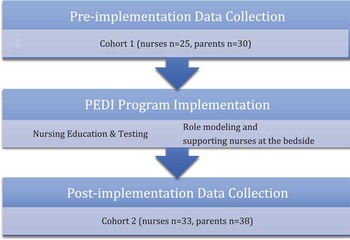
This investigation was embedded in the Parent Education Discharge Instruction Study – a pilot study measuring parent and nurse home care knowledge, nursing documentation, and child outcomes before and after introduction of the discharge programme. Details of the investigation’s methods are described elsewhere (see Figure 1).Reference Staveski, Zheleva and Paul 7 Salient to this investigation, parent participants completed the Parent Mastery Test, the Parent Perception of Uncertainty in Illness Scale, and the Readiness for Hospital Discharge Scale-parent before (Cohort 1) and after implementation of the parent education discharge instruction programme (Cohort 2).Reference Staveski, Zheleva and Paul 7 – Reference Weiss, Johnson, Malin, Jerofke, Lang and Sherburne 9 Nurses completed the Readiness for Hospital Discharge Scale-nurse before (Cohort 1) and after implementation of the parent education discharge instruction programme (Cohort 2).
Study design.

The Parent Mastery Test measures parental knowledge about important aspects of their child’s home care after paediatric cardiac surgery in India. The Parent Mastery Test is a four-item questionnaire developed by the research team to measure parents’ knowledge about important aspects of their child’s postoperative care at home after paediatric cardiac surgery in India.Reference Staveski, Zheleva and Paul 7 Learning domains included the following: when to seek medical care, signs of infection, oral care, and fingernail care. Total scores were calculated and based on a 0–4-point scale, and the proportion of correctly answered questions was reported.
The Readiness for Hospital Discharge Scale-parent was developed and validated in the United States to measure parents’ perceptions, confidence, knowledge, and skills related to transition from hospital to home.Reference Weiss, Johnson, Malin, Jerofke, Lang and Sherburne 9 The Readiness for Hospital Discharge Scale-parent is a 29-item positively weighted Likert-format scale (0-10 and is expressed as a total scale with four subscales, with an overall Cronbach’s α of 0.85.Reference Weiss, Johnson, Malin, Jerofke, Lang and Sherburne 9 The reliability of the subscales ranged from r=0.70 to 0.86.Reference Weiss, Johnson, Malin, Jerofke, Lang and Sherburne 9 The Readiness for Hospital Discharge Scale-parent has been used in studies of parents of children after solid organ transplantation and has been evaluated in hospitalised neonates and children with acute and chronic conditions.Reference Weiss, Johnson, Malin, Jerofke, Lang and Sherburne 9 , Reference Lerret and Weiss 10
As parent and nurse perceptions may be different from each other, the Readiness for Hospital Discharge Scale-parent and Readiness for Hospital Discharge Scale-nurse pose the same questions, asking parents and nurses to assess their perception of parental readiness for discharge to home care.Reference Weiss, Johnson, Malin, Jerofke, Lang and Sherburne 9 Readiness for Hospital Discharge Scale-nurse is a 29-item positively weighted Likert-format scale (0–10), the same as the Readiness for Hospital Discharge Scale-parent, but from the nurses’ viewpoint, and has four subscales. The subscales include parent status, parent knowledge, parent coping ability, and expected parental support subscales. The Readiness for Hospital Discharge Scale-nurse has a Cronbach’s α=0.90 (Correspondence with Dr Marianne Weiss, unpublished data).
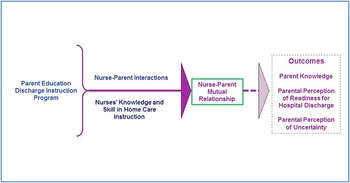
The Parent Perception of Uncertainty Scale is a 31-item Likert-format self-report scale with a standardised α of 0.91.Reference Mishel 8 The Parent Perception of Uncertainty Scale is a measure of how well a person copes and is able to resolve the uncertainty in a stressful situation related to their child’s illness and medical treatment. The Parent Perception of Uncertainty Scale has a reliability coefficient of 0.89 and has four dimensions: ambiguity concerning the state of illness, unpredictability concerning hospital course and prognosis, lack of information about the illness, its treatment, and the system of care, and lack of clarity in what information is available.Reference Mishel 8 , Reference Mishel 11 , Reference Mishel 12 The total Parent Perception of Uncertainty Scale scores range from 31 to 155, with higher scores indicating greater uncertainty. Inter-rater reliability for the dimensions ranges from 0.72 to 0.87.Reference Mishel 8 The Parent Perception of Uncertainty Scale has been used in investigations in the United States and Taiwan to examine the uncertainty of parents of children diagnosed with cancer regarding their child’s illness.Reference Liu and Yeh 13 , Reference Sanatacroce 14 The conceptual framework used to guide our investigation is outlined in Figure 2.
Conceptual model for Parent Educational Discharge Instruction programme.

Data were analysed using SPSS (IBM SPSS Statistics Version 22; Armonk, New York). Total scores and subscale totals were generated as long as 80% of the survey questions were answered. Parent Perception of Uncertainty Scale and Readiness for Hospital Discharge Scale-parent mean score differences between cohorts were evaluated using independent samples Student’s t-tests. Readiness for Hospital Discharge Scale-parent and Readiness for Hospital Discharge Scale-nurse scores before and after the parent education discharge instruction programme’s implementation were compared using a matched pair Student’s t-test and Pearson’s product-moment correlation. Pearson’s product-moment correlation was used to describe the association between Parent Perception of Uncertainty Scale and Readiness for Hospital Discharge Scale-parent scores. Spearman’s rank-order correlation was used to describe the association between total Parent Mastery Test scores and Parent Perception of Uncertainty Scale and Readiness for Hospital Discharge Scale-parent scores. Mean Parent Mastery Test scores were compared using the Fisher exact test. A p-value less than 0.05 was considered to be significant.
Results
A total of 68 parents participated in this study (Cohort 1=30, Cohort 2=38), and two of them declined to participate. There was no attrition. Mean Parent Mastery Test scores were 44% correct for Cohort 1 and increased to 92% in Cohort 2 after the discharge programme’s implementation (Fisher’s exact test, p<0.005). The proportion of parents correctly answering individual questions improved after programme implementation from 24% in Cohort 1, for oral care practices, to 97% in Cohort 2, for signs of infection.
Parent perceptions
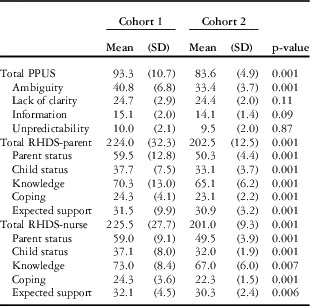
Parents in Cohort 1 (n=29) had higher mean total Readiness for Hospital Discharge Scale-parent scores (M=224, SD=32.2) compared with Cohort 2 (M=202.5, SD=12.5; p<0.05). Parent readiness for hospital discharge subscale analysis revealed statistically significant lower mean scores in all domains (paired Student’s t-test, all p=0.001) (see Table 1). Parents in Cohort 2 had lower mean total Parent Perception of Uncertainty Scale scores (M=83.6, SD=4.9) compared with parents in Cohort 1 (M=93.3, SD=10.7) (paired Student’s t-test, p<0.05). Subscale analysis showed lower ambiguity scores in Cohort 2 (M=33.4, SD=3.7) than in Cohort 1 (M=40.8, SD=10.7; p<0.005).
Comparison of parent and nurse perceptions in Cohort 1 and Cohort 2.

PPUS=Parental Perception of Uncertainty (total score); RHDS=Readiness for Hospital Discharge Score (total score)
Parent (Cohort 1 n=30; Cohort 2 n=37)
Nurse (Cohort 1 n=25; Cohort 2 n=33)
Independent samples t-test
p<0.05 significant
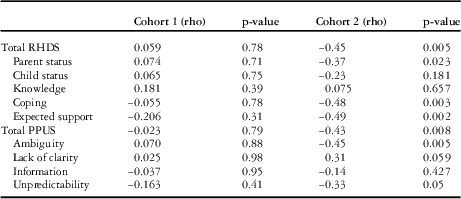
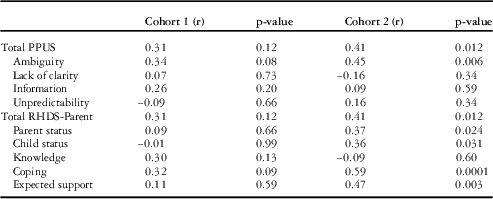
There was no significant relationship between the total Parent Perception of Uncertainty Scale scores and Readiness for Hospital Discharge Scale-parent scores (r=0.31, p=0.12) in parent Cohort 1, whereas in Cohort 2 there was a moderate positive correlation between total Parent Perception of Uncertainty Scale scores and parent perception of readiness for hospital discharge (r=0.41). Subscale analysis revealed a moderate positive correlation for expected support (r=0.47) and coping ability (r=0.59; all p<0.05) (see Table 3).
Cohort 1 showed no significant correlation between total Parent Mastery Test and Parent Perception of Uncertainty Scale scores (rho=0.059, p=0.78). On the other hand, Cohort 2 had a moderate inverse correlation between total Parent Mastery Test and total Parent Perception of Uncertainty Scale scores (rho=−0.45, p=0.005) and had a moderate inverse correlation in two subscales (ambiguity rho=−0.45 and unpredictability rho=−0.325, p<0.05). There was no significant correlation between clarity and information subscales (see Table 2).
Parent correlations between total parent mastery test scores and parent perceptions of uncertainty and readiness for hospital discharge.

RHDS=Readiness for Hospital Discharge Score (total score); PPUS=Parental Perception of Uncertainty (total score)
Spearman’s rank-order correlation
p< 0.05 significant
There were no significant correlations between total Parent Mastery Test and Readiness for Hospital Discharge Scale-parent scores in Cohort 1, whereas for Cohort 2 there was a moderate inverse correlation between total knowledge and total Readiness for Hospital Discharge Scale scores (rho=−0.45, p=0.005). Subscale analysis revealed a moderate inverse correlation with expected support and total Parent Mastery Test scores (rho=−0.49) and coping and total Parent Mastery Test scores (rho=−0.48) in parents after receiving the parent education discharge instruction programme (all p<0.005). There was a weak inverse correlation in parent status and total Parent Mastery Test scores (rho=−0.37, p=0.023). Finally, there was no significant correlation in the information subscale and total Parent Mastery Test scores or child personal status and total Parent Mastery Test scores (see Table 2).
Nurses
In total, 58 nurses participated (Cohort 1=25, Cohort 2=33) and 10 nurses did not complete the Readiness for Hospital Discharge Scale-nurse survey due to staffing constraints and workload (Cohort 1=5, Cohort 2=5). Total Readiness for Hospital Discharge Scale-nurse scores were higher in Cohort 1 (M=225.5, SD=27.7) compared with Cohort 2 (M=201, SD=9.4, p<0.05). Similarly, subscale analysis revealed higher scores in all the subscales in Cohort 1 compared with Cohort 2 (see Table 3).
Parent perceptions – correlations between PPUS and RHDS-parent in Cohort 1 and Cohort 2.

RHDS=Readiness for Hospital Discharge Score (total score); PPUS=Parental Perception of Uncertainty (total score)
Pearson’s product-moment correlation
p< 0.05 significant
Parent- and nurse-matched Readiness for Hospital Discharge Scale comparison
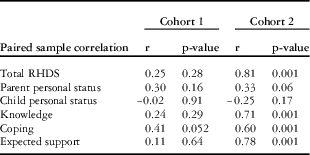
There were 56 matched parent and nurse participants in this study (Cohort 1=23, Cohort 2=33). Cohort 1 had two nurse participants who failed to complete the Readiness for Hospital Discharge Scale-nurse and the matched pairs were excluded from the sample analysis. There was no significant difference in mean total Readiness for Hospital Discharge Scale between nurses and parents in Cohort 1 and 2; however, subscale analysis in Cohort 2 revealed that nurses perceived parents to have higher mean knowledge scores (M=67.0, SD=6.0 versus M=64.9, SD=6.2, p=0.021) and lower mean coping ability scores (M=22.3, SD=1.5 versus M=22.9, SD=2.1, p=0.029). In addition, there was a strong positive correlation between parents’ and nurses’ perception of parental readiness for hospital discharge (r=0.81, p=0.001) in Cohort 2 (see Table 4).
Comparison between RHDS-parent and RHDS-nurse before and after PEDI programme implementation (n=33).

RHDS=Readiness for Hospital Discharge Score (total score)
Paired samples correlations
p< 0.05 significant
Discussion
Parents
Parents of children with CHD require home care knowledge in order to ensure their child’s health and safety, but there has been no research carried out thus far about how to achieve this in a resource-constrained environment. A study in India examined awareness, attitudes, and knowledge of parents of children with CHD and found that parents had a poor understanding of the importance of oral hygiene.Reference Rai, Supriva and Hedge 15 If lack of knowledge contributes to poor oral hygiene practices in children with CHD, children would be at higher risk for infectious endocarditis and other complications that could lead to re-hospitalisation or even death. Previous research has documented parental desire for more information and education to assist them in understanding their child’s illness and care at home.Reference Arya, Glickstein, Levasseur and Williams 16 , Reference Wray and Maynard 17
Standardised parental discharge teaching has been associated with increased knowledge, confidence, parental perception of readiness for discharge, and better coping in developed countries.Reference Weiss, Johnson, Malin, Jerofke, Lang and Sherburne 9 , Reference Yang, Chen, Mao, Gau and Wang 18 , Reference Lerret, Weiss and Stendahl 19 Our findings provide evidence for the first time that a nurse-led structured discharge teaching programme can increase parental knowledge in a low-resource setting. Moreover, the increase in knowledge was associated with parents experiencing less overall uncertainty about their child’s illness and greater knowledge about oral hygiene practices to reduce the risk of infectious endocarditis. Further research is needed to determine whether improved knowledge leads to better oral hygiene practices or reduced infection rates.
Research has shown that families of children with CHD who lack social support have high stress levels.Reference Franck, Mcquillan, Wray, Grocott and Goldman 5 , Reference Werner, Latal, Buechel, Beck and Landholt 20 The use of educational strategies to reduce parental stress, uncertainty, and anxiety has been explored in the literature – for example, Fincher et alReference Fincher, Shaw and Ramelet 21 described a reduction in parental anxiety with pre-operative parental education compared with no intervention in same-day surgery patients. Moreover, parental anxiety has been associated with a lower likelihood of following pre-operative instructions and increased likelihood of procedural cancellation.Reference Chahal, Manlhiot, Colapinto, Van Alphen, McCrindle and Rush 22 Although the parents in our study may have felt less prepared for discharge after home care instruction, they did have less uncertainty and ambiguity about their child’s condition. Further research is needed to determine whether actual parental care of children after discharge is more strongly related to their knowledge, uncertainty, or to their feelings of preparedness.
In an integrative review of discharge literature, Lerret found that meaningful interactions with staff and confidence building for parents ensured successful transitions from hospital to home care.Reference Lerret 1 Others found that standardised teaching and community follow-up increased mothers’ understanding of CHD and their comfort level in caring for their child.Reference Stinson and McKeever 23 , Reference Smith and Daughtrey 24 Our investigation found that parents had less ambiguity and perceived their child’s hospital course and prognosis to be more predictable after implementation of the parent education discharge instruction programme. Nevertheless, parents in our study felt less ready for discharge, had the perception of receiving less support at home than that required, and felt less able to cope with the transition home after receiving home care instructions. Further research is warranted to explicate key aspects associated with successful transition to home care – for example, examination of the importance of relationships and confidence building for parents as key components for a successful transition compared with standardised education and follow-up.
Parent and nurse comparisons of readiness for hospital discharge
Weiss and colleagues found that nursing assessment of poor discharge readiness was associated with a significant increase in post-discharge health care resource utilisation.Reference Weiss, Yakusheva and Bobay 25 In contrast, adult medical patients’ assessment of their discharge readiness had no association with healthcare resource utilisation.Reference Smith and Daughtrey 24 Although there was a low correlation between parents’ and nurses’ perceptions of parental readiness for hospital discharge before the introduction of the parent education discharge instruction intervention, parents’ and nurses’ perception of readiness for discharge were more closely aligned after parent education discharge instruction programme implementation. The closer alignment may be due to mutuality and the subsequent development of a nurse–parent discharge dyad.Reference Curley 6 Nurses in the pre-implementation phase may not have fully appreciated the knowledge and skills parents needed to care for their children at home. The standardised teaching programme may have heightened nurses’ awareness of the importance of follow-up care for children’s continued recovery, and during the more formal discharge teaching they were better able to assess parents’ learning needs more accurately. Further research is needed to test interventions that enhance the mutuality between parents and nurses during home care instruction and foster further development of a nurse–parent dyad. Research is also needed to improve assessment of children’s risk after discharge from the hospital and to develop interventions to mitigate those risks.
Limitations
These findings should be considered in light of the study’s limitations. Our study collected data from a non-random, convenience sample from a single site and used a pre-post design. In addition, we utilised several tools that have not been validated in the Indian context. There was nurse attrition over the course of the study due to staffing constraints and workload. All these factors are sources of potential bias and limit the generalisability of the findings; however, given the paucity of literature related to structured nurse-led parent discharge training programmes in resource-constrained environments, this exploratory study provides insight to inform future research.
Conclusion
The results of our study suggest that the parent education discharge instruction programme carried out by nurses had positive influences on parental perceptions that included a reduction in parental uncertainty and closer alignment in parents’ and nurses’ perceptions of parental readiness for hospital discharge; however, we also found negative effects such as a reduction in parental perception of readiness for hospital discharge after receiving more in-depth discharge instructions. Further explication of these influences could lead to the development of better interventions to educate and support parents during the transition from hospital to home care and may ultimately to lead to healthier lives for children with CHD. Nurses should assess parental uncertainty and readiness for discharge and provide necessary support to improve the transition to home care.
Acknowledgements
The authors acknowledge and thank the following individuals and organisations for their generous support in the development of the PEDI materials (in alphabetical order): Estelle Brouwer (MPA), Children’s HeartLink, Lizzy DeVita (illustrator and graphic designer), Justine Kidd (RN), Jeff Paurus (RN), Pam Sagan (RN), Santhi Sivanandam (MD), WiRED International, Bistra Zheleva (MBA).
This work was performed while Sandra Staveski was a doctoral candidate at the University of California, San Francisco.
Financial Support
This research received no specific grant from any funding agency, commercial, or not-for-profit sectors.
Conflicts of Interest
None.
Ethical Standards
The authors assert that all the procedures contributing to this work comply with the ethical standards of relevant international guidelines on human experimentation entitled international compilation of human research studies and with the Helsinki Declaration of 1975, as revised in 2008, and has been approved by the institutional committees of the University of California, San Francisco, and Amrita Institute of Medical Sciences.