In 2015, the Supreme Court ruled in Obergefell v. Hodges that marriages between people of the same sex must be allowed in all fifty states. The ruling followed a twenty-year push by activists to change the legal status accorded to same-sex partnerships. Most observers comment on the swiftness of their triumph with awe and credit their win to a stunning turnaround in public comfort with and approval of same-sex relationships. However, it is my contention that this narrative misses something important about how the public was persuaded on this issue, and about how public persuasion that leads to significant policy changes happens in general. I use the insights of Bryan Jones and Frank Baumgartner, along with content analysis of public discourse about the issue from 1994 to 2014, to argue that the massive shift in public support for same-sex marriage owes less to dramatic changes in people’s “hearts and minds” than to the successful shifting of the decision-making criteria the majority applied when considering the issue. In short, activists inserted several resonant, conflict-displacing frames into public discourse, Footnote 1 which allowed members of the polity to consider the issue of spousal rights from a new perspective, one that emphasized the values of marriage, family, and equality rather than gender or sexuality norms.
The inadequacy of the common hearts-and-minds thesis becomes clear when one examines the public-opinion data between the emergence of the marriage-equality movement in 1994 and its triumph in 2015. Polling shows that over the course of the movement for marriage equality, majorities of Americans retained either negative or ambivalent opinions about the moral valence of “homosexuality” per se, while opinions nevertheless changed decisively about who should have access to the rights and responsibilities of legal marriage. As recently as 2014, 51% of General Social Survey respondents indicated sexual relations between people of the same sex were “wrong” at least “sometimes,” yet the same survey reported that 56% of respondents agreed or strongly agreed that “gay couples should have the right to get married.” Footnote 2 How can most respondents both disapprove of sexual relations between people of the same sex and support same-sex marriage?
These seemingly contradictory opinions are inexplicable if we believe that what has changed about the politics of same-sex-marriage is people’s hearts. Instead, these data should point us towards a different understanding: the success of the marriage-equality movement and other “choice reversals” are not primarily the result of changes in individuals’ underlying preferences, but are instead due to changes in “contextual cues” Footnote 3 that cause people to “come to understand a problem in a different light.” Footnote 4 Thomas Nelson and his co-authors illuminate this mechanism for choice reversal, explaining that framing effects are different from the kind of persuasion that entails causing a shift in fundamental beliefs; framing works by “tell[ing] people how to weight the often conflicting considerations that enter into everyday political deliberations[, changing] the perceived relevance of alternative considerations” that themselves may remain the same. Footnote 5
In his foundational book Reconceiving Decision-Making, Bryan Jones argues that most models of political choice are based on the faulty assumption that there is a direct and straightforward link between people’s preferences and their policy choices. On the contrary, he asserts, we can only understand sudden changes in policy choices if we account for the fact that people’s values are multidimensional, which means that new policy choices can result when people decide that the value relevant for decision-making has changed. For example, many people value both “tradition” and “freedom of choice.” When one uses “tradition” as the basis for a policy decision, one may arrive at a different policy choice than when one decides based on “freedom of choice.” These two underlying value preferences, as they are also called in public opinion literature, change slowly (if they change at all). However, “attentiveness to preferences can shift abruptly as the decisional context changes” and it is these shifts in attentiveness from one value to another that account for “choice reversals” in national policy debates. Footnote 6
Further evidence for this theory of public persuasion comes from Paul Brewer’s study of the way public opinion changed on gay rights issues between 1992 and 2000, a period that saw an increase in support for anti-discrimination policies benefiting gays. Using an experimental research design, Brewer found that while Americans generally felt more warmly toward gays and lesbians at the end of the 1990s than they did at the beginning, this was not the key to explaining the shift in policy preferences. Rather, more of that shift was explained by a decreased tendency for Americans to use moral traditionalism as a basis for their opinions about gay rights. Brewer writes that “[year] 2000 respondents were less likely than [year] 1992 respondents (or for that matter, [year] 1996 respondents) to base their opinions about gay rights on their moral beliefs.” Footnote 7 He goes on to posit that the diminished tendency of the observed subjects to use moral traditionalism as the basis for their evaluation of gay rights may have been due to a “shift in the nature of public debate over gay rights.” As evidence for his supposition, Brewer notes that his own experimental research suggested that participants who read a newspaper article “linking traditional morality and opposition to gay rights” were “more likely to engage in moralistic reasoning about gay rights than participants who did not read such an article.” Footnote 8
My work extends these insights from Bryan Jones and Paul Brewer through original research confirming that reframing political debates can lead people to change their policy preferences without changing their underlying values. However, while previous work on this question has focused on helping political scientists understand how new frames cause individuals to make different decisions, my focus is on understanding how the range of frames that are most commonly included in public discourse or, the public meaning of political issues, set the stage for choice reversals in the polity, a process I call public persuasion. I argue that one need not pinpoint the cognitive processes of individuals to show that when new ideas become mainstream, they change the way most people in the polity discusses the issue (whether they agree or disagree with the new framing), thereby altering common understandings of what is at stake in political problems and which solutions are generally considered relevant and plausible. In other words, frames do important work at the level of political culture as well as at the level of the individual mind. Footnote 9
Changing the public discourse of a polity to reflect a new range of plausible solutions to problems is difficult to do, but the process of attention-shifting that allows this to happen is less complicated than it might seem. Since our underlying values are multidimensional and slow to change, when people change their minds about what decision is best, it is often because they have shifted their attention from one value to another (say, from “tradition” to “freedom of choice”) as the more relevant basis for decision-making. Public discourse affects which values people believe are relevant for political choices. One famous finding in public opinion research is that you can “prime” respondents to focus their attention on one frame over another, which can result in their making different evaluations of situations and choices about policies. Thomas Nelson and his coauthors found that people’s opinions about whether Ku Klux Klan rallies ought to be allowed in their towns are dramatically affected by reading newspaper articles that frame such demonstrations as either an issue of free speech or an issue of public safety. Footnote 10
A hypothetical example can clarify how this works. Let us say that you never drink wine at lunch, because you believe that it is unwise to do so. If I were to ask you whether wine should be banned as a lunchtime drink option, you could respond in one of two ways. You might say that you think it should, on the grounds of its foolishness. However, you could also respond that it should not be banned, if you think the relevant value for deciding this policy is not your evaluation of the wisdom of lunchtime drinking, but instead the desirability of allowing people to choose what is best for themselves. Either of these decisions is logical for a person who believes both that drinking wine at a workday lunch is unwise and that people should generally have autonomy. What varies in this example is which belief the person deems more relevant for decision-making.
This same process of attention-shifting occurs when activists persuade the public to accept a new frame for decision-making on a political issue. Advocates can cause the polity to regard a different range of preferences as plausible, not because they have caused millions of people to reconsider their individual values, but instead because they have changed the public meaning of the problem under consideration, inserting a new framework for decision-making. Footnote 11
In what follows I show that the movement for marriage equality changed the public meaning of same-sex marriage in just this way, causing those involved in the national conversation—media, officials, and citizens—to consider different criteria in evaluating the fairness of bans on gay marriage. In analyzing the arguments about same-sex marriage from 1994 to 2014 and demonstrating how they changed over time, I show how those arguments combined to frame the issue in a new way—using what Suzanna DeBoef, Frank Baumgatner, and their co-authors call “conflict-displacing” rather than “conflict-reinforcing” frames. Footnote 12 Conflict-reinforcing frames are “old, familiar, and relatively ineffective; they may motivate supporters but are unlikely to convince opponents.” These kinds of frames “reinforce divisions already present in the distribution of opinion, supporting the status quo” and “stand little chance of destabilizing opinion.” Footnote 13 Conflict-displacing frames, on the other hand, “work by structuring the alternatives in a new way, thereby eliciting a cognitive response that moves an individual away from her or his established way of thinking about the issue.” Footnote 14
Marriage-equality activists used a set of conflict-displacing frames that sidestepped the question of the moral correctness of gay sexuality and instead shifted attention to the equally powerful moral terrain of familial love and individual rights. Footnote 15 This did not initially change people’s hearts and minds about the moral correctness of gay sexuality or the value people placed on traditional sexual morality. Instead, public discussion made these evaluations less relevant to the question of whether couples of the same sex should be allowed to marry.
Models of Persuasion
There are at least two ways to think about how people’s opinions form and change. The most traditional way conceptualizes people’s attitudes as a function of basic preferences that they then express in policy debates. Footnote 16 This is the conception that underlies the logic of the public-opinion survey. In 1992, John Zaller challenged this conception by arguing that there is little evidence that people have stable, underlying attitudes about politics that they can reliably report to researchers. Instead, he posited the receive-accept-sample (RAS) model of opinion formation, in which people express opinions about the messages that they have most recently heard from political elites. In this model, opinion formation is saved from being the parroting of elite positions by the mediating factor of “acceptance,” or the degree of correspondence between the arguments that people have heard and the values that they already held. Footnote 17
There has been no real consensus on which view of opinion formation is correct, and each view gives rise to a different logic of how opinions and policy preferences can change. The traditional view holds that people’s opinions change as they receive new information, which causes them to re-examine their pre-existing beliefs. Footnote 18 Elite sampling models, on the other hand, posit that changing underlying beliefs is less relevant to shifts in policy preferences than changing what information people consider when making decisions. Footnote 19
My research builds on the second point of view, but I assert that new information regarding a political topic is most effective when it changes the public meaning of the topic in political discussion, by inserting new, resonant frames into mainstream discourse that expand the range of ways people interpret what is at stake in political debates and shift attention to new bases for decision-making. Resonant frames influence people’s political understandings and social imaginations more forcefully than data-based forms of information and evidence alone, because they inhabit a special discursive space in which background notions, common logics, and new ideas are aligned in a harmonious way. Footnote 20 Public meaning, as I conceive it, refers to the range of frames (consisting of interpretations of the problem and proposed policy solutions) that are frequently repeated, or salient, in mainstream news and can be expected to be generally intelligible to what Pierre Bourdieu terms “ordinarily competent” members of the polity. Footnote 21 If political challengers (those demanding redress for a new problem they have brought to the public sphere) are able to politicize new problems in resonant terms persistently over time, reframing public debate through a process I call political acceptance, then decision-makers will offer new policy accommodations in order to ameliorate the problem on the decisional basis that challengers have clearly and consistently articulated in public discourse. Footnote 22
In the case of marriage equality, social-movement activists inserted resonant frames into mainstream discourse that, over a twenty-year period, primed audiences to expect arguments about rights, equality, love, and family, in addition to arguments about decency and tradition. It is important to note that public opinion polls show that most of the public did not agree with challenger frames (love and equality rather than tradition and decency) until about fifteen years into the movement’s campaign. Instead, over time, the public was primed to accept the political relevance of the issue of gay marriage in the movement’s resonant terms. Content analysis shows that these resonant frames saturated mainstream discourse and were taken up even by opponents seeking to refute their veracity.
In this way, advocates for marriage equality not only created new frames, but also altered the public meaning of the problem, causing the issue to be generally understood in terms of “marriage equality,” rather than “same-sex marriage.” Public meaning encompasses the range of salient frames in mainstream discourse and takes into account the decisional context that this range creates. Changes in public meaning cause decision-makers to offer new solutions or policy accommodations, addressing the concerns brought to bear in political challengers’ resonant articulation of political problems. Advocates for marriage equality offered the public new choices to go along with newly salient frames, allowing people to choose different policy options even before, and in many cases without, changing their underlying preferences. Footnote 23
Data and Methods
To examine the public debate on gay marriage and how it changed over time, I built a data set including all the articles (news stories, editorials, and letters to the editor) mentioning same-sex marriage and related terms in the New York Times and USA Today between 1994 and 2004 and a representative random sample of articles between 2005 and 2014. The data presented here is as much qualitative as it is quantitative because it was assembled by a single researcher using a necessarily subjective perspective on how to create and categorize the different codes. What results is an inductive investigation of which frames rise and fall over time.
I separated the data into two decade-long sections instead of combining the data into one twenty-year period for several reasons. The first and most important is that the volume of data increases drastically across time. From 1994 to 2004, there are so few articles on marriage equality that I was able to build a data set that includes the entire population of 1,020 full-text articles that mention the topic in the two newspapers. From 2005 to 2014, by contrast, there are 21,457 articles that discuss the topic. Since the methodology requires reading and coding the full text of articles by hand using the discourse analysis software Atlas Ti to record the results in an orderly fashion, it was necessary to take a random sample of the articles in the second period rather than including the full population, as was possible for the first ten-year period. Footnote 24 Although it is common for studies utilizing content analysis of newspapers to examine only headlines and abstracts, I chose to examine the full text of each article because the purpose of my study is to understand the public meaning of mainstream discourse, which requires taking the context of counted words and phrases into account for proper coding and interpretation. This process is labor intensive and diverges from the usual practice, but it allows the researcher to examine the flow of discourse rather than only record the appearance of content.
Because my goal was to track the public understanding of the meaning of a new issue, it was important to derive the codes inductively from reading the text, instead of deductively imposing a set of hypothetical categories from my own, other expert, or historical understandings. To do this, I read the complete set of articles and developed a code list from the words, phrases, and themes that were repeated more than three times in the text. Further, the frames I identify were also determined inductively. I did not group together codes that I thought ought to be related. Instead, I used a kind of statistical factor analysis called Principal Component Analysis to identify frames—groups of codes that frequently co-occur together—that exist in the news discourse.
I designed this method, which I call Resonance Analysis, by adapting the Evolutionary Factor Analysis used by Frank Baumgartner and his co-authors in their seminal book Decline of the Death Penalty and the Discovery of Innocence. Footnote 25 Since this method is new, I shall explain the steps in detail. First, I searched for articles, using both ProQuest and Lexis Nexis, that mentioned “same-sex marriage” or closely related terms (e.g., gay marriage, homosexual marriage, civil unions, domestic partnership) to make sure I created as comprehensive a sample as possible. The comprehensive data set for 1994–2004 contains 1,020 full-text articles. The representative randomly sampled data set for 2005–2014 contains 849 full-text articles, including fifty articles with one or more of these keywords per year, per paper, less duplicate articles and those omitted because they were not germane to the topic or because the full text could not be obtained. The entire text database contains 1,869 articles.
Second, I read and coded each of the articles. I did so by observing and creating codes for all arguments that were mentioned three or more times in a given decade sample. I coded each article at the level of the paragraph, taking context into account, rather than coding via automated word-matching. This process generated 108 unique codes, such as “love makes a family,” “civil rights,” and “cultural backlash.” I used the discourse analysis software AtlasTi to organize and track the coded arguments, making it possible to produce code matrices to upload for statistical analysis in STATA.
Third, I used Principle Component Analysis (PCA) to investigate the level of co-variation of coded arguments in each decade sample. I used PCA rather than Evolutionary Factor Analysis (EFA), as Baumgartner and his co-authors do, because PCA can yield meaningful results with fewer observations than are required for EFA. Although I have quite a bit of data, my period of study spans only twenty years, unlike Baumgartner et al.’s data set, which spans forty-five, and the volume of data on the topic in the first decade of its emergence as a political issue is quite low.
As one might imagine, news discourse is highly correlated, and all coded arguments varied together at a rate of .41 (or 41% of the time). I determined that in order to consider a set of co-varying arguments a frame—a set of coherent arguments that each brought the other to mind for “sampling,” to use Zaller’s terminology—they should co-vary (that is, appear together) at twice the mean rate, namely .80 (or 80% of the time). It is important to underline that the frames presented in the analysis below are generated via statistical analysis. I did not simply place codes that I thought were logically related into groups that I called frames. Instead, I used PCA to estimate how tightly correlated the codes are in the text, thereby allowing the data to reveal to me how arguments actually fit together in mainstream discourse rather than how they might or ought to fit together.
Since public discussion evolves organically, with new arguments cropping up over time, the frames in the two periods are not identical. Footnote 26 I only count a fame as the same across the two periods if it consists of a majority of the same coded arguments from one period to the next. For example, although the “about equality” frame is present in the news discourse across the whole twenty-year span, the frame “progress is American” is only present in the 1994–2004 period, and several new frames (such as “hypocrisy” and “pop culture”) appear only in the 2005–2014 period. This organic evolution was also present at the level of the argument (i.e., code). Some arguments migrate from one frame to another during the twenty-year public conversation, consistently co-varying with one set of ideas in the first period and then consistently co-varying with another set of ideas in the second period. For example, the argument “love makes a family” co-varied with “biography,” “stability and monogamy,” “emotionally charged,” “just regular people,” “not a threat,” and “symbolism of marriage,” cohering into the frame “all kinds of families” in the first period, but co-varied with “equal access,” “normalization of civil unions,” “stop ‘gay-baiting,’” and “challenging gender norms,” cohering into the frame “equal access,” in the second period.
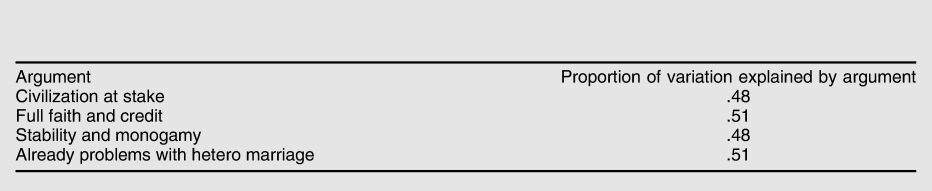
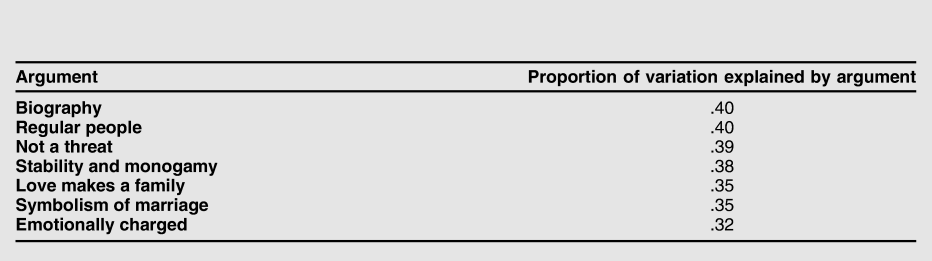
Fourth and finally, as shown in tables 1 and 2, I evaluated the frames identified via PCA for their “strength” and “resonance.” Following Baumgartner et al., I define frame strength as the eigenvalue of the correlated code matrix. Footnote 27 I define the resonance of a frame by the number of arguments that correlate to create that frame. I posit that frames that correlate a greater number of distinct arguments together are more able to cut through the general din of public discussion, efficiently presenting a set of connected ideas for consideration, or “sampling,” while still conveying a coherent set of related ideas. In addition, frames that contain several arguments are resonant, because they have the ability to connect familiar background ideas through a linking commonplace concept to a new purpose.
Resonance analysis of USA Today frame: “Defending traditional marriage”

Eigenvalue or total “Strength” of frame = 3.38.
Proportion of variation explained in first component = .84.
Resonance analysis of New York Times frame: “All kinds of families”

Eigenvalue or total “Strength” of frame = 5.82.
Proportion of variation explained in first component = .83.
For example, the socially conservative frame “defending traditional marriage” (table 1), appears in USA Today in the second decade of the marriage debate. This frame contains four arguments: that the existence of civilization is at stake in the question of marriage, that only heterosexual marriage promotes stability and monogamy, that cohabitation without marriage is damaging to the traditional institution, and that each state that legalizes recognition for same-sex couples is a threat. We can see that the frame is resonant because it contains a familiar idea, the notion of the value of marriage, linked through the commonplace concept that deviation from valued tradition can be dangerous, to the new idea that state recognition of same-sex marriage codifies the danger of personal deviance into a social threat. These arguments co-occur 84% of the time, as indicated by the proportion of variation explained in the first component of PCA. The frame is moderately strong, with an eigenvalue of 3.38. Footnote 28
It may seem cumbersome that these four arguments could appear together so often within a single news story, but in public discourse, entire arguments are often indicated by a few words, and as these arguments become more familiar, reaching audiences that have been primed by frequent repetition of key words and phrases, Footnote 29 less and less explanation is needed to invoke more fully formulated ideas. Footnote 30
Take this excerpt from a letter to the editor published in USA Today on December 14, 2009, under the header “Legalizing same-sex marriage ruins traditional institution”:
The institution of traditional marriage, between a man and a woman, in which children are successfully raised, is experiencing difficulties. Fewer people marry, fewer marriages last and cohabitation seems to be on the rise. It seems few places exhibit more symptoms of this sickness than the District of Columbia. Nevertheless, the D.C. City Council voted to give up on that institution, all the while feigning support for marriage. It seems to me that changing the definition of marriage cannot help but ruin any attempts to save the traditional institution. Supporters of same-sex marriage claim this is a civil rights issue. But the question here is not whether to prohibit a person’s behavior, but whether to prohibit the government’s misuse of religious terminology. Anyone interested in preserving marriage should urge his or her congressional delegation to intervene.
Here, we see all four arguments in the “defending traditional marriage” frame captured in under one hundred words. We are told that the changing nature of marriage, from cohabitation to decreased marriage rates to same-sex marriage, is a societal “sickness” destroying the only institution “in which children are successfully raised,” thereby endangering our way of life. This distance from “tradition” is presumably why “fewer marriages last,” decreasing the stability and value of the institution. And the District of Columbia legislature is characterized as “giving up” on the institution of marriage if they vote for the legalization of same-sex marriage. Further, the author enjoins readers to “urge his or her congressional delegation to intervene” to stop the laws allowing same-sex marriage, because the recognition of such unions anywhere is a threat to marriage everywhere.
Though the codes in the data set are inductively derived, most of the arguments that appeared three or more times did not fit neatly into frames—meaning that there are a lot more arguments overall than there are arguments that cohere into frames. In the New York Times, the more frame-rich paper, only 56 of the 108 possible codes fit into frames. The fact that arguments and frames are not symmetrical makes sense, given that public discourse is messy and not every argument consistently calls to mind other related assertions. This also underlines the skill of political challengers who are able to insert new frames into public discourse. They must clearly and consistently articulate the same arguments together over time. Even so, some frames were not very resonant, containing only two or three co-varying arguments, failing to yoke familiar background ideas to new purposes through commonplace linking concepts. Strongly resonant frames, on the other hand, contained five or six arguments that consistently appeared together successfully linking familiar ideas to new purposes.
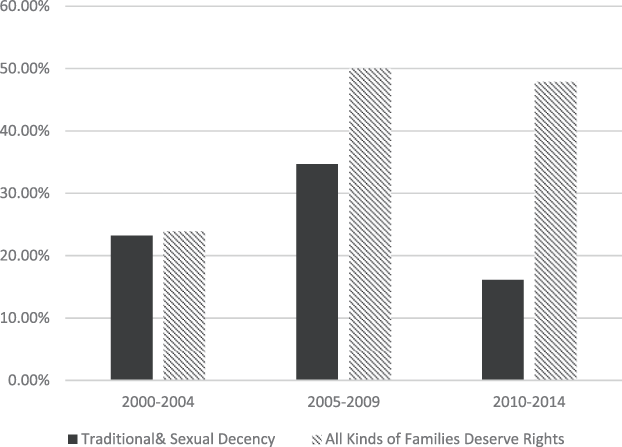
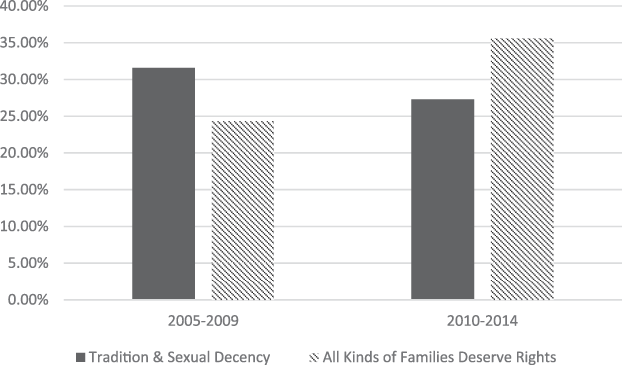
For example, the most resonant frame in the New York Times between 1994 and 2004 is “all kinds of families” (table 2). In this frame, seven distinct arguments co-occur together over the ten-year period and cohere into a single frame. These arguments include biographical portraits of gay families (often including children); accounts of how emotional the issue of marriage is for same-sex couples; claims that it’s really love that constitutes a family, rather than the presence of different-sexed partners; that same-sex couples are not a threat to heterosexual families; that marriage promotes stability and monogamy, regardless of the sex of participants; that those same-sex couples who desire to marry are “regular people” with the unremarkable desire to form family units; and that marriage is an important symbol apart from its legal benefits. This frame links the background belief that families are the most reliable and enriching basis for social and economic life through the commonplace idea that loving and stable families come in a variety of forms, with a new acknowledgement that those forms already include households headed by same-sex partners whose families ought to be legally recognized. While this strong and resonant argument probably changed some people’s hearts, what it did to the public meaning of the same-sex marriage debate was bring into focus a figure that had not previously existed—the gay family. As shown in figures 1 and 2, bringing this idea to the fore, along with other frames centering the need for equality that combined to show its significance, changed the decisional context present in mainstream discourse and helped shift the basis of decision-making for many people, even if it did not change their evaluation of the morality of same-sex partner sexual acts or what was often referred to as “the homosexual lifestyle.”
New York Times: “Tradition/sexual decency” versus “all kinds of families deserve rights” frames 2000–2014
*The volume of discourse on marriage equality from 1994–1999 in the New York Times is too low to yield frames via Principle Component Analysis. Percentage of frames does not equal 100 because not all frames fit into the broad categories of “tradition/sexual decency” and “all kinds of families deserve rights.”

USA Today: “Tradition/sexual decency” versus “all kinds of families deserve rights” frames 2005–2014
*The volume of discourse on marriage equality from 1994–1999 and from 2000–2004 in USA Today is too low to yield frames via Principle Component Analysis. Percentage of frames does not equal 100 because not all frames fit into the broad categories of “tradition/sexual decency” and “all kinds of families deserve rights.”

In sum, the “all kinds of families” and “about equality” frames contribute to changing public meaning by shifting the attention of mainstream public debate away from the decency of sexual acts and toward the value of the family unit as such, and by further invoking the importance of the rights and responsibilities that all family units should be entitled to on the grounds of fairness. In Jones’s terms, this frame works as a conflict-displacing one, changing the politically relevant evaluation for affirming marriage equality from “approval of sexual relationship” to “willingness to declare a partner pair (especially those with children) a family, deserving of the same rights and privileges that all families ought to have.”
Data Analysis
Time-series data from Gallup shows that public support for same-sex marriage has increased markedly since respondents were first asked about the issue in 1996. We see in figure 3 that majority opinion was decisively against gay marriage in the 1990s. However, between 2004 and 2012, although opinion was still mostly opposed, there was quite a bit of indecision in the polity. During this period of public indecision on the topic, proponents and opponents waged a consequential discursive and political struggle over what was at stake in the gay-marriage debate. Each side attempted to focus debate on the widespread values that, if used as the basis for evaluating marriage policy, would make their favored position a more obvious choice. They did so by deploying arguments that coalesced into the range of resonant frames that shaped the way the polity understood and evaluated the meaning of the issue.
Public opinion on same sex marriage 1996–2014
*Data from Gallup time series on marriage http://www.gallup.com/poll/117328/marriage.aspx

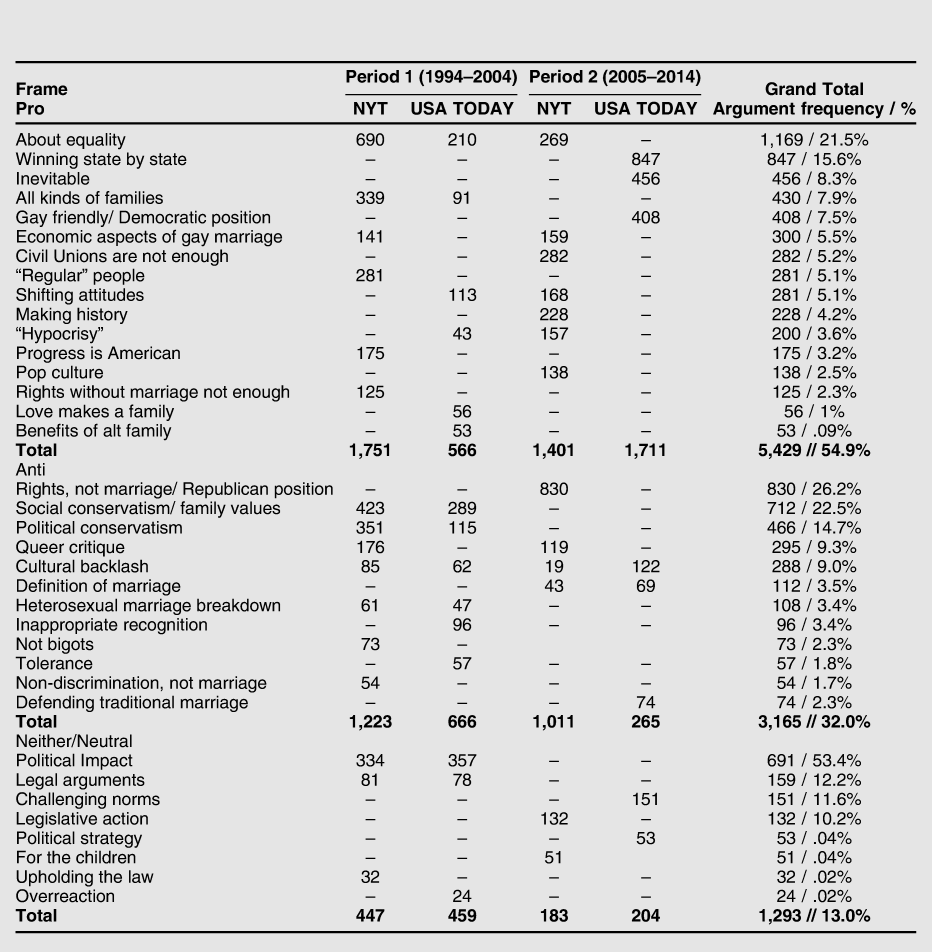
Figure 2 contains each frame that appeared in either the New York Times or USA Today from 1994 to 2014, along with its frequency in the two time periods, measured by the number of times it occurred and the percentage it represents of all frames observed. Overall, PCA revealed that there were thirty-six frames in the debate on marriage equality captured in the New York Times and USA Today between 1994 and 2014. Sixteen of those frames contained arguments expressing support for marriage equality (labeled “Pro” in figures 4 and 5), twelve of those frames contained arguments expressing opposition to marriage equality (labeled “Anti” in figures 4 and 5), and eight of those frames expressed neither support nor opposition, instead they described the political impacts of the controversy (labeled “Neither/Neutral” in figures 4 and 5). The sixteen supportive frames represent 54.9% (5,429 arguments) of the discourse that coalesced into frames during the time period, while oppositional frames account for 32% (3, 165 arguments), and descriptions of the politics of the issue account for 13% (1,293 arguments). It makes sense that challenger frames would make up most of the discourse on the topic because the burden of shifting public attention from the usual decisional context to a new one is on those advocating changes. To alter the public meaning of same-sex marriage, political challengers had to expand the range of frames that were available for sampling by ordinarily competent members of the polity, shifting attention from the old basis of decision-making (tradition, sexual decency) to a new one (fairness, family). Marriage-equality activists accomplished this by clearly and consistently articulating conflict-displacing frames in mainstream public discourse.
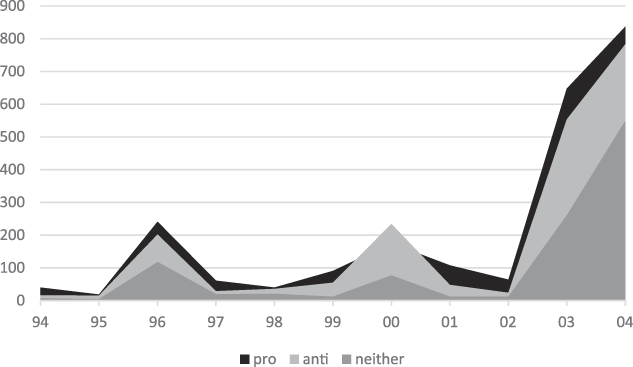
Trends in marriage equality discourse in New York Times and USA Today, 1994–2004

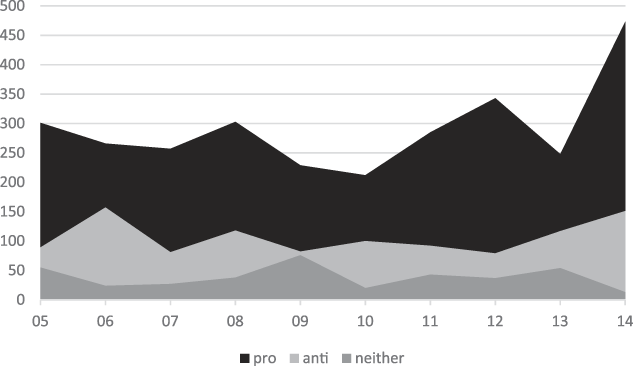
Trends in marriage equality discourse in New York Times and USA Today 2005–2014

The most frequent frame, appearing in both papers throughout the twenty-year period, was “about equality.” The arguments in this frame were enunciated so often that they accounted for 21.5% of the discourse that cohered into frames. This frame consisted of five arguments in the Times and four arguments in USA Today. Each of the frames from the two papers contained four of the same arguments: an argument making an analogy between same-sex marriage and interracial marriage; an argument invoking the black civil-rights movement as the forebear of the movement for gay rights; an argument against an amendment to the federal Constitution banning same-sex marriage; and an argument submitting that regardless of one’s moral feelings about “homosexuality,” marriage status is about equal access to the rights and responsibilities granted by legal union. The New York Times’s frame included a fifth argument that co-occurred with the others in a statistically identifiable way; it asserted that the marriage-equality movement was a legacy extension of the movement to address the AIDS crisis in the 1980s.
The “about equality” frame does the fundamental work of conflict-displacement because the arguments it contains structure the debate in a new way, refusing to argue on the established terrain of opponents, and instead offering the public a new way to understand what is at stake in the debate and a new basis for decision-making. Although this frame was not the most resonant in mainstream discourse (it combined only five distinct arguments into one coherent frame, while “all kinds of families” combined seven), it was the most salient, making the most significant rhetorical contribution to changing the public meaning of the political debate.
The other frames that appear in both papers and time periods were “shifting attitudes,” “hypocrisy,” and “cultural backlash.” The frame “shifting attitudes,” a pro-same-sex marriage frame, contended that people’s ideas about marriage equality were shifting toward acceptance over time. Another pro-marriage-equality frame, “hypocrisy,” charged that opponents of same-sex marriage were motivated by a double standard—if marriage is a social good, those who deployed this frame argued, then it should be a good available to everyone. The single anti-marriage-equality frame that persisted across the two periods was one that warned that a swift change in social mores would cause a detrimental “cultural backlash,” harming those that proponents meant to help. Footnote 31
Although each of these frames persists across the twenty-year period, they appear in the debate at very low frequency, and none are particularly resonant, with each combining only two or three arguments into a single frame. These facts should not discount the power of these frames but simply contextualize it. Each one made sense to enough people enough of the time that they kept being deployed in mainstream discourse even as the political debate evolved.
Figures 4 and 5 and table 3 show how public discourse about same-sex marriage became overwhelmingly more positive as time passed. During the first decade of the marriage-equality debate, positive frames arguing the reasons for and benefits of same-sex marriage slightly outnumbered negative frames, every year, except during the election season spanning 1999 to 2000. Indeed, public discussion of the topic spiked during every election year in the period. In election year 1996, positive stories outnumbered negative ones, but the preponderance of sentiment in mainstream discourse reversed in 2000, with negative stories outnumbering positive ones, only to flip again, with positive stories edging out negative ones in election year 2004. While discussion of marriage equality peaked during election years, no presidential candidate endorsed the idea of marriage equality during a campaign in the entire period. Footnote 32
Frames in the marriage equality discourse, New York Times and USA Today 1994–2014

All numbers are frequencies of frames as they appeared in the sample for each newspaper.
Total number of arguments that correlate into frames in NYT & USA Today from 1994–2014 is 9,887.
It is striking that in 2003, the volume of stories about same-sex marriage increased dramatically after three national events take place: the Supreme Court ruling that sodomy laws are unconstitutional in Lawrence v. Texas, the legalization of gay marriage in Massachusetts, and the adoption of the topic as a major campaign issue in the 2004 presidential election. The ensuing explosion of discourse begins to clarify the increasing dominance of the pro-marriage-equality frames in the later period. In 2003 and 2004, the pro-marriage-equality frames outnumbered the anti-same-sex-marriage frames by more than two to one. During these years, the frames that people heard most—making them most readily available for “sampling”—gave proponents of marriage equality an advantage because they posed the question of same-sex marriage in terms of “equality” rather than in terms of “sexual decency,” prompting answers that privilege the former as the decision rule.
While figures 4 and 5, and table 3 give us an overview of the entire debate, showing how frequently each frame was deployed over time and the shifting balance of positive, negative, and neutral arguments, they do not reveal the strength or resonance of the frames as they appeared in each period. In the following section, I examine these elements of the marriage-equality discourse in detail, decade by decade, and then draw some conclusions about the evolution of the discourse over the entire twenty-year period of study.
1994–2004 Footnote 33
The first decade of the same-sex marriage debate was characterized by a battle over how to understand the political stakes of the issue. Proponents of marriage equality framed the issue as fundamentally about equal civil rights and the flourishing of previously unacknowledged families. Opponents attempted to frame the debate in several different ways—as being absurd by definition, as dangerous to the fabric of society, or as a matter of improper “judicial activism.” During the first decade of same-sex marriage’s emergence as an issue, the New York Times contained fifteen statistically identifiable frames. Five of these frames were positive, seven negative, and three primarily descriptive. USA Today also contained fifteen statistically identifiable frames. Six of these frames were positive, six negative, and three primarily descriptive. Although the frames in each newspaper contained similar arguments, the way that some arguments group together into frames differs. In addition, the most resonant frames in each paper differ.
The most resonant frame in either paper during this period was “all kinds of families,” described in detail in table 2. The second most resonant frame in the New York Times and the most resonant in USA Today was the “about equality” frame, explained in detail earlier. The most resonant anti-marriage-equality frame in both the New York Times and USA Today was a socially conservative frame, “family values.” The “family values” frame advanced social and religious reasons against allowing same-sex marriage. It was constituted by six arguments focused on the importance of marriage for traditional conceptions of society, especially as represented in Judeo-Christian theology. These include arguments emphasizing the need for preserving traditional marriage, an argument asserting that marriage can only include one man and one woman by definition, an insistence that heterosexual marriage is the foundation of civilization and therefore cannot be altered, comments by diverse clergy disapproving of the notion of same-sex marriage, the assertion that children are best raised by their two biological parents, and the claim that only traditional marriage can be considered in accordance with procreative instincts dictated by natural law. Per the arguments contained in this frame, gay marriage would threaten or even destroy the idealized heterosexual version.
Answering this negative frame were two conflict-displacing frames used by opponents to change the domain of decision-making on the same-sex marriage question. The first, “about equality,” shifted attention from the question of Judeo-Christian moral values by asserting that the value that should determine the policy outcome was equal access to an important institution. The second, “all kinds of families,” worked to nullify the fear that the “family values” argument sought to stoke, using many of the same underlying assumptions about the social good of familial relation. The question of marriage, reframed this way, does not turn on whether same-sex partner sexuality is decent, or from what traditions marriage derives its sanctity, but instead on who ought to have access to the rights, privileges, status, and emotional benefits of the valued institution. By these lights, it does not matter how one personally feels about gay people; marriage rights are civil rights, and extending rights to gays and lesbians means ending discrimination and promoting equal access.
From 1994 to 2004, most Americans agreed that marriage is, by definition, a union between one man and one woman. Footnote 34 However, the question of whether and how gay people’s civil rights should be protected or expanded was much more open. And that is the question that became central to the debate in the following decade.
2005–2014 Footnote 35
During the second decade of the fight for marriage equality, a fight that ended in triumph when the Supreme Court legalized same-sex marriage in Obergefell v. Hodges in June of 2015, there were fourteen statistically identifiable frames in the New York Times. Eight of these frames were positive, four negative, and two primarily descriptive. USA Today had only ten statistically identifiable frames, three positive, five negative, and two primarily descriptive.
Although the discourse in the New York Times was overwhelmingly positive on the question of gay marriage, the most resonant frame in the paper was one opposing marriage equality. This goes to show that though the march toward marriage equality might seem certain in retrospect, it was far from inevitable. A frame called “rights, not marriage” was consistently and vigorously deployed by marriage-equality opponents in the early 2000s. It contained six arguments, including one advocating federal and state bans of same-sex marriage, another two that claimed that domestic partnership or other status would provide equal rights without necessitating marriage, one that warned that civil unions are a Trojan horse that would result in full marriage rights, and another claiming that those against marriage equality were not bigots but fair-minded Americans.
Unlike the earlier period, mainstream discourse from 2005 to 2014 produced a statistically identifiable partisan tilt. Somewhat counter-intuitively, that partisan tilt was to the right, rather than the left. That is, anti-marriage-equality arguments co-vary with mentions of either Republican candidates or Republican platforms during campaigns. However, no arguments co-vary with Democrats or the Democratic Party frequently enough to be included in frames in the New York Times. Skepticism or outright condemnation of marriage equality had been bipartisan between 1994 and 2004, but from 2005 to 2014, only Republican partisans retained their unified negative opinion. Democrats, far from championing the cause of marriage equality, simply stopped proclaiming disapproval.
The New York Times also contained four equally resonant frames supporting marriage equality, each containing five arguments. These frames, “making history,” “shifting attitudes,” “about equality,” and “regular people,” argued that marriage-equality advocates were on the verge of making history because attitudes were shifting toward support for same-sex marriage. This was so because at stake was a question of equal access to an institution of great import to ordinary people. Although these frames were statistically distinct, they worked together throughout the discourse in this period to make a powerful and consistent set of points, decisively—and surprisingly—shifting the public meaning of the debate.
During the mid-2000s, particularly in 2004, opponents of gay marriage believed that making their opposition public would only help them win public support. Public opinion was, after all, on their side. Even though 2003 marked a distinctive shift in the discourse on same-sex marriage overall, public opinion remained solidly against its legalization, with a Gallup poll taken in June of 2003 (just after the Lawrence v. Texas decision) reporting 39% support and 55% opposition to the prospect of gay marriage. Footnote 36 However, public opinion on all other indicators of gay rights, from discrimination in employment to military service, was majority positive. In addition, pollsters found that asking a question about gay marriage after asking questions about other aspects of the legality of gay rights and relationships produced higher support for same-sex marriage, indicating that people took seriously the underlying logic articulated by marriage-equality activists when they were primed to do so. And, as the decade wore on, the political benefits of being against same-sex marriage seemed to be shrinking. In an article published in 2006, headlined “Gay Marriage Losing Punch at the Ballot Box,” Kirk Johnson writes that
the debate over same-sex marriage was a black-or-white proposition two years ago when voters in eleven states barred gay couples from marrying. But this year shades of gray are everywhere, as eight more states consider similar ballot measures. Some of the proposed bans are struggling in the polls, and the issue of same-sex marriage itself has largely failed to rouse conservative voters. Footnote 37
In 2008, while electoral political winds were shifting left with the election of Barack Obama, the public seemed to send the opposite message on the marriage issue. That year, three states passed ballot measures limiting the definition of marriage, including liberal California, and 54% of respondents in Pew’s polling registered their disapproval of legalizing gay marriage. Even though marriage equality was soundly defeated at the ballot box in 2008, it is telling about the momentum of the movement that in the second decade of the marriage debate, the two frames in the New York Times that neither support nor oppose marriage equality were no longer focused on reporting the political impact of the issue on candidates, nor on laying out the legal bases for assertion of the right. Instead one was focused on “horse race” coverage of the issue itself, detailing legislative wins and losses, and the other was an ideologically mixed frame that I dub “for the children” because it contained arguments that both opposed and supported marriage equality for the sake of children.
USA Today’s discourse looked very different from the New York Times’s in this period. Whereas the number of positive frames in the New York Times increased from five to eight, making the argument about marriage equality more complex, the number decreased by half in USA Today, going from six to only three positive frames, indicating a much simpler debate. However, these three frames were very resonant and startlingly salient, dominating the discourse in the newspaper. The most resonant positive frame in the newspaper chronicled the success of the marriage movement as it won rights state by state. This frame was accompanied by two additional positive frames, one advancing the claim that marriage equality was inevitable and the other asserting a partisan tendency of the Democratic Party to be “gay friendly.”
The number of anti-gay-marriage frames in the USA Today decreased by only one in the latter decade of the debate, going from six to five. However, none of these frames approached the resonance that they had in the early period. The social-conservative frame, which was still present in USA Today (unlike the New York Times), supported only four arguments (“[there are] gay conservative/republicans,” “Leviticus,” “slippery slope,” and “take the state out of marriage”) rather than the six (“children best raised,” “civilization at stake,” “clergy opinions,” “definitional argument,” “natural law,” “preserve traditional marriage”) that it had in the first decade of debate. This decrease in resonance means that some of the arguments that had once seemed a part of a coherent position against marriage equality no longer made sense in the decisional framework that characterized mainstream discourse from 2005 to 2014. Notably, the social-conservative frame of 2005 to 2014 made much narrower claims, eschewing arguments about the danger of same-sex marriage to society, and instead invoking arguments that merely aimed to describe their opposition. Even the two frames that neither supported nor opposed gay marriage in the paper changed their emphasis from the earlier period. One chronicled the political strategy of the gay-marriage movement, rather than the political impact that support or opposition had on candidates for office. The other included arguments that explored the ways the same-sex marriage debate challenged American norms regarding gender and traditional marriage, as well as the ways that deciding the issue re-opened serious questions about the proper relation between federal and state law. Each of these descriptive frames identified the political topics most closely related to the marriage-equality debate in terms that focused less on the “horserace” of proponents and opponents and more on cultivating a deeper understanding of what legal marriage equality would mean in politics and society. While the majority of the public disapproved of gay marriage until 2012, we see that the frames of marriage-equality opponents weakened in salience and resonance in the second decade of study and, even more tellingly, even the neutral frames describing the political stakes of the issue without expressing favor, were beginning to treat legal same-sex marriage as the basis for further inquiry, rather than the issue up for debate.
Conclusion
In the foregoing, I have shown that the public meaning of gay marriage changed during the twenty-year period between the issue’s political emergence in 1994 and its legalization in 2015. The relatively swift triumph of the marriage-equality movement is most often attributed to a rapid change in many individuals’ hearts and minds. However, examination of public opinion data on the topic puts that common narrative in doubt. While opposition to same-sex marriage did decrease over time, majorities of Americans continued to think that same-sex relationships were morally questionable, even as they came to support the extension of the legal right to marry to gay couples.
This was possible because public persuasion relies less on the revision of individual values and more on shifting people’s attention from one basis of decision-making to another by persistently using resonant framings in mainstream discourse. Thomas Nelson and Donald Kinder put it this way: “public opinion . . . depends importantly on the political context; the political environment helps determine the balance of forces that make up popular thinking about public issues.” Footnote 38 This popular thinking is not simply a reflected aggregation of people’s preferences. Rather, major changes in the public meaning of new or newly politicized issues can cause people to choose new policy options without changing their minds about their values. Since individual preferences are multi-dimensional—one can value “tradition” and “fairness” simultaneously, even though they may come into conflict when applied to specific situations—major reversals in public opinion, like what the country witnessed on marriage equality, are not predicated on millions of individual revelations, but instead on a public, discursive shift that changes the public meaning of political issues and allows people to consider new bases for decision-making.
Even though most Americans disagreed with same-sex marriage, by the mid-2000s activists had convinced the polity to accept the issue as a political problem to be solved, rather than an absurdity to be dismissed. Footnote 39 They did so by consistently deploying resonant, conflict-displacing frames that emphasized the provision of rights, the primacy of family, and the inviolability of committed romantic love rather than engaging in a debate about gay sexual relationships or the traditional definition of marriage. Using these discursive tactics, activists changed the public meaning of marriage equality by persuading the public that the value most relevant to their political decision was not sex, but fairness.