





Introduction
The ‘winners and losers’ framework was developed for democratic contexts (Anderson, Blais, Bowler et al. Reference Anderson, Blais, Bowler, Donovan and Listhaug2005), but non-democracies also produce winners – regime supporters – and losers – its opponents. In autocracies, political defeats often lead to exclusion or repression, leaving lasting attitudinal imprints (Brum Reference Brum2018). The recent prevalence of semi-competitive authoritarian regimes as a form of non-democratic rule further reinforces these divisions through restrictive electoral mechanisms (Gandhi and Przeworski Reference Gandhi and Przeworski2007; Levitsky and Way Reference Levitsky and Way2010). We contend that the legacy of winning and losing in non-democratic regimes is not erased by the (re)establishment of democracy but continues to shape political trust in post-authoritarian democracies. Regardless of the electoral status of individuals in the preceding authoritarian regime, winners in current democracies may expect privileges or protections that reinforce their dominance. Contemporary losers, wary of what defeat means under autocracy – exclusion, marginalization, or worse – may carry those fears of uncertainty and vulnerability into the democratic context, even when the actual stakes are far lower. This dynamic also affects those who had been winners under the preceding non-democratic regime but became losers in the new democratic setting: their transition from a position of privilege to one of electoral defeat may enhance feelings of fear and vulnerability, fueled by uncertainty and a heightened awareness of what it means to no longer be on the winning side. Just as democratic experience bolsters democratic support (Acemoglu, Ajzenman, Aksoy et al. Reference Acemoglu, Ajzenman, Aksoy, Fiszbein and Molina2024), prolonged exposure to autocracy shapes how citizens react to political outcomes after transitions to democracy. We test these assertions by examining whether the gaps in political trust between people who voted for government parties or leaders and those who voted for opposition parties or leaders are larger among individuals with extensive autocratic experience compared to those with shorter or no exposure to autocracy.
We do not intend to argue, however, that these enduring attitudinal effects persist indefinitely. Rather, we contend that political trust, despite this heritage, is not a fixed trait but an attitude that can evolve and respond to positive democratic experiences (Fuchs-Schündeln and Schündeln Reference Fuchs-Schündeln and Schündeln2015; Besley and Persson Reference Besley and Persson2019). While citizens’ attitudes such as political trust are shaped during early socialization and may remain stable throughout life, they can also be dynamic (Sears Reference Sears, Kiesler, Morgan and Oppenheimer1981), responding to democratic improvements, enhanced checks on power, free speech, and minority rights. So, although cumulated non-democratic experiences condition how voters react to electoral outcomes, experiencing democratic improvements can attenuate these reactions and reduce winner-loser trust disparities (Nadeau, Daoust, and Dassonneville 2021; Singer Reference Singer2023).
Our study contributes to the literature by identifying a new element that helps explain how the winner-loser gap operates among citizens in newer democracies. Previous research has emphasized that citizens’ limited experience with democratic processes entails lower levels of trust, compared to citizens from long-lasting democracies. Citizens in new democracies, the argument goes, have not yet learned that today’s defeat can become tomorrow’s victory and are therefore more skeptical of representative institutions (Anderson, Blais, Bowler et al. Reference Anderson, Blais, Bowler, Donovan and Listhaug2005; Esaiasson Reference Esaiasson2011). We propose a complementary but distinct explanation: it is not merely the absence of democratic learning that matters but also the presence of formative experiences under non-democratic rule. Voters who lived under autocracy – even those who were winners under the previous regime – learned that winning and losing can have severe and lasting consequences. This distinction is consequential because it shifts the focus from what citizens lack to what they carry with them into democracy.
Our argument also extends the research on the cumulative effects of electoral outcomes. Chang, Yun-Han, and Wu (Reference Chang, Yun-Han, Wu and Thomassen2014) demonstrated that repeated losses erode system support over time, while Esaiasson (Reference Esaiasson2011) showed that well-conducted elections can reconcile losers to democratic outcomes. We build on these insights by showing that the size of the winner-loser gap is conditioned by contemporaneous variations in the quality of current democratic processes (Nadeau, Daoust, and Dassonneville 2021), as well as by citizens’ prior experiences with non-democratic governance. Put differently, democracy matters twice: both present and past institutional contexts shape how voters interpret what winning and losing means and the consequences these outcomes carry for political trust. Our contribution, therefore, is to uncover a more refined account of how past and present institutional settings jointly structure citizens’ orientations toward their political system.
Finally, we provide comparative and methodological contributions by harmonizing trust measures from the European Social Survey (ESS 2020) and the Latin American Public Opinion Project (LAPOP 2019), facilitating an interregional and longitudinal analysis of political trust across 40 countries (Durand, Peña Ibarra, Rezgui et al. Reference Durand, Peña Ibarra, Rezgui and Wutchiett2021). This design allows us to test whether the patterns we identify hold across two world regions with distinct authoritarian histories and institutional configurations.
Political trust and the role of uncertainty and vulnerability
Persistent cross-national differences in political trust have traditionally been explained through cultural determinism, rooted in the classic culturalist model (Lerner Reference Lerner1958; Almond and Verba Reference Almond and Verba1963; Easton Reference Easton1965; Uslaner Reference Uslaner2002). The rise of rational-culturalist perspectives has shifted the focus toward the endogeneity and volatility of political attitudes (Citrin Reference Citrin1974; Lane Reference Lane1992; Mishler and Rose Reference Mishler and Rose2001; Valgarðsson, Jennings, Stoker et al. Reference Valgarðsson, Jennings, Stoker, Bunting, Devine, McKay and Klassen2025), emphasizing short-term variations in political trust based on government performance, processes, and probity (Citrin and Stoker Reference Citrin and Stoker2018). This perspective aligns with the evaluative model of political trust, which conceptualizes trust as inherently relational: ‘A trusts B to do X’ (Hardin Reference Hardin2002: 56). Following this theoretical understanding, recent academic debates emphasize performance evaluations when it comes to explaining trends in political trust in contemporary democracies (see, for instance, Seyd Reference Seyd2024; Van der Meer and Van Erkel Reference Van der Meer and Van Erkel2024). However, while these studies explain within-country fluctuations and even some cross-country variations, they fail to account for enduring cross-national disparities (Devine and Valgarðsson Reference Devine and Valgarðsson2024; Devine Reference Devine2025) and, more importantly for our argument, they overlook the persistent differences in the winner-loser gap between new and old democracies already identified in Anderson and colleagues’ (Reference Anderson, Blais, Bowler, Donovan and Listhaug2005) classic work.
These shortcomings stem in part from an overly rationalistic conception of political trust. Political trust is not purely rationally based on how citizens evaluate the object of trust on its own merits (Harteveld, van der Meer, and De Vries Reference Harteveld, van der Meer and De Vries2013). Conceptual discussions on political trust have elaborated on related but distinct forms of trust as rooted in valent expectations of the political system (Hardin Reference Hardin2002, Reference Hardin2004; Bertsou Reference Bertsou2019), emphasizing the role of citizens’ perceptions of competence, fairness, and alignment with shared values in shaping these expectations. However, the literature of political trust has paid comparably little attention to the mechanisms by which assessments and perceptions are processed in generating an overall trust judgement (Seyd Reference Seyd2015: 73; Theiss-Morse, Barton, and Wagner Reference Theiss-Morse, Barton and Wagner2015: 167).
Evaluations depend on expectations (Miller Reference Miller1974: 952; Hibbing and Theiss-Morse Reference Hibbing and Theiss-Morse1995: 55), and the latter are not indifferent to partisan preferences and experiences, constituting an essential part of citizens’ bounded rationality (Jones Reference Jones2001). A less stringent rational approach should focus on ‘the cognitive basis of political trust: trust as an evaluation of politics against – conceptually idiosyncratic – ideals or benchmarks’ (van der Meer and Hakhverdian Reference Van der Meer and Hakhverdian2017: 83). The idiosyncratic benchmark of political trust involves vulnerability and uncertainty about what to expect from the political system. Vulnerability arises because trust exists in a vertical relationship between citizens and political institutions, where different agents wield power through access and influence over public decision-making (Hardin Reference Hardin2002). Uncertainty stems from the expectation that institutions should reduce unpredictability and regulate the actions of those in power (Six and Verhoest Reference Six, Verhoest, Six and Verhoest2017; Verhoest, Maggetti, Guaschino et al. Reference Verhoest, Maggetti, Guaschino and Wynen2025). After all, political trust is based on the translation of trustworthiness beliefs about the competence, benevolence, and integrity of political institutions and actors into citizens’ confidence in their future actions (Mayer, Davis, and Schoorman Reference Mayer, Davis and Schoorman1995; Rousseau, Sitkin, Burt et al. Reference Rousseau, Sitkin, Burt and Camerer1998; Six and Latusek Reference Six and Latusek2023). This way, when citizens exhibit high levels of political trust, they expect decision-makers to deliver outcomes that advance their individual or collective interests. However, these expectations could vary, shaped by past performance (Hetherington and Huser Reference Hetherington and Husser2012; Norris Reference Norris2022) and attitudes toward political actors (Mondak, Hayes, and Canache Reference Mondak, Hayes, Canache, Zmerli and van der Meer2017). Notably, expecting benefits and not expecting harm may function differently.
Influence of non-democratic experience on winner-loser gaps in trust
As it is well known, winning and losing elections can trigger a gap in political trust between those who obtain the electoral victory and are able to form the government and those who lose the elections and become part of the political opposition. This pattern seems to be consistent for different democratic settings and different democratic attitudes (Anderson, Blais, Bowler Reference Anderson, Blais, Bowler, Donovan and Listhaug2005: 42–43; see also Anderson and LoTempio Reference Anderson and LoTempio2002; Craig, Martinez, and Kane Reference Craig, Martinez and Kane2006; Moehler Reference Moehler2009; Singer Reference Singer2023; Singh, Lago, and Blais Reference Singh, Lago and Blais2011; van der Meer and Steenvoorden Reference Van der Meer and Steenvoorden2018; Martini and Quaranta Reference Martini and Quaranta2019). The presence of this winner-loser democratic attitudinal gap is often attributed to the direct impact of electoral outcomes on individuals’ perceptions of institutional fairness, responsiveness, and their own political efficacy, where victory tends to affirm these aspects and defeat tends to undermine them. Following this logic, and according to the classic work by Anderson, Blais, Bowler et al. (Reference Anderson, Blais, Bowler, Donovan and Listhaug2005: 102–109), losers in new democracies tend to exhibit significantly lower levels of political trust in their parliament than losers in older and more established democracies. This difference is often attributed to the limited electoral experience of the citizens in new democracies.
This explanation presupposes that experiences of winning and losing commence within the democratic framework. We contend this assertion for one key reason: any non-democratic regime generates winners (those controlling the institutions and influencing policymaking) and losers (those who do not have any possibility of influencing public policy decisions). Moreover, non-democratic regimes are increasingly characterized by significant institutionalization, allowing for restricted competition among parties, candidates, or factions (Gandhi and Przeworski Reference Gandhi and Przeworski2007; Levitsky and Way Reference Levitsky and Way2010). This implies that in non-democracies, the status of being a winner or a loser often has more profound consequences than in democracies. In non-democracies, losers may be excluded or repressed and face severe political, economic, and personal consequences. At the same time, benefits and rents of winners in non-democracies tend to exceed those enjoyed by government supporters, leaders, or policymakers in democracies (Brum Reference Brum2018). In democratic regimes, by contrast, governments’ actions are constrained by a set of checks and balances (the constitution and law, separation of powers, etc.) and monitored by watchdogs and the free media, which together control the benefits available to electoral winners. At the same time, losers in democratic settings are free from government coercion for having diverging preferences, ideology, or economic and social interests, as is the case in many non-democracies.
How, then, do prior non-democratic experiences shape individuals’ responses to winning or losing in democratic elections? We argue that such experiences condition the relationship between electoral status and political trust by amplifying the perceived vulnerability and uncertainty that electoral outcomes can generate. This heightened sensitivity stems from the legacy of non-democratic rule, which amplifies both the perceived stakes of electoral competition and the psychological impact of its results.
After prolonged non-democratic experiences, both winners and losers become more attuned to the broader implications of electoral outcomes in terms of security, status, and policy implementation. Former winners who prevail in the new democratic setting may interpret victory as confirmation that their previously privileged position will persist. As access to influence, resources, and status appears safeguarded under the new rules, their attachment to governing institutions is reinforced, and their trust in democratic institutions may strengthen, as they perceive the system as fair and responsive, especially when these institutions serve their policy preferences. Likewise, former losers in a non-democratic system who become electoral winners post-transition to a democracy may develop high trust in the institutions that facilitated their success.
The inverse may hold true for losers in a democratic setting who have significant non-democratic experience. Those who benefited from the prior regime may interpret their electoral defeat in a democratic system not merely as a temporal setback to their policy goals but as a threat of diminished rights, reduced access to benefits, and a generalized decline of their status. This group may hence experience a backlash, increasingly questioning and distrusting the democratic institutions of representation (the parliament). Conversely, individuals who were historically marginalized may view continued electoral failure as a perpetuation of exclusion, reinforcing skepticism toward the political process.
Building on this discussion, we formulate the first hypothesis positing that strong reactions to electoral victories and defeats are learned under non-democratic regimes and continue to affect people’s political trust even after transitions to democracy:
H1: The winner-loser gap in trust in the institutions of representation is larger in countries with longer authoritarian experience.
The preceding hypothesis tests whether autocratic experience at the country level relates to the magnitude of the winner-loser gap across different national contexts. However, this aggregate-level pattern requires further examination of how the relationship operates at the individual level, given our theoretical emphasis on individuals as carriers of experiences with winning and losing under non-democratic rule. We therefore propose an additional test of the ‘non-democratic legacy’ hypothesis: we expect voters’ trust reactions to depend on their personal exposure to non-democratic rule. In other words, the longer the time an individual spent in a non-democratic country, the stronger the imprint on their perceptions of what consequences electoral outcomes may have for their lives. In exploiting within-country variation in non-democratic exposure, we build on research that connects individual democratic experience to democratic support (Brum Reference Brum2018; Besley and Persson Reference Besley and Persson2019; Acemoglu, Ajzenman, Aksoy et al. Reference Acemoglu, Ajzenman, Aksoy, Fiszbein and Molina2024). This research has found, among others, that individual democratic capital has a positive effect on democratic support even after the country’s democratic experience is accounted for (Fuchs-Schündeln and Schündeln Reference Fuchs-Schündeln and Schündeln2015). Our next hypothesis thus reads as follows:
H2: The winner-loser gap in trust in the institutions of democratic representation is larger among individuals exposed to longer periods of authoritarian rule during their lifetime.
Effects of change in democratic quality on winner-loser gaps in trust
But are these effects of autocratic experience on voters’ reactions expected to persist indefinitely, or can they be attenuated? As previously noted, the notable disparity between winners and losers in emerging democracies was initially attributed to their inexperience with democratic processes, particularly electoral victory and defeat (Anderson, Blais, Bowler et al. Reference Anderson, Blais, Bowler, Donovan and Listhaug2005: 108–109). Even the simple experience of winning after losing might increase support for democracy (Chang, Yun-Han, and Wu-Han Reference Chang, Yun-Han, Wu and Thomassen2014). Following this reasoning, some scholars have suggested that the winner-loser gap naturally diminishes as citizens gain more exposure to electoral cycles within a democratic framework. This hypothesis aligns with the broader argument that prolonged democratic experience fosters greater support for democracy and democratic values (Fuchs-Schündeln and Schündeln Reference Fuchs-Schündeln and Schündeln2015; Besley and Persson Reference Besley and Persson2019; Acemoglu, Ajzenman, Aksoy et al. Reference Acemoglu, Ajzenman, Aksoy, Fiszbein and Molina2024; Neundorf, Dahlum, Frederiksen et al. Reference Neundorf, Dahlum, Frederiksen and Ozturk2024).
However, as Nadeau, Daoust, and Dassonneville (2021) have demonstrated, the key determinant is not simply the passage of time but rather the quality of electoral democracy; according to them, the extent of the winner-loser gap in satisfaction with democracy is shaped by the information environment, which in turn depends on the democratic quality of the electoral process. In political systems where democratic norms have eroded, electoral losers will be more likely to be exposed to information that highlights electoral irregularities, reinforcing concerns about their future electoral prospects and diminishing their trust in the system (Levitsky and Ziblatt Reference Levitsky and Ziblatt2018). Conversely, in flawed democracies, winners are more inclined to perceive their victory as confirmation of electoral fairness, engaging in motivated reasoning that leads them to dismiss unfavorable news and reinforce their trust in institutions (Nadeau, Daoust, and Dassonneville 2021). By the same token, when elections are reasonably well executed, losers build system support rather than undermine it (Esaiasson Reference Esaiasson2011). Thus, divergent levels of uncertainty and vulnerability due to processes of democratic backsliding may contribute to an increased polarization of political trust between winners and losers. While the analysis by these preceding studies focuses on the variation in the quality of democracy regardless of its within- or between-country character, we formulate a distinctly longitudinal argument: in addition to the effects of between-country differences in democracy on the winner-loser gap, we propose that the size of the winner-loser gap is shaped by within-country changes in democracy. Specifically, as democracy improves, the winner-loser gap narrows, whereas democratic backsliding increases it. Thus, our third hypothesis is:
H3: The winner-loser gap in political trust decreases (increases) as democracy strengthens (weakens) within a country.
Data
We use survey data as well as macro-level indicators describing the political and economic context. The survey data come from two cross-national projects. The first one is the European Social Survey (ESS 2020), a biennial survey of European countries conducted since 2002. The second one is the Americas Barometer, also carried out roughly every two years in the Americas by the LAPOP at Vanderbilt University (LAPOP 2019). Both surveys are academic endeavors striving to maintain the highest quality standards and constitute reputable data sources for comparative research.
We restrict the survey data to countries that are located in Europe or Latin America, have at least five surveys, and include all the variables necessary for our analysis. Applying both criteria leaves the following 40 countries from the three regions:
-
• Western Europe: Austria, Belgium, Denmark, Finland, France, Germany, Ireland, the Netherlands, Norway, Portugal, Spain, Sweden, Switzerland, and United Kingdom. All these, except Portugal and Spain, are countries without non-democratic experience after WWII.
-
• Eastern Europe: Bulgaria, Czechia, Estonia, Hungary, Lithuania, Poland, Russia, Slovenia, Slovakia, and Ukraine;
-
• Latin America: Argentina, Bolivia, Brazil, Chile, Colombia, Dominican Republic, Ecuador, El Salvador, Honduras, Jamaica, Mexico, Nicaragua, Panama, Peru, Paraguay, and Uruguay.
Our dependent variable is trust in the parliament. Political trust is ‘object-dependent’ (Hardin Reference Hardin2002; Harteveld, van der Meer, and De Vries Reference Harteveld, van der Meer and De Vries2013), meaning that overall levels vary depending on the specific institution. Cross-national research reveals a ranking: trust in political parties typically resides at the bottom, while trust in ‘state’ institutions like the police or army tends to be at the top (Denters, Gabriel, and Torcal Reference Denters, Gabriel, Torcal, Van Deth, Montero and Westholm2007). Parliaments occupy a middle ground, reflecting public evaluation of their performance and responsiveness (Linde and Ekman Reference Linde and Ekman2003; Dalton Reference Dalton2004; Torcal Reference Torcal2014).
We focus on trust in the parliament rather than trust in the government for theoretical reasons. Parliament is the central institution through which popular sovereignty is expressed and where the plurality of political preferences – including those of electoral losers – finds an institutional voice. The composition of the parliament directly reflects the distribution of winners and losers; if the experience of winning or losing shapes political trust, this effect should be most visible in attitudes toward the parliament. Trust in government, by contrast, tends to conflate evaluations of democratic representation with support for the incumbent (Miller and Listhaug Reference Miller and Listhaug1990; Rudolph and Evans Reference Rudolph and Evans2005) – winners may express high trust simply because ‘their’ people are in charge, and losers low trust for the same reason.
In LAPOP, the trust in Congress item is part of a block of questions about attitudes toward institutions and is measured on a scale from 1 (not at all) to 7 (a lot). In the ESS, trust in the parliament is the first item in a battery on trust in institutions and is measured on a scale from 0 (no trust at all) to 10 (complete trust). Due to differences in the item design, the two trust indicators are not directly comparable. We address this by specifying an ordinal response model that accounts for the differing number of response categories, as we describe in the ‘Methods’ section.
In each survey, we identify electoral winners and losers, defined as voters who support one of the government parties or leaders or one of the opposition parties or leaders, respectively. In the ESS, winners and losers are identified based on responses to questions about the voting behavior in the most recent general election. ESS party codes are translated into Party Facts IDs (Döring and Regel Reference Döring and Regel2019) with the Political Parties Crosswalk (Kołczyńska and Powałko Reference Kołczyńska and Powałko2022) and merged with party status in or outside of government from the V-Party version 2 dataset (Lindberg et al. Reference Lindberg, Düpont, Higashijima, Kavasoglu, Marquardt, Bernhard, D¨oring, Hicken, Laebens, Medzihorsky, Neundorf, Reuter, Ruth–Lovell, Weghorst, Wiesehomeier, Wright, Alizada, Bederke, Gastaldi, Grahn, Hindle, Ilchenko, von R¨omer, Wilson, Pemstein and Seim2022). As a consequence of these transformations, respondents are grouped into four categories: those who had voted for one of the government parties (winners), those who had voted for one of the opposition parties (losers), those who had not voted at all, and those who had not replied to the relevant survey questions.
In LAPOP, we also used responses to questions about voting in the most recent presidential election, excluding surveys where the question only asked about the first round of presidential elections in situations when a second round was carried out. Using the outcome of presidential elections to define electoral status while relying on trust in the national legislature (trust in the parliament in the ESS and trust in the Congress in LAPOP) as our measure of institutional confidence is theoretically justified for two reasons.
First, and following Anderson and LoTempio (Reference Anderson and LoTempio2002), the definition of who wins and loses an election is much more strongly associated with the presidential than the legislative outcome. We argue that this logic extends to presidential systems and to Latin American countries in particular, because presidential elections produce a clear winner-loser outcome and determine which political actors control the most visible and politically salient office in these regimes. The presidential outcome is also the only measure of electoral status available across the LAPOP surveys, which record the presidential vote choice but not the legislative vote.
Second, defining electoral status by the presidential contest while measuring trust in the national legislature is a deliberate design choice: it is precisely what allows for a clean and conservative test of our argument. Our interest lies in how electoral experiences shape citizens’ broader evaluations of representative institutions rather than their appraisal of the authorities currently in office (Citrin and Stoker Reference Citrin and Stoker2018). The legislature is the core institution of representative democracy and, housing both governing and opposition forces, is less exposed to the incumbent-driven bias that affects trust in the executive (van der Meer Reference Van der Meer2010). Because presidential losers are not necessarily legislative losers and because no electoral winner straightforwardly controls the legislature, especially in Latin America, trust in it is not mechanically tied to winning the presidency. Measuring trust in the executive, by contrast, would embed a near-mechanical association into our design, with presidential winners expressing confidence in the very office they have just won. Any winner-loser gap we observe in legislative trust therefore reflects a genuine spillover of the electoral experience into broader evaluations of representative institutions per se, offering a more demanding test than trust in the executive would provide.
Table A2 in the online Appendix A provides sample means of trust in parliament for electoral winners and losers by region, showing that (1) average trust among winners is higher than among losers in all regions, and (2) the winner-loser gap is greater in Eastern European countries compared to Western European countries. Comparing survey means between ESS and LAPOP is complicated due to the differing response scales in trust questions, which needs to be dealt with via modeling, an issue we address in the next section.
From the survey data, we also use four individual-level items as control variables: age, gender, years of schooling, and left-right self-placement. The latter addresses the possibility of confounding of winner and loser status with ideology. We recode the left-right scales into four categories: left, center, right, and non-response. To make the data from ESS and LAPOP more comparable, we restricted the age range of the respondents to between 18 and 90 years. Years of schooling are measured from 0 to ‘18 or more’ in LAPOP, so we constructed an analogous variable for the ESS. Finally, we use weights (the country weight for LAPOP and combined design and poststratification weight for the ESS) to correct for deviations from sample representativeness.
Measures of democratic experience and performance are derived from indicators from the Varieties of Democracy dataset version 13 (Coppedge et al. Reference Coppedge, Gerring, Knutsen, Lindberg, Teorell, Altman, Bernhard, Cornell, Steven Fish, Gastaldi, Gjerløw, Glynn, God, Grahn, Hicken, Kinzelbach, Krusell, Marquardt, McMann, Mechkova, Medzihorsky, Natsika, Neundorf, Paxton, Pemstein, Pernes, Ryd´en, von R¨omer, Seim, Sigman, Skaaning, Staton, Sund- str¨om, Tzelgov, Wang, Wig, Wilson and Ziblatt2023). We measure authoritarian history as the number of years between 1950 and 2000 in which the given country had the regime classified as an electoral or closed autocracy, based on the variable ‘Regimes of the world’, which is obtained from V-Dem’s Electoral Democracy Index and Liberal Component Index (Coppedge et al. Reference Coppedge, Gerring, Knutsen, Lindberg, Teorell, Altman, Bernhard, Cornell, Steven Fish, Gastaldi, Gjerløw, Glynn, God, Grahn, Hicken, Kinzelbach, Krusell, Marquardt, McMann, Mechkova, Medzihorsky, Natsika, Neundorf, Paxton, Pemstein, Pernes, Ryd´en, von R¨omer, Seim, Sigman, Skaaning, Staton, Sund- str¨om, Tzelgov, Wang, Wig, Wilson and Ziblatt2023: 287). The number of years of autocracy ranges from 0 in most countries of Western Europe to 50 years in Russia (see Figure A1 in the Appendix). In the analyses aimed at probing the role of individual non-democratic exposure, we construct an individual-level measure of the proportion of years under autocracy since the respondent’s age of 15 until the year of the survey. Importantly, this measure captures respondents’ cumulative exposure to authoritarian rule but does not identify whether they occupied positions analogous to electoral winners or losers under the authoritarian regime. In models testing the effect of countries’ over-time changes in democracy, we use a change in the liberal democracy index over the preceding five years (Coppedge et al. Reference Coppedge, Gerring, Knutsen, Lindberg, Teorell, Altman, Bernhard, Cornell, Steven Fish, Gastaldi, Gjerløw, Glynn, God, Grahn, Hicken, Kinzelbach, Krusell, Marquardt, McMann, Mechkova, Medzihorsky, Natsika, Neundorf, Paxton, Pemstein, Pernes, Ryd´en, von R¨omer, Seim, Sigman, Skaaning, Staton, Sund- str¨om, Tzelgov, Wang, Wig, Wilson and Ziblatt2023: 45).
In order to account for economic characteristics, we use Gross Domestic Product (GDP) per capita as provided in the V-Dem dataset (Fariss, Anders, Markowitz et al. Reference Fariss, Anders, Markowitz and Barnum2021; Coppedge et al. Reference Coppedge, Gerring, Knutsen, Lindberg, Teorell, Altman, Bernhard, Cornell, Steven Fish, Gastaldi, Gjerløw, Glynn, God, Grahn, Hicken, Kinzelbach, Krusell, Marquardt, McMann, Mechkova, Medzihorsky, Natsika, Neundorf, Paxton, Pemstein, Pernes, Ryd´en, von R¨omer, Seim, Sigman, Skaaning, Staton, Sund- str¨om, Tzelgov, Wang, Wig, Wilson and Ziblatt2023: 384), as well as the Gini index of disposable income inequality from the Standardized World Income Inequality Database (Solt Reference Solt2022). Basic descriptives of these variables are in Table A1 of the Appendix.
Methods
Our analysis is structured into two steps. First, we estimate the trajectories of overall trust in parliament, differentiating between electoral winners and losers, across 40 countries. This is achieved by employing an ordinal model as the response model, with the temporal trend represented as a spline, following the approach described in Kołczyńska, Bürkner, Kennedy et al. (Reference Kołczyńska, Bürkner, Kennedy and Vehtari2024). The response model specification accounts for variations in response options between the ESS and LAPOP surveys. Splines model relationships between variables using smooth, non-linear functions instead of fixed parametric forms. Their flexibility helps uncover patterns without imposing strong assumptions about functional shape, making splines especially useful for estimating public opinion trajectories when no prior expectations about the trend exist.
Using this method, Figure 1 illustrates the estimated levels of trust in parliament by country, categorized by region, focusing on overall trust levels, trust among electoral losers, and differences between winners and losers. The findings indicate that Western Europe, on average, exhibits the highest trust in parliament, with several countries surpassing the zero mark on the probit scale, indicating a predominance of positive trust responses. In contrast, in Eastern Europe, trust trajectories uniformly remain below this threshold. In Latin America, while most countries show trust levels below zero, there are notable exceptions. The middle panel reveals that losers in Western Europe display substantially higher trust than losers in Eastern Europe and Latin America, while the right panel shows that the winner-loser gap in Western Europe is markedly narrower than in other regions. Crucially, these two patterns are connected – the smaller gap in Western Europe suggests that the smaller gap is not due to lower trust among winners but to higher trust among losers.
Trajectories of trust in parliament by country and region.
Notes: The left-hand facets present estimated overall levels of trust in parliament. The middle facets present estimated levels of trust in parliament among electoral losers. The right-hand facets present estimated differences in political trust between electoral winners and losers. 0 on the Y axis indicates the middle of the latent probit scale. Data source: European Social Survey rounds 1–9, Americas Barometer (LAPOP) waves 2008–2018.

The second step of our analysis involves estimating a series of multilevel models to examine the determinants of winner-loser gaps in trust in parliament. The focal predictors in these models are measures of country-level (time-invariant) non-democratic history, individual non-democratic experience, and a five-year change in democracy.
The dependent variable is modeled as an ordinal variable with a cumulative link model, which assumes that survey responses reflect the categorization of a continuous latent attitude into an observed ordinal variable. The response model is specified to account for a different number of categories for surveys from Europe (ESS) and those from Latin America (LAPOP), corresponding to the respective surveys’ trust item response scale (Kołczyńska, Bürkner, Kennedy et al. Reference Kołczyńska, Bürkner, Kennedy and Vehtari2024; Gangl Reference Gangl2025), thus addressing one of the main challenges in harmonization of ordinal response scales.
The multilevel models account for the three-level structure of the data: respondents are nested in surveys (country years), which in turn are nested in countries. We specify random intercepts for both upper levels, as well as a random slope for the individual-level indicator of winner-loser status. In the presentation of model results, we leave out the threshold (intercept) estimates for latent trust to make the tables more legible. Recognizing the challenges of interpreting results of non-linear models based on regression coefficients, we provide plots with estimated levels of trust in parliament among winners and losers, conditional on the levels of the key predictors, and with control variables set to their means.
In addition to the main models presented in the next section, we estimated several other models to test the robustness of our conclusions. These extra models additionally control for the time since the most recent election, account for the position of the survey in the electoral cycle (Appendix C), use components of the V-Dem Liberal Democracy Index separately to predict short-term effects on winner-loser trust gaps (Appendix D), add non-voters as a third category next to winners and losers (Appendix E), and additionally control for five-year changes in polarization (Appendix F). The main results remain substantively similar across these alternative specifications.
The analysis was performed in R (R Core Team 2020) with the brms package (Bürkner Reference Bürkner2018) for Bayesian modeling, which provides a user-friendly interface to the statistical programming language Stan (Stan Development Team 2020). The Bayesian framework is especially appropriate for our analysis because it offers several advantages over conventional frequentist methods. First, it allows complex components to be combined within a single model (e.g., an ordinal response model with country-specific numbers of categories embedded in a multilevel structure or combined with splines to estimate the latent trend). Second, posterior draws make it easy to compute any quantity of substantive interest, such as the trust gap between winners and losers. Third, inferences can be expressed as continuous posterior probabilities rather than binary significance tests. Finally, Bayesian estimation provides explicit and standardized convergence diagnostics for all parameters.
Before turning to the results, we clarify that our statistical model does not yield causal estimates but rather partial associations, as the relationship between political trust and vote choice is possibly endogenous. Nevertheless, several features make the analysis informative. First, our key independent variable – prior exposure to non-democratic rule – temporally precedes both political trust and the vote choice. While this ordering does not eliminate other sources of endogeneity, it does establish temporal precedence, an important condition for the causal interpretation. Likewise, treating short-term variations in the democratic quality, a system-level attribute, as plausibly exogenous to individual attitudes and choices seems reasonable. Second, and even more importantly, our model is not designed to infer causal effects but to uncover both contextual and individual-level heterogeneity in the association between electoral status and political trust, variation that, as we show below, is substantial.
Results
The role of country- and individual-level exposure to autocracy
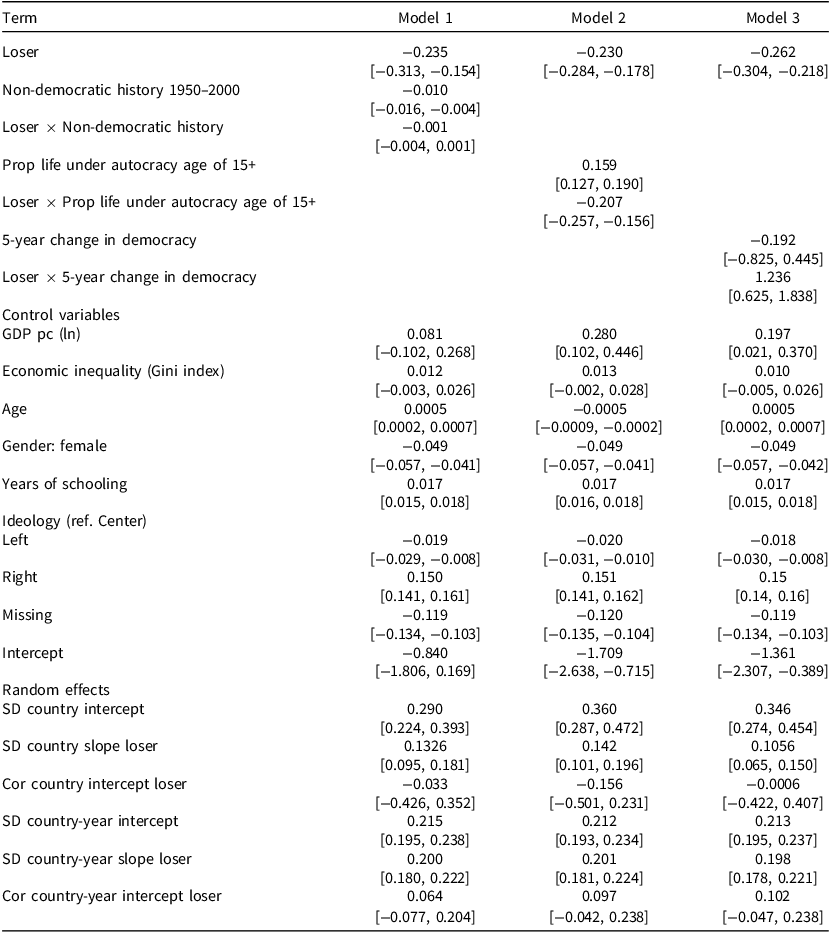
Table 1 presents coefficients for a set of three-level ordered probit models with trust in parliament as the dependent variable and individual- and macro-level predictors. The first model examines the effects of non-democratic experience from 1950 to 2000 on the winner-loser gap (H1), expecting that longer non-democratic experience is associated with greater winner-loser gaps in political trust. According to Model 1 estimates, in countries that have not experienced autocratic governments in the second half of the 20th century, the estimated gap equals 0.093 on the probit scale (95% posterior credible interval = [0.061, 0.124]), while in countries that have the highest number of non-democratic spells (in our data: Russia), the estimated gap is 0.107 (CI = [0.077, 0.139]). The difference between the two estimates is minimal, and the posterior probability for the interaction term between non-democratic history and loser status equals 0.88. These findings do not provide sufficient support to reject the null hypothesis for H1.
Winner-loser gap and non-democratic experience: estimates from multilevel ordinal regression models

Table 1. Long description
The table shows estimates from three multilevel ordinal regression models predicting trust with individual electoral winner or loser status and the country’s authoritarian experience (in Model 1), individual authoritarian experience (in Model 2), five-year change in democracy (in Model 3), as well as control variables. Each row provides specific estimate values for each column, indicating the impact of the independent or control variables on trust in parliament. The table reports coefficients (posterior means) and 95% posterior credible intervals.
Notes: N countries = 40, N country-years = 268, N respondents = 264932. Regression coefficients and 95% posterior credible intervals. Non-democratic history = number of years of autocracy between 1950 and 2000. Economic inequality = Gini index of disposable income. Data sources: European Social Survey, LAPOP, Varieties of Democracy, Standardized World Income Inequality Database.
Model 2 corresponds to H2 and analyzes the impact of individual experiences with non-democratic contexts on winner-loser trust gaps. The model includes an individual-level measure of personal autocratic experience, measured as the proportion of years the individual lived in an autocratic system since the age of 15 until the year of the survey. The findings in Figure 2 reveal that greater exposure to non-democracy, while controlling for age, is associated with a wider winner-loser trust gap. Specifically, for people with no exposure to autocratic governance, the winner-loser gap is estimated at 0.089 (CI = [0.068, 0.110]), while for people who spent their entire lives in autocratic countries, the gap is twice as large, estimated at 0.172 (CI = [0.146, 0.200). These results thus support the rejection of the null hypotheses for H2. A comparison of model fit using approximate leave-one-out cross-validation indicates a superior fit of the model with individual-level non-democratic experience compared to the one with country-level non-democratic experience. The difference in the expected log predictive density between both models is 82.4 with a standard error of 13.8, which indicates a meaningful difference in model fit (Sivula, Magnusson, Matamoros et al. Reference Sivula, Magnusson, Matamoros and Vehtari2020). We interpret this result as evidence that the individual-level political experience acquired under a non-democratic regime is the key element driving the winner-loser gap in trust among respondents.
Estimated levels of trust among winners and losers, with other covariates held at their means and ideology at ‘center’, based on Models 1 and 2 from Table 1.

The effects of changes in democratic quality on winner-loser gaps
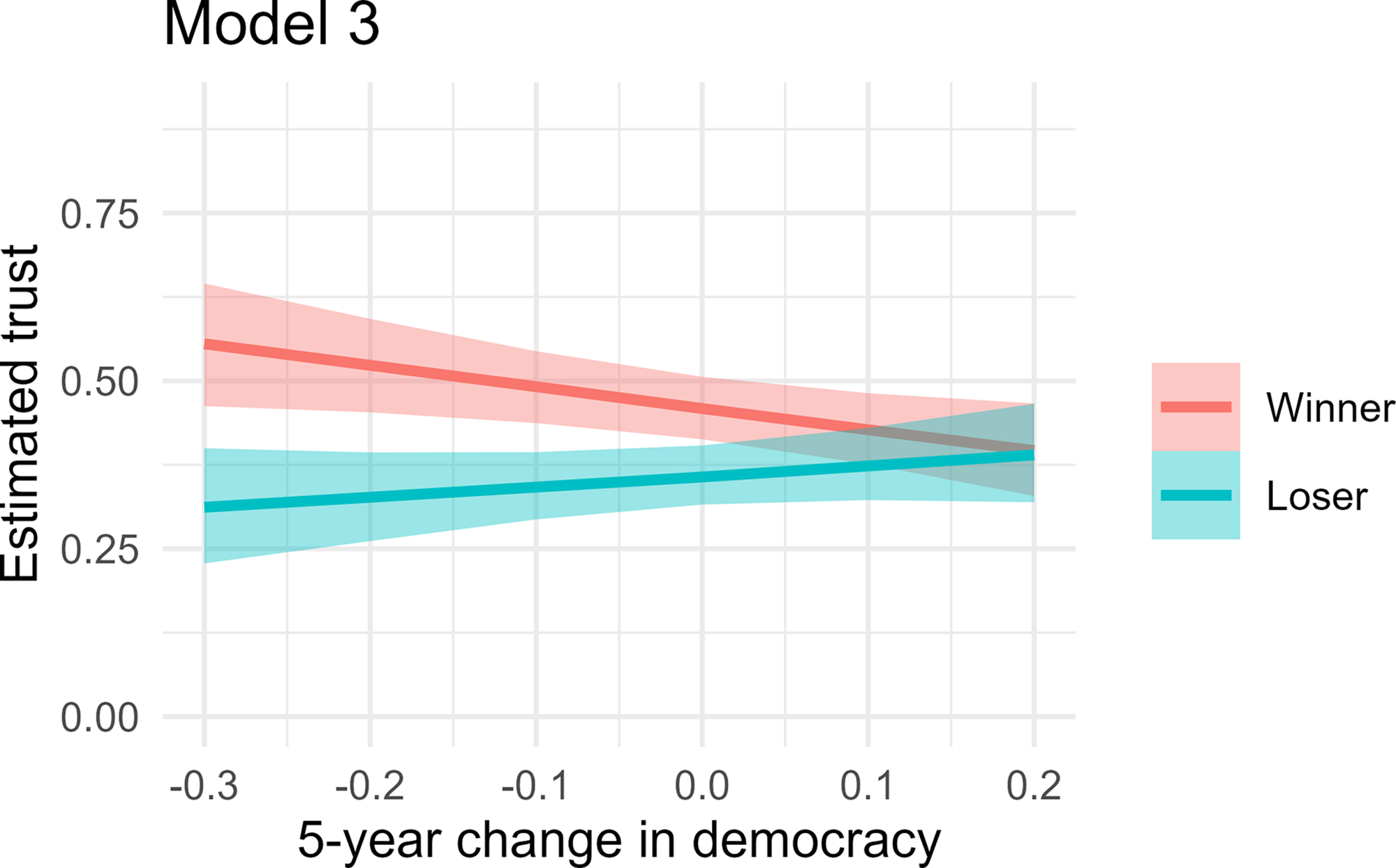
Model 3 in Table 1 provides a test of hypothesis 3 about the effects of five-year changes in democracy on winner-loser gaps in trust in parliament, estimated with an interaction between loser status and five-year changes in liberal democracy. The estimated levels of trust are plotted in Figure 3. In countries that experienced a decline in the democratic quality by 0.3 (such as Poland in 2018), the estimated winner-loser gap in trust in parliament is 0.243 (CI = [0.173, 0.311]). For countries that saw a 0.2 improvement in democratic quality (e.g., Ecuador in 2019), the estimated gap is essentially 0 (the point estimate equals 0.005, 95% CI = [−0.045, 0.056]). These results allow us to reject the null hypothesis for H3.
Estimated levels of trust among winners and losers, with other covariates held at their means and ideology at ‘center’, based on Model 3 from Table 1.

Conclusions
Large differences in perceptions of politics between electoral winners and losers are markers of political conflict and polarization (cf. Patkós Reference Patkós2023). Such divides hinder communication between groups, undermine their capacity to pursue common goals, and may even undermine trust in elections (Hérnandez-Huerta and Cantú Reference Hernández-Huerta and Cantú2022). Our paper sheds light on the processes that lead to more pronounced winner-loser gaps in political trust in new democracies by drawing attention to the historical legacy experienced by voters under authoritarian rule, responsible for greater presence of uncertainty and vulnerability. Our findings suggest that the legacies of authoritarianism continue to influence political trust after democracy is established, in contrast to foundational studies that treat winning or losing elections as an experience limited to democratic contexts (Anderson, Blais, Bowler et al. Reference Anderson, Blais, Bowler, Donovan and Listhaug2005).
Our analysis also examines how trust among winners and losers responds to fluctuations in the democratic quality. We demonstrate that short-term improvements in democratic quality can narrow the trust gap between losers and winners, refining the cross-national effects identified by Nadeau, Daoust, and Dassonneville (2021) and Singer (Reference Singer2023). This pattern aligns with the expectations of the ‘thermostatic democratic support’ theory (Cohen, Smith, Moseley et al. Reference Cohen, Smith, Moseley and Layton2022), which suggests that the conditional effects of being an electoral winner or loser are shaped by a context of increasing democratic quality. In this scenario, winners act as ‘constrainers’, becoming more skeptical of government performance as democratic institutions strengthen, while losers increase their ‘consent’, gaining trust in the system as electoral fairness and institutional accountability improve. As a result, higher democratic quality helps curb support for governments and leaders who seek to dismantle democratic checks and balances, restrict media freedom, or limit minority rights. This dynamic presents a critical safeguard for democracy, particularly in countries facing illiberal pressures.
Our confidence in the generalizability of the results is strengthened by the diversity of institutional arrangements in the countries our analysis covers. In parliamentary systems with coalition governments, supporters of junior coalition partners may find their preferred party in government but with limited influence – a partial victory at best. In presidential systems, voters may back a losing candidate while their legislative party gains seats, creating mixed outcomes. In proportional systems, the distance between the government and opposition is typically smaller than in majoritarian systems where winner-takes-all dynamics concentrate power. Despite these institutional differences, we find a clear pattern: the winner-loser gap becomes larger with increasing exposure to autocratic rule across all these settings. Rather than treating institutional heterogeneity as a limitation, we interpret this consistency as evidence that the mechanism we identify operates at a fundamental level – through a learned disposition to interpret electoral outcomes that was forged under a non-democratic rule.
The finding about the long-lasting and large winner-loser gaps among individuals with previous authoritarian experience, even decades following transitions to democracy, is both reassuring and cause for concern. Knowing that high gaps prevail over an extended period takes some pressure away from leaders of democratic transitions. We show, however, that these outcomes are not immutable: improvements in democratic quality can attenuate losers’ negative reactions to defeat and winners’ positive reactions to victory, thereby narrowing the winner-loser gaps even in countries with extended recent histories of non-democratic rule.
Our theoretical argument does not have implications for the causal relationship between political trust and the confidence gap – namely, the debate between ‘sorting’ and ‘attitudinal change’ (Muis, Brils, and Gaidytė Reference Muis, Brils and Gaidytė2022). The first perspective emphasizes political trust as a key driver in reducing support for radical right-wing parties (Kriesi and Schulte-Cloos Reference Kriesi and Schulte-Cloos2019), while the second argues that the confidence gap results from a preceding attitudinal shift (Krause and Wagner Reference Krause and Wagner2021; Cohen Reference Cohen2020). In our case, we do not address the specific voting preferences that contribute to the winner-loser gap in trust. We believe that exploring this aspect would require further research within a longitudinal theoretical framework.
The broadly comparative character of our study has important advantages, as it enables us to examine trust across different political contexts and regions, but it does so at the cost of missing some attention to specific conditions that may affect democratic trajectories. A closer examination of countries where the polarization of political support enabled democratic deconsolidation versus those where backsliding was overcome can shed light on other factors that shape democratic futures. Further research may also investigate trust formation to understand the ways in which authoritarian legacy and current democratic developments change how people weigh performance evaluations, representation perceptions, and other considerations (cf. Neundorf, Dahlum, Frederiksen et al. Reference Neundorf, Dahlum, Frederiksen and Ozturk2024).
Lastly, it is worth considering some limitations of our study that future research could address. First, our research invokes vulnerability and uncertainty from previous autocratic and current experiences of democratic backsliding as key drivers of winner-loser gaps in political trust. At the same time, our theoretical framework and empirical strategy do not detail specific mechanisms that could link these experiences to differential trust responses. Following Anderson, Blais, Bowler et al. (Reference Anderson, Blais, Bowler, Donovan and Listhaug2005), such processes might operate through cognitive schemas, emotional conditioning, or expectations about policy and access to resources. We see considerable value in future work designed to assess and test more directly among these alternative micro-mechanisms.
Second, we acknowledge that the measurement of winner or loser status we use relies on self-reported vote choice rather than validated data. While this is common in cross-national literature on winner-loser gaps, it does leave empirical results vulnerable to various response effects, including social desirability bias. We hope that future data collection can help mitigate this issue.
Third, our measure of authoritarian experience captures respondents’ exposure to non-democratic rule but does not allow us to identify their political status under the prior authoritarian regime. Consequently, we cannot distinguish between individuals who were aligned with authoritarian incumbents and those who opposed them. This limitation may attenuate the estimated effects of authoritarian legacies, as some combinations of past and present political status are likely more consequential than others. For example, individuals who supported the authoritarian regime but subsequently became democratic losers may experience particularly large declines in political trust following the loss of political influence. Conversely, former authoritarian-era opponents who become democratic winners may exhibit especially high levels of trust, reflecting both the benefits of electoral victory and their prior experience of political exclusion. Future data collection that asks respondents about their previous political alignments could help overcome this issue.
The last limitation is that we observe only the gap between winners and losers, rather than how each group changes independently. With our research design, we cannot fully disentangle whether the estimated ‘loser’ effects are driven by the negative experience of defeat, the positive experience of victory, or some combination of the two. Doing so would require a counterfactual baseline – citizens not exposed to an electoral outcome – which our data do not provide. Panel surveys or experimental designs would be better suited to overcome this constraint. Such approaches could also assess whether vulnerability and uncertainty operate symmetrically across groups. If voters are generally risk averse, the experience of losing may depress political trust more strongly than winning elevates it. In that case, the legacy of non-democratic rule would become a central explanation for why post-authoritarian societies persistently exhibit lower levels of political trust than countries with uninterrupted democratic histories.
Supplementary material
The supplementary material for this article can be found at https://doi.org/10.1017/S1475676526101972.
Acknowledgements
We would like to thank Claire Durand for her invitation to present this paper at the Centre for the Study of Democratic Citizenship Speaker Series at the University of Montreal, where we also got useful comments from her, Ruth Dassonneville, and Dietlind Stolle. We further thank participants at the European Consortium for Political Research Joint Session on Democracy, Political Trust, and Trustworthiness, organized by Daniel Devine and Lisanne de Blok, in Lüneburg in March 2024, and participants at the Quantitative Political Research Workshop organized by Adam Gendźwiłł and Michał Gulczyński in Warsaw in June 2025, for their feedback. We acknowledge the computational resources provided by the Interdisciplinary Centre for Mathematical and Computational Modelling, University of Warsaw, under computational allocation GB84-31.
Funding statement
Mariano Torcal wants to thank the ICREA ACADEMIA Excellence Award and Grant «Excelencia María de Maeztu» CEX2025-001632-M funded by Agencia Española de Investigación. Matias Bargsted acknowledges support by Agencia Nacional de Investigación y Desarrollo (ANID), Chile, through FONDECYT Regular Grant No. 1261883. Marta Kołczyńska acknowledges funding by Poland’s National Science Centre, grant number 2019/32/C/HS6/00421.
Replication materials
Replication materials are available via this link: https://osf.io/r8y7m/.
AI use statement
We acknowledge using generative AI tools to assist with language editing.




 Open access

