Introduction
Lithium-rich granitic pegmatites belong to the characteristic group of the rare-element class with a LCT (Li–Cs–Ta) geochemical signature (Černý Reference Černý1991; Černý and Ercit Reference Černý and Ercit2005; London Reference London2008, Reference London2015, Reference London2018 and references therein). The distinctive feature of these pegmatites is the unusually high to extreme degree of chemical magmatic fractionation, which resulted in a markedly elevated concentration of rare lithophile elements (especially Li, Rb, Cs and Ta). Consequently, rare-element granitic pegmatites are relatively uncommon; in general, they make up <2% of occurrences within individual pegmatite fields (Stewart, Reference Stewart1978; Charoy et al., Reference Charoy, Noronha and Lima2001). This complex type of LCT-family pegmatites represents the most fractionated granitic pegmatites in terms of geochemistry, internal zoning, and mineral diversity.
The complex rare-element granitic pegmatites of the LCT family account for about one-half of the world's Li production (Jaskula, Reference Jaskula2021), a majority of Ta production, and the entire Cs production (Bradley et al., Reference Bradley, McCauley and Stillings2017). At the deposit scale, metric tons of ore and average grades of European hard-rock Li deposits are relatively competitive when compared to the world-class LCT pegmatites from Greenbushes in Australia, Whabouchi in Canada, and the Proterozoic Ukrainian pegmatites, which exhibit similar grades and tonnages (Gourcerol et al., Reference Gourcerol, Gloaguen, Melleton, Tuduri and Galiegue2019).
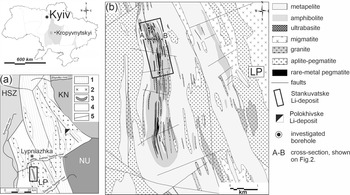
Typical examples of large, Li–Cs–Ta-rich rare-element granitic pegmatites contain very coarse to giant-size petalite or spodumene crystals, similarly the minerals associated with them (from centimetres to several metres). These crystals are typically found in the intermediate to central parts of the dykes, and are associated commonly with lithium phosphate phases (triphylite, amblygonite and montebrasite), together with younger Li-rich lepidolite micas and/or elbaitic tourmalines (e.g. in Tanco, Harding or Black Hills; Černý, Reference Černý, Möller, Černý and Saupe1989; London, Reference London2008, and references therein). Lithium-dominant aluminosilicate minerals (spodumene and petalite) form stable phases during primary magmatic crystallisation (Stewart, Reference Stewart1978; London and Burt, Reference London and Burt1982c; Burnham and Nekvasil, Reference Burnham and Nekvasil1986; Fenn, Reference Fenn1986; London et al., Reference London, Herving and Morgan1988; Charoy et al., Reference Charoy, Noronha and Lima2001; Maneta, Reference Maneta2015; Fei et al., Reference Fei2020; Liu et al., Reference Liu, Wang, Wu, Xie, Liu, Li, Yang and Li2020). Moreover, the assemblage of spodumene + quartz intergrowths (‘squi’ texture; e.g. Černý and Fergusson, Reference Černý and Ferguson1972; Chakoumakos and Lumpkin, Reference Chakoumakos and Lumpkin1990; Černý et al. Reference Černý, Ercit and Vanstone1996; Simmons and Webber, Reference Simmons and Webber2008; London, Reference London2008, Reference London2014; Roda-Robles et al., Reference Roda-Robles, Pesquera, Gil-Crespo, Vieira, Lima, Garate-Olave, Martins and Torres-Ruiz2016) is commonly a secondary product, resulting from petalite breakdown. Spodumene can also crystallise under hydrothermal conditions, at higher pressure (0.5–0.7 GPa) in a temperature range from 320 to 570°C (Li et al., Reference Li, Chou, Yuan and Burruss2013). Classic petalite or spodumene rare-element pegmatites exhibit primary magmatic textures and well-preserved mineral zoning, displaying wall, intermediate and core zones (e.g. Černý Reference Černý, Möller, Černý and Saupe1989; London Reference London2008). However, there are also known occurrences of Li-rich granitic pegmatites overprinted by subsequent tectono–metamorphic deformation and recrystallisation: examples include the Greenbushes pegmatites in Western Australia (Partington et al., Reference Partington, McNaughton and Williams1995) and the Red Cross Lake pegmatites in Manitoba, Canada (Brisbin et al., Reference Brisbin, Eby, Corkery, Černý, Chackowsky, Ferreira, Halden, Meintzer and Trueman2012; Černý et al., Reference Černý, Corkery, Halden, Ferreira, Brisbin, Chackowsky and Meintzer2012); or by metasomatic recrystallisation, which has been described in the Polokhivske Li-deposit, Central part of Ukraine (Eremenko et al., Reference Eremenko, Ivanov, Belykh, Kuzmenko and Makyvchuk1996; Vozniak et al., Reference Vozniak, Bugaenko, Galaburda, Melnikov, Pavlyshyn, Bondarenko and Syomka2000) (Fig. 1a).
This paper describes the Stankuvatske Li-deposit from the western part of the Inhul Domain of the Ukrainian Shield, which contains petalite and spodumene rare-element granitic mineralisation. To date, numerous Li-rich dykes have been discovered in this region by borehole prospecting (e.g. Nechaev et al., Reference Nechaev, Makivchuk and Belykh1991; Nechaev and Syomka, Reference Nechaev and Syomka2012; Eremenko et al., Reference Eremenko, Ivanov, Belykh, Kuzmenko and Makyvchuk1996; Vozniak et al., Reference Vozniak, Bugaenko, Galaburda, Melnikov, Pavlyshyn, Bondarenko and Syomka2000; Vozniak and Pavlyshyn (Reference Vozniak and Pavlyshyn2001); Ivanov and Lysenko, Reference Ivanov and Lysenko2001; Ivanov et al., Reference Ivanov, Kosiuga and Pogukai2011; Hrinchenko et al., Reference Hrinchenko, Bondarenko, Syomka, Ivanov and Kanunikova2016; Bondarenko et al., Reference Bondarenko, Syomka, Kurylo, Stepanyuk and Donskoy2019). However, very few data on the Li-mineralisation are available. The objective of this paper, therefore, is to describe the textures and composition of lithium minerals and associated phases in dykes that were overprinted by extensive metamorphism and recrystallisation.
Geological background
The Stankuvatske Li-deposit is situated in the north-western part of the Lypniazhka Dome Structure, which is located in the western part of the Inhul Domain of the Ukrainian Shield in the Kirovohrad region, 90 km W–SW of Kropyvnytskyi city, 10 km S-SW of Lypniazhka village, Ukraine (Fig. 1). Tectonically, the Lypniazhka Dome Structure occurs within the Zvenyhorod–Bratsk shear zone trending NW (345°) and located between the Novoukrainka granitoid massif, specifically the Korsun-Novomyrhorod Pluton in the east and the Holovnaivsk granulitic basement in the west (Gintov and Mychak, Reference Gintov and Mychak2011), Fig. 1a. This zone developed mainly as a result of intense Palaeoproterozoic tectonic and magmatic activity related to the formation of the Kirovohrad and Novoukrainka granitic massifs in the central part of the Inhul Domain. This oval anticlinal, NW-trending Lypniazhka Dome Structure consists of the Kirovohrad granite complex of Palaeoproterozoic age (Stepanyuk et al., Reference Stepanyuk, Hrinchenko, Bondarenko, Syomka and Kurylo2018). Host rocks predominantly represent Palaeoproterozoic to Neoarchean amphibolites and gneisses (2450 to 2650 Ma). Locally, bodies of basic and ultrabasic rocks are part of the host amphibolites, which have been metamorphosed at upper amphibolite facies (270−350 MPa, 650−710°C; Kurylo et al., unpublished data) (Fig. 1b). Granitic pegmatites in the area have a Palaeoproterozoic age of ~2.0 Ga (Shcherbak et al., Reference Shcherbak, Artemenko, Lisna, Ponomarenko and Shumlianskyi2008, Stepanyuk et al., Reference Stepanyuk, Hrinchenko, Bondarenko, Syomka and Kurylo2018, Reference Stepanyuk, Kurylo, Syomka, Dovbush, Bondarenko, Kovtun and Kotvitska2021).
(a) Regional geology of the western part of the Inhul Domain, Ukraine. Abbreviations: HZS – Holovanivsk suture zone that represents granulitic basement, KN – Korsun–Novomyrhorod pluton, NU – Novoukrainka granitoid massif. Numbers: 1 – Zvenyhorod–Bratsk shear zone, 2 – granite of Kirovohrad granite complex (LP: Lypniazhka Dome Structure), 3 – bodies of amphibolite and ultrabasic rocks, 4 – host metamorphic rocks of the Inhul series, 5 – regional faults. (b) Simplified geological map of Li-bearing dykes from the Stankuvatske lithium deposit (Ivanov and Lysenko, Reference Ivanov and Lysenko2001).

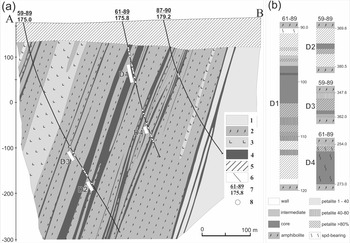
The Stankuvatske Li-deposit is represented by a swarm of more than 25 meta-pegmatite bodies identified in geological cross-sections and is hosted by amphibolite, including rare ultrabasic rocks (Fig. 2a). The Li-rich meta-pegmatite dykes form tabular bodies oriented parallel to the amphibolite foliation (Ivanov et al., Reference Ivanov, Kosiuga and Pogukai2011), with a thickness which usually ranges from ~5–33 m; however, thinner dykes (≤1 m) are also present. The length of the pegmatite bodies is estimated at up to several hundred metres. The largest pegmatite dykes are found in the central part, whereas the smallest ones can be seen on the margin of the Stankuvatske Li-deposit field (Fig. 2b). Petalite and spodumene are the dominant Li-bearing minerals in the meta-pegmatites. The contacts between the Li-rich meta-pegmatites and host amphibolites are sharp and accompanied by metasomatic alteration, with biotite-rich exocontact zones. The bulk Li2O content of the Li-rich dykes ranges from 0.34 to 2.23 wt.%, with a mean value of 1.26 wt.% (Eremenko et al., Reference Eremenko, Ivanov, Belykh, Kuzmenko and Makyvchuk1996). The meta-pegmatite dykes are covered by Quaternary sediments, and thus were mapped from drill cores extracted from the upper surface of the crystalline basement to a depth of 300 m.
Cross sections of the Stankuvatske Li-deposit: (a) cross-section through A–B line (Fig. 1) (Ivanov and Lysenko, Reference Ivanov and Lysenko2001, modified). 1: gneisses, 2: amphibolites, 3: ultrabasic rocks, 4: rare-metal granitic pegmatites, 5: sedimentary rocks, 6: boreholes, 7: borehole number (number/depth, m), 8: sample locations; (b) cross-sections in selected boreholes and relevant internal Li distribution.

Methods
A collection of polished thin sections from the four boreholes in the northern part of the Stankuvatske Li-deposit has been used for petrographic study. The compositions of the minerals were analysed at the Earth Institute of the Slovak Academy of Sciences, Banská Bystrica, Slovakia, using a JEOL JXA 8530F field-emission electron-microprobe in wavelength-dispersion mode. The following analytical conditions were applied: probe current = 20 nA, acceleration voltage = 15 kV, beam diameter = 3–10 μm, counting time = 10–30 s on the peak, and 5–15 s on the background. The X-ray lines and standards are shown in Table 1. ZAF correction was used (Bence and Albee, Reference Bence and Albee1968).
Conditions of analysis of the detected minerals with electron microprobe.

* based on 1σ.
Non-polarised Raman spectroscopy of petalite and spodumene was performed on thin sections using a Labram HR800 microspectrometer (Horiba Jobin-Yvon) based on an Olympus BX41 microscope with a confocal Czerny-Turner type monochromator (focal length 800 mm) at the Earth Institute of the Slovak Academy of Sciences, Banská Bystrica, Slovakia. A frequency-doubled Nd-YAG laser at 532 nm was used for excitation. The Raman-scattered light was collected in 180° geometry through a 100×/0.80 objective lens and dispersed by diffraction grating with 1800 grooves per mm onto a cooled, charge-coupled device (CCD) detector with a total exposure time of 300−400 s. The spectral resolution was 2 cm−1. Spectral accuracy was verified using the 734 cm−1 symmetric stretching mode of teflon.
Results
Petrography and mineral zoning
Host rocks
Host amphibolites are fine to medium grained (0.2–2 mm), consisting mainly of pale green magnesio-hornblende (Mg# [Mg/(Mg+Fe)] = 0.50–0.57), plagioclase (An66–77), ilmenite, and locally contain quartz, biotite (Mg# ≈0.60) and anthophyllite (Mg# ≈0.52), together with a small amount of pyrite, pyrrhotite, chalcopyrite and accessory zircon and apatite. The compositions of amphibole, biotite, plagioclase and ilmenite are given in Table 2. Meta-ultrabasic rocks occur exclusively in association with amphibolite bodies and were identified as a series of discontinuous layers with lengths of up to several hundred metres and a thickness of up to 85 m. These meta-ultrabasic rocks are pyroxenites, which consist of primary orthopyroxene and clinopyroxene, together with secondary actinolite, tremolite and a serpentine mineral.
Representative compositions (wt.%) of amphibole, biotite, plagioclase and ilmenite.

Notes: n.a. – not analysed; H2Ocalc in amphiboles and biotites assuming (OH+F+Cl) = 2; Mg# = Mg/(Mg+Fe). Analysis numbers: 1,3,9 – melanocratic amphibolite, sample 61-89/177 m; 2, 6, 7, 8 – amphibolite, sample 61-89/215 m; 4 – amphibolite, sample 59-89/314 m.5; 5 – exocontact, biotite-rich zone, sample 61-89/240.5 m.
Petalite dykes
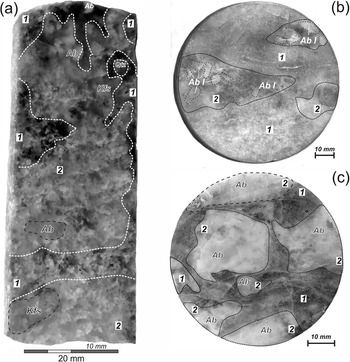
The dykes in the Stankuvatske Li-deposit are variable in their mineralogical composition, usually with strong predominance of petalite over spodumene and albite over K-feldspar. The dykes display a very heterogeneous metasomatic and metamorphic overprint, commonly with blurred contacts between the various mineral assemblages within the dykes. Macroscopically, these former pegmatite dykes are predominantly light greenish grey, with a fine-grained and saccharoidal texture, and locally visible rock fragments and porphyroclasts (Fig. 3). Consequently, the present internal structure of the largest dyke (>5 m) consists of complex, asymmetric metamorphic mineralogical zoning, especially in the intermediate part of former pegmatites (Fig. 2b). The smallest dykes, however, have no visible mineralogical zoning. The paragenetic sequence of all the identified minerals of the Stankuvatske Li-deposit dykes is listed in Table 3.
Macroscopic texture and structure of petalite-bearing dykes polished drill cores from borehole 61/89 shown on Fig. 2: (a) petalite-bearing pegmatite, intermediate part: 1 – fine-grained, saccharoidal fabric consisting of petalite, albite, quartz and relic porphyroclasts of albite; 2 –intermediate part, relics of K-feldspar, albite and quartz, and saccharoidal albite II, K-feldspar II and petalite II in groundmass; (b) albite + quartz + petalite part: 1 – fine grained albite II + petalite II + quartz II fabric; 2 – relic deformed fragments of albite I + quartz I exhibiting an augen structure; (c) fragments of coarse grained albite I (domain 2) within petalite groundmass.

Summary of the paragenetic sequence and distribution of minerals in each zone of the Stankuvatske Li-deposit dykes.

xxx – very abundant mineral; xx – common mineral; x – accessory mineral
* Chrysoberyl from the contact zone is not described in the current work.
Abbreviations: AB, outer part of dykes: albite-rich domain; AP: albite + petalite + quartz assemblage, intermediate part; KP: albite + K-feldspar + quartz ± petalite assemblage, internal intermediate part; KQ: K-feldspar + quartz ± albite ± spodumene, central part of petalite meta-pegmatite; AKS: albite + K-feldspar + spodumene assemblage, spodumene bearing dykes; CT: contact zone of petalite and spodumene dykes.
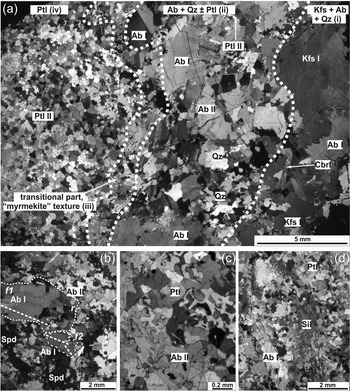
The following textural parts, or domains, of the petalite-rich meta-pegmatites were recognised, trending from the contact with the host metabasites towards the central part of the dyke (Figs 4–6).
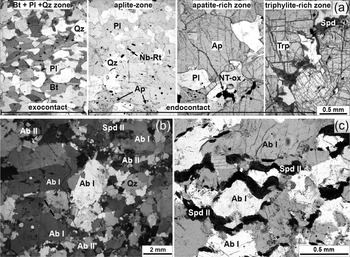
Microphotographs of contact zone and bordered albite domain: (a) exocontact – biotite-rich rock (biotite + plagioclase + quartz + holmquistite); endocontact: aplite (albite + quartz + apatite) with numerous grains of apatite, apatite-rich and triphylite-rich zones; (b) albite-rich part: porphyroclasts of tabular albite I in fine-grained albite II + quartz II fabric. (c) albite-rich part with intergranular fibrous spodumene II.

Textural and compositional features of the intermediate mineral association. (a) albite + quartz + petalite + K-feldspar assemblage of the layered intermediate part: (i) albite + K-feldspar + quartz + chrysoberyl, inner intermediate part; (ii) medium grained albite + quartz ± petalite, with fine-grained intergranular recrystallised albite and quartz; quartz and albite I contains small petalite inclusions; (iii) thin layer, characterised by ‘myrmekite’-like texture between albite – quartz and monomineral petalite domains; (iv) fine-grained petalite monomineral layer. Mineral abbreviations are from Warr (Reference Warr2021): Ab – albite, Kfs – K-feldspar, Qz – quarz, Ptl – petalite, Cbrl – chrysoberyl; I – primary and II –secondary association. (b) Two structural elements in albite–petalite–spodumene meta-pegmatite. Medium-grained porphyroclasts of albite I recrystallised to fine-grained enclave of albite II (r) and brittle fragmentation (f1 and f2). The fine-grained fabric consists of recrystallised albite II, quartz II and fibrous spodumene II. (c) Skeletal intergrowth of petalite and albite I. (d) Altered meta-pegmatite of fibrous sillimanite oriented along foliation of fine-grained matrix. Small porphyroclasts of albite I are present.

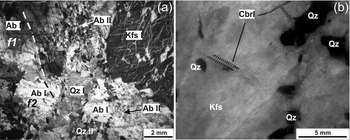
Central part of petalite meta-pegmatite dyke: (a) medium- to coarse-grained petalite bearing pegmatite from the inner intermediate domain. Dotted line shows the direction along twining and reflects a result of bending. Notice the slight rotation of broken fragment 2 (f2) to fragment 1 (f1). Albite I is intensively transformed to fine-grained albite II; (b): the central part, intergrowth of K-feldspar smoky quartz and needle-shaped chrysoberyl.

(1) The contact zone within undeformed parts of the meta-pegmatites is sharp, with the presence of metasomatic alteration (Fig. 4a). The exocontact zone is represented by a biotite-rich rock, which, in addition to biotite (Mg# 0.47–0.50) (Table 2), contains plagioclase (An32), quartz, metasomatic holmquistite, fluorapatite, and sporadically, dravitic to magnesio-foititic tourmaline. Many sections of the amphibolite and ultrabasic rocks near the contact zones are carbonated, containing not only calcite and epidote, but also garnet and sulfides. The endocontact is up to 5 cm in width and comprises three zones from the contact: (i) equigranular, fine-grained aplitic zone consisting of plagioclase (An18–20), quartz, fluorapatite, locally fibrous spodumene, and accessory triphylite, rutile (locally Nb-rich), ilmenite, chrysoberyl and zircon; (ii) fine- to medium-grained greenish blue fluorapatite zone; and (iii) light green triphylite-rich zone with chrysoberyl, fibrous spodumene and tourmaline.
(2) The meta-pegmatite rim consists of medium- to coarse-grained tabular albite (2.5–4.0 mm) or fine- to medium-grained (0.8–1.5 mm) saccharoidal albite with quartz and K-feldspar (Fig. 4b,c). In some places, monomineralic albite aggregates were found to occur as discrete pods or smaller individual dykes, generally on the edge of meta-pegmatite swarms. Occasionally, fibrous spodumene and petalite are present, though they occur only as inclusions in albite or occupy intergranular space. Accessory minerals are triphylite, zircon, columbite-(Fe), cassiterite, pyrite and sphalerite.
(3) The intermediate domain of the meta-pegmatite dykes contains two assemblages: albite + quartz + petalite ± spodumene ± K-feldspar; and albite + K-feldspar + quartz ± petalite ± spodumene (Fig. 5). The later assemblage primarily occupies the interior part of the intermediate domain. Remnant fragments of the original pegmatite range in size from 0.5–25 mm and exhibit an augen texture (Fig. 3c,b). Porphyroclasts (1–5 mm) of albite show preferred orientation along the foliation. The prominent features of the fine-grained fabric are the presence of continuous layering and pods, which most commonly consist of K-feldspar + albite + quartz ± petalite, albite + quartz ± petalite, albite + quartz + petalite, and locally monomineralic petalite (Fig. 5a). The abundance and thickness of each layer is variable, and boundaries between layers vary from sharp to gradational. Typical features include indications of dynamical recrystallisation of minerals and skeletal intergrowths of petalite + albite + quartz (Fig. 5a,c). Dynamic recrystallisation is represented mainly by inter- and intragranular recrystallisation of the deformed albite I (Fig. 5b). Fibrolitic sillimanite oriented along the foliation of the fine-grained matrix occurs in the strongly altered parts of the intermediate zone (Fig. 5d). Partial breakdown of petalite to spodumene + quartz (‘squi’ texture) was observed along the rims of petalite grains. Accessory minerals include: muscovite; chrysoberyl; sillimanite; montebrasite; triphylite; columbite-(Fe) with tiny lamellae of tantalite-(Fe); cassiterite; Nb-rich rutile; zinco- and ferronigerite; gahnite; pyrite; and sphalerite.
(4) The central part of thicker meta-pegmatite dykes consists of subhedral, medium- to coarse-grained (3–8 mm) assemblages of quartz + K-feldspar ± albite ± spodumene (Fig. 6). In the dykes investigated, this assemblage occurs locally, and consists of massive perthitic microcline crystals with interstitial quartz, together with primary spodumene and accessory fluorapatite, chrysoberyl, cassiterite, gahnite and uraninite. Recrystallisation of the groundmass has occurred only locally.
Spodumene dykes
Spodumene-rich meta-pegmatites, where spodumene predominates over petalite, typically occur as 1−5 m thick dykes and display an increasing abundance of K-feldspar towards the central part. Spodumene meta-pegmatite dykes exhibit two textural elements: (1) medium- to coarse-grained (0.3–10 mm) remnants of K-feldspar, albite, and locally quartz; (2) fine- to medium-grained (0.2–2.0 mm) albite, spodumene (10−30 vol.%), quartz, triphylite and petalite (≤2 vol.%). The accessory phases are: chrysoberyl; cassiterite; columbite-(Fe); zinco- and ferronigerite; montebrasite; muscovite; and sphalerite. The primary minerals were recrystallised along the foliation, or rock cleavage.
Mineral characteristics
Alkali feldspar
Two genetic types of albite were identified in the dykes. Albite I is a primary, volumetrically predominant mineral, which occurs as porphyroclastic euhedral grains up to 8 mm in size, with thin twinning (Figs 4b, 6a, 7). Deformed grains show bending of twin lamellae, undulatory extinction and intensive dynamic recrystallisation features. Locally, some grains of albite are completely recrystallised, however their primary habit can still be recognised (Fig. 5b). Smaller porphyroclasts form tabular euhedral crystals of 1.0–2.5 mm in size. Albite I is replaced by fibrous spodumene II and fine-grained saccharoidal albite II forming aggregates (0.1−0.5 mm in size; Figs 4b, 5, 6, 7) that are locally associated with tiny grains of muscovite and sillimanite.
Primary magmatic K-feldspar I forms medium to coarse tabular crystals (≤7 cm), which commonly exhibit undulatory extinction (Fig. 6). It occurs mainly in the central part of the meta-pegmatite dykes and less commonly in the intermediate outer domains. In the intermediate domain, coarse tabular K-feldspar I includes relicts of idiomorphic albite I (Fig. 7b), where K-feldspar I is replaced locally by spodumene II. Recrystallised K-feldspar II is rare and occurs as euhedral crystals, 0.1–0.5 mm in size, typically in strongly altered meta-pegmatites.
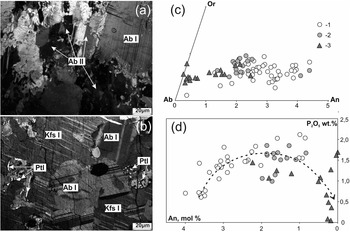
Petrography and composition of feldspars. (a) Relicts of primary albite I (Ab-I) with saccharoidal matrix of albite II. (b) K-feldspar (Kfs) phenocryst, which included albite with petalite inclusions in the border between the intermediate albite + K-feldspar + quartz and central K-feldspar + quartz domains. (c) Feldspar ternary diagram. (d) Anorthite molecule vs. P2O5 content, the dotted arrow shows the direction of the compositional trend. 1: albite-rich domain, 2: albite + K-feldspar + petalite assemblages, 3: spodumene dykes.

The composition of the alkali feldspars is shown in Table 4 and their petrography in Fig. 7. The anorthite content in albite from petalite-rich dykes attains 2−4 mol.%, yet it is lower in spodumene-bearing dykes (0.3−1.6 mol.%; Fig. 7c). Primary K-feldspar I and albite I exhibit a lower P2O5 content (ranging from 0.4−1.5 wt.% in both) in comparison with recrystallised K-feldspar II (1.8−3.8 wt.% P2O5) and albite II (1.5−2.0 wt.% P2O5). The P2O5 content gradually increases from petalite-bearing and albite-rich assemblages to the albite + K-feldspar assemblage. In contrast to the petalite dykes, albite from the spodumene two-feldspar pegmatites shows an opposing trend, with decreasing P2O5 content (Fig. 7d).
Average composition and P2O5 contents (wt.%) in alkali feldspar from different parts of dykes.*

*Mineral abbreviations: Ab – albite, Kfs – K-feldspar, Qz – quartz, Ptl – petalite, Spd – spodumene, Cber – chrysoberyl, Sil – sillimanite, Ap – apatite; I primary and II secondary mineral association.
D PKfs/Pl – empirical distribution coefficient of phosphorous between K-feldspar and plagioclase.
Petalite
Petalite (LiAlSi4O10) is the principal Li mineral identified in the meta-pegmatites (Figs 8, 9). Coarse-grained primary magmatic petalite I (crystals up to 3 cm in size) has been described only in the northern part of the Stankuvatske Li-deposit (Ivanov and Lysenko, Reference Ivanov and Lysenko2001). In the samples investigated here, petalite I was identified only rarely; it occurs as an anhedral, small (up to 2.0 mm in size) relict phase showing strong undulatory extinction. It is present in association with albite I within the intermediate part of the dykes (Fig. 5). In the albite domain, petalite I appears only as small inclusions in albite (Fig. 9a).
The Raman spectra of petalite and spodumene (sample 61-89/241.5 m).

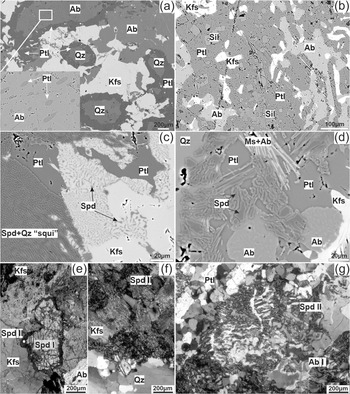
Petalite, spodumene and associated minerals. (a) Albite + petalite part (61-89/105.5 m). Relationship between K-feldspar (Kfs), albite (Ab) and petalite (Ptl). (b) Sillimanite (Sil) and K-feldspar (Kfs) in petalite matrix. (c) Alteration of petalite and K-feldspar by spodumene (61-90/217 m). The ‘squi’ texture (spodumene + quartz intergrowths) is a result of petalite and K-feldspar replacement. (d) Spodumene bearing albite + K-feldspar dyke (61-89/255.5 m). Intergrowths of secondary muscovite (Ms) + albite II were formed as a result of replacement of primary albite I and K-feldspar I. Spodumene (Spd) intergrowth with quartz (‘squi’) as the result of petalite breakdown. Spodumene-bearing pegmatite: (e) primary spodumene I (Spd I), rimmed by secondary fibrous spodumene II (Spd II); (f) spodumene in association with quartz (Qz), albite (Ab) and K-feldspar (Kfs) in tectonised pegmatite; and (g) transitional rock between petalite- and spodumene-bearing pegmatite, petalite is replaced by spodumene II.

Fine-grained petalite II is the dominant Li phase of the meta-pegmatites, in addition to the K-feldspar + quartz assemblages. Petalite II is associated with albite + quartz ± sillimanite (Fig. 9b), and it forms fine-grained aggregates, individual small tabular crystals (Fig. 5a), or symplectite-like intergrowths (Figs 5c, 9c,d). Petalite rims around quartz are 0.1−1.0 mm thick (Fig. 9a). Petalite II exhibits nearly end-member composition, as only a small amount of iron was identified (≤0.5 wt.% Fe2O3; ≤0.02 Fe atoms per formula unit [apfu]); the contents of other elements are ≤0.1 wt.% (Table 5).
Representative compositions (wt.%) of petalite, spodumene and holmquistite.*

*Notes: n.d. – not detected. Formulae based on: 5 cations and 10 atoms of O for petalite; 4 cations and 6 atoms of O for spodumene; and 13 cations and 24 atoms of O for holmquistite. Li in formula and Li2O contents were computed on the mass balance from stoichiometry. Analysis numbers: 1, 2 – sample 61-89/93.5 m; 3 – sample 61-89/255.0 m; 4, 5 – sample 61-89/199.5 m; 6 – sample 59-89/291 m; 7 – sample 61-89/153.5 m; 8,9 – sample 61-89/240.5 m.
Spodumene
Two generations of spodumene (LiAlSi2O6) were observed in the meta-pegmatites. Colourless to light brown, prismatic crystals (0.3−1.5 mm long) of spodumene I are relatively scarce (3−10 vol.%; Fig. 9e), except for a spodumene-bearing assemblage in the K-feldspar + quartz central domain of the dykes.
Fine-grained spodumene II (≤1 mm in size) is typical for the outer albite-rich domains (Fig. 4c). It forms either a fibrous aggregate (≤1 mm) or massive clusters filling the intergranular space. Locally, veins or fibroblastic aggregates of spodumene II appear as overgrowths on spodumene I (Fig. 9e). The skeletal intergrowths of spodumene II with quartz (‘squi’ texture) in the intermediate part of the dykes was formed from the breakdown of primary petalite (Fig. 9f,g). In albite-rich areas, spodumene II is associated with late muscovite + albite + montebrasite. Spodumene II is also typical in deformed spodumene dykes, where it occurs along the rock foliation and fractures (Fig. 9f). The compositions of spodumene I and II are homogeneous and almost free of substituting elements (Table 5).
Holmquistite
Holmquistite (Li2Mg3Al2Si8O22(OH)2) was found in the biotite-rich zone of the exocontact, where it occurs as thin rims around biotite and fine-grained platy crystals (<0.1 mm in size) in the biotite + plagioclase + quartz fabric. The composition is homogenous (Fe / (Mg + Fe) = 0.41–0.44) and stoichiometric (Table 5). Compositions of the platy holmquistite crystals are not presented in this paper.
Triphylite
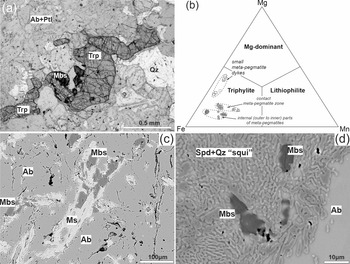
Triphylite (LiFe2+PO4) is the main Li-phosphate mineral in the Stankuvatske Li-deposit meta-pegmatites. It occurs in all pegmatite domains, with the exception of the central region. Triphylite (≤10 vol.%) is most abundant in the intermediate domain, where it occurs in the rock groundmass. In the contact zone, triphylite forms single tabular crystals (0.3−1.5 mm in size), aggregates, or monomineralic layers (Figs 4a, 10a). Triphylite is commonly replaced by secondary fluorapatite. The composition of triphylite varies widely between the meta-pegmatite domains (Table 6; Fig. 10b). The Fe/(Fe + Mn) ratio varies from 0.71 to 0.91, and it gradually decreases from albite-rich and albite + petalite + quartz to albite + K-feldspar + quartz assemblages and the contact zone. One significant feature of triphylite is the higher content of Mg in some smaller dykes consisting of albite + K-feldspar + quartz (≤11.4 wt.% MgO; ~0.4 apfu Mg).
Triphylite paragenesis and composition: (a) triphylite (Trp) in association with montebrasite (Mbs) within albite (Ab) + petalite (Ptl) + quartz (Qz) fabric, intermediate zone); and (b) composition of triphylite from different dykes and mineral association. Montebrasite (Mbs) relationships: (c) montebrasite relicts rimmed by muscovite (Ms) in albite matrix (Ab); and (d) secondary montebrasite in association with spodumene + quartz (Spd + Qz) and albite (Ab).

Representative compositions (wt.%) of triphylite.*

*Notes: n.d. – not detected. F# = Fe/(Fe + Mn). Li and Li2O contents were computed on the basis of an ideal sum of Li = 1.00 apfu. Analysis numbers: 1, 2 – sample 61-89/93.5 m; 3, 4 – sample 61-89/153.5 m; 5, 6 – sample 61-89/199.5 m; 7,8 – sample 59-89/291.5 m; 9, 10 – sample 61-89/240.5 m.
Montebrasite
Montebrasite [LiAlPO4(OH)] appears as primary and secondary minerals. Relicts of primary montebrasite I occur in the petalite + albite or spodumene II + albite + K-feldspar fabric of the intermediate domain. In addition, it is commonly associated with nigerite-group minerals, triphylite, and chrysoberyl. Montebrasite I is fine-grained (0.1−0.2 mm), colourless or light brown, yellow, and very low in F (≤0.2 wt.%). Primary montebrasite I was replaced by secondary fluorapatite and muscovite (Fig. 10a,c).
Secondary montebrasite II (≤0.3 mm) was identified in the albite II saccharoidal parts, together with spodumene–quartz intergrowths, and probably represent an alteration product of fibrous spodumene II (Fig. 10d). Montebrasite I and II commonly contain ~0.2 wt.% SrO; however, they are almost free of other substituting components (Table 7).
Representative compositions (in wt.%) of montebrasite and apatite.*

*Notes: n.d. – not detected. AMP – amphibolite, BZ – biotite-rich exocontact zone, AZ – aplite zone, ApZ – apatite-rich zone; all other abbreviations according to Table 2. Analysis numbers: 1–3 – sample 61-90/217 m; 4–6 – sample 61/89-199.5 m; 7–11 – sample 61-89/240.5 m; 12 – sample 61-89/199.5 m.
F# = Fe/(Fe + Mn). Li and Li2O contents were computed on the basis of an ideal sum of Li = 1.00 apfu.
Fluorapatite
In both the amphibolite and the biotite-rich exocontact rock, fluorapatite is abundant and forms colourless prismatic grains (Fig. 4a), characterised by high FeO (0.35 wt.%), but low MnO contents (<0.1 wt.%; Mn/Fe = 0.1−0.15) (Table 7). In the aplitic part, fluorapatite is an abundant mineral (up to 10 vol.%), occurring as fine-grained (0.2−0.7 mm) colourless prismatic crystals with low contents of trace components (<0.1 wt.% MnO; Mn/Fe = 3.1−5.6). In the petalite- and spodumene-bearing dykes, apatite is also low in Mn and F and can be classified as hydroxyl- to- hydroxyl-rich fluorapatite. The second form of apatite is a blue phase, which forms monomineralic zones containing crystals of 0.5−2 mm. This apatite shows the highest MnO content ( ̴1.0 wt.%; Mn/Fe= 7.0) and contains needle-shaped inclusions of triphylite oriented along the crystallographic apatite c-axis (Kurylo et al., Reference Kurylo, Broska, Bondarenko, Stepanyuk, Luptáková and Lyzhachenko2019).
Associated secondary minerals
Muscovite (50−300 μm) occurs in albite–petalite and K-feldspar + albite + spodumene assemblages of the intermediate part of the meta-pegmatites. Muscovite replaces montebrasite I and primary feldspars, and forms intergrowths with secondary albite II, spodumene II and quartz II (Fig. 10c).
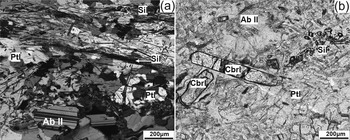
Sillimanite was observed in relatively large abundance (up to 10 vol.%) in strongly altered petalite + albite + quartz assemblages in the intermediate domain of the meta-pegmatites. In other mineral domains, sillimanite is present only as an accessory mineral. Sillimanite occurs as fibrolitic to acicular prismatic crystals up to 0.4 mm in size, forming irregular aggregates with commonly preferential orientations, and it is associated with chrysoberyl. Sillimanite partly replaces petalite II, quartz II, and albite I-II along their grain boundaries (Figs 5d, 9b, 11a). The composition of muscovite and sillimanite are given in Table 8.
Representative compositions (wt.%) of muscovite and sillimanite.

* H2O calculated from mass balance.
Notes: n.a. – not analysed, n.d. – not detected. Analysis numbers: 1 – sample 61-89/78.0 m; 2 – sample 61-89/105.5 m; 3, 4 – sample 61-89/255 m; 5, 6 – sample 61-90/217 m.
Chrysoberyl occurs sporadically in almost all domains, although it is more commonly associated with sillimanite; it also occurs rarely in intergrowths with sphalerite, cassiterite, zinconigerite, ferronigerite and triphylite (Figs 5a, 6b, 11b). It forms euhedral, elongated, prismatic 0.5–4.0 mm crystals. Chrysoberyl shows slightly elevated contents of Fe2O3 (0.2−0.5 wt.%; Table 9), and the content of other substituents is near the detection limit.
Representative compositions (wt.%) of chrysoberyl.*

*Notes: n.a. – not analysed, n.d. – not detected. Formulae based on 18 oxygen atoms. Be and BeO contents were calculated on the basis of an ideal sum of Be = 3 apfu. Analysis numbers: 1 – sample 61-89/153.5 m; 2, 3 – sample 61-89/105.5 m; 4 – sample 61-89/98.5 m.
Metamorphic mineral assemblages: (a) acicular prismatic crystals of sillimanite with preferential orientations along foliation and in associations with petalite II + albite II; (b) elongated prismatic crystals of chrysoberyl in association with sillimanite + albite II + petalite II.

Discussion
Mineral associations and geochemical features of the Stankuvatske Li-deposit granitic meta-pegmatite dykes indicate their affinity to the rare-element class, complex type, and petalite or spodumene subtype of the LCT (Li–Cs–Ta) family (Černý and Ercit, Reference Černý and Ercit2005). However, the dykes show extensive post-magmatic recrystallisation. The characterisation of magmatic minerals is limited to a small degree of preserved primary textures. Consequently, the dykes represent meta-pegmatites. The following mineral generations could be recognised in the Stankuvatske Li-deposit: (1) primary magmatic; (2) late hydrothermal–metasomatic; and (3) syntectonic–metamorphic.
Primary magmatic stage
Primary magmatic zoning in the Stankuvatske Li-deposit pegmatites is ambiguous because of the strong tectonic–metamorphic overprint, however it can be reconstructed on the basis of fragments resulting from the brittle deformation of primary feldspars, quartz, petalite and spodumene. In addition, there exist visible rock fragments and porphyroclasts, which give evidence for rapid emplacement. Albite I represents the early magmatic mineral phase in the investigated dykes, followed by quartz. Albite I is more abundant in the outer domains, whereas K-feldspar I generally occurs in central parts of the meta-pegmatite dykes. An increase in the volume of Li-rich magma during progressive magmatic crystallisation led to the subsequent precipitation of petalite or spodumene, which is associated with late-magmatic albite, K-feldspar and quartz in the intermediate and core domains. The scarcity of primary magmatic petalite I in the samples investigated may be explained by the fact that it has been replaced extensively by spodumene + quartz (‘squi’), a common assemblage in the intermediate domain. The following primary magmatic mineral zoning can be recognised in the Stankuvatske Li-deposit pegmatites: (1) wall zone: albite ± quartz; (2) outer intermediate zone: albite + quartz + petalite; (3) inner intermediate zone: albite + K-feldspar + quartz ± petalite; and (4) core zone: K-feldspar + quartz + spodumene. Triphylite and montebrasite I are the main phosphate minerals in the pegmatites, and are of magmatic origin. The high content of MgO (up to 11 wt.%) in the Mg-rich triphylite from some of the petalite dykes is very unusual, because the LiMgPO4 component rarely exceeds 10 mol.% in triphylite (Losey et al., Reference Losey, Rakovan, Hughes, Francis and Dyar2004). Triphylite, as a primary magmatic mineral, containing high MgO (up to 9.1 wt.%, 0.325 apfu Mg), has been described in the Brissago granitic pegmatite, western Southern Alps (Vignola et al., Reference Vignola, Diella, Oppizzi, Tiepolo and Weiss2008) and the Nanping pegmatite dyke, southeastern China (Rao et al., Reference Rao, Wang, Hatert and Baijot2014). However, the LiMgPO4 component in the triphylite could also represent solid solution with simferite Li(Mg,Fe3+,Mn3+)2(PO4)2, which has been described at the contact of a rare-earth-bearing granite pegmatite and phlogopitised ultramafic tremolite rock in the Radionivske pegmatite field, southeastern Ukraine (Bayrakov, et al., Reference Bayrakov, Yakubovich, Simonov, Borisovskiy and Ziborova2005). Triphylite is replaced only by secondary apatite, which contains tiny inclusions of pyrite and sphalerite, although hematite or other minerals indicative of oxidising conditions were not found. As a result, it is assumed that Fe and Mn in triphylite are entirely divalent; trivalent Fe or Mn are not present. The high Mg content in the triphylite in the smallest dykes from the Stankuvatske Li-deposit can be defined as Mg-rich triphylite, which reflects a high degree of contamination from the host amphibolites. Consequently, a solid solution of the triphylite with simferite is not indicated according to the formula balance.
The origin of the spodumene dykes and their relationship to the petalite dykes is not clear and requires further research. A characteristic of the spodumene dykes is that they are not very thick (typically between 1–5 m), indicating that they are probably apophyses rather than dykes. This interpretation is consistent with similar textural and compositional features of different mineral assemblages in both the petalite and spodumene dykes, and may also be applied to small albite-rich dykes.
The parental magma of the pegmatites investigated was peraluminous, enriched in P and Li (Rb, Cs), but vapour-undersaturated (Vozniyak et al., Reference Vozniak, Bugaenko, Galaburda, Melnikov, Pavlyshyn, Bondarenko and Syomka2000). Enrichment in P of parental magma is evidenced by the high P contents of primary feldspars and by abundances of primary magmatic phosphates such as triphylite and montebrasite. The scarcity of tourmaline and the absence of Li-rich mica document low primary B and F contents in the pegmatite magma.
Hydrothermal–metasomatic alteration
The source of Li is probably related to Li-rich fluids that reached a lower temperature at the hydrothermal stage and/or leached Li from primary Li-phosphates and Li-silicates at a later hydrothermal stage. Alteration of albite and petalite could produce secondary spodumene II in the Stankuvatske Li-deposit dykes by the following reactions (London and Burt, Reference London and Burt1982b, Reference London and Burt1982c):


The observed spodumene–quartz symplectite intergrowths (‘squi’) are well-known in many Li-rich pegmatites (e.g. Černý and Ferguson, Reference Černý and Ferguson1972; Charoy et al., Reference Charoy, Lhote and Dusausoy1992; Černý et al., Reference Černý, Ercit and Vanstone1996; Stilling, Reference Stilling1998; London, Reference London2008). In the Stankuvatske Li-deposit, primary spodumene I occurs much more rarely than petalite and was found typically in tectonically-deformed parts of the rocks perpendicular to shearing, as well as in the K-feldspar + quartz central zone of petalite-bearing pegmatites.
The post-magmatic hydrothermal–metasomatic alteration of primary magmatic petalite or spodumene in the Stankuvatske Li-deposit pegmatites led to the formation of saccharoidal albite II, together with K-feldspar II, petalite II, spodumene II and secondary muscovite. Similar alteration reported from other pegmatite localities (e.g. London and Burt, Reference London and Burt1982a; Nizamoff, Reference Nizamoff2006; Galliski et al., Reference Galliski, Černý, Márquez-Zavalía and Chapman2012; Rao et al., Reference Rao, Wang, Hatert and Baijot2014) reflects a gradual change from an alkaline to an acidic character of the post-magmatic fluids. However, it is difficult to distinguish if formation of these minerals was due to the hydrothermal–metasomatic alteration or to subsequent metamorphic overprint.
The well-preserved metasomatic contact zone provides important information about the behaviour of the main and trace components in the parental magma. Intensive leaching of K, Li, Rb (Cs), F, H2O, CO2, partially P and H2O (but not Na) from the pegmatites into the host amphibolites is documented by the formation of Rb–Cs-rich biotite, Li-amphibole (holmquistite), dravite and magnesiofoitite, found sporadically in the exocontact zone, in addition to fluorapatite and triphylite in the endocontact zone. A similar metasomatic alteration has been described around the rare-element pegmatites in the Tanco mine, Canada (London, Reference London1986; Morgan and London, Reference Morgan and London1987, Reference Morgan and London1989; Wolf and London,Reference Wolf and London1997) and the Polochivske deposits of Ukraine (Vozniak, Reference Vozniak, Bugaenko, Galaburda, Melnikov, Pavlyshyn, Bondarenko and Syomka2000; Ivanov, Reference Ivanov, Kosiuga and Pogukai2011).
Metamorphic overprint of pegmatites
The textural relationships observed in the Stankuvatske Li-deposit pegmatites document their strong metamorphic reworking, which led to substantial replacement of the primary magmatic features by reducing the grain size of recrystallised primary minerals, thus yielding new, fine-grained polymineralic aggregates. Similar observations were made by Eremenko et al. (Reference Eremenko, Ivanov, Belykh, Kuzmenko and Makyvchuk1996), Bakarsiev et al. (Reference Bakarzhiev, Makivchuk, Ivanov, Eremenko and Pavkin2000), and Ivanov and Lysenko (Reference Ivanov and Lysenko2001). Vozniak et al. (Reference Vozniak, Bugaenko, Galaburda, Melnikov, Pavlyshyn, Bondarenko and Syomka2000) and Vozniak and Pavlyshyn (Reference Vozniak and Pavlyshyn2001) proposed that the fine-grained quartz + albite + petalite fabric is the product of metasomatic replacement of a primary magmatic mineral association, caused by infiltration of CO2-rich fluids.
The layered albite + quartz + petalite intermediate domain probably reflects high strain and considerable recrystallisation and shearing of primary magmatic petalite I, albite I and quartz. An analogous scenario was proposed for lepidolite-bearing meta-pegmatites from Red Cross Lake, Canada (Brisbin et al., Reference Brisbin, Eby, Corkery, Černý, Chackowsky, Ferreira, Halden, Meintzer and Trueman2012).
The presence of sillimanite and chrysoberyl also indicates a late tectono–metamorphic overprint of the Stankuvatske Li-deposit meta-pegmatites. Moreover, petalite II forms either polygonal aggregates, reflecting static recrystallisation, or a corona structure around primary albite I and quartz I (Figs 5, 9a). Petalite II is probably a product of the recrystallisation of primary petalite I, as evidenced by rare relic primary petalite I, which was found among the petalite–albite intergrowths within the intermediate domain of the dykes. Petalite II in the petalite-rich zone is oriented parallel to chrysoberyl and sillimanite, thereby indicating its simultaneous formation during the metamorphism. Alkali feldspar shows evidence of both ductile and brittle deformation. The undulatory extinction of K-feldspar and bending of albite I reflect a high strain of deformation.
Both stress and shearing generated abundant, lineated, fibrous sillimanite at the expense of muscovite (and probably also albite), as was described by Černý et al. (Reference Černý, Novák and Chapman1992):


The textural and chemical features also suggest a metamorphic origin for the chrysoberyl within the intermediate zone of the meta-pegmatite dykes. This is typically associated with quartz and fibrolitic sillimanite, and it is oriented parallel to the rock foliation (Fig. 9d). An origin of chrysoberyl by metamorphic overprint has also been documented in several beryl-bearing granitic pegmatites (Franz and Morteani, Reference Franz and Morteani1984, Reference Franz, Morteani and Grew2002; Černý et al., Reference Černý, Novák and Chapman1992; Beurlen, et al., Reference Beurlen, Thomas, Melgarejo, Silva, Da Rhede, Soares and Silva2013). The possible reaction describing the formation of metamorphic chrysoberyl could be written as:

(Franz and Morteani, Reference Franz and Morteani1984, Reference Franz, Morteani and Grew2002). Remnants of beryl were not found in the samples investigated; however, it is probably the most reasonable primary magmatic source of Be.
Pressure–temperature conditions
The pressure–temperature (P–T) conditions of magmatic crystallisation of the Stankuvatske Li-deposit are not completely understood, however stability relations among the Li-aluminosilicates can be estimated from an experimentally constrained diagram (London and Burt, Reference London and Burt1982a, Reference London and Burt1982c; London, Reference London1984). The most important reaction, i.e.

in the Li-aluminosilicate system separates the stability field of spodumene-bearing pegmatites from those that contain only primary petalite. Under equilibrium conditions, petalite will be stable between 380°C at 200 MPa and 660°C at 400 MPa (Fig. 12a) (London and Burt, Reference London and Burt1982b, London, Reference London1984). Lowering temperatures causes petalite to break down to an intergrowth of spodumene + quartz (‘squi’ texture). It can be assumed that spodumene I from the central part of the investigated petalite-bearing dykes is a very uncommon phase and was probably formed as a result of increasing hydrostatic pressure or, more likely, a temperature decrease during the late-magmatic stage of pegmatite crystallisation. Formation of spodumene II points to the breakdown of primary magmatic petalite at subsolidus conditions together with extensive albitisation. According to experimental data for water-saturated haplogranite melt, the solidus line lies at ~650°C at 400 MPa, however components such as Li, B, P and F distinctly decrease the solidus temperature (e.g. Jahns, Reference Jahns and Černý1982; London, Reference London1992, Reference London2014). The lower P–T boundary in their pegmatite system is limited by the stability of eucryptite, which is not present in the Stankuvatske Li-deposit dykes. The stability field of eucryptite + quartz is constrained to conditions below 160 MPa and 320°C (London, Reference London1984).
Pressure-temperature diagram summarising a possible genetic scenario of the Stankuvatske Li-deposit: (a) magmatic stage of meta-pegmatite crystalisation; (b) metamorphic overprint. Explanations: (1) the Li–Al silicate grid (London, Reference London1984); (2) the Al2SiO5 triple point (Holdaway, 1971); (3) the experimental liquidus and solidus curves for the Hardling pegmatite (Chakoumakos and Lumpkin, Reference Chakoumakos and Lumpkin1990); (4) the liquids and solidus curves for water saturated haplogranite melt (Jahns Reference Jahns and Černý1982); (5) muscovite + quartz = K-feldspar + Al2SiO5 + H2O equilibria (Chatterjee et al., Reference Chatterjee and Johannes1974); (6a) beryl + 2Al2SiO5 + 3 chrysoberyl + 8 quartz at a(H2O) = 0, and 0.5 (6b) from Barton (Reference Barton1986). HR: the peak conditions of regional metamorphism (unpublished data by authors) in host rocks. PG: crystallisation conditions of the Stankuvatske Li-deposit petalite and spodumene pegmatites; M: conditions of metamorphic grade. Mineral abbreviations: Qz –quartz, Ptl – petalite, Spd – spodumene, Ecp – eucryptite, Vir – virgilite, Ky – kyanite, Sil – sillimanite and And – andalusite.

The upper P–T boundary for the metamorphism of the Stankuvatske Li-deposit pegmatites is given by the peak of the regional metamorphism of the metabasite host rocks, estimated at T = 650−710°C and P = 270−350 MPa (Kurylo, unpublished data). Experimental data are combined with the peak conditions of regional metamorphism in Fig. 12b. The lower limit of metamorphic conditions (~560−570°C) is constrained by the sillimanite–andalusite boundary and the reaction

Consequently, we estimate the P–T conditions of the meta-pegmatite formation at ~600 ± 50°C and ~0.3 GPa. The absence of primary mica suggests an emplacement in relatively dry conditions. Secondary mica occurs only locally and probably reflects the lower-T retrograde stage of metamorphism.
Conclusions
The investigated petalite- and spodumene-bearing meta-pegmatite dykes from the Stankuvatske Li-deposit belong to the rare-element pegmatite class and LCT pegmatite family. The former parental magma of the granite pegmatites was peraluminous, very poor in mafic components, and undersaturated in F and B; however, it was enriched in Li and P. The low contents of F and B (and partly Ta and Cs) explain the absence of tantalite, tapiolite, pollucite, tourmaline and Li micas. Li-enrichment of the pegmatite magma resulted in the formation of abundant petalite and spodumene in an Al- and alkali-rich environment.
The magmatic paragenesis is assumed to be albite I + K-feldspar I + quartz + montebrasite + triphylite + petalite I ± spodumene I. Spodumene I follows petalite as a result of decreasing T at the late-magmatic stage (central dyke part). The sequence of crystallisation clearly reflects internal zoning of the Stankuvatske Li-deposit pegmatite dykes.
Secondary generations of fine-grained petalite, spodumene, albite and K-feldspar formed during post-magmatic stages, i.e. hydrothermal–metasomatic alteration and/or subsequent tectono–metamorphic recrystallisation of the primary pegmatites. The initial subsolidus metasomatism of primary feldspars took place in alkaline conditions as a result of Na (partly K) for Li exchanges. An extensive tectono–metamorphic overprint of the pegmatites (~600±50°C; ~0.3 GPa) caused recrystallisation of the former minerals and crystallisation of metamorphic sillimanite and chrysoberyl.
Acknowledgements
This research was supported by the Slovak Research and Development Agency under the APVV-18-0107 and APVV-18-0065. We also thank Stanislava Milovská for assistance with the Raman spectra. Reviews by two anonymous reviewers and by Principal Editor Prof. Roger H. Mitchell and Associate Editor Edward Grew significantly improved this manuscript. Their help is greatly appreciated.
Competing interests
The authors declare none.