Introduction
Liberal intervention since the end of the Cold War has frequently proved more difficult, complex and protracted than policymakers initially envisaged. The defining military interventions of the age in Somalia, Bosnia, Iraq, and Afghanistan leave little doubt that intervention frequently disappoints any expectations of a short and decisive exercise of force. Yet the reasons for this are under-theorised and the literature is divided upon the question of whether the complications and difficulties that engulf specific interventions should be regarded as a consequence of particular planning or operational problems or whether it is inherent in the practice of intervention itself.Footnote 1 A historical perspective is useful here for generating comparative analyses across different periods and for developing a longer-term view on the impact and determinants of intervention outcomes, which by definition is unavailable for analyses of recent and present-day interventions. As a step in this direction, this article develops a general model or framework of analysis that focuses upon the strategic and operational dimensions of intervention and applies it empirically to British intervention in the period from the Congress of Vienna (1815) to the middle of the nineteenth century, whilst drawing some parallels with intervention in the present.
If ‘strategy’ is ‘the process of selecting goals and choosing appropriate means to achieve them within the resource constraints faced’,Footnote 2 a historical analysis allows one to evaluate the place of military intervention in determining those big questions and issues that comprise the major themes of Great Power ordering and reordering in any specific age. Crucially, the impact of military intervention can be analysed in relation to a wider set of factors and processes, which would also have been influential in determining the issues at stake, namely the sociopolitical, cultural, and institutional. In the period 1815–50, the main themes or ‘problems’ of ‘ordering’ that Britain as the liberal hegemonic Power tended to intervene over were the ‘opening-up’ of the world economy (stimulated by industrialisation); the defence of Christian communities (particularly in the Ottoman Empire) and the abolition of the transatlantic slave trade as religious objections were reinforced by the notion of the ‘rights of man’; and the politically delicate question of ‘revolution’ in Europe as the reverberations of 1789 and the appeal of liberalism and national self-determination continued to shake the absolutist Powers. This is not to say that there were not also other factors, most notably considerations of the balance of power in the ‘Eastern Question’ that were also important, but rather that there were certain specific themes and issues that reflected the particular character of the age. In this vein, since the end of the Cold War liberal military interventions have tended to coalesce around themes of Islamic-Western relations; the security implications of ‘failed’ or ‘fragile’ postcolonial states; humanitarian crises and human rights; and since 2011 the question of whether to intervene in the civil and transnational conflicts associated with the ‘Arab Spring’. Hence whilst each age may manifest certain lines of continuity with its predecessors it also has its own distinctive character defined in relation to the historical development and evolution of the modern world and the specific contradictions and crises that this generates.
What emerges very clearly is that the relationship between military intervention and the achievement of political aims for Britain in the early nineteenth century was complex and if one focuses only on the military dimension at times paradoxical. With regard to ‘opening up’, for example, the imagined markets of both China and Latin America were regarded by commercial groups as of enormous prospective significance, if only one could create a suitable and stable trading order and develop access to the interior. In both regions intervention was used to achieve commercial aims. However, whereas British intervention in China was militarily successful, the attainment of political aims proved strictly limited, whilst at the River Plate intervention was militarily a failure but shortly after its ignominious end the political (commercial) aims were freely given. Patently, in both cases there were other factors at work, which determined the political issues at stake. By the same token, the limited political utility of military intervention in the recurring cycles of civil war and revolution associated with the struggle between absolutist and constitutional social forces is also evident. Whilst intervention may have influenced the fate of particular revolutions it was unable to address the underlying causes. Yet, after 1848 the ‘problem’ of revolution faded from significance, having being settled at a deeper political level, at least until it re-emerged in the face of a different set of social pressures during the First World War.Footnote 3 With regard to the Atlantic slave trade to Brazil, why was it in 1849–50 that the thirty year abolition campaign met with success but not a decade earlier when Palmerston had also intensified intervention? What emerges is that in order to understand the impact of specific military interventions and the development and fate of the underlying issues at stake it is important to recognise the interplay between military action and the wider sociopolitical and cultural milieu both within the intervening and the intervened state.
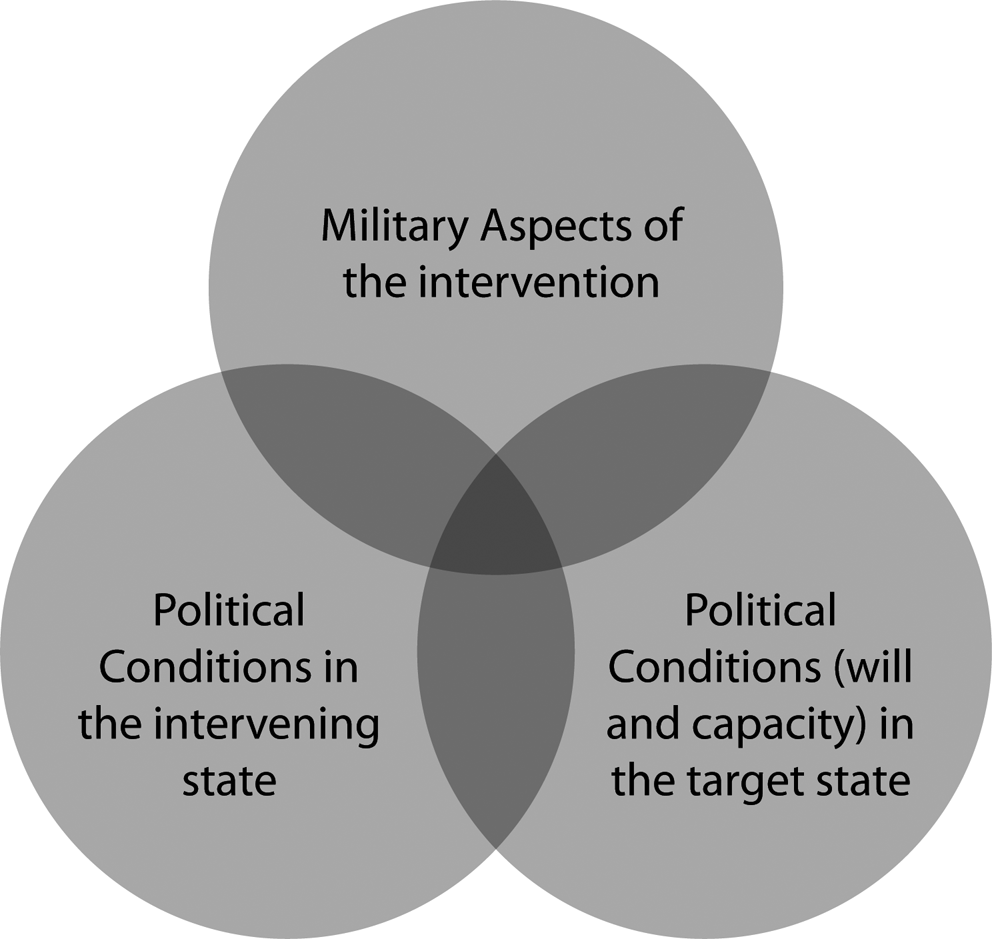
Whilst there is a large general theoretical literature on the factors that shape the propensity to use force, and a significant literature on individual interventions that in various degrees integrates theory and practice, general theoretical frameworks for understanding intervention remain underdeveloped.Footnote 4 With few exceptions the analysis tends to be piecemeal and lacking a general model or framework through which to comprehend the determinants of intervention outcomes and within which to situate many of the ‘syndromes’ associated with military intervention such as, for example, the risks of ‘quaqmire’ or ‘mission-creep’, or the challenges of consistency and legitimacy. To this end the article offers a basic model which highlights the power of factors across three different domains of social interaction to determine the outcomes of intervention and the requirement for a timeline in which developments in each domain are sufficiently aligned or synchronised with those in the others. The three domains comprise the military sphere, the domestic political sphere within the intervening state, and the domestic political sphere within the target state (see fig. 1). The model helps to explain that whilst liberal military interventions are not necessarily bound to ‘fail’, however this may be defined, they are inherently difficult with a high risk of complications.
The interactive dynamics of intervention

Whilst one might assume that intervening Powers have superior military capacity, this may not necessarily translate into a military victory locally nor deliver the interveners political aims. Also, factors within the target state are always important, whether this be the strength of political will to resist or perhaps the lack of political or institutional capacity to deliver what the intervener requires. But so too are political considerations within the intervening state. The capacity for domestic political factors to hamstring military operations is probably most pronounced within a democracy given such constitutional-institutional factors as the formal independence of the legislature and judiciary from the executive, the normative-legal environment, and the presence of opposition political parties that may have different notions regarding foreign policy and be in a position to execute them following electoral success (as illustrated below).
The key contribution of the strategic perspective and operational model offered here is to force an interactive understanding of the dynamics and determinants of intervention operations and outcomes. This captures the point that intervention outcomes are a product of the interplay between factors in both the intervening and the target state and the importance of the fit between them at a specific point in time. The issue with alignment or synchronisation arises because the three domains operate along separate and quasi-autonomous timelines. To put it differently, they do not orbit the same sun. If one takes, for example, NATO action in Afghanistan there is a clear disjuncture between the domestic political timeline that is constructed in accordance with the electoral cycle at home and military estimates of the timeline for the stabilisation of Afghanistan and in turn with the still longer timeline held by the Taliban for its will and capacity to sustain the conflict.Footnote 5 In the Afghanistan case there is no obvious prospect of synchronisation between the three domains as did happen, for example, in the case of slave trade abolition discussed below. But in any case, whilst synchronisation does not mean that intervention will necessarily succeed in its immediate objectives the lack of synchronisation in any sphere may well be sufficient to impede or undermine the intervention.
Besides these specific interactive dynamics that are illustrated empirically below, there are also a number of general contextual factors that operate, often in combination, to make liberal military intervention inherently difficult. The first is the highly ambitious political nature of many liberal interventions. These often seek to induce or advance liberal reordering projects whether this be the incorporation of states into a world market, the regulation of domestic political-ideological forces in the target, statebuilding, democracy promotion, or the way regimes treat their citizens. The second factor is closely related, namely the highly intrusive character of many interventions evident in the sensitive political and social areas that are targeted. Typically, this might be in relation to questions of constitutional form and regime type, socioeconomic system, the treatment of citizens or minorities, the status of foreigners or foreign property, or marked by interference in long-standing local tensions and rivalries between different groups with direct implications for the distribution of power and status between them. All of these, in one way or another, are pretty much guaranteed to get under the skin. Hence what for the intervening Power may be an issue of instrumental or non-vital importance, can for groups within the target state be a high-stakes, even existential matter, which may in turn lead to high levels of resistance or evasion.
Third, John Vincent was very clear that a characteristic of intervention is that it is a discrete event: ‘though intervention is a perennial feature of international politics …, each intervention is a discrete act; an intervention made permanent becomes something else’.Footnote 6 Now, whilst in the present age involvement increasingly extends beyond the combat phase of any intervention the presence and withdrawal of military forces continues to represent a politically and symbolically important, indeed watershed, phase of the engagement. Further, interventions are still frequently justified as being of limited, discrete duration, not least in order to gain the necessary political and military support at home. This, however, alerts target regimes to the political difficulties intervention may present for the intervening Power which in turn may stiffen resistance and affect the strategy of the target actor's forces. Hence long before Saddam Hussein asserted in 1990 that democracies didn't have the stomach for a long fight the seasoned Argentine diplomat General Guido, when asked in December 1845 for his opinion on how to defeat the British, replied that the Argentines did not need to win, just to keep fighting.Footnote 7
Fourth, given that military interventions are often intended to be discrete and limited affairs, the intervener requires some mechanism or set of social relations through which to ensure longer-term compliance. This might simply be the threat of renewed intervention or a more permanent coercive form of imperial relationship, such as colonisation. But repeat interventions, let alone annexations, are costly affairs and hence interveners have typically sought an alternative political strategy through which to secure their objectives. The politics of intervention, then, are often geared towards seeking a state of cooperation, albeit coerced cooperation, between the intervener and target. Again, the point is not lost on the target actors, for the nineteenth-century Chinese Qing rulers reckoned on the British having sufficient power to force their way into the power structure of the ruling elite but not enough to play a part in government without their help.Footnote 8 Thus, despite the presence of significant differences in the coercive power of the intervener and the target, the intervener – particularly if the intervention is for liberal or democratic ends – is likely to require a measure of ‘partnership’ with the target if it is to achieve its political aims, and this can prove difficult and unpredictable.
British intervention 1815–50
In turning now to consider the model in relation to British intervention between 1815–50, the selected cases discussed below fall within the major (re)ordering themes of the age and are taken from a wide range of geographical areas.Footnote 9 With regard to the coercive incorporation of a peripheral zone into the world market (or ‘opening-up’) the cases of China and the Argentine confederation represent the two regions to which contemporaries attached greatest value whilst being sufficiently different to draw out the factors that determine intervention outcomes. With regard to the humanitarian strand the campaign for the abolition of the transatlantic slave trade has been described as the ‘most expensive international moral effort in modern world history’Footnote 10 and has been cited recently as a model of robust and successful intervention. Accordingly, it merits a closer look in order to draw out the conditions of this apparent success. The cases selected to highlight the challenges of intervention in the major ideological struggle of the age are those of the Portuguese Civil War (1832–4) and the Spanish Civil War (1834–9). Whilst it is not possible here to fully and systematically test the explanatory power of the synchronicity model the cases are able to highlight the mechanisms through which it operates. It also shows that many of the problems associated with intervention in the present age were also abundantly evident in the early nineteenth century too. The first part of the discussion across each theme offers some contextual background and focuses on the strategic dimension whilst the second part focuses on the operational.
‘Opening up’ I
It is the business of Government to open and secure roads for the merchant. (Lord Palmerston, 1841)Footnote 11
The termination by parliament of the East India Company's monopoly on trade with China in 1833 also marked the end of a specific social structure of trade that, whilst bureaucratic and restrictive, had accommodated and internalised a number of sensitive political issues, which subsequently proved difficult to renegotiate. Nevertheless, the Company's monopoly had become increasingly outdated due both to British industrialisation and the rise of the opium trade. Industrialisation led to a shift in the economic significance of China for Britain from being a supplier of luxuries such as silk and tea to a potentially enormous market for British commerce and manufactures, the difficult issue of access permitting. The rise of the opium trade had dramatically altered the balance of trade in Britain's favour but was at the same time becoming an increasing concern for the Qing rulers and cause of friction in Anglo-Chinese relations. Yet British ideas about commerce (and associated notions of European civilisation and progress) held little appeal to the ‘Celestial Empire’. Rather, the Qing rulers perceived themselves to be at the centre of civilisation and held little interest in dealings with the foreign barbarians, whom they sought to contain at the frontier and who were expected to recognise the emperor's authority.Footnote 12 Thus, when Britain sent as the first post-Company Superintendent a government representative, William Napier, rather than a senior merchant as the Chinese had indicated, the local Viceroy refused to receive him: after all, the Chinese were not part of ‘international society’ and did not recognise the principle of the sovereign equality of states or European norms of diplomatic practice.
It was, however, the issue of ‘market access’ that excited the merchant lobby and already in 1830 the Canton merchants had expressed to parliament their frustration at the failure of diplomacy to expand the China trade and argued for the use of force, which was a view subsequently shared by Napier. The issue continued to simmer until in 1839 Commissioner Lin pursued a much more robust approach to the suppression of the opium trade and confined the British trading community at Canton until they handed over their stock, which they did after the British Superintendent promised compensation. It was this ‘insult to the flag’ that gave the British Foreign Secretary Lord Palmerston, the necessary pretext for the first ‘Opium War’ in which British naval power proved overwhelming. Yet the translation of the power of the gunboat into a new order of commercial relations was a different matter. To this end the efforts were grounded in the ‘Treaty System’ established under the Treaty of Nanking, 1842, which was intended to form a new institutional base for the development of commerce.Footnote 13 Its provisions included the abolition of the Cohong monopoly, the opening of five ports for trade, equal intercourse between officials of corresponding rank, a uniform moderate tariff on imports and exports, the cession of the island of Hong Kong to Britain, and the payment of a war indemnity (which included the cost of the confiscated opium).
However, for the Chinese the Nanking Treaty was less an epiphany on the road to Manchester than a tactical, hopefully temporary expedient to mollify the barbarian at the frontier whilst attending to more pressing problems of order within the heartland of empire. The major problem facing China in this period was the disintegration of centralised power and authority as evident in a host of social and economic problems, a series of revolts by secret societies and the expansion of criminal organisations that challenged the reach and prestige of the Qing regime.Footnote 14 The Chinese found a myriad of ways through which to thwart the market liberalisation that London and the merchants sought to introduce, but perhaps most significant at a popular level was simply the fact that ‘China would not abandon its own markets, methods and products’ such that after 1843 the China trade actually contracted (leading Britain to press China for the legalisation of opium).Footnote 15 Ultimately, it was the deep cultural and civilisational differences that explained the disappointment of British aspirations: as Fairbank writes ‘the Chinese oecumene had not yet been shattered intellectually’.Footnote 16
This said, in this increasingly fragmented political environment the effects of the Treaty System and by inference the effects of gunboat diplomacy did play out differently depending upon local conditions and carried different implications for the possibilities of establishing a new institutional bases for the conduct of trade. In this regard Canton and Shanghai marked the two ends of a spectrum. At Canton officially sanctioned popular hostility towards the British made trade virtually impossible such that the province was formally closed to the British after riots in 1846 on the grounds that the safety of Europeans could no longer be guaranteed. Indeed, it was the ongoing tensions over the rules of trade that led Palmerston to launch the ‘Second Opium’ or ‘Arrow War’ of 1856–60. By contrast, and to jump slightly ahead of the period under consideration, the International Settlement in Shanghai in the 1850s became host to a large number of refugees fleeing the Taiping rebels and the security of the settlement was itself threatened by the Cantonese-Fukienese rebels of the Small Sword Society. In the absence of central Chinese power and authority, a community of interests developed between the local Chinese and foreign communities in the security of the Settlement and in the development of more effective administration. Thus it was, for example, that the Shanghai authorities cooperated with the British in the liberalisation of commerce and the exploration of the Yangtze River as the resultant increase in customs revenues would provide for the better administration and development of the province. In circumstances of local disorder and threat the special status of Shanghai and the continued presence of British naval forces offered a measure of protection that was appreciated by both parties.Footnote 17
Notions of culture, civilisation, and identity – the oecumene – played out quite differently in the Latin American context. In 1838 at the River Plate, or Banda Oriental, a Uruguayan civil conflict developed a strong Argentine dimension. British intervention in the civil war was as much an embarrassment as it was a failure yet within a few years of British withdrawal the political aims for which Britain had fought were now being freely given. Indeed, it is an irony of the case that the apparent success of naval intervention in China in 1842 had encouraged the view of merchants and the public that similar measures in Latin America would lead to the opening of the vast interior to British manufactures and commerce, not least through free navigation on the Paraná.Footnote 18 By way of context, it had been less than thirty years since Argentina had won its independence from Spain and many of the independence generation were still in power. The process of nationbuilding and state formation in this period was frequently violent, with wars against the Indians and between rival caudillo leaders, sometimes with an ideological character. In 1828, Britain had mediated the war between the Argentine and Brazil over Uruguay, leading to a British commitment to the preservation of Uruguayan independence. For London, Uruguay was a strategically valuable area positioned between the two large Powers of the eastern seaboard on the River Plate and which in Montevideo offered an alternative commercial base and entrepôt to Buenos Aires.
Buenos Aires was the most powerful of the Argentine Confederation's provinces and its governor, General Rosas, had made his name in the Indian Wars of the 1830s. He had not, however, fought for independence in 1810, preferring the colonial order, but four years earlier, aged 13, he had joined the fight to repulse the British invasion of the River Plate. For Rosas, aside from the threat Montevideo presented to Buenos Aires' position as the regional commercial hub and generator of customs revenues (in fact levels of trade in Buenos Aires far outstripped those at Montevideo), the Uruguayan capital had become a base for his ‘unitarian’ political opponents. Whereas the ‘federalists’ tended to support a decentralised political structure (which suited the caudillos with their respective provincial power bases), and promoted the notion of a sistema America hostile to European interference, the unitarians were more cosmopolitan in outlook, advocated greater centralisation over control and distribution of resources and were more open to European migration and trade. This said, whereas Rosas was ruthless against his domestic political opponents, British subjects at Buneos Aires did not generally face interference in their affairs and whilst British trade had failed to rise much in the first half of the nineteenth centuryFootnote 19 the rights of British subjects were for the most part respected and upheld.
When in October 1838, the deposed president of Uruguay, General Oribe fled to Buenos Aires in the face of a revolt by his French backed predecessor, General Rivera, he formed an alliance with Rosas whilst Rivera found backing from the exiled Argentine Unitarian, General Lavalle. Palmerston offered good offices and mediation and his successor, Aberdeen, sought to continue this policy with a view to preventing the expansion of Rosas' power and maintaining the independence of Uruguay. However, by December 1842, ‘the Anglo-French mediation offer [had taken] on the appearance of being more a mechanism for staving off a Uruguayan surrender than an impartial intervention’Footnote 20 and by November 1843, Aberdeen and Peel were exploring options for more robust involvement. Whilst notions of a joint operation that would include Brazil were dropped, Aberdeen was in February 1845 bullish about the prospects for a joint Anglo-French naval demonstration: ‘it is hardly possible’, he told his plenipotentiary, Wiliam Gore Ouseley, ‘to conceive that when the consequences which must follow from a refusal to listen to the advice of the two powers shall have been evident to [Rosas], he will allow it to pass unheeded’.Footnote 21 Yet, by December he had lost confidence in the ability of Britain and France to force a successful conclusion and became increasingly anxious about the proactive policies of the representatives on the spot. Rosas and Oribe's position was simply too strong militarily; British commitment too weak. In November 1849, Britain accepted Rosas' terms as ‘the only means of bringing the disastrous state of things now existing to a favourable conclusion’.Footnote 22 British intervention had failed in achieving its political objectives of securing greater openness for commerce and access to the inland waterways. Arguably, its main contribution was to have prolonged the conflict for six years when in 1843 Admiral Purvis prevented Rosas' navy shelling Montevideo such as to reduce Rivera's defensive depth whilst Oribe's land forces attempted to deliver the decisive blow.Footnote 23
Yet Rosas' fortunes were soon to change for the worse as his increasing efforts to concentrate power at Buenos Aires had fostered resentment and a countervailing force such that between October 1851 and January 1852 Rosas's erstwhile ally, the governor of the strategically important state of Entre Rios, General de Urquiza in alliance with Brazil and the Uruguayan government forced Oribe to surrender and routed Rosas' army. In what for Britain was a fortuitous twist of fate, whilst ‘the dynamics of relations among the different provinces and states of the River Plate were determined internally … the result, the stabilisation and unification of Argentina, fulfilled Britain's objectives’.Footnote 24 Underlying local political dynamics was a change of direction in Argentine political life from conflict to commerce, albeit one that benefited from some real incentive in terms of the contemporary development of the world economy. For McLean, ‘the introspective mentality of the Gaucho was disappearing and the forces of the international economy would no longer be held back by the political sterility of a generation steeped in the traditions of the independence struggle’.Footnote 25 Whilst the post-Rosas period did not mark a seamless break with the past within the next two years the economic monopoly of Buenos Aires had been replaced by freedom of navigation for international trade on the waterways of the Plate and the development of constitutional reform and rise of immigration presaged several decades of growth due to Argentina's strong export trade.
For Britain the strategic aim towards which intervention was employed was the expansion of the zone of market access for its manufactured goods and the establishment or stabilisation of the political conditions, which would sustain such access. What, however, were the factors that actually determined this question and what was the specific impact of military/naval intervention therein? In both the Chinese and the Argentine cases the most powerful determinants of market access were identity-based alignments, the wider appeal of the specific hegemonic project itself, and in some cases (such as Shanghai) the appeal of reciprocal utility-based cooperation. Moreover, these key determinants played out over a significantly longer time-line than that associated with intervention, as one would expect given the nature of the historical processes in play. For the South American states (and as shown in more detail when discussing Brazil below) this was a very intense and violent period of postcolonial state-consolidation following independence which played out over the course of a generation. For China, the magnitude of the encounter with the encroaching Western world was much greater and played out over a period of 150 years. However, in the shorter term defeat in the two Opium Wars did lead to the rise of the ‘self-strengthening’ movement in the 1860s but this half-hearted and unsuccessful nationalist-modernisation movement signalled a long-lasting ambivalence in Chinese attitudes towards modernity and relations with the European world.Footnote 26
Besides, arguably it was the Western missionaries who proved a more powerful transformative force. The diffusion of Christian ideas provided a set of conceptual ideas through which most famously the Taipings could articulate their grievances and launch a civil war in which over twenty million people died, reinforcing the point that the key drivers of change rested with the interplay of social forces and ideational and cultural factors.Footnote 27 In China the use of force contributed to a long-lasting current of anti-Western political thought whilst at the River Plate it was an embarrassment and in terms of British aims arguably even irrelevant.
Opening up II
In terms of the three important domains identified above, it is clear that in the Chinese case the power of domestic political factors in the target state was sufficient to severely limit the realisation of British ambitions as the civilisational and cultural gulf could not be bridged through coercive means alone. The impenetrability of social and cultural systems and active political resistance prevented the achievement of an open, liberalised commercial space despite clear British naval superiority. In terms of British domestic politics Palmerston was able to secure parliamentary support in the First Opium War despite strong protests from speakers such as William Gladstone. Out of interest, this was not the case in 1856 when an anti-war motion was passed 263–49. In this case, Palmerston dissolved the government but secured re-election with an increased majority and therein his war. However, as shown in the remaining cases discussed below in other instances liberal institutions and political processes did directly affect the conduct of major interventions in this period.
At the River Plate the key determinant of the outcome of British intervention was Rosas' superior military position. However, whilst the problems of British policy were at one level due to the forward actions of the British representatives ‘on the spot’, underlying this was the lack of sound legal and political foundations that undermined the entire intervention and which gave it a somewhat surreptitious appearance. Public statements of non-belligerency severely limited the foreign secretary's options and embarrassed his position (as well as the country) after the onset of what would now be called ‘mission-creep’. Whilst Aberdeen was disposed to a cautious policy and did seek to limit the extent of Britain's involvement, as the official policy of neutrality was increasingly realised to be failing in the objective of delivering a swift end to the war (and with it the release of Rosas' grip on Montevideo) then pressures for a more robust involvement grew. Not that the local naval commander needed much encouragement. As part of his efforts to have the Argentine government accept British and French mediation, Commodore Purvis lifted the Argentine blockade of Montevideo only to be subsequently overruled by the advocate general in London. The Law Lords clearly exposed the contradiction in Britain's position by pointing out that the right of the Argentine government as a belligerent to impose the blockade ‘cannot be interfered with or controlled by any third state professing neutrality between the contending parties’.Footnote 28 Other clear instances of partiality and interference included the launch by the British and French plenipotentiaries of an expedition along the Paraná, which since 1841 Rosas had closed but to those vessels holding authorisation from Buenos Aires; the commandeering of an army battalion of 626 officers and men who had been en route to South Africa, much to London's dismay; and the operation of a selective blockade as a means of revenue generation, incurring in turn a series of diplomatic protests from other nations.
In November 1843, both Peel and Aberdeen maintained that British policy was one of non-interference in accordance with principle, even if in private they were becoming increasingly sensitive to commercial and popular pressures for action, particularly as the inconsistency of their policy was in danger of ridicule.Footnote 29 With the continuing refusal by Rosas to accept British mediation, Aberdeen in December 1844 authorised Ouseley to undertake an armed intervention if diplomacy should once again fail, the aims being to pacify the republics of the Plate, secure the definitive independence of Uruguay, and the advancement of Britain's commercial and diplomatic relations with all the states in the region, perhaps also establishing contacts with Paraguay (which in effect meant an expedition on the Paraná). Yet in January 1846, Aberdeen was obliged to reveal his instructions to Ouseley in parliament which in his words will ‘unfortunately render it manifest to everyone that our proceedings in the River Plate are at variance with their letter and spirit’.Footnote 30
It was shortly after this debacle that Aberdeen decided to seek a negotiated withdrawal from the Plate, as for one thing it was difficult now to see where exactly a policy of British intervention might go. Yet, as noted above, withdrawal was to take another three years and was largely on Rosas' terms. In the parliamentary debates Aberdeen managed the remarkable achievement of incurring severe rebuke from Wellington, Palmerston, and Gladstone with the First Lord of the Admiralty subsequently adding his own frustration.Footnote 31 The surreptitious nature of the intervention had granted licence to the ‘men on the spot’, frequently given the Uruguayans false hope of greater assistance, prolonged but not determined the outcome, and embarrassed Britain both domestically and in the eyes of other Powers, whilst also signalling British weakness to the ‘half-civilised governments’ of the world.Footnote 32 The failure of the British mission, then, was most obviously a function of the relative balance of forces between the intervener and the target, but both the particularly embarrassing nature of the intervention and its half-hearted nature were a function of the stretching of its non-belligerency status without the approval of parliament and failure either to maintain the spirit of that policy or to give a position of belligerency proper authority.
Humanitarianism I
The British campaign to abolish the Atlantic slave trade to BrazilFootnote 33 has in recent years been held up as an example of what robust action can achieve, for a year after Palmerston intensified naval action in 1849 the trade was virtually abolished.Footnote 34 These recent commentaries have tended to emphasise the military dimension of the campaign and largely overlook developments within the target state, Brazil, or indeed within the British political system.Footnote 35 Two specialist studies have, however, argued that by the time of the British naval intervention the Brazilian government had already started to implement measures to abolish the trade.Footnote 36 Be that as it may, what in this case were the conditions and factors that determined the suppression of the transatlantic slave trade to Brazil and what was the specific impact of British intervention? Vital in fact was the will and capacity of local elites to effect suppression and, importantly, this was itself dependent upon the development of historically specific processes of nation-state consolidation and state capacity-building following Brazil's independence from Portugal. Hence with Miller, ‘the eventual abolition of the slave trade depended on a favourable conjuncture of political and economic forces within the country as well as Palmerston's threats, although these were crucial to the timing of the abolition’.Footnote 37
Palmerston had intensified the campaign on the West African and the Brazilian coasts a decade earlier but whilst this did squeeze the trade it antagonised the Brazilians and, as will be discussed below, was abandoned for legal reasons. But, in any case, the 1830s for Brazil was a period of such severe political violence, disorder, and limited state capacity that the suppression of the trade at this point was not a feasible prospect. After the emperor, Dom Pedro I – of whom more below – had abdicated and returned to Europe in 1831 a subsequent liberal reformist moderado government decentralised power in a move intended to mark a departure from the centralised and authoritarian practices of the monarchy but which had the effect of fuelling violent competition for power in the provinces. Indeed, the ‘perception and reality of state power were probably weaker in 1835 than they had ever been in the nation's history’.Footnote 38 Upon returning to office in 1837, the Conservatives undertook a process of recentralisation and increased state control over the local judiciary and restored the Council of State. The end of the regency marked by the crowning in 1841 of the new emperor, Dom Pedro II, further stabilised the country. Financially, Brazil's refusal to renew the unpopular and non-reciprocal commercial treaty with Britain and to impose its own tariff regime generated approximately half of the government's revenue, which in turn enabled the development of the navy which was available for anti-slave trade patrols. Whilst violence was still widespread during the 1840s, the provincial revolts were defeated through the combined use of the police and the national guards and thus when the Conservatives returned to power in 1848 after the ineffective quinqeno liberal they formed the ‘strongest and most stable [government] Brazil had known since independence’.Footnote 39
By 1850, then, Brazil had a level of political and state capacity that it did not have a decade earlier. Thus when British intervention forced the crisis of 1849–50 and the prospect of further disorder and war the Conservative elite not only wished to safeguard the Brazilian nation-state, which they had struggled to consolidate and develop over the course of their political careers, but they were also in a position to do so, albeit at the cost of losing long-term access to fresh supplies of slave labour.Footnote 40 It was, then, Brazilian nationbuilding and state-formation – processes that are measurable in terms of decades – that provided the necessary institutional capacity for the achievement of British foreign policy aims.
Humanitarianism II
The discussion above traced the importance of domestic political developments in Brazil and the underlying process of nationbuilding and state consolidation for the abolition of the slave trade, and that in this regard Palmerston's naval action of 1849 was well-timed. But this fortuitous synchronisation between Palmerston's intensified naval unilateralism and domestic political developments within Brazil was also subject to a range of pressures from within British domestic politics where support for this long and costly campaign which had hitherto been, at best, a limited success, was in decline. In 1846, support for the reduction of duties on slave grown sugar had shown the limits of humanitarian sentiments amongst the British public and in parliament too rising support for the abandonment of the campaign was reflected in the fortunes of the Select Committees on the topic led by the free trader William Hutt.
But Palmerston's intensification of naval enforcement action in 1849 was the second time he had taken a unilateralist turn away from the flawed treaty-based preventive stop-and-search system. Previously, however, the Law Lords had withdrawn their support for the policy when first applied in 1839 and the slave traders themselves had brought legal action against individual ship captains for the illegal confiscation of property. Consequently, tactics changed and authorisation for such forward action was revoked. Whilst captures had increased, the disjuncture between the domestic political and naval/military domains had proved a major setback. This time, in an effort to avoid a similar fate, Palmerston had authorised his unilateralist turn on the basis of the Aberdeen Act (1845) that equated the slave trade with piracy. Yet it was fortunate that the Brazilian response was so swift, for there were soon signs that the Law Lords were losing confidence in the legality of the actions this time around too which in light of the rising political disaffection with the campaign may have proved terminal.Footnote 41 In this case, then, the favourable synchronisation of developments within the intervener's military and political domains and that of Brazil's domestic domain did produce the intervener's desired outcome. This was rather fortunate, for as in earlier periods it appeared that the dealignment of the domestic political from the military timelines was again pushing shut the window of synchronisation.
Revolutions I
Between 1815 and 1850, three main waves of revolution broke across the European continent, from 1820–4, 1829–34, and 1847–51.Footnote 42 Each wave triggered interventionist pressures from states associated with either the absolutist or constitutionalist cause, notably Austria, Russia, and Prussia on the one hand and Britain and France on the other, albeit dependent upon regime type and political party. Yet the underlying difference between the absolutist and the constitutional positions was articulated in Castlereagh's response to a Russian proposal at the Congress of Aix-La-Chapelle in 1818 that the Powers should not only guarantee the territorial settlement of Vienna but also the governments of other states. This, Castlereagh argued, would mean that ‘force was collectively to be prostituted to the support of established power without any consideration of the extent to which it was abused’.Footnote 43
As noted above whilst intervention in this period might settle or influence the immediate outcome of specific revolutions, it did not settle the ‘problem’ of revolution per se. What did settle this question in Europe, at least until the First World War, was a fundamental shift in class-based political alignments such that after 1830 the ‘united front’ against absolutism became increasingly fragmented. After 1848, many ‘moderate republicans’ allied with the high bourgeoisie and the aristocracy against the radical republican challenge to property. In this way, the revolutions of 1848 ‘gave birth to a new form of conservatism, able to absorb elements of liberalism, nationalism, and even socialism, and to transform them almost beyond recognition’.Footnote 44 It was, then, shifts in patterns of class relations that provided the institutional bases for the longer-term settlement of the recurring issue of revolution in European politics in this period, and the cries for intervention that it generated. Also worthy of note in this regard is Schroeder's argument that the Concert system also deserves recognition for managing questions of revolution in so far as it provided a Europe-wide institutional framework through which Powers of different ideological complexions could soothe and negotiate their differences.Footnote 45
Revolution II
The discussion of revolution and intervention above highlighted the significance of longer-term class realignments as the political-institutional framework that settled the issue of revolution in Europe in this period, and that these social forces took several decades to work themselves through. Yet a closer look at British intervention practice in this period reveals its ideological and partisan character such that in the Iberian Peninsula in the late 1820s–1830s the arbiter of British policy was effectively the electoral cycle and whether it brought Wellington or Palmerston into office.
In 1826, Dom Pedro I, emperor of Brazil, succeeded to the Portuguese throne but abdicated in favour of his infant daughter, Doña Maria, to whom he granted a Charter of limited (constitutional) monarchy. However, the following year Pedro's brother, Dom Miguel, declared himself king and abolished the Charter. Miguel was backed by the church, the army, and the majority of the aristocracy and soon established control over the state. Wellington was on the verge of recognising the regime when the Tories were succeeded by the Whig Reform Ministry in November 1830 whereupon his successor, Palmerston, refused to recognise Miguel and sought to re-energise the constitutionalist cause. For Wellington, the stability offered through Miguel's model of rule was far preferable to a period of regency or constitutional experimentation and well-served British interests of security for commerce and the counter-balancing of French and Spanish influence, which following the July Revolution in France he regarded as especially urgent.
The Portuguese question was for both sides in this period ‘a vital issue in the great conflict of the age between what the Tories called ‘revolution’ and ‘order’ and the Whigs ‘reform’ and ‘reaction’.Footnote 46 In this contest, the ‘civil war of 1832 to 1834 marked a brutal mid-point in the slowly developing revolution which carried Portugal from royal absolutism to constitutional democracy’.Footnote 47 Dom Pedro I had continued to support Maria and Palmerston sought Pedro's return from Brazil in order to restore the constitutionalist cause. After this initiative failed due to the lack of support from the Eastern Powers Palmerston became increasingly convinced of an anti-constitutionalist conspiracy between the Tories, the Eastern Powers, and the Miguelites. His response was to argue for a policy of Anglo-French intervention but faced with a lack of cabinet support turned instead to a policy of covert support for Maria whilst publicly defending the policy of non-intervention, not least to prevent the Spanish from supporting Miguel and preventing Pedro and Maria landing at Oporto.
Attitudes of the Whigs and the Tories towards the principle of non-intervention at this point were principally instrumental. The Tories were furious with the substance of Whig policy but were constrained from attacking it in parliament on substantive grounds due to fear of being labelled apologists for absolutism, so challenged instead the government's failure to maintain the stated policy of non-intervention. If the government had pursued a policy of non-intervention the likely outcome would have been that Miguel would have defeated Maria's advance and absolutism would have prevailed. The Eastern Powers, for their part, ‘were convinced that the whigs would shortly be defeated on the Reform Bill and would be succeeded by a tory government which would recognise Miguel’.Footnote 48
Yet it was a development at the regional level – the death in September 1833 of Ferdinand VII in Spain – that unblocked the military impasse through leading the queen regent, Queen Christina, to cooperate with Britain in the removal of Miguel due to his support of the principal challenger to her daughter's throne, Don Carlos, who was arming in Portugal for an invasion of Spain. From this emerged in April 1834 the Whig creation of the Quadruple Alliance, which Palmerston regarded as the political expression of a new constitutionalist movement on Europe's Western seaboard and which, through the exercise of Spanish land and British naval forces replaced Miguel with Maria.
In the Portuguese case, then, a political shift at the regional level enabled the formation of a coalition that settled a civil war that the Whigs had in fact revived for political and ideological reasons. Whilst liberal institutions had operated to deny authority for the continued expansion of the conflict this did not prevent Palmerston from expanding operations covertly. However, the partisan character of British policy soon re-emerged as the focus of Iberian affairs shifted to Spain and initially at least Britain and France sought to assist the Spanish government in suppressing the Carlist revolt that had sprung up in northern Spain. After Don Carlos had surrendered to British naval forces in 1834, he refused to renounce his claims to the Spanish throne and in June returned to Spain, which, the Spanish government argued, left the terms of the April 1834 treaty unfulfilled. Palmerston was sympathetic to this view and worked for a number of Additional Articles to the Alliance which obliged the French to prevent support reaching the Carlists through France whilst the British would supply the Spanish government with arms and if necessary a naval force. For Palmerston, these were quite possibly the first steps to a more extensive intervention, should the situation require it, and Palmerston himself was disappointed when the Law Lords prevented him from instituting a blockade in the absence of belligerent status.
However, the Tories strongly resented the Additional Articles and Wellington, who returned to office as foreign secretary in December 1834, regarded them as marking the limits of British involvement. At this point ‘the civil war in Spain was the most pressing external problem which confronted the new government’.Footnote 49 Wellington pursued a stronger non-interventionist line but did look to the possibility of an alliance with the Eastern Powers in order to dissuade a French advance over the Pyrenees. Whilst he was becoming more confident of the prospect of an eventual Carlist victory, his main efforts at this point were directed towards limiting the scale of atrocities, which he felt would jeopardise the prospects for peace between the two parties. However, in April 1835, the Whigs returned to office and under Palmerston the emphasis of policy shifted once again from the containment of France to the containment of absolutism. But Palmerston found himself becoming increasingly drawn into the conflict such that the supply of arms had expanded to include the recruitment of British volunteers, the despatch of the French Foreign Legion, British naval action, and acceptance in principle of the hitherto unwelcome option of sending the French army into Spain. However, Louis Philippe refused such a step, leading to the fall of the Thiers government in September 1836 and the collapse of the Quadruple Alliance and replacement by a strongly non-interventionist successor. In the Spanish case, then, the expansion of a partisan intervention, which then as now is precarious grounding for a national policy, was halted only by developments in a third state. But besides, historians are doubtful about the longer-term impact of British intervention in the conflict. Whilst Palmerston's intervention in the region was clearly influential as the preservation of a constitutional regime in Portugal denied the Carlists a second front, it was ‘in no sense the crucial factor in the final defeat of Carlism’Footnote 50 and after the war ended in 1839 the underlying issues remained unresolved.Footnote 51
Conclusion
The empirical focus of this analysis has been upon the key themes in British intervention for purposes of liberal reordering in the period between 1815–50, namely the ‘opening-up’ and stabilisation of market spaces, the termination of the Atlantic slave trade to Brazil, and the coercive mediation of contests between absolutist and constitutionalist social forces. Whilst these themes are specific to a particular period in the development of the modern world, they may also be situated within a longer range historical narrative of modernity in terms of the expansion of a capitalist world economy, modern conceptions of the ‘subject’, the ‘state-based’ political administration of territory, inter-civilisational dynamics and hierarchies, and the play of political and ideological ideas centred around the notion of ‘democracy’.
Considering intervention in relation to the specific themes, questions or (for the intervening Powers) ‘problems’ of the age enables due emphasis to be placed upon the ordering and reordering nature of such tasks, their scale, and importantly also the timeframes that are likely to be in play. Such considerations are vital if one is to develop an appropriately strategic understanding of the place of intervention in such (re)ordering projects. In the period under discussion the most significant determinants of British (re-) ordering were rarely the interventions per se. Rather, it was the effect of a number of wider factors and processes such as nationbuilding and the consolidation of state-capacity; the degrees of cultural and ideational affinity between intervener and target and calculations of rational-instrumental utility over the short and longer-term; and the shifting balance of class forces in the social structure of nations. Whilst military intervention was not necessarily inconsequential and at times may have made a vital difference to the outcome of specific questions, it was not able to run against these deeper historical currents despite the often exaggerated view of its impact held by policymakers and analysts.
That intervention is neither autonomous from wider political and historical forces nor able to provide a ‘quick fix’ to political ‘problems’ reinforces the point that it is necessary to maintain a firm grip on the prospective utility and limits of military intervention in relation to the wider sociological determinants of major strategic issues. In the nineteenth century, the issues that states sought to intervene over were themselves subject to deeper sets of historical, sociological, and institutional determinants that were often not visible to the intervening actors themselves and which played out over a matter of decades. As the contest then between constitutionalism and absolutism, the abolition of the slave trade, or the opening and stabilisation of market spaces was primarily determined by deeper sociological and political forces, then so too now the fate of relations between Islamic and Western political forces, the stable administration (in whatever form) of those territorial spaces that are presently the subject of ‘state-building’ interventions, or the spread of democracy.Footnote 52 This raises important questions about the strategic balance between the political and military aspects of Western foreign policy. In particular, and aside from the question of whether intervention is in fact necessary, the historical analysis above points to the need for military intervention's role or contribution to be clearly articulated in terms of a wider grand strategy grounded in a fully political understanding of the themes and issues in question. Without this, military intervention is but the militarisation of foreign policy.
The theoretical contribution to the evaluation of specific intervention outcomes has been to emphasise the importance of systematically analysing developments in three domains: the domestic political conditions in the intervening state, the domestic political conditions in the target state, and of course the military dimension itself. Factors in any of these domains can be sufficient to adversely affect (from the intervener's perspective) the outcome of an intervention and besides this the empirical analysis above supports the notion that there needs to be sufficient alignment or synchronisation between the various timelines that determine developments within each domain. Hence Palmerston's second period of robust unilateralism in the slave trade campaign coincided with favourable political and institutional developments in Brazil in a way that was not possible a decade earlier; whilst Argentinean elites came to identify greater participation in the growing world economy with their own wish to move beyond the period of post-independence struggles and with their own sociocultural aspirations, Qing elites perceived matters differently; and whilst leading British actors were committed to a particular side in the civil contests on the Iberian Peninsula, this was in fact to different sides, reflecting political and ideological divisions within British and European society and preventing the maintenance of a consistent foreign policy. Whilst any general conclusions from the study of one period must necessarily be tentative, there is a prima facie case that the requirement for matters to go sufficiently well across the three domains and for sufficient synchronisation between them is an important reason why liberal interventions so often prove more difficult, complex, and protracted than the protagonists expect.