


Introduction
Reassurance seeking plays a key role in different psychopathologies, especially in depression and anxiety disorders (Parrish and Radomsky, Reference Parrish and Radomsky2010). Cognitive biases and beliefs of depressed individuals are focused to potential loss, abandonment, worthlessness, guilt, shame, hopelessness, rejection and failure (Beck, Reference Beck1967, Reference Beck1976; Beck et al., Reference Beck, Rush, Shaw and Emery1979), therefore they might be in need of reassurance mostly to feel secure in their relationship and be certain about their value for others (Coyne, Reference Coyne1976; Parrish and Radomsky, Reference Parrish and Radomsky2010). On the other hand, in anxiety disorders, reassurance seeking functions to reduce the perceived threat, responsibility for negative outcomes and distress caused by uncertainty (Abramowitz and Moore, Reference Abramowitz and Moore2007; Parrish and Radomsky, Reference Parrish and Radomsky2006; Rachman, Reference Rachman2002; Salkovskis et al., Reference Salkovskis, Clark and Gelder1996). The role of reassurance seeking in anxiety disorders (e.g. hypochondriasis/health anxiety, generalized anxiety disorder (GAD), social phobia and panic disorder) has been relatively less studied compared with depression (Cougle et al., Reference Cougle, Fitch, Fincham, Riccardi, Keough and Timpano2012; Parrish and Radomsky, Reference Parrish and Radomsky2006, Reference Parrish and Radomsky2010). The current study aimed to examine the role of reassurance seeking specifically in obsessive compulsive disorder (OCD). Therefore, firstly, an adaptation study of the Reassurance Seeking Questionnaire (ReSQ; Kobori and Salkovskis, Reference Kobori and Salkovskis2013) was conducted. The specificity of reassurance seeking in OCD was then investigated compared with other anxiety disorders and depression.
Particularly, in OCD, reassurance seeking is hypothesized to function as a form of neutralizing and safety behaviour aimed to reduce the anxiety caused by the probability of a negative event and one's perceived responsibility for the adverse outcomes (Rachman, Reference Rachman2002). Reassurance seeking in OCD is described as an attempt to ‘put things right’ and prevent the possibility of being blamed by self or others for something that one might be responsible for (Salkovskis, Reference Salkovskis1985). The person offering the reassurance, intentionally or unintentionally, gives the message that he/she is aware of the situation, there is nothing to worry about or there is no need to take further action. However, similar to other OCD-related neutralization behaviours, such as checking compulsions, reassurance might temporarily reduce anxiety and distress, and in the long term, it contributes to the maintenance of obsessive compulsive symptoms (Rachman, Reference Rachman2002; Rachman and Hodgson, Reference Rachman and Hodgson1980; Salkovskis, Reference Salkovskis1985; Salkovskis and Kobori, Reference Salkovskis and Kobori2015; van den Hout and Kindt, Reference van den Hout and Kindt2004). Reassurance seeking is a safety behaviour that has two functions; firstly, to reduce the perception of threat, and secondly to pass some of the responsibility for any danger and also the possibility of being blamed to the person offering reassurance (Kobori et al., Reference Kobori, Salkovskis, Read, Lounes and Wong2012). Salkovskis and Kobori (Reference Salkovskis and Kobori2015) showed that although anxiety reduction decreases over the medium to longer term, OCD patients feel better after getting reassurance relative to not getting it at all. In terms of cognitive beliefs related to OCD, the literature mainly focuses on the association between reassurance seeking and inflated responsibility attitudes (Parrish and Radomsky, Reference Parrish and Radomsky2006). In their experimental study, Parrish and Radomsky (Reference Parrish and Radomsky2011) examined the effects of manipulation of threat, responsibility and ambiguity of feedback on anxiety and compulsive urges (to seek reassurance and to check), and found that higher levels of perceived threat, responsibility and ambiguity of feedback were associated with higher anxiety and compulsive urges. Besides inflated sense of responsibility, reassurance seeking behaviours are also related to achieving the feelings of certainty, perfection and rightness which are other motivations underlying the reassurance (Kobori et al., Reference Kobori, Salkovskis, Read, Lounes and Wong2012).
In their qualitative study, Kobori and his colleagues (Reference Kobori, Salkovskis, Read, Lounes and Wong2012) draw attention to the fact that reassurance seeking is the most frequent interpersonal manifestation of OCD, and it is the OCD symptom that causes considerable interpersonal conflicts. They examined the way individuals with OCD try to seek reassurance and the perceived consequences of reassurance seeking, and claimed that uncertainty is the key perceived motivation to seek reassurance. While the individuals constantly need to validate the reassurance they obtain, at the same time they have concerns about the possible negative impact of reassurance seeking on other people. In a later study, Kobori and Salkovskis (Reference Kobori and Salkovskis2013) aimed to measure the scope, extent and process of reassurance seeking behaviour, and to identify the degree of specificity of reassurance seeking in OCD as opposed to panic disorder. It was found that both individuals with panic disorder and OCD seek reassurance more frequently than healthy controls. However, individuals with OCD seek reassurance more intensely and more carefully than both anxious and healthy control groups.
Our clinical observations indicate that many individuals suffering from OCD require reassurance from others, especially from trusted and loved ones via different ways; by seeking reassurance verbally (e.g. ‘Are you sure that I'm clean?’), by seeking the trusted person to watch their rituals/compulsions (e.g. ‘Please watch me when I lock the door’) or by requiring the trusted person to accompany their rituals (e.g. ‘Please touch the oven with me so you can tell me that it is not hot’). As Kobori et al. (Reference Kobori, Salkovskis, Read, Lounes and Wong2012) stated, individuals with OCD became very sensitive and careful in this process; they examine the reassurance provider's face, analyse their tone of voice, and critically question the answer they obtained, and sometimes combine the other's reassurance with self-reassurance. On the one hand, they had a strong urge to seek reassurance, but on the other hand, they were concerned about the negative impact of reassurance seeking on others. Hesitation, ambivalence, inhibition and feelings of embarrassment were the experiences of OCD patients as they might frustrate and bother the reassurance provider. However, despite the interpersonal problems and the reassurance provider's own distress, OCD sufferers and reassurance providers accept reassurance as a supportive strategy, as it temporarily diminishes the anxiety and distress of the patient (Halldorsson and Salkovskis, Reference Halldorsson and Salkovskis2017).
To our knowledge, four measurement tools have been developed to assess reassurance seeking in anxiety disorders. Rector et al. (Reference Rector, Kamkar, Cassin, Ayearst and Laposa2011) developed the Reassurance Seeking Scale (RSS) which assesses triggers/motivations to seek reassurance. The second measurement tool was the Threat-related Reassurance Seeking Scale (TRSS; Cougle et al., Reference Cougle, Fitch, Fincham, Riccardi, Keough and Timpano2012), which assesses two types of reassurance seeking: (a) general threat-related reassurance seeking (seeking reassurance from others that negative outcomes will not occur) and (b) evaluative threat-related reassurance seeking (the individual is assured that others do not think negatively of him or her). The third measure, which mainly assesses the reassurance in health anxiety, is the Reassurance Questionnaire (RQ; Speckens et al., Reference Speckens, Spinhoven, Van Hemert and Bolk2000). It was developed to assess the extent to which patients feel reassured by their physicians. The factor analysis of the English version of RQ demonstrated two factors as Doubt in Physician and Persistent Health Anxiety (Pugh et al., Reference Pugh, Hadjistavropoulos and Sharpe2013). The fourth assessment tool, the Reassurance Seeking Questionnaire (ReSQ), was developed by Kobori and Salkovskis (Reference Kobori and Salkovskis2013). They stated that the triggers and motivations of reassurance seeking were measured by both RSS and TRSS, but the sources used to seek reassurance, the frequency, process and consequences of reassurance, were not questioned by these assessment tools. Based on their previous qualitative study (Kobori et al., Reference Kobori, Salkovskis, Read, Lounes and Wong2012), they developed a self-report questionnaire to measure the range of manifestations of reassurance-seeking behaviours. In the current study, we preferred to conduct the adaptation study of ReSQ as it is a comprehensive measurement tool and involves the assessment of a various range of reassurance sources and trust to these sources; moreover, it gives the opportunity of assessing the process of reassurance seeking (i.e. carefulness during reassurance seeking). Compared with other reassurance scales, the ReSQ with its four scales, is a comprehensive but longer measurement tool. The ReSQ is described in more detail in the Method section.
The purpose of this study was to conduct the adaptation of the Reassurance Seeking Questionnaire (Kobori and Salkovskis, Reference Kobori and Salkovskis2013), into the Turkish language, and to examine its psychometric properties. The study also aimed to investigate the specificity of reassurance seeking by including OCD, anxiety disorders and depressive patients in the same study, different from previous studies that compared OCD only with depression (Kobori et al., Reference Kobori, Sawamiya, Iyo and Shimizu2015), panic disorder (Kobori and Salkovskis, Reference Kobori and Salkovskis2013) or with social phobia, GAD and panic disorder with or without agoraphobia (Rector et al., Reference Rector, Kamkar, Cassin, Ayearst and Laposa2011).
Method
Participants
Five groups of subjects participated in the study: (a) 53 individuals diagnosed with OCD (OCD group); (b) 73 individuals diagnosed with anxiety disorders (AC group; i.e. panic disorder, social phobia, GAD and post-traumatic stress disorder); (c) 67 individuals diagnosed with major depression (DC); (d) 110 healthy individuals for the control group (HC group); and (e) 481 university students. The university student sample was only used to examine test–retest reliability, and factor structure of the scales via confirmatory factor analysis (CFA). Besides the university students sample (mean age 20.33 years, SD = 1.80), in order to reduce the possible effects of age gap between the clinical groups and the university students sample, an age-matched healthy control group was also included. The university students sample was composed of students from various departments of Gazi University. The healthy control group was composed of volunteer administrative personnel of Gazi University.
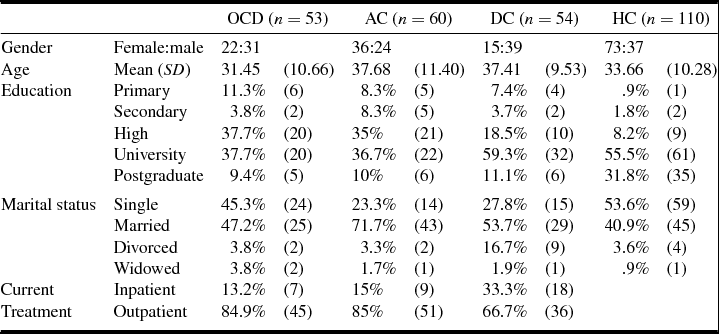
All clinical groups consisted of patients at the Psychiatry Clinic of the Gülhane Education and Research Hospital, Ankara, Turkey. The patients were diagnosed with the Structured Clinical Interview for DSM-IV Axis I Disorders (SCID-I; First et al., Reference First, Spitzer, Gibbon and Williams1996) by psychiatrists. Comorbid cases (i.e. patients with substance dependency, bipolar disorder) were not included in the study. Moreover, thirteen depressive controls, and thirteen anxious controls who scored over 50 points (2SD above the mean of the clinical sample) on the Obsessive Compulsive Inventory-Revised total score, were excluded from the analysis, in order to eliminate the possible OCD comorbidity of these subjects whose primary diagnosis was depression or other anxiety disorders. There were not any drop-outs in the other groups. Demographic characteristics of the samples are given in Table 1.
Demographic status of the participants

Measures
Obsessive-Compulsive Inventory-Revised Form (OCI-R)
The OCI-R is an 18-item self-report measure of obsessive-compulsive symptoms (Foa et al., Reference Foa, Huppert, Leiberg, Langner, Kichic, Hajcak and Salkovskis2002). The OCI-R was translated into Turkish by Yorulmaz et al. (Reference Yorulmaz, Inozu, Clark and Radomsky2015). In the present study, the alpha coefficients for the total score were .89, .92, .91 and .89, respectively, for the OCD, AC, DC and HC groups.
Obsessive Beliefs Questionnaire (OBQ)
The 44-item OBQ assesses dysfunctional beliefs about threat over-estimation/responsibility, importance/control of intrusive thoughts, and perfectionism/need for certainty related to OCD (OCCWG, 2001, 2003, 2005). The psychometric properties of the Turkish version of the scale was conducted by Yorulmaz et al. (Reference Yorulmaz, Karanci, Baştuğ, Kisa and Goka2008). In the present study, the alpha coefficients for the total score were .93, .96, .91 and .93 for the OCD, AC, DC and HC samples, respectively.
Reassurance Seeking Questionnaire (ReSQ)
The ReSQ was developed to measure the range of manifestations of reassurance seeking behaviours in OCD (Kobori and Salkovskis, Reference Kobori and Salkovskis2013). The ReSQ has four subscales and a fifth section that assesses emotional reactions. In the original study (Kobori and Salkovskis, Reference Kobori and Salkovskis2013), four scales were used to assess the way people seek reassurance and its consequences, the fifth section (emotional reactions) was excluded and reported in another study (Kobori et al., Reference Kobori, Sawamiya, Iyo and Shimizu2015). Parallel with the original study, in this study four scales were used which were as follows:
(a) Source: the 21-item scale assesses how frequently participants seek reassurance from a range of sources. Each item (e.g. ‘I ask reassurance from people close to me’) is rated ranging from never (0) to always (5). This section consists of five subscales: ‘involving other people in reassurance’, ‘professionals’, ‘direct seeking from people’, ‘self-reassurance’ and ‘external references’. The internal consistency (Cronbach's alpha) for the overall 21-item scale was .862, the test–retest reliability for the overall scale was .816, and the test–retest reliability for each factor ranged from .527 to .918.
(b) Trust: the 16-item scale assesses how much participants trust a range of reassurance sources. Each item (e.g. ‘I trust reassurance from people close to me’) is rated ranging from not at all (0) to completely (5). If an item is not used as a source for reassurance, then the item is marked as ‘N/A’. The mode of each participant's other ratings is used for the ratings of N/A. The section consists of four subscales: ‘trust in people’, ‘trust in health professionals’, ‘trust in self-reassurance’ and ‘trust in external references’. The internal consistency (Cronbach's alpha) for the overall scale was .838, the test–retest reliability for the overall scale was .745, and the test–retest reliability for each factor ranged from .625 to .817.
(c) Intensity: the 16-item scale assesses how many times participants seek the same reassurance until they stop. Each item (e.g. ‘I ask reassurance from people close to me’) is rated as never (0), once (1), twice or three times (2), four to six times (3), or many times (4). If an item is not used as a source for reassurance, then the item is marked as N/A. The mode of each participant's other ratings is used for the ratings of N/A. The section consists of four subscales: ‘direct seeking from people’, ‘self-reassurance’, ‘professionals’ and ‘external references’. The internal consistency (Cronbach's alpha) for the overall scale was .821, the test–retest reliability for the overall scale was .826, and the test–retest reliability for each factor ranged from .700 to .926.
(d) Carefulness: the 11-item scale assesses how careful participants become when they are seeking reassurance. Each item (e.g. ‘I look carefully at the person to see if they are confident about what they say to me’) is rated ranging from never (0) to always (5). The section has three subscales: ‘becoming critical’, ‘careful listening’ and ‘caring for the person’. The internal consistency (Cronbach's alpha) for the overall scale was .850, the test–retest reliability for the overall scale was .870, and the test–retest reliability for each factor ranged from .694 to .895.
State and Trait Anger Expression Inventory (STAXI)
The STAXI is a 4-point Likert-type scale to determine the anger levels expressed by people (Spielberger, Reference Spielberger1988). The first 10 items of the scale measure trait anger, the other 24 items point out individuals’ anger expression styles (i.e. anger-in, anger-out, and anger control). The scale was translated and adapted into Turkish by Özer (Reference Özer1994). For the present study, only trait anger subscale score was used, and the alpha coefficients were .90, .92, .82 and .84 for the OCD, AC, DC and HC samples, respectively.
Guilt Inventory (GI)
The GI (Kugler and Jones, Reference Kugler and Jones1992) consists of 45 items that assess trait and state guilt, as well as moral standards. The responses are recorded on a 5-point scale. The Turkish adaptation was developed by Altin (Reference Altın2009). For the present study, only the total score was used, and the alpha coefficients were .87, .88, .81 and .89 for the OCD, AC, DC and HC samples, respectively.
Beck Depression Inventory II (BDI-II)
To assess the level of depressive symptoms, the BDI-II (Beck et al., Reference Beck, Steer, Ball and Ranieri1996) was used. It is a 21-item self-report scale in which the items are rated between 0 and 3. The revised form was adapted to Turkish by Kapçi et al. (Reference Kapçi, Uslu, Turkcapar and Karaoglan2008). In the present study, the alpha coefficients were .93, .92, .87 and .91 for the OCD, AC, DC and HC samples, respectively.
Stait Trait Anxiety Inventory-Trait Form (STAI-T)
The STAI is a 4-point Likert-type self-report questionnaire consisting of 20 items for state anxiety and 20 items for trait anxiety (Spielberger et al., Reference Spielberger, Gorsuch and Lushene1970). In the present study only Trait Anxiety Inventory was utilized. The adaptation study of the STAI to a Turkish population was done by Öner and Le Compte (Reference Öner and Le Comte1983). In the present study, the alpha coefficients for the trait anxiety score were .64, .62, .74 and .54 for the OCD, AC, DC and HC samples, respectively.
Procedure
The ReSQ was translated into Turkish by three independent bilingual clinical psychologists. The research team compared the three translated forms with the original scale and chose the translations that reflected the original items best, so that the first Turkish form was obtained. Afterwards, a pilot study was conducted with 10 participants in order to see whether the items were understood correctly. After necessary revisions, the final Turkish form was obtained and it was also tested for the accuracy with five participants before the main data were collected. Afterwards, the final Turkish form was translated back into English by an independent bilingual psychologist. The back-translated form revealed semantically similar items with the original scale.
The Informed Consent form, Demographic Information Form, OBQ, OCI-R, ReSQ, BDI, STAI-T, GI and STAXI were filled out by all of the sample groups. The instruments were administered to university students during regular class hours after taking the instructors’ and the participants’ consent. For test–retest evaluation, participants were asked to complete a second copy of ReSQ after a 3-week interval. In the healthy control group, the instruments were given in a closed envelope. Student sample and healthy control groups were not screened out through a psychiatric assessment. Clinical data were collected from the Psychiatry Clinic of the Gülhane Education and Research Hospital. After the psychiatric assessment with SCID-I by the psychiatrists, participants who met the inclusion criteria (diagnosed with OCD, one of the anxiety disorders, or depression without comorbidity) were informed about the research and only voluntary participants were included the study. Ethical approval was obtained from Ethics Commission of Gazi University and Gülhane Training and Research Hospital.
Results
Overview
Prior to analyses, missing data (<1%) in questionnaires were replaced with the participant's mean score on the respective measure (Tabachnick and Fidell, Reference Tabachnick and Fidell2007). All measures were then screened for univariate and multivariate normality, and distributions of all continuous data were checked, and the results were found to be satisfactory. First, we present the analyses aimed to examine the psychometric properties of the Turkish version of the ReSQ. The factorial validities were examined by CFA using university students’ data (n = 481). Internal consistencies of Source, Trust, Intensity and Carefulness scales of ReSQ were investigated using the OCD, AC, DC and HC samples. Next, test–retest reliabilities were examined in a subgroup of the university student sample. Thereafter, the criterion validity of the scale was assessed using concurrent validity analyses. The concurrent validities of each scale of the ReSQ were first investigated by correlating with the OCI-R, OBQ, BDI, STAI-T, GI and STAXI only by the OCD group. Then concurrent validity was further examined by conducting a stepwise regression analysis with OCI-R total and subscale scores as dependent variables, with each scale of the ReSQ as independent variables. Lastly, we compared four criterion groups (OCD, AC, DC and HC groups) on the four scales of the ReSQ, as well as their subscales.
Factorial validity and reliability
Validating factor structure of the Source scale and reliability
This scale originally had five factors: Involving Other People in Reassurance (4 items), Professionals (5 items), Direct Seeking from People (2 items), External References (4 items), and Self-reassurance (6 items). A CFA was contacted in order to validate a five-factor structure of the Source scale in the Turkish sample using AMOS (Analysis of Moment Structures). Model fit of the original five-factor structure of the ReSQ the Source Scale (Kobori and Salkovskis, Reference Kobori and Salkovskis2013) was examined via several common indices: χ² Index; Comparative Fit Index (CFI; Bentler, Reference Bentler1989), Goodness of Fit Index, Adjusted Goodness of Fit Index (Byrne, Reference Byrne1994) and the Root Mean Square Error of Approximation and its 90% confidence interval (RMSEA; Browne and Cudeck, Reference Browne, Cudeck, Bollen and Long1993; Steiger, Reference Steiger1990). Acceptable model fit is indicated if the following criteria are met: RMSEA < 0.08 (Browne and Cudek, Reference Browne, Cudeck, Bollen and Long1993); GFI, AGFI and CFI > 0.90 (see Brown, Reference Brown2006 for a review).
First, we tested suitability of the five-factor model that was based on the EFA findings of Kobori and Salkovskis (Reference Kobori and Salkovskis2013) in the initial psychometric evaluation of the ReSQ. Results indicated that the five-factor model provided relatively inadequate fit indices (χ²591 = 1263.90, p < .001, χ²/d.f. = 7.06, AGFI = 0.76, GFI = 0.82, CFI = 0.08, RMSEA = 0.10, p < .001).
Analysis of localized areas of strain provided strong evidence for adding a dual loading from Source item 13 (I seek reassurance from notes I have taken in the past) to both the Self-Reassurance and External References latent factors. The fourth factor, ‘External references’, involves items assessing seeking reassurance from any external source such as books and/or websites. As indicated by Kobori and Salkovskis (Reference Kobori and Salkovskis2013) since most of the websites do not provide accurate information and they may be exposed to conflicting information, checking a variety of websites can be quite frustrating for individuals with OCD. In this case, it is quite possible that they can use their past notes as an external reference. Because the content of item 13 is consistent with the other two items on the External Reference factor, we decided to implement the suggested modification. When this dual loading was allowed to be estimated the previously positive path (β = .43, p < .01) from item 13 to the Self-reassurance latent factor became non-significant (β = .05, p = ns). Therefore, item 13 was removed from the Self-reassurance factor.
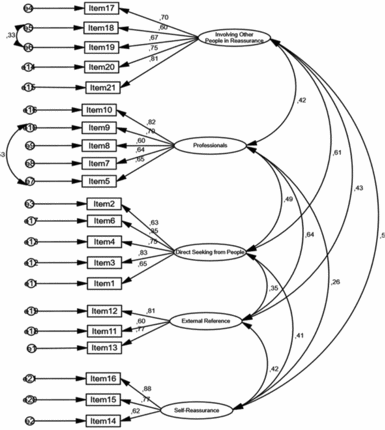
Modification indices provided further evidence for adding a dual loading from Source item 2 (I ask reassurance from my partner) to both the Involving Other People in Reassurance and Direct Seeking from People latent factors. As indicated in the original study (Kobori and Salkovskis, Reference Kobori and Salkovskis2013), the first factor, ‘Involving Other People in Reassurance (Factor 1)’, reflects asking others to be with them, watch/assist them, and to do something as a way of reassurance. On the other hand, the third factor, ‘Direct Seeking from People (Factor 3)’, reflects directly asking reassurance from people. Due to similar wording, item 2 loaded on the Factor 3 in the current study. Even though Kobori and Salkovskis (Reference Kobori and Salkovskis2013) kept this item on the first factor by referring to the interaction of the partners, we decided to keep this item on Factor 3, since the content of item 2 fits very well with the other items loaded on Factor 3 [e.g. I ask reassurance from people close to me (Item 3), I ask reassurance from my family (Item1)]. When this dual loading was allowed to be estimated the previously positive path (β = .43, p < .01) from item 2 to the Involving Other People in Reassurance latent factor became non-significant (β = .01, p = n.s.). Therefore, item 2 loaded only on the Direct Seeking from People latent factor. Furthermore, analysis of localized areas of strain indicated that there was strong evidence of correlated residuals between items 5–9, and items 18–19. Because of content similarity between items, a correlated residual was added. After all these implemented modifications, five-factor structure of Source scale demonstrated an acceptable fit to the data (χ²591 = 699.78, χ²/d.f. (177) = 3.95, AGFI = 0.87, GFI = 0.90, CFI = 0.90, RMSEA = 0.07, p < .001) (see Fig. 1).
Factor structure of Source scale

The internal consistency (Cronbach's alpha) for the overall 21-item scale was .885, and the internal consistency coefficients for each factor ranged from .715 to .804. The test–retest reliability for the overall scale was .67, and the test–retest reliability for each factor ranged from .601 to .520.
Validating factor structure of the Trust scale and reliability
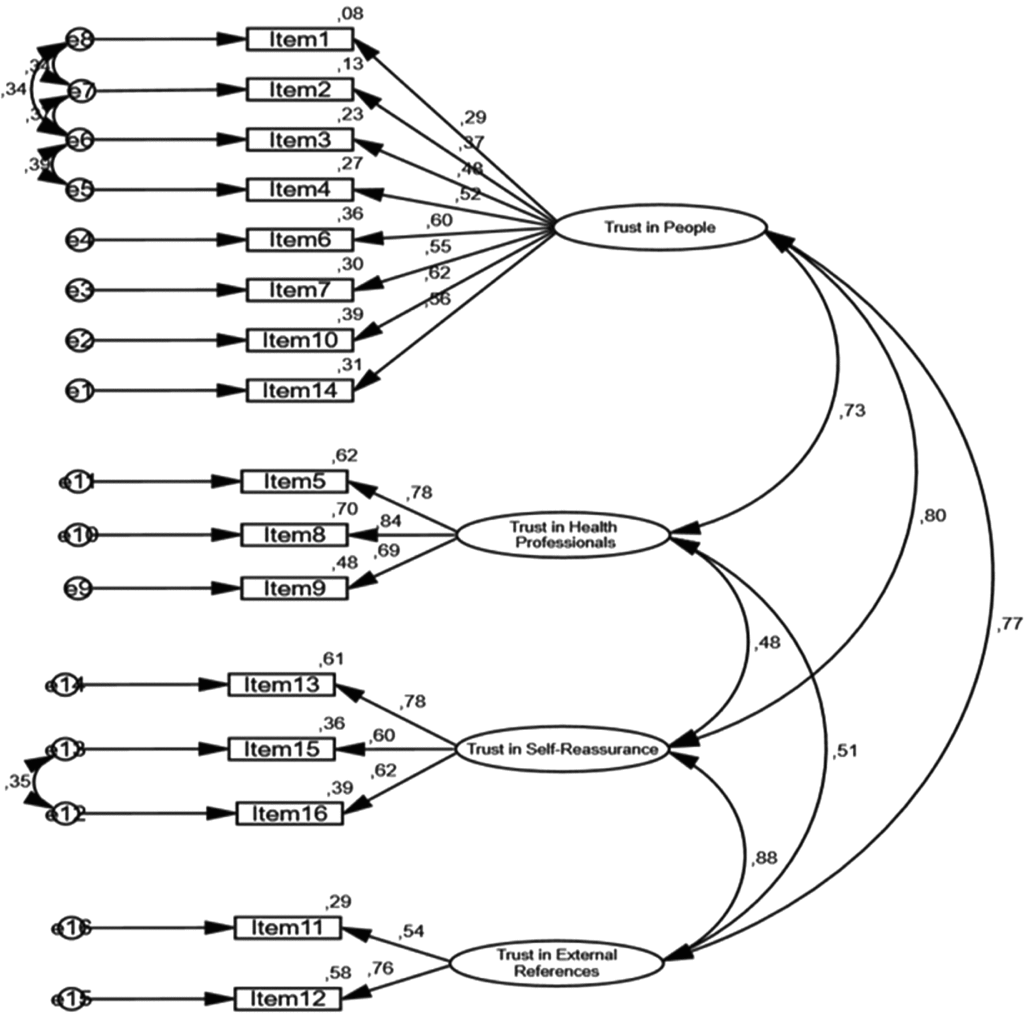
This scale originally had four factors: Trust in People (8 items), Trust in Health Professionals (3 items), Trust in Self-reassurance (3 items) and Trust in External References (2 items). Goodness of fit indices indicated that the fit of this model needed some modifications (χ²591 = 713.92, χ²/d.f. (98) = 7.29, AGFI = 0.80, GFI = 0.85, CFI = 0.81, RMSEA = 0.10, p < .001). Analysis of localized areas of strain indicated that there was strong evidence of correlated residuals between items 3–4, 2–3, 1–3, 1–2 and 15–16. Based on suggested modifications, before adding a correlated residual, we first examined the content of the items. The content of item 3 (I trust reassurance from people close to me) is very similar to the content of the item 4 (I trust reassurance from people I know), 2 (I trust reassurance from my partner) and item 1 (I trust reassurance from my family). It is quite reasonable that if a person uses his/her partner and family as a reassurance source he/she also uses the people who are close to him/her and the individual knows them. Therefore, we decided to implement four suggested modifications. Similarly, item 15 (I trust reassurance that I have rephrased in my mind) has a very similar content with item 16 (I trust lists of things which I prepared for myself as a reassurance). It is logical that some of things in a person's list can also be rephrased in a person's mind. Hence, we decided to also implement this modification. After these modifications, four-factor structure of Trust scale demonstrated an acceptable fit to the data (χ²591 = 369.41, χ²/d.f. (93) = 3.97, AGFI = 0.89, GFI = 0.93, CFI = 0.92, RMSEA = 0.07, p < .001) (see Fig. 2).
Factor structure of Trust scale

The internal consistency (Cronbach's alpha) for the overall scale was .886, and it ranged from .602 to .839 for each factor. The test–retest reliability for the overall scale was .611, and the test–retest reliability for each factor ranged from .591 to .514.
Validating factor structure of the Intensity scale and reliability
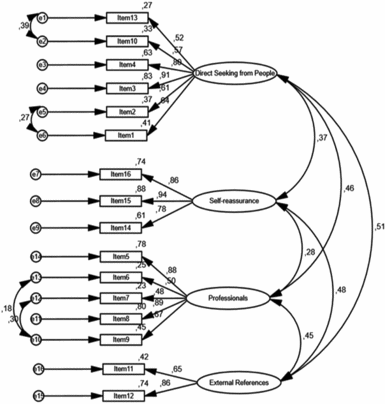
This scale originally had four factors: Direct Seeking from People (6 items), Self-reassurance (3 items), Professionals (3 items) and External References (2 items). Goodness of fit indices indicated that a series of modifications should be employed to improve model fit of the data (χ²591 = 660.47, χ²/d.f. (98) = 6.74, AGFI = 0.81, GFI = 0.86, CFI = 0.88, RMSEA = 0.10, p < .001). Analysis of localized areas of strain indicated that there was strong evidence of correlated residuals between items 10–13, 7–9, 1–2 and 6–9. Based on suggested modifications, before adding a correlated residual, we first examined the content of the items. The content of item 10 (I ask for reassurance from people even if I know what they are likely to say when I ask them) is similar to the content of the item 13 (I seek reassurance by using my phone to call people). It is possible that a person more probably calls people that he/she already knows what they are likely to say when asking reassurance. Furthermore, the modification suggestion on item 6 (I ask for reassurance from technical professionals, e.g. electrician, plumber), 7 (I ask for reassurance from religious authority, e.g. clergy, priest, rabbi), and 9 (I ask for reassurance from my family doctor) indicated that there would be content similarity among these items. It can be suggested that a person who asks for reassurance from religious authority and technical professionals may also have a tendency to seek reassurance from the family doctor. It is possible that religious authority and technical professionals may not be enough to feel relief and a person further wants to get a reassurance from a more reliable source like a family doctor. Last, we examined the content of item 1 (I ask for reassurance from my family) and 2 (I ask for reassurance from my partner). It is logical that if a person seeks reassurance from her/his partner that means he/she also seek reassurance from family. Therefore, we concluded that there was a content similarity between suggested items, and a correlated residual was added. After these modifications, the four-factor structure of Trust scale demonstrated an acceptable fit to the data (χ²591 = 460.06, χ²/d.f. (94) = 4.89, AGFI = 0.87, GFI = 0.91, CFI = 0.92, RMSEA = 0.08, p < .001) (see Fig. 3).
Factor structure of Intensity scale

The internal consistency (Cronbach's alpha) for the overall scale was .900, and it ranged from .754 to .943 for each factor. The test–retest reliability for the overall scale was .655, and the test–retest reliability for each factor ranged from .683 to .440.
Validating factor structure of the Carefulness scale and reliability
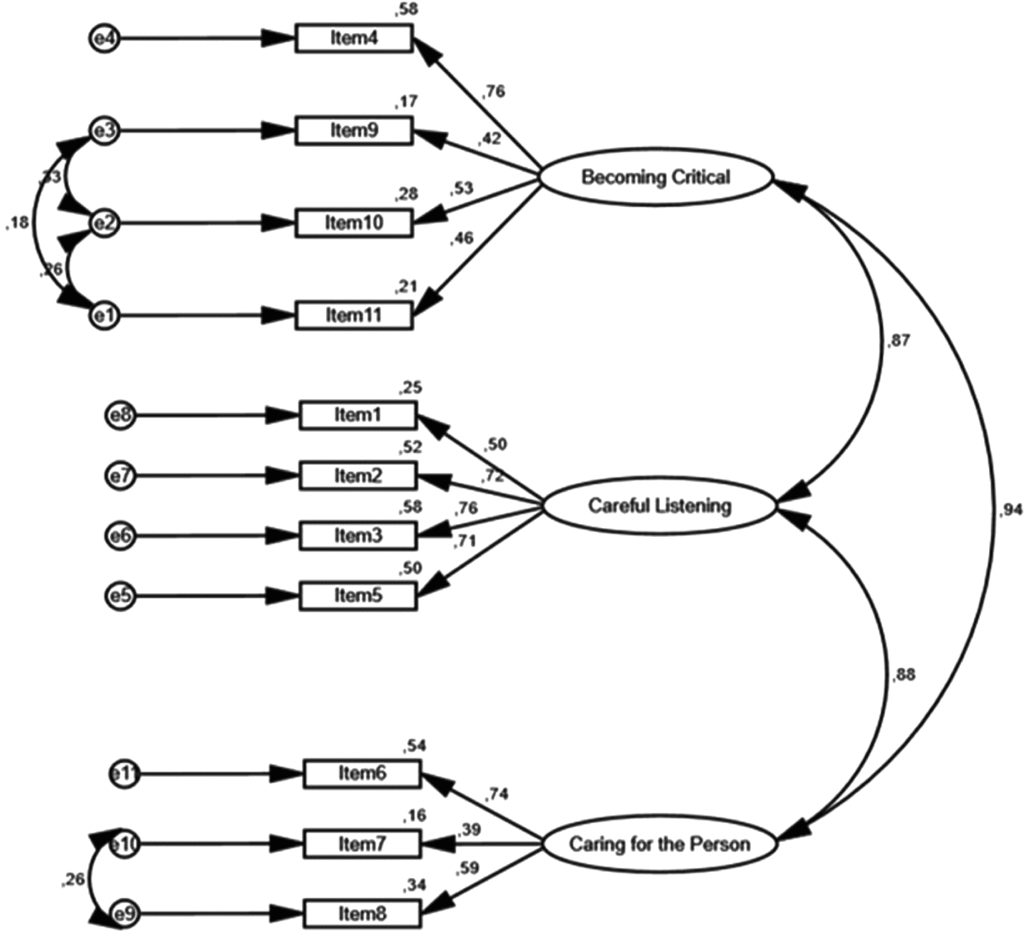
This scale originally had three factors: Becoming Critical (4 items), Careful Listening (4 items) and Caring for the Person (3 items). Goodness of fit indices indicated that the fit of this model was relatively poor (χ²591 = 284.03, χ²/d.f. (41) = 6.93, AGFI = 0.86, GFI = 0.91, CFI = 0.88, RMSEA = 0.10, p < .001). Analysis of localized areas of strain indicated that there was strong evidence of correlated residuals between items 9–10, 7–8, 10–11 and 9–11. Consistently, before adding a correlated residual, we first examined the content of the items. If a person thinks asking repetitive reassurance can make people angry (item 7, I try not to ask too many times so I don't upset or annoy the person), he/she more probably will try to show his/her appreciation to make them more comfortable (item 8, I show my appreciation e.g. ‘thank you’ to make the person comfortable with giving reassurance). If a person looks for mistakes and contradictions in how people answer his/her questions (item 11), it is understandable that he/she becomes annoyed if he/she thinks that the person answers in an inconsistent manner (item 10), as well as he/she would show frustration related to the vague reply (item 9). Therefore, suggested modifications on adding a correlated residual between items 10–11, 9–11 and 9–10 seemed logical. After these modifications, three-factor structure of Carefulness scale demonstrated a good to excellent fit to the data (χ²591 = 166.92, χ²/d.f. (37) = 4.51, AGFI = 0.90, GFI = 0.95, CFI = 0.94, RMSEA = 0.07, p < .001) (see Fig. 4).
Factor structure of Carefulness scale

The internal consistency (Cronbach's alpha) for the overall scale was .805, and it ranged from .495 to .753 for each factor. The test–retest reliability for the overall scale was .715, and the test–retest reliability for each factor ranged from .705 to .569.
Criterion-referenced validity
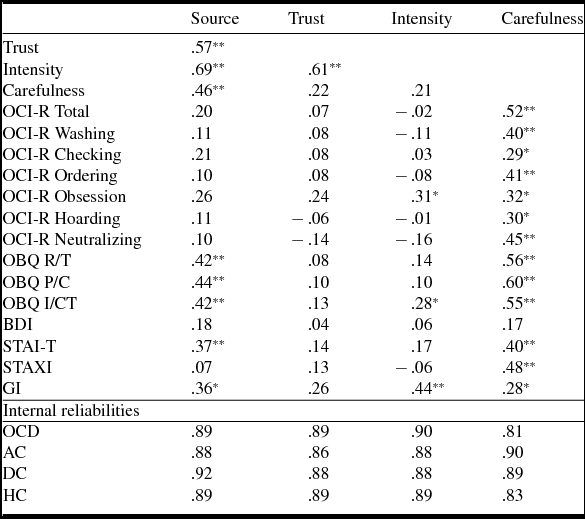
The concurrent validity of the ReSQ was assessed only in the OCD group. In all of the analyses, mean scores of the scales were used. First, the association of the ReSQ scales with the OCD symptoms and beliefs, depression, trait anxiety, anger and guilt was examined (Table 2). The result revealed that Source, Trust and Intensity scales had significant correlations with each other, with the correlation between Source and Intensity scales being the highest (.69). However, Carefulness scale showed significant correlation only with Source scale. As a special interest, with regard to the correlations between ReSQ scales and OCI-R, only Carefulness scale showed significant associations with OCI-R total and subscales (from .29 to .52). Besides, Intensity scale had a significant correlation with OCI-R Obsessions subscale. When we examined associations of ReSQ scales with OBQ, both Source and Carefulness scales showed a significant association with all obsessive-related beliefs including Responsibility/Threat Estimation, Perfectionism/Certainty, and Importance/Control of Thoughts, while the Trust scale was not significantly correlated with these variables. Furthermore, again except Trust scale, ReSQ scales were significantly related to feelings of guilt. Moreover, anger scores were also associated with Carefulness scale.
Inter-correlations between ReSQ scales and measures of general psychopathology

Source: Source of Reassurance Subscale of ReSQ; Trust: Trust Subscale of ReSQ; Intensity: Intensity Subscale of ReSQ; Carefulness: Carefulness Subscale of ReSQ; OCI-R: Obsessive Compulsive Inventory-Revised Total Score; OBQ R/T: Obsessive Beliefs Questionnaire-Responsibility/Threat Estimation; P/C: Obsessive Beliefs Questionnaire Perfectionism/Certainty; I/CT: Obsessive Beliefs Questionnaire Importance/Control of Thoughts; BDI: Beck Depression Inventory; STAI-T: State Trait Anxiety Inventory-Trait Form; STAXI: State and Trait Anger Expression Inventory; GI: Guilt Inventory *p < .05; **p < .001.
The concurrent validity of the ReSQ was also examined using stepwise multiple regression analysis with the OCI-R total and its subscales as dependent variables, with the four ReSQ scales as independent variables. The results indicated that ‘Carefulness’ scale was the only significant predictor for the OCI-R total (β = .52, t (48) = 4.19, p < .001), as well as its six subscales: Ordering (β = .41, t (48) = 3.10, p < .01), Washing (β = .40, t (48) = 3.01, p < .01), Obsessions (β = .32, t (48) = 2.37, p < .05), Hoarding (β = .30, t (48) = 2.16, p < .05), Neutralization (β = .45, t (48) = 3.44, p < .01), and Checking (β = .29, t (48) = 2.06, p < .05).
Criterion group comparison across Reassurance Seeking Questionnaire scales and subscales
In order to examine the specificity of reassurance seeking to OCD as opposed to AC, DC and HC, the scales of the ReSQ were compared among groups. All the scores were divided by the number of items to provide comparable means.
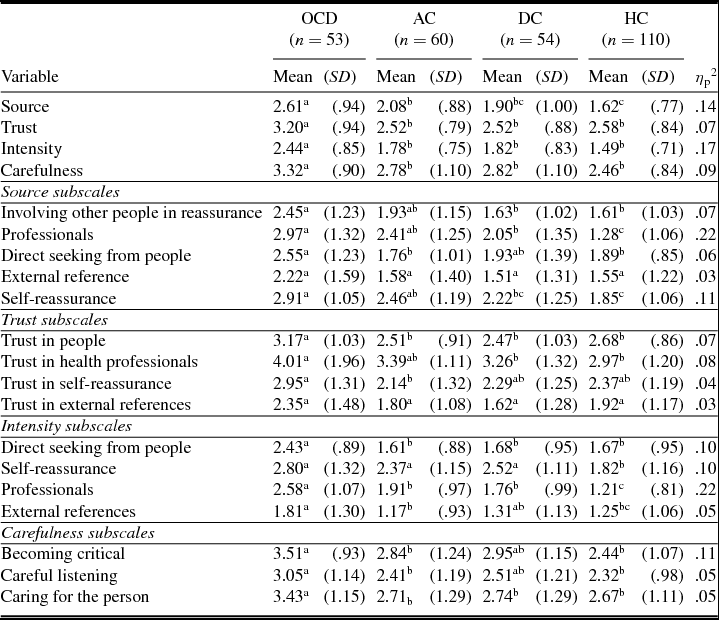
A 4 (Groups: OCD, AC, DC, HC) × 4 (ReSQ scales: Source, Trust, Intensity, Carefulness) multivariate analyses of variance (MANOVA) was conducted in order to compare groups across the four types of measures. A one-way MANOVA revealed significant main effects for Group (Wilks’ λ = .70, F [12, 714.64] = 6.40, p < .001, ηp2 = .09). Follow-up ANOVAs revealed significant main effects for Group on all the scales, and the post-hoc multiple comparison using Bonferroni's test revealed that the OCD group had higher scores on four scales of the ReSQ relative to the AC, DC and HC groups. DC and AC groups did not differ from each other in terms of reassurance seeking dimensions.
Next, four separate MANOVAs were performed in order to examine group differences in each subscale of the four scales of ReSQ (Source, Trust, Intensity, Carefulness) among the four groups (see Table 3 for the post-hoc multiple comparisons using Bonferroni's test). A MANOVA of Source subscales (Wilks’ λ = .68, F [15, 718.147] = 7.32, p < .001, ηp2 = .12) revealed significant main effects for Group (between factor). Follow-up ANOVAs revealed significant main effects for Group on all the subscales except for External Reference. The post-hoc multiple comparison using Bonferroni's test revealed that OCD group scored higher on Involving Other People in Reassurance, Professionals, and Self-Reassurance than both DC and HC. The unique difference between OCD group and AC was observed in Direct Seeking from People, by the OCD group scoring higher on this subscale.
Group differences of ReSQ scales

The identical superscript letters in the same row indicate no significant difference between groups, based on Bonferroni multiple comparison test (significance < .05).
The second MANOVA was conducted to compare Trust subscales among the four groups. A MANOVA of Trust subscales revealed significant main effects for Group (between factor), Wilks’ λ = .85, F [12, 690.833] = 3.58, p < .001, ηp2 = .05. Follow-up ANOVAs revealed significant main effects for Group on all the subscales except for trust in External Reference. The post-hoc multiple comparison using Bonferroni's test revealed that OCD group scored higher on Trust in People and Trust in Health Professionals than both DC and HC. When we examined group differences between OCD group and AC, results indicated that OCD group scored higher on both Trust in People and Trust in Self-Reassurance subscales.
Thereafter, a MANOVA performed in order to compare Intensity subscales among four groups revealed again significant main effects for Group (Wilks’ λ = .67, F [12, 690.83] = 9.56, p < .001, ηp2 = .13). Examination of follow-up ANOVAs indicated that main effect of Group was significant for all the subscales. The post-hoc multiple comparison using Bonferroni's test revealed OCD group scored higher on Direct Seeking from People and Professionals than three control groups. While the OCD group scored higher on External Reference relative to both AC and HC, the group scored higher on the Self-Reassurance than only HC.
Finally, a MANOVA was performed in order to compare the Carefulness subscales among the four groups, thereby indicating significant main effects for Group, Wilks’ λ = .87, F [9, 637.790] = 4.18, p < .001, ηp2 = .05. Follow-up ANOVAs indicated that main effect of Group was significant for all the subscales. The post-hoc multiple comparison using Bonferroni's test revealed OCD group scored higher on Caring for the Person than three control groups, and the OCD group scored higher on Becoming Critical and Careful Listening than both AC and HC.
Discussion
The purpose of the present study was to examine the psychometric properties of the Turkish version of the ReSQ using four criterion groups: OCD, AC, DC and HC. We also examined whether reassurance is specific to OCD as opposed to other anxiety disorders and depression. The results indicated a good reliability and validity information for the Turkish version of the ReSQ, supporting the cross-cultural nature of the scales.
The validity of the Turkish version of the ReSQ was evaluated using construct, criterion referenced validity, and specificity of the reassurance to OCD. The factorial validity of the scale was examined via CFA in a healthy control group using AMOS. Consistent with the findings of the original study (Kobori and Salkovskis, Reference Kobori and Salkovskis2013), results supported the five-dimensional structure of the Source scale, the four-dimensional structure of the Trust and Intensity scales, and the three-dimensional structure of the Carefulness scale. Our results supported that reassurance seeking is a multifactorial structure and involving different features of the reassurance during assessment is important. The results revealed satisfactory internal consistency coefficients, and acceptable test–retest reliabilities. Relatively lower test–retest reliability of the scales, which was examined in a non-clinical sample, indicated that the frequency of resources used by individuals and the confidence that the individuals have for different sources of information may change over time. For example, it is quite possible that sometimes external resources are used more often to get reassurance; however, sometimes professionals can be used more frequently. It is possible that change in trust on different information sources may result in change in the frequency of resources used for reassurance.
Parallel with the original study (Kobori and Salkovskis, Reference Kobori and Salkovskis2013), criterion validity of the scale was examined by the use of stepwise multiple regression and correlation with other variables using the OCD group only. As expected, the scales of the ReSQ showed significant associations with each other, except Carefulness scale, which showed significant correlation only with Source scale. Moreover, the highest correlation was observed between Source and Intensity scales. As expected, when the intensity of reassurance increases a person seeks reassurance from more different sources. Of special interest, with regard to the correlations between ReSQ scales and OCI-R, only Carefulness scale showed significant associations with OCI-R total and subscales. These results were supported by multiple regression analysis results which indicated that ‘Carefulness’ was the only significant predictor for the OCI-R total as well as its six subscales. The non-significant correlations between other scales of ReSQ and OCI-R subscales might be due to the small sample size of the OCD group which may not represent the heterogeneous symptom subtypes of the disorder. Parallel with our findings, the specific role of carefulness in OCD symptoms was also shown in the study of Kobori and Salkovskis (Reference Kobori and Salkovskis2013). They found that Carefulness scale was the best predictor of the severity of the OCD symptoms. The Carefulness scale measures how careful participants become when they are seeking reassurance. Clinical observations show us that carefulness is an important feature of OCD patients, at least for some subgroups such as who have cleaning, checking and ordering compulsions. These OCD sufferers do not want to skip any detail that would be important for them to prevent any feared harmful consequences. They can be very meticulous and exacting and this may invoke anger and frustration for those living and working with them. The results of the current study supported that similar carefulness while conducting compulsions might also be seen while seeking reassurance. They become very sensitive and careful in the reassurance seeking process which reflects as examining the reassurance providers’ face, analysing their tone of voice, and critically questioning the consistency and certainty of the reassurance providers’ answers. A very recent study assessing the carer's perception of and reactions to reassurance seeking showed the importance of carefulness of the OCD patients while seeking reassurance. Their findings suggested that the frequency of the carer's reassurance provision is associated with how carefully sufferers seek reassurance, rather than their OCD symptom severity (Kobori et al., Reference Kobori, Salkovskis, Pagdin, Read and Halldorsson2017).
For further support for the criterion validity of the scale, we examined associations of ReSQ scales with OBQ. The results indicated that both Source and Carefulness scales showed significant associations with all obsessive related beliefs including Responsibility/Threat Estimation, Perfectionism/Certainty, and Importance/Control of Thoughts. The results indicated that as the dysfunctional beliefs increase, the OCD sufferers use more sources to obtain reassurance and become more careful during the reassurance seeking process. Furthermore, the correlational analysis revealed that the emotions of guilt, anger and anxiety of OCD patients would also be related with reassurance seeking. More specifically, the associations between ReSQ scores and scores obtained from GI, STAXI and STAI-T indicated that as the frequency and the intensity of the reassurance seeking increase, the patients feel guiltier as well. Similarly, increased carefulness of the OCD patients during the reassurance seeking process is related to increased levels of anger, guilt and anxiety. Many studies have already verified the association between these negative feelings and obsessive compulsive symptom subtypes (Mancini and Gangemi, Reference Mancini and Gangemi2004; Rachman, Reference Rachman1993; Shafran et al., Reference Shafran, Watkins and Charman1996; Whiteside and Abramowitz, Reference Whiteside and Abramowitz2004, Reference Whiteside and Abramowitz2005), but there is very limited research examining the role of reassurance seeking in this link. These negative emotions might not only be due to the symptoms/symptom subtypes, but might be related to other factors like reassurance seeking behaviours. There is limited literature related to the reassurance seeking and reassurance providing processes. As indicated by Kobori and Salkovskis (Reference Kobori and Salkovskis2013), partners and family members are most likely to be involved in the reassurance seeking process, and during this interpersonal interaction, OCD patients experience hesitation, ambivalence, inhibition and feelings of embarrassment as they know that they frustrate and bother the reassurance provider. On the carer's side, reassurance provision, which is a kind of symptom accommodation of the family member (Calvocoressi et al., Reference Calvocoressi, Lewis, Harris, Trufan, Goodman, McDougle and Price1995), is linked to increased family distress (Albert et al., Reference Albert, Bogetto, Maina, Saracco, Brunatto and Mataix-Cols2010), increased levels of anxiety and depression in the relatives of OCD patients (Amir et al., Reference Amir, Freshman and Foa2000), and being exposed to anger and distress of the OCD patient (Calvocoressi et al., Reference Calvocoressi, Mazure, Kasl, Skolnick, Fisk, Vegso, Van Noppen and Price1999). Supporting these findings, the current study has some clinical implications showing the importance of questioning and targeting these negative emotions, their relation with reassurance seeking, and the negative impact of these factors on the interpersonal relations of OCD sufferers in the therapy process.
The criterion validity of the ReSQ was further assessed by examining the degree of specificity of reassurance seeking to OCD as opposed to AC, DC and HC groups. Group comparisons based on overall subscale scores indicated that while DC and AC did not differ from HC, patients with OCD reported seeking reassurance more frequently and intensely from a range of sources, trusting these sources more, and becoming more careful when they seek reassurance compared with AC, DC and HC groups. Therefore, this significant difference indicated that reassurance seeking might have specific aspects to OCD.
A more detailed analysis of the Source scale indicated that there is a unique difference between patients with OCD and AC in Direct Seeking from People. OCD patients would seek reassurance from family members, people close to them, or even from strangers. OCD patients and DC differed in Involving Other People in reassurance, seeking reassurance from Professionals, and Self-reassurance. Patients with OCD would more often ask someone to be with them or watch the way other people react when they worry about something. On the other hand, consistent with Coyne's (Reference Coyne1976) interactional theory of depression, depressed people might induce a negative mood in other people through social interaction and therefore might evoke rejection from them. Similarly, OCD patients might use professional reassurance more actively than DC to decrease their worries. It seems quite reasonable when we take into account clinical characteristics of OCD and depression. While patients with depression may prefer to be alone and socially withdrawn, patients with OCD may try to get professional reassurance when they worry about something. Besides these factors, consistent with the clinical observations, compared with depression cases, therapists can also be drawn into the process of reassurance providing more while working with OCD patients. Moreover, OCD patients might use professional reassurance (such as a GP) more frequently if they have comorbid health anxiety.
In terms of the Trust scale, the results indicated that the OCD group showed a tendency to trust the reassurance sources more than AC, DC and HC groups. Compared with AC, DC and HC, individuals with OCD rated reassurance information from significant others as more reliable. In OCD, inflated sense of responsibility for causing and preventing harm and intolerance of uncertainty motivate them to perform some safety seeking behaviours. Reassurance from people who are close to the patient might be a safer option for them to transfer or share responsibility and/or to decrease the uncertainty. Therefore, they might have a tendency to rely on and trust the reassurance they obtained to decrease the anxiety immediately.
A more detailed analysis of the Intensity scale indicated that individuals with OCD would engage in reassurance more intensively when Directly Seeking from People and Professionals compared to AC, DC and HC. Furthermore, they also scored higher on the intensity of reassurance from External References than AC and HC. Based on these results, it can be suggested that intensity of reassurance seeking, defined as repeatedly seeking the same reassurance over and over at a specific time, from significant others and professionals would be specific to OCD as opposed to both AC and DC. Intensity of reassurance is consistent with the characteristics of OCD, that patients with OCD feel a strong urge to check things repeatedly, have certain thoughts or perform routines and rituals over and over.
In terms of the Carefulness scale, the OCD group scored significantly higher on all scales than both AC and HC groups, and they differed from the DC group in only Caring Person subscale. Higher scores in Becoming Critical and Careful Listening scales indicated that OCD patients become more sensitive and experience increased attention to the inconsistencies, ambiguity, mistakes or contradictions in the reassurance they obtained, and become more critical in this process compared with AC and HC. Caring for the Person was the only subscale in which OCD group scored significantly higher than all of the three control groups. Based on this result, it seems to be specific to OCD patients to work hard to find easiest way to provide reassurance, or find the way to convince others to give reassurance. Similar to Kobori and Salkovskis's findings (Reference Kobori and Salkovskis2013), our results imply that OCD patients might be more concerned about negative reactions of others because they are aware that reassurance seeking frustrates and bothers others and can cause interpersonal conflicts. Therefore, individuals with OCD seem to try harder to decrease interpersonal conflicts and their negative feelings (e.g. embarrassment) when they seek reassurance by restraining to ask too many times, showing their appreciation or by searching some indirect ways that may others do not understand they are asking reassurance. The findings related to increased carefulness tendency, might be a further support for the importance of interpersonal aspect of reassurance seeking (Salkovskis and Kobori, Reference Salkovskis and Kobori2015). For this reason, intervention programmes should not neglect the interpersonal impact of reassurance seeking in the maintenance of the disorder. Halldorsson and Salkovskis (Reference Halldorsson and Salkovskis2017) pointed out the development of ‘family assisted’ (Flessner et al., Reference Flessner, Freeman, Sapyta, Garcia, Franklin, March and Foa2011), and ‘partner assisted’ (Abramowitz et al., Reference Abramowitz, Baucom, Boeding, Wheaton, Pukay-Martin, Fabricant, Paprocki and Fischer2013) treatment interventions for OCD in recent years. Thus, it is crucial to study the role of reassurance seeking in OCD more comprehensively to understand the aetiology of the disorder, and the mechanisms underlying the maintenance of the disorder, and also to improve intervention programmes.
This study has some strengths and limitations. One of the strengths of the study was the inclusion of clinical samples as well as a more sizeable non-clinical validation sample. As suggested by Kobori and Salkovskis (Reference Kobori and Salkovskis2013), to enhance the discriminant validity of the scale, the current study included the depressive patients to the sample, and the results revealed some unique features of reassurance seeking in OCD patients. Additionally, the current study also revealed some transdiagnostic elements of reassurance seeking behaviour. Despite these strengths, there are also certain methodological weaknesses of the present study. The AC group consisted of quite mixed diagnoses including GAD, panic disorder, post-traumatic stress disorder and social phobia. This prevents detailed examination of reassurance seeking phenomena in other anxiety disorders to better understand its specificity to OCD. Moreover, university student sample and healthy control groups could not be screened out through a psychiatric assessment. Importantly, because of the small sample size of OCD group, we obtained relatively low reliability coefficients especially for the Carefulness subscales (e.g. Becoming Critical, Caring for the People). Therefore, these results should be replicated in future studies. Finally, the limitations of self-report measures such as social desirability or defensiveness of the participants also apply for the current study.
To conclude, this study presents acceptable test–retest and internal consistency coefficients, and also good construct, convergent, discriminant and criterion validity information for the Turkish version of the ReSQ, which can be utilized in the Turkish culture in order to evaluate different features of reassurance seeking in OCD. The adaptation of the Turkish version of the scales is also quite important, as it enables some cross-cultural comparisons to be conducted. Finally, the current findings suggest that reassurance seeking has multiple components, some of which are specific to OCD.
Conflicts of interest: The authors have no conflicts of interest with respect to this publication.
Ethical statements: All authors have abided by the Ethical Principles of Psychologists and Code of Conduct as set out by the APA: http://www.apa.org/ethics/code/. Ethical approval was obtained from Ethics Commission of Gazi University (ref. no. 66868116–604.01.02/54_5321) and Gulhane Training and Research Hospital (ref. no. 1491-577-13/1648.4-704).
Financial support: This study was supported by the Scientific and Technical Research Council of Turkey (TUBITAK) (grant no. 113K214).



Comments
No Comments have been published for this article.