Introduction
The Echinococcus granulosus tapeworm is responsible for cystic echinococcosis (CE), a zoonotic disease with worldwide distribution. The life cycle of the parasite is mainly domestic. The definitive carnivorous host, primarily the dog, harbours the adult cestode in the small intestine and eggs are eliminated through the faeces. Ingestion of the eggs by an intermediate host, mainly livestock species, leads to the development of the metacestode (larval stage) in the internal organs (liver and lungs principally). Humans infected by the metacestode are considered aberrant hosts. The annual cost to the livestock industry of treating cases and economic losses amounted to US$2 billion in 2006 (Budke et al., Reference Budke, Deplazes and Torgerson2006; Torgerson & Craig, Reference Torgerson and Craig2011).
In Europe, E. granulosus has an uneven geographic distribution, with very low prevalence rates in some of the northern and central countries, and moderate to high prevalence in southern, south-eastern and eastern regions (Eckert et al., Reference Eckert, Gemmell, Meslin and Pawlowski2001). The first report of CE in Moldova was a description of 448 human cases during the period 1946–1954 (Logvinski, Reference Logvinsky1952; Covaly, Reference Covaly1960). Recently, a survey using a combination of immunological and imaging techniques found a very high human incidence of 4.3 cases per 100,000 inhabitants per year (Prisacari & Lungu, Reference Prisacari and Lungu2014). Because of this, CE is a high public health priority in the Republic of Moldova. Concerning livestock, high CE prevalence was described in some southern districts of Moldova in 1986–1990, with 72.6% of sheep, 49.1% of cattle and 18.2% of pigs infected (Bondari, Reference Bondari1992). In 2011, the first molecular characterization of E. granulosus in sheep and cattle established the presence of E. granulosus sensu stricto (s.s.) only (Umhang et al., Reference Umhang, Chihai and Boue2014).
The principal aim of this study is to assess the prevalence of CE by providing a consistent epidemiological investigation in sheep, cattle and pigs. Investigations regarding animal species, the type of livestock farm, age and the acquisition of macroscopic cyst data (organ location, size, fertility) should contribute to a better understanding of the infection with a view to future control of CE in Moldova.
Materials and methods
The survey was conducted from January to December 2012 at the Navelina slaughterhouse in the district of Orhei located in the centre of the country. Cattle, sheep and pigs were selected from various regions of Moldova. The cattle and sheep came from collective farms in the public sector and from private households, including family farms in the private sector, while pigs were selected only from industrial pig-farming complexes with indoor intensive housing. Collective farms are small pieces of land with intensive breeding of generally over 100 animals of a single species only. In the private sector, extensive farming is realized with smaller numbers of different species of domestic animals (cattle, sheep, horses, pigs and poultry).
The carcasses and internal organs (liver, lungs, spleen, heart and kidneys) of the slaughtered animals were examined (visual inspection and palpation) at the slaughterhouse in order to detect hydatid cysts. Animals were divided into three groups according to age: less than 2 years old, 2–5 years old and more than 5 years old. A sample of 100 infected livers and 100 infected lungs from both cattle and sheep was used to evaluate the level of infection. This index, reflecting the infected proportion of the organ, was described as low if less than a quarter of the organ was affected, moderate if less than a half of the organ was affected, and severe if more than half of the organ was infected.
A morphometric study was performed on a sample of 332 cysts, of which 189 were from cattle (129 from liver, 60 from lungs) and 143 from sheep (102 from liver, 41 from lungs). The organs were examined macroscopically and microscopically at the Parasitological Laboratory of the Institute of Zoology of the Academy of Science of the Republic of Moldova. Cyst size was determined by measuring the diameter of individual cysts using a calliper. The cysts were categorized as small ( < 2 cm), medium (2–5 cm) and large (>5 cm). Their fertility was determined by microscopic detection of protoscoleces in aspirated cyst fluids.
Confidence limits of prevalence were established by an exact binomial test with a 95% confidence interval. The effect of the type of farm (private or collective) and the age (age class) on prevalence was estimated using chi-squared tests. Statistical tests were considered significant if the P value was < 0.05.
Results
In total, 1525 cattle, 5580 sheep and 12,700 pigs were surveyed. No CE infection was observed in pigs, while prevalence was 59.3% (n= 905) in cattle and 61.9% (n= 3454) in sheep (table 1). Animals raised in private households had a significantly higher rate of infection than those from collective farms (P< 0.001). The frequency of infection increased with age in both species (table 2). The prevalence in cattle and sheep of more than 5 years of age (67.6% and 86.0%, respectively) was significantly higher than that of 2- to 5-year-old animals (38.5% and 71.0%) and that of animals under 2 years of age (9.2% and 15.1%) (P< 0.001). No cysts were found in the spleen, heart or kidneys. In 51.8% of sheep and 51.2% of cattle both liver and lungs were infected. Up to 41.6% of sheep were infected with cysts occurring in the liver only, compared with 36.9% in cattle. Cysts in the lungs only were observed in 11.9% of sheep and in 6.6% of cattle.
The prevalence (%) of Echinococcus granulosus in cattle and sheep, relative to type of breeding. N, number of hosts examined; CI, 95% confidence limits.

* Correspond to a chi-square test with a P value < 0.01.
The prevalence (%) of cystic echinococcosis in 1525 cattle and 5580 sheep relative to host age. N, number of hosts examined; CI, 95% confidence limits.

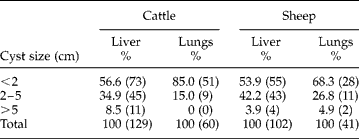
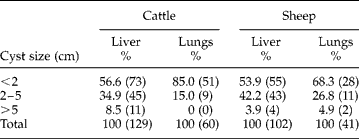
In both sheep and cattle from collective farms, there is a decreasing trend of the proportion of organs affected when the level of infection increased (table 3). On the other hand, in private households this proportion increased along with the infection level, except in cattle lungs. The level of infection generally appeared to be higher in private households. Most of the cysts were less than 2 cm in diameter in both organs and both species (table 4). Cysts of more than 5 cm in diameter appeared to be very rare, particularly in the lungs. In cattle, fertility was 1.1%, with protoscoleces found in only two liver cysts. A much higher fertility rate of 47.6% was observed in sheep, with a very similar rate in both organs.
The prevalence (%) of cystic echinococcosis in the liver and lungs of sheep and cattle, relative to the type of breeding. N, number of organs examined.

Prevalence (%) of cystic echinococcosis in cattle and sheep, relative to size of cysts; the number of organs examined is given in brackets.
Discussion
After a preliminary slaughterhouse survey conducted in 2011, which focused on the molecular characterization of CE, this study was designed over the following year to more precisely assess the prevalence of CE in Moldova. The hyperendemic status of the country was confirmed by the very high prevalence in sheep (61.9%) and cattle (59.3%). Although the prevalence estimation obtained for the previous year was higher, the low number of animals investigated (40 sheep and 19 cattle) was considered to be a potential source of overestimation (Umhang et al., Reference Umhang, Chihai and Boue2014). Prevalence in European countries is generally much lower, except in neighbouring Romania where a similar prevalence of 49.9% and 32.3% was described in sheep and cattle, respectively (Mitrea et al., Reference Mitrea, Ionita, Wassermann, Solcan and Romig2012). Surprisingly, no infection in pigs was observed, despite examination of 12,700 animals and a previous report of 13.2% infected swine (Bondari, Reference Bondari1992). In fact, while pig infection was reported in Romania, it was not due to E. granulosus s.s. but rather to E. canadensis (G6/7) (Bart et al., Reference Bart, Morariu, Knapp, Ilie, Pitulescu, Anghel, Cosoroaba and Piarroux2006; Neghina et al., Reference Neghina, Neghina, Marincu and Iacobiciu2010). In Moldova, despite the possibility of infection by E. granulosus s.s., the absence of infection was probably due to the indoor intensive farming practised for all the animals investigated. Since free-range pig farming also exists in Moldova, the presence of E. granulosus infection in this species remains possible.
The type of farm appears to be an essential element in CE infection in Moldova, since sheep and cattle from private households have a significantly higher rate of infection than those from collective farms. The commonly used intensive farming specific to the public sector leads to reduced exposure to the parasite, as opposed to the private sector where pasturage and free ranging are predominantly practised. Furthermore, animals from collective farms are mainly slaughtered under strict veterinary supervision, which does not occur in the private sector where home-slaughtering is generally practised. Thus, elimination of raw viscera by burying them in a hole in the ground, or by the widespread tradition of feeding them to dogs, contributes to perpetuating the life cycle, particularly when there is an overabundance of stray dogs. Since independence was proclaimed in the Republic of Moldova in 1991, the proportion of animals raised in the public and private sectors has completely reversed, with about 95% of animals now being raised in the private sector. The presence of numerous surrounding private households may explain the high prevalence in collective farms, despite the application of control measures.
The prevalence of infection is increasing in accordance with the age of both sheep and cattle. One can suppose that the prevalence may be slightly overestimated due to the lower number of young compared to older animals. This positive association between age and the probability of infection has already been reported, notably in sheep, with a probability of infection increasing 1.15-fold for each further year of age (Scala et al., Reference Scala, Garippa, Varcasia, Tranquillo and Genchi2006). Furthermore, Torgerson et al. (Reference Torgerson, Ziadinov, Aknazarov, Nurgaziev and Deplazes2009) described a massive accumulation of protoscoleces with the age of sheep, due to the increasing number of cysts and a proportional increase of protoscoleces with the volume of cysts.
The high proportion of infected organs may be attributed to massive infection. In addition, with the high rate of infection we can suppose that successive infections are represented. Molecular proof of mixed infections by different haplotypes between organs or in the same organ, probably due to successive infections, has already been reported in sheep and cattle (Casulli et al., Reference Casulli, Interisano, Sreter, Chitimia, Kirkova, La Rosa and Pozio2012; Umhang et al., Reference Umhang, Richomme, Boucher, Hormaz and Boué2013, Reference Umhang, Chihai and Boue2014; Boufana et al., Reference Boufana, Lahmar, Rebai, Ben Safta, Jebabli, Ammar, Kachti, Aouadi and Craig2014).
The proportion of fertile E. granulosus s.s. cysts in sheep and in cattle found here is very similar to that usually found (Cardona & Carmena, Reference Cardona and Carmena2013). Nevertheless, due to the previous high fertility rate (20.0%) in cattle observed in Moldova, a potential contribution of this species to the life cycle was suggested. This possibility is not confirmed here, and additional surveys will probably rule out cattle from the life cycle of E. granulosus s.s. in Moldova, as in the rest of Europe.
In conclusion, very high CE prevalence was observed in sheep and cattle, particularly in the private sector. The life cycle was found to be largely maintained by sheep and dogs, as reported previously for E. granulosus s.s. characterized in the country (Umhang et al., Reference Umhang, Chihai and Boue2014). Human CE is a high public health priority with an annual growth rate in humans of 4.7% (Prisacari & Lungu, Reference Prisacari and Lungu2014). Furthermore, CE and other parasitic species (Fasciola hepatica, Dicrocoelium lanceatum, Strongyloides papillosus) have caused great economic losses, estimated at US$114,285,714 annually (Erhan, Reference Erhan2010). However, further studies are needed to obtain a complete overview of the epidemiology of this parasite in its intermediate and definitive hosts, in order to implement control and preventive measures specifically targeting farms in the private sector.
Acknowledgements
The authors would like to thank all the staff of the Navelina slaughterhouse (Orhei, Republic of Moldova) who contributed to the preparation of this study through their participation in sample selection, as well as Céline Richomme (ANSES, France) for performing statistical analyses.
Financial support
This study was carried out as part of research project 11.817.08.13F funded by the Supreme Council for Sciences and Technological Development of the Academy of Sciences of Moldova.
Conflict of interest
None.