Nowhere does history indulge in repetitions so often or so uniformly as in Wall Street. When you read contemporary accounts of booms or panics the one thing that strikes you most forcibly is how little either stock speculation or stock speculators today differ from yesterday. The game does not change and neither does human nature.
From the thinly disguised biography of legendary speculator Jesse Livermore, by E. Lefevére (1923, p. 180)
INTRODUCTION
Overview
This paper demonstrates how a simple form of extrapolative expectations might arise and persist in a standard asset pricing model. In quantitative simulations, the model can generate excess volatility of stock prices, time-varying volatility of returns, long-horizon predictability of returns, bubbles driven by optimism about the future, and sharp downward movements in stock prices that resemble market crashes. All of these features appear to be present in long-run U.S. stock market data.
The framework for the analysis is a Lucas-type asset pricing model in which a representative agent forecasts the value of a composite variable that depends on both the growth rate of dividends and the price-dividend ratio. To make a conditional forecast, the agent may choose one of the following: (1) a rational (or fundamentals-based) forecast that employs knowledge of the stochastic process governing dividends, (2) a constant forecast that is based on a simple long-run average of the forecast variable, or (3) a time-varying forecast that extrapolates from the last observation of the forecast variable. To ensure that the extrapolation is “operational,” I assume that the agent employs lagged information about the forecast variable, not the contemporaneous realization of the variable (which depends on the agent's own forecast).
I show that an agent who is concerned about minimizing forecast errors may inadvertently become “locked-in” to an extrapolative forecast. In particular, the initial use of extrapolation alters the law of motion of the forecast variable so that the agent perceives no accuracy gain from switching to one of the alternative forecast methods. In deciding whether to switch, the agent keeps track of the forecast errors associated with each method. If the mean-squared forecast error from extrapolation is less than that of the alternatives, then there is no incentive to switch. The degree of optimism or pessimism in the extrapolation is governed by a single parameter which influences the mean, variance, and autocorrelation of the forecast variable. As the extrapolation parameter increases (reflecting more optimism), the mean shift and the autocorrelation shift work in favor of lock-in while the variance shift works against lock-in.
The extrapolation parameter can be interpreted as an index of investor sentiment. Alternatively, a particular value of the extrapolation parameter can be justified as a “restricted perceptions equilibrium” (RPE) of the type described by Evans and Honkapohja (2001). Specifically, if the agent's perceived law of motion for the forecast variable is a geometric random walk, then the resulting RPE yields an optimistic extrapolation that satisfies the conditions needed for lock-in. From the agent' perspective, a geometric random walk allows for nonstationary bubble behavior and enforces a non-negativity constraint on the forecast variable.
Lock-in occurs because the (atomistic) representative agent fails to internalize the influence of his own forecast on the equilibrium law of motion of the forecast variable. Lock-in can thus be interpreted as a suboptimal competitive equilibrium that arises in the presence of an externality, that is, feedback from the agent's expectations to the law of motion. The term “lock-in” borrows from the concept of path dependence in problems involving the choice among competing technologies. The original contributions of David (1985) and Arthur (1989) argue that early chance events or “historical accidents” may give rise to irreversibilities that cause agents to stick with an inferior technology. In this model, extrapolation can be viewed as an inferior forecasting technology because accuracy would improve if the representative agent could be induced to switch to the fundamentals-based forecast.
For the case of iid dividend growth, I derive (approximate) analytical expressions for the mean squared forecast errors and the moments of the asset pricing variables under extrapolative expectations. I show that lock-in can occur over a wide range of values for the extrapolation parameter and the coefficient of relative risk aversion. As the extrapolative forecast becomes more optimistic, the mean price-dividend ratio rises above the fundamentals-based value and the share price becomes more volatile. The price-dividend ratio exhibits positive serial correlation whereas the equity return can exhibit either positive or negative serial correlation, depending on the size of the risk coefficient. The agent's use of extrapolation gives rise to persistent forecast errors. It turns out that the degree of serial correlation in the model forecast errors is very similar to that found by Mankiw, Reis, and Wolfers (2004) in their empirical study of survey-based inflation forecast errors.
The model-generated time series for the price-dividend ratio and the equity return compare favorably in many respects to the corresponding series in long-run U.S. data. The price-dividend ratio can drift upwards for prolonged intervals when the agent employs an optimistic extrapolation. Oftentimes, these bubble-like episodes are followed by sharp downward movements in stock prices that resemble market crashes. The nonlinear law of motion that governs the forecast variable contributes to the complicated behavior of the asset pricing variables and the attendant time-varying volatility.
The analysis concludes with a discussion of model extensions that allow for (1) a mixture of agent types, (2) endogenous switching between forecasts, and (3) alternative forecast methods.
Related Literature
The model in this paper is motivated by a variety of evidence which suggests that real-world expectations are often less than fully rational. In theory, the price of a stock represents a consensus forecast of the discounted stream of future dividends that will accrue to the owner of the stock. One characteristic of an optimal forecast is that it should be less variable than the object being forecasted. This principle appears to be clearly violated in the case of stock prices. Numerous empirical studies starting with Shiller (1981) and LeRoy and Porter (1981) have demonstrated that stock prices exhibit “excess volatility,” that is, observed prices are much more variable than the discounted stream of ex post realized dividends.1
The finding of excess volatility is robust to a variety of discounting methods, as demonstrated by Shiller (2003).
Studies that directly examine the forecasts of market participants also find evidence of less-than-rational behavior. Arbarbanell and Bernard (1992) and Easterwood and Nutt (1999), among others, find that security analysts' earnings forecasts tend to overreact to new information, particularly when the information is positive in nature. Chan et al. (2003) find that analysts' forecasts of long-term earnings growth rates are consistently too optimistic and exhibit low predictive power for the actual earnings growth rates subsequently achieved.
An empirical study by Chow (1989) finds that an asset pricing model with adaptive expectations outperforms one with rational expectations in accounting for observed movements in U.S. stock prices and interest rates. Empirical studies by Ritter and War (2002) and Campbell and Vuolteenaho (2004) find support for the hypothesis of Modigliani and Cohn (1979) that investors are prone to inflation-induced valuation errors.2
For a summary of this research, see Lansing (2004).
Controlled experiments on human subjects suggest that people's decisions are influenced by various “heuristics,” as documented by Kahneman and Tversky (1974). The “representativeness heuristic” is a form of non-Bayesian updating whereby subjects tend to overweight recent observations relative to the underlying laws of probability that govern the process. The “availability heuristic” is the tendency of subjects to overweight information that is easily recalled from memory. Using both survey and experimental data, DeBondt (1993) finds that the forecasts of nonprofessional investors adhere to a simple trend-following methodology; they tend to be optimistic in bull markets and pessimistic in bear markets. Vissing-Jorgenson (2004) finds evidence of extrapolative expectations in investor survey data; investors who have experienced high portfolio returns in the past expect higher returns in the future. In studies involving experimental asset markets, researchers frequently observe bubbles and crashes that appear to be driven by irrational expectations.3
See Smith, Suchanek, and Williams (1988), Lei, Noussair, and Plott (2001), and Hommes et al. (2005).
It is well known that the introduction of irrational “noise traders” or agents with distorted beliefs into asset pricing models can help account for various features of real-world data.4
See, for example, Delong et al. (1990), Barsky and Delong (1993), Barberis, Schleifer, and Vishney (1998), Hansen, Sargent, and Tallarini (1999), Cecchetti, Lam, and Mark (2000), Kurz and Motolese (2001), Abel (2002), and Abreu and Brunnermeier (2003), among others.
It should be noted that rational models of asset pricing are not immune to criticism either. Reasonably calibrated versions of recent models fail to capture some important features of the data, as noted by Otrok, Ravikumar, and Whiteman (2002) and Polkovnichenko (2004).
THE MODEL
The analysis is conducted using the frictionless pure exchange model of Lucas (1978). There is a representative agent who can purchase equity shares to transfer wealth from one period to another. Each equity share pays an exogenous stream of stochastic dividends in perpetuity.
The agent's problem is to maximize

subject to the budget constraint

where ct is the agent's consumption in period t, β is the subjective time discount factor, and α is the coefficient of relative risk aversion (the inverse of the intertemporal elasticity of substitution). When α=1, the within-period utility function can be written as log(ct). The symbol
represents the agent's subjective expectation conditioned on information that is available at time t. Under rational expectations,
corresponds to the mathematical expectation operator evaluated using the objective distribution of dividend growth (which is presumed known to the agent). The symbol pt denotes the ex-dividend price of the equity share, dt is the dividend, and st is the number of shares purchased in period t.
The level of dividends dt follows a geometric random walk with drift such that

where xt denotes the iid growth rate in period t, and
and
are the mean and variance of the growth rate distribution.
The first-order condition that governs the agent's share holdings is given by

Equation (4) can be rearranged to obtain

where Mt+1=β(ct+1/ct)−α is the so-called stochastic discount factor and Rt+1=(pt+1+dt+1)/pt is the gross return from holding the equity share from period t to t+1. Defining the price-dividend ratio as yt≡pt/dt, the gross equity return can be written as
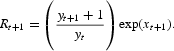
Without loss of generality, shares are assumed to exist in unit net supply. Market clearing therefore implies st=1 for all t. Substituting this equilibrium condition into (2) yields, ct=dt for all t. In equilibrium, equation (4) can now be written as

where θ≡1−α. Equation (7) shows that the price-dividend ratio in period t depends on the agent's subjective joint forecast of next period's dividend growth rate xt+1 and next period's price-dividend ratio yt+1. For the analysis that follows, it is convenient to transform equation (7) using a change of variables to obtain

where zt≡βexp(θxt)(yt+1). Under this formulation, zt represents a composite variable that depends on both the growth rate of dividends and the price-dividend ratio. Equation (8) shows that the value of zt in period t depends on the agent's conditional forecast of that same variable.6
The general form of equation (8), whereby the current value of an endogenous variable depends on its expected future value, appears in a wide variety of economic models. Examples include the cobweb model and the New Keynesian Phillips curve. Brock and Hommes (1998) derive an asset pricing equation that is similar to (8) in a model in which agents are myopic mean-variance optimizers.
Rational Expectations
Under rational expectations, the current share price is uniquely pinned down by the agent's forecast of the discounted value of all future dividends, adjusted for risk. A crucial assumption is that the agent knows the stochastic process governing dividends. To derive the unique rational expectations solution, we first replace
in (8) with the mathematical expectation operator Et. Equation (8) can then be iterated forward to substitute out zt+1+k for k=0, 1, 2, … Applying the law of iterated expectations and imposing a transversality condition yields the following present-value pricing equation
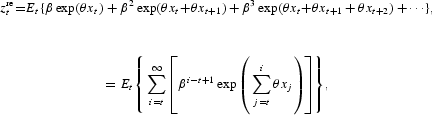
where
represents the value of the forecast variable under rational expectations. Because xt is iid and normally distributed, equation (9) admits the following closed-form solution
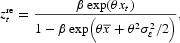
provided
Given
we can recover the price-dividend ratio by applying the definitional relationship
This procedure yields

which shows that the rational (or fundamentals-based) price-dividend ratio is constant for all t. This result provides a convenient benchmark for evaluating alternative solutions of the model. If an alternative solution delivers a time-varying price-dividend ratio, then the resulting share price can be said to exhibit “excess volatility.”
Equation (10) can be used to compute the following conditional forecast
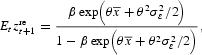
which shows that a rational agent will employ a constant forecast that depends only on economic fundamentals.
Expectations Based on a Long-Run Average
The fundamentals-based forecast derived above assumes that agents know the stochastic process governing dividends. Moreover, the imposition of a transversality condition assumes that agents are extremely forward-looking—to the point of respecting an arbitrage relationship applied to distant future periods.7
The transversality condition and other technical arguments are often cited to rule out the existence of so-called rational bubbles. But, as noted by LeRoy (2004, p. 801), “[C]ommitting to the full neoclassical paradigm produces an argument against bubbles that, although logically airtight, is simply not plausible. It is a testament to economists' capacity for abstraction that they have accepted without question that an intricate theoretical argument against bubbles has somehow migrated from the pages of Econometrica to the floor of the New York Stock Exchange.”
takes the form of a simple average of past observed values of the forecast variable zt. After a long time-series of observations, the agent's subjective forecast would be given by

where E(zt) is the unconditional mean of the stochastic process that governs zt.
Extrapolative Expectations
During the early stages of the time horizon, the agent will not have had sufficient time to discover the fundamentals of the dividend process. Moreover, there will be very few observations of zt from which to construct a forecast based on a past average. These limitations motivate consideration of an alternative forecasting algorithm, one in which the agent simply extrapolates from the last observation of the forecast variable. The formulation used here is intended to capture the spirit of the representativeness and availability heuristics documented by Kahneman and Tversky (1974). The formulation also captures the idea that individuals tend to employ simple rules or models in decision making or forecasting.
The agent's extrapolative forecast is given by

where A is a positive extrapolation parameter. Equation (14) can be viewed as a simplified version of a more general setup where the agent's forecast is constructed from a weighted moving average of past values of the forecast variable.8
The more general setup would take the form
where δ is a discount factor applied to past observations. Traditional adaptive expectations corresponds to the special case where A≤1 and δ = 1−A. Equation (14) allows A>1 but imposes δ = 0.
Recent examples of this approach in the context of asset pricing models include Brock and Hommes (1998), Gaunersdorfer (2000), Hommes (2001), and Sögner and Mitlöhner (2002), among others.
In contrast to the fundamentals-based forecast and the long-run average forecast that are both constant for all t, the extrapolative forecast is forever changing, depending on the most recent observation. Importantly, the extrapolative forecast does not nest the fundamentals-based forecast as a special case. When A ≠ 1, the extrapolative forecast is biased because the unconditional mean of the forecast
does not coincide with the unconditional mean of the variable being forecasted.10
Gu and Wu (2003) show that a biased forecast can be optimal when the forecaster's objective is to minimize the mean absolute error of the forecast. In this case, the optimal forecast is given by median of the forecast variable rather than the mean. If the distribution of the forecast variable is negatively (positively) skewed, then the optimal forecast exhibits optimism (pessimism).
exceeds the variance of the variable being forecasted.
Substituting the extrapolative forecast (14) into equation (8) yields the following nonlinear law of motion for the forecast variable:

which is autoregressive. For zt to remain stationary, we require E[Aβexp(θxt)]<1, which implies the following upper bound on the extrapolation parameter

Using equation (15), the price-dividend ratio can be recovered by applying the definitional relationship yt=ztexp(−θxt)/β−1, yielding
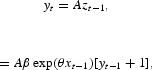
which is also nonlinear and autoregressive. Taking the mathematical expectation of both sides of (17) and noting that xt−1 is not correlated with yt−1(=Azt−2), we obtain the following expression for the mean price-dividend ratio

As A increases, the agent becomes more optimistic and the mean price-dividend ratio rises. When A>1, the mean price-dividend ratio exceeds the fundamentals-based value given by equation (11). Thus, irrational optimism about the future gives rise to a “bubble” in which the share price is persistently above the intrinsic value implied by the underlying fundamentals of the dividend process. This feature of the model is consistent with historical interpretations of bubble episodes. Shiller (2000) argues that occurrences of major speculative bubbles have generally coincided with periods of widespread investor optimism about a “new era.” Indeed, the law of motion (15) captures the basic form of a feedback mechanism which Shiller (1990) argues is the basic driving force of speculative bubbles.11
For additional discussion of bubble mechanisms and applications to historical episodes, see the symposium in Journal of Economic Perspectives, Spring 1990.
In the Appendix, I show that the variance of the price-dividend ratio can be approximated by the following expression:
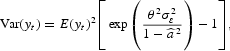
where E(yt) is given by (18) and
As the extrapolation parameter A increases, the price-dividend ratio becomes more volatile. Equation (19) implies Var(yt) > 0 whenever θ ≠ 0, that is, whenever the utility function is not logarithmic. Given that Var
, equation (19) shows that the agent's use of an extrapolative forecast generates excess volatility whenever θ ≠ 0.
Restricted Perceptions Equilibrium
One interpretation of the extrapolation parameter A is that it represents an index of investor sentiment. Alternatively, the value of A can be endogenized as part of “restricted perceptions equilibrium” (RPE) in which the representative agent's forecasting rule is optimized for a perceived law of motion (PLM) that does not nest the actual law of motion (ALM) as a special case.12
The terminology in this section follows Evans and Honkapohja (2001, Chapter 13).
Froot and Obstfeld (1991) demonstrate how a nonstationary “rational bubble” solution may help account for some observed features of U.S. stock prices.
PROPOSITION 1. If the representative agent's PLM is log(zt) = log(zt−1) +vt, where
is a perceived iid shock, then a restricted perception equilibrium is given by the ALM (15) with
Proof. Iterating the PLM ahead two periods (which is the agent's forecast horizon) yields zt+1=zt−1exp(vt+1+vt). The agent's optimal forecast using lagged information is
Comparing this forecast to the form of the extrapolative expectation (14) implies that the RPE value of the extrapolation parameter is given by
The perceived shock variance
can be computed directly from sample observations of log(zt) using the formula
An approximation of the ALM for log(zt) is derived in the appendix. Straightforward computations yield

where I have made repeated substitutions of the approximate ALM for log(zt). From the appendix, we have
which yields the result
The RPE value is thus given by
LOCK-IN OF EXTRAPOLATIVE EXPECTATIONS
This section shows how an agent who is concerned about minimizing forecast errors may inadvertently become locked-in to the use of an extrapolative forecast.
Forecast Errors
Suppose that the agent initially adopts the extrapolative forecast given by (14). The forecast error observed by the agent is
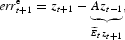
where the superscript “e” stands for “extrapolation.” The ALM for zt is governed by (15). Given a sufficiently long time-series of forecast errors, the agent could compute a fitness measure for the forecast. One commonly used fitness measure is the mean-squared error, which is given by

where
is the unconditional correlation coefficient between zt+1 and zt−1, as derived in the appendix. In deriving equation (21), I have made use of the relationships
and
. The unconditional moments of zt (also derived in the Appendix) are given by

where
Now consider an agent who is contemplating a switch to either the fundamentals-based forecast or a forecast based on a long-run average. Before the switch occurs, the actual law of motion for zt is governed by (15). For simplicity, assume that enough time has gone by to allow the agent to have discovered the stochastic process for dividends. The fundamentals-based forecast is thus given by equation (12). The long-run average forecast is given by equation (22). In deciding whether to switch forecasts, the agent keeps track of the forecast errors associated with each method. If the mean-squared forecast error associated with extrapolation is less than that of the other two methods, then there is no incentive to switch; the agent is said to be locked-in to the extrapolative forecast.
For the fundamentals-based forecast, the agent's perceived forecast error is given by
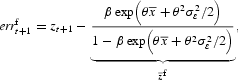
where the superscript “f” stands for “fundamentals.” The symbol
will henceforth be used to represent the fundamentals-based forecast, which is constant for all t. Given a sufficiently long time-series of forecast errors, the agent could compute the following fitness measure for the fundamentals-based forecast
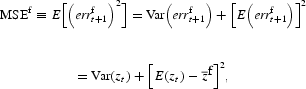
where E(zt) and Var(zt) continue to be given by equations (22) and (23).
For the long-run average forecast, the agent's perceived forecast error is given by
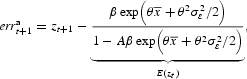
where the superscript “a” stands for “average.” Notice that the long-run average forecast is identical to the fundamentals-based forecast in the special case when A=1. The fitness measure for the long-run average forecast is given by

where Var(zt) is again given by equation (23).
Factors Influencing Lock-In
Definition
Lock-in of extrapolative expectations occurs for the forecast variable zt≡βexp(θxt)(yt+1) such that
- The ALM for zt is given by equation (15),
- A∈(0, Amax), and
- MSEe=min{MSEe, MSEf, MSEa}.
A comparison of the forecast fitness measures given by equations (21), (25), and (27), reveals three factors that influence whether lock-in will occur.
First, the agent's use of an extrapolative forecast can shift the mean of the forecast variable relative to that which prevails under a fundamentals-based forecast. This factor, which is captured by the term
in equation (25), works in favor of lock-in because it increases the mean-squared error of the fundamentals-based forecast. When A=1, the mean shift term vanishes, making lock-in less likely to occur. In the case of the long-run average forecast, equation (27) shows that the mean shift term is absent for any value of A. This occurs because a long-run average is based on the observed times-series of zt itself. In contrast, the fundamentals-based forecast
is a theoretical construct that depends only on preference parameters and the observed stochastic process for dividends.
Second, the use of an extrapolative forecast imparts self-fulling autocorrelation to the forecast variable. This factor, which is captured by the term
in (21), also works in favor of lock-in because it reduces the mean-squared error of the extrapolative forecast. The other two forecasts are constant for all t and thus do not exploit the autocorrelation in zt.
Third, the use of a time-varying forecast raises the variance of the forecast relative to the other two methods, which employ constant forecasts. This factor, which is captured by the term (1+A2)Var(zt) in (21), works against lock-in because it increases the mean-squared error of the extrapolative forecast relative to the alternatives.
Lock-in occurs if the first two factors dominate the third factor. In general, the outcome will depend on the values of some key parameters, namely A, θ, and β. Analytical results are derived below for the case of log utility, which implies θ=0. Other cases are explored numerically.
The intuition for why lock-in occurs is straightforward. In computing the forecast fitness measures, the representative agent views the evolution of zt as being determined outside of his control. In equilibrium, of course, the chosen forecast method does in fact influence the evolution of zt. When the agent chooses the extrapolative forecast, the resulting law of motion for zt is such that the fundamentals-based forecast is no longer the most accurate.14
Adam (2005b, p. 13) shows that similar intuition accounts for the existence of a restricted perceptions equilibrium in a representative agent version of a sticky price model.
Analytical Results for Log Utility
The case of log utility (θ=0) provides some useful insight into the conditions needed to achieve lock-in of extrapolative expectations. Imposing θ=0 in the law of motion (15) removes any influence of stochastic dividends on the forecast variable. The unconditional moments of zt are now given by E(zt)=β/(1−Aβ) and Var(zt)=0. Substituting these moments into the forecast fitness measures (21), (25), and (27) yields

where A ∈(0, β−1). When A = 1, all three fitness measures equal zero. In this case, all three forecast methods are identical and fully rational.
When A ≠ 1, equations (28) and (29) imply MSEe < MSEf for β > 0.5. Thus, a sufficiently patient agent would refrain from switching to a fundamentals-based forecast because the switch would appear to result in a larger mean-squared forecast error. This result can be attributed to the mean shift in zt that is induced whenever A ≠ 1. With log utility, the autocorrelation and variance of zt are not shifted because the forecast variable is constant for all t. When A ≠ 1, equations (28) and (30) imply MSEe > MSEa. Thus, an agent with log utility would be inclined to abandon extrapolation in favor of the long-run average forecast. This result can be attributed to the absence of a mean shift relative to the alternative forecast.
Numerical Results for General Power Utility
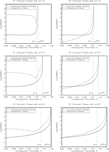
In the case of general power utility, analytical comparisons of the mean squared forecast errors are not tractable. Figures 1A through 1F present numerical comparisons for three different risk coefficients:
which correspond to the values θ={−0.5, −2.0, −5.0}. These risk coefficients are below the maximum level of 10 considered plausible by Mehra and Prescott (1985). Throughout the paper, the agent's discount factor is assumed to be β=0.999. As shown further later, the parameter combination β=0.999 and α=6 yields model-generated statistics that are reasonably close to those observed in long-run U.S. data.15
I follow the common practice of restricting attention to the case where β < 1. However, it should be noted that an equilibrium with positive interest rates can still exist with β > 1, as shown by Kocherlakota (1990).
and σε=0.0324.16
Over the period from 1889 to 1997, U.S. consumption growth exhibits weak serial correlation with an AR(1) coefficient of −0.128. The data are available from John Campbell's Web site: http://kuznets.fas.harvard.edu/~campbell/data/newdata.

Forecast fitness measures (1A–1E).
For scaling purposes, I plot a monotonic transformation of the fitness measure, that is, the logarithm of the root mean-squared error. A lower value for the fitness measure implies a more accurate forecast. The fitness measure is plotted over a range of values for A, where vertical lines mark the RPE value A* from Proposition 1 and the upper bound Amax from equation (16). In each figure, the fitness measure for the extrapolative forecast (solid line) is compared to the fitness measure for the alternative forecast (dotted line).
Figures 1A and 1B plot the results for α = 1.5, which represents a utility function with a bit more risk aversion than log utility. In Figure 1A, the extrapolative forecast is more accurate than the fundamentals-based forecast for all A ∈(0, Amax). The downward spike at A = 1 results from taking the logarithm of a small positive number. In Figure 1B, the extrapolative forecast is more accurate than the long-run average forecast for A ∈(0.96, Amax). Higher values of A increase the autocorrelation of the forecast variable thus allowing the extrapolative forecast to dominate the long-run average forecast which ignores any autocorrelation. Recall that the unconditional correlation coefficient between zt+1 and zt−1 is given by
, which is increasing in the value of A. The RPE value is A* = 1.0003, which satisfies the conditions needed for lock-in. As A → Amax, the actual law of motion for zt becomes nonstationary and the mean-squared error of all forecasts explodes.
Figures 1C and 1D plot the results for α = 3.0, which magnifies the influence of stochastic dividends on the forecast variable zt. Again, the extrapolative forecast is always more accurate than the fundamentals-based forecast. Now the extrapolative forecast is more accurate than the long-run average forecast over a wider range of values for the extrapolation parameter, that is, for A ∈(0.91, Amax). In general, as the risk coefficient increases, the extrapolative forecast dominates the long-run average forecast over a wider range of values for A. The RPE value is A* = 1.0042, which satisfies the conditions needed for lock-in.
Figures 1E and 1F plot the results for α = 6.0 The extrapolative forecast is always more accurate than the fundamentals-based forecast. Now the extrapolative forecast is more accurate than the long-run average forecast for A ∈(0.85, Amax). The RPE value is A* = 1.0266, which again satisfies the conditions needed for lock-in.
Overall, the numerical results show that lock-in of extrapolative expectations is more likely to occur for higher degrees of risk aversion (as measured by α) and higher levels of investor optimism (as measured by A). Equation (16) shows that the upper bound Amax is decreasing in the agent's discount factor β. As β increases, the qualitative features of the figures remain unchanged but the vertical asymptote which marks Amax shifts to the left.
Moments of Asset Pricing Variables
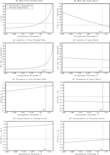
Figures 2A through 2H show how changes in the value of the extrapolation parameter A influence the unconditional moments of the asset pricing variables. In each figure, the moment obtained under extrapolative expectations (solid line) is compared to the corresponding moment under rational expectations (dotted line). The expressions that govern the moments are derived in the Appendix. For illustrative purposes, I focus on a particular risk coefficient with α=6.

Analytical moments of asset pricing variables (2A–2H).
Figure 2A plots the mean price-dividend ratios computed from equations (11) and (18). Under extrapolative expectations, higher values of A cause the mean price-dividend ratio to increase in a nonlinear fashion. A check of figures 1E and 1F shows that the conditions needed for lock-in are satisfied at the RPE value of A*=1.0266. When A=A*, the model implies E(yt)=20.4, which is reasonably close the U.S. average of 25.2 for the period 1871 to 2002.17
The long-run historical data for the U.S. stock market cited in the paper were obtained from Robert Shiller's Web site: http://www.econ.yale.edu/~shiller/.
for all t. Because the agent forecasts the value of zt+1 using the observation zt−1, the RPE value of A*=1.0266 implies that the agent optimistically projects about a 3% increase in the forecast variable over the next two periods.
Figure 2B plots the mean equity return computed using the following expressions:

which are derived in the Appendix. Under extrapolative expectations, a higher value of A, reflecting more optimism, results in a lower mean return. Under both types of expectations, a higher value of the discount factor β also results in a lower mean return. The intuition is straightforward. Increased optimism about future payoffs or increased patience about future payoffs make the agent more willing to defer current consumption and increase saving, thereby driving up the share price and reducing the realized return. At the RPE value of A*=1.0266, the mean net return is 9.6%, which is somewhat above the U.S. arithmetic average real return of 8.2% over the period 1871 to 2002. Interestingly, the mean net return under rational expectations is also 9.6%. It turns out that equations (31) and (32) are identical when the extrapolation parameter A is set to the RPE value of
Figure 2C plots the volatility (standard deviation) of the price-dividend ratio computed from the approximate expression (19). Under extrapolative expectations, volatility increases with A in a nonlinear fashion whereas volatility is always zero under rational expectations. At the RPE value of A*=1.0266, the standard deviation of yt predicted by equation (19) is 10.3. This value is reasonably close to the corresponding U.S. value of 12.4 for the period 1871 to 2002. As A → Amax, the actual law of motion (17) implies that yt becomes nonstationary and volatility increases without bound.
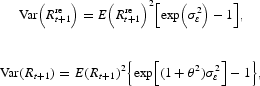
Figure 2D plots the volatility of the equity return computed from the expressions:
where
and E(Rt+1) are given by equations (31) and (32). For any given value of A, the figure shows that return volatility is substantially higher under extrapolative expectations. This result is not surprising given that equation (6) shows that the change in the price-dividend ratio from period t to t+1 represents one component of the equity return, with dividend growth representing the other component. At the RPE value of A* = 1.0266, the standard deviation of Rt+1 predicted by equation (34) is 18.2%. Under rational expectations, the standard deviation of
is 3.55%. Over the period 1871 to 2002, the standard deviation of real U.S. equity returns is 17.8%. In equation (34), a higher value of the risk coefficient implies a higher value of θ2, thereby magnifying the impact of stochastic dividend growth on return volatility.
Figure 2E plots the persistence of the price-dividend ratio, as measured by the unconditional correlation coefficient between yt and yt−1. Under extrapolative expectations, the correlation coefficient is given by
which increases with A in a linear fashion. At the RPE value of A* = 1.0266, we have
This figure is a bit higher than the corresponding U.S. value of 0.87 for the period 1871 to 2002. Under rational expectations, the price-dividend ratio is constant which technically implies that the correlation coefficient is undefined. In this case, the figure plots a horizontal line at 1.0 to indicate the result
for all t.
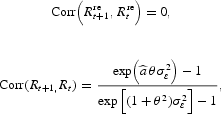
Figure 2F plots the persistence of the equity return computed from the expressions:
where
denotes the unconditional correlation coefficient and
Under extrapolative expectations, the sign of the correlation coefficient depends on the degree of risk aversion via the parameter θ≡1−α. The value of θ governs the co-movement between the price-dividend ratio and lagged dividend growth, as shown by the ALM for yt (17). When utility is logarithmic (θ=0), we have
for any value of A. Decreased risk aversion relative to log utility causes the numerator of equation (36) to become positive such that
Increased risk aversion relative to log utility causes the numerator to become negative such that
. In this case, an increase in the extrapolation parameter A causes the correlation coefficient to become more negative, as shown in Figure 2F. When α=6 and A=A*, we have
Using annual data for the period 1871 to 2002, real U.S. equity returns exhibit slightly positive serial correlation, with a correlation coefficient of 0.04. Experiments with the model indicate that a small positive correlation coefficient can be obtained if the law of motion for consumption/dividend growth (3) is modified to allow for an AR(1) process with positive serial correlation.18
Over the shorter sample period from 1926 to 1997, U.S. consumption growth exhibits positive serial correlation, with an AR(1) coefficient of 0.268. During this same period, inflation-adjusted U.S. equity returns continue to exhibit slightly positive serial correlation, with a correlation coefficient of 0.07.
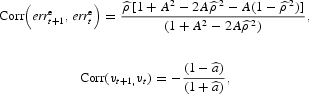
Figure 2G plots the autocorrelation of the agent's two-step ahead forecast errors. Figure 2H plots the autocorrelation of the agent's perceived exogenous shock vt when the PLM for the forecast variable is a geometric random walk. Straightforward computations yield the following expressions:
where
is defined by equation (20) and vt=log(zt)−log(zt−1) from Proposition 1. At the RPE value of A* = 1.0266, we have
, which shows that extrapolation gives rise to persistent forecast errors. Interestingly, Mankiw, Reis, and Wolfers (2004, p. 219) find that survey-based measures of inflation forecast errors exhibit similar persistence properties, with autocorrelation coefficients ranging from 0.37 to 0.64. In a theoretical study using a sticky price model, Adam (2005b) solves for an RPE in which the autocorrelation of forecast errors is also around 0.5. He shows that it would take more than 33 data points on average for the agent to reject the hypothesis of no autocorrelation. At the RPE value of A* = 1.0266, we have
, which is very close to the agent's perception of no autocorrelation in the shock term.
Model Simulations
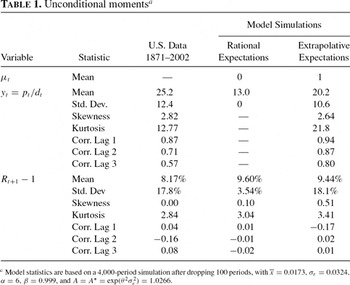
Table 1 presents unconditional moments of the asset pricing variables computed from a long simulation of the model. The table also reports the corresponding statistics from U.S. data over the period 1871 to 2002. For the model with extrapolative expectations, the statistics reported in Table 1 may differ slightly from the values computed from the approximate analytical expressions that were used to construct Figures 2A through 2F.

The model price-dividend ratio under extrapolative expectations exhibits high volatility, positive skewness, and excess kurtosis, all of which are also present in long-run U.S. data. The model equity return under extrapolative expectations exhibits high volatility, but only small amounts of positive skewness and excess kurtosis. Annual U.S. equity returns exhibit neither skewness nor excess kurtosis, but there is evidence of positive skewness and excess kurtosis at quarterly and monthly frequencies.
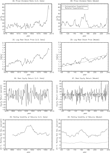
Figures 3A through 3H plot U.S. stock market data together with the corresponding model-generated series. Under extrapolative expectations, the model-generated series compare favorably in many respects to the U.S. counterparts. Figure 3A shows the sharp run-up in the U.S. price-dividend ratio during the stock market bubble of the late 1990s. The bubble episodes in the model are somewhat less extreme (Figure 3B), but larger bubbles can be observed with different draws for the dividend growth shocks. Figure 3C shows that the real stock price in U.S. data exhibits long upward swings which are often punctuated by sharp, short-lived declines. Similar behavior can be observed in the model with extrapolative expectations (Figure 3D). The complicated behavior of the asset pricing variables under extrapolative expectations derives from the nonlinear law of motion (15). Coakley and Fuertes (2004) and Bohl and Siklos (2004) fit nonlinear time series models to U.S. stock market valuation ratios over the period 1871 to 2001. Both studies find evidence that valuation ratios drift upward into bubble territory during bull markets, but these persistent departures from fundamentals are eventually eliminated via swift downward adjustments during bear markets.

Comparison of U.S. data versus model simulations (3A–3H).
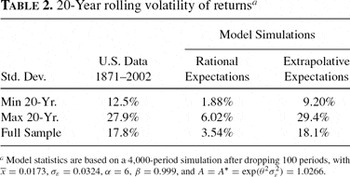
Figure 3E illustrates the extreme volatility of U.S. equity returns, a feature that is captured by the model under extrapolative expectations (Figure 3F). Figure 3G provides evidence of time-varying volatility in U.S. equity returns. As noted by Schwert (1989), U.S. equity returns exhibit high volatility during the middle part of the sample which includes the Great Depression. From 1871 to 2002, the 20-year rolling standard deviation of returns varies from a minimum of 12.5% to a maximum of 27.9%. The full-sample standard deviation is 17.8%. Figure 3H provides evidence of time-varying return volatility in the model with extrapolative expectations. Table 2 provides a quantitative comparison of the return volatilities in the data and the model.

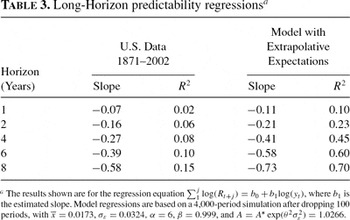
Numerous empirical studies starting with Fama and French (1988) and Campbell and Shiller (1988) have demonstrated that the log price-dividend ratio forecasts aggregate U.S. equity returns in excess of the risk-free rate over long horizons. Cochrane (2001, p. 394) points out that long-horizon predictability is directly related to the phenomenon of excess volatility. Table 3 shows that the model-generated returns under extrapolative expectations are highly forecastable over long horizons. As usual, predictability is demonstrated using a simple regression of the holding period return on a constant and the logarithm of the price-dividend ratio that prevails at the beginning of the period. Similar to the behavior observed in U.S. data, the R2 of the regression increases with the forecast horizon as does the magnitude of the estimated slope coefficient. The intuition for long-horizon predictability in the model is straightforward. A high price-dividend ratio implies that the ratio is more likely to be above its long-run mean. Because the price-dividend ratio is stationary, the ratio will eventually revert to its long-run mean. The inevitable drop in the price-dividend ratio over a long horizon produces a lower realized return. Under rational expectations, the price-dividend ratio is constant for all t and thus provides no information about future returns.

EXTENSIONS OF THE BASIC MODEL
Mixture of Agent Types
In the basic model, a representative agent initially adopts the extrapolative forecast given by (14) and then contemplates switching to either the fundamentals-based forecast or the long-run average forecast. A simple extension allows for a mixture of agent types, with each type initially employing a different forecast method. Following Kirman (1991) and others, I assume that the governing market expectation that enters the law of motion of the forecast variable is the average expectation across agents. For an economy initially populated by extrapolators and fundamentalists, the ALM for the forecast variable becomes
, where λ ∈ [0, 1] is the proportion of agents who employ the extrapolative forecast. For an economy initially populated by extrapolators and long-run averagers, the ALM becomes zt = βexp(θxt)[λ(Azt−1) +(1−λ)E(zt) + 1], where E(zt) is no longer given by (22) but instead now depends on λ. In both versions of the heterogenous agent economy, the introduction of the parameter λ shifts the unconditional moments of zt that appear in the expressions for the forecast fitness measures MSEe, MSEf, MSEa. In either case, as λ declines, the extrapolative forecast becomes less accurate relative to the alternatives, making lock-in less likely to occur. This result is not surprising because λ governs the influence that the extrapolators have on the ALM for zt. In this context, lock-in can be interpreted as a type of suboptimal Nash equilibrium in which the extrapolators choose not to deviate from their initial forecast given that a sufficient number of other agents are forecasting in the same way.
Endogenous Switching Between Forecasts
A slight modification of the model allows for the possibility of endogenous switching between forecast methods. This occurs when the agent's metric for assessing performance is the forecast error observed in the most-recent period (which corresponds to a year in the model calibration). From a modeling perspective, a tendency to overweight recent forecast performance is consistent with the availability and representativeness heuristics. From an individual agent's perspective, an emphasis on recent data appears to be justified, given the (self-induced) regime-switching that is evident in observable variables.
The setup is similar to the “adaptive belief systems” examined by Brock and Hommes (1997, 1998) and Hommes (2001), among others. To keep things simple, I abstract from heterogeneity of beliefs among agents but allow the representative agent's beliefs to vary over time. I also abstract from any costs of collecting and processing information that might be expected to increase with the degree of sophistication of the forecast method.
Simulations of the adaptive belief system give rise to endogenous switches between forecasts at intervals of varying length. Each forecast regime exhibits persistence even though the underlying forecast fitness measures depend only on the forecast errors in the most recent period.19
Lengthening the forecast evaluation window (or alternatively, imposing geometrically declining weights on past squared forecast errors) imparts more inertia to the fitness measures which has the effect of increasing the average interval between regime switches.
An interesting issue for future research, suggested by a referee, would be to characterize the basins of attraction of each forecast method when equal weights are assigned to past squared forecast errors.
Alternative Forecast Methods
In the basic model, a representative agent considers only two alternatives to the extrapolative forecast, that is, a fundamentals-based forecast and a long-run average forecast. A more sophisticated agent might consider an expanded set of alternatives. One possibility is a first-order autoregression on the observed time-series of zt. Given a long time-series of observations and assuming that the agent employs lagged information, an autoregressive forecast would take the form
where E(zt) is given by equation (22) and
is the correlation coefficient between zt+1 and zt−1. Unlike the other two alternatives, this forecast method exploits the autocorrelation in zt.21
Another closely related possibility is an adaptive forecast, which takes the form
where A < 1.
where Var(zt) is given by equation (23).22
We have
. The expression for
, is derived using the relationships
and
One can show that the new law of motion for zt will become nonstationary when the agent switches to an autoregressive forecast that is parameterized using the sample moments of zt generated by the original law of motion (15). More generally, one can show that an autoregressive forecast cannot be justified as a stationary consistent expectations equilibrium (CEE) of the type described by Sögner and Mitlöhner (2002).
CONCLUDING REMARKS
Theories about expectations have long played a role in efforts to account for the observed behavior of equity prices. Keynes (1936, p. 156) likened the stock market to a “beauty contest,” in which participants devoted their efforts not to judging the underlying concept of beauty, but instead to “anticipating what average opinion expects the average opinion to be.” Keynes readily acknowledged the concept of irrational, herd-like behavior among investors in stating (p. 157): “There is no clear evidence from experience that the investment policy which is socially advantageous coincides with that which is most profitable.” He cautioned that it may be “scarcely practicable” to employ a rational, long-term investment strategy in a market dominated by short-term “game-players.” More recently, Federal Reserve Chairman Alan Greenspan (1999) warned that “an unwarranted, perhaps euphoric, extension of recent developments can drive equity prices to levels that are unsupportable.”
The flavor of the above ideas is clearly evident in the model set forth in this paper. The main contribution is to show that an individual agent can become locked-in to the use of a suboptimal, extrapolative forecast if other agents (i.e., “game-players”) are following the same approach. From the perspective of an individual agent, switching to a fundamentals-based forecast would appear to reduce forecast accuracy, so there is no incentive to switch. A reasonably calibrated version of the model is capable of generating excess volatility, time-varying volatility, bubbles, crashes, and other well-documented features of long-run U.S. stock market data.
In the model, the representative agent's choice of forecast method is guided by the principle of minimizing forecast errors. In this sense, the agent can be viewed as boundedly rational. The use of a forecast algorithm that extrapolates from the last observation also can be viewed as boundedly rational because it economizes on the costs of collecting and processing information. As noted by Nerlove (1983, p. 1255): “Purposeful economic agents have incentives to eliminate errors up to a point justified by the costs of obtaining the information necessary to do so…. The most readily available and least costly information about the future value of a variable is its past value.”
Further extensions of the basic model to include bond pricing may provide insight into other observed features of real-world asset markets.
APPENDIX A
This appendix derives analytical expressions for the unconditional moments of the price-dividend ratio and the equity return.
RATIONAL EXPECTATIONS
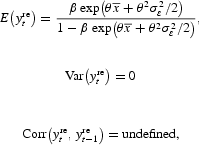
Equation (11) shows that
is constant for all t. This result implies
where
denotes the unconditional correlation coefficient between
and
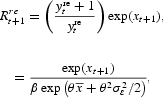
Making use of equations (6) and (11), the gross equity return is given by
where
is the constant price-dividend ratio from (11). Equation (A.4) implies that the mean and variance of the equity return are given by

where I have made use of the properties of the log-normal distribution. In particular, if
then
where θ is a constant. Also, as Var[exp(θx)]=E[exp(θx)2]−{E[exp(θx)]}2, we have
The first two moments of the log equity return are given by

The unconditional correlation coefficient between
and
is given by

where I have made use of the relationship E[exp(xt+1)exp(xt)]=E[exp(xt+1)]E[exp(xt)] because xt is iid.
EXTRAPOLATIVE EXPECTATIONS
Taking the unconditional expectation of both sides of (15) and noting that xt is not correlated with zt−1, we obtain the following expression for the mean of the forecast variable

To obtain a simple expression for the variance of the forecast variable, I approximate the law of motion for log(zt) using a first-order Taylor-series expansion around the point
Specifically,

where the Taylor-series coefficients are given by
and
Taking the unconditional variance of both sides of equation (A.11) yields
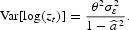
Assuming that the distribution of zt is approximately log-normal, we can make use of the relationship

where E(zt) is given by (A.10). Given that yt = Azt−1 from (17), the unconditional moments of the price-dividend ratio can be computed using the relationships, E(yt)=AE(zt) and Var(yt)=A2 Var(zt).
The unconditional correlation coefficient between zt and zt−1 is defined as

The expectation E(ztzt−1) can be computed from the law of motion (15) as follows:
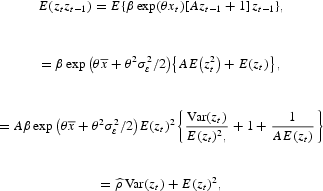
where I have made use of the relationship
and equation (A.10). Substituting the above expression for E(ztzt−1) into equation (A.14) yields the result that
A similar procedure can be used to show that
Given that yt=Azt−1, the price-dividend ratio has the same autocorrelation structure as the forecast variable.
The gross equity return can be written as
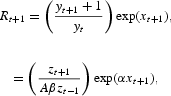
where I have eliminated yt+1 using the definitional relationship yt+1=zt+1exp(−θxt+1)/β−1 and eliminated yt using the relationship yt=Azt−1 from (17). From the above expression, it follows directly that

Using equation (A.16), straightforward computations yield

where I have again made use of the Taylor-series approximation in (A.11) and the expression for Var[log(zt)] in (A.12).
Given the unconditional moments of log(Rt+1) from (A.17) and (A.18), and assuming that the distribution of Rt+1 is approximately log-normal, the moments of Rt+1 can be computed using the following relationships
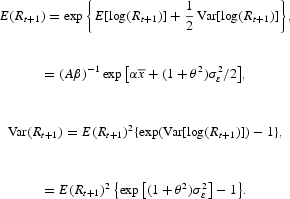
To compute the unconditional correlation coefficient between Rt+1 and Rt, we must first obtain an expression for E(Rt+1Rt). Assuming that the distribution of the product term Rt+1Rt is approximately log-normal, we can make use of the relationship

where (A.16) implies that log(Rt+1Rt) is given by

Using (A.22), straightforward computations yield the following unconditional moments:

where (A.24) is obtained by repeated substitution of the approximate law of motion for log(zt) given by (A.11). Substituting the above moments into (A.21) and collecting terms yields
This moment can be combined with the moments given by (A.19) and (A.20) to yield the following expression for the correlation coefficient:

where θ≡1−α and
For helpful comments and suggestions, I thank two anonymous referees and seminar participants at UC Davis, the 2003 Society for Economic Dynamics Meeting, the 2005 Society for Nonlinear Dynamics and Econometrics Meeting, the 2005 Eastern Finance Association Meeting (recipient of best paper award in investments), and the 2005 Federal Reserve System Macroeconomic Committee Meeting.