In early 1900, the well-known British author and critic Sydney Brooks expressed astonishment at how “greatly moved” people in the United States were by the Second Anglo-Boer War (1899–1902). It had become, he wrote, “the most prominent of American public questions, influencing politics and engaging the keenest attention of millions.”Footnote 1 Indeed scholars have noted it rarely left the front page of the nation's papers, cartoonists made it a favorite subject, and that more than fifty-four books on the topic were published during the conflict.Footnote 2 However, historians have largely failed to convincingly account for the public's preoccupation, dismissing interest in it simply as a result of party politics, “the people's” misunderstanding of the nation's diplomatic needs, or misguided emotional attachment to the Boers.Footnote 3 Moving beyond these conclusions, one scholar recently provided a helpful topology of the response and suggested the war “shaped Americans’ self-images in lasting ways.”Footnote 4 In the following essay, I give a layered but focused explanation of the role the war played in the American imaginary.
My first claim is that American reactions were driven by class, ethnic, and political divisions. Debate over the war served as a proxy for these domestic differences. Part one of the essay shows that prosperous Anglo-Americans, many of whom often voted for the Republican Party, largely backed the British conquest of the two tiny South African republics. They depicted the Boers as opponents of civilization. The McKinley administration's pro-British policy of neutrality was seen as necessary to maintain the progressive influence of English-speaking people around the world. Anti-British voices in the United States were depicted as dangerous elements that threatened both progress and Anglo-Americans’ social and political leadership at home.
Part two describes how pro-Boer Americans saw the conflict. It demonstrates that a large number of Americans supported the white Dutch-speaking “Boer” inhabitants of the republics. Farmers, urban laborers, and many Americans of Irish, German, and Dutch descent sympathized with the Boers. They disproportionally voted the Democratic or Populist Party tickets and depicted the conflict as a fight against inequality. Utilizing Anglophobia, republican rhetoric, and anti-modernist arguments, they painted the British and their supporters in the United States as opponents of American democracy.
Throughout this discussion, I use the famed turn-of-the-century international correspondent and author Richard Harding Davis's experience in the war as a vantage from which to observe events and array evidence to demonstrate these claims. Davis, an example of the pro-British Anglo-American elite of the day, traveled to South Africa and authored the most widely read coverage of the war. However, Davis soon changed his views, and voiced arguments similar to the pro-Boer opposition.
Davis's experience further illustrates my second claim: that racial discourse occupied an important role in the debate over the war. In the early parts of the study, I show that Anglo-Americans, like Davis, who supported the British commonly equated Anglo-Saxonism with Americanism and believed progress depended upon Anglo-Saxon dominance both inside the United States and abroad.Footnote 5 Davis was an important symbol of Anglo-Saxon manhood and empire in the years before 1900. However, when Davis changed his views regarding the war, he undermined Anglo-Saxonist assumptions.Footnote 6 That shift supported the efforts to discredit Anglo-Saxonism made by many in the pro-Boer ranks. Led by a vocal Irish American opposition, people of non-Anglo Northern European descent seized on Boer successes to assert racial equality. Furthermore, they insisted that Boer resistance to British domination was equivalent to their own struggle against Anglo-Saxon racial and socioeconomic tyranny in the United States, and thereby positioned themselves as the true Americans.
In the final section of the essay, I focus upon my third claim: the conflict encouraged the ongoing shift away from an ethnic-centered notion of race to one based on color. Again, Davis's case is illustrative of a larger change facilitated by the conflict. As Davis inched away from Anglo-Saxonism, he embraced assumptions put forward by those who emphasized “whiteness” as the true marker of racial superiority. I argue whiteness gained ground as a result of the conflict. This happened for several reasons revolving around the contradictions the war exposed between Anglo-Saxonism and Americanism that forced both a psychological and sociopolitical need among some to reimagine their schema of racial dominance. Key to these problems were the Boers’ early victories, the effectiveness of pro-Boer arguments, the examples of American volunteers fighting for the Boers, and the link Americans made between the Boers’ cause and segregationist thinking. The results were most clearly seen among Anglo-Saxonists like Davis who responded by exploiting the slippage inherent within racial discourse to reinterpret the nature of racial supremacy, and thereby avoid the conflict between Anglo-Saxonism and American exceptionalism. The result weakened Anglo-Saxonism and revitalized the belief that non-Anglo Northern Europeans counted as racially superior whites.
Together these arguments demonstrate that the public responses to the Boer War revolved around contesting racial schemata used to advance the sociopolitical interests of specific segments of the population. It also shows how these racial identifiers evolved in response to global events and sociocultural negotiation. In doing so, this analysis supports the salience of the historiographically contested concept of “whiteness”—understood here not as a neutral, biological quality, but a fluid, historically contextualized, intersectional phenomenon used to claim rights, or justify inequalities—as a subject of study needed to fathom the role of racial ideology as a mechanism of power in the United States at the turn of the century.Footnote 7
Anglo-Saxonism and Anglo-American Views of the Boer War
At the outset of the Second Boer War, contemporary observers of American attitudes about the conflict agreed that the support for Britain was strongest among prosperous Anglo-Americans and the Republican Party. In 1900, Boer diplomat Montagu White observed that pro-British sympathy was concentrated in the East and among the “best” Americans.Footnote 8 Republican papers such as The New York Mail and The Philadelphia Press, as well as business and missionary journals, favored the British and supported McKinley's pro-British decision to remain neutral.Footnote 9 John Hay, an architect of the administration's diplomacy, declared that “the one indispensable feature of our foreign policy shall be a friendly understanding with England.”Footnote 10
On both sides of the Atlantic, the policies of rapprochement and imperial expansion were actuated in part by beliefs in the racial superiority and mission of the Anglo-Saxon race. Transatlantic journals spread these views, and in one, The Nineteenth Century, Edward Dicey declared, “With us of the Anglo-Saxon race, it is our mission, our manifest destiny, to rule the world.”Footnote 11 Social Darwin racial theory was mustered to support these views.Footnote 12 One letter to the editor of the Boston Traveler by “An Anglo-Saxon” declared that the two nations were part of a single Anglo-Saxon race that had “no equal in civilization, morality, and bravery,” but bore “the painful duty to guard [inferior] races on their journey to oblivion.”Footnote 13 As one critic of these views observed in March of 1900 in Oberlin, Ohio, “No recent conceit has attained such colossal eminence as the Anglo-Saxon egotism that its progress marks the necessary pathway [to] the kingdom of God in the world.”Footnote 14
The consensus view of Richard Harding Davis is that he broadly embodied the beliefs of many Anglo-Americans.Footnote 15 By the time he arrived in South Africa in mid-February of 1900, he was widely recognized as a booster for imperialism and an Anglophile. Davis's appointment to the London Daily News suggests the enormous influence he had amassed in this culture of transatlantic Anglo-Saxonism. Davis attained fame by reporting on the “manly” sporting world of working-class New York City. At the same time, he moved in the city's best social circles. For many, these two qualities made Davis the personification of the fictional heroes of his wildly popular “Gallegher” and “Cortlandt Van Bibben” short story series: talented Anglo-Saxon blue bloods who combined chasteness, generosity, and the sophistication admired within the genteel culture with the physical robustness that these same Americans believed was necessary for survival in a Darwinist world.Footnote 16 The illustrator Charles Gibson further popularized Davis as the embodiment of Anglo-Saxon manhood by using his likeness for the male companion of the “Gibson girl,” Gibson's famed image of modern womanhood.Footnote 17
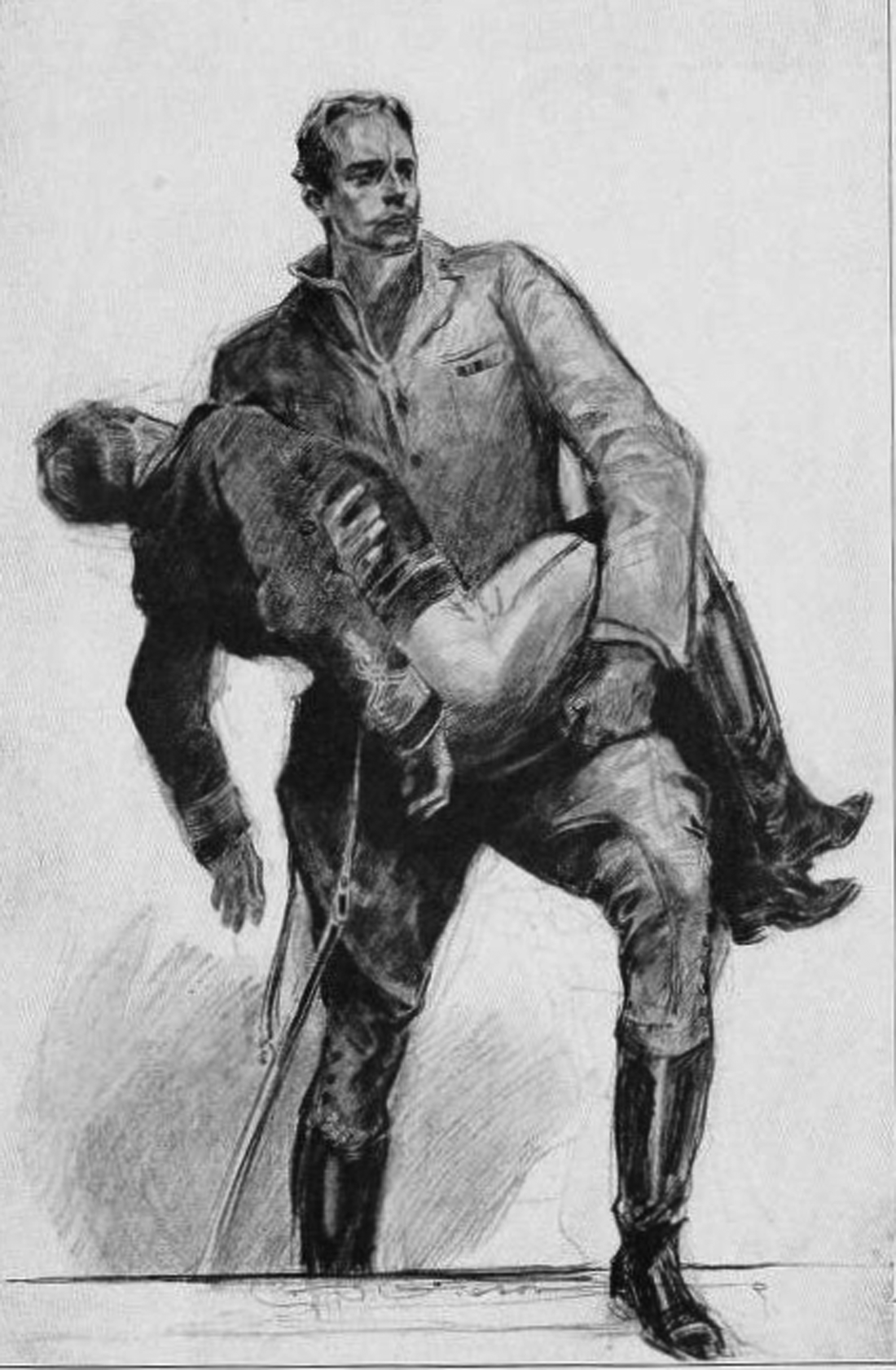
Davis's fame led to his editorship of the middle-class magazine Harper's Weekly at the astonishing age of twenty-six. In a move that solidified his reputation as the epitome of dynamic Anglo-Saxon manhood, he grew restless working in an office and abandoned it to pursue international journalism and adventure fiction. In the following years, his fame grew as a man who on one day would chronicle royal coronations from inside London high society, and on another set off to explore the borders of “barbarism and savagery” in South America. Davis's coverage of the Rough Riders in Cuba, to which he became one of only three honorary members, solidified his stature as a “fashionable fighter.”Footnote 18 Along the way he played a significant role in making Theodore Roosevelt a national hero, a favor Teddy returned when he declared Davis “as good an American as ever lived.”Footnote 19 Davis's travel-adventure fiction, such as his popular South American novel, Soldiers of Fortune, described Britain and the United States as racial brothers. Gibson's illustration from the book depicts the novel's hero, the American engineer Robert Clay, rescuing a British officer (fig. 1). Davis's exploits were enough to convince the British press he was as “fine a type” of “Anglo Saxon” manhood as “the Americans make him out to be.”Footnote 20
Soldiers of Fortune, 261.

Davis had already demonstrated pro-British views long before he arrived in South Africa to cover the Boer War. In 1896, Davis had authored one of the most influential accounts of the colonial adventurer Leander Starr Jameson's failed attempt to trigger a revolt among British “Uitlander” settlers against the Boers’ rule in the Transvaal territories. Davis blamed the conflict on the Boers’ resistance to progress. “Personally,” Davis argued, “I am convinced […] the men who were at the head of this revolution […] believed that they were acting for the best good of the country […] as did the revolutionists of 1776 in our own country.”Footnote 21
In keeping with the belief in the Anglo-Saxon's special role in history, Davis depicted the Boers as lacking in the civility, intelligence, and energy needed to lead Africa into the future. The lack of these qualities, and not the color of their skin, were the marks of their inferiority. This was consistent with the dominant view of race at the time. The historian Thomas Gugielmo observed that ethnicity rather than color was pivotal to intergroup racial distinction between peoples of European descent at the time.Footnote 22 Since at least the 1840s, older stock Anglo-Saxon Americans had grown to view the Irish, German, and Dutch as inferior white peoples.Footnote 23 In the years after the Jameson Raid the question of the Boers’ racial characteristics regularly appeared in the pages of journals. Just as Davis had done, writers identified ethnic and cultural characteristics of the Boers—“aversion to progress,” heterogeneous “mixed” race tongue, and religious “fanaticism”—as signs of their primitiveness.Footnote 24Vanity Fair characterized “Paul” Kruger, the president of the South African Republic, as backward in all of these ways, and it clarified the racial implications by insinuating that he was a man of “obscure parentage.”Footnote 25 As a speaker before the “Anglo Saxon Brotherhood” in Philadelphia concluded, although “pale skinned” the Boers were not Anglo-Saxon.Footnote 26
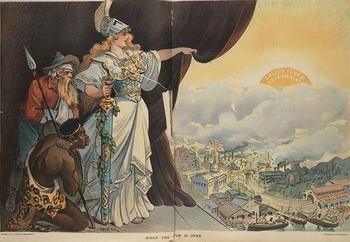
In the Social Darwinist views of the age, Boer inferiority meant that they had to be conquered if progress was to be achieved. Support for this view can be found in lectures and editorials across the country. A letter to The New York Times asserted that it was up to the “Anglo Saxon race [to] accomplish the civilization of South Africa.” Without Anglo-Saxon help, another wrote, the Boers were destined to disappear like the inferior American Indian.Footnote 27 In an illustration from Puck magazine, Lady Britannia is shown pulling back the curtain on the future filled with modern technology and commercial activity (fig. 2). The Boers’ intermediary racial and evolutionary status between black savagery and white civilization is depicted by the Boer's hunched position between the Anglo-Saxon goddess of progress and the squatting African.Footnote 28
Puck, May 30, 1900.

Davis's initial decision to cover the war from behind the British lines resulted from his view of the Boers as inferior. He was disinclined to associate with “the most rotten, cowardly lot of rebels [the Boers] I ever thought possible.”Footnote 29 Indeed, one reason Davis was drawn to South Africa was because he thought it would afford the opportunity to see a concrete demonstration of the contrast between civilization and savagery. Observing the British Army would allow him to see the greatest example of “modern military organization, equipment, and discipline” as there was in the world.Footnote 30 The British Army possessed “search-lights, heliographs, war balloons, Roentgen rays, pontoon bridges, telegraph wagons, and trenching tools, farriers with anvils, major-generals, map makers, ‘gallopers,’ intelligence departments, even biographers and press-censors.”Footnote 31 By contrast, he wrote with disdain, “the Boer Army was absolutely lacking” in any of these modern tools.Footnote 32
By the outbreak of the conflict, these views had convinced many Anglo-Americans that Britain was justified in seeking to conquer the Boers.Footnote 33 Speakers across the country declared that they must “sympathize with our Anglo-Saxon brothers” because the “advance of civilization” required it.Footnote 34 The Anglo-Saxon global imperative eclipsed pro-Boer feelings harbored by those such as Theodore Roosevelt whose family was of Dutch extraction. When he became president in 1901, he did not change McKinley's policy of neutrality. Just as it was in “the interest of civilization that the U.S. […] should be dominant in the Western Hemisphere,” he said, it was also in the best interest of the world for the “English-speaking race [to] be dominant in South Africa.”Footnote 35 Although Roosevelt preferred to talk about the English-speaking people, it was evident this referred to Anglo-Saxon assimilation of other peoples.Footnote 36 Davis shared these views. Before leaving London in 1900, he told the Harmsworth's Daily Mail that for him the U.S. “experience in the Philippines is not so very unlike yours in the Transvaal.”Footnote 37 For American Anglo-Saxons, in short, the U.S.’ special historical mission and identity were commonly aligned with that of the Anglo-Saxon race.Footnote 38
The McKinley administration's efforts to strengthen the global influence of the Anglo-Saxon people was tied to their concern with maintaining the sociopolitical dominance of Anglo-Americans and the Republican Party domestically.Footnote 39 At this time many Anglo-Americans believed their dominance was “threatened by hordes of inferiors—immigrants at home and savages abroad,” explained the historian Matthew Frye Jacobson.Footnote 40 Domestically the influx of non-Anglo foreigners who voted for the Democratic Party was seen as a grave political threat. The problem with these peoples, according to Roosevelt, was that they belonged to “races which do not assimilate readily with our own.”Footnote 41 He believed this to be the same problem the British faced with the Boers.Footnote 42 Unassimilable races were deemed a threat to Anglo-Saxonism. One letter writer to the Boston Traveler who signed the missive “Anglo-Saxon,” warned that the “decadent Irish and German races” in the United States were bound “to make one last dying effort to stem the tidal wave of Anglo-Saxonism.”Footnote 43 The Boer War was drawn into these fears. Alfred Thayer Mahan, the famed military strategist, declared that his greatest fear about the conflict was that “unsavory elements in the American population (primarily Irish, Germans, Democrats, and Populists) would take advantage of the widespread sympathy for the Boers to try to disrupt the Anglo-American understanding” necessary to preserve Anglo-Saxon dominance.Footnote 44
Pro-Boer Views and the Vulnerability of American Anglo-Saxonism
Mahan had ample reasons to be concerned. The majority of Americans opposed British efforts in South Africa, disagreed with the pro-British policies of the Republicans, and rejected Anglo-Saxon racial beliefs. In the debate, pro-Boer forces linked Republicans to the British. They then played upon anti-British sentiments, thereby appealing to farmers and industrial workers who viewed Great Britain as a symbol of economic inequality.Footnote 45 Even more significantly, pro-Boer American opposition was closely tied to resistance against racial and cultural chauvinism of Anglo-Saxons. As one letter to The Washington Post indicated, many pro-Boer Americans viewed Anglo-Saxonism as the alien presence in the United States and believed the nation would be better once people like the “Anglomanic Mahan” migrated to England.Footnote 46
The majority of Americans supported the Boers and did so for ethnic and political reasons. Historian Richard Mulanax concluded that “most contemporary observers declared that the majority of Americans supported the Boer side.” Indeed, that fact was so “patent and indisputable,” Brooks observed at the time, it was not worth discussing. To him the reasons for this support were equally clear.Footnote 47 Among the most important, the war was an opportunity for the political opponents of the Republicans. Pro-Boer tactics excited the ethnic grievances held by Catholics and Americans of Irish, German, and Dutch descent.Footnote 48The Washington Post, The New York World, The Chicago Tribune, The Baltimore Sun, and St. Louis Post-Dispatch, all mass circulation papers that favored the Democratic and Populist Parties, were sympathetic to the Boers. The immigrant press, led by Irish American papers, was more strident, vociferously denouncing what they termed the “glorifier[s] of the Anglo-Saxon race.”Footnote 49 But they were not alone. As the historian Jennifer Ann Sutton observed, although many German Americans voted for the Republican Party, the Boer War made them “potential Democratic voters not only because of Anglo-American rapprochement, but also because of domestic pressure to conform to bourgeois Anglo-cultural expectations.”Footnote 50 Indeed, many German newspapers withdrew support for McKinley because of his policy in South Africa.Footnote 51 Although Teutonic race theory had partially blended with Anglo-Saxonism in the previous decades, fault lines persisted that produced anxiety on both sides.Footnote 52 The rise of Germany and World War I would eventually expose the tension more directly.Footnote 53
Surprisingly, Davis's experience in South Africa offers us an ideal window through which to study the pro-Boer cause as well as the impact events had on Anglo-Saxons like him. Davis arrived in South Africa not only on assignment for the London Times but also for a pro-Boer paper, the New York Herald. Its owner, James Gordon Bennett Jr., hired Davis despite his Anglophilic views because the intrepid reporter was simply too famous not to employ. Fortunately for Bennett, during the course of the war Davis's views of the conflict veered in the direction favored by the Herald’s readers. In South Africa, Davis's views of the war first began to show a change in his private letters, one of many indicators he was not altering his opinion for readers. He complained that the British officers were “terribly dull souls” of “nearly all one class,” and later lamented their preoccupation with “etiquette and rank.”Footnote 54 From here his concerns grew in substance and intensity.Footnote 55
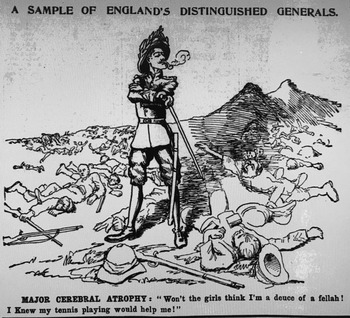
This early criticism of the British by Davis bore the hallmarks of Anglophobia: the widespread tendency since the Revolution to harbor revulsion for Britain's aristocratic social and political attitudes. Depictions of the British leaders as elitist were common in this tradition and they appeared widely in pro-Boer press. In one from The Irish World and American Industrial Liberator on February 17, 1900, a dapper British officer—“Major Cerebral Atrophy”—stands above a field of dead British soldiers and declares, “I knew my tennis playing would help me” (fig. 3). Brooks complained the war “has been a glorious time for […] our delightful old friend, the professional Anglophobiac.” The Anglophobe's reappearance “has been made too pitifully apparent that nine-tenths of the love for the Boer is made up of hatred of the English.”Footnote 56
The Irish World, February 17, 1900.

George William Curtis observed that there was nothing particularly new in the Democrats’ efforts to damage the Republican Party by associating it with the British because “party spirits have always stigmatized with the English name whatever it opposed.”Footnote 57 Rebecca Harding Davis, the journalist's mother, declared, “If you were raised in New England, it was part of your religion to hate the British.”Footnote 58 The Atlantic Monthly confirmed, “We train our children as we were trained ourselves to execrate all things British, and to think only of England's tyranny.”Footnote 59 Hints of these sentiments were evident in the letters of Cecil Davis, Richard's new wife, who accompanied him. Although both clearly enjoyed being surrounded by the British elite on the boat, she alternated between smirking Anglophobia (“I am in the painful state of being half convinced that the English have rights”) and snide Anglo-Saxonist racial sarcasm (“However I think I can escape all troubles by turning Kaffir & Red American Indians & [Filipino] & from this high moral stand no one can move Me.”).Footnote 60 Anglophobia had long served as a way for Americans to differentiate themselves and declare their equality. Even Theodore Roosevelt condemned those “noxious [pro-British] elements in the body politic” he believed resulted from feelings of inferiority.Footnote 61 In the emergent sociopolitical context, however, Anglophobia had taken on new potency. Ethnic Americans understood that many in the Republican Party shared the Anglo-Saxon racial beliefs that shaped British policy in South Africa. Within this racial system ethnic Americans knew that they, not unlike the Boers, occupied a subordinate position.
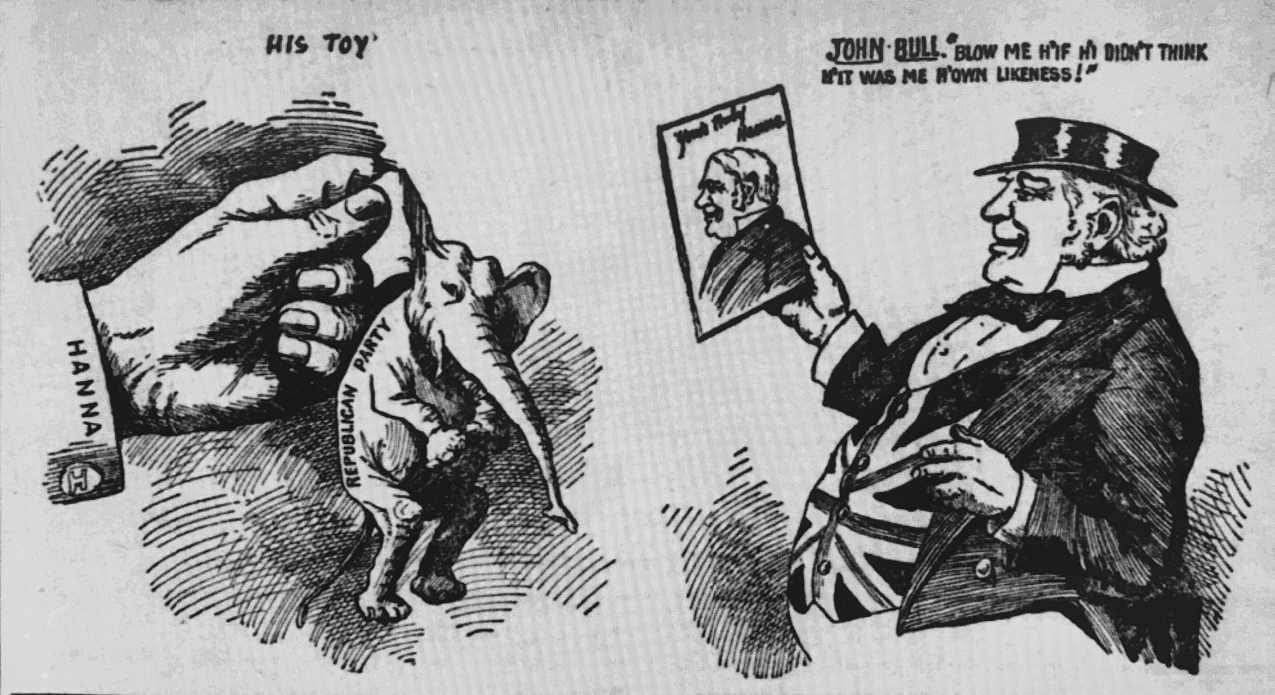
Democrats and Populists also sought to tie Republicans to British economic elitism and anti-democratic imperialism. Populists such as Nebraska Senator William V. Allen argued Britain's true interest in the Boer Republics was in gold and diamonds.Footnote 62 Grover Cleveland declared that despite what the Republicans said, it was the “fact that the British wash gold, and not the rather inconsequential fact that the Boer do not wash themselves, [that] has brought on this war.”Footnote 63 Their opponents argued the Republicans supported the British because they were similarly motivated. In his famed 1896 “Cross of Gold” speech, William Jennings Bryan had railed against the avarice of British financiers and their accomplices in the Republican Party. In 1900 he declared the Boer War as yet another example of this transatlantic Anglo-Saxon conspiracy against democracy. The goal of the “ill-concealed Republican alliance with England” was to rob the “heroic burghers” of their “liberty and independence.”Footnote 64 A March 31, 1900, cartoon in The Irish World depicted Mark Hanna, the chairman of the Republican Party, and a wealthy businessman who bankrolled and ran McKinley's campaigns in 1896 and 1900, driving senators with a whip shaped like a dollar sign into acrobatic leaps over the Constitution. Another image in The Irish World depicted John Bull expressing his satisfaction as an elephant (the symbol of the Republican Party) hangs like a dangling puppet against a tent named “McKinley's Imperial British Un-America Exhibition.” At the same time, illustrators repeatedly emphasized Hanna's physical resemblance to John Bull (fig. 4).
The Irish World, May 5, 1900.

The implication was that the Republican Party, monopoly capitalism, and Anglo-Saxonism threatened the principles and institutions of American liberty in the United States as well as South Africa. That belief fueled fears of American decline. With the guerrilla war in the Philippines dragging on, many believed the McKinley administration was lying about the progress being made. In Kentucky the newly elected Democratic governor had been assassinated by elements linked to monopoly business interests who backed his Republican opponent. In Congress the Republican majority was blocking antitrust bills, while Senator Henry Cabot Lodge was pushing efforts to limit immigration that he claimed threatened “the very fabric of the Anglo-Saxon race.”Footnote 65 It was enough to lead pro-Boer Bishop James Ryan of Illinois to bellow in fear:
The Republic is in danger. The magnificent, the triumphant struggle of the Boer [sic] is just in time to open our eyes to the danger without and the danger within and to retrieve the spirit of the former and heroic days. FREEMEN OF AMERICA, THROUGHOUT ITS LENGTH AND BREADTH, TO YOUR FEET WITH A HAIL TO THE BOER, GOD BLESS HIM, AND GOD SPEED HIM!Footnote 66
William Sulzer, a populist Democrat of New York, proclaimed Congress's failure to decry “the cruel and barbarous war” had led him to wonder: “Is the great light of the republic going out” in the United States?Footnote 67 The conclusion was clear, wrote the Minneapolis Irish Standard, the “Republican Party under the likes of the evil genius Mark Hanna” was undermining American democracy by promoting “Anglo-Saxon civilization.”Footnote 68 The Republicans recognized how political vulnerable they were to attacks, and bitterly complained about Bryan “fanning into flame whatever anti-British sentiment […] among our heterogenous population.”Footnote 69
Studying Davis, we begin to see just how Republicans and Anglo-Saxonists were personally affected by such arguments. Davis left the United States publicly declaring his confidence in the righteousness of the British cause and its fidelity to American values.Footnote 70 Soon after his arrival, however, Davis became distressed as British actions contradicted his Anglo-Saxonist expectations. Davis wrote with disappointment that the British commander Redvers Buller displayed “no romance, no chivalry, none of the heady inspiration Theodore Roosevelt had offered in Cuba.”Footnote 71 British censorship focused his frustration into anger, and a cool response to his purposed article on censorship submitted to the editors of The Anglo-Saxon Review sparked a break: “this is not my war.” Then he abruptly decided to return home.Footnote 72 In an attempt to explain his actions to his mother he wrote, “The chief reason [for leaving was] that the English irritated me and I had so little sympathy with them that I could not write with any pleasure of their work.”Footnote 73 He no longer clearly identified with “the work” of Britain's “civilizing mission.”
The fact of British Imperialism had triggered Davis's small “r” republican values closely tied to Anglophobia and accelerated his disassociation from the British. In his private letters, Davis invoked the Jeffersonian vision of the average farmer's fight against the colossal forces of tyranny. He wrote, “My sporting blood refused to boil, at the spectacle of such a monster Empire getting the worst of it from an untrained band of farmers.” Then as if it surprised him, he declared, “I found I admired the farmers—so we decided to chuck it and go to London.”Footnote 74
Davis's comments were the precursor to a dramatic change of heart. A week later, he announced plans to travel to Pretoria rather than return home. He was now interested in seeing the war from “both sides.”Footnote 75 No sooner had he arrived than Davis's dispatches began to laud the Boers’ republican simplicity and unreserved generosity. They were a “simple, kindly eyed, [and] uneducated” people.Footnote 76 Theirs was an army of “farmers, clerks, attorneys, shopkeepers” and “school-boys,” whose commanders resembled “well-to-do New Jersey farmers.”Footnote 77 Davis observed that “He [the Boer soldier] was going [to war] without any enticements or medals or rewards or pensions, […] no one had offered him the freedom of any city […] no pretty ladies poured out tea for him[.]” For Davis, the Boers had come to be, by degrees, the virtues, republican “everyman” of American lore.Footnote 78
Buried within Davis's observations was another theme closely intertwined with republican thought at the time: a distrust in modernity. Biographer John Seeley previously noted these tendencies in Davis's earlier writings.Footnote 79 In the Boer War, Davis's anti-modernism emerged in a number of ways. Praise for the British Army as “the most wonderful organization I ever imagined” and very much “like a beautiful locomotive,” for example, becomes a reason to distrust it as a soulless machine that lacks heart.Footnote 80 The Tommy, Davis wrote, was a “professional soldier who does whatever he is ordered to do,” by which he was suggesting they had become dehumanized automatons.Footnote 81
Davis pointed to the consumer impulses and greed of the British as another indicator of the corruption he associates with modernity. Once again, he used striking contrasts to deliver his point. Unlike the British soldier, Davis sarcastically observed,
no kind friends presented [the Boer] with a field-glass, nor a copy of ‘Bloc on War,’ or Baden Powell's ‘Aid to Scouting,’ nor a kodak camera, nor a bottle of meat tablets, nor a sparklet squeezer, nor a Mappin & Webb's wrist watch, nor a patent water-filter, nor a knight-cap, nor khaki pajamas [… all] the official issue [of] absolutely essential items for the front […] and sold at Piccadilly.Footnote 82
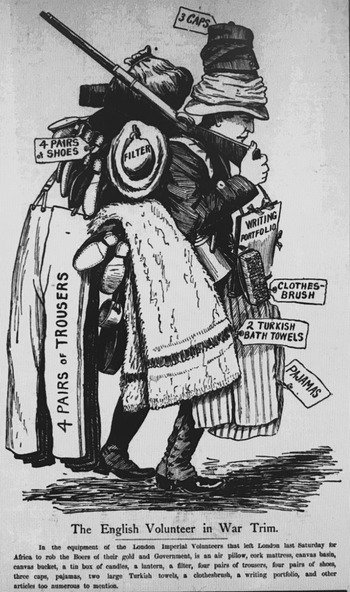
Similarly mocking observations on British consumerism appeared in the pro-Boer press.Footnote 83 One of the most illustrative can be seen in the cartoon from The Irish World that shows the British Tommy burdened with the luxuries of modernity (fig. 5).
The Irish World, January 20, 1900.

Davis returned to the theme many times, frequently equating consumerism with decadence. “There were no Boer,” Davis pointed out, “with steam yachts or [who] have built a house in Park Lane.” By contrast, Davis approvingly observed the discovery of gold in the Transvaal led Kruger—the almost folkloric personification of Afrikanerdom—to warn, “Do you know what gold is? For every ounce of that gold you will pay with tears of blood. Go to your farm and read the Book. It will tell you what gold is.”Footnote 84
Davis's comparisons of Pretoria's quiet traditionalism versus the wantonness of the Uitlander city, Johannesburg, encapsulated his efforts to frame the conflict as a fight between the traditional virtues of republican simplicity and corrupt modern life. The Boers in Pretoria aimed to “preserve […] the patriarchal idea upon which the republic was founded.” The city was “ordered in keeping with the simplicity, conservatism, and outdoor life of the Boer.” Conversely, Davis depicted Johannesburg as “a wanton city,” a modern “city where the streets were lined with gold, the city of vast intricate machinery, of vaster and more intricate speculations.”Footnote 85 “Personally,” Davis concluded of the Boer, “I know no class of men I admire as much or who to-day preserve the best and oldest ideas of charity, fairness and goodwill to men.”Footnote 86
Davis's anxiety over the potential pitfalls of modern life was not uncommon within the Anglo-American bourgeois culture. Davis was one of many prosperous Americans who suffered through bouts of nervous disorder, termed neurasthenia, that left him bedridden for weeks at a time. Scholars have argued the condition resulted from the collision between older values with the realities of modern society.Footnote 87 Davis's lifelong pursuit of the “primitive experience” exemplifies one fairly typical response to these fears. During the trip to South Africa, he expressed a longing to see the “real Africa not the shoddy colonial shopkeeper's paradise” of Cape Town and Johannesburg.Footnote 88 The Boers, while not primitive, were also not tainted by the “shoddiness” of modernity. The Irish American politician William Bourke Cockran, a Democrat who had nonetheless helped McKinley win in 1896 and counted British Anglo-Saxon royalty such as the Churchills among his friends, broke with both over the Boers. “If the Boers were untutored in civilization's virtues,” he told an audience, “they were untutored also in its vices.”Footnote 89
Davis's aim to escape the artificiality of modernity was also a rejection of his own social milieu. Scholars have shown that anti-modernist sensibilities were frequently linked with personal dissatisfaction. The emotionally distorted manner in which Davis spoke of the British and the Boers suggests that he did indeed experience the war in highly self-referential fashion. Along these lines, given his own role as a transatlantic icon of fashion, his mockery of British officers’ consumerism is curious. Davis had a well-earned reputation as a priggish fop and delighted in describing the luxuries with which he surrounded himself.Footnote 90 At the same time, he continuously sought refuge from what he perceived to be the emasculating inauthenticity of such a lifestyle by seeking out intense experience. Davis's behavior exemplifies what T. J. Jackson Lears described as an anti-modernist impulse: a tendency to celebrate an imagined past and seek primitive truths, both triggered by a psychological reflex to the disorientating instabilities of the modern world.
According to Lears, these concerns stimulated the celebration of Saxon martial skills and the support of the British Empire. The fear of decay was held at bay among Anglo-Saxon elites by a belief in martial revitalization and the continued health of the race's chivalric impulse. For anti-modernists such as John Fiske, Lears explained, “the latent survival of Saxon force and vigor offered a cause for hopefulness even in a flabby commercial age.” Similarly, anti-modernists turned to the “Puritan” and “country” strain of republican thought that “exalted the freeholding warrior-citizen as a redeemer of modern comfort and complacency.”Footnote 91
It was for this reason, however, that the events in South Africa proved so troubling for those like Davis and explains why British reverses left him, among others, prone to the arguments made by Boer supporters. Anglo-Saxon hopes in the race's martial vitality and chivalry was deeply wounded in South Africa.Footnote 92 Davis and others expected a “quick campaign” and were shocked when that did not happen. The key architect of U.S. foreign affairs in the McKinley administration, Secretary of State John Hay, was exasperated by British reverses. He complained of how the turn of events strengthened the pro-Boer. “It is wholly illogical […] that the less the Boer need sympathy the more they get.”Footnote 93 The surprising turn of events left Roosevelt “absorbed in interest in the Boer War” because, he told Hay, the “lack of fighting edge in British soldiers” made him fear that the British Empire was in decay.Footnote 94 If true, Hay responded, it would be a “portentous fact.”Footnote 95 Indeed, by 1901 Roosevelt “confessed” to Cecil Spring Rice, “I am totally puzzled by the duration of the war.” “The South African situation,” he admitted, has revealed “unpleasant signs of exhaustion” in the race.Footnote 96 These were the sort of fears that led the New York Mail and Express to warn that Anglo-Saxonism was “on trial to a greater degree” than it had ever been in the past.Footnote 97 For his part Roosevelt told Rice, “I do not wonder that you sometimes feel depressed over the future both of our race and our civilization.”Footnote 98
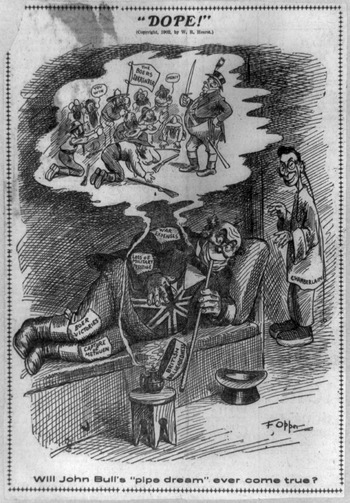
Pro-Boer imagery certainly enflamed concerns over Anglo-Saxon manhood. The previous illustrations depicting British officers as effeminate fops and soldiers as consumerist drones provide two examples. Another was an image from the New York Journal (fig. 6). In this cartoon, the artist presented Britain in both a racially ambiguous and an emasculating fashion. Dressed in clothing torn by military defeats, spiraling costs, and declining prestige, John Bull's hopes for victory in South Africa have become nothing more than a drug-induced pipe dream. Driving the point home, Joseph Chamberlain, the influential British Anglo-Saxon chauvinist, was caricatured as the unmanly third-sex Chinese serving up the “dope.”Footnote 99
The New York Journal, ca. 1902, Courtesy of Library of Congress Prints and Photographs Division Washington, DC.

Davis's disappointment with the chivalric masculinity and physical energy of the British parallels these attacks. Britain's barbaric policy of concentrating Boer women and children into camps was “contrary to the usages of civilized war,” and another affront to his expectations for manhood. Once again, his response was to dissociate. Someday we will “wake up to the fact that the Englishman, in spite of his universal reputation to the contrary, is not a good sportsman because he is a poor loser.”Footnote 100
The fact that the British could now be seen as losers produced yet another problem by jeopardizing the assumed link between the Anglo-Saxon-led progress of civilization and U.S. exceptionalism. If one accepted that the British and Americans were Anglo-Saxon brothers, Britain's shortcomings and defeats raised vexing questions about America's unique importance. At the same time for those who supported the Boers, the conflict also threatened to undermine U.S. destinarianism. To them, the pro-British policy of the McKinley administration jeopardized the nation's claim to be a beacon of liberty. If, as Assistant Secretary of the Interior Webster Davis declared, the British had “become as dangerous to mankind in our time as the political tyranny of the old Eastern world and the religious tyranny of the middle ages,” then was it also true that Americans, the Anglo-Saxon brothers and political allies of the British, were also a danger to progress?Footnote 101 If the Boers were “prompted by as lofty a patriotism, by as ardent a desire for freedom, as inspired our forefathers,” asked one senator, how can we do nothing without harming our republican virtues?Footnote 102 The fact the United States was not helping the Boers explains Ryan's desperate capitalized declaration: the “REPUBLIC IS IN DANGER.” If the United States did not turn away from Britain, “the manly Boer must fight the battle of liberty alone, and we must look to him, not he to us, for the lesson of freedom.”Footnote 103
These examples illustrate that Americans on both sides were disturbed by the potential parallels between the United States and the British Empire raised by the conflict. Yet the problem for pro-Boer advocates was far less acute; the Boers and those in the United States who supported them, it could be concluded, were the true heirs of the American Revolution. Those who supported the British could by contrast be cast as unmanly and un-American. In his book John Bull's Crimes, Webster Davis told readers the Boer “have the same spirit that prompted the farmers to face death for liberty at Lexington Green, [and that] nerved the arms of Americans at Saratoga, Bunker Hill and Brandywine, that warmed the hearts of Washington and his shivering patriots at Valley Forge[.]”Footnote 104 Senator Mason began his call for the United States to support the Boers by asserting, “The war between monarchy and republicanism began in earnest July 4, 1776, and no treaty of peace has ever been concluded, nor ever will be, until this question is settled right.”Footnote 105 For his part, Davis quickly adopted this way of framing events and help spread it in his publications. Boer motives, Davis wrote, “are as fine as any that called ‘A Minute Man’ from his farm.”Footnote 106
Davis's changed views on the war had, at the very least, an impact on public opinion of him. When he left for South Africa, Davis was ridiculed and hissed at pro-Boer rallies for his comments on the war and dismissal of the Irish vote. Having a “head [that] has grown faster than his brains,” this “intellectual giant,” said one speaker in Boston to great applause, was a typical “little yellow dog” Anglomaniac who adopted the British lion's skin. “If he takes the time away from his looking glass” long enough to carefully “know more” of what is happening abroad and at home, “he will keep his mouth shut, and his long, handsome, Anglo-Saxon ear open.” In sum Davis was dumb, inauthentic, and effeminate. By the time of his return, however, The Irish World now declared him an exponent of true Americanism. Davis returned “with the best reputation” of anyone covering the war, said another paper, because although he had gone “out to South Africa [an] Anglophile,” once there he had formed his own judgment and returned with a distinctly American perspective. Supporters defended him in similar fashion in papers as far flung as the Cedar Rapids, Iowa's The Gazette.Footnote 107 His former friends were far less pleased. He lost club memberships in Britain; disparaging comments about him were printed in the London Times and The Anglo-Saxon Review; and then repeated in places like Norfolk, Chicago, Brooklyn, and San Francisco. He was labeled “a renegade” by his fellow Anglo-Saxons, Davis explained, and although he was “sorry that my English friends have taken such an aversion to me,” all he had done was to report the truth.Footnote 108
Reimagining Racial Supremacy: From Anglo-Saxonism to Whiteness
The intensity of feeling on all sides can be explained by the fact that the war served as a proxy for contentious domestic battles. None of these fights were more important than the way the war had the capacity to revise the racial schema that legitimated access to social, economic, and political power in the nation. The greatest impact of the conflict in the United States was the way it helped recode the terms that defined racial supremacy. The Boer War encouraged the evolution of whiteness among both pro-Boer and pro-British Americans. Early on, support for the Boers became a means to unite ethnic non-Anglo-Saxon whites in their fight to be included within the ranks of the racially superior. An emphasis on whiteness resulted. Just as importantly the republican, anti-modernist, and exceptionalist arguments destabilized Anglo-Saxonism among those who identified as such, opening the way to their acceptance of whiteness.
Opposition to Anglo-Saxonism in the United States evolved in the decades before the Boer War. In 1890, John C. Fleming had taken aim at Anglo-Saxonism in his North American Review article “Are We Anglo Saxons?” The owner and editor of the Shawnee, Ohio People's Advocate, Fleming opposed the equation of Americanism with Anglo-Saxonism. Fleming, a Populist Party delegate at the time, argued Anglo-Saxonism was an aristocratic British racial idea that “some here in America [by which he meant Anglo-American Republicans] had received with enthusiasm” because it elevated their status while diminishing that of other white peoples. What were the others of European descent to do, asked Fleming? Was “the Irishman, for instance” expected to “tacitly admit the Anglo Saxon to be something like a proprietor of these United States and representative of a race aristocracy?” The fact was “Europe, not England, is the mother of America,” he proclaimed. Rather than using Anglo-Saxonism to divide white Americans, Fleming argued, we:
should all be content with our Caucasian origins and American citizenship, and we should be proud to see even in this generation a type developing itself which is destined to pass into the future as essentially American, as different from Celtic as from Latin, as different from Anglo-Saxon as from either—a type which while still new will so spread and assert itself as to render impossible a Cossack or Chinese destruction of the world's civilization.Footnote 109
Ten years later, in 1900, this fight over the terms of racial supremacy took center stage in the Boer War. It was understood by all that British victory in South Africa would strengthen Anglo-Saxonism and its narrow understanding of racial supremacy. If that happens, wrote a contributor to St. Louis Post-Dispatch, the Transvaal will “never be a white man's country.” Instead it will become a land of the “boss and the nigger,” with the Boers subservient to the Anglo-Saxons. An Anglo-Saxon victory in South Africa, wrote the author, means the difficulties faced by “the ordinary white man increases instead of diminishes.”Footnote 110 In a letter to the editor of the Weekly Iberian in Louisiana, a Eugene Guillot complained of the Anglo-Saxonist views he saw being printed about the Boer War. The United States, he said, was not an Anglo-Saxon but a white nation and should oppose any war “against a civilized nation of the Caucasian race.”Footnote 111 The emphasis upon “Caucasianism” or whiteness served to counter the narrow understanding of racial privilege suggested by the term Anglo-Saxon.Footnote 112 Because of the implications at home of the South African conflict, there was a “considerable body of American citizens” of every “ethnic category” and “creed” who were ready, said another at the time, to oppose those in the United States who were willing to support England's “attempt to abolish the white republics” of South Africa.Footnote 113
A letter written by Mark Van Costerhout, editor of the Orange City, Iowa, Vrije Hollander, highlights the stakes with which the war was invested by many and the significance of racial whiteness. “It is not so much a war” over land, he said, as it is a conflict over the right of the Anglo-Saxons to rule everywhere, but most especially in the United States.
No, it is a struggle for the mastery between the Anglo-Saxon race and […] the Dutch. […] the Celtic, the Teutonic, the Latin, the Slav races, they all feel it, they all rejoice at a Dutch victory as if it were their own. And here in America where of late a certain party began to talk as if we too were Anglo-Saxon […] we see the dividing line as clear as in some streams of Switzerland where the milk white flow and a blackish stream come together but do not mix their waters. […] Germans, Celt, Slav, Dutch, they all unite […] “Hurrah for the Boers,” and this means down with Anglo Saxon. …[T]he Anglo-Saxons in their insolent, overbearing way try to stamp out […] the hopes, aspirations of other races and nationalities. We, the men of other nationalities ought to stand together […] We are satisfied to lay aside our national prejudices, we are willing to blend, to amalgamate, to become a new, a great “American nation,” but we will not allow you [the Anglo Saxon] to treat us as Helots[.]Footnote 114
Here, as in a good deal of the pro-Boer press, Van Costerhout evoked the discourse of ethnicity but only to subordinate it via an assertion of amalgamated whiteness to an emphasis upon color as the true defining feature of racial supremacy. It was not right to treat other pale skinned people as inferiors and slaves as the Spartans did the Helots. These examples support the claims by some historians that whiteness at this time was utilized to counter discrimination against non-Anglo European immigrants. Boer supporters continually redefined racial supremacy by shifting away from an emphasis upon ethnicity to color and thereby fortifying the claim of non-Anglo-European immigrants to full U.S. citizenship. In the process, as numerous sources reveal, they were also redefining Americanness as a multiethnic whiteness.Footnote 115
One place newspaper reports on the war advanced whiteness was in the extensive coverage of the roughly three hundred, mostly ethnic, American volunteers fighting for the Boers. Chief among the reporters who focused on them were J. B. Clarke of Pittsburgh Courier, Howard Hillegas of New York World, George Parson of Collier's Weekly, and Allan Luther Sangree of New York Sun and Cosmopolitan.Footnote 116 No volunteers gained greater notice than the “Irish-Boer Hospital Corps” from Chicago, shown in The Irish World February 24, 1900 image, marching down New York's Fifth Avenue to the cheers of thousands on their way to the pier.
Again, Davis's dispatches offered a good illustration of the wider phenomenon. On his train ride to the front, Davis encountered the “sixty wild Irish boys from ‘across the tracks’ of Chicago” who had “come ten thousand miles to help him fight for his liberty.” They had made their way past custom agents by declaring their intention to provide medical care. But as the train traveled further away from authorities, the men began to swagger “along the platform at each new stopping-place, in costumes which became by hourly additions more and more warlike.” Laughing, they complained that their Red Cross badges were “stopping the circulation of the fighting-blood in their Irish veins.” By the time of their arrival at the front, bandoliers had entirely replaced their bandages.Footnote 117
Davis's vivid description of the scene at the Jones Hotel in Ventersburg the night before a battle reveals his willingness to confer onto these ethnic-American men qualities he previously only associated with Anglo-Saxons. In the hours before dawn, the American Scouts, as they were known, enjoyed the free drinks offered them by the Cincinnati-born proprietor and his wife, whom Davis described in his private letters as “a grand low comedy character from Brooklyn […] sitting up in bed in curl papers, and with a Webley revolver.”Footnote 118 In an example of how Davis was seeking to elevate the volunteers’ heroic stature, his public dispatches cut such humorous asides and maintained a melodramatic tone. He focused on spurs and not curlers. The sound of the scouts’ jangling boots filled the hotel as they played pool and drank with men “from every capital of Europe.” Davis admiringly observed, these men had come “to try and save the independence of a free people.” That evening they “drank to the health of every nation, save one.” With each toast, “it was as though a jury composed of men from all of Europe and the United States had gathered in judgment on the British nation.” These were heroic white men condemning the Anglo-Saxon.Footnote 119
Other Americans journalists lauded the volunteers for placing the public interest ahead of their own, stoically confronting the prospect of death, displaying a democratic disregard for class, and refusing to exchange liberty for life. These men were American heroes who had come to South Africa to aid an independent people in the fight against the tyrannical forces of monopoly capitalism, military intimidation, cultural elitism, and ethnocentrism. Confronted by such heroism, Anglo-American journals grudgingly lauded both the Volunteers and Boers.Footnote 120 In effect, coverage of the ethnic-American fighters proclaimed the right of all white men to American liberty not just the Anglo-Saxon.
Another way in which to see the central importance of racial whiteness within the debate over the Boer War can be demonstrated by those people left out of the discussion. Despite the fact that Filipino Katipunan, Chinese Boxers, and Cuban Mambises were fighting for liberty as the same time, they were rarely mentioned. In a similar fashion, the native African were absent in much of the coverage of the war. Davis, like the rest of the press, almost totally ignored despite the extensive role they played in the conflict. The absence of these peoples in the debate communicates the central relationship of color to freedom in the American racial imaginary.Footnote 121
For both Fleming's and Van Costerhout's whiteness depends upon the exclusion of non-white peoples: an imagined Other whose darkness alone marked them as inferior. They were endorsing a simplified biracial topology of supremacy over the more complex ethnic-based system of racial hierarchy. The shift towards color was part of a broader trend. Although Southern elites had embraced Anglo-Saxonism after the Civil War, the reaction to the rise of the Populist movement eventually encouraged broadening the definition of whiteness. In the decade after Fleming's dismissal of Anglo-Saxonism. the color line hardened with the spread of both Negrophobia, Jim Crow laws, and segregationist policy.Footnote 122 A 1901 newspaper article in the Detroit Free Press captured the essence of the matter. The author was baffled by hearing at a Baptist convention that there was “a glorious future for the Anglo-Saxon negro.” While it has become acceptable in recent years, he wrote, to talk of an Anglo-Saxon Irishman, German, or Dutchman, as if they were all one people, “the Anglo-Saxon negro is too much. He is the limit.”Footnote 123
The impact of the Boer War in helping to revitalize a color-based dualist racial schema in the United States is further suggested by the way white supremacists embraced the Boer. Numerous states offered free land to Boer willing to immigrate. It was argued that the Boers were “accustomed to dealing with inferior races” and therefore will be able to “readily adapt themselves to the conditions prevailing in this country.”Footnote 124 The one-time Smithsonian naturalist William Harvey Brown argued in his book On the South African Frontier that the Boers provided a good example that Americans should follow. “Oom Paul [‘Uncle’ Paul Kruger] and his followers know what is due the nigger and we are risking much in allowing the black man to think that he is equal to the white.”Footnote 125 For Boer supporters, Anglo-Saxon Britain's “negrophilistic” policies threatened the one true boundary: the color line.Footnote 126
From a different angle, the widespread African American support for the British further confirms the racial dimension of the war's domestic significance. According to Sylvia Jacobs, in the majority of black papers, “the British stood for equal justice for all, while the Boer represented oppression.”Footnote 127 In 1900 the African Methodist Episcopal Church concluded that the Boers “entertain the belief that the color of a man's skin” determines access to the rights of citizenship.Footnote 128 To support them, and to denying the right to vote for “the colored men of Puerto Rico, of Cuba and of the Philippines,” wrote a contributor to The Colored American, is to assert unequivocally “that self-government is the right of only the white race.” To be dark skinned means to “be declared unfit for self-government.”Footnote 129 These, and the many more examples that could be used, demonstrate that the Boer War focused public attention on the connection of whiteness, racial supremacy, and the rights to American citizenship.
As I have argued here, however, one of the most important ways the conflict impacted U.S. racial politics was the way it strained Anglo-Saxonism among its adherents. Soon after the war began, Roosevelt had been forced to admit that the Boers possessed “at bottom the same qualities that the English and Scotch, Scandinavians, Netherlanders, and Germans all have.”Footnote 130 “The eighteen months’ warfare,” Roosevelt conceded in 1901, “has given many people a strong feeling that the Boers must possess altogether exceptional qualities.”Footnote 131 The line between the Anglo-Saxon and other ethnic whites had become blurred. Henry Cabot Lodge had been similarly affected in the early stages of the conflict. Searching to explain the turn of events, he shifted from the rhetoric of Anglo-Saxonism to whiteness. British defeats, he said, could be explained as a demonstration that the British had “forgotten what it was like to fight white men.”Footnote 132 Poultney Bigelow had come to view the English and Dutch as two people “who have practically the same blood in their veins.”Footnote 133 Roosevelt's views continued to evolve. In April of 1901, he confessed to his son, “When the war broke out […] I believed […] that civilization demanded the triumph of the English. But I confess that what has gone on has shaken my conviction a good deal.” To another he wrote, “the Anglomania” of a few years ago is dead because of “England's failure in South Africa[.]”Footnote 134
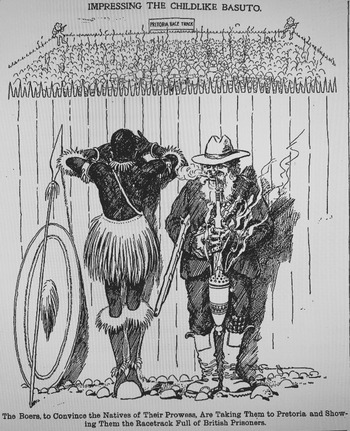
Although the narrow understanding of Anglo-Saxonism was weakened, Roosevelt and others had already begun to refashion their faith in the argument of racial supremacy by emphasizing the language of amalgamation over assimilation. He now “earnestly hoped [the] process of amalgamation” would restore the situation in South Africa.Footnote 135 By 1902 his concerns from a decade earlier about the Boers’ racial fitness had been dispelled. The Boers, he said, would “become part of an English-speaking, homogeneous population of mixed origins, [and] a very valuable addition to the English-speaking stock throughout the world.”Footnote 136 The historian Paul Kramer argued that the Spanish-American War and Filipino Insurrection encouraged a decline in Anglo-Saxonism.Footnote 137 The Boer War had a similar effect, because it encouraged Anglo-Saxonists to decouple the capacity for racial supremacy from ethnicity and reassign it to a homogenized whiteness, a conclusion visually suggested in the Chicago Daily Tribune illustration “Impressing the Childlike Basuto” (fig. 7).Footnote 138
Chicago Daily Tribune, January 2, 1900.

But how was this transition to an emphasis upon amalgamated whiteness over Anglo-Saxonism rationally negotiated? As we have seen in the war debate, perceived similarities between the United States and South Africa played an important role in fostering the imaginative links Americans made between themselves and the Boers. Perhaps none was more important than the shared “frontier” heritage because it facilitated the shift from an ethnic to color-centered paradigm of racial supremacy. Throughout the conflict pro-Boer advocates used Western imagery to draw positive comparisons between the Boers and Americans. According to Davis, the Boers’ trek-wagons “were much like the great hooded carts which the empire makers of our West drove across the prairie.”Footnote 139 Elsewhere he said the frontier had forged the Boers into “a thousand self-governing, self-respecting farmers” who now were “fighting for the land they have redeemed from the lion and the savage, [and] for the towns and cities they have reared in a beautiful wilderness.”Footnote 140 Boers's bivouacs reminded Webster Davis “very much of the manner in which the pioneers of our own western states camped when they crossed the plains and had to protect themselves from the roving bands of wild savages.”Footnote 141 These comparisons were also infused with racial implications. In 1893, Frederick Jackson Turner had influentially declared that it was in “the crucible of the frontier the immigrants were Americanized, liberated, and fused into a mixed race, English in neither nationality nor characteristics.”Footnote 142
This link between the West and race provided a critically important means by which American Anglo-Saxons could rationalize the events of the war and recuperate their faith in notions of racial supremacy more broadly. If the Boers were like American frontier settlers and cowboys, their victories against the British were not a refutation of Anglo-Saxon racial superiority but an affirmation of a distinctively superior American racial type. That result would reaffirm both the logic of race and American exceptionalism. In January of 1900, the U.S. Army Inspector-General J. C. Breckinridge Sr. told the Indianapolis News that the problem the British were having in South Africa was simple: the British had once again foolishly “undertaken the subjugation of a body of God-fearing frontiersman” who were “as fearless as any white man living.” As a result, Britain was undergoing “the same experience it did with our ancestors.”Footnote 143 Roosevelt believed that events could be explained by the fact the Boers were “actual settlers” rather than educated urbanites, and as a result worth three of the Anglo-Saxon Tommy.Footnote 144 These statements suggest that by the war's end, a whiteness forged in the crucible of the frontier, and not Anglo-Saxonism, had become the racial focus of Roosevelt, Webster, Lodge, and Breckinridge.
Davis confirmed upon his return that he believed the corpse of Anglo-Saxon exceptionalism was one of the causalities littering the South Africa veld. The war, he said, had cost Great Britain “her former place as a military power, her position as a religious nation [and] right to speak again in the name of Christianity[.]” “The reality of Anglo-Saxon Englishman is not what we have learned in the past to expect from our English cousins.” It was in the space opened up by such thoughts that “whiteness” gained strength as an alternative “higher law of racial superiority.”Footnote 145 Britain had lost its “cherished [Anglo-Saxon] alliance with the U.S.,” Davis concluded.Footnote 146 With that, the movement to imagine the United States as the center of its own global empire advanced another step.Footnote 147
Conclusion: Davis and the Popular Culture of Whiteness
This study reveals the Boer War debate encouraged the rise of whiteness while undercutting Anglo-Saxonism in the American imaginary. The Boer War contributed to this shift because a sizable portion of Americans, those on the pro-Boer side of the debate, sought to advance a view of white racial unity that advantaged them. The contradictions between Anglo-Saxonism and Americanism also drove pro-British supporters to endorse whiteness as an alternative explanation of racial supremacy. These conclusions support the observation made by some historians of race that the importance of ethno-racial distinctions between Americans of Northern European gave way to an amalgamated notion of racial whiteness in the early twentieth century. Anglo-Saxonist thinking certainly persisted as did the concern with ethnicity. Indeed these events set the stage from which William Z. Ripley's 1899 tripartite division of the Caucasoid would evolve into Madison Grant's 1916 classification of the “Alpine” and “Mediterranean” white peoples of Central and Southern Europe as inferior to the “Nordic” Northern European. In the years surrounding World War I, Grant's ideas provided an intellectual framework for a racial politics featuring eugenics, a revived Klan, and immigration restrictions in which older Northern Europeans formed a broad alliance against the “New Immigrants.”Footnote 148
Once again, Davis's example illustrates how the Boer War continued to influence this shift in the American racial imaginary. In 1902, shortly after his return to the United States, Davis gave expression to this emerging equation of Americanness with an inclusive whiteness of Northern Europeans in the last of his adventure novels, Captain Macklin. The hero, Royal Macklin, was the son of an Irishman who had come to America in search of opportunity and died fighting for the Confederacy. Thirty years later the younger Macklin was tossed out of West Point for a minor infraction and rejected as an acceptable suitor by the Anglo-Saxon father of his beloved Beatrice. He traveled to Honduras and there helped the deposed President General Garcia reclaim his post. Disaster threatened when Garcia betrayed his foreign fighters and Beatrice was taken captive and threatened with rape. Macklin led an attack that liberated the country and Beatrice. Victory erased her father's objections to their marriage.
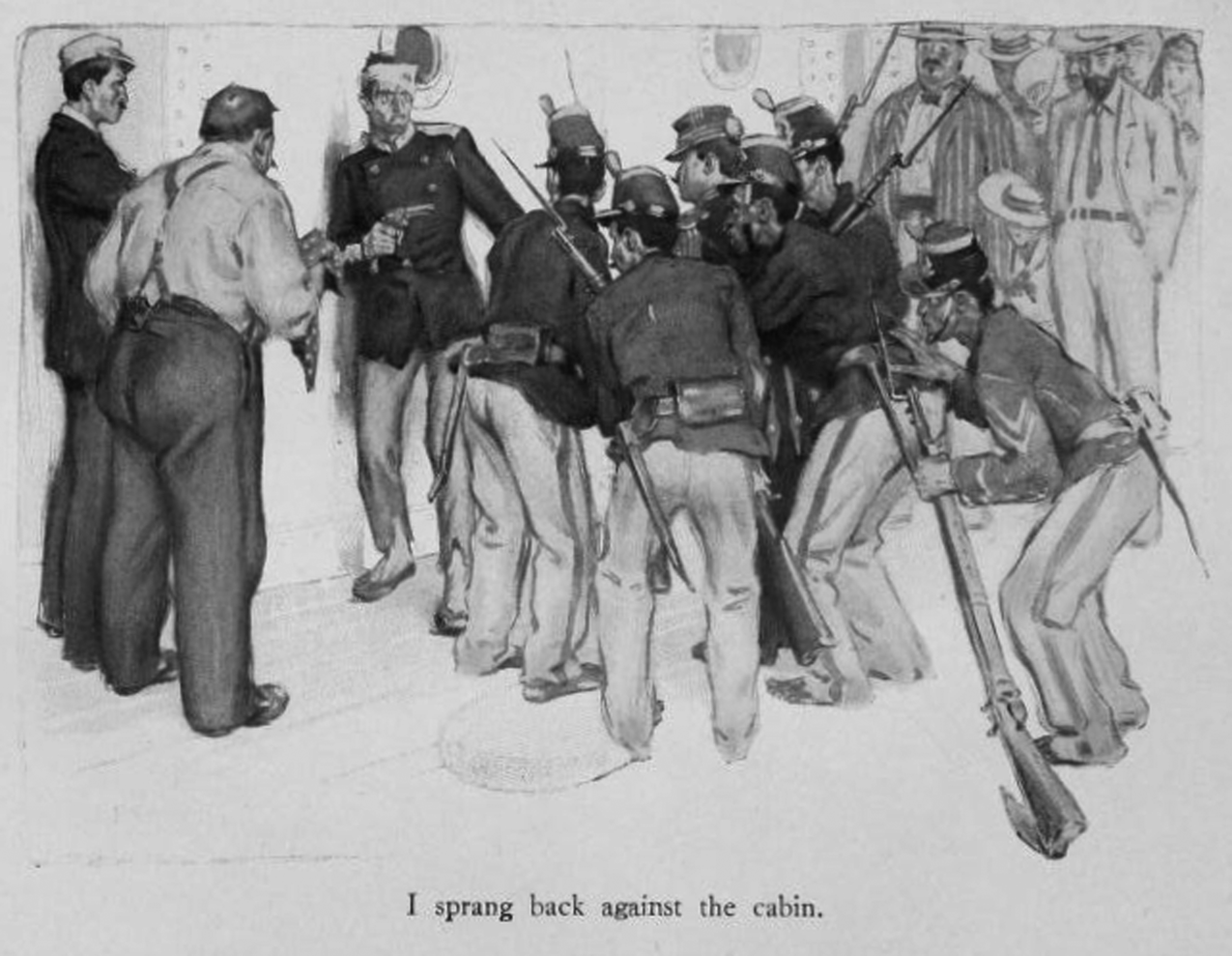
Davis brought the subtextual themes of overcoming white ethnic divisions and class conflict within the United States into full view in the final pages. Despite all Macklin had done for them, “[w]ithin a week the natives had turned from us to the painted idols of their jungle.” Cornered as he sought to escape aboard an American liner, the American Captain of the ship prepared to turn him over to native authorities. In disbelief, Macklin berates him: “Do you mean to tell me […] that you refuse to protect me from these half-breeds [….] And you call yourself an American? […] Protect your owner, protect yourself […] You're no American. You're no white man. No American would let a conch-nigger run his ship” (fig. 8).Footnote 149 Realizing he was talking to Macklin, the captain tossed the “half-breeds” overboard and gave the Irish hero his cabin and passage back to America: a nation of superior white people. As used by Davis, the racial term “breed” referred not to ethnicity but to color alone. To be Irish was to be white and analogous to Anglo-Saxon. By contrast, the “half-breeds” were the result of crossing a more absolute color line, not an ethnic one. That same year, the British journalist W. T. Stead, who had broken with the establishment by defending the Boers, published The Americanization of the World: The Trend of the Twentieth Century in which he called for the unity of “every white-skinned person.” America, he declared, was “fusing the various nationalities into one homogeneous [white racial] whole[.]”Footnote 150 As David Blight has shown, the belief in white racial unification contributed to a decline in the sociopolitical tensions that had troubled the turn of the century, even as it intensified the color line.Footnote 151 Indeed, the history detailed here reveals how the Boer War provides an example of the way in which white supremacy persisted, as David R. Roediger suggests, by working through and not just against the forces of freedom.Footnote 152
Captain Macklin, 295.

Over the next decade the herrenvolk white racial nationalism apparent in Davis's Captain Macklin and in leading racial thinkers like Stead became increasingly important in the United States.Footnote 153 In 1915, Captain Macklin became a hit movie directed by D. W. Griffith and starring Lillian Gish as Macklin's Beatrice. The treacherous Garcia, whose lascivious designs on Beatrice were given greater emphasis, was played by Abenaki Native American actor Elijah Tahamont.Footnote 154 D. W. Griffith had brought Elijah to Hollywood where he performed under his stage name “Dark Cloud.”Footnote 155 Of course, Griffith was the director of that other 1915 film, Birth of a Nation. In both films the threat to the purity of whiteness, symbolized in each by an interracial rape of Lillian Gish, served to unite light-skinned peoples in defense of the one true color line: the one that prevents, as the Saturday Evening Post advertisement for the film Captain Macklin put it, whites from becoming “half breeds.”Footnote 156