Introduction
The global population is ageing, especially in the most developed regions in the world, where lower birth rates and increases in life expectancy have made ageing the most prominent demographic phenomenon of the twenty-first century and a key priority for governmental policy making. In Spain, for example, half the population will be at least 50 years of age by 2050 (Bloom and Canning Reference Bloom and Canning2006; United Nations 2013). In response, many studies, based on reports issued by international organisations (e.g. European Commission 2006; Organisation for Economic Co-operation and Development (OECD) 2005), emphasise the costs and economic impacts of ageing from a macro-economic perspective (Berlemann, Oestmann and Thum Reference Berlemann, Oestmann and Thum2014; Means and Evans Reference Means and Evans2012). The resulting reformulation of government policies – mainly related to health and retirement – in developed regions (Bloom, Canning and Fink Reference Bloom, Canning and Fink2010; Moffat et al. Reference Moffat, Higgs, Rummery and Jones2012) and their associated costs also have pushed governments to explore new ways to enhance their citizens' quality of life and help seniors ‘age well’ by engaging them in varied activities (Means and Evans Reference Means and Evans2012), including leisure and tourism.
According to Dolnicar, Yanamandram and Cliff (Reference Dolnicar, Yanamandram and Cliff2012), travel leads to personal satisfaction, and Gibson (Reference Gibson2006) indicates a positive link between enjoyment of leisure and satisfaction later in life. Activity theory (Havighurst Reference Havighurst, Williams, Tibbitts and Donahue1963) also asserts that extending the activities and social interactions of seniors for as long as possible is essential to their welfare (Nimrod and Rotem Reference Nimrod and Rotem2012). The social interactions and personal development that result from travel may contribute to improving people's health, quality of life and wellbeing (Dolnicar, Yanamandram and Cliff Reference Dolnicar, Yanamandram and Cliff2012; McCabe, Joldersma and Li Reference McCabe, Joldersma and Li2010; Uysal, Perdue and Sirgy Reference Uysal, Perdue and Sirgy2012), especially among seniors (Dann Reference Dann2002; Nimrod and Rotem Reference Nimrod and Rotem2012). Tourism thus can benefit both the general economy and the welfare of individual travellers (Higgins-Desbiolles Reference Higgins-Desbiolles2006).
Tourism by seniors also is substantial, such that people older than 60 years will likely have made more than 2 billion international trips by 2050 (United Nations World Tourism Organization (UNWTO) 2010), far more than the 593 million trips made in the early 2000s (Patterson Reference Patterson2006). This sector thus stands to benefit greatly from global ageing trends. In the most developed regions, where ageing is prominent and tourism already has been established as important for their citizens to ‘age well’ (Means and Evans Reference Means and Evans2012), the growing senior tourism sector may come to represent a growth engine (Chen, Liu and Chang Reference Chen, Liu and Chang2013; OECD 2014; Schröder and Widmann Reference Schröder, Widmann, Conrady and Buck2007) and a deeply attractive market. This status is radically different from traditional views in the tourism industry, which perceived the senior market as relatively unattractive (González et al. Reference González, Rodríguez, Miranda and Cervantes2009; Gunter Reference Gunter1998; Metz and Underwood Reference Metz and Underwood2005; Moschis Reference Moschis1992; Szmigin and Carrigan Reference Szmigin and Carrigan2001; Walker Reference Walker2004). As a result of these views, social policies often promoted senior travel, usually through so-called social tourism programmes (Álvarez Reference Álvarez1994; Dann Reference Dann2001; McCabe and Johnson Reference McCabe and Johnson2013; Minnaert, Maitland and Miller Reference Minnaert, Maitland and Miller2009).
In Spain, the supply of social tourism for seniors has existed for more than 25 years, as part of the active ageing policies carried out by the Spanish government through IMSERSO (Institute for Senior Citizens and Social Services). The programmes help supply organised trips (full board, transport) to seniors with modest incomes; simultaneously, they help address industry seasonality, provide job creation and represent an increasingly relevant source of revenue for the state (Waterhouse et al. Reference Waterhouse, Aeca and Anet1997). The success of its social tourism programmes also led the Spanish government to undertake an international initiative in 2008, namely the European Senior Tourism programme (within the framework of the Calypso project). It aims to facilitate access to tourism among the most disadvantaged strata of the population, including seniors, pensioners, youth, people with disabilities, and families facing social or financial difficulties. Yet as populations age, they tend to become more heterogeneous in their educational levels, purchasing power and health conditions (Gilleard and Higgs Reference Gilleard and Higgs2002; Wallace Reference Wallace2000). Seniors retiring today thus seem to show less interest in social tourism programmes than previous generations (Chen and Shoemaker Reference Chen and Shoemaker2014), and new approaches are required to characterise and appeal to this heterogeneous segment (Le Serre and Chevalier Reference Le Serre and Chevalier2012).
Most explanations of seniors' consumption behaviours rely on individual chronological age and employment status. However, several authors (Barak and Schiffman Reference Barak, Schiffman and Monroe1981; Bone Reference Bone1991; Chen Reference Chen2009; Gunter Reference Gunter1998, Iyer, Reisenwitz and Eastman Reference Iyer, Reisenwitz and Eastman2008; Norman et al. Reference Norman, Daniels, Mcguire and Norman2001; Oates, Shufeldt and Vaught Reference Oates, Shufeldt and Vaught1996; Stroud Reference Stroud2008; Tréguer and Segati Reference Tréguer and Segati2005; Walker Reference Walker2004) question this approach. Seniors' lifestyles and buying behaviour depend on how they adapt to changes in their income, time availability and health at the different stages of their lives (Anken, Chaipoopirutana and Combs Reference Anken, Chaipoopirutana and Combs2008; Grande Reference Grande1993). Therefore, lifecycle theory might offer a better alternative for explaining their behaviour. Cooper et al. (Reference Cooper, Fletcher, Fyall, Gilbert and Wanhill2007), Bojanic (Reference Bojanic1992) and Lawson (Reference Lawson1991) also claim that the consumption of leisure and tourism relates directly to disposable income, which depends on, among other things, an individual's life stage. A person's lifecycle stage – determined by her or his age, employment status, living situation, and so forth – produces different behavioural patterns (Collins and Tisdell Reference Collins and Tisdell2002a , Reference Collins and Tisdell2002b ; Cooper et al. Reference Cooper, Fletcher, Fyall, Gilbert and Wanhill2007; Oppermann Reference Oppermann1995). Significant changes in lifecycles tend to occur between the ages of 50 and 60 years, because people often retire, see their children leave their homes, lose their spouse and become grandparents (Moschis Reference Moschis1992; Silvers Reference Silvers1997). Furthermore, modern people, who live longer, also are exposed to more social changes (e.g. divorce, stepfamilies, greater access to education), such that their lifecourse becomes less linear. Thus, we investigate senior tourist needs on the basis of lifecycle theory, rather than a simple age-based or employment status segmentation (UNWTO 2010).
Nimrod and Rotem (Reference Nimrod and Rotem2012) and Shoemaker (Reference Shoemaker2000) assert that Atchley's (Reference Atchley1989) continuity theory can better explain travel tendencies among seniors. The basic premise of this theory is that adults maintain the same activities, behaviours and social relations into the last stages of their lives (Agahi, Ahacic and Parker Reference Agahi, Ahacic and Parker2006). Cuenca (Reference Cuenca1995) notes that adults' leisure practices, whether they have retired or are prior to retirement, do not differ substantially. The consumption patterns of seniors are often very similar throughout this period of their lives (Lohmann and Danielsson Reference Lohmann and Danielsson2001; Schröder and Widmann Reference Schröder, Widmann, Conrady and Buck2007), and factors such as retirement rarely affect them (Lohmann and Danielsson Reference Lohmann and Danielsson2001; Nimrod and Rotem Reference Nimrod and Rotem2012). Therefore, in accordance with continuity theory, the travel patterns of seniors might be predicted on the basis of their past experiences.
However, lifecycle theory and continuity theory cannot capture the changing patterns of tourist behaviour that reflect distinct generational cohorts (March Reference March2000; Oppermann Reference Oppermann1995). As generational theory suggests, the era in which people are born affects their behavioural development, which is a particularly relevant variable for senior tourism research (Chen Reference Chen2009; Chen and Shoemaker Reference Chen and Shoemaker2014; Huh Reference Huh2006; Jang and Ham Reference Jang and Ham2009; Sakai, Brown and Mak Reference Sakai, Brown and Mak2000; You and O'Leary Reference You and O'Leary2000). Consumer habits result from individual experiences over a lifetime and form in adulthood; individuals who experience similar events then exhibit similar consumption patterns as adults (Glover and Prideaux Reference Glover and Prideaux2009; Holbrook and Schindler Reference Holbrook and Schindler1996; Leventhal Reference Leventhal1997; Lohmann and Danielsson Reference Lohmann and Danielsson2001; Moschis Reference Moschis1996; Schröder and Widmann Reference Schröder, Widmann, Conrady and Buck2007), which tend to persist for roughly two decades (Lohmann and Danielsson Reference Lohmann and Danielsson2001).
Accordingly, this study combines lifecycle theory with generational theory to understand the tourism behaviour of Spanish seniors. That is, we propose that this segment's tendency and motivation to travel reflect variables that represent their lifecycles and that give rise to differences across generational cohorts. In so doing, we make two main contributions. First, we identify whether variables related to different stages of the lifecycle explain actual differences across different cohorts and if socio-cultural features determine senior travel trends. Second, we seek to determine if two dimensions of motivation – as determined by the stage of the lifecycle and generational cohort membership – are related. With this approach, we advance existing tourism literature. That is, prior research has highlighted the relevance of ageing and cohort effects on tourists' participation, but our study addresses senior travel behaviour from a theoretical perspective, through the explicit application of lifecycle theory and generational theory. As Wang (Reference Wang2005) notes, insufficient studies have addressed senior travel behaviours from a theoretical point of view.
Literature review
Tourism participation
By analysing seniors' participation in travel over their lifecycle, we can identify the effects of socio-demographic characteristics on tourism demand with a theoretical framework. In turn, we can determine if changes in travel behaviour are due to the ageing process, the particular cohort being analysed or the personal circumstances of a person's life (Bernini and Cracolici Reference Bernini and Cracolici2015).
In prior tourism studies, changes in travel behaviour over a lifetime generally have been explained by the ageing process or stages in the family lifecycle. That is, age conditions the different stages of tourism participation patterns. Cooper et al. (Reference Cooper, Fletcher, Fyall, Gilbert and Wanhill2007) argue that both the propensity to travel and the type of tourist experience relate closely to the traveller's age. They refer to the internal or ‘domestic’ age of a person to reflect the lifecycle stage he or she has attained, rather than chronological age, because the former approach distinguishes better among the types of tourism demand and propensities to travel. Zimmer, Brayley and Searle (Reference Zimmer, Brayley and Searle1995) identify self-perceived age and health as the greatest barriers to senior travel, whereas Wu (Reference Wu2003) cites self-perceived age and economic status. Multiple authors (Lohmann and Danielsson Reference Lohmann and Danielsson2001; Oppermann Reference Oppermann1995; Schröder and Widmann Reference Schröder, Widmann, Conrady and Buck2007; Zimmer, Brayley and Searle Reference Zimmer, Brayley and Searle1995) find non-linear relationships between age and consumption trends, such that the tendency to travel tends to increase after the age of 50 years, remains virtually constant until the age of 75 years and then starts to decline, mainly due to health considerations.
Several authors cite links between key barriers to senior travel – health, economic status, disposable income – and variables related to the person's stage in the lifecycle (e.g. age, employment status, structure, household size, income level). McGuire (Reference McGuire1984) indicates that people who do not travel because they lack the time often have more income; those who do not travel for health reasons usually are older. However, Faranda and Schmidt (Reference Faranda and Schmidt1999) argue that having free time does not determine the tendency to travel; instead, a lack of time in association with a lack of money, poor health, physical/emotional costs or a lack of companionship may be the major barriers (Nyaupane, McCabe and Andereck Reference Nyaupane, McCabe and Andereck2008). They also detect that economic and time barriers facing older senior citizens influence younger seniors, though the former are more concerned about health when travelling than the latter are. Blazey (Reference Blazey1992) argues that people who are still active in the labour market are more influenced by economic barriers and time, whereas retirees confront more health limitations. Thus Blazey considers a lack of security, income and available time as substantial barriers. According to Huang and Tsai (Reference Huang and Tsai2003), seniors living with a partner or children are more limited by economic barriers. Wang (Reference Wang2005) states that as senior income increases, so does self-perceived health status, and Romsa and Blenman (Reference Romsa and Blenman1989), Fleischer and Pizam (Reference Fleischer and Pizam2002) and Jang and Wu (Reference Jang and Wu2006) believe that self-perceived health and economic status are the greatest impediments to senior travel. Finally, Chen (Reference Chen2009) identifies health problems and a lack of time and companionship as the major barriers. Therefore, we deduce that the main barriers to senior travel are health, economic status and perceptions of available time. Yet Nyaupane, McCabe and Andereck (Reference Nyaupane, McCabe and Andereck2008) note that these factors evolve differently throughout a person's lifecycle and are not homogeneous.
Generally, empirical literature explores tourism consumption behaviour without explicitly invoking lifecycle models. It cites demographic characteristics that influence participation in travel, including income or education, which they use to identify the generation gap between recent seniors and those of older generations. Some authors (González et al. Reference González, Rodríguez, Miranda and Cervantes2009; Hudson Reference Hudson2010) accordingly assert that modern seniors differ markedly from stereotypes of senior tourists, suggesting notable differences between co-existing senior generational cohorts. Little empirical support for this theory appears in prior tourism research though. A few studies (e.g. Chen and Shoemaker Reference Chen and Shoemaker2014; Lehto et al. Reference Lehto, Jang, Achana and O'Leary2008) identify significant differences between Baby Boomers (born between 1946 and 1964) and the Silent Generation (born from the mid-1920s to the early 1940s) in their tourism experiences. With a case study, Pennington-Gray, Fridgen and Stynes (Reference Pennington-Gray, Fridgen and Stynes2003) demonstrate the validity of cohorts for predicting senior tourism. Specifically, Baby Boomers are more educated and experienced with travel, whereas the Silent Generation has less education and little or no travel experience (Kuo and Lu Reference Kuo and Lu2013; Patterson Reference Patterson2006; Plog Reference Plog and Theobald2005).
Pendergast (Reference Pendergast, Benckendorff, Moscardo and Pendergast2010) argues for combining such theories under the umbrella term ‘generational theories’. It is important to distinguish among them when applying them to senior tourism though. That is, generational theory emphasises differences across generational cohorts, with the assumption that senior tourists in the same generation exhibit coherence or consistency in their travel characteristics and behavioural patterns. Lifecycle theory instead addresses what happens to each individual as she or he moves inexorably up the age ladder. Continuity theory then attempts to explain how people adapt to ageing. Together, these theories offer a three-dimensional lens through which we might gain a fuller view of the senior travel market (Chen and Shoemaker Reference Chen and Shoemaker2014).
Seniors' travel motivation
Research into travel and tourism often focuses on motivation (Alén, Domínguez and Fraiz Reference Alén, Domínguez and Fraiz2010). According to Wu (Reference Wu2003), among the various motivation theories, the most widely used in a travel context refers to the ‘push’ and ‘pull’ factors. For example, Fodness (Reference Fodness1994), adapting Katz's (Reference Katz1960) functional theory of attitudes to tourism, developed a scale to measure tourism motivation according to five dimensions: knowledge function, utilitarian function (minimise punishment), social-adjustive function, value-expressive function and utilitarian function (maximise rewards). This model in turn relates to the push and pull factors that motivate senior travel. That is, Crompton (Reference Crompton1979) establishes a connection of push factors and the desire/need to travel, as well as a link between pull factors and destination choices. Other authors identify relationships between the motivation dimensions (Baloglu and Uysal Reference Baloglu and Uysal1996; Kim and Lee Reference Kim and Lee2002; Klenosky Reference Klenosky2002; McIntosh and Thyne Reference McIntosh and Thyne2005; Oh, Uysal and Weaver Reference Oh, Uysal and Weaver1995; Pyo, Mihalik and Uysal Reference Pyo, Mihalik and Uysal1989; Uysal and Jurowski Reference Uysal and Jurowski1994), though these relationships have not been confirmed among senior tourists.
The main push factors for senior travellers appear somewhat consistent in prior research, including visits to family or friends, seeking novelty, knowledge seeking and escaping from daily routines (You and O'Leary Reference You and O'Leary1999); escape, education, relaxation, family and action (Norman et al. Reference Norman, Daniels, Mcguire and Norman2001); getting to know new places and other people's ways of life (Wu Reference Wu2003); rest, relaxation, socialisation and spending time with family (Huang and Tsai Reference Huang and Tsai2003); improving self-esteem, pursuit of knowledge, relaxation and socialisation (Jang and Wu Reference Jang and Wu2006); novelty, pursuit of knowledge, rest and relaxation (Sangpikul Reference Sangpikul2008); and seeing new things and spending time with family (Chen Reference Chen2009). Most research focuses on seniors travelling on vacation, though they also travel to visit friends and family, for their health or for work (Bai et al. Reference Bai, Smith, Cai, O'Leary and Chon1999; Blazey Reference Blazey1992; Chen, Liu and Chang Reference Chen, Liu and Chang2013; Collins and Tisdell Reference Collins and Tisdell2002a , Reference Collins and Tisdell2002b ; Hossain, Bailey and Lubulwa Reference Hossain, Bailey and Lubulwa2003; Lee and Tideswell Reference Lee and Tideswell2005). In turn, the main pull factors in prior literature include good public transport, hygiene and cleanliness, security, climate and cultural activities (You and O'Leary Reference You and O'Leary1999); natural, cultural or historical attractions, and climate (Norman et al. Reference Norman, Daniels, Mcguire and Norman2001); cleanliness, safety, travel costs, and cultural and natural attractions (Wu Reference Wu2003); places of historical or artistic interest, health care and climate (Huang and Tsai Reference Huang and Tsai2003); cleanliness, safety, events, and cultural and natural attractions (Jang and Wu Reference Jang and Wu2006); cultural and historical attractions, and the availability of commercial areas (Sangpikul Reference Sangpikul2008); and workplace safety, hygiene and cleanliness (Chen Reference Chen2009).
Furthermore, travel motivations evolve as people move through the different stages of their lives (Collins and Tisdell Reference Collins and Tisdell2002a , Reference Collins and Tisdell2002b ; Cooper et al. Reference Cooper, Fletcher, Fyall, Gilbert and Wanhill2007). It also varies as a function of socio-cultural variables (Blazey Reference Blazey1992; Huang and Tsai Reference Huang and Tsai2003; Sangpikul Reference Sangpikul2008), which implies the potential for differences across generational cohorts. Collins and Tisdell (Reference Collins and Tisdell2002a , Reference Collins and Tisdell2002b ) and Blazey (Reference Blazey1992) assert that younger seniors, who are still active in the labour market, travel more for work purposes than do those who have retired; the retirees travel more to visit family or friends than do those who are still employed. Huang and Tsai (Reference Huang and Tsai2003) suggest that retired people are attracted to places that offer appealing landscapes, events, and facilities for travel and shopping; older women, retired seniors and seniors living with their partners also are more attracted to the quality of the services provided at the destination. Jang and Wu (Reference Jang and Wu2006) find that the healthiest seniors assign more importance to destination attributes. According to Norman et al. (Reference Norman, Daniels, Mcguire and Norman2001), younger seniors care more about the climate, events and attractions at the destination than older seniors do. Furthermore, Sangpikul (Reference Sangpikul2008) establishes that educated seniors value destinations of historical interest and natural landscapes with a variety of events and attractions, easy transport, safety, quality services at reasonable prices, commercial areas and a good climate.
Thus, four main travel types emerge: holiday, visiting friends or relatives, health and work (Backer Reference Backer2012; Blazey Reference Blazey1992; Connell Reference Connell2006; Javalgi, Thomas and Rao Reference Javalgi, Thomas and Rao1992; Lee Reference Lee2005; Paci Reference Paci1994; Pearce and Moscardo Reference Pearce, Moscardo, Buhalis and Costa2006; Saiprasert Reference Saiprasert2011; UNWTO 2010; Wu Reference Wu2010; Yun Reference Yun2009). Holiday trips outnumber the rest, but Fleischer and Seiler (Reference Fleischer and Seiler2002) still identify important trends in senior travel for other purposes.
Finally, we note that Dann (Reference Dann1981) uses reason and motivation as interchangeable terms to refer to the purpose for travelling, and Fodness (Reference Fodness1994) calls for a behavioural approach to segmenting senior travel markets, to identify the links between push factors (purpose of the trip) and pull factors, given the absence of studies for this group. Both factors are deeply rooted in consumer behaviour research and have been used widely in tourism studies to gain greater understanding of tourists' motivation. We designed this study to identify patterns or changes in the motivations of senior travellers, using variables that reflect different stages of the lifecycle and differences among cohorts.
Methodology
Sampling methods and data collection
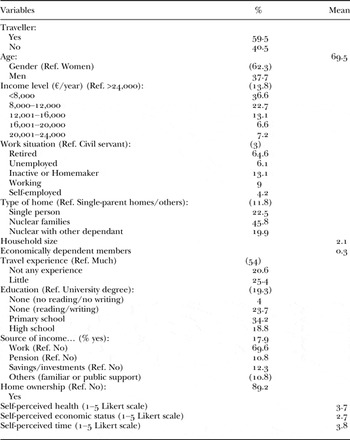
To achieve our study goals, we conducted an empirical analysis of data collected through a telephone survey. Through these contacts, potential respondents were invited to participate in a purely academic study, with their anonymity guaranteed. The questionnaire consisted of two parts. The first involved socio-demographic variables, referring to the lifecycle stage (i.e. age, gender, employment status, income, family structure and size, health, time, self-perceived economic status; all measured on five-point Likert scales), as well as the respondent's socio-cultural level (i.e. travel experience, occupation, education level, purchasing power, source of income, home ownership). The sources for these questions included studies by Blazey (Reference Blazey1992), Chen and Wu (Reference Chen and Wu2009), Fleischer and Pizam (Reference Fleischer and Pizam2002), Huh (Reference Huh2006), Jang and Ham (Reference Jang and Ham2009), McGuire (Reference McGuire1984), Nyaupane, McCabe and Andereck (Reference Nyaupane, McCabe and Andereck2008), Romsa and Blenman (Reference Romsa and Blenman1989), Schröder and Widmann (Reference Schröder, Widmann, Conrady and Buck2007), Wu (Reference Wu2003) and Zimmer, Brayley and Searle (Reference Zimmer, Brayley and Searle1995).
The second part featured issues related to the push and pull motivation dimensions. That is, measures of the purposes for travel included holidays, visiting family or friends, health and work. For the measure of the influence of destination attributes, we used a four-point scale, ranging from ‘Not at all important’ to ‘Very important’, and listed items pertaining to hygiene and cleanliness, safety, climate, total cost, events and attractions, ease of transport, shopping areas, medical coverage, historical/artistic sites, natural sites/landscapes and distance. These measures came from studies by Bai et al. (Reference Bai, Smith, Cai, O'Leary and Chon1999), Blazey (Reference Blazey1992), Hossain, Bailey and Lubulwa (Reference Hossain, Bailey and Lubulwa2003), Huang and Tsai (Reference Huang and Tsai2003), Jang and Wu (Reference Jang and Wu2006), Lee and Tideswell (Reference Lee and Tideswell2005), Norman et al. (Reference Norman, Daniels, Mcguire and Norman2001), Sangpikul (Reference Sangpikul2008) and Wu (Reference Wu2003). We summarise the questionnaire items in Tables 1 and 2.
Descriptive statistics of the sample

Note: Ref.: reference category.
Exploratory factor analysis of the destination attributes/‘pull’ factors

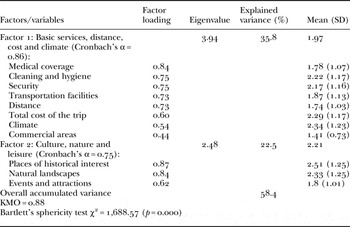
Note: SD: standard deviation.
To find Spanish residents over 55 years of age to interview over the telephone, we used the Infobel database v11, which includes the addresses and telephone numbers for about 11 million individuals and businesses in Spain. The random selection we used was limited to individual contacts. The cut-off age reflected the average age used in previous studies of seniors and their tourism behaviours. As Cooper et al. (Reference Cooper, Fletcher, Fyall, Gilbert and Wanhill2007) and Prideaux, Wei and Ruys (Reference Prideaux, Wei and Ruys2001) argue, the Baby Boomer generation (in Spain, those around 55 years of age in the mid-2010s) also has prompted profound changes in the tourism market.
We chose a two-stage probability sample to obtain the data needed to identify market segments. In the first stage, the target population was divided into sub-populations, or clusters, depending on their geographic area of residence (i.e. by province). We calculated the total number of travellers relative to the number of adults older than 55 years in each province and the total number of travellers over this age in each autonomous community. Thus, we could calculate the sample size by province, proportional to the number of travellers. We obtained 602 valid questionnaires, for an overall response rate of 24.7 per cent and a co-operation rate of 53.4 per cent. Those who did not respond were mainly seniors with health-related problems, little disposable income and little travel experience, in line Shoemaker's (Reference Shoemaker1989, Reference Shoemaker2000) findings. To test for potential bias between those who responded to the questionnaire and those who did not, we compared the respondents' overall profile against the profile of Spanish senior travellers prepared by Instituto de Estudios Turísticos (2010). The comparative review yielded similar results for both groups, so non-response does not appear to be a substantial concern.
Data analysis techniques
We conducted a binary logistic regression and one-factor analysis of variance (ANOVA). With the binary logistic regression, we predict the presence or absence of a characteristic or outcome based on the values of a set of predictor variables when the dependent variable is dichotomous and the independent variables are continuous or categorical. With this statistical technique, the probability that the dependent variable occurs when the independent variable increases by one unit can be calculated as: (eB − 1) × 100 (Cea Reference Cea2002).
We used the Nagelkerke R 2 instead of the Cox and Snell R 2 to estimate the fit of the multinomial logistic regression model, because the former covers the range from 0 to 1, whereas the theoretical maximum value may be less than 1 in the latter (Cea Reference Cea2002).
Results
Sample characteristics
As we show in Table 1, of the 602 surveys we collected, almost 60 per cent (N = 358) came from respondents who had made at least one overnight trip in the previous year. The average age of respondents was 69.5 years, and most of them were women (62.3%). Their income level was relatively low, such that annual incomes less than €8,000 represented 36.6 per cent of the sample, and €8,000–12,000 accounted for 22.7 per cent. In addition, 64.6 per cent of the respondents were retired. In terms of the type of household, two-member and nuclear households (45.8%) stood out over the rest. However, most respondents were self-sufficient, with an average of 0.3 dependants.
More than half of the respondents claimed travel experience (54%), and most had some form of education, mainly primary (34.2%). Furthermore, in line with the employment status information, most of their incomes came from pensions (69.6%). The proportion of respondents who indicated they had savings or investments beyond their main source of income was 10.8 per cent. In addition, 89.2 per cent stated that they owned their main residence. Finally, among the self-rated factors, health and self-perceived time availability earned the highest average scores, of 3.7 and 3.8, respectively, whereas disposable income, at 2.7 on average, did not reach a sufficient threshold.
Regarding their motivation for their latest trip, leisure travel accounted for 70.7 per cent of the trips, visits to relatives and/or friends prompted 21.8 per cent, travel for health reasons represented 3.9 per cent and trips for work accounted for 3.6 per cent. The attributes of the destination most valued by seniors included the existence of historic/architectural places of interest (2.51), parks/natural landscapes (2.33) and the climate (2.34). The least valued were the availability of events and attractions (1.8), medical coverage (1.78), distance (1.74) and the availability of commercial areas (1.41), as we show in Table 2.
Binary logistic regression
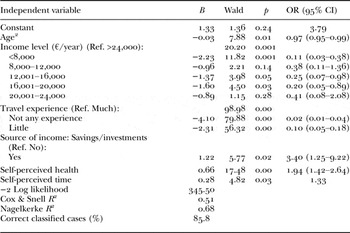
In Table 3, the variables acting as predictors in the binary logistic regression model explained 68 per cent of the variation in the tendency to travel among seniors over 55 years of age in Spain (Nagelkerke R 2 = 0.68), and they correctly classify 85.8 per cent of the cases. The most significant variables in the model were: age2 (p = 0.01); annual income less than €8,000 (p = 0.001), €12,001–16,000 (p = 0.05) or €16,001–20,000 (p = 0.03); no (p = 0.00) or little (p = 0.00) travel experience; income from savings/investments (p = 0.02); self-perceived health (p = 0.00), and self-perceived time availability (p = 0.03).
Binary logistic regression (forward stepwise method, Wald)

Notes: OR: odds ratio. CI: confidence interval.
At a specific age, the probability of travelling decreases exponentially as the person grows older, representing a 3.2 per cent decrease for the first year (odds ratio (OR) = 0.97). To obtain this result, we used the quadratic term of age, or age2. For income, the negative sign in the significant categories indicated that respondents with lower annual incomes (<€8,000, 89.3%, OR = 0.11; €12,001–16,000, 74.6%, OR = 0.25; €16,001–20,000, 79.7%, OR = 0.20) were less likely to travel than those with incomes over €24,000 per year. Nearly all the travellers (98.3%, OR = 0.02) noted that they had little or no travel experience, and 90.1 per cent (OR = 0.10) were less likely to travel than those who had extensive travel experience. In contrast, consumers with greater purchasing power (determined by house ownership and source of income) and savings or investments were 239.8 per cent more likely to travel than those without this type of income. A one-unit increase in self-perceived health increased the probability of travelling by 93.7 per cent (OR = 1.94). Similarly, the probability of travelling increased by 32.7 per cent (OR = 1.33) when self-perceived time increased by one unit.
Therefore, senior travel trends depend on lifecycle variables, as well as those related to the person's socio-cultural level, and these factors create differences across distinct generational cohorts.
Exploratory factor analysis (pull factors)
We reduced the variables connected to the destination attributes (pull factors), because these correlated variables could share some unobservable latent structure (Cea Reference Cea2002). Then, using Varimax rotation, we conducted an exploratory factor analysis.
The results of this factor analysis in Table 2 show that two factors explained 58.4 per cent of the variance. The first (Factor 1: basic services, distance, cost and climate) consisted of eight variables: medical coverage, hygiene and cleanliness, safety, ease of transport, distance, total cost of the trip, weather and commercial areas. It explained most of the variance, at 35.8 per cent. The second factor (Factor 2: culture, nature and leisure) encompassed the remaining three variables, namely places of historical interest, attractions/events, and natural landscapes and attractions, and it explained 22.5 per cent of variance. The consistency of the scale was good for both factors (Cronbach's alpha = 0.86 and 0.75, respectively).
One-factor ANOVA
We performed an ANOVA to determine if any relationship existed between the push (main motivation for the trip) and pull (destination attributes) factors. We thus included the main motivation for the trip as the independent variable and Factors 1 (basic services, distance, cost, weather) and 2 (culture, nature and leisure) as dependent variables, one in each ANOVA.
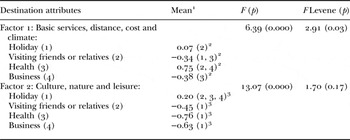
Table 4 outlines the significant differences between the two factor averages with respect to the purpose for travel. That is, we found a relationship of dependency between the purpose of a trip (push factors) and the destination attributes (pull factors). The average importance assigned to the attributes of Factor 1 (basic services, distance, cost and climate) differed, according to the purpose of trip. For example, it was greater for health-care travel (0.75) than for other types, in descending order: vacations (0.07), visiting family or friends (−0.34) and work (−0.38). Regarding the attributes in Factor 2 (culture, nature and leisure), our study respondents assigned them greater importance for their holiday trips (0.20), followed by travel to visit family or friends (−0.45), work (−0.63) and health (−0.76).
One-factor analysis of variance

Notes: 1. Note that the factors are scaled. 2. The numbers in parentheses identify statistically significant groups (p ⩽ 0.05) according to the post hoc Games–Howell test. 3. The numbers in parentheses identify the statistically significant groups (p ⩽ 0.05) according to Tukey's honestly significant difference (HSD) post-hoc test.
The variable averages exhibited significant differences. In a prior test of the homogeneity of these variances, we identified these differences and thereby conducted appropriate post hoc tests. The Levene test for Factor 1 revealed that the variances were not homogeneous (p = 0.03). We applied the Games–Howell test for different variances and found significant differences between vacation travel and travelling to visit friends or family; between visiting family or friends and health; and between health and work. Factor 2 instead had homogeneous variances (p = 0.17), so we applied the Tukey's honestly significant difference (HSD) post-hoc test for equal variances. It revealed significant differences between leisure travel and visiting friends/family, vacation trips and trips for reasons of health, and trips for vacation or work.
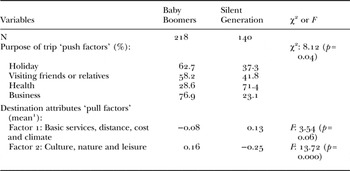
Finally, we tested the effect of generational cohort membership on the two motivation dimensions. First, using a chi-square test (χ2), we analysed the effects of generational cohort membership on the main purpose of the trip, or the push factor. Second, using a two-way ANOVA (F), we determined the effects of cohorts on the destination attributes, or pull factors.
The results in Table 5 confirm a dependence relationship between the generational cohort membership of Spanish seniors and the two motivation dimensions. With regard to the main purpose of the trip, we found significant differences (p = 0.04) between generational cohort membership and the push factors, mainly in travel for reasons of health versus work. Travel for health reasons was significantly higher among the Silent Generation (71.4%) than among Baby Boomers (28.6%); travelling for work was significantly more prominent for the Baby Boomers (76.9%) than for the Silent Generation (23.1%). With regard to the destination attributes, only Factor 2 was significant (p = 0.000). The Baby Boomers, with an average of 0.16, were more attracted to places with the pull factors of cultural, natural and recreational attractions than was the Silent Generation, with an average of −0.25.
Chi square and analysis of variance

Note: 1. Note that the factors are scaled.
These findings signal the existence of a relationship between push factors (main motivation for the trip) and the pull factors (attributes of the destination). They thus have notable implications for both research and practice.
Discussion and conclusion
As the population has grown older, on-going studies and reports have focused on the implications of this demographic change. Most studies emphasise the social costs associated with old age, from the perspective of providing public services, such as health care and pensions. Governments in developed regions focus on minimising these costs by encouraging citizens to engage in leisure and tourism activities that benefit their quality of life. Yet ageing populations also are very heterogeneous, which affects their patterns of behaviour. This study addresses senior travel behaviour, particularly the tendency and motivations to travel, from a foundation in lifecycle and generational theories. The findings not only provide support for these theories but also reflect their effects on the travel behaviour of today's Spanish seniors.
In particular, our results suggest that tourism participation decreases exponentially as a person ages, in line with findings by Lohmann and Danielsson (Reference Lohmann and Danielsson2001) or Schröder and Widmann (Reference Schröder, Widmann, Conrady and Buck2007). Similar to Chen (Reference Chen2009), we identify self-perceived health and time availability as primary barriers to seniors' travel. Still, recent research by Hillman (Reference Hillman2013) indicates that older Australians continue to travel, even as their health starts to deteriorate. As it becomes apparent that they may not have a lot of time left to live, older people become acutely aware that any trip might be one of their last experiences (Wilcock Reference Wilcock2007). Furthermore, people with high incomes and savings/investments are more likely to travel, though this trend changes across their lifecycle stages. In accordance with continuity theory, people with little or no travel experience are less likely to travel than those with extensive travel experience, consistent with studies that suggest the travel patterns of seniors can be predicted on the basis of their past behaviours (e.g. Nimrod and Rotem Reference Nimrod and Rotem2012).
In addition, in our effort to test the effect of generational cohort membership on the two dimensions of senior motivation, we find significant interactive effects between generation and motivation, suggesting the need for segmentation in the senior leisure market (Chen and Shoemaker Reference Chen and Shoemaker2014). People who travel for health reasons are attracted to destinations with better basic services, distance, cost and weather; those who travel for vacation are most attracted to aspects connected to culture, nature and leisure. Furthermore, we find significant differences between Baby Boomers and the Silent Generation in terms of both the main purpose of the trip (push) and the attributes of the destination (pull) (Chen and Shoemaker Reference Chen and Shoemaker2014; Lehto et al. Reference Lehto, Jang, Achana and O'Leary2008).
Practical implications
To uncover the main implications of senior participation in travel, we must account for income elasticity in tourism demand and the tendency to travel. Most Spanish pensioners suffer reduced purchasing power, mainly because their pensions are inadequate for current living conditions and have not been revised in accordance with the Consumer Price Index. This external condition may trigger a drop in this group's demand for travel, especially among pensioners with the most modest incomes who find themselves unable to cope with existing expenses. Scherger, Nazroo and Higgs (Reference Scherger, Nazroo and Higgs2011) caution that significant inequalities may arise among seniors. Because income has a strong effect on the propensity to travel, travel supported by the public sector in Spain (IMSERSO) offers a way to offset this group's loss of purchasing power. According to Waterhouse et al. (Reference Waterhouse, Aeca and Anet1997), the state not only recovers its initial investments in these programmes but even earns profits from them.
The lack of relationship between employment status and travel frequency corroborates arguments by Nimrod and Rotem (Reference Nimrod and Rotem2012) and Shoemaker (Reference Shoemaker2000). Retired Spanish seniors continue to participate in tourism as they did when they were active in the labour market, which suggests support for Atchley's (Reference Atchley1989) widely studied continuity theory for gerontology.
In terms of motivation, travel marketing experts must use the dependence between the purpose of the trip and the destination attributes to segment their markets and design effective promotional activities. Holiday travel markets for seniors thus should highlight places of historical and artistic interest and natural landscapes, as well as events that can engage their interest. These attributes are especially important to Baby Boomers, who are particularly attracted to such destinations. In the market of seniors who travel for health reasons though, efforts should highlight safe, hygienic, clean and reasonably priced destinations with good weather conditions that offer basic services, in terms of both transportation and available commercial areas. Vacation travel likely will continue to be common among seniors, but we recommend that the tourism industry takes special consideration of trips for health. According to UNWTO (2010), health-related trips will become increasingly important for ageing populations, especially in Europe. The ageing rate of the Spanish population is expected to be high in coming years, so the public sector should continue to promote trips through IMSERSO programmes. This tactic is especially important from a preventive point of view; such trips offer an important means to lower health-care costs for the state (Waterhouse et al. Reference Waterhouse, Aeca and Anet1997).
Limitations and further research
A first limitation of this study is methodological, related to the sampling frame we used to obtain respondents to interview. Although telephone databases offer a quick and efficient way to identify a target population, they fail to represent the entire population. Not everyone living in Spain, aged 55 years or older, has a telephone landline, and even those who do might not be included in the database. In addition, Wooldridge (Reference Wooldridge2006) notes that despite the widespread use of cross-sectional studies such as ours in economics and other social sciences, their predictive ability is very limited. This limitation could be overcome with longitudinal studies. Other researchers similarly have called for such an approach (Chen and Shoemaker Reference Chen and Shoemaker2014; Huh Reference Huh2006; Wang Reference Wang2005), because it could effectively capture changes related to travel behaviour over time as these changes occur.
Acknowledgement
This paper is a research line included as a Working Paper of the Cátedra Fundación Ramón Areces de Distribución Comercial (http://catedrafundacionarecesdc.uniovi.es).