


INTRODUCTION
The increase in party polarization in the United States over the past 40 years is by now a well-established phenomenon (see Layman, Carsey, and Horowitz Reference Layman, Carsey and Horowitz2006). Yet, despite extensive research, the debate over the causes of this phenomenon continues. One controversy pertains to the question of whether the growing polarization of the political elite reflects some fundamental shifts in the values and ideological orientations of the American electorate. Some argue that a “culture war” has taken place (Abramowitz and Saunders Reference Abramowitz and Saunders2008). Others contend that the electorate’s issue preferences, even on contentious matters such as abortion, have remained fairly stable over the years (Fiorina and Abrams Reference Fiorina and Abrams2008).
Most of the empirical research focuses on voters’ attitudes on issues and policies. Yet, mass polarization may manifest itself more directly in terms of partisan affect; that is, in the feelings and attitudes of one political group toward another. Research in social psychology suggests that group identity serves as a trigger for emotions and attitudes. It is found that individuals have an inherent affinity for members of their own social group, the “ingroup”, and an aversion toward members of the “outgroup” (Tajfel Reference Tajfel1970; Tajfel and Turner Reference Tajfel and Turner1979). This is true even when group membership is randomly assigned or is defined according to trivial characteristics.
In a political context, social groups are naturally defined in terms of party identification. Indeed, voters with strong party affiliation are known to have a positive bias in the judgment of co-partisans and a negative bias in the judgment of opposing partisans (Green, Palmquist, and Schickler Reference Green, Palmquist and Schickler2004). Recent survey-based studies provide strong evidence that affective polarization has intensified in the United States over the past several decades (Abramowitz and Webster Reference Abramowitz and Webster2016; Iyengar and Krupenkin Reference Iyengar and Krupenkin2018; Iyengar, Sood, and Lelkes Reference Iyengar, Sood and Lelkes2012); ordinary Republicans and Democrats harbor increasingly antagonistic attitudes toward each other.Footnote 1 Moreover, Iyengar, Sood, and Lelkes (Reference Iyengar, Sood and Lelkes2012) indicate that the rise of affective polarization is not “a symptom of a divergent movement in policy attitudes” (p. 421). That is, partisan affect may have intensified in spite of issue preferences being relatively constant at the mass level.
Scholars have long recognized the importance of partisan affect in voting behavior. Beginning with the classical studies by the Columbia and Michigan schools in the ‘50s, research shows that people often vote based on their habit and emotions rather than careful comparisons of the parties’ issue positions (Berelson, Lazarsfeld, and McPhee Reference Berelson, Lazarsfeld and McPhee1954; Campbell et al. Reference Campbell, Converse, Miller and Stokes1960; Erikson, Mackuen, and Stimson Reference Erikson, Mackuen and Stimson2002; Lewis-Beck et al. Reference Lewis-Beck, Jacoby, Norpoth and Weisberg2008; Miller, Shanks, and Shapiro Reference Miller, Shanks and Shapiro1996). Recently, Abramowitz and Webster (Reference Abramowitz and Webster2016) show that partisan affect is a good predictor of party loyalty in American presidential and congressional elections.
Despite the extensive empirical research, there is a lack of theoretical understanding of the interaction between elite and mass polarization. One reason for this gap is the tradition, going back to Downs (Reference Downs1957), of modeling the electorate as rational decision-makers who vote based on comparisons of candidates’ policy positions. One of the most persistent findings of the Downsian literature is the convergence of office-motivated candidates to the center, in the form of the median or mean voter theorems.Footnote 2 Importantly, policy convergence occurs for any distributions of voter preferences; it does not co-vary with the ideological polarization of the electorate.Footnote 3
In this paper, we take a different approach to modeling spatial politics and establish partisan affect as a potential driver of elite polarization. Our model departs from the Downsian tradition in that voting behavior is determined by a retrospective heuristic rather than the evaluation of the “expected party differential.” In particular, a voter’s decision to reelect the incumbent is not only influenced by the incumbent’s policies, but also by the voter’s partisan affect as well as random events outside of the incumbent’s control, such as the global oil price.Footnote 4 Voters need not be aware of their own ideological positions, the parties’ policy locations, or any other aspects of the model; all that matters is that policies influence the voters’ experience and affect, and consequently, voting behavior. Politicians, on the other hand, are rational and office-motivated.
In our model, partisan affect influences voting behavior through a key principle taken from the literature on group identity—ingroup responsiveness. Studies from social psychology suggest that individuals are more sensitive to the behavior or traits of ingroup members than to those of outgroup members. A person judges ingroup members more favorably for exhibiting positive traits, but more harshly for exhibiting negative traits (Marques and Paez Reference Marques and Paez1994). This phenomenon is also known as the “black sheep effect” (Marques, Yzerbyt, and Leyens Reference Marques, Yzerbyt and Leyens1988). One explanation is that individuals apply more extreme norms to ingroup members than to others and, therefore, judge more severely ingroup members who violate the norms (Mackie and Cooper Reference Mackie and Cooper1984).
In a political context, ingroup responsiveness implies that voters with stronger partisan affect tend to be more zealous; that is, they exhibit stronger emotional responses to their own party’s actions, such as its policy positions. The Tea Party movement provides a good illustration of this phenomenon. While the ideological position of Tea Party supporters is not very different from that of the typical Republican (Jones Reference Jones2010; Newport Reference Newport2010), Tea Party supporters are distinguished by their greater affinity for the Republican party and their stronger dislike for the Democratic party (Kimball, Summary, and Vorst Reference Kimball, Summary, Vorst, Green, Coffeey and Cohen2014, 37–55). Congruent with the idea of ingroup responsiveness, Tea Party supporters exhibit greater zeal for holding their representatives to conservative ideals. At the height of the Tea Party movement, Republican congressmen felt intense pressure to remain uncompromising on policies, as “any deviation from the conservative line is met with a flood of phone calls and a credible threat of a primary challenge” (Lee Reference Lee2013).
Ingroup responsiveness creates an impetus for a party to bias its policies toward the ideological positions of its partisans. Specifically, the party has little incentive to moderate its policies because doing so results in a loss of support from its partisans that is larger than the gains in support from neutral and opposing voters.Footnote 5
Our paper contributes to the nascent field of behavioral models of politics. The adaptive learning approach has been used to address various questions in political science.Footnote 6 Bendor, Diermeier, and Ting (Reference Bendor, Diermeier and Ting2003) explore the “paradox of voting” in an adaptive voting model. Diermeier and Li (Reference Diermeier and Li2017) study electoral accountability with behavioral voters. Andonie and Diermeier (Reference Andonie and Diermeierforthcoming) model multiparty elections with behavioral voters. Bendor, Kumar, and Siegel (Reference Bendor, Kumar and Siegel2010) demonstrate how behavioral voters develop partisanship toward parties with fixed ideologies.
THE MODEL
There is a majority-rule election between two parties, A and B. One of the parties is the incumbent; the other is the challenger. The incumbent chooses policy θ ∈ [−1, 1] to maximize the expected share of votes.Footnote 7 Note that the parties do not differ in exogenous valence nor do they have policy motivations. This precludes policy divergence in the standard Downsian models (see Roemer Reference Roemer1994).
There is a unit mass of voters that is indexed by i. Each voter has a bliss point  ${b_i} \in {\cal B} \subset \left[ { - 1,1} \right]$, where
 ${\cal B}$ is finite.Footnote 8 We refer to the group of voters who have bliss point b as “b voters.” We assume that voters are distributed symmetrically around zero.Footnote 9 Voters have different levels of affinities for the parties, which captures the idea of partisan affect. Voter i’s affinity for party A and B is denoted by
 $p_i^A \in [0,1]$ and
 $p_i^B = 1 - p_i^A$, respectively. Let
 ${G_b} = \Pr \left[ {p_i^A \le x|{b_i} = b} \right]$ denotes the cumulative distribution function (CDF) of the affinities for party A among b voters.
Voter i’s behavior is a function of her experience, which is shaped by the incumbent’s policy, her party affinities, and by exogenous shocks that are independent of other features of the environment. We treat the shocks as a random variable, πi, which is identically distributed across voters.
Formally, the probability that voter i votes for the incumbent is given by the function:
 $$\alpha \left( {{p_i},{\delta _i},{\pi _i}} \right) \in \left[ {0,1} \right],$$
where p i is the voter’s affinity for the incumbent and δi = |θ − b i| is the “policy distance.” We assume that α is continuous in πi, and that it is differentiable and strictly decreasing in δi. The latter assumption is the behavioral analogy to the single-peaked preferences found in Downsian models. In particular, the closer the policy is to the voter’s bliss point, the more likely she is to have a positive experience and vote for the incumbent. It is worth noting that such positive experience may not arise from any rational evaluation or reasoning of the voter; indeed the voter may not be aware of the relationship between the incumbent’s policy and her own experience.
We assume that voters exhibit ingroup responsiveness, i.e., voters with stronger partisan affect are more sensitive to policy deviations by their own party. This is formalized in Assumption 1.
Assumption 1 (Ingroup Responsiveness).  $\left| {{{\partial \alpha } \over {\partial {\delta _i}}}} \right|$ is strictly increasing in p i.
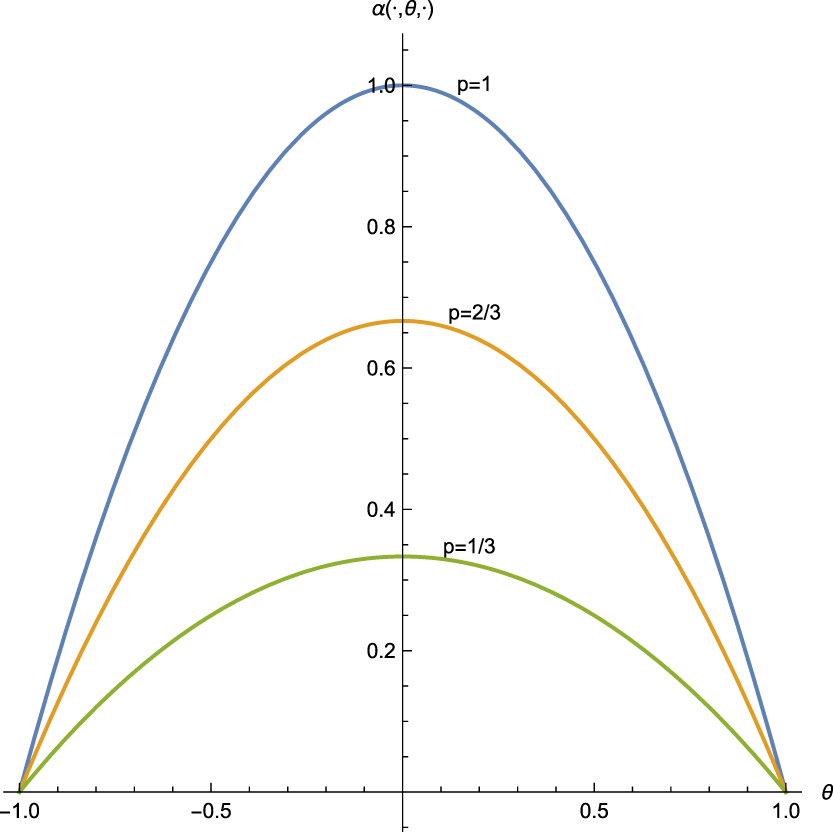
The derivative  ${{\partial \alpha } \over {\partial {\delta _i}}}$ measures the voter’s attitudinal/behavioral response to changes in the incumbent’s policy. Assumption 1 states that the greater a voter’s affinity for the incumbent, the stronger her response is to changes in the policy. Figure 1 provides an illustration of α (defined as a function of θ) that satisfies Assumption 1, and Example 1 provides a parametric form of α that satisfies Assumption 1.
α as a Function of θ at Different Levels of p for Voter i With b i = 0

Example 1. Let the support of πi be a subset of [0, 1]. For a parameter β ∈ [0, 1], define
 $$\alpha \left( {{p_i},{\delta _i},{\pi _i}} \right) = \beta \left[ {{{{p_i} \cdot \left( {2 - {\delta _i}} \right)} \over 2}} \right] + \left( {1 - \beta } \right){\pi _i}.$$
Note that α ∈ [0, 1], and ingroup responsiveness is satisfied as  $\left| {{{\partial \alpha } \over {\partial {\delta _i}}}} \right| = {{\beta {p_i}} \over 2}$ is increasing in p i. The functional form resembles the well-known Bush–Mosteller rule in the adaptive learning literature (Bush and Mosteller Reference Bush and Mosteller1955).
We present the main results in the Results section. All proofs are relegated to an online appendix.
RESULTS
In this section, we characterize the policy choices of the parties when the electorate is affectively polarized. Definition 1 formalizes the notion of affective polarization. To gain an intuitive understanding of this definition, consider a simplified setting wherein voters have either bliss point l < 0 or r > 0. The electorate is affectively polarized if, subject to a possible switch of party labels, l voters are more likely than r voters to have high affinities for party A.Footnote 10 In other words, the distribution G l first order stochastic dominates (henceforth FOSD) the distribution G r.Footnote 11 Definition 1 extends this idea to the general setting.
Definition 1. The electorate is affectively polarized if G b FOSD G b′ for any b < 0 < b′.
When the electorate is affectively polarized, leftist voters, i.e., those with bliss points b < 0, are (affective) partisans of party A, and rightist voters, i.e., those with bliss points b > 0, are partisans of party B. Our main result, Proposition 1, states that the incumbent biases its policy toward its partisans. Note that for the result (and the ones that follow), we implicitly assume the uniqueness of optimal policy, which simplifies the statements without affecting the insights.Footnote 12
Proposition 1. Suppose the electorate is affectively polarized, then party A’s optimal policy, θ A, is biased to the left (i.e., θ A ≤ 0), and party B’s optimal policy, θ B, is biased to the right (i.e., θ B ≥ 0).
To see the intuition for Proposition 1, consider the case where party A is the incumbent. When party A deviates from the median policy, 0, it gains support from one group of voters and loses support from the other group. Given ingroup responsiveness, the leftist voters are more responsive to policy deviations than rightist voters. Therefore, party A has an incentive to bias its policy to the left since the increased support from leftist voters outweighs the decreased support from rightist voters.Footnote 13
Proposition 1 does not rule out the possibility that the incumbent chooses the median policy. Corollary 1 shows that policy divergence arises when there are few centrist voters (i.e., those with bliss point b = 0).
Corollary 1. If the measure of centrist voters is sufficiently small, then the incumbent chooses a nonmedian policy (i.e., θ A < 0 and θ B > 0).
Intuitively, centrist voters serve as a centripetal force that moderates the incumbent’s policy; the incumbent loses support from the centrist voters when its policy deviates from the center. This loss is small when the size of centrist voters is small, and consequently the incumbent is willing to deviate from the center so as to appeal to its partisans. Note that the condition in Corollary 1 refers to ideological polarization since it is a statement about the distribution of voter bliss points. This is distinct from the idea of affective polarization, which deals with the distribution of party affinities and is an intrinsically psychological concept.
Empirical research suggests that affective polarization has intensified over the past few decades (see Iyengar and Krupenkin Reference Iyengar and Krupenkin2018). Proposition 2 provides a theoretical foundation for the hypothesis that the increase in affective polarization at the mass level is a driving force for the growing elite polarization in America. Specifically, as affective polarization increases, the parties choose more extreme policies. This observation does not assume any shifts in voters’ bliss points and is, therefore, orthogonal to the controversy over whether or not the American electorate has become more polarized on policy issues.
For exposition purposes, we consider a simplified setting in which the electorate is evenly divided among three bliss points: l = −1, m = 0, and r = 1.Footnote 14 Here, affective polarization increases when l voters or r voters become more partial to party A or B, respectively. This can be formalized using the following concept.
Definition 2. A distribution G FOSD increases if G is replaced by G′, where G′ FOSD G; G FOSD decreases if G is replaced by G′, where G FOSD G′.
Given Definition 2, we can say that affective polarization increases if G l FOSD increases or G r FOSD decreases. Proposition 2 shows that policy divergence increases when affective polarization increases. On the other hand, a party moderates its policy when centrist voters have stronger affinities for the party.
Proposition 2. Let  ${\cal B} = \left\{ {l,m,r} \right\}$. If G l FOSD increases or G r FOSD decreases, then θ A decreases and θ B increases, i.e., party A (B)’s optimal policy shifts to the left (right). If G m FOSD increases, then both θ A and θ B increase. The changes are strict if θ A, θ B ∉ {−1, 0, 1}.
Since voters exhibit ingroup responsiveness, parties have an incentive to appeal to voters who are more partial to them. An increase in affective polarization means that voters with extreme ideologies become more partisan. Therefore, parties are willing to choose more extreme policies to appeal to the extreme voters. By similar logic, if the centrist voters become more partial to a party, then the party is more willing to moderate its policy.Footnote 15
CONCLUSION
While the growing party polarization in America has been well-documented, there is ongoing debate about the causes of this phenomenon. In contrast to elite polarization, there is no definitive evidence for a significant increase in mass polarization on policy issues. Recent research, however, suggests that the intensity of partisan affect, or affective polarization, has dramatically increased over the past few decades. This paper proposes a behavioral model of elections that takes partisan affect into account. We show that office-motivated parties have an incentive to bias their policies toward their affective partisans given that voters exhibit ingroup responsiveness. Moreover, greater affective polarization leads to greater policy divergence. This observation does not assume that voters’ positions on policy issues have moved. That is, the result is consistent with a world wherein an increase in affective polarization, by itself, is sufficient to induce an increase in elite polarization.
Recent evidence by Rogowski and Sutherland (Reference Rogowski and Sutherland2016) suggests that elite polarization reinforces affective polarization. This leads to interesting questions about the dynamic interaction between partisan affect and elite behavior. For example, what are the conditions under which affective polarization and elite polarization are mutually sustaining? Also, can temporary shocks, such as an economic crisis, have long-term consequences on party ideologies and affective polarization? We hope to address these questions in future work by adapting our framework to a dynamic setting.
SUPPLEMENTARY MATERIAL
To view supplementary material for this article, please visit https://doi.org/10.1017/S0003055418000655.






Comments
No Comments have been published for this article.