Introduction
Intracytoplasmic sperm injection (ICSI) is one of the assisted reproductive techniques used to treat infertility, especially in cases of male infertility with poor sperm quality. It has been well documented that morphology of spermatozoa used for injection is an indicator of the competence of sperm and therefore directly related to ICSI outcome including fertilization and pregnancy rates (De Vos et al., Reference De Vos, Van De Velde, Joris, Verheyen, Devroey and Van Steirteghem2003). Despite the selection of sperm cell under a magnification of ×400 in a routine ICSI application, it is hard to distinguish a morphologically normal sperm cell. Subtle morphological defects of the sperm cell were reported to cause fertilization problems (Bartoov et al., Reference Bartoov, Berkovitz, Eltes, Kogosowski, Menezo and Barak2002), reduced blastocyst development, (Vanderzwalmen et al., Reference Vanderzwalmen, Hiemer, Rubner, Bach, Neyer, Stecher and Cassuto2008), and gave poor clinical outcome (Bartoov et al., Reference Bartoov, Berkovitz, Eltes, Kogosovsky, Yagoda, Lederman and Barak2003; Berkovitz et al., Reference Berkovitz, Eltes, Lederman, Peer, Ellenbogen, Feldberg and Bartoov2006; Antinori et al., Reference Antinori, Licata, Dani, Cerusico, Versaci, d’Angelo and Antinori2008). Bartoov and colleagues introduced a new technique called motile sperm organelle morphology examination (MSOME). In this technique, they examined the morphology of motile spermatozoa without staining under an inverted light microscope that was equipped with high-power differential interference contrast (Nomarski/DIC) optics (×150 magnification) enhanced by digital imaging (×44 magnification) in real time. With these selected optics they succeeded to increase total magnification up to over ×6000. This high magnification allows the distinction of exquisite details of sperm cells and organelles including sperm compartment sizes, abnormalities and especially vacuoles, which are impossible to distinguish with routine magnifications. Vacuoles are important indicators of functional sperm problems and their presence is known to be correlated with sperm DNA damage. Several studies have also shown that the vacuoles negatively affect human embryo development (Franco Jr et al.., Reference Franco, Baruffi, Mauri, Petersen, Oliveira and Vagnini2008; Garolla et al., Reference Garolla, Fortini, Menegazzo, De Toni, Nicoletti, Moretti and Foresta2008). Those results are correlated with the fact that DNA damage has an adverse effect on preimplantation and post-implantation embryo development.
Combination of this technique with routine ICSI gave rise to a new technique called intracytoplasmic morphologically selected sperm injection (IMSI), which enabled the selection of morphologically ‘perfect’ sperm during microinjection. This technique involves non-invasive imaging that has several advantages that are still controversial. Several studies have reported that when the IMSI procedure is used, higher pregnancy and delivery rates and lower miscarriage rates in cycles were obtained (Hazout et al., Reference Hazout, Dumont-Hassan, Junca, Bacrie and Tesarik2006; Antinori et al., Reference Antinori, Licata, Dani, Cerusico, Versaci, d’Angelo and Antinori2008), while others opposed these results (Oehninger et al., Reference Oehninger, Veeck, Lanzendorf, Maloney, Toner and Muasher1995; Küpker et al., Reference Küpker, Schulze and Diedrich1998; Celik-Ozenci et al., Reference Celik-Ozenci, Jakab, Kovacs, Catalanotti, Demir, Bray-Ward and Huszar2004).
The aim of the present study was to evaluate the efficacy of the IMSI technique with different infertility populations that are undergoing ICSI. In this regard, the possible effects of IMSI on ICSI outcome measures (fertilization, embryo development, pregnancy, implantation and ongoing pregnancy rates) were evaluated in a non-selected group and two-selected infertile groups (a group with at least one of the sperm parameters that was abnormal and a group with previous implantation failure with at least two previous unsuccessful ICSI cycles).
Materials and Methods
Study design
In total, 142 cycles (IMSI, n = 72; routine ICSI, n = 70) were performed on the patients who were under infertility treatment between January 2016 and June 2016 at the In Vitro Fertilization (IVF) Unit in Memorial Antalya Hospital, (Antalya, Turkey). All patients were informed and their written consent forms were taken. The ethical committee of İstanbul Medipol University approved this study with number 10840098–604.01.01-E.42839.
We compared the outcome parameters of ICSI (fertilization, top quality embryo, pregnancy, implantation and ongoing pregnancy rates, %) between IMSI cycles and routine ICSI cycles in three different patient populations to analyse the effects of IMSI procedure and to analyse patients that may benefit from the procedure. Couples having more than one IVF attempt, a female age of <37, poor responders [basal follicle-stimulating hormone (FSH) level of > 10 mIU/ml], women with a body mass index (BMI) of > 25, a sperm concentration of < 1 μl/ml, patients with total immotile sperm, couples with a genetic abnormality in any partner, cycles with <4 mature retrieved oocytes, preimplantation genetic diagnosis cycles and cycles with testicular sperm retrievals were excluded from the study to avoid the possible contribution of these parameters on the outcome. The first group included 54 unselected couples with various infertility origins (female/male/both and unexplained), the second group included 45 couples with male factor infertility in which at least one of the semen parameters was abnormal (oligo- and/or astheno- and/or teratozoospermia) according to World Health Organization (WHO) criteria and the third group included 49 patients with repeated implantation failure who had at least two previous unsuccessful ICSI cycles. All groups were divided into two subgroups, to one of which routine ICSI was applied (called the r-ICSI group) and the other to which IMSI was applied (called the IMSI group) randomly. The outcome parameters were compared within and between each group.
Sperm preparation and selection
Fresh ejaculated semen samples were prepared by density gradient technique with two different dilutions (90%, 45%) of PureSperm solution (Nidacon International, Mölndal, Sweden) as described previously by Yilmaz et al. (Reference Yilmaz, Koyuturk, Kilic, Alpak and Aytoz2005). Briefly, the semen samples were layered on two different layers of solutions and centrifuged for 20 min (250 g). The pellet was washed with G-IVF medium (VitroLife, Gothenburg, Sweden) for 10 min (500 g). Preparation of the final sperm cell suspension for IMSI and the ICSI procedures was performed according to the description by Bartoov et al. (Reference Bartoov, Berkovitz, Eltes, Kogosovsky, Yagoda, Lederman and Barak2003).
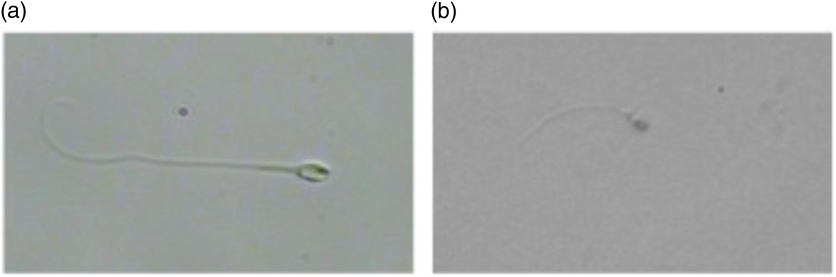
Sperm selection for routine ICSI was achieved under ×40 magnification using an inverted microscope (Olympus E-300) supplemented with a Hoffman modulation. Sperm selection for IMSI was performed using an inverted microscope (Eclipse TE 300; Nikon Diaphot, Tokyo) equipped with a high-power DIC (Nomarski) with a magnification of ×6600. A motile sperm with a normal distinguishable morphology was chosen if possible (Fig. 1). Selection criteria for IMSI were based on Bartoov et al. (Reference Bartoov, Berkovitz, Eltes, Kogosovsky, Yagoda, Lederman and Barak2003) criteria that defined the head of sperm as smooth, symmetric, intact, oval shaped, and vacuoles that should be less than 4% of nuclear area in the sperm head (Bartoov et al., Reference Bartoov, Berkovitz, Eltes, Kogosovsky, Yagoda, Lederman and Barak2003). The primary intention during the selection of sperm was to choose sperm cells without vacuoles or with vacuoles smaller than 1 µm (0.72 ± 0.11 µm), with a normal oval shape and normal head dimensions (length 4.6 ± 0.12 µm; width 3.4 ± 0.2), with no nuclear abnormalities, a smooth midpiece without cytoplasmic droplet and a normal elongated tail for the microinjection procedure. When it is not possible to find a morphologically normal sperm cell, the best sperm cells available with minimum number of abnormalities were selected for microinjection. Sperm cells with evidence of major head malformations or amorphous head were not used for either IMSI or r-ICSI.
(a ) Sperm image with MSOME (Eclipse TE 300; Nikon Diaphot, Tokyo) equipped with a high-power differential interference contrast (DIC; Nomarski) optics with a magnification of ×6600. (b) Sperm image taken with an inverted microscope (Olympus E-300) equipped with a Hoffman modulation.

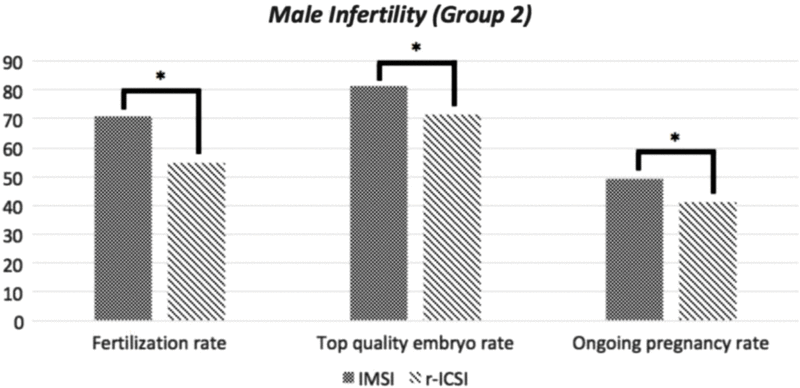
Comparison of three significant outcome parameters (fertilization, top quality embryo, and ongoing pregnancy rate) in male infertility group. * P < 0.05

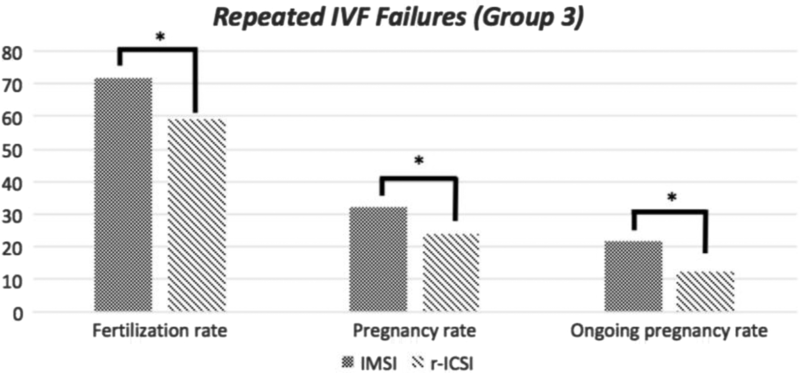
Comparison of three significant outcome parameters (fertilization, pregnancy, and ongoing pregnancy rate) in repeated IVF failure group. * P < 0.05

Ovarian stimulation and ICSI procedure
Female partners had undergone controlled ovulation induction by using a short or long gonadotrophin releasing hormone (GnRH) analogue suppression protocol or a GnRH antagonist protocol with human menopausal gonadotrophins (HMG) or recombinant FSH (rec-FSH) for stimulation of follicular development. Cumulus−oocyte complexes (COC) were collected 34–36 h after the administration of 5000 IU of Ovitrelle (human chorionic gonadotrophin – hCG). Cumulus oophorous and corona radiata cells that surrounded the oocytes were denuded using Hyase 10× (VitroLife, Sweden) and by pipetting with different diameters. Maturation of the oocytes was observed using an inverted microscope (Nikon, Japan). Metaphase II oocytes with a single polar body and metaphase I oocytes that extruded their first polar body within 4 h, were used for microinjection with the selected sperm either by IMSI or r-ICSI (Fig. 1). Microinjection of the oocytes was performed 4 h later, as described by Van Steirteghem et al. (Reference Van Steirteghem, Nagy, Joris, Liu, Staessen, Smitz, Wisanto and Devroey1993).
Fertilization and embryo development assessment
Microinjected oocytes were cultured in a 25-µl single microdrop of culture medium (G-IVF, VitroLife) covered with sufficient light paraffin oil (OVOIL, VitroLife). Fertilization was checked 16–18 h after ovum pick up (OPU) and described as the presence of two pronuclei (2PN) and two polar bodies (2PB) in the ooplasm. Fertilization rates were calculated by dividing the number of fertilized oocytes to the number of mature oocytes collected. Fertilized oocytes were checked on days 2 and 3 for embryonic development. Embryo development rates were calculated by dividing the number of embryos developed to the total number of fertilized oocytes. Cleavage and embryo qualities of the embryos were analysed according to the embryo selection criteria of Staessen et al. (Reference Staessen, Camus, Khan, Smitz, Van Waesberghe, Wisanto, Devroey and Van Steirteghem1989). Grades A and B embryos were classified as top quality embryos (fragmentation ≤10%, even blastomeres, homogeneous cytoplasm, no vacuoles and refractile bodies, smooth perivitelline space), grades C and D embryos were classified as poor quality embryos. Top quality embryo rates were calculated by dividing the number of top quality embryos by the total number of embryos. Mean rates for all parameters were calculated by averaging rates calculated for each couple.
Embryo transfer policy and pregnancy assessment
Patients were given progesterone supplement (Crinone 8% gel, Merck Serono) on the day before the embryo transfer. Endometrium thickness was measured, and embryo transfers were performed if the endometrium thickness was more than 10 mm. Embryo transfers were performed by the same clinician via using ultrasonography on day 3. A Wallace catheter (Smiths, Kent, UK) was used for all embryo transfers. The cervix was rinsed after introduction of speculum to the vagina and the cervical mucus was aspirated before embryo transfer. Embryos were left 2–3 cm below the fundus and the catheter was stabilized for 30 s after the embryo transfer was performed. Patients remained still on the table for 10 min after embryo transfers were performed. Sibling embryos were frozen after written and consent permissions.
A β-hCG value of ≥50 mIU/ml in the blood sample 12 days after the day of embryo transfer, and a doubled β-hCG level 2 days after the first pregnancy was seen as a marker for positive pregnancy. Visualization of the chorionic sac with ultrasonography 1 week after pregnancy assessment was accepted as a sign for clinical pregnancy. The term ‘embryos implanted’ described the implanted embryos and implantation rate was calculated by dividing the number of embryos implanted to the number of embryo transfers.
Statistics
The data were analysed using SPSS (Statistical Package for Social Sciences) software (SPSS Inc., Chicago, IL, USA) for Windows 10.0. We used Shapiro–Wilk’s test to observe the distribution of the data. The Mann−Whitney U-test was used for abnormally distributed variables and Student’s t-test was used for normally distributed variables. Chi-squared test was used to compare the pregnancy rates between the groups. Results were given as mean ± standard deviation (SD) and the statistical significance was assessed at P < 0.05.
Results
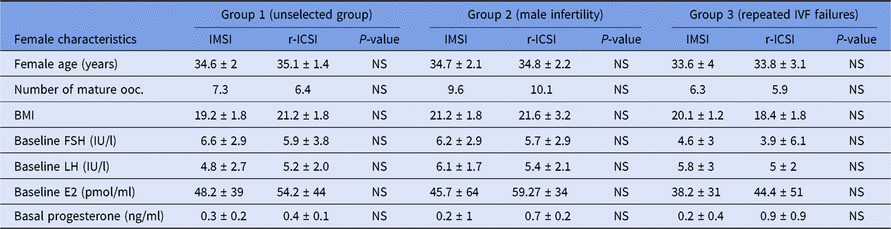
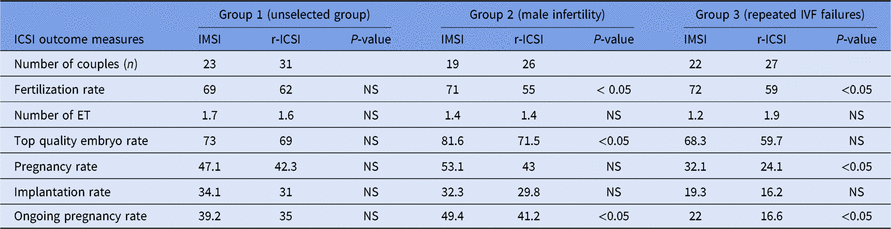
Mean age of the women, number of mature oocytes (metaphase II) collected and number of embryos transferred were similar in all three groups (P > 0.05). Demographic characteristics of females and males for all groups are given in Tables 1 and 2, respectively. Causes for infertility among the first non-selected group were as follows: female factor (18% in the IMSI group and 35% in the r- ICSI group), male factor (9% in the IMSI group and 10% in the r-ICSI group), both (63% in the IMSI group and 45% in the r-ICSI group), and unexplained (9% in the IMSI group and 10% in the r-ICSI group). No significant differences were observed between the fertilization rates, top quality embryo rates, pregnancy rates, implantation rates and ongoing pregnancy rates between the IMSI and r-ICSI groups in the given non-selected group (Table 3).
Comparison of demographic female characteristics for all groups. Values are mean ± standard deviation (SD) unless otherwise stated

r-ICSI, routine intracytoplasmic sperm injection; IMSI, intracytoplasmic morphologically selected sperm injection; ooc., oocytes; NS, not significant; BMI, body mass index; FSH, follicle-stimulating hormone; LH, luteinizing hormone; E2, estradiol.
Comparison of demographic male characteristics for all groups. Values are mean ± standard deviation (SD) or n (%) unless otherwise stated

r-ICSI, routine intracytoplasmic sperm injection; IMSI, intracytoplasmic morphologically selected sperm injection; NS, not significant.
Comparison of ICSI outcome parameters for all groups. Values are mean percentage (%) unless otherwise stated

r-ICSI, routine intracytoplasmic sperm injection; IMSI, intracytoplasmic morphologically selected sperm injection; NS, not significant; ET, embryo transfer.
In the male infertility group, we observed a significant increase in the fertilization rates and quality of embryos in the IMSI group (Fig. 2). Although there was no significant difference in the pregnancy and implantation rates, ongoing pregnancy rates were significantly higher in the IMSI group than in the r-ICSI group (Table 3). In the group with previous implantation failures, fertilization rates were also significantly increased in the IMSI group, although no difference was observed for embryo quality rates (Fig. 3). The most promising outcome of the present study was the significant increase in pregnancy rates and ongoing pregnancy rates in the IMSI group of the previous implantation failure group, yet no difference was observed for implantation rates.
Discussion
Sperm morphology is the only criterion for selection of sperm for intracytoplasmic sperm injection. No tests on live sperm cells are available that can select the best sperm to microinject into the oocyte and that have the potential to induce better embryologic development. As analysis has to rely on sperm morphology, observing ultrastructural details with higher magnification may be useful as a selection technique. The IMSI technique is a non-invasive technique with the opportunity to observe ultrastructural details of sperm organelles. Clinical usage of the IMSI procedure is controversial, as some studies have suggested the positive effect of IMSI on clinical outcome, while the others claim no proven benefit of the technique. We observed no favourable effect of the use of IMSI in a non-selected patient group based on various causes of infertility. However, with this study we present promising results for the positive effect of IMSI by observing fertilization rates, embryo quality, and also ongoing pregnancy rates in the male factor infertility group and a positive effect on fertilization, pregnancy and ongoing pregnancy rates previous IVF failure group when compared with classical ICSI.
There was a significant increase in the fertilization rates of IMSI applied group with male factor infertility. Data obtained on the subject were controversial as some researchers found no correlation between IMSI and fertilization (Hazout et al., Reference Hazout, Dumont-Hassan, Junca, Bacrie and Tesarik2006; Vanderzwalmen et al., Reference Vanderzwalmen, Hiemer, Rubner, Bach, Neyer, Stecher and Cassuto2008; Mauri et al., Reference Mauri, Petersen, Oliveira, Massaro, Baruffi and Franco2010; de Almeida Ferreira Braga et al., Reference Braga, Setti, Figueira, Nichi, Martinhago, Iaconelli and Borges2011; Wilding et al., Reference Wilding, Coppola, Di Matteo, Palagiano, Fusco and Dale2011), while the others found a significant increase in the fertilization rate (Yazbeck et al., Reference Yazbeck, Delaroche, Jacquesson, Ayel, Selva and Rougier2008; Tasaka et al., Reference Tasaka, Doshida, Sato, Kyoya, Nakajo and Kyono2009). Knez et al. (Reference Knez, Zorn, Tomazevic, Vrtacnik-Bokal and Virant-Klun2011) concluded that fertilization may be impaired when sperm with a vacuole was microinjected. However, there was a higher fertilization rate when injecting a sperm without or minimal number of vacuoles, and normal head morphology. Our results confirm these data with a significant increase in fertilization rates when IMSI was used in terms of male factor infertility. It was suggested that vacuoles in the sperm cells may be correlated to the sperm DNA integrity, fragmentation and chromatin packaging problems or chromosomal abnormalities (Cayli et al., Reference Cayli, Jakab, Ovari, Delpiano, Celik-Ozenci, Sakkas and Huszar2003; Hazout et al., Reference Hazout, Dumont-Hassan, Junca, Bacrie and Tesarik2006; Franco Jr et al., Reference Franco, Baruffi, Mauri, Petersen, Oliveira and Vagnini2008, 2011; Garolla et al., Reference Garolla, Fortini, Menegazzo, De Toni, Nicoletti, Moretti and Foresta2008; Oliveira et al., Reference Oliveira, Massaro, Baruffi, Mauri, Petersen, Silva and Franco2010; Boitrelle et al., Reference Boitrelle, Ferfouri, Petit, Segretain, Tourain, Bergere and Selva2011; Wilding et al., Reference Wilding, Coppola, Di Matteo, Palagiano, Fusco and Dale2011; Skowronek et al., Reference Skowronek, Casanova, Alciaturi, Capurro, Cantu, Montes and Sapiro2012). According to the results of these studies, vacuolization may represent the integrity of DNA integrity in the sperm cell indirectly, and IMSI technique may give us the opportunity to select a healthy sperm with no vacuolization under better magnification than used in routine ICSI. Better embryo quality rates on day 3 with IMSI were examined in our male infertility group that were not in accordance with the results of Vanderzwalmen et al. (Reference Vanderzwalmen, Hiemer, Rubner, Bach, Neyer, Stecher and Cassuto2008), who found similar top quality embryo rates at cleavage stage in both IMSI and ICSI but an increased embryo quality rate in the blastocyst stage. Different results obtained may be due to the different patient selection criteria in which the ages of women were higher (<40 years with a mean age of 36.7). As indicated in some other studies, it was suggested that IMSI enhances the outcome positively, but only at the blastocyst stage because activation of the embryonic genome starts after the third day, and therefore represents a late paternal effect (Greco et al., Reference Greco, Scarselli, Iacobelli, Rienzi, Ubaldi, Ferrero and Tesarik2005; Garolla et al., Reference Garolla, Fortini, Menegazzo, De Toni, Nicoletti, Moretti and Foresta2008). However, our results for earlier positive embryonic effect may be explained by the fact that sperm-derived genome is not totally silent during fertilization and cleavage divisions, and mRNA synthesis has been detected in male pronucleus (Tesarik, Reference Tesarik2005). Therefore contribution of sperm to early embryo development seems possible. In this context, our results support the findings of Bartoov et al. (Reference Bartoov, Berkovitz and Eltes2001) and Berkovitz et al. (Reference Berkovitz, Eltes, Yaari, Katz, Barr, Fishman and Bartoov2005) who also demonstrated significantly higher top quality embryo rates in patients treated with IMSI. Antinori et al. (Reference Antinori, Licata, Dani, Cerusico, Versaci, d’Angelo and Antinori2008) compared ICSI with IMSI in couples diagnosed with severe oligoasthenoteratozoospermia and found a significant increase in implantation and clinical pregnancy rates in the IMSI group. The difference in pregnancy and implantation rates was not statistically different in our study, although ongoing pregnancy rates were significantly increased in the IMSI group. Our findings for implantation and pregnancy rates seem to be in accordance with the results of Leandri et al. (Reference Leandri, Gachet, Pfeffer, Celebi, Rives, Carre‐Pigeon and Parinaud2013) who concluded that there was no significant improvement in clinical outcomes including implantation and clinical pregnancy between IMSI and ICSI (Leandri et al., Reference Leandri, Gachet, Pfeffer, Celebi, Rives, Carre‐Pigeon and Parinaud2013). However, the author gave no information about the ongoing pregnancy rates, which we found higher in our study. Our results were similar to those of the study of Balaban et al. (Reference Balaban, Yakin, Alatas, Oktem, Isiklar and Urman2011), who reported no significant improvement in the clinical outcome of the IMSI group for an unselected patient population which is in accordance with our study, whereas higher implantation rates for male factor patients showed that the IMSI procedure may be beneficial for these patients. It is logical to think that IMSI may improve IVF outcome measures in male factor infertility (Balaban et al., Reference Balaban, Yakin, Alatas, Oktem, Isiklar and Urman2011). Present data justify the clinical application of IMSI for a selected group of patient with male factor infertility. We did not observe the same positive effect of IMSI for the non-selected group, indicating that negative effects of poor sperm parameters can be overwhelmed by the IMSI technique that enables choice of ultrastructurally normal sperm cells as an indicator of healthy sperm.
The most promising result of our study is the significantly increased rates of fertilization, pregnancy, and ongoing pregnancy for repeated implantation failure patients. Our results were in accordance with the results of Shalom-Paz et al. (Reference Shalom-Paz, Anabusi, Michaeli, Karchovsky-Shoshan, Rothfarb, Shavit and Ellenbogen2015) who showed a significantly increased pregnancy outcome, regardless of the quality of sperm in couples treated with IMSI with repetitive IVF/ICSI failure (Shalom-Paz et al., Reference Shalom-Paz, Anabusi, Michaeli, Karchovsky-Shoshan, Rothfarb, Shavit and Ellenbogen2015). There are limited data analysing the possible effect of IMSI for repeated implantation failure patients. The present study will contribute to the literature regarding this patient population.
Studies on this subject were summarized by the Cochrane Database 2013 (Teixeira et al., Reference Teixeira, Barbosa, Ferriani, Navarro, Raine‐Fenning, Nastri and Martins2013), which reported supportive results from randomized controlled trials in a routine clinical use of IMSI in which it analysed nine randomized controlled trials, evaluating 2014 couples. The report concluded that there was no evidence-based effect on the live birth rates or miscarriage rates and on the evidence that IMSI improves clinical pregnancy. Therefore, this study will contribute to the literature analysing the effects of the IMSI technique on different patient populations.
Well designed prospective studies analysing the effects of IMSI for different groups of patients with higher number of cycles are needed to corroborate the trends observed in this study and to analyse the overall effect of sperm morphology on ICSI.
Financial support
This research received no specific grant from any funding agency, commercial or not-for-profit sectors.
Conflicts of interest
None.
Ethical standards
Not applicable.