Introduction
Intermittent explosive disorder (IED) is characterized by impulsive, non-premeditated aggressive outbursts that are disproportionate to provocation (American Psychological Association, 2013). Although some form of IED has been included in the Diagnostic and Statistical Manual of Mental Disorders (DSM) for many years, problems with the earlier diagnostic criteria precluded extensive research into this disorder (Coccaro et al. Reference Coccaro, Kavoussi, Berman and Lish1998; Coccaro, Reference Coccaro2012). In DSM-IV, IED was defined as the occurrence of several episodes of failure to resist aggressive impulses, resulting in assaults or property destruction. To meet disorder criteria these episodes needed to be greatly out of proportion to any precipitating stressor and to not be better accounted for by another mental disorder. DSM-5 criteria are more specific about the number and type of aggressive outbursts, requiring at least three destructive (of property or involving physical injury to persons or animals) aggressive outbursts within a year, or a higher number of non-destructive aggressive outbursts.
Although there has been less research on the epidemiology of IED compared with other mental disorders, DSM-IV IED was assessed in national surveys in the USA (Kessler et al. Reference Kessler, Coccaro, Fava, Jaeger, Jin and Walters2006; McLaughlin et al. Reference McLaughlin, Green, Hwang, Sampson, Zaslavsky and Kessler2012) and in a small number of national and regional surveys in other countries (Fincham et al. Reference Fincham, Grimsrud, Corrigall, Williams, Seedat, Stein and Myer2009; Yoshimasu & Kawakami, Reference Yoshimasu and Kawakami2011; Al-Hamzawi et al. Reference Al-Hamzawi, Al-Diwan, Al-Hasnawi, Taib, Chatterji, Hwang, Kessler and McLaughlin2012; Axinn et al. Reference Axinn, Ghimire, Williams and Scott2013; Rees et al. Reference Rees, Silove, Verdial, Tam, Savio, Fonseca, Thorpe, Liddell, Zwi and Tay2013). These studies have varied in assessment and diagnosis of IED, with some studies reporting very high prevalence estimates (Fincham et al. Reference Fincham, Grimsrud, Corrigall, Williams, Seedat, Stein and Myer2009; Rees et al. Reference Rees, Silove, Verdial, Tam, Savio, Fonseca, Thorpe, Liddell, Zwi and Tay2013). In this study from 17 of the World Mental Health (WMH) Surveys we report on the cross-national epidemiology of IED using a consistently applied, conservative diagnostic definition, examining prevalence, age of onset, type of aggressive outburst, sociodemographic correlates, co-morbidity, associated impairment and treatment. In the context of prior research that has linked prior trauma exposure with IED diagnosis (Fincham et al. Reference Fincham, Grimsrud, Corrigall, Williams, Seedat, Stein and Myer2009; Nickerson et al. Reference Nickerson, Aderka, Bryant and Hofmann2012; Fanning et al. Reference Fanning, Meyerhoff, Lee and Coccaro2014), we also investigated associations between lifetime traumatic events and subsequent IED onset.
Method
Samples and procedures
This study uses data from all WMH surveys that measured IED (Appendix Table 1). A stratified multi-stage clustered area probability sampling strategy was used to select adult respondents (18 years+) in most WMH countries. In most countries, internal subsampling was used to reduce respondent burden and average interview time by dividing the interview into two parts. All respondents completed Part 1 which included the core diagnostic assessment of most mental disorders including IED. All Part 1 respondents who met lifetime criteria for any mental disorder and a probability sample of respondents without mental disorders were administered Part 2 which assessed the remaining disorders and other information related to survey aims (including exposure to traumatic events). Part 2 respondents were weighted by the inverse of their probability of selection for Part 2 of the interview to adjust for differential sampling. Additional weights were used to adjust for differential probabilities of selection within households, to adjust for non-response, and to match the samples to population sociodemographic distributions. All respondents provided written informed consent and measures taken to ensure data accuracy, cross-national consistency and protection of respondents are described in detail elsewhere (Kessler & Ustun, Reference Kessler and Ustun2004; Kessler & Ustun, Reference Kessler and Ustun2008).
Measures
IED
All surveys used the WMH survey version of the World Health Organization (WHO) Composite International Diagnostic Interview (CIDI 3.0) (Kessler & Ustun, Reference Kessler and Ustun2004), a fully structured, lay-administered face-to-face interview, to assess lifetime history of DSM-IV mental disorders including IED. DSM-IV criterion A for IED requires ‘several discrete episodes of failure to resist aggressive impulses that result in serious assaultive acts or destruction of property’. This was operationalized in the CIDI by requiring the respondent to report at least three attacks in the same year of at least one of three types of anger attacks: (i) ‘when all of a sudden you lost control and broke or smashed something worth more than a few dollars’; (ii) ‘when all of a sudden you lost control and hit or tried to hurt someone’; and (iii) ‘when all of a sudden you lost control and threatened to hit or hurt someone’. 12-Month diagnosis was assigned if those meeting lifetime criteria reported at least three attacks in the past 12 months, and 30-day diagnosis was assigned if those meeting 12-month criteria reported an anger attack in the past 30 days.
DSM-IV criterion B for IED requires that the aggressiveness is ‘grossly out of proportion to any precipitating psychosocial stressor’. This criterion was operationalized in the CIDI by requiring the respondent to report either that they ‘got a lot more angry than most people would have been in the same situation’ or that the attacked occurred ‘without good reason’ or that the attack occurred ‘in situations where most people would not have had an anger attack’.
DSM-IV criterion C for IED requires that the ‘aggressive episodes are not better accounted for by another mental disorder and are not due to the direct physiological effects of a substance or a general medical condition’. This was assessed through a series of questions (for details, see Kessler et al. Reference Kessler, Coccaro, Fava, Jaeger, Jin and Walters2006) that ruled out IED diagnosis if anger attacks occurred exclusively when respondents had been drinking or using drugs, when they were in a depressive or manic episode, or as a consequence of an organic cause such as epilepsy, head injury or use of medications.
This classification of IED is the ‘narrow’ definition of IED reported in the US National Comorbidity Survey Replication (NCS-R) (Kessler et al. Reference Kessler, Coccaro, Fava, Jaeger, Jin and Walters2006), but in the present study we have applied an additional impairment criterion that required respondents to report that their anger attacks caused at least some degree of interference with their work, social life or relationships. This makes the diagnosis of IED in this report more conservative than in earlier reports based on WMH Surveys data (Kessler et al. Reference Kessler, Coccaro, Fava, Jaeger, Jin and Walters2006, Reference Kessler, Coccaro, Fava, McLaughlin, Grant and Potenza2012; Yoshimasu & Kawakami, Reference Yoshimasu and Kawakami2011; Al-Hamzawi et al. Reference Al-Hamzawi, Al-Diwan, Al-Hasnawi, Taib, Chatterji, Hwang, Kessler and McLaughlin2012).
DSM-IV v. DSM-5 criteria
DSM-5 criteria recognize two different patterns of aggressive outburst: high frequency/low intensity (criterion A1: non-destructive verbal or physical aggression occurring at least twice weekly for at least 3 months) or low frequency/high intensity (criterion A2: at least three destructive outbursts within a year-long period) (Coccaro et al. Reference Coccaro, Lee and McCloskey2014b ). The diagnostic algorithm used in the present study requires three aggressive outbursts within 1 year, but there was insufficient information on the lifetime frequency of specific types of aggressive outburst to confirm whether those meeting the DSM-IV criteria operationalized in this study would also meet DSM-5 criteria.
Impairment
Those meeting criteria for IED in the past 12-months were asked to rate the extent to which their symptoms interfered with his or her life and activities in the worst month of the past year using the Sheehan Disability Scales (Leon et al. Reference Leon, Olfson, Portera, Farber and Sheehan1997). These are 0–10 visual analogue scales that ask how much a focal disorder interfered with home management, work, social life and personal relationships using the response options none (0), mild (1–3), moderate (4–6), severe (7–10).
Traumatic events
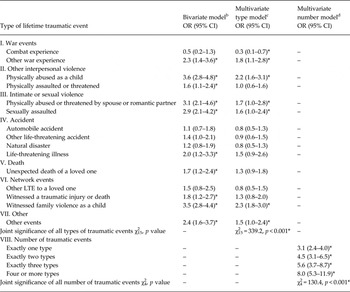
Lifetime exposure to the events listed in Table 5 was assessed at the beginning of the CIDI post-traumatic stress disorder section (administered to the Part 2 subsamples). Additional questions were asked to determine the age of first occurrence and frequency of occurrence.
Statistical analysis
All analyses with the exception of Table 5 (traumatic events) and Table 4 (co-morbidity) used the Part 1 samples. Cross-tabulations were used to calculate prevalence, impairment, co-morbidity and treatment. Discrete-time survival analyses (Singer & Willett, Reference Singer and Willett1993) with person-year as the unit of analysis were used to investigate time-lagged associations between traumatic events and first onset of IED. Logistic regression and survival analyses were used to examine sociodemographic correlates. Significance was calculated using Wald and McNemar's χ2 tests. As the WMH data are both clustered and weighted, the design-based Taylor series linearization (Shah, Reference Shah, Armitage and Colton1998) implemented in version 11 of the SUDAAN software system (Research Triangle Institute, 1999) was used to estimate standard errors and evaluate the statistical significance of coefficients. Statistical significance was consistently evaluated using two-sided tests, with p < 0.05 considered significant.
Results
Cross-national prevalence of IED
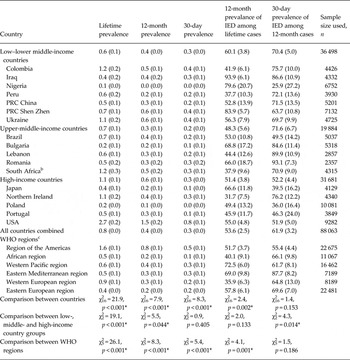
The lifetime prevalence of IED varied significantly across countries ranging from a low of 0.1% in Nigeria to a high of 2.7% in the USA (Table 1). In all countries combined, lifetime IED prevalence averaged 0.8%, with 0.4% and 0.3% meeting criteria for 12-month and 30-day prevalence, respectively. The proportion meeting 12-month criteria among lifetime cases (12-month/lifetime), which can be taken as a proxy indicator of recurrence of disorder, was 53.6%. The proportion with 30-day prevalence among 12-month cases (30-day/12-month: 61.9%) suggests that episodes of IED can be moderately enduring. Although lifetime prevalence of IED was significantly higher in high-income countries (predominantly through the effect of the higher prevalence in the USA), the proxy indictors of recurrence and duration of episodes were highest in low-income countries, and lowest in high-income countries.
Prevalence of DSM-IV IED a in the World Mental Health surveys

Data are given as percentage (standard error).
DSM-IV, Diagnostic and Statistical Manual of Mental Disorders, fourth edition; IED, intermittent explosive disorder; PRC, People's Republic of China; WHO, World Health Organization.
a The definition of IED in this study conforms to the ‘narrow’ definition used in prior reports from the World Mental Health Surveys but with the additional criterion of some degree of interference in functioning.
b The higher South African estimate in the paper by Fincham et al. (Reference Fincham, Grimsrud, Corrigall, Williams, Seedat, Stein and Myer2009) was not calculated by the World Mental Health Data Coordination Centre and is incorrect: http://www.hcp.med.harvard.edu/wmh/ftpdir/Fincham_et_al_2009_erratum.pdf
c Region of the Americas (Colombia, Brazil, Peru, USA); African region (South Africa, Nigeria); Western Pacific region [PRC Shen Zhen, PRC China (Beijing and Shanghai), Japan]; Eastern Mediterranean region (Iraq, Lebanon); Western European region (Northern Ireland, Portugal); Eastern European region (Romania, Poland, Bulgaria, Ukraine).
* p < 0.05; two-sided test.
Median age of onset of IED was 17 years in the total sample (16 years in high-income countries and 18 years in lower- and 19 years in middle-income countries, respectively), with an interquartile range (IQR) across countries of 13–23 years, indicating that IED is generally an early-onset disorder (Appendix Table 2).
Type of anger attacks – 12-month IED
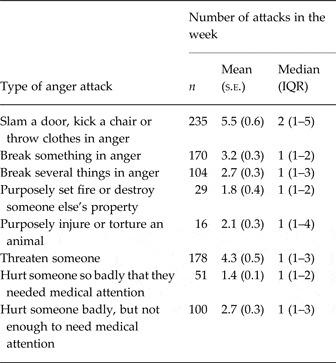
Respondents with 12-month IED were asked to think about the week during the past 12 months when they had their most violent attack and to report type and number of attacks during that week (Table 2). The case number in the first column indicates the number reporting at least one of each kind of attack; respondents could report more than one type of attack. The less destructive attacks were reported most frequently, with 235 reporting that they slammed a door, kicked a chair or threw clothes in anger, with a mean of 5.5 and a median of 2 such attacks per individual. At the other end of the violence spectrum 43% (151/357) reported that they hurt someone badly, with 14% (51/357) reporting that these attacks resulted in the need for medical attention for the victim. The discrepancy between the higher means and low medians within each type of attack indicates that a small group of individuals report high frequencies of attacks, and it is notable that some individuals reported more than one instance of arson, torturing an animal or hurting someone during the specified week.
Type and number of anger attacks during the week of the past year containing the most violent attack, among those with 12-month intermittent explosive disorder (n = 357)

s.e., Standard error; IQR, interquartile range.
Impairment of 12-month IED (Table 3)
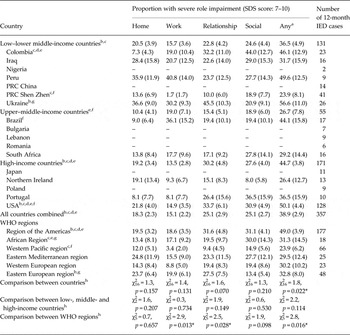
In all countries combined, the proportion of those with 12-month IED who reported severe impairment in at least one domain was 38.9% in all countries combined, ranging (non-significantly) from 26.7% in middle-income countries to 36.5% in low-income countries and 44.7% in high-income countries. The highest levels of impairment were in the Ukraine, with 56.6% reporting severe impairment, followed by 50.1% of those with IED in the USA reporting severe impairment. By contrast, in Shenzhen, People's Republic of China (PRC) a considerably smaller proportion of those with IED (23.9%) reported severe impairment. In all countries combined, severe impairment was more likely in the social and relationship domains than in the work and home domains, although this pattern was less evident in middle-income countries.
Severity of role impairment (SDS) associated with 12-month IED, by country

Data are given as percentage (standard error). A dash was inserted where the number of 12-month cases is less than 5.
SDS, Sheehan Disability Scale; IED, intermittent explosive disorder; PRC, People's Republic of China; WHO, World Health Organization.
a Highest severity category across four SDS role domains.
McNemar's χ2 test to determine if there is a significant difference (p < 0.05) for: bwork v. relationship impairment; cwork v. social impairment; dhome v. relationship impairment; ehome v. social impairment; fhome v. work impairment; grelationship v. social impairment for each row entry. For example, subscript ‘d’ for Colombia indicates that the proportion with severe impairment associated with intermittent explosive disorder is significantly higher for relationship than home.
h χ2 Test of homogeneity to determine if there is variation in impairment severity across countries.
* p < 0.05; two-sided test.
Impairment was increased by co-morbidity: the proportion reporting severe impairment was 43.5 (s.e. = 2.6) % among those with lifetime co-morbid disorders compared with 15.3 (s.e. = 1.8) % among those without lifetime co-morbidity (data not shown: available on request). Further results relating to co-morbidity are reported below.
Sociodemographic correlates
Statistically significant correlates of lifetime risk of IED in the total sample included being male, being young, being unemployed, being divorced or separated, and having less education (Appendix Table 3). There were no significant correlates of recurrence (12-month/lifetime). Being unemployed was positively associated with episode duration (30-day/12-month), and being never married was negatively associated with both episode duration and with current (30-day) prevalence of IED.
Lifetime co-morbidity with other DSM-IV disorders
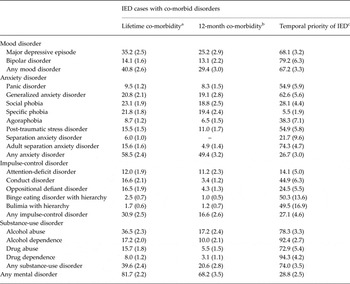
Most respondents with lifetime IED (81.7%) met criteria for at least one other lifetime disorder (Table 4). The single most common co-morbid disorder was alcohol abuse (36.5%), closely followed by depression (35.2%). The most common class of co-morbid disorders was anxiety disorders (58.5%). The majority of those with 12-month IED (68.2%) also met criteria for a co-morbid disorder, most frequently an anxiety disorder. In terms of the temporal sequencing of disorders, lifetime IED preceded lifetime co-morbid mood disorders in 67.2% of cases, but only preceded co-morbid anxiety disorders in 26.7% of cases. IED onset also typically preceded substance use disorders onset (74.0% of lifetime cases), but did not precede most impulse control disorders.
Co-morbidity of IED with other DSM-IV disorders

Data are given as percentage (standard error).
IED, Intermittent explosive disorder; DSM-IV, Diagnostic and Statistical Manual of Mental Disorders, fourth edition.
a Percentage of respondents with lifetime IED who also meet lifetime criteria for at least one of the other DSM-IV disorders.
b Percentage of respondents with 12-month IED who also meet 12-month criteria for at least one of the other disorders.
c Percentage of respondents with either lifetime IED and at least one of the other disorders, whose age of onset of IED is reported to be younger than the age of onset of all co-morbid disorders under consideration.
Associations (odds ratios; ORs) of traumatic events with onset of IED (Table 5)
In bivariate survival models with each traumatic event as a single predictor, controlling for sociodemographic variables (age, gender, education, marital status, employment status) and country, most traumatic events were associated with subsequent first onset of IED, with the strongest associations between witnessing family violence as a child [OR 3.5, 95% confidence interval (CI) 2.8–4.4] and being physically abused as a child (OR 3.6, 95% CI 2.8–4.8). When all traumatic events were included in the one multivariate model, some dropped out of significance but physical abuse and witnessing violence as a child remained significantly associated with IED onset, as did non-combat war experience, intimate or sexual violence, and other (private) events. Combat experience was protective in the multivariate model (OR 0.3, 95% CI 0.1–0.7). Odds of IED onset increased substantially with the experience of an increasing number of different types of traumatic events, ranging from OR of 3.1 for one type of event to 8.0 for four or more types of events.
Associations between lifetime traumatic events and the subsequent onset of DSM-IV intermittent explosive disorder a

DSM-IV, Diagnostic and Statistical Manual of Mental Disorders, fourth edition; OR, odds ratio; CI, confidence interval; LTE, lifetime traumatic event.
a Analysis for this table was performed on 14 out of 17 surveys due to restriction of data on lifetime traumatic events, and on the Part 2 subsamples in those surveys (n = 33 970).
b Bivariate models: each trauma type was estimated as a predictor of IED onset in a separate discrete time survival model controlling for age cohorts, gender, person-year, education, marriage, employment status and country.
c Model was estimated with dummy variables for all trauma types entered simultaneously as predictors of IED onset including the controls specified in (b).
d Model was estimated with dummy variables for number of traumas without any information about type of trauma as predictors of IED onset including the controls specified in (b).
* p < 0.05; two-sided test.
Treatment of IED
Rates of treatment were low, with 25% of those with 12-month IED (of any severity) reporting treatment in the health care sector in the past 12 months in all countries combined (Appendix Table 4). Treatment rates varied significantly across country income groups, with 12% reporting treatment in low-income countries, with corresponding percentages of 28.4 and 33.5% in middle- and high-income countries, respectively.
Discussion
These results should be considered within the context of the study limitations. The retrospective assessment of mental disorders underestimates lifetime mental disorders (Takayanagi et al. Reference Takayanagi, Spira, Roth, Gallo, Eaton and Mojtabai2014) and is likely to lead to inaccuracies in the age of onset timing (Simon & Von Korff, Reference Simon and Von Korff1995); these limitations can also affect time-lagged associations and the estimates of temporal priority in the co-morbidity analyses. In addition, although the clinical validity of many of the CIDI diagnoses in the WMH Surveys has been confirmed in clinical reappraisal interviews (Haro et al. Reference Haro, Arbabzadeh-Bouchez, Brugha, de Girolamo, Guyer, Jin, Lepine, Mazzi, Reneses, Vilagut, Sampson and Kessler2006), this has not occurred with IED. Finally, these prevalence estimates are based on a conservative application of DSM-IV criteria and we are unable to judge whether DSM-5 estimates would be higher or lower than those we report here.
The average lifetime prevalence of DSM-IV IED across countries was 0.8%, making IED one of the rarer mental disorders. Prevalence was found to vary considerably across countries, with lifetime prevalence of IED ranging from 0.1% (Nigeria) to 2.7% (USA). These prevalence estimates are lower than reported in prior publications from this dataset (Kessler et al. Reference Kessler, Coccaro, Fava, Jaeger, Jin and Walters2006, Reference Kessler, Coccaro, Fava, McLaughlin, Grant and Potenza2012; Yoshimasu & Kawakami, Reference Yoshimasu and Kawakami2011; Al-Hamzawi et al. Reference Al-Hamzawi, Al-Diwan, Al-Hasnawi, Taib, Chatterji, Hwang, Kessler and McLaughlin2012) due to the application of a more conservative diagnostic algorithm that required that anger attacks cause some degree of interference in functioning. The cross-national variation is difficult to interpret as it may reflect a combination of variation in risk factors, in cultural factors that affect willingness to disclose mental health symptoms (Kessler & Ustun, Reference Kessler and Ustun2008; Yoshimasu & Kawakami, Reference Yoshimasu and Kawakami2011) and in methodological factors such as response rate and sampling. What can be concluded is that this study did not find support for the hypothesis that IED is more prevalent in countries characterized by war, terrorism and conflict (Fincham et al. Reference Fincham, Grimsrud, Corrigall, Williams, Seedat, Stein and Myer2009; Al-Hamzawi et al. Reference Al-Hamzawi, Al-Diwan, Al-Hasnawi, Taib, Chatterji, Hwang, Kessler and McLaughlin2012; Rees et al. Reference Rees, Silove, Verdial, Tam, Savio, Fonseca, Thorpe, Liddell, Zwi and Tay2013), given that we did not find IED prevalence to be relatively elevated in countries marked by recent or current conflict (e.g. Lebanon, Iraq, South Africa, Northern Ireland).
Consistent with prior clinical and community studies lifetime risk of IED was higher among males, the young, the unemployed and those with lower educational attainment (Coccaro et al. Reference Coccaro, Posternak and Zimmerman2005; Kessler et al. Reference Kessler, Coccaro, Fava, Jaeger, Jin and Walters2006, Reference Kessler, Coccaro, Fava, McLaughlin, Grant and Potenza2012; Ortega et al. Reference Ortega, Canino and Alegria2008). We also observed that divorce or marital separation was associated with increased lifetime risk of IED, although the temporal sequence of that association is unclear. Also consistent with prior studies, IED was found to typically begin in adolescence, to have a high degree of co-morbidity with other mental disorders, and to usually onset at an earlier age than the co-morbid disorders (Coccaro et al. Reference Coccaro, Posternak and Zimmerman2005; Kessler et al. Reference Kessler, Coccaro, Fava, Jaeger, Jin and Walters2006). In the context of the confirmed classification in DSM-5 of IED as an impulse control disorder it is interesting to note that we found that IED was as likely to be co-morbid with mood and anxiety disorders as with impulse control disorders; as noted by others this suggests that affective instability is an important component of IED (Kessler et al. Reference Kessler, Coccaro, Fava, Jaeger, Jin and Walters2006; Coccaro, Reference Coccaro2012).
The information respondents provided on the type and frequency of anger attacks during the week of their most violent attack indicates that many anger attacks are non-destructive, although individuals engaging in these less destructive attacks might also have engaged in the more destructive attacks. Anger attacks that caused harm to others were also quite common, with 43% of those meeting 12-month criteria for IED reporting that they had hurt someone badly during their most violent anger attack. Moreover, a small proportion reported purposely torturing or injuring an animal, or arson. Our data do not allow us to determine whether some of these acts might have been premeditated rather than reactive. A recent study of a predominantly clinical population found that 5.9% of those meeting criteria for DSM-5 IED were also classified as ‘highly likely’ to meet criteria for psychopathic personality (Coccaro et al. Reference Coccaro, Lee and McCloskey2014a ).
A substantial minority (39%) of those with 12-month IED reported severe impairment in at least one domain and this was most typically the social or relationship domain. Some individuals with IED are therefore significantly disabled by their disorder; on the other hand, the majority reported only mild–moderate impairment. It may be that some of those with IED are not fully aware of, or may partly deny, the full ramifications of their aggressive outbursts either for themselves or for those on the receiving end of the outbursts. The intermittent nature of the aggressive outbursts may also be a factor that reduces the degree to which the disorder interferes with functioning.
The large sample size of the combined surveys allowed a comprehensive investigation of lifetime traumatic event predictors of the onset of IED, especially in terms of evaluating their independent associations. In time-lagged analyses we found that a wide range of traumatic events were associated with risk of subsequent IED in bivariate analyses, but some of these events lost significance in multivariate analysis, suggesting that their association with IED occurred through their association with other traumatic events. One of the independent predictors of IED in the multivariate model was childhood experience of physical abuse (but not physical assaults in general), consistent with the well-established intergenerational transmission of violence mediated by a range of neurobiological, emotional, cognitive and behavioral mechanisms (Van Goozen et al. Reference Van Goozen, Fairchild, Snoek and Harold2007; Fanning et al. Reference Fanning, Meyerhoff, Lee and Coccaro2014). Witnessing of family violence was also associated with IED onset independent of the direct experience of child physical abuse; this is congruent with prior studies showing the witnessing of family violence to be a reliable, independent risk factor for youth involvement in violence (Yexley et al. Reference Yexley, Borowsky and Ireland2002). We found prior experience of intimate partner violence and sexual assault to be independently associated with IED onset. While other studies have found IED to be associated with reports of intimate partner violence (O'Leary et al. Reference O'Leary, Tintle, Bromet and Gluzman2008; Murray-Close et al. Reference Murray-Close, Ostrov, Nelson, Crick and Coccaro2010) and it is intuitive that IED would increase risk of perpetration of intimate partner violence, further study using prospective data is required to confirm whether the experience of intimate partner violence is a risk factor for the onset of IED as our findings suggest. Finally, the experience of non-combat war experience was a risk factor for IED onset; by contrast, combat experience was protective. This latter finding may reflect military selection procedures.
In summary, IED using a conservative definition was found to be a relatively low prevalence disorder with an average of 0.8% (lifetime prevalence) in this group of 16 countries. IED is more likely to occur among males, the young and the socially disadvantaged. It is one of the earlier-onset disorders and is highly co-morbid with other disorders, especially mood and substance use disorders. Experience or witnessing of violence in early life as well as some experiences of violence in adulthood are predictively associated with lifetime risk of IED. This supports the view that at an individual level violence exposure is associated with perpetration of violence; however, we did not find that IED prevalence varied across countries in a pattern consistent with country-level conflict exposure. A substantial minority of respondents with IED reported severe functional impairment but this probably underestimates the true societal costs of IED in terms of the effects of explosive anger attacks on families and relationships.
Acknowledgements
The WHO WMH Survey Initiative is supported by the National Institute of Mental Health (NIMH; R01 MH070884), the John D. and Catherine T. MacArthur Foundation, the Pfizer Foundation, the US Public Health Service (R13-MH066849, R01-MH069864 and R01 DA016558), the Fogarty International Center (FIRCA R03-TW006481), the Pan American Health Organization, Eli Lilly and Company, Ortho-McNeil Pharmaceutical, GlaxoSmithKline and Bristol-Myers Squibb. We thank the staff of the WMH Data Collection and Data Analysis Coordination Centers for assistance with instrumentation, fieldwork and consultation on data analysis.
The Colombian National Study of Mental Health (NSMH) is supported by the Ministry of Social Protection.
Implementation of the Iraq Mental Health Survey (IMHS) and data entry were carried out by the staff of the Iraqi Ministries of Health and Planning with direct support from the Iraqi IMHS team with funding from both the Japanese and European Funds through the United Nations Development Group Iraq Trust Fund (UNDG ITF).
The Nigerian Survey of Mental Health and Wellbeing (NSMHW) is supported by the WHO (Geneva), the WHO (Nigeria) and the Federal Ministry of Health, Abuja, Nigeria.
The Chinese WMH Survey Initiative is supported by the Pfizer Foundation.
The Shenzhen Mental Health Survey is supported by the Shenzhen Bureau of Health and the Shenzhen Bureau of Science, Technology, and Information.
The Ukraine Comorbid Mental Disorders during Periods of Social Disruption (CMDPSD) study is funded by the US NIMH (R01-MH61905).
The São Paulo Megacity Mental Health Survey is supported by the State of São Paulo Research Foundation (FAPESP) Thematic Project Grant 03/00204-3.
The Bulgarian Epidemiological Study of common mental disorders EPIBUL is supported by the Ministry of Health and the National Center for Public Health Protection.
The Lebanese National Mental Health Survey (L.E.B.A.N.O.N.) is supported by the Lebanese Ministry of Public Health, the WHO (Lebanon), National Institute of Health/Fogarty International Center (R03 TW006481-01), the Sheikh Hamdan Bin Rashid Al Maktoum Award for Medical Sciences, anonymous private donations to the Institute for Development, Research, Advocacy & Applied Care (IDRAAC), Lebanon, and unrestricted grants from AstraZeneca, Eli Lilly, GlaxoSmithKline, Hikma Pharmaceuticals, Janssen Cilag, Lundbeck, Novartis and Servier.
The Romania WMH study projects ‘Policies in Mental Health Area’ and ‘National Study Regarding Mental Health and Services Use’ were carried out by National School of Public Health & Health Services Management (former National Institute for Research & Development in Health, present National School of Public Health Management & Professional Development, Bucharest), with technical support of Metro Media Transilvania, the National Institute of Statistics – National Centre for Training in Statistics, SC Cheyenne Services SRL, Statistics Netherlands and were funded by the Ministry of Public Health (former Ministry of Health) with supplemental support of Eli Lilly Romania SRL.
The South Africa Stress and Health Study (SASH) is supported by the US NIMH (R01-MH059575) and National Institute of Drug Abuse (NIDA) with supplemental funding from the South African Department of Health and the University of Michigan.
The Peruvian WMH Study was funded by the National Institute of Health of the Ministry of Health of Peru.
The WMH Japan (WMHJ) Survey is supported by the Grant for Research on Psychiatric and Neurological Diseases and Mental Health (H13-SHOGAI-023, H14-TOKUBETSU-026, H16-KOKORO-013) from the Japan Ministry of Health, Labour and Welfare.
The Northern Ireland Study of Mental Health was funded by the Health & Social Care Research & Development Division of the Public Health Agency.
The Portuguese National Mental Health Study was carried out by the Department of Mental Health, Faculty of Medical Sciences, NOVA University of Lisbon, with collaboration of the Portuguese Catholic University, and was funded by Champalimaud Foundation, Gulbenkian Foundation, Foundation for Science and Technology (FCT) and the Ministry of Health.
The NCS-R is supported by the NIMH (U01-MH60220) with supplemental support from the NIDA, the Substance Abuse and Mental Health Services Administration (SAMHSA), the Robert Wood Johnson Foundation (RWJF; grant 044708) and the John W. Alden Trust.
The Polish project Epidemiology of Mental Health and Access to Care – EZOP Poland was carried out by the Institute of Psychiatry and Neurology in Warsaw in consortium with the Department of Psychiatry – Medical University in Wroclaw and National Institute of Public Health-National Institute of Hygiene in Warsaw and in partnership with Psykiatrist Institut Vinderen – Universitet, Oslo. The project was funded by the Norwegian Financial Mechanism and the European Economic Area Mechanism as well as the Polish Ministry of Health. No support from the pharmaceutical industry or other commercial sources was received.
The sponsors had no input into the design and conduct of the study; collection, management, analysis and interpretation of the data, or preparation, review or approval of the manuscript.
Declaration of Interest
D.S. has received research grants and/or consultancy honoraria and/or served on speaker bureaus for Biocodex, Eli-Lilly, GlaxoSmithKline, Lundbeck, Pfizer, Servier, Solvay and Wyeth. D.S. is supported by the Medical Research Council (MRC) of South Africa.
R.C.K. has been a consultant for Analysis Group, GlaxoSmithKline Inc., Kaiser Permanente, Merck & Co, Inc., Ortho-McNeil Janssen Scientific Affairs, Pfizer Inc., Sanofi-Aventis Groupe, Shire US Inc., SRA International, Inc., Takeda Global Research & Development, Transcept Pharmaceuticals Inc., Wellness and Prevention, Inc. and Wyeth-Ayerst; has served on advisory boards for Plus One Health Management, Mensante Corporation, Lake Nona Institute, U.S. Preventive Medicine and has had research support for his epidemiological studies from Analysis Group Inc., Bristol-Myers Squibb, Eli Lilly & Company, EPI-Q, Ortho-McNeil Janssen Scientific Affairs., Pfizer Inc., Sanofi-Aventis Groupe and Shire US, Inc. He owns stock in Datastat, Inc.
All other authors have no conflicts of interest to declare.
Supplementary material
For supplementary material accompanying this paper visit http://dx.doi.org/10.1017/S0033291716001859