

1. Introduction
“Technology has made life fundamentally interconnected. [The] age of information has resulted in complex issues for informational privacy.”Footnote 1
The age-old proverb that “knowledge is power” has significant repercussions for the individual's position in today's world where data is pervasive and all-encompassing. The Honorable Supreme Court of India has described the present epoch as an age of information where information is knowledge.Footnote 2 Information is now freely available in the public domain, spurred by new technological advancements in science, medicine, biosciences, and other allied fields.Footnote 3 For example, as online social and economic activities proliferate, the significance of data privacy and protection is increasingly apparent. Of equal concern is the manner and means by which personal data is collected or used, including the disclosure to third parties of individuals’ personal information without their knowledge or consent.Footnote 4 Indeed, technological advancements have raised questions about the proper use and the possible misuse of people's information.
Relatedly, we have entered an era where it has become commonplace to sequence an individual's genome for health or identification purposes. Genomic technologies are generating a wealth of new knowledge about human health and the potential for disease.Footnote 5 In 1990, a large-scale research project popularly known as the Human Genome Project (HGP) was launched to study the human genome. Until 2003, the HGP had made significant investments in studying the possible ethical, legal, and social implications (ELSI) of genetic development. Several benefits of genome sequencing have been identified over the years such as those for public health, disease prevention, and personalized medicine. Today, a plethora of genetic tests are being integrated into healthcare systems. These tests range from whole-genome or whole-exome sequencing to multi-omics and epigenetic testing adopted by clinical practices. Now widely available, these tests are often offered as direct-to-consumer genetic testing (DTC-GT) services.Footnote 6 A few examples of these DTC-GT services are Veritas Genetics, Ancestry, and 23andMe.
With the wide-scale availability of these types of tests in countries like the United States, and the emerging situations where the same tests could be adopted and introduced in countries like India, concerns have arisen regarding ELSI. Such concerns arise from the possibility of the differential treatment of asymptomatic individuals or their relatives based on their actual or assumed genetic information collected mostly through DTC-GT testing.Footnote 7 Because genetic testing has been proven to be an effective tool for understanding and controlling health and disease, discriminatory practices against the aforementioned asymptomatic individuals or their relatives are certainly a cause for concern.
1.1. Genetic Discrimination and the Law
Genetic technology has enabled precision medicine, but there are concurrently potential gene discrimination (GD) issues. Genetic data can be used to discriminate against individuals and oppress vulnerable populations.Footnote 8 According to UNESCO, GD is “usually understood as a type of discrimination based on genetic characteristics that is intended to infringe or has the effect of infringing on human rights, fundamental freedoms, and human dignity.”Footnote 9 Thus, GD refers to any form of differential treatment against one individual that is based on actual or suspected gene characteristics.Footnote 10
The possibility of the unfair treatment of individuals based on their genetic traits can arise in multiple situations and areas, including, but not limited to, insurance, employment, and healthcare. As far back as the 1970s, the first instance of GD appeared in the United States when individuals of African-American descent were prevented from obtaining employment or health insurance because they had tested positive in the mandatory genetic screening programs for sickle cell disease (a group of inherited blood disorders).Footnote 11 Concerns about possible discriminatory uses of genetic information among academics and vulnerable members of society became more pronounced in the 1980s and 1990s, coinciding with the overall progress made in human genetics during that period. One example of that progress is the identification of several rare disorders caused by a single gene.
ELSI concerns, which were shared across countries in Western Europe and North America, eventually led to the introduction of instruments aimed at prohibiting GD.Footnote 12 For instance, these two foundational human rights texts emerged in 1997: the European Convention on Human Rights and Biomedicine (CHRB), which expressly bars “any form of discrimination on the basis of genetic heritage,”Footnote 13 and the Universal Declaration on the Human Genome and Human Rights (UDHGHR), which was issued by the United Nations Educational, Scientific and Cultural Organization (UNESCO). One thing that is certain, which forms the basis of these texts despite a lack of regulatory uniformity, is that any type of discrimination based on genetic disposition, information, or heritage violates the basic tenets of human rights.
Indeed, these human rights documents observe that an individual's genetic information must be protected from unauthorized disclosure.Footnote 14 The ambit of protection covers collection and preservation as well as the maintenance of genetic data's confidentiality. For example, the International Covenant on Civil and Political Rights (ICCP) explicitly aims to respect and promote data privacy.Footnote 15 The UDHGHRFootnote 16 includes provisions on non-discrimination and the right to privacy. It further emphasizes the importance of protecting the dignity and rights of individuals regarding the use or misuse of their genetic information. The International Declaration on Human Genetic Data (IDHGD)Footnote 17 explicitly emphasizes the need to protect the confidentiality of genetic data and calls for the development of national laws and policies to address genetic discrimination across countries. The Convention on the Rights of Persons with Disabilities (CRPD) also recognizes the right to non-discrimination and access to health, while the Council of Europe's CHRBFootnote 18 is the sole legally binding international covenant for protecting human rights in relation to the biomedical field.Footnote 19
These covenants and treaties provide guidance and principles for protecting individuals from genetic discrimination, ensuring the privacy and confidentiality of genetic information, and promoting the responsible use of genetics and biotechnology.
1.2. Genetic Discrimination: An Asian Perspective
Asia is one of the world's leading regions in the genomics and precision medicine revolution.Footnote 20 Several Asian countries are actively working with international groups to create public biobanks with large amounts of data collected from their populations.Footnote 21 The Hong Kong government, for example, has established the Hong Kong Genome Institute to conduct large-scale genome sequencing. In South Korea, samples from about 240,000 participants were collected for a genome and epidemiology study. Taiwan has established its own National Biobank Consortium, which integrates thirty-three pre-existing biobanks for a comprehensive big-data network of biomedical data. Likewise, in Japan, BioBank Japan has worked with about 300,000 participants to secure DNA and serum samples.Footnote 22
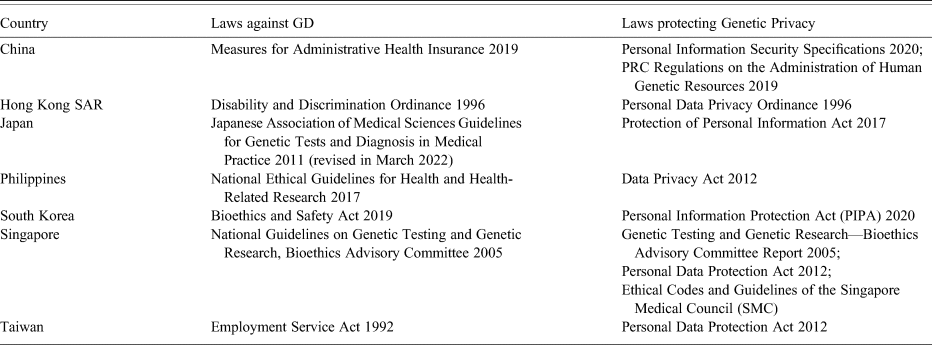
In response to the threat of GD, various policymakers in Asia have reacted by developing regulations that must meet several criteria points, including the overall prohibition of genetic discrimination. Countries like Taiwan, Singapore, Japan, China, etc., have focused their laws on alleviating any fears associated with genetic testing and preventing people from refusing to take a genetic test or participating in genetic research out of fear of GD.Footnote 23 Laws have been adopted in many countries to avoid discrimination. Still, these nations are struggling to keep up with technological advances in the study of genes and DNA, as research databases and DTC-GT services have made them increasingly accessible and easier to link to individuals.Footnote 24
The following table shows the current scenario of laws across several Asian jurisdictions.Footnote 25
Laws across Asian Jurisdictions

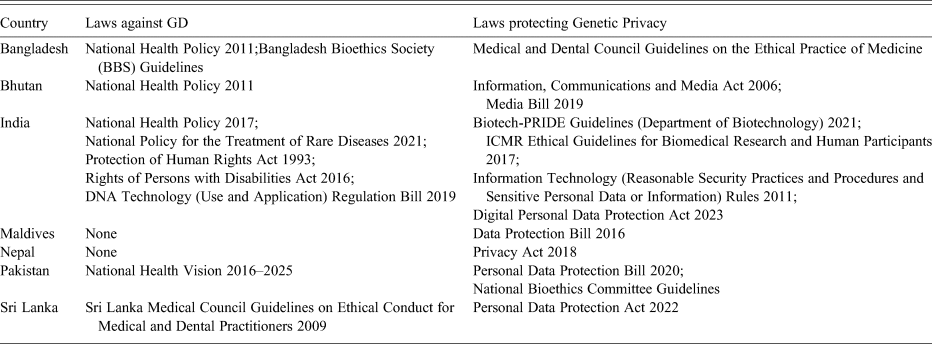
Over the years, GD has generally become recognized as a potential tool for interfering with human rights and the right to equality. This problem has merited the attention of policymakers across Asian countries as well; however, this phenomenon has evolved differently in South Asia.Footnote 26 The nations of the Indian subcontinent (viz. Bangladesh, Bhutan, India, the Maldives, Pakistan, Nepal, and Sri Lanka), which geographically comprise the majority of South Asia, make it an important “hub” with the potential for developing laws addressing GD.Footnote 27 The geographic, cultural, and ethical foundations of these nations are analogous, and the social, economic, and political challenges these countries face are also comparable.Footnote 28 In addition, their healthcare systems currently require significant modernization. Therefore, the following part will look at the laws and provisions to ascertain whether the existing constitutional and legal structures in these countries have sufficiently addressed the problem of GD or whether there is a need to legislate further.
2. Country-Specific Analysis of Laws and Policies Regarding Genetic Discrimination and Privacy
The need to keep sensitive information about a person confidential calls for disciplinary control over the stakeholders, including medical practitioners, employers, etc. Any information, including an individual's family history, employment status, health issues, and particularly the risk of a genetic disease that can lead to social stigma, needs to be protected.Footnote 29 The next section of the article identifies laws and policies (or the lack thereof) related to genetic data and GD in seven countries that comprise much of the area of the South Asia region: Bangladesh, Bhutan, India, the Maldives, Nepal, Pakistan, and Sri Lanka. Subsequently, the article discusses the findings and conjectures why the protection principles related to personal genetic data may not yet be fully integrated into national norms or regional health policies.
2.1. Bangladesh
Bangladesh is a signatory to several international covenants and treaties that address human rights, particularly those on discrimination and privacy. Bangladesh ratified the International Covenant on Civil and Political Rights (ICCPR) in 2000, and it ratified the CRPD in 2007. Furthermore, Bangladesh is a signatory to the Universal Declaration of Human Rights (UDHR). While these international covenants do not specifically address GD, they provide a broader framework for protecting human rights and preventing discrimination on any grounds, including genetic. Bangladesh's obligations under these covenants require the government to take measures to prevent and address discrimination in all forms, including GD.
2.1.1. Status of Genetic Discrimination and Privacy Laws in Bangladesh
In Bangladesh, GD has been reported in the contexts of employment and insurance. There have been instances where individuals have been denied employment or promotion due to a family history of genetic disorders, and insurance companies have refused coverage based on the same criteria.Footnote 30 However, there is currently no specific legislation in Bangladesh that addresses GD.
The Constitution of Bangladesh guarantees the right to privacy under article 43, which states, “Every citizen shall have the right to the protection of his or her privacy.” However, this provision has not been interpreted to address genetic privacy specifically.Footnote 31 The Constitution of Bangladesh also guarantees equal rights and non-discrimination based on race, gender, religion, and place of birth.Footnote 32 The Labor Act of Bangladesh prohibits discrimination in employment and working conditions based on such factors as race, gender, religion, or disability.Footnote 33
Similarly, there is no specific legislation in Bangladesh that addresses genetic privacy. The Bangladesh Medical & Dental Council has guidelines on the ethical practice of medicine, which includes genetic testing and counseling.Footnote 34 These guidelines recommend obtaining informed consent from patients before performing genetic tests and also maintaining the confidentiality of test results.Footnote 35 However, these guidelines are not legally binding and have no enforcement mechanism. As a result, the protection of genetic privacy in Bangladesh is currently limited.
Regarding healthcare, Bangladesh's National Health Policy 2011 seeks to ensure equal and non-discriminatory access to health services for all citizens. This policy highlights the significance of providing equal access to health services to disadvantaged and vulnerable populations, including individuals with disabilities.Footnote 36 In addition, the Bangladesh Bioethics Society (BBS)Footnote 37 seeks to promote ethical practices in research, healthcare, and biotechnology. The BBS has established guidelines for the ethical conduct of research, which includes provisions for protecting the rights and dignity of study participants and preventing discrimination based on numerous factors such as genetic information.Footnote 38 However, the absence of a specific GD policy in Bangladesh could potentially expose individuals to GD. Future policymakers may wish to consider enacting laws and regulations to protect against it.
2.2. Bhutan
Bhutan is a party to several international covenants and treaties that address GD-related issues. The UDHR, ICCPR, and CRPD are a few of these instruments. Bhutan has also ratified the International Convention on Eliminating All Forms of Racial Discrimination (ICERD). The ICERD prohibits racial discrimination in all forms, including discrimination based on genetic characteristics.
2.2.1. Bhutan's Stance on Genetic Discrimination and the Status of Existing Laws
There is limited information available on instances of GD in Bhutan. However, given that Bhutan is a small and relatively homogeneous country with a low level of genetic testing, there have been fewer opportunities for GD to occur there than in other countries. Bhutan does not have specific laws that address GD, although some peripherally related norms might be applicable. For example, the Constitution of the Kingdom of BhutanFootnote 39 prohibits discrimination based on “race, sex, language, religion, politics, or other status.”Footnote 40
One area where GD could potentially manifest is in the workplace, where employers could use genetic information to make hiring or firing decisions. Bhutan's labor laws prohibit discrimination “on the basis of race, sex, language, religion, politics, or other status,” which could potentially cover GD. The Labour and Employment Act of Bhutan 2007, under Chapter II (Prohibitions), specifically prescribes that employers shall not discriminate against their employees for vacancies, wage conditions, and minimum wages.Footnote 41 Section 237 also defines discrimination as a less favorable treatment a person receives based on certain conditions. Any express or implied reference to GD, however, is lacking.Footnote 42
Another potential area where GD could occur is in healthcare, where healthcare providers could use genetic information to deny individual healthcare coverage or treatment. Bhutan's National Health Policy 2011 (NHP 2011) prohibits discrimination based on genetic information and recognizes the importance of protecting the confidentiality of genetic information. Indeed, section 3 of the policy states that genetic information shall be treated as confidential and not disclosed without the individual's informed consent.Footnote 43 The NHP 2011 guidelines intend in spirit that no person should be discriminated against based on their genetic data.
Bhutan's Information, Communications and Media Act 2006 broadly addresses concerns about online privacy, but the same cannot be said about specifically addressing genetic information. The recent 2019 Media Bill addresses matters related to the protection of the right to privacy of individuals.Footnote 44 In addition, the government is responsible for conducting privacy impact assessments from time to time.Footnote 45
These policies and laws demonstrate the need for more specific genetic data discrimination and privacy laws in Bhutan. However, the 2019 Media Bill provides a glimpse of Bhutan's commitment to maintaining data privacy despite the absence of specific legislation.
2.3. India
In India, there are no specific laws that prohibit GD. However, several laws and regulations can potentially be applied to address GD in particular contexts.
Congenital diseases and hereditary disorders are a significant health burden in India.Footnote 46 Therefore, genetic testing and counseling services must be adequate and effective. Birth-related malformations and genetic diseases are the third leading cause of infant mortality in India's urban areas.Footnote 47 India has a large population with a high birth rate and a preference for consanguineous marriage in many communities, which has resulted in a high prevalence of genetic disorders.
Discussions on data privacy and GD have been gathering force over the years in India. For example, in 2018, the Government of India's Department of Biotechnology (DBT) organized a consultation on “GD and Social Stigma” to explore GD-related issues and identify strategies to address them.Footnote 48 The DBT has also been actively involved in research and development related to human genetics. The Human Genetics and Genomics Program funds genome-related health and disease research, which supports basic, translational, and clinical genomic research to improve medical care.Footnote 49
The DBT and the Government of India have also launched the Unique Methods of Management and Treatment of Inherited Disorders (UMMID) Initiative to combat the high prevalence of genetic diseases in India. The initiative is designed to provide comprehensive clinical care, including establishing Genetic Diagnostic Units in government hospitals as part of the National Inherited Diseases Administration (NIDAN) Kendras; training and producing skilled clinicians in human genetics; accurately screening pregnant women and newborns; and providing the successful detection and proper diagnoses of inherited genetic diseases.Footnote 50 The 2021 Biotech–Promotion of Research and Innovation through Data Exchange (Biotech–PRIDE) Guidelines is an outcome of such programs, initiatives, and consultations. These guidelines articulate the need for the protection of privacy and confidentiality of data. For instance, Guideline 1.2 mandates that shared modalities should ensure privacy protection, and the same must be non-discriminatory and fair for all individuals when sharing their data. It is noteworthy that the guidelines’ “Imperatives of data exchange and sharing” require that data sharing be conducted “in a responsible manner.”Footnote 51
The Constitution of India prohibits discrimination “on the basis of religion, race, caste, sex, or place of birth.” Under article 15, the constitution prohibits discrimination on these grounds while article 21 guarantees the “right to life and personal liberty.”Footnote 52 As interpreted by at least one Indian court, the constitution guarantees under article 21 the right to genetic privacy, and under article 14, protection from GD.Footnote 53 In 2017, an appeal was brought before the Honorable High Court of Delhi to decide on the discrimination of persons with genetic disorders in the context of health insurance.Footnote 54 The court considered clause 4.17 of the impugned insurance policy wherein “‘genetic disorder’” was one exclusion subject to which the company was not liable to pay the amount insured.Footnote 55 The Honorable single-judge bench observed that determination of what is a “‘genetic disorder’” would require genetic testing, which is a “complex and expensive process.”Footnote 56
Furthermore, the court observed that applying a general rule would lead to arbitrariness if a type of genetic disorder is excluded without proper genetic testing or that kind of exclusion is included. Hence, the court found that the exclusion clause itself was “too broad, ambiguous and discriminatory.”Footnote 57 It held that discrimination based on genetic heritage is unconstitutional “in the absence of appropriate genetic testing and [the] laying down of intelligible differentia.”Footnote 58 However, the matter was appealed, and vide order dated August 27, 2018, the Honorable Supreme Court of India granted a stay on the operation of the High Court of Delhi's judgment. The stay order was made partially, as the Supreme Court listed five crucial matters involving a substantial question of law that it aims to address in this case.Footnote 59 These five aspects relate to the issue of discrimination against persons with genetic malformations and raise an important question of whether the Constitution of India provides for a right to health.Footnote 60 The matter is still sub judice. However, the High Court did discuss (for once in the judicial history of India) the implications of GD, albeit in the insurance sector.
In the health sector, India's National Health Policy 2017 (NHP 2017) emphasizes the need for ethical considerations in healthcare, including the use of genetic information. The Key Policy Principles under NHP 2017 state that healthcare should be provided non-discriminatorily and equitably, emphasizing vulnerable and underprivileged sectors of society.Footnote 61 Moreover, the Indian Council of Medical Research (ICMR) 2017 Ethical Guidelines for Biomedical Research on Human Participants covers genetic information. These guidelines state that “research involving human subjects should be conducted in accordance with ethical principles that respect the dignity, rights, safety, and well-being of the research participants,” including those involved in genetic tests.Footnote 62 Additionally, the National Policy for Treatment of Rare Diseases 2021 aims to support and treat patients suffering from rare diseases. The policy dictates that the focus of the government is “to create awareness amongst all the levels of health care personnel as well as [the] general public towards the [sic] rare diseases. This will encourage people to seek pre-marital genetic counselling, the identification of high-risk couples [and] families and also result in [the] prevention of births as well as early detection of cases of rare diseases.”Footnote 63
For the protection of data and privacy, the Information Technology (Reasonable security practices and procedures and sensitive personal data or information) Rules, 2011, provide for the protection of sensitive personal data or information, which may include genetic information. The rules require entities that collect such information to obtain informed consent from the concerned individual, provide notice regarding the collection and use of such information, and take reasonable security measures to protect the information.Footnote 64
Discrimination violates the ICCPR, the International Covenant on Economic, Social and Cultural Rights (ICESCR), and the CRPD of the United Nations.Footnote 65 To protect and implement these covenants, the Indian Parliament enacted the Protection of Human Rights Act 1993, which provides measures for ensuring the protection of human rights and prohibiting any form of discrimination on any grounds, including disability.Footnote 66 Furthermore, the Rights of Persons with Disabilities Act 2016 prohibits discrimination based on a person's physical incapacity or disability, which can include genetic disabilities.Footnote 67 However, the Indian courts’ due interpretation could further clarify the issue.
The DNA Technology (Use and Application) Regulation Bill 2019 was another outcome of debates and consultations on GD. The bill was created to identify missing persons, victims, offenders, undertrials, and deceased persons. The bill would have created a DNA Regulatory Board (DRB) and also National and Regional DNA Data Banks, including a national forensic DNA database for identifying the abovementioned groups. The goal was to improve scientific DNA testing in the country.Footnote 68 The Digital Personal Data Protection Bill 2022 received the assent of the President of India and became an act on August 11, 2023. The provisions of the act focus on the purposeful data processing of individuals while concurrently ensuring their rights are protected against the necessity of collecting data for law enforcement purposes.Footnote 69 The DNA Technology Bill of 2019, however, was withdrawn in July 2023.
The laws and regulations in India are not explicitly designed to address GD, and their effectiveness in preventing GD may be limited when they can only provide protection in specific contexts. Various policies can also be used to avoid GD in India, but there is still a need for a specific law that directly addresses GD.
2.4. Maldives
The Maldives does not currently have specific laws that address GD. However, the Maldives Constitution prohibits “discrimination on the basis of race, gender, religion, or political beliefs.” Articles 17 and 24 lay down the rights to non-discrimination and privacy, respectively.Footnote 70 These constitutional guarantees could be interpreted to include genetic information.
In addition, the Maldives has ratified the UDHR, which recognizes the right to privacy, and the ICCPR, which recognizes the right to life and the “prohibition of cruel, inhuman, or degrading treatment or punishment.” Further, the ICESCR prohibits discrimination on various grounds, including genetic information. However, these international treaties have not been incorporated explicitly into the laws of the Maldives.Footnote 71
Without specific laws, individuals in the Maldives may have to rely on general laws and regulations to protect their genetic information. The penal code prohibits obtaining private information or any secure information without a license or authority and disclosing such information to a third party.Footnote 72 The Maldives’ Ministry of Economic Development announced the drafting of a new data protection bill in 2016, but it has not yet been promulgated.Footnote 73 In such a situation, individuals who have faced discrimination based on their genetic data may have to rely on the general antidiscrimination provisions of the constitution and other laws. It is also possible that the Maldives government will enact specific laws that prohibit GD in the future, particularly as advances in genetic research and testing continue to raise ethical and legal questions.
2.5. Nepal
Nepal has yet to pass specific laws or craft distinct policies addressing GD.
The new Constitution of Nepal, promulgated in 2015, describes the country as a “federal republic.” As a result, substantial changes have occurred in Bangladesh's legal system.Footnote 74 Article 28 of the constitution, read with the Individual Privacy Act of 2018 and the penal code, guarantees the right to privacy and information protection, which can be read to include genetic information. Footnote 75 The Privacy Act itself is not considered a data privacy law per se because certain basic principles are missing. However, the private sector bodies operating in Nepal are bound to follow the act's various provisions.Footnote 76 The act encompasses online business and commercial activities that involve the collection of user data and restricts it from being shared with third parties.Footnote 77 The act requires that the reason for collecting personal data and user information, including genetic information, be demonstrated with clarity.
2.6. Pakistan
Pakistan has ratified or signed several international covenants and instruments that relate to GD. For example, it approved the ICCPR in 2010 and signed the UNESCO Declaration on the Responsibilities of the Present Generations Towards Future Generations (DRPGTFG) in 1997. The declaration emphasizes the importance of considering the impact of scientific and technological developments on future generations, including the potential for GD.Footnote 78 Pakistan signed the UDHGHR in 1997 and ratified the CRPD in 2011.
2.6.1. Genetic Discrimination Privacy Laws and Policy in Pakistan
In Pakistan, GD, privacy legislation, and policies are still in their infancy. There is currently no legislation that explicitly addresses GD or protects the confidentiality of genetic information. However, there are some laws and policies in place that may provide some protections. These laws and policies may indirectly address concerns regarding GD and privacy. For example, the Pakistan Electronic Crimes Act 2016 includes provisions that prohibit unauthorized access, copying, or transmission of data, which could potentially apply to genetic data.Footnote 79
Similarly, Pakistan's constitution includes a right to privacy that could be applied to genetic information. Article 25(1) of the Constitution of PakistanFootnote 80 guarantees “equality before [the] law and equal protection of [the] law” while article 14 declares that the dignity of man and privacy of home shall be inviolable, which could again potentially apply to genetic data protection.Footnote 81 However, the constitution does not explicitly address discrimination based on genetic information.
In 2020, Pakistan's Ministry of Information Technology and Telecom introduced the Personal Data Protection Bill. This proposed act includes provisions that resonate with the requirements of international frameworks for data protection and regulation, including the European Union's GDPR. It encompasses the right to access and amend personal data, recognizes the provisions for withdrawing individual consent, and allows for the erasure of data upon request. A data-control authority is provided to prevent the data processing of individuals’ information. All these provisions have kept the bill in line with internationally applicable and acceptable norms on data privacy. In other words, there is a potential need for data localization in the proposed act.Footnote 82 In addition, the National Bioethics Committee of PakistanFootnote 83 was established in 2007 to advise on ethical aspects related to biotechnology, genetic research, and healthcare. The committee has published guidelines for the ethical conduct of research that involves the participation of humans, which may indirectly address some privacy concerns related to genetic analysis. However, the committee has not yet produced specific recommendations or policies on genetic privacy.
Like in India, the general population of Pakistan has a high rate of first-degree consanguineous associations. This has made Pakistanis prone to developing various genetic disorders.Footnote 84 Therefore, researchers and medical geneticists in the country have developed the Pakistan Genetic Mutation Database (PGMD), which provides access to data analysts and facilitates the interpretation of possible gene mutations. The PGMD is a public domain database and records more than one thousand genetic mutations along with at least 130 distinct types of scientific disorders. It is anticipated that databases like the PGMD will assist researchers, geneticists, and clinicians by providing genetic screening of population-specific mutations. In turn, this is expected to facilitate effective genetic counseling and assistance with personalized healthcare.Footnote 85
The lack of a specific policy or law on GD in Pakistan could lead to potential violations of the privacy and rights of individuals who undergo genetic testing or have genetic conditions. Although Pakistan has introduced the ambitious National Health Vision 2016–2025, which mentions “new strategic priorities including non-communicable diseases,” there is no mention of genomics.Footnote 86 Thus, there is clearly a need for the government of Pakistan to develop policies and laws that specifically address GD and protect the privacy and rights of individuals based on their genetic information.
2.7. Sri Lanka
Data protection is essential in Sri Lanka, which has a growing population and presumably an increasing use of information technology. The 19th amendment to Sri Lanka's Constitution of 1978 guarantees fundamental rights for its citizens. However, there is no specific guarantee for the right to individual privacy.Footnote 87 In 2022, the Personal Data Protection Act was enacted, which was prepared by the Sri Lankan Ministry of Digital Infrastructure and IT and the Legal Draftsman's Department. The law covers the “fundamental principles of privacy and data protection.” It prescribes measures for protecting personal data held by various stakeholders, such as banks, hospitals, telecom operators, and other entities that process such personal data. The act also aims to “regulate the processing of personal data, designate a data protection authority, and safeguard the rights of citizens.”Footnote 88
The Sri Lankan Medical Council has also issued guidelines on genetic testing and counseling, including the necessity of informed consent and ensuring the confidentiality of collected genetic information. These guidelines may allow for protection against discrimination, mainly based on genetic information.Footnote 89 In addition, Sri Lanka is a signatory to the UDHGHR, which recognizes the importance of protecting genetic information and preventing discrimination based on genetic characteristics. Despite these protections, however, there is still a need for specific laws and policies in Sri Lanka to address GD and protect individuals from harm.
3. Discussion
The existing legal frameworks for protecting individual rights and privacy in Asia do not automatically guarantee protection from genetic discrimination. And the specific laws that do exist there to protect personal genetic data are only partially coping with the problem. In contrast, in countries like the United States and Canada, specific laws do existFootnote 90 against genetic discrimination, and these acts operate in tandem with the existing non-discrimination provisions in those countries’ insurance and labor laws. As globalization and rapid technological advancements occur, it is essential to think on that scale and seek out the reasons for the absence of uniform domestic laws on GD and genetic data privacy—in Asia, but more specifically in South Asia.
Existing laws in South Asian countries

3.1. Disparities among Laws across Asia
Despite Asia's thriving private sector, which provides technologies and genetic services to consumers worldwide, there is disparity among the genetic services available in that region. Many of the countries in South Asia, for example, are developing countries. In general, people in low- and lower-middle-income nations do not have access to genetic services even though these services have become essential to medical practices in the twenty-first century. Some of the identified reasons that citizens in these nations lack such services are insufficient knowledge, exorbitant costs, scarcities of epidemiological data, antiquated medical education systems, inadequate infrastructures, and the absence of comprehensive health strategies.Footnote 91 Personal traits have also been identified that act as barriers.Footnote 92
As a whole, South Asian countries have limited access to genetic services; legal and policy protections for genetic privacy and discrimination are accordingly limited. Several medical councils have issued guidelines on genetic testing and counseling, which may serve as a guide for ethical practice, but they are not binding. It is worth noting that reports of GD are uncommon in these nations, and the limited legal frameworks that do exist do not denote specific penalties for data security breaches.
3.2. Difficulties in Developing Laws Against Genetic Discrimination
The reluctance and unwillingness of South Asian nations to develop their own GD-related norms are due to the prevalence of external and internal obstacles. These obstacles also impede collective decision-making and are contributing factors that hamper the formation of a regional framework to combat the problem of GD.Footnote 93 A few of the factors that can be identified in this regard are the following:
3.2.1. Social and Linguistic Differences
Sociological disparities and diverse groups’ perspectives have been identified as the most significant barriers to the global development of a data protection framework.Footnote 94 Accordingly, social differences and cultural histories might influence the growth of data protection policies across South Asia. Literature also suggests that different languages may have various levels of recognition, which could affect collective policy formulation in the region.Footnote 95
3.2.2. Mistrust Among Countries
Several factors, such as socio-political and ideological differences, border disputes, and the continuation of cross-border conflicts, contribute to mistrust among nations. For example, the tensions resulting from India and Pakistan's border disputes illustrate why countries embroiled in combat or war-like situations find it difficult to cooperate in the long run for the common good. Even so, in 2015, as an outcome of the Madheshi movement, the India-Nepal border, which has historically remained open, was closed down.Footnote 96 As a result, the blockade impacted bilateral ties between the two nations. Efforts are still underway to resolve the basic issues and restore mutual trust.Footnote 97
3.2.3. Legal and Legislative Differences
The ways nations adhere to regional bilateral or multilateral conventions or international treaties vary from nation to nation, and these disparities tend to influence the creation of joint initiatives for developing domestic laws. Legal and legislative differences impede cross-border cooperation and make responding, investigating, and enforcing the law difficult.Footnote 98 Moreover, the enactment of laws in some nations is determined by national-level decisions based on multiple factors and circumstances. These concerns could be economic, political, or social. For instance, most countries that ratified the Budapest Convention (a framework agreement on cybercrime) took too long for several reasons, including the delayed development of the enabling domestic laws.Footnote 99
There are indeed visible differences among GE and genetic data protection laws across Asian countries. For example, laws in India and Bangladesh mandate notifying authorities about a data breach.Footnote 100 However, in China, appropriate government entities and network users must warn of security faults and vulnerabilities.Footnote 101 In contrast, Japan requires that an effort be made to notify authorities of the breach incident.Footnote 102 In India, the recently passed Digital Personal Data Act 2023 makes it mandatory for the concerned “data fiduciary”Footnote 103 to notify the “data principal”Footnote 104 or the person whose digital data has been breached, as well as the Data Protection Board of India.Footnote 105
4. Conclusions and Recommendations
Genetic discrimination is a global issue that has sparked discussion and debate. There are numerous forms of GD, including social discrimination and victim stigmatization, which can create unofficial barriers to accessing healthcare and cause discrimination against female mutation carriers. Individuals should be protected against the unauthorized disclosure of genetic information as specified in international human rights standards to prevent the incidence of GD.
This study identified the GD and genetic privacy frameworks in seven subcontinental nations and highlighted the need for comprehensive norms in those areas. With over 1.8 billion people, the South Asian region is one of the most densely populated regions in the world, but its national laws on genetic testing and data lack force and authority and are not uniform. Further, due to the diversity of actors and interests in the region, there are enormous challenges involved with crafting legally applicable principles for genetic privacy.
Lack of sufficient expertise in drafting legislation specific to GD and genetic privacy; outdated medical education systems; poor health, medical, and genetic-testing facilities; high costs for health infrastructure development; and the absence of umbrella health policies are among the reasons why there is a dearth of specific laws or policies in South Asia. Barriers to regional cooperation regarding GE and genetic data protection have also been identified, including social and linguistic differences, mistrust among nations, and legislative differences. To address these issues, additional research is needed to develop nuanced, multilevel, GD policies and to investigate methods for identifying common factors that could unite these nations to develop a unified data protection mechanism.
These authors suggest that the South Asian Association for Regional Cooperation (SAARC) should encourage South Asian nations to develop uniform protection mechanisms for genetic information. SAARC should form a project team to raise awareness of the need for personal data protection, provide guidance, and help to make this a reality. The group's terms of reference must be clearly stated, and the association must be able to obtain pledges from governments that they will debate and publish their plans for developing legislation to protect genetic data and privacy. In reality, this may not be simple if there is no consensus among the region's nations, and if they continue to adhere to unyielding domestic ideologies and positions. It would not be easy to set a deadline for achieving the desired outcome because the process itself is likely to evolve, and success depends on the good faith and willingness of these countries to play their parts in the interest of regional and international communities. If world order is to have any meaning, these attitudes must be changed. The potential also exists for nations that are already considered developed to provide funds to protect citizens’ privacy and examine current policies in developing and underdeveloped countries.Footnote 106
In conclusion, these authors hope that the results of this study will help future academics analyze discourses on genetic discrimination and privacy. Moreover, the data reported in this work should serve as a valuable resource, contributing to efforts to develop feasible mechanisms to protect citizens’ genetic information while at the same time ensuring the utility of that information in the contexts of healthcare provision and disease prevention.